Security for Agentic AI on AWS by Category - 30 Best Practices, What the Guide Names, and Where Each One Lands on AWS
First Published:
Last Updated:
Implementing the items of this guide raises two questions. The first is which AWS services or features to implement them with. By this article's count, only 6 of the 30 items name an AWS service in their text as a control to use. The second is how to use the guide alongside the other official AWS documents. AWS's recommendations for agent security are also distributed across the Well-Architected Agentic AI Lens and Generative AI Lens, the AWS Security Reference Architecture (AWS SRA) guide on AI security, the Security Blog's Agentic AI Security Scoping Matrix, and the AWS AI Security Framework.
This article is an index that maps each of the guide's 30 items to the AWS services and documents that the guide names, to where the item lands on AWS, and to the articles on this site that go deeper. What the guide names and this article's mapping are in separate columns, and every row of this article's mapping carries the marker (this article's mapping). Additionally, it outlines the scope differences between the guide and five related documents, and indicates the version of the guide's OWASP mapping table.
This article was written after reviewing the material on November 25, 2026 (Japan Standard Time). It was written before AWS re:Invent 2026 (November 30 – December 4, 2026) and does not include any information that will be presented at that event. This article was not tested on AWS. Pricing information is not included.
Related articles on this site:
- OWASP Top 10 for Large Language Model Applications Mapped to AWS Controls - What Each Control Covers, Where It Stops, and What the Application Still Owns
- OWASP Top 10 for Agentic Applications Mapped to AWS Controls - What Each Control Mitigates and What Residual Risk Remains
- Threat Modeling Generative AI Applications on AWS - STRIDE for RAG, Agents, and Tool Use
- AI Agent Defense in Depth Model (AIDDM) - WAF, Guardrails, Reasoning Sandbox, and Output Filter
- Stopping an AI Agent on AWS - What Each Control Stops, What Keeps Running, and Who Can Undo It
Table of Contents
- 1. Scope and Assumptions
- 2. How to Read the Tables
- 3. How the Guide Is Organized
- 4. What the Guide Names
- 5. Full Tables of the 30 Items in Eight Categories
- 6. Items for Which the Guide Names No Service
- 7. Where the Guide's Pages Disagree, and What Has Changed
- 8. How the Guide Differs from Related Official Documents
- 9. The Version of the OWASP Mapping and the Mapping Tables on This Site
- 10. Frequently Asked Questions about Security for Agentic AI on AWS
- 11. Summary
- 12. References
1. Scope and Assumptions
This chapter first defines the intended audience, the scope of this article, the referenced materials, and the terminology used. The key conclusions are as follows:- The guide is divided into eight categories, and counting the headings of the category pages gives 30 items. Fifteen are AI-specific and fifteen are General. The guide does not provide an overall total (Section 3.3).
- The guide's document history only includes a single line indicating the initial version released on January 8, 2026 (Section 3.4).
- Six of the 30 items name, in their text including link text, an AWS service as a control to use. For the remaining 24 items, the placement within AWS is left to the reader's discretion (Chapters 4 and 6).
- Where the 30 items land on AWS is this article's mapping, not a recommendation of the guide (Chapter 5).
- The guide's pages use different names for the three layers. The name that item 6.1 uses for AWS SRA differs from the current title of the linked page. Some one-line descriptions on the OWASP page read as if they do not match the text of the items. Three services and features that the guide refers to no longer accept new customers as of the verification date (Chapter 7).
- The guide does not reference the later-released Agentic AI Lens or the AWS AI Security Framework. The 30 items in the guide and the 30 Best Practices (BPs) in the Agentic AI Lens represent separate frameworks (Chapter 8).
- The guide's mapping for OWASP only covers the OWASP Top 10 for LLM Applications 2025. There is no corresponding mapping for the OWASP Top 10 for Agentic Applications (Chapter 9).
- Following the verification date, including at re:Invent 2026, these documents may be subject to change (Section 2.3).
1.1 Intended Audience
This article is intended for the following audience:- Security personnel and architects within teams designing and operating AI agents on AWS.
- Readers who want to look up, from one item of the guide, which AWS service to implement it with and where to read more.
- Those who want to decide which of the guide, the two lenses, AWS SRA, the Scoping Matrix, and the AWS AI Security Framework to read, and for what purpose.
1.2 Scope: What This Article Covers, and What It Does Not
This article will address the following topics:- A complete listing of the guide's eight categories and 30 items, and how they were counted.
- For each item, the distinction between the AWS services and documents that the guide names and this article's mapping.
- Discrepancies between pages within the guide, and the current availability of services referenced in the guide.
- Differences in scope between the guide and five related documents.
- The version of the guide's OWASP mapping table, and its relationship to the mapping tables in articles already published on this site.
This article does not cover the following topics. Each is left to the article or document in parentheses.
- Detailed configuration settings for each service (refer to the individual articles linked within the table in Chapter 5).
- Explanations of each OWASP risk, and the corresponding AWS control mappings (refer to "OWASP Top 10 for Large Language Model Applications Mapped to AWS Controls" and "OWASP Top 10 for Agentic Applications Mapped to AWS Controls").
- Procedures for threat modeling (refer to "Threat Modeling Generative AI Applications on AWS").
- Methods for stopping an AI agent (refer to "Stopping an AI Agent on AWS").
- Pricing information.
- Attack techniques. This article will not include examples or descriptions of prompt injection methods.
1.3 Verification Date and Sources Read
This article was written after reviewing the following materials on November 25, 2026 (Japan Standard Time). In the text, this article uses the English names in parentheses.First, this article read the 14 pages of Security for agentic AI on AWS in AWS Prescriptive Guidance (the guide). The authors are James Schafer and Melanie Li (Amazon Web Services). The 14 pages are the introduction page, the concepts page, the best practices overview page, eight category pages, the Mapping to OWASP top 10 for LLM applications page (OWASP page), the conclusion and resources page, and the document history. The HTTP
Last-Modified of every page was between 18:59 and 19:00 GMT on November 24, 2026. Compared with copies taken on November 24, 2026, the text of all 14 pages was the same.This article also read the following sources.
- The Security section of the AWS Well-Architected Framework's Agentic AI Lens, including its table of contents and document revisions (Agentic AI Lens).
- The introduction page of the AWS Well-Architected Framework's Generative AI Lens and its document revisions (Generative AI Lens).
- The introduction section of AWS Prescriptive Guidance's AWS Security Reference Architecture (AWS SRA) – AI security, including its table of contents and document history (AWS SRA AI security guide).
- The Scoping Matrix article from the AWS Security Blog: "The Agentic AI Security Scoping Matrix: A framework for securing autonomous AI systems." The article was published on November 21, 2025.
- The AWS AI Security Framework article from the AWS Security Blog: "The AWS AI Security Framework: Securing AI with the right controls, at the right layers, at the right phases." The article was published on May 15, 2026, and includes a note indicating it was updated on May 26, 2026.
- Pages from individual service user guides, used as the basis for the mapping in Chapters 5 and 6 (a list of these pages is included in Chapter 12).
- Pages detailing changes in availability for AWS Audit Manager, Amazon SageMaker Clarify, and Amazon Bedrock Agents Classic (Section 7.3).
All of this material was gathered from the original text obtained via curl and from searching the AWS documentation.
1.4 Terminology
This article uses the following terms consistently:- Item: One heading on a category page of the guide, for example 1.4 Isolate sessions. This article refers to items using their number and English title.
- BP: A best practice of the Agentic AI Lens, referred to by an identifier such as AGENTSEC01-BP01. This article does not call the guide's items BPs.
- AI-specific and General: Labels that the guide applies to each item. This article uses the original English terms for these labels without translation.
- Naming: Writing the name of an AWS service in the text of an item. This article also counts names in link text. Details are provided in Section 4.1.
- Where it lands: The AWS services, features, and mechanisms used when implementing an item. This is this article's mapping.
- Three layers: The three layers into which the guide divides what an agent does. This article uses the words perceive, reason, and act, following the words of the concepts page (Sections 3.1 and 7.1).
2. How to Read the Tables
This chapter defines the columns of the full tables in Chapter 5, the terms for the classes of naming, and how verification dates are written.2.1 Table Columns
The tables in Chapter 5 are organized by category and each has the following six columns:- Number: The number of the item in the guide.
- Title: The original English text of the guide's heading. Excludes any trailing labels enclosed in parentheses, which have been moved to the Label column.
- Label: Indicates whether the item is AI-specific or General.
- What the guide names: The AWS services that the item's text names, and the AWS pages it links to. Each cell begins with a class term (Section 2.2).
- Where it lands on AWS: This article's mapping. Every row begins with (this article's mapping), including rows that list the same service that the guide names.
- Article on this site: Articles on this site that go deeper into the item. If there is no such article, the cell says None.
2.2 Classes of Naming
This article describes what the guide names with the following five terms. The tables use the same English spelling.- Named as a control: The text mentions an AWS service and describes it as a control to be used.
- Named as where misconfigurations occur: The text mentions an AWS service, but it is presented as an example of a location where misconfigurations might occur.
- Link only: The text does not mention the name of the service, but a link points to a page related to that service.
- AWS documents only: Both the text and any links refer solely to AWS documentation or tools. This includes Well-Architected lenses, Prescriptive Guidance, white papers, blogs, and open-source tools published by AWS.
- Nothing from AWS: The text does not mention any AWS service names, and no links point to AWS pages.
2.3 How Verification Dates Are Written
The verification date for this article is November 25, 2026 (Japan Standard Time). The items listed, related materials' dates and quantities, and the status of services described are as of the verification date. These details may change after the verification date. All dates in this article are written with the year included.3. How the Guide Is Organized
This chapter explains how the guide divides the agent's functions, which labels are applied to each item, and how the items are arranged.3.1 Three Layers – Perceive, Reason, Act
The concepts page divides what one agent does into three aspects, in the following sentence:An individual agent's function can be divided into three aspects: perceive, reason, act.The concepts page lists the threats associated with each of the three layers. The perceive layer handles data intake and interpretation, with data poisoning and prompt injection being the primary threats. The reason layer is responsible for planning, knowledge retrieval, decision-making, and memory. The act layer translates the results of reasoning into API calls or database updates. The page notes that the perceive and act layers can generally rely on traditional microservice security frameworks, while the reason layer presents unique challenges due to the probabilistic nature of AI judgments.
However, the guide does not assign any of its eight categories to one of these three layers. This article also avoids assigning items to the three layers. The introduction page uses different terminology to refer to these three layers (Section 7.1).
3.2 AI-specific and General Labels
The best practices page explains why each item has either the AI-specific or the General label:For that reason, each recommendation is labeled as either AI-specific or General.According to the best practices page, AI-specific items guide organizations with strong foundations on which additional practices to adopt. General items describe practices worth considering for their value in strengthening security, including the security of agentic AI systems. The guide does not state that the labels are used to rank the importance of items. For example, 8.1 Implement comprehensive operational observability is labeled AI-specific, while 7.1 Establish continuous security posture management is labeled General.
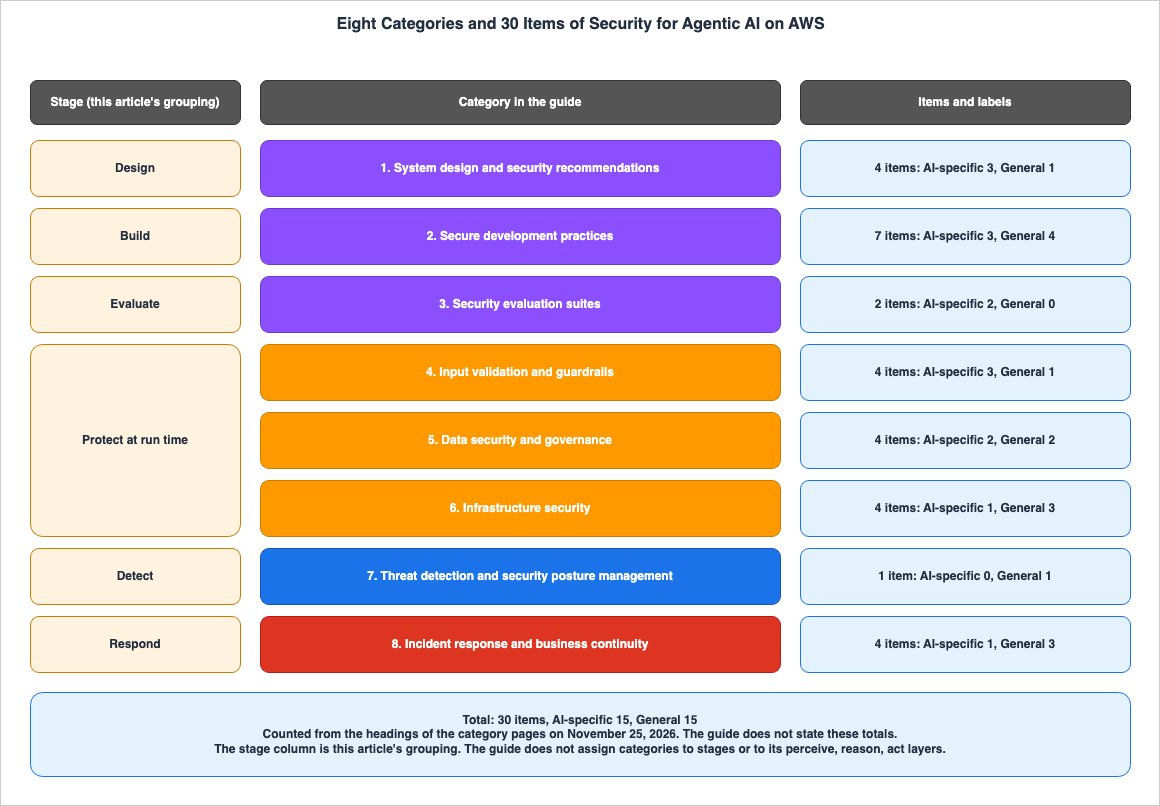
3.3 Eight Categories and Their Item Counts
The best practices page organizes information into eight categories. Each category page begins with a list of items, followed by headings for each individual item. This article counted the number of headings.| Category | Category page | AI-specific | General | Total |
|---|---|---|---|---|
| 1. System design and security recommendations | best-practices-system-design | 3 | 1 | 4 |
| 2. Secure development practices | best-practices-dev-practices | 3 | 4 | 7 |
| 3. Security evaluation suites | best-practices-eval-suites | 2 | 0 | 2 |
| 4. Input validation and guardrails | best-practices-input-validation | 3 | 1 | 4 |
| 5. Data security and governance | best-practices-data | 2 | 2 | 4 |
| 6. Infrastructure security | best-practices-infrastructure | 1 | 3 | 4 |
| 7. Threat detection and security posture management | best-practices-threat-detection | 0 | 1 | 1 |
| 8. Incident response and business continuity | best-practices-incident-response | 1 | 3 | 4 |
| Total | — | 15 | 15 | 30 |
The category names, taken from the list on the best practices page, exclude "for agentic AI systems" (category 1) and "for agentic AI systems on AWS" (categories 2 through 8). The number of items within each category varies from 1 to 7. Category 3 contains only AI-specific items, while category 7 contains a single General item. The numbers 30, 15, and 15 represent the counts determined by this article, not the numbers written in the guide itself.
3.4 Revision History
The document history table contains only one row:| Change | Description | Date |
|---|---|---|
| Initial publication | — | January 8, 2026 |
The guide has not been revised since its initial publication. While the
Last-Modified date on the guide's pages is November 24, 2026, the text is the same as the copy taken on November 24, 2026, and no additional entries have been added to the document history. The date on which a page was republished should not be read as the date of a revision of the guide. Since the initial publication, the materials and services referenced in the guide have changed (Chapter 7).4. What the Guide Names
This chapter shows how this article defines naming and which class each of the 30 items falls into.4.1 Definition of Naming
This article decides naming by whether the text of an item contains the name of an AWS service. The text includes link text. For example, the last sentence of 6.4 Deploy adequate edge protection uses, as link text, the title of a page that contains the name AWS WAF. This article counts this as naming.Items whose text does not contain the name, and whose link alone points to a service page, are separated as Link only. For example, 2.3 Implement adaptive authentication links the term adaptive authentication to the Amazon Cognito Developer Guide, but the name Amazon Cognito does not appear in its text.
This article treats AWS's Well-Architected lenses, Prescriptive Guidance, white papers, and blog posts as documents, rather than services. Similarly, Threat Composer, an open-source tool published by AWS, is treated as a tool rather than a service.
4.2 Items by Class
The 30 items fall into the classes as follows:| Class | Items | Count |
|---|---|---|
| Named as a control | 1.4 (Amazon Bedrock AgentCore), 4.1 (AWS Audit Manager, in the title of a blog post given as an example), 4.2 (Amazon Bedrock Guardrails), 4.3 (Amazon Bedrock Guardrails and CloudWatch), 5.2 (Amazon Cognito), 6.4 (AWS WAF) | 6 |
| Named as where misconfigurations occur | 7.1 (AWS Identity and Access Management and security groups) | 1 |
| Link only | 1.1 (Amazon Bedrock), 2.3 (Amazon Cognito), 3.2 (Amazon SageMaker Clarify) | 3 |
| AWS documents only | 1.2, 2.1, 2.4, 2.6, 3.1, 4.4, 5.1, 5.3, 5.4, 6.1, 6.2, 6.3, 8.4 | 13 |
| Nothing from AWS | 1.3, 2.2, 2.5, 2.7, 8.1, 8.2, 8.3 | 7 |
| Total | — | 30 |
Six of the 30 items name an AWS service in their text as a control to use. Four of these six items name Amazon Bedrock, Amazon Bedrock Guardrails, Amazon Bedrock AgentCore, or Amazon Cognito. The remaining two are AWS Audit Manager and AWS WAF.
The count of items may vary depending on the definition used. If Link only counts as naming, the count is 9, or 10 with 7.1. If the names of documents also count, it is 23. For this reason, each row of the tables in Chapter 5 shows what the item names and what it links to. Readers can recalculate the count based on their own definitions.
4.3 When It Is Fair to Say the Guide Recommends a Service
Only for the six Named as a control items does this article treat the named services as services that the guide recommends using. Item 7.1 mentions IAM policies and security groups as examples of places where a Cloud-Native Application Protection Platform (CNAPP) might identify misconfigurations. Item 7.1 does not say to use IAM or security groups.The three Link only items do not say to use the linked services. For example, item 1.1 links the term confused deputy to the page of the Amazon Bedrock User Guide on cross-service confused deputy prevention. The link serves as an explanation of the term, and does not constitute a recommendation to use Amazon Bedrock.
5. Full Tables of the 30 Items in Eight Categories
This chapter lists all 30 items, in one table for each of the eight categories. The columns are described in Section 2.1, and the class terms in Section 2.2. Every cell in the Where it lands on AWS column is this article's mapping; the pages it is based on are in Chapters 6 and 12.5.1 Category 1 — System design and security recommendations
Category 1 lists items to consider during the design phase, focusing on selecting options that effectively mitigate well-known threats to LLM applications.| Number | Title | Label | What the guide names | Where it lands on AWS | Article on this site |
|---|---|---|---|---|---|
| 1.1 | Use deterministic execution logic unless AI is needed | AI-specific | Link only: The page of the Amazon Bedrock User Guide on cross-service confused deputy prevention | (this article's mapping) Keep deterministic processing in the application's code, and keep the tool allow list in AgentCore Gateway and AgentCore Policy. | None |
| 1.2 | Determine agent scoping | AI-specific | AWS documents only: Well-Architected Framework, access control for stored data best practice | (this article's mapping) Define execution roles (IAM) for each agent and the agent unit within AgentCore Runtime. | Agent Sandboxing and Blast-Radius Isolation on AWS |
| 1.3 | Implement shared memory management | AI-specific | Nothing from AWS | (this article's mapping) Utilize namespace separation within AgentCore Memory and use a single tool to mediate writes to shared memory. | AI Agent Memory Design Guide |
| 1.4 | Isolate sessions | General | Named as a control: Amazon Bedrock AgentCore (link to the Runtime session page) | (this article's mapping) AgentCore Runtime sessions. | Scoping Each Session on AgentCore Runtime |
1.1 requires the use of an allow list when selecting tools in LLM responses. The guide does not specify which service should host the allow list. 1.3 identifies a single deterministic tool that mediates access to shared memory as the most effective mitigation strategy. Again, the guide does not indicate which service should be used to create that tool. 1.4, one of the items that names an AWS service most concretely, states that the AgentCore Runtime's sessions consolidate conversation history, retrieved knowledge, and intermediate states of reasoning under a unique session ID.
5.2 Category 2 — Secure development practices
Category 2 outlines practices that build upon the standard development disciplines used for traditional applications, incorporating considerations for prompt management and addressing vulnerabilities specific to AI systems.| Number | Title | Label | What the guide names | Where it lands on AWS | Article on this site |
|---|---|---|---|---|---|
| 2.1 | Conduct threat modeling | AI-specific | AWS documents only: Threat Composer (GitHub repository from AWS Labs) | (this article's mapping) Threat Composer. A tool, not a service. | Threat Modeling Generative AI Applications on AWS |
| 2.2 | Treat prompts as code artifacts | AI-specific | Nothing from AWS | (this article's mapping) Prompt versions in Amazon Bedrock Prompt Management, and Git repositories. | Prompt Lifecycle Management on AWS |
| 2.3 | Implement adaptive authentication | AI-specific | Link only: Adaptive authentication section in the Amazon Cognito developer guide. | (this article's mapping) Adaptive authentication for threat protection in Amazon Cognito user pools. | Impersonation or Delegation - Amazon Cognito Token Exchange |
| 2.4 | Implement secure coding standards | General | AWS documents only: Well-Architected security pillar, manual code review best practices. | (this article's mapping) Code security (SAST) with Amazon Inspector. | None |
| 2.5 | Perform static code analysis and maintain software bill of materials | General | Nothing from AWS | (this article's mapping) SBOM export and code security (SCA) in Amazon Inspector | AI Bill of Materials on AWS, Agent Skills Security Vetting Guide |
| 2.6 | Enforce Zero Trust principles for all system access | General | AWS documents only: Zero Trust principles section in Prescriptive Guidance. | (this article's mapping) Inbound authorization of AgentCore Gateway (JWT or IAM), and AgentCore Identity | Who Is Consenting - OAuth Session Binding and the Consent Portal in AgentCore Identity |
| 2.7 | Balance access control granularity with development efficiency | General | Nothing from AWS | (this article's mapping) Do not tie to a specific service. Determine the granularity of permissions and claims in conjunction with the identity team. | Identity Lifecycle for AI Agents |
2.1 refers to Threat Composer, a tool published by AWS Labs on GitHub, which is not an AWS service. 2.3 starts from agents acting with the effective permissions of the authenticated end user, through delegation or impersonation. Furthermore, it recommends evaluating adaptive authentication (risk-based authentication) and suggests requiring additional authentication factors or a chain of user approvals for high-risk operations. 2.5 calls for integrating SBOMs and tools with an organization's CNAPP functionality, but does not specifically mention AWS services.
5.3 Category 3 — Security evaluation suites
Category 3 lists items for systematically evaluating the behavior of foundation models before deployment.| Number | Title | Label | What the guide names | Where it lands on AWS | Article on this site |
|---|---|---|---|---|---|
| 3.1 | Conduct model system card reviews | AI-specific | AWS documents only: Article on the AWS Machine Learning Blog introducing AWS AI Service Cards | (this article's mapping) AWS AI Service Cards and system cards published by model providers | None |
| 3.2 | Use security evaluation suites | AI-specific | Link only: Pages in the Amazon SageMaker developer guide on automated evaluation of foundation models, and the fmeval library pages | (this article's mapping) fmeval library, Amazon Bedrock Evaluations, AgentCore Evaluations | Amazon Bedrock Model Evaluation Practical Guide |
The two pages linked from 3.2 are related to evaluating foundation models in Amazon SageMaker Clarify. SageMaker Clarify does not accept new customers as of the verification date (Section 7.3). 3.2 also links to SecEval, which is outside AWS.
5.4 Category 4 — Input validation and guardrails
Category 4 lists items that layer sanitization in the application with guardrails at the model to defend against malicious inputs.| Number | Title | Label | What the guide names | Where it lands on AWS | Article on this site |
|---|---|---|---|---|---|
| 4.1 | Deploy automated testing suites for prompt validation | AI-specific | Named as a control: AWS Audit Manager and Amazon Bedrock (in the title of an AWS Machine Learning Blog post given as an example) | (this article's mapping) Continuous testing pipelines, and Amazon Bedrock Evaluations and AgentCore Evaluations | Amazon Bedrock AgentCore Evaluations Practical Guide |
| 4.2 | Deploy Amazon Bedrock Guardrails | AI-specific | Named as a control: Amazon Bedrock Guardrails and its prompt attack filters. Generative AI Lens: GENSEC04-BP02 | (this article's mapping) Prompt attack filters for Amazon Bedrock Guardrails | Amazon Bedrock Guardrails Implementation Deep Dive |
| 4.3 | Enable prompt logging with metrics | AI-specific | Named as a control: Amazon Bedrock Guardrails and its CloudWatch metrics page | (this article's mapping) CloudWatch metrics for Amazon Bedrock Guardrails, and model invocation logging for Amazon Bedrock | Amazon Bedrock Security and Governance |
| 4.4 | Implement multi-layered input sanitization | General | AWS documents only: Generative AI Lens: GENSEC04-BP02 | (this article's mapping) Sanitization and normalization in the application code, before inference | AWS WAF for Generative AI |
4.2 asks for Amazon Bedrock Guardrails on all Amazon Bedrock invocations and makes enabling the prompt attack filters an essential requirement. In the same item, the guide also says that Guardrails can be enhanced by adopting defense-in-depth practices. Item 4.3 cites an increasing trend in metrics related to
GuardrailPolicyType being set to SensitiveInformationPolicy as an example of a potential indicator of attempts to manipulate system behavior. Item 4.4 asks not to rely on prompts and guardrails alone, and to sanitize and normalize user input in application code before it is sent to the inference engine. AWS Audit Manager, which the example article in 4.1 uses, is in maintenance as of the verification date (Section 7.3).When implementing 4.2, check two conditions that the prompt attack page of the Amazon Bedrock User Guide states. One condition is that when invoking models using
InvokeModel and InvokeModelWithResponseStream, user input must be clearly indicated using input tags. Without the tags, prompt attacks are not filtered for those calls. The other is that the filter does not evaluate tool results:The prompt attack filter does not evaluate tool results.An agent passes tool results back to the model for the next inference, so instructions in tool results are outside the prompt attack filter. This article reads 4.4 (sanitization in application code) and 1.1 (a tool allow list) as asking for controls because such paths outside Guardrails exist.
5.5 Category 5 — Data security and governance
Category 5 outlines the items for classifying and handling data, including training data and inference outputs.| Number | Title | Label | What the guide names | Where it lands on AWS | Article on this site |
|---|---|---|---|---|---|
| 5.1 | Implement pipelines for fine-tuning data | AI-specific | AWS documents only: Machine Learning Lens, AWS Glue data pipeline whitepaper, Generative AI Lens - GENSEC06-BP01 | (this article's mapping) Data pipelines (AWS Glue) that operate without manual intervention, and separation of the account where fine-tuning data is stored. | None |
| 5.2 | Restrict AI operations against sensitive systems | AI-specific | Named as a control: Amazon Cognito (adaptive authentication page) | (this article's mapping) Amazon Cognito's adaptive authentication, and a deterministic broker that mediates tool invocations. | What a Deny Stops in AgentCore Harness Lifecycle Hooks |
| 5.3 | Establish a data governance framework | General | AWS documents only: AWS's "What is data governance" page, and Prescriptive Guidance on generative AI data. | (this article's mapping) Data governance aligned with the authorization system | Identity-Aware Data Access on AWS |
| 5.4 | Prevent data loss | General | AWS documents only: AWS's "What is data loss prevention" page. | (this article's mapping) Amazon Macie, Amazon Bedrock Guardrails' sensitive information filtering, and CloudWatch Logs data protection policies. | PII Detection and Redaction Patterns for Generative AI on AWS, Masking at Ingestion |
5.1 strongly recommends building a data pipeline to deliver fine-tuning data to the production system and removing human access to that data. 5.2 asks for a deterministic broker tool between agents and data sources when downstream systems lack adequate controls. The guide shows a figure in which the broker uses adaptive authentication to inspect high-risk data modifications, and points to the Amazon Cognito documentation. 5.4 states that for organizations already equipped with Data Loss Prevention (DLP) measures, extending those to the agent systems can provide an efficient supplementary control.
5.6 Category 6 — Infrastructure security
This category focuses on measures to contain breaches and prevent their spread through isolation and the deployment of immutable infrastructure.| Number | Title | Label | What the guide names | Where it lands on AWS | Article on this site |
|---|---|---|---|---|---|
| 6.1 | Use the AWS Security Reference Architecture for AI systems | AI-specific | AWS documents only: AWS SRA and its generative AI guide | (this article's mapping) AWS SRA AI security guide and account separation in AWS Organizations | AWS Organization Guardrails, Amazon Bedrock Security and Governance |
| 6.2 | Apply defense-in-depth principles | General | AWS documents only: AWS Machine Learning Blog article on layered defense using the OWASP Top 10 for LLMs. | (this article's mapping) Independent controls for the edge, input, reasoning, and output layers | AI Agent Defense in Depth Model (AIDDM) |
| 6.3 | Reduce human access to infrastructure | General | AWS documents only: Generative AI Lens (GENOPS04-BP01), Well-Architected Framework reliability and operational excellence best practices, DevOps Guidance break-glass procedures. | (this article's mapping) Infrastructure as Code (e.g., AWS CloudFormation), AWS Systems Manager Automation runbooks, break-glass procedures. | None |
| 6.4 | Deploy adequate edge protection | General | Named as a control: AWS WAF (page for rate-based rules). | (this article's mapping) AWS WAF rate-based rules and managed rules. | AWS WAF for Generative AI |
6.1 asks to use AWS account structures to separate agents from data sources that are not directly related to their function. For example, it suggests isolating data used for fine-tuning from the execution environment. The link text of 6.1 calls the AWS SRA generative AI guide by a name that differs from its title as of the verification date (Section 7.2). Item 6.3 asks for tested, standardized runbooks, immutable infrastructure, and break-glass procedures, but does not name an AWS service.
5.7 Category 7 — Threat detection and security posture management
Category 7 outlines items related to threat detection and the ongoing management of security posture. There is only one item.| Number | Title | Label | What the guide names | Where it lands on AWS | Article on this site |
|---|---|---|---|---|---|
| 7.1 | Establish continuous security posture management | General | Named as where misconfigurations occur: AWS Identity and Access Management policies, Amazon VPC security groups, and resource permissions. | (this article's mapping) AWS Security Hub CSPM, AWS Security Hub, Amazon GuardDuty, Amazon Inspector | Threat Detection for AI Workloads on AWS, Detection Engineering on AWS, Tuning Security Hub CSPM Without Hiding Findings |
Item 7.1 is written around Cloud-Native Application Protection Platforms (CNAPP). The guide describes CNAPP as a combination of infrastructure configuration monitoring, runtime threat detection, and application security testing, designed to identify potentially vulnerable configurations – what the guide calls toxic combinations – that may appear harmless when considered individually. Item 7.1 ends by saying that CNAPP and static code analysis alone cannot detect threats specific to agentic AI systems, such as prompt manipulation, or behaviors that emerge from interactions between multiple agents. The guide does not name an AWS detection service in 7.1.
5.8 Category 8 — Incident response and business continuity
Category 8 outlines items related to incident response and business continuity. At the beginning of this category, it highlights an additional risk: as agent systems begin to perform tasks previously handled by people, operational personnel may become unable to handle those tasks during an incident.| Number | Title | Label | What the guide names | Where it lands on AWS | Article on this site |
|---|---|---|---|---|---|
| 8.1 | Implement comprehensive operational observability | AI-specific | Nothing from AWS | (this article's mapping) AgentCore Observability, along with Amazon CloudWatch and Amazon Bedrock model invocation logging | None |
| 8.2 | Establish emergency shutdown capabilities for high-risk scenarios | General | Nothing from AWS | (this article's mapping) Methods for stopping AgentCore Runtime sessions, denying access via IAM roles, and configuring AgentCore Gateway policies, depending on the specific component to be stopped. | Stopping an AI Agent on AWS |
| 8.3 | Maintain business continuity plans for critical operations | General | Nothing from AWS | (this article's mapping) Business procedures, alternative systems, and personnel – not AWS services. | None |
| 8.4 | Implement recovery methods within acceptable timeframes | General | AWS documents only: Two Well-Architected Framework reliability best practices (automated recovery and defining recovery objectives). | (this article's mapping) AWS Resilience Hub (RTO and RPO) | None |
8.1 identifies the generation of harmful content, bias, reduced user satisfaction, unexpected usage, privacy violations, and non-compliance with regulations as areas requiring monitoring. If real-time detection is not possible, it says that post-operation detective controls, such as regularly scanning collected logs, can be a suitable alternative. This article does not map 8.3 to an AWS service. This article does not treat business continuity planning as a function that can be replaced by a service.
6. Items for Which the Guide Names No Service
This chapter shows the basis of this article's mapping for the 24 items other than Named as a control.6.1 Basis of the Mapping
This article mapped the items by comparing, sentence by sentence, what the text of each item asks for with what the user guide of a service states. Of the 24 items, 17 were mapped to AWS services. The following table shows those 17 items and the basis pages. The URLs of the basis pages are in Chapter 12.| Number | This article's mapping | Basis pages |
|---|---|---|
| 1.1 | AgentCore Gateway and Policy in Amazon Bedrock AgentCore | Policy page in the AgentCore developer guide. |
| 1.2 | IAM execution role for each agent | Runtime IAM permissions page in the AgentCore Developer Guide |
| 1.3 | AgentCore Memory namespace | Memory organization page in the AgentCore Developer Guide |
| 2.2 | Prompt versions in Amazon Bedrock Prompt Management | Creating prompt versions in the Amazon Bedrock user guide. |
| 2.3 | Adaptive authentication with threat protection in Amazon Cognito | Threat protection and adaptive authentication pages in the Amazon Cognito developer guide. |
| 2.4, 2.5 | Code security and SBOM export in Amazon Inspector | Code Security page and SBOM export page in the Amazon Inspector User Guide |
| 2.6 | Inbound authorization of AgentCore Gateway, and AgentCore Identity | Inbound authorization page and workload identities page in the AgentCore Developer Guide |
| 3.2 | fmeval, Amazon Bedrock Evaluations, and AgentCore Evaluations | Clarify availability changes page in the Amazon SageMaker developer guide, Amazon Bedrock evaluation page, and AgentCore evaluation types page. |
| 5.1 | Data pipelines in AWS Glue, and account separation | AWS Glue whitepaper (linked in the guide) and item 6.1 of the guide. |
| 5.4 | Amazon Macie, Amazon Bedrock Guardrails, and CloudWatch Logs data protection policies | Amazon Macie user guide, sensitive information filtering page in the Amazon Bedrock user guide, and masking page in the CloudWatch Logs user guide. |
| 6.1 | AWS SRA AI security guide and account separation in AWS Organizations | Introduction page in the AWS SRA AI security guide. |
| 6.3 | Infrastructure as Code (IaC) and runbooks in AWS Systems Manager Automation | Automation page in the AWS Systems Manager user guide. |
| 7.1 | AWS Security Hub CSPM, AWS Security Hub, Amazon GuardDuty, and Amazon Inspector | Two services page and exposure findings page in the AWS Security Hub user guide, and AI Protection page in the Amazon GuardDuty user guide. |
| 8.1 | AgentCore Observability, Amazon CloudWatch, and model invocation logging in Amazon Bedrock | Observability page in the AgentCore Developer Guide, and model invocation logging page in the Amazon Bedrock User Guide |
| 8.2 | Means of stopping, by where the agent is stopped | The service pages that Stopping an AI Agent on AWS checked |
| 8.4 | RTO and RPO in AWS Resilience Hub | Setting RTO and RPO in the AWS Resilience Hub user guide. |
Even among the six Named as a control items, this article adds services to what the guide names: Amazon Bedrock Evaluations and AgentCore Evaluations for 4.1, model invocation logging in Amazon Bedrock for 4.3, and a broker that mediates tool calls for 5.2. The basis for 4.3 is the model invocation logging page of the Amazon Bedrock User Guide.
This article adds one caveat about the mapping for 7.1. Item 7.1 refers to configurations that, while seemingly harmless individually, can create vulnerabilities when combined, a concept the guide calls toxic combinations. While the exposure findings page of the AWS Security Hub User Guide describes correlations between multiple security signals, as far as this article read, it does not use the term toxic combinations. This article does not treat the two as the same thing.
6.2 Items Not Mapped to an AWS Service
This article did not map the remaining seven items to a specific AWS service.- 2.1 Conduct threat modeling: Threat Composer, which the guide names, is an open-source tool, not an AWS service.
- 2.7 Balance access control granularity with development efficiency: The goal is for the identity team to be involved in defining permissions and claims, and to select a granularity that is not overly fine-grained. This is a matter of organizational processes, rather than which service is used.
- 3.1 Conduct model system card reviews: The materials to be reviewed include AWS AI Service Cards and system cards published by model providers; these are not services themselves.
- 4.4 Implement multi-layered input sanitization: The guide asks for sanitization in application code before input is sent to the inference engine.
- 5.3 Establish a data governance framework: The item calls for aligning data governance with authorization mechanisms. This article did not choose a specific service as where it lands.
- 6.2 Apply defense-in-depth principles: The item covers the idea of layering defenses, and other items deal with which services to place in each layer.
- 8.3 Maintain business continuity plans for critical operations: The item concerns the procedures for maintaining business operations, as well as alternative systems and personnel, in the event that the agent system is unavailable.
6.3 Reading the Mapping
The mappings in this article are not intended to definitively assign a single service to each item. For example, AWS WAF and Amazon Bedrock Guardrails can each handle part of the input sanitization in 4.4, but the guide asks for sanitization in application code. The mappings are intended as a starting point, indicating the service that most closely aligns with the requirements outlined in each item's description.7. Where the Guide's Pages Disagree, and What Has Changed
This chapter addresses discrepancies and inconsistencies between pages of the guide, as well as changes that occurred after the initial publication. This chapter shows both texts side by side and does not decide that either one is wrong.7.1 Names of the Three Layers
The introduction page calls the three layers perceive, react, and act. The sentence is as follows. This article added the [sic].This guide provides practical security recommendations for developing hosted agentic AI systems the [sic] follow the perceive, react, act layer architecture.The concepts page, as described in Section 3.1, uses the words perceive, reason, and act to list threats. This article uses the words of the concepts page.
7.2 Naming and Revision of AWS SRA
Item 6.1 refers to the AWS SRA generative AI guide as follows:Use the latest AWS SRA – generative AI guide to align with AWS security best practices for generative AI systems.The title of the linked page, as of the verification date, is AWS Security Reference Architecture (AWS SRA) – AI security. The URL path security-reference-architecture-generative-ai is unchanged. The document history for the AWS SRA AI security guide consists of the following three entries:
| Change | Date |
|---|---|
| Initial publication as standalone guide | December 22, 2025 |
| Reorganization and new content | February 24, 2026 |
| Major content refresh | November 2026 |
The Major content refresh row notes the alignment with the AWS AI Security Framework, as well as expanded descriptions of AgentCore and SageMaker AI. Its date gives only the month, not the day. Because the guide is still the initial version of January 8, 2026, the AWS SRA that 6.1 calls the latest differs in content from the one at the time the guide was written.
7.3 Services with Changed Availability
Three services and features that the guide refers to no longer accept new customers as of the verification date.| Item | Service | How it appears in the guide | Status as of the verification date |
|---|---|---|---|
| 4.1 | AWS Audit Manager | Title of the article on the AWS Machine Learning Blog (used as an example) | Since April 30, 2026, it cannot be set up in new accounts. It is in maintenance. |
| 3.2 | Amazon SageMaker Clarify | Link to the page for evaluating foundation models | Not accepting new customers. This article was unable to determine when this change occurred. |
| concepts page (outside the items) | Amazon Bedrock Agents (currently known as Amazon Bedrock Agents Classic) | The term Amazon Bedrock guardrails links to a page on associating a guardrail with an agent | Not open to new customers since July 30, 2026 |
The AWS Audit Manager availability page states that existing customers can continue using the service, but no new features are being developed. The Amazon SageMaker Clarify availability page suggests alternatives to evaluating foundation models, including the fmeval library, Amazon Bedrock Evaluations, and Amazon Bedrock Guardrails. If you are considering implementing 3.2, this article recommends starting with the alternatives listed on that page.
The concepts page describes the reason layer and references Amazon Bedrock guardrails, linking to the Amazon Bedrock Agents page. The Agents Classic page in the Amazon Bedrock user guide clarifies that only Agents Classic is not accepting new customers; existing models, knowledge bases, and Guardrails are not affected. Amazon Bedrock Guardrails remains available to new customers as of the verification date.
7.4 One-Line Descriptions on the OWASP Page
The OWASP page lists guide items categorized by OWASP risk, with a one-line description provided for each item. The following three instances demonstrate cases where the one-line description may not accurately reflect the content of the item. This article presents them as its own observations.First, consider items 2.6 and 2.7. In the LLM02 section, the one-line descriptions are as follows:
2.6 Enforce Zero Trust principles for all system access – Balances access with security
2.7 Balance access control granularity with development efficiency – Verifies all data access
Item 2.6's main text emphasizes ensuring that tools are not called without proper authentication and authorization. Item 2.7 focuses on balancing access control granularity with development efficiency. The description "Balances" aligns with the title of item 2.7, while "Verifies" is closer in meaning to the main text of item 2.6. Item 2.7 also has descriptions that begin with Verifies under other risks.
Second, examine item 1.4 within the LLM04 section.
1.4 Isolate sessions – Isolates training sessionsItem 1.4's main text discusses user session isolation but does not mention training sessions.
Third, consider item 4.4 in the LLM05 section.
4.4 Implement multi-layered input sanitization – Validates output before useItem 4.4's main text addresses sanitizing input before sending it to the inference engine, but it does not discuss output validation.
When using the OWASP page to select items, it is advisable not to rely solely on the one-line descriptions. Instead, open and carefully review the full text of each item.
7.5 Documents Published After the Guide
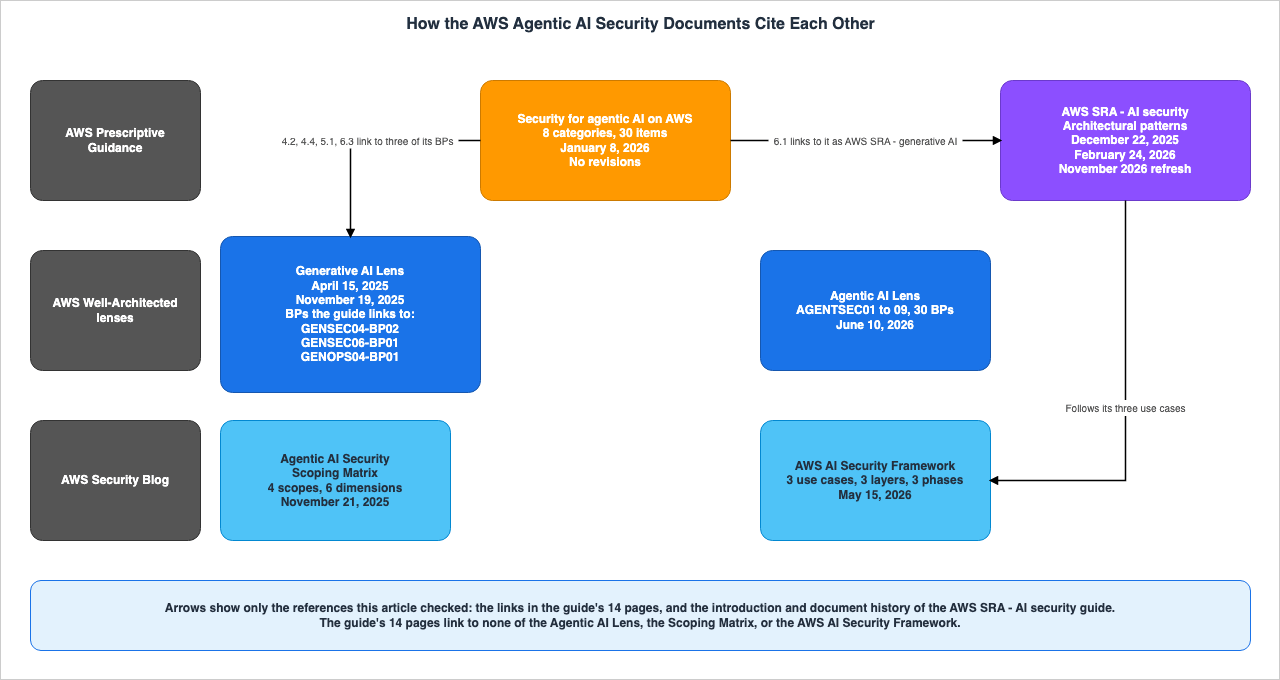
After the guide's initial publication, two related documents were published and one was substantially revised. They are the AWS AI Security Framework (May 15, 2026), the Agentic AI Lens (June 10, 2026), and a major content refresh for the AWS SRA AI security guide (November 2026). The 14 pages of the guide link to none of the Agentic AI Lens, the Scoping Matrix, and the AWS AI Security Framework. The Scoping Matrix was released on November 21, 2025, and was published before the guide.8. How the Guide Differs from Related Official Documents
This chapter outlines the differences between this guide and five related documents, showing what each one lists, how many, and what it covers.8.1 The Scope of the Six Documents
The following table shows the type, the dates, and the unit of what each of the six documents lists.| Document | Type | Date | What it lists |
|---|---|---|---|
| the guide | Prescriptive Guidance | January 8, 2026 (initial publication, unrevised) | 8 categories, 30 items (counted from headings) |
| Agentic AI Lens | Well-Architected Lens | June 10, 2026 (initial release) | 9 questions (AGENTSEC01 to AGENTSEC09) and 30 BPs in the Security pillar |
| Generative AI Lens | Well-Architected Lens | April 15, 2025 (initial publication), November 19, 2025 (new lens version) | Questions and BPs for each of the 6 pillars |
| AWS SRA AI security guide | Prescriptive Guidance | December 22, 2025 (standalone guide), February 24, 2026, November 2026 | Architectural patterns for 3 use cases |
| Scoping Matrix | AWS Security Blog | November 21, 2025 | 4 scopes and 6 security dimensions |
| AWS AI Security Framework | AWS Security Blog | May 15, 2026 (updated May 26, 2026) | 3 use cases, 3 layers, and 3 phases |
This article counted the BPs of the Agentic AI Lens's Security pillar in the lens's table of contents: 3, 3, 4, 2, 2, 4, 5, 2, and 5 for AGENTSEC01 through AGENTSEC09. While the guide's 30 items and the Agentic AI Lens's 30 BPs share the same count, they represent distinct frameworks and do not correspond on a one-to-one basis.
8.2 How Each Document States Its Scope
Each document states its scope as follows.The Security section of the Agentic AI Lens begins with the following sentence:
The security portion of this lens provides security best practices and questions for organizations implementing autonomous AI agents and agentic systems on AWS.The introduction page for the Generative AI Lens states:
The AWS Well-Architected Generative AI Lens provides guidance and best practices for designing, deploying, and operating generative AI applications on AWS.The introduction page for the AWS SRA AI security guide states:
This guide provides architectural patterns for securing AI workloads on AWS.The Scoping Matrix states:
To address this gap, we’ve developed the Agentic AI Security Scoping Matrix, a mental model and framework that categorizes four distinct agentic architectures based on connectivity and autonomy levels, mapping critical security controls across each.The AWS AI Security Framework states:
This post introduces the Amazon Web Services (AWS) AI Security Framework—a structured model that helps you align the right security controls to the right use case, at the right layer, at the right phase.In the introduction, the guide states one of its objectives as follows:
Understand the design decisions that relate to securely operating hosted agentic AI systems8.3 What to Read Each Document For
This article recommends using the six documents as follows. This is this article's inference, not a division of roles that the AWS documents state.- The guide: Survey what to practice in agentic AI systems through 30 items, and look up their mapping to the OWASP Top 10 for LLM Applications 2025.
- Agentic AI Lens: Used during Well-Architected reviews to address security considerations specific to agents. Record BP identifiers as the basis for mitigations.
- Generative AI Lens: Look up BPs for generative AI applications in general, not limited to agents. Items 4.2, 4.4, 5.1, and 6.3 of the guide link to BPs of this lens.
- AWS SRA AI security guide: Used to determine how to deploy AWS security services in multi-account environments. Item 6.1 of the guide points to this guide.
- Scoping Matrix: Assigns the level of autonomy of an agent to one of four scopes, and determines the level of control needed across six dimensions.
- AWS AI Security Framework: Give leadership a shared language for which controls to put in, by use case, layer, and phase. The AWS SRA AI security guide follows the three use cases of this framework.
9. The Version of the OWASP Mapping and the Mapping Tables on This Site
This chapter shows which version the guide's OWASP mapping covers, and how it relates to the two mapping tables on this site.9.1 Only the 2025 Edition of the LLM Top 10
The OWASP page states its scope as follows:The following are the suggested control mappings between this guide and the OWASP Top 10 for LLM Applications 2025.The OWASP page lists guide items under each of the 10 risks from LLM01 to LLM10. By this article's count, there are 122 pairs of a risk and an item. Every one of the 30 items appears under at least one risk. Seven items (2.1, 2.7, 6.1, 6.2, 7.1, 8.1, and 8.3) appear under all 10 risks, and 8.4 appears under the 9 risks other than LLM10. Item 5.4 appears under only one risk (LLM02).
The OWASP page does not map to the OWASP Top 10 for Agentic Applications. The Resources section on the conclusion page mentions OWASP's Agentic AI threats and mitigations as reference material used in creating the guide, but does not provide a corresponding table.
9.2 The Two Mapping Tables on This Site
This site contains two articles that map the OWASP list to AWS controls.- OWASP Top 10 for Large Language Model Applications Mapped to AWS Controls: That article maps each risk in the LLM list to AWS controls, to where each control stops, and to what the application still owns. Section 16 of that article describes how it differs from the guide's OWASP page.
- OWASP Top 10 for Agentic Applications Mapped to AWS Controls: That article maps each risk in the agent list to AWS controls and the risk that remains. Its AWS side aligns with the Agentic AI Lens, specifically from AGENTSEC01 to AGENTSEC09.
The guide's OWASP page maps OWASP risks to item numbers of the guide. In contrast, these two articles on this site map OWASP risks to controls within AWS services. To go from an item number of the guide to AWS services, refer to the table in Chapter 5 of this article.
10. Frequently Asked Questions about Security for Agentic AI on AWS
This chapter answers common questions that come up when reading the guide, with references to specific sections within the text.Q1. How many items are there in total in the guide?
By counting the headings for each category, there are 30 items. 15 are AI-specific and 15 are General. The guide does not state this total. The number was counted on November 25, 2026 (Section 3.3).Q2. Which AWS service does the guide name for each item?
For most items, it names none. Only 6 of the 30 items name, in their text, an AWS service as a control to use. These are 1.4 (Amazon Bedrock AgentCore), 4.1 (AWS Audit Manager), 4.2 and 4.3 (Amazon Bedrock Guardrails), 5.2 (Amazon Cognito), and 6.4 (AWS WAF). Item 4.3 also names CloudWatch metrics (Section 4.2).Q3. Is the Where it lands on AWS column in the Chapter 5 tables a recommendation by AWS?
No. It is this article's mapping, and every row carries the marker (this article's mapping). The service pages it is based on are in Chapters 6 and 12.Q4. Are the 30 items in the guide and the 30 BPs (Best Practices) of the Agentic AI Lens the same?
They are not the same. While both number 30, the 30 items in the guide refer to the number of headings within 8 categories. In contrast, the 30 of the Agentic AI Lens is the number of BPs under the 9 questions, from AGENTSEC01 to AGENTSEC09. The two do not correspond one to one. The guide does not link to the Agentic AI Lens, which was published later (Section 8.1).Q5. Does the guide's OWASP mapping also cover the OWASP Top 10 for Agentic Applications?
No, it does not. The OWASP page focuses solely on OWASP Top 10 for LLM Applications 2025 (Section 9.1).Q6. When was the guide last updated?
As of the verification date, the guide has not been revised. The document history only shows a single entry: the initial version from January 8, 2026. While theLast-Modified date of the pages is November 24, 2026, the text has not changed (Section 3.4).Q7. Which document is the AWS SRA generative AI guide that 6.1 points to?
Refer to the AWS Security Reference Architecture (AWS SRA) – AI security guide. As of the verification date, the link in 6.1 points to a page with this title. The AWS SRA AI security guide was substantially revised in November 2026, and its content differs from when the guide was written (Section 7.2).Q8. When implementing 3.2 now, can SageMaker Clarify, which the guide links to, be used?
As of the verification date, SageMaker Clarify is not currently accepting new customers. The availability change page of the SageMaker Developer Guide lists the fmeval library, Amazon Bedrock Evaluations, and Amazon Bedrock Guardrails as alternatives (Section 7.3).11. Summary
Before implementing an item of the guide on AWS, check the following.- You have checked whether the item is AI-specific or General and which of the eight categories it is in (Chapter 3).
- You have determined whether the guide specifically names AWS services, provides only links, or simply references documentation (as described in Chapter 4).
- For items that the guide does not specifically name, you have decided where it lands on AWS yourself and kept the basis pages (Chapters 5 and 6).
- You have checked that the availability of the services the guide refers to, as in 3.2 and 4.1, has not changed (Section 7.3).
- You have read the full text of each item, not just the brief description on the OWASP page (Section 7.4).
- You are treating the guide's 30 items and the Agentic AI Lens Best Practices as separate frameworks (Chapter 8).
- You check the mapping to the OWASP list for agentic applications in a separate mapping table, not in the guide (Chapter 9).
- You have checked that the guide, the AWS SRA AI security guide, and the Agentic AI Lens have not been revised since the verification date of November 25, 2026, by re-opening the relevant pages (Section 2.3).
12. References
- Security for agentic AI on AWS - AWS Prescriptive Guidance
- Key security concepts for agentic AI on AWS - AWS Prescriptive Guidance
- Security best practices for agentic AI systems on AWS - AWS Prescriptive Guidance
- 1. System design and security recommendations for agentic AI systems - AWS Prescriptive Guidance
- 2. Secure development practices for agentic AI systems on AWS - AWS Prescriptive Guidance
- 3. Security evaluation suites for agentic AI systems on AWS - AWS Prescriptive Guidance
- 4. Input validation and guardrails for agentic AI systems on AWS - AWS Prescriptive Guidance
- 5. Data security and governance for agentic AI systems on AWS - AWS Prescriptive Guidance
- 6. Infrastructure security for agentic AI systems on AWS - AWS Prescriptive Guidance
- 7. Threat detection and security posture management for agentic AI systems on AWS - AWS Prescriptive Guidance
- 8. Incident response and business continuity for agentic AI systems on AWS - AWS Prescriptive Guidance
- Mapping to OWASP top 10 for LLM applications - AWS Prescriptive Guidance
- Conclusion and resources - AWS Prescriptive Guidance
- Document history - AWS Prescriptive Guidance
- Security - Agentic AI Lens
- Document revisions - Agentic AI Lens
- Generative AI Lens - AWS Well-Architected Framework
- Document revisions - Generative AI Lens
- AWS Security Reference Architecture (AWS SRA) – AI security - AWS Prescriptive Guidance
- Document history - AWS SRA – AI security
- The Agentic AI Security Scoping Matrix: A framework for securing autonomous AI systems - AWS Security Blog
- The AWS AI Security Framework: Securing AI with the right controls, at the right layers, at the right phases - AWS Security Blog
- AWS Audit Manager availability change - AWS Audit Manager
- Clarify availability change - Amazon SageMaker AI
- Policy in Amazon Bedrock AgentCore: Control Agent Interactions - Amazon Bedrock AgentCore
- IAM Permissions for AgentCore Runtime - Amazon Bedrock AgentCore
- Use isolated sessions for agents - Amazon Bedrock AgentCore
- Memory organization in AgentCore Memory - Amazon Bedrock AgentCore
- Set up inbound authorization for your gateway - Amazon Bedrock AgentCore
- Understanding workload identities - Amazon Bedrock AgentCore
- Evaluation types - Amazon Bedrock AgentCore
- Observability, audit logging, and tracing for your agents - Amazon Bedrock AgentCore
- Create a version of a prompt in Prompt management - Amazon Bedrock
- Evaluate the performance of Amazon Bedrock resources - Amazon Bedrock
- Detect prompt attacks with Amazon Bedrock Guardrails - Amazon Bedrock
- Monitor Amazon Bedrock Guardrails using CloudWatch metrics - Amazon Bedrock
- Monitor model invocation using CloudWatch Logs and Amazon S3 - Amazon Bedrock
- Amazon Bedrock Agents Classic maintenance mode - Amazon Bedrock
- Advanced security with threat protection - Amazon Cognito
- Working with adaptive authentication - Amazon Cognito
- Amazon Inspector Code Security - Amazon Inspector
- Exporting SBOMs with Amazon Inspector - Amazon Inspector
- Remove PII from conversations by using sensitive information filters - Amazon Bedrock
- What is Amazon Macie? - Amazon Macie
- Help protect sensitive log data with masking - Amazon CloudWatch Logs
- AWS Systems Manager Automation - AWS Systems Manager
- Set RTO and RPO - AWS Resilience Hub
- What are Security Hub and Security Hub CSPM? - AWS Security Hub
- Exposure findings in Security Hub - AWS Security Hub
- GuardDuty AI Protection - Amazon GuardDuty
- Applying rate limiting to requests in AWS WAF - AWS WAF, AWS Firewall Manager, AWS Shield Advanced, and AWS Shield network security director
- Responsible AI Tools and Resources - AWS
References:
Tech Blog with curated related content
Written by Hidekazu Konishi