AWS Service Renames Reference - Old Names, New Names, and the Identifiers a Rename Leaves Behind
First Published:
Last Updated:
es:, sso:, and kinesisanalytics:. The display names for these services have been updated to Amazon OpenSearch Service, AWS IAM Identity Center, and Amazon Managed Service for Apache Flink, respectively. Should these policies be rewritten to reflect the new names, or is it correct to retain the original identifiers?For several renames, AWS has published pages detailing the changes and what remains unchanged. These include a summary of the Amazon OpenSearch Service rename, the "Legacy namespaces remain the same" section for IAM Identity Center, and the What's New post for Amazon Managed Service for Apache Flink. When examined together, the range of retained identifiers varies for each rename. For the AWS CodeConnections rename, a new service prefix,
codeconnections, has been added. Two AWS sources say different things about the handling of the older codestar-connections.This article lists, in chronological order, 25 renames in which AWS itself stated the old and new names side by side. For each rename, it summarizes what has changed, what has been retained, and where AWS documents this information. It does not address the origins of the names or the merits of the renames themselves. The intended audience is operations personnel and architects who maintain IAM policies, SCP configurations, Infrastructure as Code (IaC), and monitoring queries. Specifically, it aims to assist readers who need to determine whether to update older identifiers or if new identifiers have been introduced.
All information presented in this article has been verified against AWS primary sources. The confirmation date is September 25, 2026. Any matter not explicitly mentioned in the primary sources is stated as such. Where discrepancies exist between different AWS primary sources, those discrepancies are presented as they appear.
Table of Contents
- What a Rename Changes and What It Leaves Behind
- The Layers of an AWS Service Name
- Five Kinds of Name Change
- The Renames in Order
- The Anatomy of Each Rename
- When a Rename Adds or Changes Identifiers
- What the Reference Pages Show on the Confirmation Date
- Which Date Is the Rename Date
- What to Check in Policies, Templates, and Monitoring
- Frequently Asked Questions
- Summary
- References
1. What a Rename Changes and What It Leaves Behind
AWS service names have two layers: one for human readers and another used by code and policies. A rename initially affects the former. The extent to which the latter changes varies, and you'll need to review AWS documentation for each rename to understand the full impact. This section first defines the questions this article addresses and the scope of its coverage.1.1 The Question This Article Answers
Operators primarily have two questions regarding a rename. First, they want to know whether they need to update existing IAM policies, SCPs, CloudFormation templates, and scripts that still contain the old names. Second, they want to determine whether identifiers with the new names have been added, or whether the identifiers with the old names are still correct.To answer these questions, simply knowing the date of the rename and the new name is not sufficient. It's necessary to review the documentation for each rename to understand what AWS says it updated and what it says remains unchanged. This article compiles that information, organizing it into a consistent format for each rename.
1.2 Inclusion Criteria and What Other Articles Cover
This article only includes renames explicitly stated with both the old and new names by AWS itself. Specifically, it focuses on instances found in What's New, the AWS News Blog, rename pages in the user guides, and the Document history, where the old and new names are linked using terms such asrenamed, is now, formerly, or previously known as.This article does not aim for comprehensive coverage. A single page on which AWS lists its renames was not found during the research for this article (through September 25, 2026). Therefore, the entries in this article were individually gathered from primary sources for each rename. Some renames are not included. For example, the rename from Amazon Omics to AWS HealthOmics is not included because the announcement and date of the rename could not be verified in the primary sources.
Where a service has a timeline, that timeline covers the history of its rename. This article does not reproduce that information, instead providing only a single entry and a link to the relevant resource.
- Information on service end-of-life and lifecycle status is available in AWS Retired Services History and Timeline. This timeline explicitly states that a rename does not constitute a retirement and therefore does not include renames. The status terms in this article follow AWS Service Lifecycle States.
- AWS History and Timeline documents the overall history of AWS services. This timeline maintains a policy of noting renames as annotations on the original entry, rather than creating new entries for the new names.
- The FAQs of their respective timelines address the background and dates for the renames of Identity Center, OpenSearch Service, Kinesis, and SageMaker. This article does not rephrase these four sets of questions.
- Where the AWS Primary Sources Disagree About Launch Dates addresses the sources of date information and how those dates are recorded, including dates related to renames.
- IAM Policy Evaluation Logic Step-by-Step explains how IAM evaluates policies. This article does not cover the logic of policy evaluation.
1.3 How the Facts Were Established
Each row in the list contains the URL of the primary source documenting the rename and, where one was found, its date. The table states which source each date comes from. What changed and what remained in each rename were taken from its summary page, its What's New post, and the user guide.Separately, this article checked what three reference pages show on the confirmation date. These documents were the Service Authorization Reference (which lists IAM service prefixes), the AWS CLI command reference, and the CloudFormation resource type reference. These observations are in Section 7, kept apart because what a reference page shows on the confirmation date and what AWS said would remain after a rename are separate facts.
2. The Layers of an AWS Service Name
The name of an AWS service isn't limited to the name displayed on screens or in documents. API namespaces, IAM service prefixes, ARNs, CLI command names, and CloudFormation type names all have their own names. This section defines the layers of distinction that will be used when referring to these names.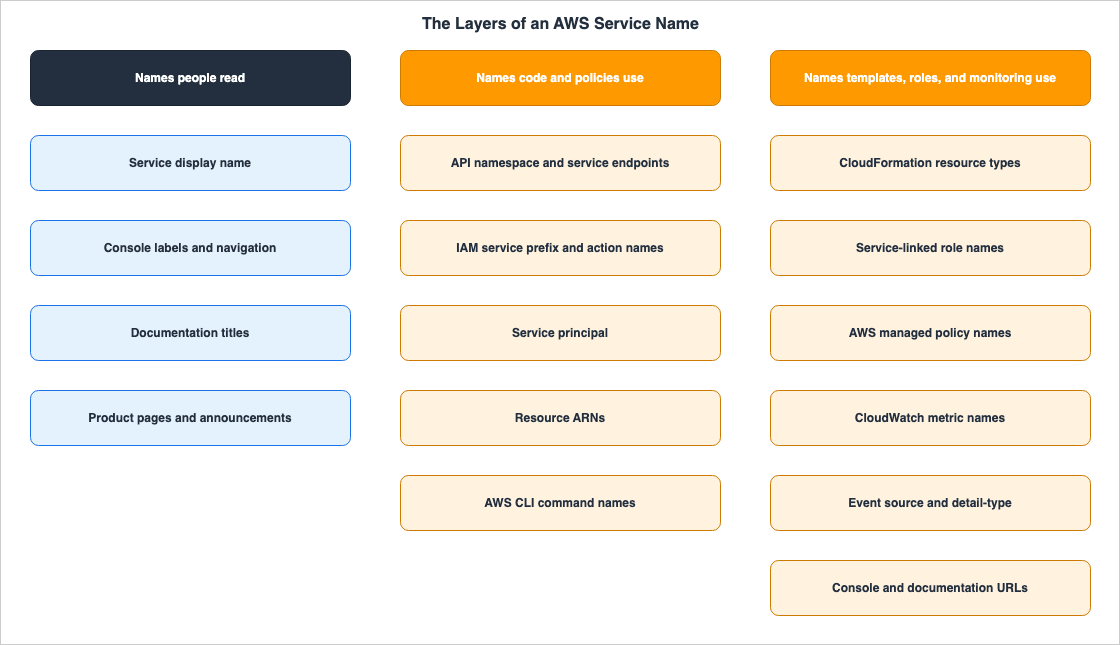
2.1 Names People Read and Names Code Uses
The left column displays names that are intended for human readers. This includes service display names, console labels and navigation elements, document titles, and product pages and announcements. The central and right columns display names used by code, policies, templates, and monitoring systems. The central column contains names such as API namespaces and endpoints, IAM service prefixes and action names, service principal names, ARNs, and AWS CLI command names. The right column includes CloudFormation resource types, service-linked role names, names of AWS managed policies, CloudWatch metric names, event sources anddetail-type values, and URLs for the console and documentation.Names from the central and right columns remain in what users write. These include IAM policy actions, Service Control Policies (SCPs), the
Type field in CloudFormation templates, monitoring alarms, EventBridge rules, and URLs for bookmarks and scripts.2.2 Why the Two Layers Move Separately
When code or policies use names that are changed, existing applications may stop functioning correctly. For several renames, AWS has written which of these names it left unchanged. Regarding the rename of IAM Identity Center, the documentation explains the rationale for retaining certain legacy names.The sso and identitystore API namespaces along with the following related namespaces remain unchanged
for backward compatibility purposes.The source is the IAM Identity Center User Guide, specifically the "What is IAM Identity Center?" section. Similar explanations can be found regarding the rename of SageMaker AI and WorkSpaces Secure Browser. However, the specific layers that are retained vary depending on the rename. In the case of AWS CodeConnections, a new service prefix was added. For Amazon OpenSearch Service, the service prefix remained
es, while new operation names were introduced for the APIs. The specific differences for each rename are shown in the tables in Section 5 and in Section 6. The figure only shows the names of the layers and does not indicate which layers have been modified.3. Five Kinds of Name Change
Changes to names in AWS come in different forms. When categorized by what happened to the original name, there are five distinct kinds. The "Kind" column in the list indicates which of these five kinds applies.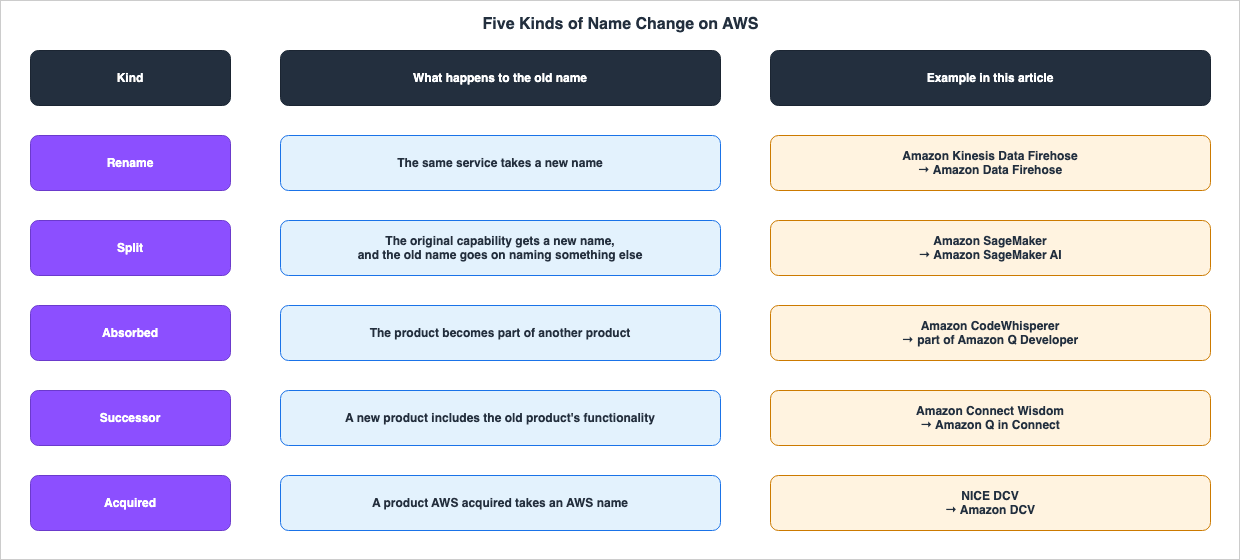
3.1 Rename
This category covers cases in which the same service took a new name. Out of the 25 items listed, 14 fall under this kind. A prominent example is Amazon Kinesis Data Firehose, which was renamed to Amazon Data Firehose, as announced on February 9, 2024.This category also includes renames that incorporate a generational identifier. The Service Availability Updates released on June 30, 2026, state that Amazon Bedrock Agents, which were introduced in November 2023, have been renamed to Amazon Bedrock Agents Classic. The same announcement also indicated that Amazon Bedrock Agents Classic has entered a maintenance status. Details regarding this status can be found in the AWS Retired Services History and Timeline.
3.2 Split
This pattern involves a feature being given a new name, while the original name continues to be used, now referring to something different. This applies to five cases. The destination of the original names varies with each rename.- Amazon SageMaker was renamed to Amazon SageMaker AI. The name "Amazon SageMaker" now refers to the next-generation SageMaker, announced on the same day.
- AWS Security Hub was renamed to AWS Security Hub CSPM. The name "AWS Security Hub" now refers to a new, integrated service.
- The existing capabilities of Amazon GameLift became Amazon GameLift Servers. The name "Amazon GameLift" remains, encompassing a broader range of services, including Amazon GameLift Streams.
- The SMS, MMS, push notification, and text-to-voice messaging features of Amazon Pinpoint have been renamed to AWS End User Messaging. The marketing features, such as campaigns and journeys, have retained the name "Amazon Pinpoint."
- Amazon Connect has been renamed to Amazon Connect Customer. The name "Amazon Connect" now serves as a family name for four different solutions.
In this pattern, searching for the original name will lead you to something different than the original feature. In articles or policy comments written before the rename, the original name now refers to a different entity.
3.3 Absorbed
This refers to products that have been integrated into another product with a broader scope. Three products fall under this category. The Amazon Q Developer User Guide states that, as of April 30, 2024, Amazon CodeWhisperer became a part of Amazon Q Developer. Amazon QuickSight was integrated into Amazon Quick, and continues as a feature under the name Amazon Quick Sight. Amazon EC2 Systems Manager was announced as part of AWS Systems Manager in a What's New post dated November 29, 2017. However, the current Systems Manager User Guide lists Amazon EC2 Systems Manager as a previous name for AWS Systems Manager.3.4 Successor
The new product is a version that inherits the functionality of the previous product. Two instances fall under this category. The What's New announcement dated November 28, 2023, states that Amazon Q in Connect includes features of Amazon Connect Wisdom.This generative AI assistant, which includes functionality formerly available as Amazon Connect Wisdom, ...However, this announcement does not explicitly state that Wisdom was renamed to Amazon Q in Connect. Amazon EventBridge was announced as a new service in the What's New announcement dated July 11, 2019. That announcement stated that EventBridge utilizes the CloudWatch Events API and that existing default event buses, rules, and events could be managed within both the EventBridge and CloudWatch Events consoles. Meanwhile, the EventBridge page of the Systems Manager User Guide gives Amazon CloudWatch Events as the former name of EventBridge. This article classifies these two instances as "Successor."
The EventBridge User Guide previously contained a dedicated page about the former name and the shared API, but as of the confirmation date of September 25, 2026, that page had been redirected to a different page. A page that describes a rename can itself disappear or move later.
3.5 Acquired
This category covers products that AWS acquired and then gave an AWS name. One rename falls under it. On October 1, 2024, the AWS News Blog announced that NICE DCV had been renamed Amazon DCV. AWS Acquisitions History and Timeline covers the history of the acquisition and the future of NICE's other products.3.6 What This Article Does Not Treat as a Rename
Service discontinuations, the cessation of new enrollments, and transitions to maintenance are not considered renames. If a service that was previously renamed later enters a discontinued or maintenance status, a note on the status is placed after the table, and the details are left to the retired services timeline.Changes to the names of individual features within a product are also excluded from this article's listing. For example, the Amazon Connect Customer Administrator Guide, in a Document history entry dated August 4, 2026, states that feature names were changed to align with naming guidelines established in July 2026. AWS History and Timeline regarding Amazon Connect covers this change.
4. The Renames in Order
The list is divided into three tables. Each row includes the old name, the new name, the date and source, and the kind. The dates are linked to primary sources that describe the renames. The kind of source is indicated in parentheses. Renames for which the date could not be confirmed are listed at the end of the final table.4.1 From 2017 to 2023
| Old name | New name | Date (source) | Kind |
|---|---|---|---|
| Amazon EC2 Systems Manager | AWS Systems Manager | 2017-11-29 (What's New) | Absorbed |
| Amazon CloudWatch Events | Amazon EventBridge | 2019-07-11 (What's New) | Successor |
| Amazon Elasticsearch Service | Amazon OpenSearch Service | 2021-09-08 (rename summary page) | Rename |
| Amazon S3 Glacier storage class | Amazon S3 Glacier Flexible Retrieval | 2021-11-30 (What's New) | Rename |
| AWS Single Sign-On | AWS IAM Identity Center | 2022-07-26 (What's New) | Rename |
| ACM Private CA | AWS Private Certificate Authority | 2022-09-27 (Document history) | Rename |
| Amazon Kinesis Data Analytics | Amazon Managed Service for Apache Flink | 2023-08-30 (What's New) | Rename |
| AWS Fault Injection Simulator | AWS Fault Injection Service | 2023-11-15 (Document history) | Rename |
| Amazon Connect Wisdom | Amazon Q in Connect | 2023-11-28 (What's New) | Successor |
AWS History and Timeline regarding AWS Systems Manager documents the rename of Systems Manager. EventBridge is covered in AWS History and Timeline regarding Amazon EventBridge, OpenSearch Service in AWS History and Timeline regarding Amazon OpenSearch Service, S3 Glacier Flexible Retrieval in AWS History and Timeline regarding Amazon S3, IAM Identity Center in AWS History and Timeline regarding AWS Identity and Access Management, Managed Service for Apache Flink in AWS History and Timeline regarding Amazon Kinesis, and Fault Injection Service in Chaos Engineering on AWS with AWS Fault Injection Service. Amazon Q in Connect was renamed "agent assist" in 2026. AWS History and Timeline regarding Amazon Connect details this change.
4.2 In 2024
| Old name | New name | Date (source) | Kind |
|---|---|---|---|
| Amazon Kinesis Data Firehose | Amazon Data Firehose | 2024-02-09 (What's New) | Rename |
| AWS CodeStar Connections | AWS CodeConnections | 2024-03-29 (What's New) | Rename |
| Amazon CodeWhisperer | Part of Amazon Q Developer | 2024-04-30 (rename summary page) | Absorbed |
| Amazon WorkSpaces Web | Amazon WorkSpaces Secure Browser | 2024-05-20 (Release history) | Rename |
| Amazon Pinpoint's SMS, MMS, push notification, and text-to-voice messaging features | AWS End User Messaging | 2024-07-29 (What's New) | Split |
| NICE DCV | Amazon DCV | 2024-10-01 (AWS News Blog) | Acquired |
| AWS Application Composer | AWS Infrastructure Composer | 2024-10-04 (What's New) | Rename |
| Amazon SageMaker | Amazon SageMaker AI | 2024-12-03 (user guide) | Split |
The Kinesis timeline covers the rename of Data Firehose. AWS History and Timeline regarding Amazon Q details the lineage of Amazon Q Developer and its predecessor CodeWhisperer. The IDE plugins and paid subscriptions for Amazon Q Developer will reach their end of support on April 30, 2027. The AWS DevOps Blog announced this schedule on April 30, 2026. The same announcement clarifies that the Amazon Q Developer integration for Slack and Microsoft Teams is not subject to this end of support. Amazon Pinpoint will reach end of support on October 30, 2026. New customer onboarding concluded on May 20, 2025. According to the Amazon Pinpoint end-of-support page, the APIs for SMS, voice, mobile push, OTP, and phone number validation will not be affected and will continue to be supported by AWS End User Messaging. The details are available in AWS Retired Services History and Timeline. AWS History and Timeline regarding Amazon SageMaker covers the rename of SageMaker AI and its relationship to the next generation of SageMaker.
4.3 From 2025 to 2026
| Old name | New name | Date (source) | Kind |
|---|---|---|---|
| AWS Chatbot | Amazon Q Developer in chat applications | 2025-02-19 (rename summary page) | Rename |
| Amazon GameLift | Amazon GameLift Servers | 2025-03-06 (AWS News Blog) | Split |
| AWS Security Hub | AWS Security Hub CSPM | Date not specified in primary source. First mention of the name is 2025-06-17 (What's New) | Split |
| Amazon QuickSight | Part of Amazon Quick (Amazon Quick Sight) | 2025-10-09 (Document history) | Absorbed |
| Amazon Connect | Amazon Connect Customer | 2026-04-28 (AWS News Blog) | Split |
| AWS Application Migration Service | AWS Transform MGN | 2026-06-08 (What's New) | Rename |
| Amazon Bedrock Agents (November 2023 generation) | Amazon Bedrock Agents Classic | 2026-06-30 (What's New) | Rename |
| Amazon AppStream 2.0 | Amazon WorkSpaces Applications | Date unconfirmed. The old name is listed on the product page. | Rename |
The Security Hub CSPM row does not leave the rename date blank, for the following reason. The Security Hub FAQ states that what was previously called Security Hub is now offered as Security Hub CSPM, but does not include a specific date. In the sources checked, the name Security Hub CSPM first appears in the What's New post dated June 17, 2025.
The date in the QuickSight row is the date of a row in the Document history of the Amazon Quick User Guide. The What's New post with the same date announces the general availability of Amazon Quick Suite. The date of the change from Quick Suite to Quick could not be confirmed in the primary sources. The Amazon Q timeline covers the lineage of Amazon Q and Amazon Quick.
AWS History and Timeline regarding Amazon Connect covers the Amazon Connect row. What AWS Transform Automates and What Stays Human discusses the impact of the rename of Transform MGN. Regarding WorkSpaces Applications, the sources checked for this article did not contain a date for the rename. The previous name is listed on the product page.
5. The Anatomy of Each Rename
This section forms the core of this article. For each rename, this section lays out what changed, what stayed, and where AWS recorded it, in the same three columns.5.1 How to Read the Anatomy Table
The rows in the table indicate the change from an old name to a new name, along with the corresponding date. The three columns are as follows:- What changed: This column lists items where the primary source indicates a change.
- What stayed: This column includes only items where the primary source indicates that the item did not change, remains the same, or continues to be valid. If the primary source says nothing, the cell reads "The source does not say." Nothing in this column is inferred from what remained unchanged in another rename.
- Where AWS recorded it: This column lists the primary source document containing the relevant information.
The table is divided into renames for which AWS listed what stayed (5.2) and those for which it did not list which identifiers stayed (5.3). You can verify how identifiers are displayed for most of the renames listed in Section 5.3 by referring to the observation tables in Section 7.
5.2 Renames Where AWS Listed What Stayed
First, the three renames from 2017 to 2021.| Rename | What changed | What stayed | Where AWS recorded it |
|---|---|---|---|
| Amazon EC2 Systems Manager → AWS Systems Manager (2017-11-29) | The service name. AWS Systems Manager incorporates the functionality of EC2 Systems Manager. | Examples of legacy abbreviations that remain include: SSM Agent, SSM parameters, the endpoint ssm.region.amazonaws.com, AWS::SSM::Document, AWS Config rule identifiers such as EC2_INSTANCE_MANAGED_BY_SSM, the aws ssm command, the managed policy AmazonSSMReadOnlyAccess, and ARNs like arn:aws:ssm:.... | The "Systems Manager service name history" section of the user guide. |
| Amazon CloudWatch Events → Amazon EventBridge (2019-07-11) | The new service name. EventBridge adds the ability to receive events from SaaS partners and your own applications. | Because EventBridge uses the same API as CloudWatch Events, the way you use the CloudWatch Events API remains unchanged. Existing default event buses, rules, and events can be managed in both the EventBridge console and the CloudWatch Events console. | What's New, and the EventBridge page in the Systems Manager User Guide. |
| Amazon Elasticsearch Service → Amazon OpenSearch Service (2021-09-08) | With the new configuration API version 2021-01-01, 21 API operations were renamed (for example, CreateElasticsearchDomain → CreateDomain). Also changed: the CLI command aws opensearch, instance type suffixes like .search, and CloudWatch metric names (when upgrading a domain to OpenSearch). And the detail-type of events sent to EventBridge and CloudWatch. | Service principal es.amazonaws.com, vendor code, domain ARNs, and domain endpoints. The event source aws.es. Older API versions continue to be available. | The "Summary of changes" page in the user guide (Amazon OpenSearch Service rename - Summary of changes). |
Next, the six renames from 2022 to 2024.
| Rename | What changed | What stayed | Where AWS recorded it |
|---|---|---|---|
| AWS Single Sign-On → AWS IAM Identity Center (2022-07-26) | Service name | API namespaces sso and identitystore. CLI commands aws configure sso, identitystore, sso, sso-admin, sso-oidc. Managed policies that begin with AWSSSO and AWSIdentitySync. Endpoints that include sso and identitystore. CloudFormation resources that begin with AWS::SSO. Service-linked role AWSServiceRoleForSSO. Console URLs that include sso and singlesignon. Documentation URLs that include singlesignon. | IAM Identity Center rename section in the user guide |
| Amazon Kinesis Data Analytics → Amazon Managed Service for Apache Flink (2023-08-30) | Service name in the management console, documentation, and service web pages | Service endpoints, APIs, AWS CLI, IAM access policies, CloudWatch metrics, AWS Billing console dashboards | What's New |
| Amazon Kinesis Data Firehose → Amazon Data Firehose (2024-02-09) | Service name in the management console, documentation, and service web pages | Service endpoints, APIs, AWS CLI, IAM access policies, CloudWatch metrics | What's New |
| AWS CodeStar Connections → AWS CodeConnections (2024-03-29) | New service prefix codeconnections. New ARN arn:aws:codeconnections:.... New resource type AWS::CodeConnections::Connection. ARNs for connections created in the console | Two sources disagree on the handling of the old service prefix codestar-connections (6.2). The resource type AWS::CodeStarConnections::Connection continues to be supported | What's New and a summary page in the Developer Tools console User Guide |
| Amazon WorkSpaces Web → Amazon WorkSpaces Secure Browser (2024-05-20) | Service name | API namespace workspaces-web. CLI commands, CloudWatch metrics, endpoints, CloudFormation resources, service-linked roles that include workspaces-web, console and documentation URLs, ReadOnly managed role, KMS grant names, Kinesis stream prefixes for user activity logs. Existing portal URLs <UUID>.workspaces-web.com | Release history section in the administrator guide |
| Amazon Pinpoint (SMS, MMS, push notifications, text-to-voice) → AWS End User Messaging (2024-07-29) | Service name in the management console, documentation, AWS Support, and service web pages | APIs, AWS CLI, IAM access policies, service events, endpoints. Marketing features continue to use the name Amazon Pinpoint | What's New |
Finally, the three renames from December 2024 to 2025.
| Rename | What changed | What stayed | Where AWS recorded it |
|---|---|---|---|
| Amazon SageMaker → Amazon SageMaker AI (2024-12-03) | The service name. This rename does not apply to existing Amazon SageMaker features. | API namespace sagemaker. AWS CLI commands. Managed policies that begin with AmazonSageMaker. Endpoints that include sagemaker. CloudFormation resources that begin with AWS::SageMaker. Service-linked role AWSServiceRoleForSageMaker. Console and documentation URLs that include sagemaker. | Amazon SageMaker AI rename section in the user guide. |
| AWS Chatbot → Amazon Q Developer in chat applications (2025-02-19) | The display name within chat applications. The @aws mention in calls has changed to @Amazon Q. The console name. Names of AWS Organizations policies (Chatbot policies → chat applications policies). | Service principal, IAM permissions, console URLs, Organizations policy schema, namespace, endpoint, service-linked role name. APIs, SDKs. | Summary page for the AWS Chatbot rename in the administrator guide. |
| Amazon QuickSight → Amazon Quick (2025-10-09) | The product name. QuickSight has become a feature named Amazon Quick Sight within Amazon Quick. | Existing QuickSight APIs, SDKs, and integrations. | Overview page and Document history in the Amazon Quick User Guide. |
Regarding the "What stayed" column in the table, it's worth verifying some of these details in the original documentation. The What's New post for Managed Service for Apache Flink lists what did not change as follows.
The name change is effective in the AWS Management Console, documentation, and service webpages.
There are no other changes, including to service endpoints, APIs, the AWS Command Line Interface (AWS CLI),
the AWS Identity and Access Management (IAM) access policies, Amazon CloudWatch metrics, or the AWS Billing
console dashboard. Your existing applications will continue to work as they did previously.
The summary page for the AWS Chatbot rename also mentions where the old name might still appear.
Mentions of the name AWS Chatbot may persist in the CloudFormation guide, AWS General Reference entry,
and user guide page URLs.
Service principals, IAM permissions, console urls, organizations policy schemas, namespace, endpoints,
and service-linked role names will remain unchanged.
The summary page for the OpenSearch Service rename includes a disclaimer stating that the list of unchanged items is not exhaustive.
The following features and functionality, among others not listed, will remain the same:The beginning of the same page states that its list of what changed is not exhaustive either. Since AWS itself does not claim that the list is comprehensive, the "What stayed" column also does not represent a complete list.
5.3 Renames Where the Source Does Not Say Which Identifiers Stayed
Of the following 13 instances, 12 are cases where the primary sources documenting the renames do not specify whether an identifier remains. The What stayed column is not left blank; it says so. The Amazon Connect timeline covers the remaining one, Amazon Connect.First, seven of these instances occurred between 2021 and 2024.
| Rename | What changed | What stayed | Where AWS recorded it |
|---|---|---|---|
| Amazon S3 Glacier storage class → Amazon S3 Glacier Flexible Retrieval (2021-11-30) | The name of the storage class | The source does not say. The user guide on the confirmation date lists the storage class identifier as GLACIER. | What's New |
| ACM Private CA → AWS Private Certificate Authority (2022-09-27) | The name of the service and the console. On February 13, 2023, the prefix for AWS managed policy names changed from AWSCertificateManagerPrivateCA to AWSPrivateCA (6.5). | For identifiers, the source does not say. The renamed managed policies keep their functionality (6.5). | User guide's Document history and the AWS managed policies page. |
| AWS Fault Injection Simulator → AWS Fault Injection Service (2023-11-15) | The name of the service | The source does not say. | User guide's Document history. |
| Amazon Connect Wisdom → Amazon Q in Connect (2023-11-28) | A new product incorporating Wisdom's features | For identifiers, the source does not say. Wisdom's functionality is included in the new product. | What's New |
| Amazon CodeWhisperer → Part of Amazon Q Developer (2024-04-30) | The product. The management settings for the Professional edition differ from those for CodeWhisperer Professional. | For identifiers, the source does not say. Familiar CodeWhisperer features are available in Amazon Q Developer, with a few changes. | The rename summary page in the Amazon Q Developer User Guide. |
| NICE DCV → Amazon DCV (2024-10-01) | The name of the product. Concurrent with the 2024.0 release. | The source does not say. The installation instructions within the same article still refer to packages that begin with the name nice-dcv. | AWS News Blog |
| AWS Application Composer → AWS Infrastructure Composer (2024-10-04) | The name of the service | The source does not say. | What's New |
Next, the six renames from 2025 onward, including the one whose date could not be confirmed.
| Rename | What changed | What stayed | Where AWS recorded it |
|---|---|---|---|
| Amazon GameLift → Amazon GameLift Servers (2025-03-06) | The name of existing features. Amazon GameLift became the overarching name. | The source does not say. | AWS News Blog |
| AWS Security Hub → AWS Security Hub CSPM (Date not specified in the primary source) | The name of an existing service. The name AWS Security Hub now refers to a new service. | For identifiers, the source does not say. Existing security checks, compliance monitoring, and integrations continue to work. | AWS Security Hub FAQ |
| Amazon Connect → Amazon Connect Customer (2026-04-28) | The name of the product. Amazon Connect became the family name. | Not covered in this article. The Amazon Connect timeline covers it. | AWS News Blog |
| AWS Application Migration Service → AWS Transform MGN (2026-06-08) | The name of the service. | For identifiers, the source does not say. Compliance certifications are retained. | What's New |
| Amazon Bedrock Agents → Amazon Bedrock Agents Classic (2026-06-30) | The name of the generation launched in November 2023. It was also transitioned to a maintenance status with the same announcement. | For identifiers, the source does not say. Existing customers can continue to use it. | What's New (Service Availability Updates) |
| Amazon AppStream 2.0 → Amazon WorkSpaces Applications (Date unconfirmed) | The name of the service. | The source does not say. | Product page |
Regarding these 12 items, it cannot be determined from the "What stayed" column whether identifiers were retained. What you can check instead is what the reference pages display on the confirmation date (Section 7).
6. When a Rename Adds or Changes Identifiers
A change in name doesn't always mean that identifiers remain unchanged. This section presents examples where a rename resulted in the addition of identifiers, and other examples where the name of an identifier changed after the rename. All of these instances demonstrate why conclusions drawn from one rename should not be automatically applied to other renames.6.1 AWS CodeConnections Added a New Service Prefix
On March 29, 2024, AWS CodeStar Connections was renamed to AWS CodeConnections. The rename summary page in the Developer Tools console User Guide describes the new service prefix, along with information on how the previous service prefix will be handled.Actions for resources that are created under the new service prefix codeconnections are available.
Creating a resource under the new service prefix will use codeconnections in the resource ARN.
Actions and resources for the codestar-connections service prefix remain available.
When specifying a resource in the IAM policy, the service prefix needs to match that of the resource.According to the same page, the AWS CLI version 2 is required to use the new service prefix in CLI commands. The ARN (Amazon Resource Name) for newly created connections will now follow the format
arn:aws:codeconnections:.... A new resource type, AWS::CodeConnections::Connection, has been added to CloudFormation, and the existing resource type AWS::CodeStarConnections::Connection will continue to be supported.When specifying resources in IAM (Identity and Access Management) policies, it's important to note the following: You must ensure that the service prefix used in the policy matches the service prefix of the resource being referenced. It's possible to have connections created with the old service prefix and connections created with the new service prefix within the same account. These two types of connections have different service prefixes in their ARNs.
6.2 Two AWS Sources Disagree About the CodeStar Connections Prefix
Concerning the same rename, the What's New post dated March 29, 2024, states something different.The AWS Management Console will create connection resources referencing CodeStar Connections till May 1, 2024,
and after that it will generate connection resources referencing CodeConnections, to give you time to make
changes in your IAM policies to use the new resource names.The new APIs, CLI and Console will accept both the old and new connection resource identifiers, and the old
APIs, CLI and SDK referencing CodeStar Connections will not be available after April 2025.There are two discrepancies. The first concerns the date when the console will begin creating connections using the new ARN. What's New states this will be May 1, 2024, while the rename summary page indicates July 1, 2024.
Beginning July 1, 2024, the console creates connections with codeconnections in the resource ARN.The second discrepancy relates to the fate of the old service prefix. What's New states that older APIs, CLI, and SDKs referencing CodeStar Connections will become unavailable after April 2025. However, the rename summary page states that actions and resources associated with the
codestar-connections service prefix will continue to be available.On the confirmation date, the Service Authorization Reference still includes a page for the
codestar-connections service prefix. The AWS CLI command reference also lists commands for codestar-connections. This article does not attempt to verify whether the older APIs are actually still functional. It also does not judge which source is correct. Verify this in your own account before deciding whether to retain or rewrite policies that include the older service prefix.6.3 Amazon OpenSearch Service Added New API Operation Names Under the Same Prefix
On September 8, 2021, following the rename, Amazon OpenSearch Service added a new version of the configuration API,2021-01-01. Twenty-one API operations have been replaced with shorter names that are independent of the engine. For example, CreateElasticsearchDomain has become CreateDomain. Amazon OpenSearch Service continues to support both versions of the API. The IAM service prefix remains es, and the same prefix is applied to new operations, such as es:CreateDomain.Regarding IAM policies and Service Control Policies (SCPs), there are differences in how they are handled. According to the summary page detailing the rename, OpenSearch Service will continue to respect existing IAM policies by internally replicating permissions for the older APIs. The summary page, however, specifies a different approach for SCPs.
To prevent your SCP policies from breaking, you need to add both the old and the new API operations
to each of your SCP policies.
The same page also states that this applies not only to permissions but also to explicit denials. For example, an SCP statement that denies domain deletion must include both the old and new operation names.
{
  "Effect": "Deny",
  "Action": [
    "es:DeleteElasticsearchDomain",
    "es:DeleteDomain"
  ],
  "Resource": "*"
}
This example was written for this article, following the example on the summary page. The two action names are on the
es page of the Service Authorization Reference on the confirmation date.The summary page also lists other changes. Instance type suffixes have changed from
.elasticsearch to .search. A new resource, AWS::OpenSearchService::Domain, has been added to CloudFormation. Upgrading a domain to OpenSearch changes the names of several CloudWatch metrics, which breaks existing alarms. The detail-type for events sent to Amazon EventBridge has also changed, although the event source, aws.es, remains unchanged.6.4 The opensearch Service Prefix Is a Different Matter
The Service Authorization Reference includes a page for theopensearch service prefix under the Amazon OpenSearch heading, distinct from the es page. This naming might lead one to believe that a new service prefix was added as a result of the rename.However, reviewing the relevant page reveals that the
opensearch service prefix defines only two resource types: application and datasource. The API operations table on the same page associates operations such as CreateDomain (for creating domains) with actions under the es: prefix. On the confirmation date, the IAM actions related to domains were still located under the es service prefix. The Service Authorization Reference does not state when or why the opensearch service prefix was added. This article does not treat it as an identifier added as a result of the rename.6.5 AWS Private CA Changed Its Managed Policy Names Later
ACM Private CA was renamed to AWS Private Certificate Authority on September 27, 2022, as noted in the Document history. Approximately four and a half months later, on February 13, 2023, a new entry was added to the Document history.Changing security policy names to match new service nameAccording to the AWS managed policies page, at that time, the prefix of the AWS managed policy names changed from
AWSCertificateManagerPrivateCA to AWSPrivateCA. The new names are AWSPrivateCAFullAccess, AWSPrivateCAReadOnly, AWSPrivateCAPrivilegedUser, AWSPrivateCAAuditor, and AWSPrivateCAUser. The page states that the functionality remains unchanged.Policy name prefixes were changed from AWSCertificateManagerPrivateCA to AWSPrivateCA.
Functionality remains unchanged.This example demonstrates that the name of an identifier may change after the service is renamed. The page does not address how templates or scripts that reference the older names will be affected. According to the Service Authorization Reference consulted on the confirmation date, the service prefix for this service is
acm-pca.The dates of the rename in each source, and the name that each source used on each date before and after it, are traced in AWS History and Timeline regarding AWS Private Certificate Authority - Overview, CA Modes and Connectors, Features, Summary of Updates, and Introduction to AWS Private CA.
7. What the Reference Pages Show on the Confirmation Date
The tables in Section 5 reflect what AWS wrote about each rename. This section, separately, lists what the reference pages displayed as of the confirmation date.7.1 How the Observation Table Differs From the Anatomy Table
The observation table does not claim that identifiers remain after a rename. The statement made by AWS regarding renames, and how the reference page displays information on a specific confirmation date, are separate facts. The latter would change if AWS were to add or modify identifiers after the rename. The values in the observation table reflect the display as of the confirmation date of September 25, 2026.The observation table presents three reference pages:
- The Service Authorization Reference column lists the heading of the service's page, along with the IAM service prefix that the page indicates.
- The AWS CLI column lists the command names found in the index of the AWS CLI version 2 command reference.
- The CloudFormation column lists the namespaces found in the index of the CloudFormation resource type reference, along with the headings assigned within that index.
7.2 The Observation Table
The row labels represent the names as they were at the time of confirmation. First, eight of the renames that occurred between 2017 and 2023.| Current name | Service Authorization Reference | AWS CLI | CloudFormation |
|---|---|---|---|
| AWS Systems Manager | AWS Systems Manager (ssm) | aws ssm | AWS::SSM (AWS Systems Manager) |
| Amazon EventBridge | Amazon EventBridge (events) | aws events | AWS::Events (Amazon EventBridge) |
| Amazon OpenSearch Service | Amazon OpenSearch Service (es). There is also Amazon OpenSearch (opensearch) (6.4). | aws opensearch, aws es | AWS::OpenSearchService (Amazon OpenSearch Service), AWS::Elasticsearch (Amazon OpenSearch Service (legacy Elasticsearch resource)) |
| AWS IAM Identity Center | AWS IAM Identity Center (sso), AWS Identity Store (identitystore) | aws sso-admin, aws sso, aws sso-oidc, aws identitystore | AWS::SSO (AWS IAM Identity Center) |
| AWS Private Certificate Authority | AWS Private Certificate Authority (acm-pca) | aws acm-pca | AWS::ACMPCA (AWS Private Certificate Authority) |
| Amazon Managed Service for Apache Flink | Amazon Kinesis Analytics (kinesisanalytics), Amazon Kinesis Analytics V2 (kinesisanalytics) | aws kinesisanalyticsv2, aws kinesisanalytics | AWS::KinesisAnalytics (Amazon Managed Service for Apache Flink), AWS::KinesisAnalyticsV2 (Amazon Managed Service for Apache Flink V2) |
| AWS Fault Injection Service | AWS Fault Injection Service (fis) | aws fis | AWS::FIS (AWS Fault Injection Service) |
| agent assist (formerly Amazon Q in Connect) | Amazon Q in Connect (wisdom) | aws wisdom, aws qconnect | AWS::Wisdom (Amazon Connect Customer Wisdom) |
Next, 11 of the renames that occurred in 2024 or later, or whose date could not be verified.
| Current name | Service Authorization Reference | AWS CLI | CloudFormation |
|---|---|---|---|
| Amazon Data Firehose | Amazon Kinesis Firehose (firehose) | aws firehose | AWS::KinesisFirehose (Amazon Data Firehose) |
| AWS CodeConnections | AWS CodeConnections (codeconnections), AWS CodeStar Connections (codestar-connections) | aws codeconnections, aws codestar-connections | AWS::CodeConnections (AWS CodeConnections), AWS::CodeStarConnections (AWS CodeStar Connections) |
| Amazon Q Developer | Amazon CodeWhisperer (codewhisperer), Amazon Q Developer (qdeveloper), Amazon Q (q) | No matching command in the index | No matching namespace in the index |
| Amazon WorkSpaces Secure Browser | Amazon WorkSpaces Secure Browser (workspaces-web) | aws workspaces-web | AWS::WorkSpacesWeb (Amazon WorkSpaces Secure Browser) |
| Amazon SageMaker AI | Amazon SageMaker (sagemaker) | aws sagemaker | AWS::SageMaker (Amazon SageMaker AI) |
| Amazon Q Developer in chat applications | AWS Chatbot (chatbot) | aws chatbot | AWS::Chatbot (Amazon Q Developer in chat applications) |
| Amazon GameLift Servers | Amazon GameLift Servers (gamelift) | aws gamelift | AWS::GameLift (Amazon GameLift Servers) |
| AWS Security Hub CSPM | AWS Security Hub (securityhub) | aws securityhub | AWS::SecurityHub (AWS Security Hub CSPM) |
| Amazon Quick Sight | Amazon QuickSight (quicksight) | aws quicksight | AWS::QuickSight (Quick Sight) |
| AWS Transform MGN | AWS Application Migration Service (mgn) | aws mgn | No matching namespace in the index |
| Amazon WorkSpaces Applications | Amazon AppStream 2.0 (appstream) | aws appstream | AWS::AppStream (Amazon WorkSpaces Applications) |
7.3 What the Observation Table Shows
Based on the observation table, three key points can be identified.First, some pages within the Service Authorization Reference still use outdated names in their headings. For example, Data Firehose is listed under
Amazon Kinesis Firehose, Q Developer in chat applications under AWS Chatbot, SageMaker AI under Amazon SageMaker, Transform MGN under AWS Application Migration Service, and WorkSpaces Applications under Amazon AppStream 2.0. Conversely, pages related to IAM Identity Center, Fault Injection Service, GameLift Servers, and WorkSpaces Secure Browser use the updated names. However, searching the Service Authorization Reference by the new names misses some pages.Second, the index for CloudFormation resource types uses outdated names for many namespaces while using updated names for the headings. For instance, the heading for
AWS::KinesisFirehose refers to Amazon Data Firehose, the heading for AWS::Chatbot refers to Amazon Q Developer in chat applications, and the heading for AWS::AppStream refers to Amazon WorkSpaces Applications. The name of the resource type used in templates does not match the heading used in the index.Third, the command names used in the CLI and the service prefixes used in IAM may not always align, even for the same service. For example, Managed Service for Apache Flink uses the CLI command
kinesisanalyticsv2, while the service prefix on the V2 page in the Service Authorization Reference is kinesisanalytics. Similarly, IAM Identity Center uses CLI commands such as sso-admin, while the service prefix is sso.8. Which Date Is the Rename Date
The date column in the list states which source each date comes from. In some cases, the date of the rename may not be a single, definitive date. This section outlines the different kinds of date and describes how documents may apply a new name to historical records.8.1 Three Kinds of Date
Renames can involve at least three different dates. These include the announcement date, the date the documentation was updated with the new name, and the date the console began operating with the new name.The rename of CodeConnections provides an example where the announcement date and the date the console began operating with the new name were different. The What's New post and the rename summary page both state that the rename occurred on March 29, 2024. However, according to What's New, the console began creating connections with the new ARN on May 1, 2024, while the rename summary page indicates this occurred on July 1, 2024 (6.2).
In some cases, the rename date may not be explicitly stated in the primary sources. For example, Security Hub CSPM mentions the rename in its FAQ but does not provide a specific date. This article gives the date on which the name first appears in the sources checked, and says so.
Where the AWS Primary Sources Disagree About Launch Dates discusses the guidelines for determining which dates to record. This article lists the kind of source alongside the date, allowing readers to compare dates across different sources.
8.2 Documentation That Applies the New Name to Past Entries
The Document history of a document may sometimes reflect updated names for records from previous periods.For Amazon WorkSpaces Applications, the Document history shows records from 2019 with new names. For example, the record from December 12, 2019, is listed as an update for the WorkSpaces Applications client, version 1.0.525. At that time, the name was Amazon AppStream 2.0.
The Document history of the Amazon Quick User Guide indicates that the record from October 9, 2025, reflects the rebranding of Amazon QuickSight to Amazon Quick. On the same date, the What's New post announced the product name as Amazon Quick Suite.
If you need to know the name used on a particular date, you should consult the What's New announcements or the AWS News Blog for that date. The wording of a row in a Document history may use a name that was applied after the row was first written.
9. What to Check in Policies, Templates, and Monitoring
This section lists the items that operators should verify after a rename, mostly those that AWS has stated explicitly. It does not provide general guidance on renames for which AWS provides no specific instructions.9.1 IAM Policies and SCPs
AWS has announced several renames, explicitly stating that there are no changes to IAM. The What's New posts for Managed Service for Apache Flink, Data Firehose, and End User Messaging all indicate that IAM access policies remain unchanged. The rename summary page for Amazon Q Developer in chat applications states that IAM permissions remain unchanged. The sections regarding the renames for IAM Identity Center and SageMaker AI state that the API namespaces have not changed.For several renames, AWS has also asked for adjustments or changed identifier names.
- OpenSearch Service: SCPs should include both the old and new operation names (6.3). IAM policies should be updated to use the new operation names, as recommended on the rename summary page. Policies that only include the old operation names will continue to function, as OpenSearch Service internally replicates and respects those permissions. When upgrading to OpenSearch, the endpoint
/_plugin/kibanawill change to/_dashboards. If your IAM policies use the Kibana endpoint, update them to include/_dashboardsas well. - CodeConnections: When specifying resources in policies, ensure that the service prefix matches the service prefix of the resource (6.1).
- AWS Private CA: The names of several AWS managed policies changed on February 13, 2023 (6.5).
9.2 CloudFormation Templates
Among the 25 renames in this article, AWS made explicit statements about CloudFormation resource types for the following:- IAM Identity Center: Resource types that begin with
AWS::SSOremain unchanged. - SageMaker AI: Resource types that begin with
AWS::SageMakerremain unchanged. - WorkSpaces Secure Browser: CloudFormation resource types remain unchanged.
- Systems Manager: The section on naming history lists
AWS::SSM::Documentas an example of where the old abbreviation SSM remains. - CodeConnections: A new resource type,
AWS::CodeConnections::Connection, has been added, and the existing resource typeAWS::CodeStarConnections::Connectionwill continue to be supported. - OpenSearch Service: A new resource type,
AWS::OpenSearchService::Domain, has been added. On the confirmation date, the CloudFormation index labels the olderAWS::Elasticsearchas a legacy Elasticsearch resource.
9.3 Metrics, Alarms, and Event Rules
- Managed Service for Apache Flink and Data Firehose: What's New indicates that there are no changes to the CloudWatch metrics.
- WorkSpaces Secure Browser: The CloudWatch metrics remain unchanged.
- End User Messaging: There are no changes to the service's events.
- OpenSearch Service: Upgrading a domain to OpenSearch changes the names of several CloudWatch metrics and breaks existing alarms. The rename summary page advises updating alarms to the new metrics before upgrading. EventBridge rules that rely on older event formats will need to be updated to accommodate the new
detail-typeformat. - Q Developer in chat applications: If you are calling the bot using
@awsfrom programs such as webhooks, you will need to change the way you make those calls.
9.4 Searching the Documentation
After a rename, you need to search for documents using both the old and new names. There are three reasons for this.First, old names remain in the URLs of documents. The rename sections for IAM Identity Center, SageMaker AI, and WorkSpaces Secure Browser state that URLs containing
singlesignon, sagemaker, and workspaces-web, respectively, do not change. The URLs for WorkSpaces Applications documentation, as of the confirmation date, contain appstream2.Second, some headings in the Service Authorization Reference still use the old names (see 7.3). It is more reliable to search using the service prefix. On the confirmation date, many page URLs include the service prefix, as in
list_es.html and list_firehose.html, but some do not, as in list_iam-identity-center.html (sso).Third, the summary page for the AWS Chatbot rename indicates that the old name may still appear in the CloudFormation guide, in the AWS General Reference, and in the URLs of user guide pages.
10. Frequently Asked Questions
This section collects the questions that come up again and again across renames. The FAQ sections of the timelines for Identity Center, OpenSearch Service, Kinesis, and SageMaker address questions regarding the specific dates when those services were renamed.10.1 If AWS services are renamed, will it be necessary to update the action names in your IAM policies?
The answer varies depending on the specific service rename. For Managed Service for Apache Flink, Data Firehose, End User Messaging, and Q Developer in chat applications, AWS explicitly states that there are no changes to IAM access policies or permissions. For OpenSearch Service, you need to include both the old and new action names in the SCP. For CodeConnections, you need to ensure that the service prefix in the policy matches the service prefix of the resource. In some cases, the primary source announcing the rename says nothing about IAM; in those instances, check the service prefix in the Service Authorization Reference as it stands on the day you check.10.2 Can a renamed AWS service get a new IAM service prefix?
Yes. Among the 25 renames in this article, AWS CodeConnections is an example. Following the rename on March 29, 2024, the new service prefixcodeconnections was added, and newly created connections will have this prefix in their ARN. Two AWS sources disagree on the handling of the older codestar-connections. The opensearch service prefix for Amazon OpenSearch Service does not hold the domain actions, so this article does not treat it as a prefix added as a result of a rename.10.3 Why is the Service Authorization Reference displaying an outdated name?
The primary sources checked for this article do not give a reason. On the confirmation date, the pages for Data Firehose, Q Developer in chat applications, SageMaker AI, Transform MGN, and WorkSpaces Applications still used older names in their headings. It's more reliable to search using the service prefix rather than the heading name.10.4 Will the older CLI commands still work after the rename?
Whether older CLI commands continue to work after a rename varies. Several services, including Managed Service for Apache Flink, Data Firehose, End User Messaging, IAM Identity Center, SageMaker AI, WorkSpaces Secure Browser, and Systems Manager, explicitly state that the AWS CLI remains unchanged or that older CLI commands continue to function. Regarding CodeConnections, while the What's New post announced that older CLI commands would not be available after April 2025, the CLI command reference on the confirmation date still includes thecodestar-connections command. The summary page for OpenSearch Service states that AWS CLI version 1.20.40 or later is required to use the new aws opensearch command. The CLI command reference on the confirmation date also lists aws es.10.5 Is a renamed AWS service a retired service?
No. A service rename does not constitute a service termination. AWS Retired Services History and Timeline covers service termination and lifecycle status. However, for some renamed services, a change of status was announced after the rename or together with it. The Amazon Q Developer IDE plugins and paid subscriptions will reach end of support on April 30, 2027, and Amazon Bedrock Agents Classic was transitioned to a maintenance status in the same announcement that renamed it on June 30, 2026.10.6 Does AWS publish a list of renames?
A single, consolidated list was not found during the research for this article (through September 25, 2026). AWS announces renames individually, in places such as What's New posts and rename pages in user guides. The list compiled in this article is a collection of these announcements and does not represent a complete record.10.7 What date should be recorded as the date of the rename?
Record the date of the source you cite, together with the kind of source. A rename may involve the announcement date, the date the documentation was updated, and the date the console's functionality changed. In CodeConnections, the date the console began using the new ARN to establish connections is recorded differently depending on the documentation, with dates of May 1, 2024, and July 1, 2024, being specified.11. Summary
AWS service names have two layers: a name intended for human readers, and a name used by code and policies. Renames first affect the former. The extent to which the latter is changed can only be determined by reviewing AWS documentation for each rename.There were twelve renames where AWS explicitly listed the remaining elements. The scope of these listings varies for each rename. IAM Identity Center and SageMaker AI provide a detailed listing, covering everything from API namespaces to URLs. Managed Service for Apache Flink and Data Firehose list endpoints, APIs, CLIs, IAM access policies, and metrics. CodeConnections introduced a new service prefix. OpenSearch Service retained the same service prefix but added operation names to the API, and asks that SCPs include both names.
Twelve other renames were documented in primary sources, but these sources did not state whether identifiers remained. It is not possible to determine from these twelve renames whether any identifiers remained unchanged. One of them, AWS Private CA, changed the names of managed policies approximately four and a half months after the rename. The reference pages on the confirmation date show what was displayed on that day. These reference pages themselves contain a mix of old and new names in their headings.
If you find any identifiers using old names in your existing policies or templates, first check the list in Section 4 to determine the kind and date of the rename. Next, read the information provided by AWS regarding that rename in the table in Section 5. If no information is provided, consult the observation table and the Service Authorization Reference to confirm the service prefix as it stands on the day you check.
12. References
- Amazon OpenSearch Service rename - Summary of changes - Amazon OpenSearch Service
- What is IAM Identity Center? - AWS IAM Identity Center
- AWS Single Sign-On (AWS SSO) is now AWS IAM Identity Center - AWS What's New
- Connections rename - Summary of changes - Developer Tools console
- Introducing AWS CodeConnections, formerly known as AWS CodeStar Connections - AWS What's New
- Amazon Q Developer rename - Summary of changes - Amazon Q Developer
- Amazon Q Developer end-of-support announcement - AWS DevOps & Developer Productivity Blog
- Amazon Q Developer in chat applications rename - Summary of changes - Amazon Q Developer in chat applications
- Introducing Amazon Managed Service for Apache Flink - AWS What's New
- Introducing Amazon Data Firehose, formerly known as Amazon Kinesis Data Firehose - AWS What's New
- Introducing AWS End User Messaging - AWS What's New
- Amazon Pinpoint end of support - Amazon Pinpoint
- What is Amazon SageMaker AI? - Amazon SageMaker AI
- Release history for Amazon WorkSpaces Secure Browser - Amazon WorkSpaces Secure Browser
- What is AWS Systems Manager? - AWS Systems Manager
- Introducing AWS Systems Manager - AWS What's New
- Monitoring Systems Manager events with Amazon EventBridge - AWS Systems Manager
- Introducing Amazon EventBridge - AWS What's New
- Amazon S3 Glacier storage class is now Amazon S3 Glacier Flexible Retrieval - AWS What's New
- Understanding and managing Amazon S3 storage classes - Amazon Simple Storage Service
- Document History - AWS Private Certificate Authority
- AWS managed policies - AWS Private Certificate Authority
- Document history - AWS Fault Injection Service
- Amazon Q in Connect offers generative AI powered agent assistance in real-time - AWS What's New
- NICE DCV is now Amazon DCV with 2024.0 release - AWS News Blog
- AWS Application Composer is now AWS Infrastructure Composer - AWS What's New
- Scale and deliver game streaming experiences with Amazon GameLift Streams - AWS News Blog
- AWS Security Hub FAQs
- Introducing AWS Security Hub for risk prioritization and response at scale (Preview) - AWS What's New
- What is Amazon Quick? - Amazon Quick
- Document history for the Amazon Quick User Guide - Amazon Quick
- Introducing Amazon Quick Suite: your agentic AI-powered workspace - AWS What's New
- Top announcements of the What's Next with AWS, 2026 - AWS News Blog
- AWS Application Migration Service is now AWS Transform MGN - AWS What's New
- AWS Service Availability Updates - AWS What's New
- Desktops and application streaming - Amazon WorkSpaces applications - AWS
- Document History for Amazon WorkSpaces Applications - Amazon WorkSpaces Applications
- Service Authorization Reference - Actions, resources, and condition keys for AWS services
- Actions, resources, and condition keys for Amazon OpenSearch Service - Service Authorization Reference
- Actions, resources, and condition keys for Amazon OpenSearch - Service Authorization Reference
- AWS CLI Command Reference
- AWS resource and property types reference - AWS CloudFormation
- AWS Retired Services History and Timeline - Discontinued, Sunset, and Closed-to-New-Customer Services
- AWS History and Timeline - Almost All AWS Services List, Announcements, General Availability(GA)
- AWS Service Lifecycle States - Maintenance, Sunset, Full Shutdown, and What Each One Takes Away
- Where the AWS Primary Sources Disagree About Launch Dates - Which Document Systems Carry a Date, What Shapes the Disagreements Take, and Which Date to Record
- IAM Policy Evaluation Logic Step-by-Step - Explicit Deny, RCP, SCP, Resource Policy, Identity Policy, Permission Boundary, and Session Policy
- AWS Acquisitions History and Timeline - Which Companies Became Which Services, and What Remains Today
- What AWS Transform Automates and What Stays Human - Agentic and Self-Directed Paths, the Handoff Points That Are Designed In, and What Functional Equivalence Testing Actually Covers
- AWS History and Timeline regarding AWS Systems Manager - Overview, Functions, Features, Summary of Updates, and Introduction to SSM
- AWS History and Timeline regarding Amazon EventBridge - Overview, Functions, Features, Summary of Updates, and Introduction
- AWS History and Timeline regarding Amazon OpenSearch Service - Overview, Functions, Features, Summary of Updates, and Introduction
- AWS History and Timeline regarding Amazon S3 - Focusing on the evolution of features, roles, and prices beyond mere storage
- AWS History and Timeline regarding AWS Identity and Access Management - Overview, Functions, Features, Summary of Updates, and Introduction to IAM
- AWS History and Timeline regarding Amazon Kinesis - Overview, Functions, Features, Summary of Updates, and Introduction
- AWS History and Timeline regarding Amazon SageMaker - Overview, Functions, Features, Summary of Updates, and Introduction
- AWS History and Timeline regarding Amazon Q - Overview, Functions, Features, Summary of Updates, and Introduction
- Chaos Engineering on AWS with AWS Fault Injection Service - Experiment Design, Stop Conditions, and Safety Rails
References:
Tech Blog with curated related content
Written by Hidekazu Konishi