AWS History and Timeline regarding Amazon SageMaker - Overview, Functions, Features, Summary of Updates, and Introduction
First Published:
Last Updated:
This time, I have created a historical timeline for Amazon SageMaker, AWS's flagship machine learning platform — the service that grew from a single managed offering for building, training, and deploying models into a broad portfolio spanning data labeling, AutoML, feature management, MLOps pipelines, large-scale foundation model training, and a unified data and AI environment.
Just like before, I am summarizing the main features while following the birth of Amazon SageMaker and tracking its feature additions and updates as a "Current Overview, Functions, Features of Amazon SageMaker".
This article focuses on the major, service-level milestones — the 2017 launch, SageMaker Studio, JumpStart, Pipelines, Feature Store, Clarify, the inference modes, Canvas, HyperPod, and the 2024 "next generation of Amazon SageMaker" rebrand — rather than on every built-in algorithm, instance type, or SDK change. The goal is a single page where an ML engineer, data scientist, AI platform owner, or AWS architect can see when each SageMaker capability arrived and why it mattered.
A note on naming as of the time of writing (knowledge baseline: early 2026).
At re:Invent 2024, AWS announced "the next generation of Amazon SageMaker," which reshuffled the brand. The classic SageMaker service — for building, training, and deploying models — was renamed to Amazon SageMaker AI and still exists as a standalone service, while the name Amazon SageMaker now denotes a unified platform for data, analytics, and AI whose central experience is Amazon SageMaker Unified Studio. In the timeline below, milestones that predate re:Invent 2024 use the original name as it was announced; the current-state descriptions use "SageMaker AI" for the model build, train, and deploy service and "SageMaker Unified Studio" for the 2024+ unified platform.
Background and Method of Creating Amazon SageMaker Historical Timeline
The reason for creating a historical timeline of Amazon SageMaker is that, since its launch at re:Invent 2017, SageMaker has grown from a single "build, train, and deploy" service into a layered platform: data labeling (Ground Truth), an ML IDE (Studio), AutoML (Autopilot), MLOps (Pipelines and the Model Registry), feature management (Feature Store), responsible AI (Clarify and Model Monitor), no-code ML (Canvas), a spectrum of inference modes, and large-scale foundation model training (HyperPod) — before the 2024 rebrand reframed the whole thing. Understanding the order in which these capabilities arrived explains why SageMaker is organized the way it is today. Therefore, I decided to organize the information of Amazon SageMaker with the following approaches.- Tracking the history of Amazon SageMaker and organizing the transition of updates
- Summarizing the feature list and characteristics of Amazon SageMaker
- Clarifying the 2024 naming change (the rename to Amazon SageMaker AI and the new Amazon SageMaker Unified Studio) so each timeline entry can be placed in the right mental model
There may be slight variations in the dates on the timeline due to differences in the timing of announcements or article postings in the references used.
The content posted is limited to major features related to the current Amazon SageMaker and necessary for the feature list and overview description.
In other words, please note that the items on this timeline are not all updates to Amazon SageMaker features, but are representative updates that I have picked out.
Amazon SageMaker Historical Timeline (Updates from November 29, 2017)
Now, from here is the timeline regarding the features of Amazon SageMaker. Amazon SageMaker was announced and made generally available on November 29, 2017 at AWS re:Invent. The history of Amazon SageMaker therefore spans well over eight years at the time of writing this article.2017 | 2018 | 2019 | 2020 | 2021 | 2022 | 2023 | 2024 | 2025 | 2026
* You can sort the table by clicking on the column name.| Date | Summary |
|---|---|
| 2017-11-29 | Amazon SageMaker is announced and made generally available at AWS re:Invent 2017. It launches as a fully managed end-to-end service covering three stages of machine learning: zero-setup hosted Jupyter notebooks for authoring, one-click distributed training with built-in algorithms and support for frameworks such as TensorFlow and Apache MXNet, and one-click deployment to auto-scaling HTTPS endpoints with built-in A/B testing. References: Introducing Amazon SageMaker |
| 2018-06-07 | Amazon SageMaker Automatic Model Tuning becomes generally available. Also known as hyperparameter optimization, it uses Bayesian optimization to run many training jobs with different hyperparameter combinations and find the best-performing configuration, working with built-in algorithms, custom containers, and the SageMaker Python SDK. References: Amazon SageMaker Automatic Model Tuning |
| 2018-07-17 | Amazon SageMaker Batch Transform launches for high-throughput offline inference. It runs inference over large datasets without a persistent endpoint: SageMaker provisions managed compute, reads input from Amazon S3, writes results back to S3, and tears the compute down automatically. References: Amazon SageMaker supports high-throughput Batch Transform |
| 2018-11-28 | Amazon SageMaker Ground Truth is announced at re:Invent 2018. It is a managed data labeling service that routes data to public (Amazon Mechanical Turk), vendor, or private human workforces through built-in workflows, and uses active learning to automatically label part of the dataset to reduce labeling effort. References: Introducing Amazon SageMaker Ground Truth |
| 2018-11-28 | Amazon SageMaker Neo is announced. It lets developers train a model once and compile it to run optimally on multiple target hardware platforms — cloud instances and edge devices — across frameworks such as TensorFlow, MXNet, and PyTorch. References: Introducing Amazon SageMaker Neo |
| 2018-11-28 | Amazon SageMaker RL brings managed reinforcement learning. It extends SageMaker's managed training infrastructure to reinforcement learning, bundling RL toolkits and integration with simulation environments for use cases such as robotics, autonomous systems, and industrial control. References: Amazon SageMaker RL – Managed Reinforcement Learning |
| 2018-11-28 | Amazon SageMaker Inference Pipelines is announced. It allows a linear sequence of containers — preprocessing, inference, and post-processing — to be deployed behind a single real-time endpoint or batch transform job, removing the need to run feature transformations on the client side. References: Amazon SageMaker announces developer productivity enhancements |
| 2018-11-28 | AWS Marketplace adds machine learning algorithms and models for Amazon SageMaker. Customers can discover, buy, and deploy third-party algorithms and pre-trained model packages directly into SageMaker via the console, notebooks, SDK, or CLI. References: AWS Marketplace for Machine Learning on Amazon SageMaker |
| 2019-08-26 | Amazon SageMaker Managed Spot Training launches. It lets training jobs run on Amazon EC2 Spot Instances with SageMaker automatically handling interruptions and retries, substantially lowering training cost without custom infrastructure tooling. References: Amazon SageMaker launches Managed Spot Training |
| 2019-12-01 | Amazon SageMaker Operators for Kubernetes are introduced. They let teams invoke SageMaker training, tuning, and inference through native Kubernetes APIs and kubectl, integrating managed ML with Kubernetes-based workflows.References: Introducing Amazon SageMaker Operators for Kubernetes |
| 2019-12-03 | Amazon SageMaker Studio is announced as the first fully integrated development environment (IDE) for machine learning. Announced at re:Invent 2019, Studio brings code authoring, experiment tracking, data visualization, debugging, and model monitoring together in a single web-based interface. References: Introducing Amazon SageMaker Studio |
| 2019-12-03 | Amazon SageMaker Autopilot is announced. It is an AutoML capability that automatically explores algorithms, preprocesses tabular data, and tunes hyperparameters to build classification and regression models, while remaining transparent by generating editable notebooks for every step. References: Introducing Amazon SageMaker Autopilot |
| 2019-12-03 | Amazon SageMaker Experiments is announced. It automatically tracks the inputs, parameters, and results of training runs as trials grouped into experiments, with a visual comparison view inside Studio for identifying the best run. References: Introducing Amazon SageMaker Experiments |
| 2019-12-03 | Amazon SageMaker Debugger is announced. It automatically captures tensors, gradients, and other internal state during training in real time, analyzes them for anomalies, and surfaces alerts in Studio, reducing debugging time. References: Introducing Amazon SageMaker Debugger |
| 2019-12-03 | Amazon SageMaker Model Monitor is announced. It continuously monitors deployed models in production, detecting data and quality drift by comparing live traffic against a training baseline and emitting per-feature metrics to Amazon CloudWatch. References: Introducing Amazon SageMaker Model Monitor |
| 2019-12-03 | Amazon SageMaker Processing is announced. It runs data preprocessing, feature engineering, and model evaluation workloads on fully managed compute that is provisioned for the job and released on completion, using built-in or custom containers. References: Amazon SageMaker Processing |
| 2019-12-03 | A new Amazon SageMaker notebook experience launches in preview inside Studio. It lets users start Jupyter notebooks in seconds without pre-selecting an instance, share notebooks with one click, and sign in through AWS Single Sign-On. References: The new Amazon SageMaker notebook experience (preview) |
| 2020-04-29 | Amazon SageMaker notebooks reach general availability and Studio expands to more Regions. The fully managed notebook experience inside Studio graduates from preview, and SageMaker Studio becomes available in US East (Ohio), US East (N. Virginia), US West (Oregon), and EU (Ireland). References: General availability of Amazon SageMaker notebooks |
| 2020-12-08 | Amazon SageMaker Pipelines, the first purpose-built CI/CD service for machine learning, becomes generally available together with the SageMaker Model Registry. Pipelines automates end-to-end ML workflows as repeatable, versioned definitions, while the Model Registry catalogs and versions models with built-in approval workflows for deployment. References: Introducing Amazon SageMaker Pipelines |
| 2020-12-08 | Amazon SageMaker Feature Store becomes generally available. It is a fully managed repository to create, store, share, and serve curated ML features for both real-time and batch use, keeping features consistent between training and inference. References: Introducing Amazon SageMaker Feature Store |
| 2020-12-08 | Amazon SageMaker Clarify launches for bias detection and explainability. It helps detect potential bias in data and models throughout the ML lifecycle and explains model predictions using feature attribution, integrating with Studio, Experiments, and Model Monitor. References: Detect bias and explain model behavior with Amazon SageMaker Clarify |
| 2020-12-08 | Amazon SageMaker Data Wrangler becomes generally available. It provides a visual interface and hundreds of built-in transformations to import, explore, and prepare data for ML inside Studio, reducing data preparation time. References: Introducing Amazon SageMaker Data Wrangler |
| 2020-12-08 | Amazon SageMaker JumpStart becomes generally available. It offers one-click access to pre-trained models and end-to-end solution templates inside Studio, letting users deploy and fine-tune popular models without starting from scratch. References: Introducing Amazon SageMaker JumpStart |
| 2020-12-08 | Amazon SageMaker Edge Manager launches. It optimizes, secures, monitors, and maintains ML models deployed across fleets of edge devices such as cameras and robots, working together with SageMaker Neo for model compilation. References: AWS introduces Amazon SageMaker Edge Manager |
| 2020-12-08 | Amazon SageMaker introduces managed distributed training libraries for data and model parallelism. They optimize multi-GPU collective communication and automatically partition very large deep learning models, enabling efficient training of models with billions of parameters. References: Amazon SageMaker simplifies training models with billions of parameters |
| 2021-08-20 | Amazon SageMaker Asynchronous Inference becomes generally available. It is an inference option that queues incoming requests and processes them asynchronously, suited to large payloads (up to 1 GB) and long processing times (up to 15 minutes), and it can scale the endpoint down to zero instances when there are no requests to process. References: Amazon SageMaker Asynchronous Inference |
| 2021-11-30 | Amazon SageMaker Canvas becomes generally available. It gives business analysts a visual, point-and-click, no-code interface to build ML models and generate predictions using SageMaker AutoML technology, with no coding required. References: Amazon SageMaker Canvas |
| 2021-12-01 | Amazon SageMaker Serverless Inference is introduced in preview at re:Invent 2021. It deploys models without provisioning or managing infrastructure, automatically scaling compute with request volume and charging only for usage rather than idle time. References: Amazon SageMaker Serverless Inference (preview) |
| 2021-12-01 | Amazon SageMaker Training Compiler becomes generally available. It accelerates deep learning training by optimizing the model graph and GPU execution, integrated into the PyTorch and TensorFlow environments in SageMaker. References: Amazon SageMaker Training Compiler |
| 2021-12-01 | Amazon SageMaker Inference Recommender becomes generally available. It automatically benchmarks and recommends the best instance type, count, and configuration for deploying a model, replacing a manual tuning process that previously took weeks. References: Amazon SageMaker Inference Recommender |
| 2021-12-01 | Amazon SageMaker Ground Truth Plus launches. It is a turnkey data labeling service in which an AWS-managed expert workforce, combined with active learning, produces high-quality training datasets without the customer building labeling workflows. References: Amazon SageMaker Ground Truth Plus |
| 2021-12-01 | Amazon SageMaker Studio Lab is introduced in preview. It is a free, no-configuration ML development environment based on JupyterLab that requires only an email address, providing compute, persistent storage, and pre-installed ML frameworks for learning and experimentation. References: Amazon SageMaker Studio Lab |
| 2022-04-21 | Amazon SageMaker Serverless Inference becomes generally available. Following its preview, it launches across commercial AWS Regions with higher maximum concurrency, SageMaker Python SDK support, and Model Registry integration. References: Amazon SageMaker Serverless Inference is now generally available |
| 2022-11-10 | Amazon SageMaker JumpStart adds the Stable Diffusion text-to-image model and the BLOOM large language model. Users can deploy and fine-tune text-to-image (Stable Diffusion) and multilingual text-generation (BLOOM) foundation models through the JumpStart UI or the SageMaker Python SDK, broadening JumpStart's generative AI catalog. References: Stable Diffusion and BLOOM models in SageMaker JumpStart |
| 2022-11-30 | Amazon SageMaker launches new ML governance tools — Role Manager, Model Cards, and Model Dashboard — at re:Invent 2022. Role Manager generates least-privilege IAM roles for ML personas, Model Cards standardize model documentation, and Model Dashboard gives a unified view of deployed models and their monitoring status. References: New ML governance tools for Amazon SageMaker |
| 2022-11-30 | Amazon SageMaker introduces managed shadow testing. It routes a configurable copy of live production inference traffic to a shadow variant while returning only the production model's responses to callers, letting teams validate a new model under real traffic before promoting it. References: Amazon SageMaker shadow testing |
| 2022-11-30 | Amazon SageMaker geospatial capabilities launch in preview. They give data scientists access to geospatial datasets, purpose-built processing and models, and interactive map visualization inside Studio for Earth observation and location-based ML. References: Amazon SageMaker geospatial ML (preview) |
| 2022-11-30 | Amazon SageMaker Studio adds real-time collaboration with shared spaces. Multiple users can access, edit, and run the same notebooks simultaneously, and a single AWS account can host multiple SageMaker domains. References: Amazon SageMaker Studio real-time collaboration |
| 2023-05-25 | Amazon SageMaker JumpStart adds fine-tuning of foundation models with domain adaptation. It lets customers fine-tune large language models on their own domain-specific text through the JumpStart UI and the SageMaker Python SDK, deepening JumpStart's role as a generative AI on-ramp. References: Fine-tune foundation models in SageMaker JumpStart |
| 2023-10-05 | Amazon SageMaker Canvas adds ready-to-use foundation models for no-code generative AI. Business analysts can access foundation models — including models available through Amazon Bedrock and SageMaker JumpStart — from a chat interface and compare responses, without writing code. References: Ready-to-use foundation models in Amazon SageMaker Canvas |
| 2023-11-29 | Amazon SageMaker HyperPod becomes generally available at re:Invent 2023. It is purpose-built, resilient infrastructure for distributed training of foundation models at scale, with automated cluster health monitoring, fault detection, and checkpoint-based job resumption after hardware failures. References: Amazon SageMaker HyperPod |
| 2023-11-29 | Amazon SageMaker introduces new inference capabilities that reduce cost and latency. Inference components allow multiple models to share a single endpoint with per-model accelerators and scaling, and a new request-routing algorithm lowers average end-to-end latency. References: New Amazon SageMaker inference capabilities |
| 2023-11-29 | Amazon SageMaker Clarify adds foundation model evaluation in preview. It evaluates and compares foundation models on metrics such as accuracy, robustness, bias, and toxicity using curated prompt datasets, with optional human evaluation for subjective dimensions. References: Amazon SageMaker Clarify foundation model evaluations (preview) |
| 2023-11-30 | A redesigned Amazon SageMaker Studio launches, and the previous experience is renamed SageMaker Studio Classic. The new Studio offers a suite of IDEs in one web interface — including a Code Editor based on Code-OSS (Visual Studio Code Open Source) and an improved JupyterLab — with faster startup and fewer clicks to deploy. References: New and improved Amazon SageMaker Studio |
| 2024-06-19 | Amazon SageMaker with a fully managed MLflow capability becomes generally available. Teams can create MLflow tracking servers to manage machine learning experiments and compare runs as a managed capability integrated with SageMaker, removing the need to self-host and operate MLflow infrastructure. References: Amazon SageMaker with MLflow |
| 2024-07-09 | Amazon SageMaker introduces a generative AI inference optimization capability. The capability offers a menu of model optimization techniques — speculative decoding, quantization, and compilation — that can be applied to generative AI models from SageMaker. AWS states that it delivers up to approximately 2x higher throughput while reducing costs by up to approximately 50% for models such as Llama 3, Mistral, and Mixtral. References: Amazon SageMaker generative AI inference optimization capability |
| 2024-12-03 | AWS announces the next generation of Amazon SageMaker at re:Invent 2024 and renames the existing model build, train, and deploy service to Amazon SageMaker AI. The new SageMaker becomes a unified platform for data, analytics, and AI, while SageMaker AI continues to exist as a standalone service for building, training, and deploying models. References: The next generation of Amazon SageMaker |
| 2024-12-03 | Amazon SageMaker Unified Studio is announced in preview. It is a single integrated environment that brings together data processing, SQL analytics, ML model development, and generative AI application building — drawing on tools from Amazon EMR, AWS Glue, Amazon Athena, Amazon Redshift, Amazon Bedrock, and SageMaker AI — with Amazon Q Developer assistance. References: Amazon SageMaker Unified Studio (preview) |
| 2024-12-03 | Amazon SageMaker Lakehouse is announced. It unifies data across Amazon S3 data lakes and Amazon Redshift data warehouses through Apache Iceberg-compatible access, so analytics and ML tools can work from a single copy of data with consistent permissions. References: Amazon SageMaker Lakehouse |
| 2024-12-03 | Amazon SageMaker Data and AI Governance, including Amazon SageMaker Catalog, is announced. Built on Amazon DataZone, it provides discovery, governance, and collaboration over data and AI assets with generative-AI-assisted metadata and unified fine-grained access controls. References: Amazon SageMaker Data and AI Governance |
| 2024-12-04 | Amazon SageMaker HyperPod task governance becomes generally available. It gives administrators centralized, priority-based scheduling and automated preemption across shared accelerated compute, with team-level quotas and a usage dashboard. References: Amazon SageMaker HyperPod task governance |
| 2024-12-04 | Amazon SageMaker HyperPod flexible training plans become generally available. Users specify instances, quantity, duration, and a preferred start date, and SageMaker assembles and provisions the most cost-efficient training plan automatically. References: Amazon SageMaker HyperPod flexible training plans |
| 2024-12-04 | Amazon SageMaker HyperPod recipes become generally available. They provide pre-configured, AWS-validated training stacks for popular publicly available foundation models, so teams can begin training or fine-tuning in minutes with automated data loading, distributed training, and checkpointing. References: Amazon SageMaker HyperPod recipes |
| 2024-12-06 | Amazon SageMaker introduces Fast Model Loader and Container Caching to speed up generative AI inference scaling. Announced at re:Invent 2024, Fast Model Loader streams model weights directly from Amazon S3 to the accelerator and Container Caching pre-caches container images, so large language model endpoints load and scale out much faster in response to traffic. References: Accelerate scaling of generative AI inference with Amazon SageMaker |
| 2025-01-30 | Amazon SageMaker Unified Studio preview expands to additional Regions. The preview becomes available in several more Regions across Asia Pacific, Europe, South America, and Canada, broadening early access. References: Amazon SageMaker Unified Studio preview in additional Regions |
| 2025-03-10 | Amazon SageMaker AI inference adds rolling updates for inference component endpoints. Endpoints hosting inference components can be updated in batches rather than all at once, reducing the extra capacity required and avoiding downtime during model updates. References: Rolling updates for inference component endpoints |
| 2025-03-13 | Amazon SageMaker Unified Studio becomes generally available. The unified data and AI environment reaches GA with integrated EMR, Glue, Athena, Redshift, Bedrock, and SageMaker AI tooling, simplified permissions, and generally available Amazon Q Developer and Amazon Bedrock capabilities inside the studio. References: Amazon SageMaker Unified Studio is now generally available |
| 2025-06-30 | Amazon SageMaker HyperPod training operator becomes generally available. It is a Kubernetes extension for resilient foundation model training on Amazon EKS, adding surgical fault recovery that restarts only affected processes instead of entire jobs. References: Amazon SageMaker HyperPod training operator |
| 2025-07-10 | Amazon SageMaker HyperPod adds a new observability capability. It provides a unified dashboard of real-time cluster and task metrics with automated remediation hooks, helping teams diagnose and recover from issues during large training runs. References: Amazon SageMaker HyperPod observability |
| 2025-08-12 | Amazon SageMaker HyperPod and training jobs add support for Amazon EC2 P6e-GB200 UltraServers. The UltraServers connect up to 72 NVIDIA Blackwell GPUs in a single NVLink domain, giving SageMaker a large unified accelerator pool for training and deploying the largest foundation models. References: Amazon SageMaker supports P6e-GB200 UltraServers |
| 2025-09-08 | Amazon SageMaker HyperPod adds managed tiered checkpointing. Checkpoints are written first to CPU memory and replicated across nodes, with configurable backup to Amazon S3, so a recovery does not have to start from remote storage every time. It is a cluster-level opt-in, while how often a checkpoint is taken stays in the training script. References: Announcing Managed Tiered Checkpointing for Amazon SageMaker HyperPod |
| 2025-09-18 | Amazon SageMaker HyperPod adds autoscaling with Karpenter. It enables just-in-time provisioning of accelerated compute for inference and training workloads, scaling capacity up and down with demand. References: Amazon SageMaker HyperPod autoscaling with Karpenter |
| 2025-11-21 | Amazon SageMaker introduces notebooks with a built-in AI agent. A new serverless notebook experience in SageMaker Unified Studio lets data teams combine SQL, Python, and natural-language prompts in one workspace, with an AI agent that generates and runs code from plain-language requests so analytics and ML work no longer needs pre-provisioned infrastructure. References: Notebooks with a built-in AI agent in Amazon SageMaker |
| 2025-11-21 | Amazon SageMaker Data Agent is introduced for analytics and AI/ML development. The AI-powered agent turns natural-language requests into code and multi-step execution plans, drawing on data catalogs and business metadata to accelerate data preparation and model development. References: Introducing Amazon SageMaker Data Agent |
| 2025-11-21 | Amazon SageMaker HyperPod adds support for running IDEs and notebooks directly on clusters. Developers can run JupyterLab or Code Editor, or connect a local IDE, on persistent HyperPod GPU clusters, so interactive development shares the same resilient infrastructure as training and inference workloads. References: Amazon SageMaker HyperPod supports IDEs and Notebooks |
| 2025-11-24 | Amazon SageMaker HyperPod adds support for Amazon EC2 Spot Instances. HyperPod EKS clusters can use Spot capacity for accelerated workloads, with Karpenter-based autoscaling and managed interruption handling that substantially lower the cost of GPU-intensive training and inference. References: Amazon SageMaker HyperPod supports Spot Instances |
| 2025-11-25 | Amazon SageMaker AI inference adds bidirectional streaming. A new Bidirectional Stream API supports simultaneous audio input and transcript output for real-time speech-to-text and voice-agent workloads, removing the need for custom WebSocket implementations. References: Amazon SageMaker AI inference bidirectional streaming |
| 2025-11-25 | Amazon SageMaker AI adds support for EAGLE speculative decoding. EAGLE (Extrapolation Algorithm for Greater Language-model Efficiency) has the model propose and verify several tokens at once rather than one at a time. AWS states that it improves large language model inference throughput by up to 2.5x. References: Amazon SageMaker AI supports EAGLE speculative decoding |
| 2025-11-26 | Amazon SageMaker HyperPod adds managed tiered KV cache and intelligent routing for inference. The capabilities cache and reuse key-value attention state across memory tiers and route requests to warm instances, improving latency and throughput for long-context prompts and multi-turn conversations. References: SageMaker HyperPod managed tiered KV cache and intelligent routing |
| 2025-12-02 | Amazon SageMaker AI announces a serverless MLflow capability. Managed MLflow for experiment tracking now provisions in minutes and scales automatically, including scaling to zero when idle, and integrates natively with JumpStart, the Model Registry, and SageMaker Pipelines. References: Amazon SageMaker AI serverless MLflow capability |
| 2025-12-03 | Amazon SageMaker AI introduces serverless model customization at re:Invent 2025. Teams can fine-tune popular models — including Amazon Nova, Llama, Qwen, DeepSeek, and GPT-OSS — using supervised fine-tuning and reinforcement learning without managing training infrastructure, with an AI-agent-guided workflow (in preview) spanning data preparation through deployment. References: New serverless model customization capability in Amazon SageMaker AI |
| 2025-12-03 | Amazon SageMaker HyperPod adds checkpointless training. Announced at re:Invent 2025, it recovers from hardware failures without restarting from saved checkpoints, cutting recovery time from hours to minutes and sustaining high training goodput at large accelerator scale. Why this and managed tiered checkpointing are not alternatives to each other, and how far each one reaches, is covered in Distributed Training Resilience on AWS. References: Amazon SageMaker HyperPod checkpointless training |
| 2025-12-03 | Amazon SageMaker HyperPod adds elastic training. Foundation model training scales automatically with available capacity and workload priority — with no code changes through HyperPod recipes — so jobs keep progressing as accelerators are added or reclaimed. References: Elastic training on Amazon SageMaker HyperPod |
| 2026-01-30 | Amazon SageMaker Unified Studio adds AWS PrivateLink support. Administrators can reach SageMaker Unified Studio over private VPC connectivity so traffic stays within the AWS network instead of traversing the public internet, with IAM policies enforcing access. References: Amazon SageMaker Unified Studio supports AWS PrivateLink |
| 2026-07-06 |
Amazon SageMaker HyperPod supports Disaggregated Prefill and Decode (DPD), separating the prefill and decode phases of LLM inference onto dedicated GPU pools and transferring the key-value cache between them over Elastic Fabric Adapter using GPU-Direct RDMA. An intelligent router sends long-context requests through the disaggregated path and shorter prompts straight to the decoder, so short prompts do not pay the transfer overhead. It is enabled by adding a pdSpec section to the same InferenceEndpointConfig custom resource used for inference endpoints on the HyperPod Inference Operator. What the split adds to operations is covered in Disaggregated Prefill and Decode for LLM Serving on AWS.
|
Read as a whole, the SageMaker timeline is the story of AWS progressively covering every stage of the machine learning lifecycle and then, in 2024, folding that lifecycle into a single data-and-AI platform. The 2017 promise — build, train, and deploy from one managed service — never went away; AWS layered tooling for labeling, AutoML, MLOps, responsible AI, no-code building, and foundation model training on top of it, and the 2024 "next generation" rebrand (SageMaker AI plus SageMaker Unified Studio) is best understood as unifying that accumulated lifecycle with data and analytics rather than replacing it. Since then, re:Invent 2025 has pushed the platform toward serverless and agentic workflows — serverless model customization and managed MLflow in SageMaker AI, and notebooks with a built-in AI agent in SageMaker Unified Studio — while making large-scale training on HyperPod more resilient through checkpointless and elastic training.
Current Overview, Functions, Features of Amazon SageMaker
From here, I introduce the current list of Amazon SageMaker features and overview.
Amazon SageMaker is best understood in two layers as of the time of writing. Amazon SageMaker AI is the service that covers the full machine learning lifecycle — preparing data, building and training models, tuning them, deploying them for inference, and monitoring them in production. Amazon SageMaker (the next generation) is the broader unified platform whose central experience, Amazon SageMaker Unified Studio, brings data engineering, analytics, ML, and generative AI together with shared governance through SageMaker Lakehouse and SageMaker Catalog.
The diagram below maps the classic ML lifecycle stages to the SageMaker AI capabilities most associated with each.
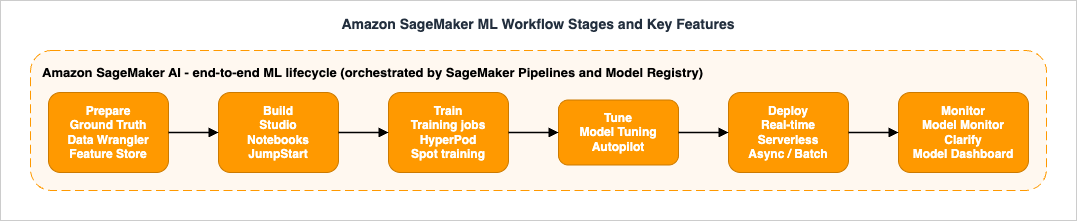
The figure summarizes how the SageMaker AI capabilities line up with the lifecycle: prepare (Ground Truth, Data Wrangler, Feature Store), build (Studio, notebooks, JumpStart), train (training jobs, HyperPod, Managed Spot Training), tune (Automatic Model Tuning, Autopilot), deploy (real-time, serverless, asynchronous, and batch inference), and monitor (Model Monitor, Clarify, Model Dashboard), with SageMaker Pipelines and the Model Registry orchestrating the whole flow.
Amazon SageMaker Use Cases
The principal use cases of Amazon SageMaker in current deployments are:
- Custom model development — data scientists build, train, and deploy bespoke models with full control over algorithms, frameworks, and infrastructure
- Automated machine learning (AutoML) — teams without deep ML expertise generate strong tabular models with SageMaker Autopilot and the AutoML technology behind Canvas
- No-code ML for analysts — business analysts use SageMaker Canvas to build models and generate predictions through a visual interface
- Foundation model training and fine-tuning — organizations train or fine-tune large foundation models at scale using SageMaker HyperPod, the distributed training libraries, and JumpStart
- MLOps and governance — platform teams operationalize ML with SageMaker Pipelines, Model Registry, Model Cards, Model Dashboard, and Role Manager
- Production inference at any shape — applications serve predictions through real-time, serverless, asynchronous, or batch inference depending on latency and throughput needs
- Responsible AI — teams detect bias and explain predictions with SageMaker Clarify and watch for drift with Model Monitor
- Unified data and AI work — with SageMaker Unified Studio, data engineering, analytics, and AI development happen in one governed environment over a lakehouse
Specific Examples of Use Cases
- A retailer prepares and labels product images with SageMaker Ground Truth, then trains a computer vision model for visual search.
- A bank builds a fraud-detection model with Autopilot, reviews the generated notebook, and registers the approved model in the Model Registry before deployment.
- A media company fine-tunes a foundation model from JumpStart on its own content and serves it through a real-time endpoint with inference components.
- A startup deploys an intermittently used model with Serverless Inference to avoid paying for idle capacity.
- An enterprise pre-trains a large language model on a HyperPod cluster using a HyperPod recipe and a flexible training plan.
- A marketing analyst uses Canvas to forecast demand and generate text with foundation models, without writing code.
- A regulated business documents each model with Model Cards and monitors live endpoints with Model Monitor and Clarify to satisfy governance requirements.
- A data team works in SageMaker Unified Studio to query a SageMaker Lakehouse, build features, and develop a generative AI application in one place.
Amazon SageMaker Key Functions and Features
- SageMaker Studio and Code Editor — the integrated development environment for ML, offering a Code Editor based on Visual Studio Code Open Source, JupyterLab, and managed notebooks (the earlier experience is SageMaker Studio Classic).
- Data labeling — Ground Truth and Ground Truth Plus — managed and turnkey services for creating high-quality labeled training data with human workforces and active learning.
- Data preparation — Data Wrangler and Feature Store — visual data preparation with hundreds of built-in transformations, and a managed repository for storing and serving consistent features across training and inference.
- AutoML — Autopilot — automatic algorithm selection, preprocessing, and hyperparameter tuning for tabular data, with transparent, editable notebooks.
- No-code ML — Canvas — a visual interface for building models, generating predictions, and using foundation models for generative AI without code.
- JumpStart and foundation models — one-click access to pre-trained models, foundation models, and solution templates that can be deployed and fine-tuned.
- Training — training jobs, distributed libraries, Training Compiler, Managed Spot Training, and HyperPod — managed training that scales from single jobs to resilient, large-scale foundation model clusters, with HyperPod adding Spot Instance support, checkpointless training, and elastic training for resilient, cost-efficient runs at scale.
- Automatic Model Tuning — Bayesian hyperparameter optimization across many training jobs to find the best configuration.
- Inference options — real-time, serverless, asynchronous, and batch transform — a spectrum of deployment modes, plus inference components and Inference Recommender to optimize endpoint cost and latency, and managed tiered KV cache and intelligent routing on HyperPod for efficient large-model inference.
- MLOps — Pipelines and Model Registry — a purpose-built CI/CD service for ML, a versioned catalog of models with approval workflows, and managed (serverless) MLflow for experiment tracking.
- Serverless model customization and agentic notebooks — fine-tune popular models (such as Amazon Nova, Llama, Qwen, DeepSeek, and GPT-OSS) without managing training infrastructure, and work in notebooks with a built-in AI agent and the SageMaker Data Agent in SageMaker Unified Studio.
- Responsible AI — Clarify and Model Monitor — bias detection, explainability, foundation model evaluation, and continuous monitoring for data and quality drift.
- Governance — Role Manager, Model Cards, and Model Dashboard — least-privilege role generation, standardized model documentation, and a unified operational view of deployed models.
- Edge and optimization — Neo and Edge Manager — compile models for diverse hardware and manage models deployed across edge device fleets.
- The next generation of SageMaker — Unified Studio, Lakehouse, and Catalog — a unified environment for data, analytics, and AI; an open lakehouse over Amazon S3 and Amazon Redshift; and a DataZone-based catalog for discovery and governance.
How Amazon SageMaker relates to Amazon Bedrock
Amazon SageMaker AI and Amazon Bedrock are complementary. SageMaker AI is the platform for building, training, tuning, deploying, and operating machine learning models — including training and fine-tuning your own foundation models — with full control over data, infrastructure, and the model lifecycle. Amazon Bedrock is a fully managed service for accessing third-party and Amazon foundation models through a single API, with managed capabilities such as Knowledge Bases, Guardrails, and Agents for building generative AI applications quickly. Many teams use both: Bedrock for fast generative AI application development on managed models, and SageMaker AI for custom model development and large-scale training. The next generation of SageMaker reinforces this by integrating Bedrock capabilities into SageMaker Unified Studio. For the parallel history of generative AI on AWS, see the AWS History and Timeline regarding Amazon Bedrock and the AWS Generative AI History and Timeline, and for terminology see the AWS AI and ML Glossary and the Amazon Bedrock Glossary.
Frequently Asked Questions about Amazon SageMaker History
The following are direct answers to the most common Amazon SageMaker history and feature questions. Each answer is intentionally short (1–3 sentences) so that it can be lifted directly into AI search results and human conversations alike, and each maps back to a row in the timeline above.
Q1. When did Amazon SageMaker launch?
Amazon SageMaker was announced and made generally available at AWS re:Invent 2017 on November 29, 2017, as a fully managed service to build, train, and deploy machine learning models.
Q2. When did SageMaker Studio launch?
SageMaker Studio was announced at re:Invent 2019 on December 3, 2019, as the first fully integrated development environment (IDE) for machine learning. A redesigned Studio with a Visual Studio Code-based Code Editor launched on November 30, 2023, and the original experience was renamed SageMaker Studio Classic.
Q3. When did SageMaker JumpStart launch?
JumpStart became generally available on December 8, 2020 at re:Invent 2020. It later became a major on-ramp for generative AI, adding foundation models such as Stable Diffusion and BLOOM on November 10, 2022 and foundation model fine-tuning in 2023.
Q4. When did SageMaker Pipelines and Feature Store launch?
Both became generally available on December 8, 2020 at re:Invent 2020 — Pipelines (with the Model Registry) as the first purpose-built CI/CD service for machine learning, and Feature Store as a managed repository for machine learning features.
Q5. When did SageMaker Serverless Inference launch?
Serverless Inference was introduced in preview on December 1, 2021 at re:Invent 2021 and became generally available on April 21, 2022.
Q6. When did SageMaker Canvas launch?
SageMaker Canvas, the no-code machine learning interface, became generally available on November 30, 2021, and added ready-to-use foundation models for generative AI on October 5, 2023.
Q7. What changed with the 2024 "next generation of SageMaker" (the SageMaker AI rename and SageMaker Unified Studio)?
At re:Invent 2024 on December 3, 2024, AWS announced the next generation of Amazon SageMaker as a unified platform for data, analytics, and AI. The existing model build, train, and deploy service was renamed Amazon SageMaker AI and continues as a standalone service, while the new platform introduced Amazon SageMaker Unified Studio (preview), SageMaker Lakehouse, and SageMaker Catalog. SageMaker Unified Studio reached general availability on March 13, 2025.
Q8. How does Amazon SageMaker relate to Amazon Bedrock?
SageMaker AI is for building, training, fine-tuning, deploying, and operating models — including your own foundation models — with full control, while Amazon Bedrock provides managed access to foundation models through a single API for building generative AI applications quickly. They are complementary, and the next generation of SageMaker integrates Bedrock capabilities into SageMaker Unified Studio.
References:
AWS Documentation(Amazon SageMaker AI Developer Guide)
Amazon SageMaker (product page)
What's New with AWS?
AWS News Blog
AWS Machine Learning Blog
Summary
This article extracted the history of Amazon SageMaker from its 2017 launch as a managed build, train, and deploy service, through data labeling with Ground Truth (2018), the SageMaker Studio IDE and Autopilot (2019), the MLOps and responsible-AI wave of Pipelines, Feature Store, Clarify, Data Wrangler, and JumpStart (2020), no-code Canvas and serverless inference (2021–2022), the generative-AI and HyperPod era and the redesigned Studio (2022–2023), and the 2024 "next generation of Amazon SageMaker" that renamed the classic service to Amazon SageMaker AI and introduced SageMaker Unified Studio, SageMaker Lakehouse, and SageMaker Catalog, with Unified Studio reaching general availability in 2025 and, at re:Invent 2025, serverless model customization and managed MLflow in SageMaker AI, agentic notebooks and the SageMaker Data Agent in SageMaker Unified Studio, and more resilient HyperPod training through checkpointless and elastic training.
The most striking feature of the SageMaker timeline is how steadily AWS closed the gap between data, traditional machine learning, and generative AI: nearly every year added a capability that removed undifferentiated heavy lifting from a stage of the ML lifecycle, until 2024 unified the whole lifecycle with data and analytics in a single platform. For engineers, the practical question has shifted from "can SageMaker do this?" to "which SageMaker capability — and, after 2024, SageMaker AI or SageMaker Unified Studio — is the right tool for this stage of the work?"
This SageMaker timeline pairs naturally with the AWS History and Timeline regarding Amazon Bedrock, the AWS Generative AI History and Timeline, and the history of machine learning on AWS, which together trace AWS's path from machine learning to generative AI. For terminology, see the AWS AI and ML Glossary and the Amazon Bedrock Glossary.
In addition, there is also a historical timeline of all AWS services including services other than Amazon SageMaker, so please have a look if you are interested.
AWS History and Timeline - Almost All AWS Services List, Announcements, General Availability(GA)
This timeline will be updated as Amazon SageMaker continues to evolve.
References:
Tech Blog with curated related content