AWS Acquisitions History and Timeline - Which Companies Became Which Services, and What Remains Today
First Published:
Last Updated:
This article presents a timeline of AWS and Amazon's acquisitions, detailing which companies were acquired and how their technology evolved into various AWS offerings, and what remains today. This article covers only the cases where AWS or Amazon was the buyer. This is not a general discussion of acquisitions, nor is it the view from the companies that were acquired.
Laid out as a timeline, a pattern emerges that is not visible in a list of features. The date an acquisition is announced and the date that technology appears under the AWS name are two different dates. Where both dates are recorded to the month or finer, the gap runs from about one year and one month to about two years and two months. The outcome depends on where that gap ends. Some companies' names are directly carried over as product names. Others have had their names disappear, with their underlying technology integrated into different services. And some shipped and were later wound down.
The information in this article was verified as of 2026-09-17; the 2026-08-26 row and the notes on the DuckLabs agreement were rechecked on 2026-10-07.
Related articles from hidekazu-konishi.com:
- AWS Custom Silicon History and Timeline - Nitro System, Graviton, Inferentia, Trainium, and Introduction
- AWS History and Timeline - Almost All AWS Services List, Announcements, General Availability(GA)
- AWS Retired Services History and Timeline - Discontinued, Sunset, and Closed-to-New-Customer Services
- AWS Service Lifecycle States - Maintenance, Sunset, Full Shutdown, and What Each One Takes Away
- Summary of AWS Application Migration Service (AWS MGN) Architecture and Lifecycle Relationships, Usage Notes - Including Differences from AWS Server Migration Service (AWS SMS)
- CI/CD Tools History and Timeline - Trademarks, Acquisitions, Foundations, and Where the Build Runs
- Terraform and OpenTofu History and Timeline - A License Clause, a Fork, a Foundation, and an Acquisition
- AWS re:Invent History and Timeline - Keynotes, Major Announcements, and Evolution by Year
Background and Method of Creating the AWS Acquisitions Timeline
What Counts as an Acquisition Here
This article is not exhaustive. It is not a roster of the companies AWS or Amazon has acquired. It includes only acquisitions that meet three criteria at once:- The acquirer is AWS or Amazon. Acquisitions by other companies, even if those acquisitions involve products that run on AWS, are not included in this article.
- The acquisition itself, or the relationship between the acquired company and AWS offerings, is publicly documented on an official AWS or Amazon domain.
- The acquired company's technology is, or is publicly announced to be, integrated into an AWS offering.
The second criterion is the most stringent. While there are many reports of acquisitions, this article only considers information from primary sources — specifically, content found on
aws.amazon.com, docs.aws.amazon.com, repost.aws, and www.aboutamazon.com. News articles, summaries, and analyst reports are not considered primary sources.The third criterion is in place to exclude acquisitions related to Amazon's retail and devices businesses. Following links from Amazon's public announcements often leads to acquisitions in areas such as healthcare, home robotics, film studios, and autonomous driving. Acquisitions related to AWS are more frequently announced on individual service team blogs, rather than in broader company announcements. Even when the acquirer is the same company, the announcement location can vary.
In other words, please note that the items on this timeline are not all AWS and Amazon acquisitions, but are the ones I could tie to an AWS offering through a primary source.
The Primary Sources This Article Used
Each row carries the URL of its primary source. The following types of sources were used:- AWS News Blog — This blog contains articles specifically announcing acquisitions, although the number is limited.
- Blogs of Individual Service Teams — Including the AWS Security Blog, AWS for Media and Entertainment Blog, AWS HPC Blog, AWS Big Data Blog, and AWS Architecture Blog. Mentions of acquisitions are scattered throughout these blogs.
- What's New — Announcements of new services and changes to existing service offerings.
- AWS Documentation and Whitepapers — Including notes within user guides and a whitepaper detailing the security design of the Nitro System.
- About Amazon — Recent announcements regarding agreements.
⚠ Acquisition dates cannot be retrieved from a search of the AWS documentation. Because documents describing service specifications generally do not focus on the origin of those services, mentions of acquisitions are primarily found in product blogs and individual team introductions. This structure presented the greatest limitation in creating this article.
How This Timeline Records Dates That AWS Did Not Provide
The precision of the dates varies from row to row. Speculation is not used to sharpen them. The level of detail AWS published is reproduced as it stands.- Rows that include the day: NICE, Wickr, DuckLabs. All of these have dates mentioned in their respective announcement articles.
- Rows that include the month: Elemental Technologies. The day can be read by cross-referencing another article marking the tenth anniversary, but the acquisition itself is described only by month.
- Rows that include only the year: Annapurna Labs, Cloud9, Thinkbox Software, CloudEndure. Of these, the Cloud9 acquisition appears only inside a parenthesis in a product announcement one year later.
- Rows where the acquisition date is not publicly available: Sqrrl and TSO Logic. No statement by AWS giving an acquisition date for these two companies could be found. The rows are placed on the date when the technology was first released under the AWS name.
⚠ The source of the information also varies by row. The year that AWS acquired Thinkbox Software sits inside a customer quote in an AWS article. The connection between Sqrrl and Amazon Detective is discernible from a profile article featuring an individual who works at AWS. In both cases, the information comes from sources published by AWS, but it is not a direct statement of fact from AWS itself. The rows concerned say so.
The Stage Column
Each row in the timeline includes aStage column. It uses three values:Acquisition— Rows indicating when AWS or Amazon acquired the company, or announced a definitive agreement to do so. The row says which of the two it carries.Service— Rows indicating when the company's technology first shipped under the AWS name.Lifecycle— Rows indicating changes in the status of the offering. This includes closing to new customers, a move to maintenance, the end of the offering, and a rename.
The distance between an
Acquisition row and the Service row that follows it is what this article is about.What This Article Leaves to Other Articles
This article covers only the acquisitions and what each one became. The following topics belong to other articles:- The Evolution of AWS Custom Silicon — Details on the generations and applications of Nitro, Graviton, Inferentia, and Trainium can be found in AWS Custom Silicon History and Timeline. This article does not discuss chip generations, performance, or naming conventions. Regarding Annapurna Labs, a single row states that the company acquired in 2015 is the chip development arm today.
- Details on Service Retirement — The date each offering closed to new customers, the date it ended, and the migration targets can be found in AWS Retired Services History and Timeline. This article records in a single row the fact that something built from an acquisition was wound down.
- Definitions of Service Statuses — Explanations of what maintenance, sunset, and full termination entail can be found in AWS Service Lifecycle States. This article will not include a section explaining the meaning of these statuses.
- Migration Procedures — Information on the configuration of AWS Application Migration Service (MGN) and its differences from legacy server migration services can be found in Summary of AWS Application Migration Service (AWS MGN) Architecture and Lifecycle Relationships. This article does not detail migration steps.
- Acquisitions Where the Buyer Was Not AWS — Examples of ownership changing hands in the developer tools can be found in CI/CD Tools History and Timeline. Information on cases where ownership transitioned from licensing terms, through forks, and ultimately to a foundation, can be found in Terraform and OpenTofu History and Timeline. This article does not discuss acquisitions in general terms.
- Announcements and Launch Dates for All Services — Information on the announcement and general availability (GA) dates for each service can be found in AWS History and Timeline.
⛔ This article does not include pricing information. While changes to service terms will be included in the timeline, specific amounts will not be listed. Acquisition costs and stock conditions will also not be mentioned.
AWS Acquisitions Historical Timeline (Updates from 2015)
Below is a chronological list of AWS and Amazon acquisitions, and of what AWS did with the technology it bought. Each row carries a link to its primary source.Use the following table of contents to navigate by year:
- 2015-2016 - The first four companies. What happened to their names diverged here.
- 2017-2019 - What was acquired starts showing up in the console.
- 2020-2022 - Technology that shipped without the company name.
- 2024-2026 - What was wound down, what was renamed, and the latest agreement.
* You can sort the table by clicking on the column name.
2015-2016 - The First Four Companies, and Where the Names Diverged
During the 2015-2016 period, four companies joined. And at this point, the paths of those four companies were already diverging. One company's name became a product name, one explicitly stated it would maintain its brand name, one survived only inside a parenthesis, and one remained as the name of a department.| Date | Company | Stage | Summary |
|---|---|---|---|
| 2015 | Annapurna Labs | Acquisition | Amazon acquired Annapurna Labs. A whitepaper detailing the security design of the AWS Nitro System notes that Annapurna Labs was acquired by Amazon in 2015 after a successful partnership in the initial phases of the development of key AWS Nitro System technologies. The same note indicates that this division is responsible for AWS Nitro System hardware, as well as the AWS custom Arm-based Graviton processors, the AWS Trainium and AWS Inferentia hardware accelerator chips, AWS Nitro SSD, and Aqua (advanced query accelerator) for Amazon Redshift. ⚠ The primary source only mentions the year. An article introducing Arm-based instances simply states, We acquired Annapurna Labs in 2015 after working with them on the first version of the AWS Nitro System. The lineage of the chips is not the subject of this article. Generations and applications are detailed in AWS Custom Silicon History and Timeline. See also: The components of the Nitro System / New - EC2 Instances (A1) Powered by Arm-Based AWS Graviton Processors |
| 2015-09 | Elemental Technologies | Acquisition | AWS acquired Elemental Technologies. An article published ten years later states, Elemental Technologies was already making history in video processing when Amazon Web Services (AWS) acquired it in September 2015. Another article from the same period states, September 3, 2025 marks 10 years since AWS acquired Elemental Technologies, now known as AWS Elemental. From that, the day can be read. ⚠ However, the sentence that states the acquisition gives the month alone. This row keeps the date at the month. The company name would later appear as the prefix for five service names released in the same week. See also: AWS Elemental celebrates 10 years of innovation / AWS to show new generative AI, news distribution innovations at IBC 2025 |
| 2016-02-12 | NICE | Acquisition | AWS announced that it had reached an agreement to acquire NICE. An article on the AWS News Blog carries the acquisition in its title and states, We have signed an agreement to acquire this leading provider of software and services for high performance and technical computing. The location is recorded as From their headquarters in Asti, Italy, NICE delivers products and solutions to customers all over the world. ⚠ This article differs from the others in that it says outright what would happen to the company after the acquisition. It states, The NICE brand and team will remain intact and will continue to develop and support the EnginFrame and Desktop Cloud Visualization (DCV) products. The brand was to be kept. The expected closing date is We expect the deal to close in Q1 of 2016. This is the first row on this timeline whose acquisition announcement carries a day. See also: Amazon Web Services to Acquire NICE |
| 2016 | Cloud9 | Acquisition | AWS acquired the provider of an integrated development environment that runs in a web browser. ⚠ Where this is readable is not an announcement of the acquisition itself, but a parenthesis inside a product announcement one year later. An article introducing AWS Cloud9 explains its foundation as Based on the popular open source Ace Editor and c9.io IDE (which we acquired last year). Because that is a relative expression counted from the day of the announcement, the precision stops at the year. This article reads it as 2016. See also: AWS Cloud9 - Cloud Developer Environments |
2017-2019 - What Was Acquired Shows Up in the Console
In 2017, the acquisitions made in 2015 and 2016 began to materialize as products. Over these three years, two additional companies joined. This three-year period marked both the time when acquisitions began to appear as tangible products, and also the period when references to those acquisitions gradually disappeared from product announcements.| Date | Company | Stage | Summary |
|---|---|---|---|
| 2017-03-27 | NICE | Service | EnginFrame 2017 became generally available. ⚠ This What's New opens in the first person, and the voice is NICE itself rather than AWS. It states, NICE is pleased to announce the general availability of EnginFrame 2017, our powerful and easy to use web front-end for accessing Technical and Scientific Applications on-premises and in the cloud. The sentence, The NICE brand and team will remain intact, which was present in a previous announcement, is retained in this description. This phrasing will not appear in products integrated as AWS services. See: NICE EnginFrame 2017 is now available with even simpler AWS integration |
| 2017 | Thinkbox Software | Acquisition | AWS acquired the provider of rendering management software. ⚠ The AWS references indicating this year are excerpts from a customer statement quoted in the article, rather than statements made directly by AWS. The statement by Laszlo Sebo, Supervising Technical Director at Scanline, reads, Thinkbox Software, the creator of XMesh, was a small, development-centric company, so when it was acquired in 2017 by AWS, we had some concern about the long-term goals for these tools that are so important to us. The product suite would later be known as AWS Thinkbox. See: AWS open sources Thinkbox artist tools for Autodesk Maya and Autodesk 3ds Max |
| 2017-11-26 | Elemental Technologies | Service | AWS Elemental MediaConvert became generally available. During the same week, MediaLive, MediaPackage, MediaStore, and MediaTailor were also launched, bringing the total to five. ⚠ An AWS News Blog article published on 2017-11-27, introducing all five services, made no mention of the acquisition. The description focuses on the services themselves, beginning with, Today we are launching an array of broadcast-quality media services, each designed to address one or more aspects of the challenge that I outlined above. Two years after the acquisition, only the company name prefix remained in the service names. See: Introducing AWS Elemental MediaConvert / AWS Media Services - Process, Store, and Monetize Cloud-Based Video |
| 2017-11-30 | Cloud9 | Service | AWS Cloud9 was launched. ⚠ Because the acquisition year is the only precise date available, the gap between the acquisition and the launch could be anywhere from 11 months to just under two years. The product name retains the acquired company's name, and the article describes the underlying technology as Based on the popular open source Ace Editor and c9.io IDE (which we acquired last year) This single sentence is the only available record that simultaneously documents both the acquisition and the launch. See: AWS Cloud9 - Cloud Developer Environments |
| 2019 | CloudEndure | Acquisition | AWS acquired CloudEndure. A subsequent AWS News Blog article, published two years later, states, Since AWS acquired CloudEndure in 2019, our new colleagues have offered CloudEndure Migration and CloudEndure Disaster Recovery. An AWS Architecture Blog article also states, In 2019, CloudEndure was acquired by AWS, and provided the licensing for CloudEndure to all of their users free of charge for migration. ⚠ Both primary sources independently state the same year, but neither provides a month or day. The company name would later become two product names, and then be replaced by two AWS service names. See: How to Use the New AWS Application Migration Service for Lift-and-Shift Migrations / Field Notes: Requirements for Successfully Installing CloudEndure Migration and CloudEndure Disaster Recovery |
2020-2022 - What Shipped Without the Name
Across these three years, the technology of two companies shipped without the company name attached. Over the same period, the names that had survived started to change hands as well.| Date | Company | Stage | Summary |
|---|---|---|---|
| 2020-03-31 | Sqrrl | Service | Amazon Detective became generally available. The article states, At re:invent 2019, we announced a preview of Amazon Detective. Today, it is our pleasure to announce its availability for all AWS Customers. ⛔ No statement by AWS giving an acquisition date for Sqrrl could be found. The AWS statement that ties the company to the service sits in a profile of an AWS employee, who said, I came to AWS through the acquisition of a company I co-founded called Sqrrl, which then became Amazon Detective. ⚠ The date on this row is not the date of the acquisition. It is the date the technology shipped under the AWS name. The service name does not retain any trace of the acquired company name. References: Amazon Detective - Rapid Security Investigation and Analysis / AWS Security Profile: Ely Kahn, Principal Product Manager for AWS Security Hub |
| 2020-07-20 | TSO Logic | Service | Migration Evaluator became available. ⚠ The primary source for this row is not a sentence. It is a label attached to the product name. What's New writes the product as Migration Evaluator (Formerly TSO Logic). ⛔ No statement by AWS giving an acquisition date or describing the deal could be found. ⚠ On the current product page that this article checked, the label is not there. This is a row where the trace survived once as a label and then went away. Reference: Introducing Migration Evaluator: Fast Track your Business Case for AWS |
| 2021-05-18 | CloudEndure | Service | AWS Application Migration Service became generally available. The What's New section states, AWS Application Migration Service is based on the technology of CloudEndure Migration and provides similar capabilities, but is available on the AWS Management Console. ⚠ The AWS News Blog post introducing it appeared the previous day, on 2021-05-17. This article takes the What's New date and keeps both URLs. This is the first row on which the company name came off the service name. The differences between the service and the previous migration service are detailed in Summary of AWS Application Migration Service (AWS MGN) Architecture and Lifecycle Relationships. References: Announcing general availability of AWS Application Migration Service / How to Use the New AWS Application Migration Service for Lift-and-Shift Migrations |
| 2021-06-25 | Wickr | Acquisition | AWS announced the acquisition of Wickr. An AWS Security Blog post stated, We're excited to share that AWS has acquired Wickr, an innovative company that has developed the industry's most secure, end-to-end encrypted, communication technology. ⚠ Within this timeline, this is the second of the three rows on which the acquisition announcement carries a day. The title of the post is AWS welcomes Wickr to the team. Reference: AWS welcomes Wickr to the team |
| 2021-11-17 | CloudEndure | Service | AWS Elastic Disaster Recovery became generally available. The service is based on CloudEndure Disaster Recovery technology, and the user guide states, AWS Elastic Disaster Recovery (Elastic Disaster Recovery) is the next generation of CloudEndure Disaster Recovery (CEDR) and is the recommended service to use for Disaster Recovery to AWS. ⚠ With this, the technology of one company had been replaced by two separate AWS services. The migration component was launched on 2021-05-18, and the disaster recovery component on this date. References: Announcing general availability of AWS Elastic Disaster Recovery / Elastic Disaster Recovery FAQ |
| 2022-11-28 | Wickr | Service | AWS Wickr became generally available. A preview announcement for the service was made earlier in the same year, on 2022-07-26. The What's New section states, AWS Wickr is an end-to-end encrypted, enterprise communications service that offers advanced security features and facilitates one-to-one chats, group messaging, calling, file sharing, screen sharing, and more. This came one year and five months after the acquisition announcement. ⚠ Within this timeline, this is one of two companies for which both the acquisition and the launch carry a day. The other is NICE. The company name carries into the product name with a prefix in front of it. References: Announcing the general availability of AWS Wickr / AWS announces AWS Wickr (Preview) |
| 2022-12-30 | CloudEndure | Lifecycle | CloudEndure Migration ended support in commercial AWS Regions. An AWS re:Post article stated, As of December 30, 2022, CloudEndure Migration is no longer available in all commercial AWS Regions. At the time, it was still available in the China Regions, AWS GovCloud (US), and AWS Outposts. ⚠ The range has narrowed further since then. The AWS Managed Services documentation now states, Following the successful launch of AWS Transform MGN, the CloudEndure Migration service is now end of life in all AWS Regions. This is the point at which a product bearing the acquired company's name was replaced by a successor bearing the AWS name, and then went away. References: I want to migrate my server or virtual environment to AWS using CloudEndure Migration / Use AMS SSP to provision AWS CloudEndure in your AMS account |
2024-2026 - What Was Wound Down, What Was Renamed, and the Latest Agreement
Most of the rows in this period areLifecycle. About eight years have passed since those acquisitions, and the movement is now on the side of what came out of them. And at the very end of the timeline sits one agreement shaped differently from the rest.| Date | Company | Stage | Summary |
|---|---|---|---|
| 2024-07-25 | Cloud9 | Lifecycle | AWS Cloud9 closed to new customers. AWS documentation states, we have made the decision to close new customer access to AWS Cloud9, effective July 25, 2024, and continues to state that existing users can continue using the service as usual. ⚠ Of the products that took the acquired company name as their own, this is the first to close to new customers. Details regarding the end date, the meaning of the status, and migration options can be found in AWS Retired Services History and Timeline. See also: Supported Resource Types for AWS Config |
| 2024-09-25 | NICE | Lifecycle | The discontinuation of NICE EnginFrame has been announced. An article on the AWS HPC Blog states, we have made the decision to discontinue NICE EnginFrame, including NICE EnginFrame Views, effective September 25, 2025. ⚠ The same article explicitly states regarding another product, There are no changes planned for NICE DCV which continues to be actively supported by AWS. This marks the end for one of two products that were previously announced in 2016, stating that The NICE brand and team will remain intact. See also: Discontinuation of NICE EnginFrame effective September 25th, 2025 |
| 2024-10-01 | NICE | Lifecycle | NICE DCV has been rebranded as Amazon DCV. An article on the AWS News Blog states, Today, NICE DCV has a new name. So long NICE DCV, welcome Amazon DCV. The same article notes, Since Amazon acquired NICE 8 years ago, we've witnessed a diverse range of customers adopting DCV. The same sentence counts the years back to the acquisition. ⚠ This marks the end of the statement made in 2016, stating that the brand would be maintained. The announcement of one product's end came the previous month, followed by the renaming of the other product the following month. See also: NICE Desktop Cloud Visualization (DCV) is now Amazon DCV with 2024.0 release / NICE DCV renames to Amazon DCV and releases version 2024.0 with support for Ubuntu 24.04 |
| 2025-09-25 | NICE | Lifecycle | The service for NICE EnginFrame has ended. This is the date announced in the previous announcement. ⚠ For this company, the run of rows begins with the statement from 2016, The NICE brand and team will remain intact and will continue to develop and support the EnginFrame and Desktop Cloud Visualization (DCV) products. It ends with one product gone and the other renamed. The period between the announcement and the actual end of service is one year. See also: Discontinuation of NICE EnginFrame effective September 25th, 2025 |
| 2025-11-07 | Thinkbox Software | Lifecycle | AWS Thinkbox Deadline 10 has entered maintenance mode. The product page states, On November 7, 2025, AWS Thinkbox Deadline 10 will enter maintenance mode. We recommend exploring AWS Deadline Cloud for render management. The same date is also listed in AWS Service Availability Updates. ⚠ The service recommended as a migration option does not include the acquired company's name in its title. The product that carried the acquired company's name moved to maintenance, and a successor without that name is what AWS recommends. See also: AWS Thinkbox / AWS Service Availability Updates |
| 2026-08-26 | DuckLabs | Acquisition | Amazon has announced that it has signed a definitive agreement to acquire DuckLabs. An article on About Amazon states, Amazon has announced it has signed a definitive agreement to acquire DuckLabs, and continues, When the transaction closes, the talented DuckLabs team, based in Amsterdam, will join AWS. ⛔ This is the only row on this timeline shaped differently from the rest. The same article states, We are not acquiring the DuckDB open source project, which will remain free and open source. The AWS Big Data Blog also states, The DuckDB open-source project will also continue to be driven by the DuckLabs team, remain open source under the independent Foundation (the non-profit that oversees DuckDB), and available under the MIT license as it does today. The relationship is not new; the About Amazon article states, AWS and DuckLabs have worked together since 2024. ⚠ The AWS News Blog's weekly roundup uses the title Welcome DuckLabs to the team, echoing the phrasing used in the announcement regarding Wickr in 2021. See also: AWS to acquire DuckLabs, the Amsterdam-based company behind DuckDB / AWS and DuckLabs: Building the future of analytics together / AWS Weekly Roundup: Welcome DuckLabs to the team, Agentic Resource Discovery (ARD), and more (August 31, 2026) |
Current Overview of What the Acquisitions Became
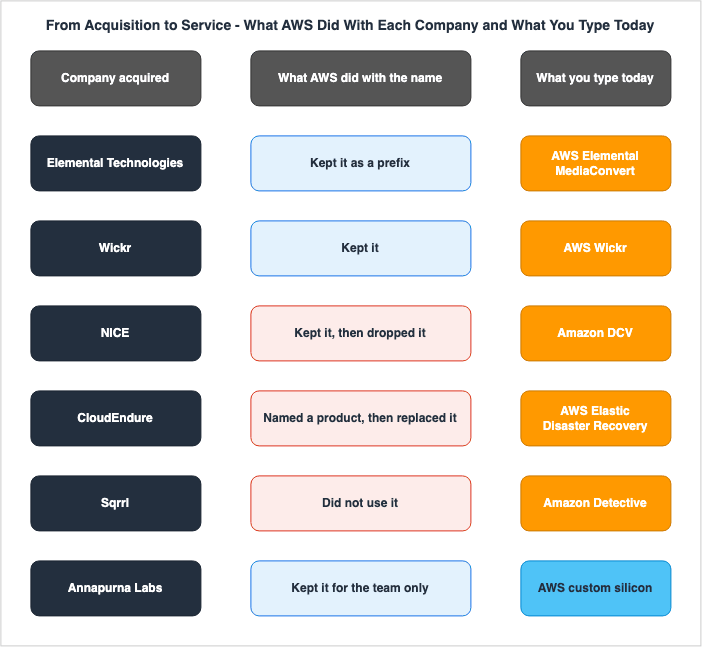
Company Names That Became Product Names
This is the pattern that is easiest to follow. The name of the acquired company survives as part of the name of an AWS offering.| Acquired Company | Current Name | How the Name Remains |
|---|---|---|
| Elemental Technologies | AWS Elemental MediaConvert and others | Used as a prefix on several service names. |
| Cloud9 | AWS Cloud9 | The name itself. Closed to new customers. |
| Thinkbox Software | AWS Thinkbox Deadline 10 | The product name. Now in maintenance mode. |
| Wickr | AWS Wickr | The name itself. |
| NICE | Amazon DCV | The company name came off on 2024-10-01. Before that the product was NICE DCV. |
| CloudEndure | — | No AWS offering has carried the company name since 2022-12-30. |
⚠ What this table says changes over time. NICE and CloudEndure are examples of companies whose names were initially incorporated into product names but have since been removed. The fact that a name remains does not guarantee that this state will continue.
The Ones Whose Names Did Not Reach a Service
These are offerings whose origin cannot be read from the service name.Amazon Detective is based on technology from Sqrrl. Only one AWS statement records this connection, and this article found it inside an employee profile. ⚠ The company name is not to be found in the product documentation or in the launch announcement.
Migration Evaluator comes from TSO Logic. The product previously had a label indicating
(Formerly TSO Logic), and that designation was present in the What's New announcement when it was first released. ⚠ On the current product page that this article checked, the label is not there.Annapurna Labs did not become part of a product name, but the name survives as a team. The AWS product page states:
Annapurna Labs, an Amazon company, is the chip development arm of AWS responsible for designing the AWS Nitro System, AWS Graviton processors, AWS Inferentia chips, and AWS Trainium chips. ⚠ The range AWS lists for this team is wide, and yet the name sits on no service. AWS Custom Silicon History and Timeline carries the generations and the applications.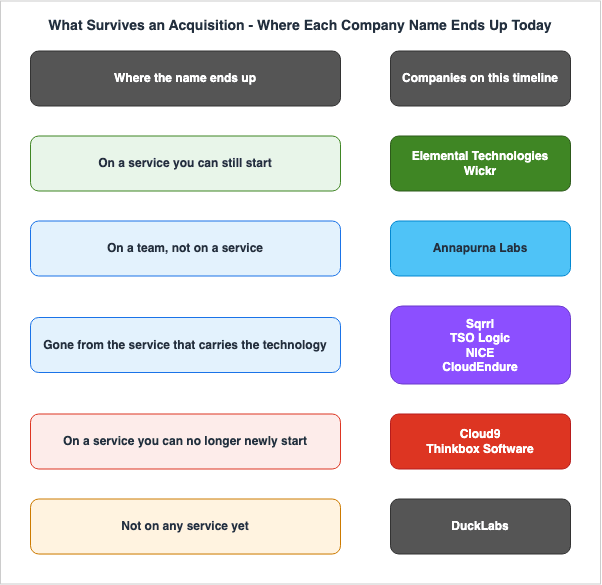
The Ones That Were Wound Down After the Acquisition
An acquisition does not guarantee an offering that keeps running. Four offerings built from an acquisition have moved to maintenance or stopped being offered.- AWS Cloud9 — Closed to new customers on 2024-07-25.
- NICE EnginFrame — Discontinuation announced on 2024-09-25, and the offering ended on 2025-09-25.
- AWS Thinkbox Deadline 10 — Transitioned to maintenance on 2025-11-07.
- CloudEndure Migration — Ended availability in the commercial AWS Regions on 2022-12-30, and subsequently reached end-of-life across all AWS Regions.
⚠ The four differ in kind. What each takes away from a user depends on whether it is closing to new customers, the end of availability, a move to maintenance, or replacement by a successor. This article does not delve into the specifics of each status. AWS Service Lifecycle States defines each state, and AWS Retired Services History and Timeline lists the dates and the migration targets.
⚠ A name change and the end of availability are separate matters. AWS renamed Amazon DCV, and still offers it. AWS Application Migration Service is now known as AWS Transform MGN according to current documentation, but remains available. Be careful not to misinterpret a name change as the end of availability.
The Distance Between the Acquisition and the Launch
Read the timeline two columns at a time, and a distance opens between anAcquisition row and the first Service row that follows it.| Acquired Company | Acquisition Date | First Appearance Under the AWS Name | Approximate Gap |
|---|---|---|---|
| Cloud9 | 2016 | 2017-11-30 | 11 months to just under 2 years (the acquisition is recorded to the year) |
| Wickr | 2021-06-25 | 2022-11-28 | Approximately 1 year and 5 months |
| NICE | 2016-02-12 | 2017-03-27 | Approximately 1 year and 1 month |
| Elemental Technologies | 2015-09 | 2017-11-26 | Approximately 2 years and 2 months |
| CloudEndure | 2019 | 2021-05-18 | 1 year and 5 months to 2 years and 5 months (the acquisition is recorded to the year) |
| Annapurna Labs | 2015 | — | Absorbed as a team. No standalone offering carries the name. |
⚠ The gaps in this table are approximate. Three rows record the acquisition to the year alone, so some rows can be compared month by month and others cannot. No estimation has been added to refine the numbers.
⚠ The length of a gap says nothing about the reason for it. AWS has not said why any of these gaps ran as long as they did. This article does not attempt to provide those reasons either. All that can be observed is the sequence: an acquisition is announced, followed by a period with no visible activity, and then the emergence of a product bearing the AWS name.
⚠ Sqrrl and TSO Logic cannot go in this table. Their acquisition dates have not been published, so there is no starting point from which to measure.
What the DuckLabs Agreement Does Differently
Only the final row in the timeline has a different structure.In previous acquisitions, the technology of the acquired company either became part of AWS offerings or was integrated within AWS itself. The announcement regarding DuckLabs explicitly excludes certain assets from the acquisition. The About Amazon article states,
We are not acquiring the DuckDB open source project, which will remain free and open source. The AWS Big Data Blog also states that the project will remain under an independent foundation and continue to be provided under the current license.⚠ What sets this row apart is that the announcement treats the company and what it built as two separate things. On the earlier rows, acquiring a company and acquiring what that company had built were the same act.
⛔ This article does not evaluate the implications of this arrangement. The validity of the license and the significance of the foundation are not the focus of this article. Terraform and OpenTofu History and Timeline follows the license terms and the foundation.
⚠ As of 2026-09-17, when this article was first written, no products or services had emerged from this agreement. While the announcement mentioned potential future integration, no dates had been publicly announced. So this row does not have a
Service row after it yet.⚠ On 2026-09-30, the AWS News Blog post announcing Apache Iceberg and Parquet queries from Amazon Aurora PostgreSQL stated,
DuckLabs, the team that maintains the DuckDB project, recently joined Amazon, and this capability is an example of how the efficiency of DuckDB is being integrated into our services. The post names DuckDB, whose open source project the 2026-08-26 announcement placed outside the deal, as what is being integrated. No AWS or Amazon page checked on 2026-10-07 gives the date the transaction closed. This article therefore still does not add a Service row after this one. What DuckDB runs inside Aurora is covered in Querying Apache Iceberg and Parquet from Amazon Aurora PostgreSQL.Frequently Asked Questions about AWS Acquisitions History
Which AWS services came from acquisitions?
There are quite a few. Some services retain the name of the acquired company in their own name: for example, the various AWS Elemental services came from Elemental Technologies, AWS Cloud9 from Cloud9, the various AWS Thinkbox products from Thinkbox Software, and AWS Wickr from Wickr. Other services, where the acquired company name is not reflected in the name, include Amazon Detective (from Sqrrl), Migration Evaluator (from TSO Logic), Amazon DCV (from NICE), AWS Application Migration Service, and AWS Elastic Disaster Recovery (all from CloudEndure). ⚠ While AWS's various custom silicon lines are based on designs from Annapurna Labs, that was more of a division than a product offering.Why does this timeline give only a year for some acquisitions?
Because that is what AWS wrote. Four rows describe an acquisition with the year alone. ⚠ Speculation is not added to sharpen the dates. Rows whose source gives a month are recorded to the month, and rows whose source gives a day are recorded to the day. For the two companies with no date at all, the row sits on the day the technology shipped under the AWS name, and the row says so.Where does AWS write about its acquisitions?
Across several blogs rather than in one place. On the AWS News Blog, the only article with an acquisition in its title that this article could confirm is the one about NICE. Wickr is mentioned on the AWS Security Blog, DuckLabs on the AWS Big Data Blog and About Amazon. ⚠ Otherwise, the information about most acquisitions is scattered, appearing as a single sentence within other articles rather than being the primary subject. Elemental Technologies is referenced in an anniversary post on the AWS for Media and Entertainment Blog, CloudEndure in an article introducing its successor service, Cloud9 in a parenthesis inside a product announcement, and Annapurna Labs in a note inside a Nitro System whitepaper.What happened to CloudEndure?
A successor took its place. CloudEndure Migration stopped being available in the commercial AWS Regions on 2022-12-30, and AWS Managed Services documentation now states,Following the successful launch of AWS Transform MGN, the CloudEndure Migration service is now end of life in all AWS Regions. AWS Elastic Disaster Recovery took over the disaster recovery side, and the user guide calls AWS DRS the next generation of CloudEndure Disaster Recovery (CEDR). ⚠ This article does not cover the practical aspects of migration. Summary of AWS Application Migration Service (AWS MGN) Architecture and Lifecycle Relationships carries the configuration and the procedures.Is NICE DCV the same product as Amazon DCV?
Yes, NICE DCV and Amazon DCV refer to the same product, under different names. An article on the AWS News Blog, published on 2024-10-01, states,Today, NICE DCV has a new name. So long NICE DCV, welcome Amazon DCV. ⚠ This is a rebranding, not a product discontinuation. Another product from the same acquisition, NICE EnginFrame, was announced for discontinuation on 2024-09-25, and ended on 2025-09-25. The two should not be run together.Did every AWS acquisition become a service that is still running today?
No. Four offerings built from an acquisition have moved to maintenance or stopped being offered. AWS Cloud9 closed to new customers on 2024-07-25, NICE EnginFrame ended on 2025-09-25, and AWS Thinkbox Deadline 10 moved to maintenance on 2025-11-07. A successor took the place of CloudEndure Migration. ⚠ AWS Retired Services History and Timeline carries the status of each one and where to migrate.Does the DuckDB open source project now belong to Amazon?
No. Amazon's announcement clearly states,We are not acquiring the DuckDB open source project, which will remain free and open source. The AWS Big Data Blog also states that the project will remain under an independent foundation and continue to be provided under the current license. ⚠ What is being acquired is the company. The project sits outside the deal. This is the only row on this timeline where the company and the thing it built were announced as separate matters.Why does this timeline not list every AWS acquisition?
Because coverage cannot be verified. This article makes a row only where AWS or Amazon has written about the company in connection with an AWS offering on a domain of their own. ⚠ So the absence of a row here does not mean that no acquisition took place. Anything for which no primary source could be found is left out rather than hedged.Summary
This article compiles a timeline of AWS and Amazon acquisitions, tracing the technologies acquired and what products ultimately resulted from them, and what remains today.The date of an acquisition and the date the technology shipped under the AWS name are two different dates. Across the rows that can be compared month to month, the gap runs from about one year and one month to about two years and two months. Three rows record the acquisition to the year alone, so only some of them compare exactly. ⚠ Furthermore, AWS does not state the reasons for these time gaps. This article also does not provide those explanations.
The names of the acquired companies ultimately fell into three categories. Some companies' names were directly adopted as the names of the resulting products. Others disappeared entirely, with only their underlying technology incorporated into different services. And some remained as the names of specific departments within AWS. ⚠ This categorization is not always definitive. For example, NICE and CloudEndure initially had their names incorporated into service names, but those names have since been removed.
Four offerings built from an acquisition were wound down. An acquisition does not guarantee an offering that keeps running. ⚠ The four differ in kind. Closing to new customers, ending the offering, moving to maintenance, and replacement by a successor should not be rounded into the same word.
The most challenging aspect of creating this article was accurately determining the dates. AWS documentation primarily describes the specifications of services, and rarely focuses on their origins. Of the primary sources used for this article's timeline, only three give the acquisition date to the day. For two companies, it could not be found. The varying levels of accuracy for the dates in the timeline reflect the limitations of the available source material.
Only the final row is shaped differently. The agreement from 2026-08-26 treats the company and the products it was developing as separate entities. Whether this shape becomes the standard from here is not something this article can say at the time of writing.
This timeline will be updated as AWS and Amazon acquisitions continue to evolve.
Additional articles cover related topics.
References:
Tech Blog with curated related content
Written by Hidekazu Konishi