AWS History and Timeline regarding AWS Identity and Access Management - Overview, Functions, Features, Summary of Updates, and Introduction to IAM
First Published:
Last Updated:
This time, I have created a historical timeline for AWS Identity and Access Management (AWS IAM), the foundational service that defines who can do what on which resources across every other AWS service.
Just like before, I am summarizing the main features while following the birth of AWS IAM and tracking its feature additions and updates as a "Current Overview, Functions, Features of AWS IAM".
I hope these will provide clues as to what has remained the same and what has changed — particularly in a service where the original policy evaluation logic from 2010–2011 is still intact while successive layers of additional guardrails (Service Control Policies, Resource Control Policies, Permissions Boundaries, Session Policies, ABAC, Cedar) have accumulated on top.
Background and Method of Creating AWS IAM Historical Timeline
This time, the reason for creating a historical timeline of AWS IAM is that since AWS IAM was launched in Preview in 2010 and announced as Generally Available in 2011, it has been the foundational service that every other AWS service depends on for authentication and authorization. The original two policy types in 2011 (Identity-based and Resource-based) have since been joined by SCP, Permissions Boundary, Session Policy, RCP, and the adjacent Cedar policies in Amazon Verified Permissions, leaving today's practitioner with a notably broader policy surface to reason about. Therefore, I decided to organize the information of AWS IAM with the following approaches.- Tracking the history of AWS IAM and organizing the transition of updates
- Summarizing the feature list and characteristics of AWS IAM
- Including the immediately adjacent identity services (Organizations SCP/RCP, IAM Identity Center, Amazon Verified Permissions, Cedar) that are essential context for any modern IAM design, clearly marked as adjacent services rather than parts of IAM itself
There may be slight variations in the dates on the timeline due to differences in the timing of announcements or article postings in the references used.
The content posted is limited to major features related to the current AWS IAM and necessary for the feature list and overview description.
In other words, please note that the items on this timeline are not all updates to AWS IAM features, but are representative updates that I have picked out.
AWS IAM Historical Timeline (Updates from May 3, 2011)
Now, from here is the timeline regarding the features of AWS IAM. AWS IAM was first offered in Preview on August 31, 2010, and then announced as Generally Available on May 3, 2011. The history of AWS IAM is therefore well over a decade at the time of writing this article.* You can sort the table by clicking on the column name.
| Date | Summary |
|---|---|
| 2010-08-31 | AWS Identity and Access Management (IAM) launches in Preview. Customers can define IAM users, groups, and JSON-based access policies within an AWS account, replacing the previous model where every API call used the AWS account root credentials. |
| 2011-05-03 | AWS IAM is announced as Generally Available (GA). Every AWS account gains a free, integrated IAM service for creating users, groups, and Identity-based / Resource-based policies. The core evaluation model (explicit Deny overrides any Allow; otherwise the union of Identity-based and Resource-based policies grants access) is established and remains the foundation today. |
| 2011-08-25 | IAM adds support for Multi-Factor Authentication (MFA) using virtual MFA devices. This broadens MFA beyond the previously supported physical hardware tokens, making MFA practical for every IAM user. |
| 2011-11-03 | Cross-Account Access via IAM Roles is launched. Users and services in one AWS account can assume a role in another account using sts:AssumeRole, enabling delegated administration and the multi-account patterns that underpin every modern AWS landing zone. |
| 2012-06-11 | IAM Roles for Amazon EC2 (Instance Profiles) are launched. EC2 instances can obtain temporary AWS credentials automatically by being launched with an Instance Profile, ending the era of baking long-lived access keys into AMIs. |
| 2013-01-30 | The IAM Policy Simulator is released. Administrators can test the effect of IAM policies on principals and resources before deployment, surfacing the result that the evaluation engine would return for each requested action. |
| 2013-04-03 | IAM Policy Variables are launched. Policies can reference request context such as ${aws:username} in resource ARNs, which is the foundational primitive that later enables Attribute-Based Access Control (ABAC). |
| 2013-05-28 | Web Identity Federation with public OIDC providers is launched. End-user identities from Login with Amazon, Facebook, and Google can directly assume IAM roles via sts:AssumeRoleWithWebIdentity without an intermediate token-vending service. |
| 2013-07-08 | IAM supports Resource-Level Permissions for Amazon EC2 and Amazon RDS API actions, allowing policies to restrict actions to specific instances, snapshots, or databases by ARN. |
| 2013-09-17 | Credential Report and Access Key Last Used features are added. Auditors can now see, in a single CSV report, when each access key was last used, when each user last signed in, and which users have MFA enabled. |
| 2013-11-11 | IAM supports Identity Federation with SAML 2.0 Identity Providers. Enterprise identity providers such as Active Directory Federation Services can now broker single sign-on into the AWS Management Console, eliminating the need to create one IAM user per employee. |
| 2015-02-04 | IAM introduces AWS Managed Policies — a curated set of policies maintained by AWS for common job functions and AWS service usage, kept up to date as new APIs ship. |
| 2016-12-01 | AWS Organizations launches in Preview at re:Invent 2016, introducing Service Control Policies (SCP). SCP is the first cross-account guardrail above IAM — an Allow-boundary policy applied at the Organization, OU, or account level that no Identity-based policy can exceed. |
| 2017-02-27 | AWS Organizations is announced as Generally Available (GA), including SCP general availability. SCP becomes the standard way to enforce maximum permissions across an entire AWS Organization, replacing earlier ad-hoc account isolation patterns. |
| 2017-04-13 | Tag-based conditions are launched in IAM policies via aws:RequestTag and aws:ResourceTag condition keys.This is the formal foundation for Attribute-Based Access Control (ABAC) within IAM, enabling per-tag authorization across many AWS services. |
| 2017-12-05 | AWS Single Sign-On (AWS SSO) is launched. AWS SSO provides centralized sign-in for AWS accounts in an AWS Organization and for business applications, materializing permission sets as IAM roles in member accounts. |
| 2018-07-12 | IAM Permissions Boundaries are launched. Administrators can delegate the ability to create IAM users and roles to developers, while capping the maximum permissions those new identities can hold — a key primitive for safe self-service IAM in larger organizations. |
| 2018-11-26 | AWS Resource Access Manager (RAM) is announced as Generally Available. Adjacent to IAM, RAM enables AWS resource sharing across accounts within an Organization without bilateral resource policies, integrating with AWS Organizations. |
| 2018-11-29 | Session Tags and the aws:PrincipalTag condition key are launched for STS AssumeRole.This enables fully dynamic ABAC for federated identities: principal attributes from an external identity provider are propagated into the session and matched against resource tags at evaluation time. |
| 2019-04-18 | AWS Organizations adds Service Last Accessed Data for SCP, letting administrators see which services were actually used under each Service Control Policy to refine guardrails based on real usage. |
| 2019-12-02 | IAM Access Analyzer is launched at re:Invent 2019. It uses automated reasoning (provable security) to identify resources shared outside a defined zone of trust (account or Organization), surfacing IAM roles, Amazon S3 buckets, AWS KMS keys, AWS Lambda functions, Amazon SQS queues, and AWS Secrets Manager secrets accessible from external principals. |
| 2020-06-03 | IAM Access Advisor adds action-last-accessed information for Amazon S3 management actions, helping refine least-privilege policies down to the individual action level rather than only the service level. |
| 2021-04-27 | IAM Access Analyzer Policy Validation is launched. It evaluates IAM policies against more than 100 policy checks during authoring, surfacing findings such as overly broad permissions, missing condition keys, and security warnings before deployment. |
| 2021-11-19 | IAM Access Analyzer Policy Generation is launched. It generates fine-grained IAM policies from CloudTrail activity logs, automating the path from over-permissive starter policies to least-privilege production policies. |
| 2022-07-05 | IAM Roles Anywhere is announced as Generally Available. Workloads running outside AWS (on-premises servers, containers, applications) can obtain temporary AWS credentials by presenting X.509 certificates issued by a trusted private certificate authority, replacing long-lived IAM user access keys for hybrid workloads. |
| 2022-07-26 | AWS Single Sign-On (AWS SSO) is renamed to AWS IAM Identity Center, and is repositioned as the recommended service for workforce identity in AWS. The underlying service capabilities are unchanged at the rename; the new name reflects its role as the front door for human access to AWS. |
| 2022-10-20 | AWS IAM Identity Center adds Session Management Features, enabling configurable session duration up to 7 days for the AWS access portal and integrated applications — a significant extension over the previous maximum of 12 hours for IAM-Identity-Center-issued sessions. |
| 2023-06-13 | Amazon Verified Permissions is announced as Generally Available; the announcement describes Cedar, the policy language it uses, as an open-source language for access control (AWS had open-sourced Cedar on 2023-05-10). Adjacent to IAM, Verified Permissions targets application-level (not infrastructure-level) authorization, providing a managed evaluation service for Cedar policies that supports role-based and attribute-based access control with formal verification techniques. |
| 2023-11-26 | IAM Access Analyzer adds Unused Access findings at re:Invent 2023. The new findings surface unused IAM roles, unused IAM user access keys, unused IAM user passwords, and unused services and actions within IAM roles and IAM users, providing a single dashboard view of identity drift. |
| 2023-11-26 | IAM Access Analyzer adds Custom Policy Checks, letting security teams validate IAM policies against custom security standards (e.g., "this policy must not grant iam:PassRole on production roles") as part of CI/CD pipelines. |
| 2023-11-26 | AWS IAM Identity Center adds Trusted Identity Propagation at re:Invent 2023. User identity from a starting application (e.g., Amazon QuickSight) is propagated through downstream services (e.g., Amazon Redshift, Amazon S3) while preserving the original identity, replacing the previous pattern of impersonating a single shared service role. |
| 2024-11-13 | Resource Control Policies (RCP) are launched as a new policy type in AWS Organizations. RCPs apply to resources (such as Amazon S3 buckets and AWS KMS keys) as the resource-side counterpart to identity-side SCPs, enabling organization-wide enforcement at the resource level — for example, requiring that every S3 bucket in the Organization deny anonymous public access regardless of its individual bucket policy. |
| 2024-12-01 | Declarative Policies for AWS Organizations are launched, enforcing baseline service-level configurations (e.g., VPC, EBS) across all accounts in an Organization through a policy-as-code mechanism that survives configuration drift. |
AWS IAM is one of the rare AWS services where the original 2011 evaluation logic (Explicit Deny precedence, union of Identity-based and Resource-based Allows for same-account access, implicit deny otherwise) is still intact today. Almost every major addition in this timeline arrived as either a new policy type (SCP in 2016, Permissions Boundary in 2018, Session Policy in 2018, RCP in 2024) or as a sibling service (AWS Organizations, AWS SSO/Identity Center, IAM Roles Anywhere, Amazon Verified Permissions and Cedar) — not as a breaking change to the core. This makes the IAM timeline less about feature churn and more about the steady accumulation of additional intersection stages around the unchanging granting core.
The implication for engineers is that designing IAM today is less the question "what does IAM allow?" and more the question "which of the seven Decision Diamond stages is the right place for this guardrail?" The next section organizes the resulting policy landscape and tooling.
Current Overview, Functions, Features of AWS IAM
From here, I introduce the current list of AWS IAM features and overview.
AWS Identity and Access Management (AWS IAM) is the foundational AWS service that defines, authenticates, and authorizes principals (users, roles, federated identities) to perform actions on AWS resources. IAM is free, global, and required for every API call to AWS.
A terminology note before we proceed: "IAM User" and "IAM Identity Center user" are distinct concepts.
IAM Users are long-lived identities within a single AWS account, with their own sign-in credentials and access keys.
IAM Identity Center users live in a separate identity store (or are synchronized from an external IdP) and access AWS accounts by assuming IAM Roles for permission sets.
Since the 2022 rename, the recommended path for workforce identity is IAM Identity Center, not new IAM Users. This article uses "IAM User" only in its original, single-account sense.
Use Cases for AWS IAM
The principal use cases of AWS IAM in current deployments are:
- Granting AWS Management Console and API access to internal developers and operators
- Granting workloads (Amazon EC2, AWS Lambda, Amazon ECS, Amazon EKS, Amazon Bedrock AgentCore, on-premises workloads) temporary credentials via IAM Roles
- Enforcing organization-wide guardrails through AWS Organizations Service Control Policies (SCP) and Resource Control Policies (RCP)
- Implementing least-privilege when delegating IAM creation through Permissions Boundaries
- Attribute-Based Access Control (ABAC) for multi-tenant SaaS, where the tenant identifier in the session is matched against resource tags
- Federation from external identity providers (Okta, Microsoft Entra ID, Google, custom SAML/OIDC providers) for single sign-on
- Hybrid workload identity via IAM Roles Anywhere using X.509 certificates from a trusted private certificate authority
- Cross-account access via assumed roles for centralized logging, security tooling, and platform-team operations
Conceptual Model of AWS IAM — The IAM Decision Diamond
Every AWS API request passes through a fixed sequence of seven evaluation stages that together determine whether it is allowed or denied. The canonical naming frame for this sequence on this site is The IAM Decision Diamond, defined and walked through case-by-case in AWS IAM Policy Evaluation Logic Step-by-Step — The IAM Decision Diamond. This section recaps the seven stages in the same order so that each timeline entry above can be located in the evaluation pipeline; for a deeper walkthrough with twelve concrete request traces, see the dedicated article.
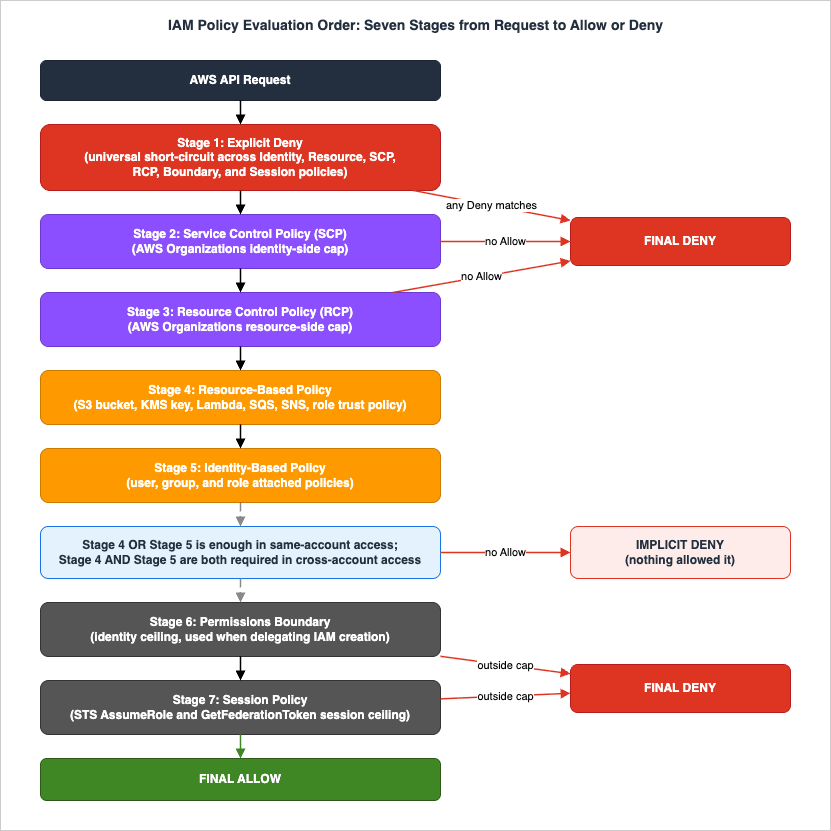
The following table summarizes the seven stages in evaluation order. Stages 2, 3, 6, and 7 are intersection (ceiling) stages that can only cap permissions, while Stages 4 and 5 are union (granting) stages that produce the Allow under same-account semantics or the joint requirement under cross-account semantics. Once any stage ends in Deny, no later stage can override it.
* You can sort the table by clicking on the column name.
| Stage | Policy | Role | Allow Condition / Deny Condition |
|---|---|---|---|
| Stage 1 | Explicit Deny | Universal short-circuit (checked across all six other policy types) | Allow: no explicit Deny statement matches the request. Deny: any explicit Deny matches in any policy type — the evaluation terminates here and no later stage can override it. |
| Stage 2 | Service Control Policy (SCP) | Identity-side Organization cap (intersection) | Allow: the SCPs at the root, OU chain, and account of the calling principal all permit the action. Deny: any SCP in that chain excludes the action. SCP can never grant; it can only cap. |
| Stage 3 | Resource Control Policy (RCP) | Resource-side Organization cap (intersection) | Allow: the RCPs applied to the resource's account chain permit the action (currently supported on Amazon S3, AWS STS, AWS KMS, Amazon SQS, and AWS Secrets Manager at launch). Deny: any RCP in that chain excludes the action. |
| Stage 4 | Resource-Based Policy | Granting stage (union with Stage 5 in same-account; required alongside Stage 5 in cross-account) | Allow: the resource policy (Amazon S3 bucket policy, AWS KMS key policy, AWS Lambda resource policy, Amazon SQS / Amazon SNS policy, IAM role trust policy, etc.) lists the caller as a Principal and permits the action.Deny path: in cross-account access, absence of an Allow here is sufficient to deny even if the identity policy allows the action. |
| Stage 5 | Identity-Based Policy | Granting stage (union with Stage 4 in same-account; required alongside Stage 4 in cross-account) | Allow: at least one of the identity policies attached to the calling User, Group membership, or Role permits the action. Deny path: if neither Stage 4 nor Stage 5 produces an Allow, the request is denied by implicit deny. |
| Stage 6 | Permissions Boundary | Identity ceiling (intersection cap on a User or Role) | Allow: the action falls inside the boundary. The effective permissions are the intersection of the identity policy and the boundary. Deny: the action falls outside the boundary — even if the identity policy explicitly Allows it. |
| Stage 7 | Session Policy | Session ceiling (intersection cap on STS AssumeRole / GetFederationToken sessions) |
Allow: the action falls inside the session policy passed at session creation time. Deny: the action falls outside the session policy. A session policy can only narrow the role's permissions, never widen them. |
| Final | Result | — | Allow: all seven stages passed and at least one Allow exists at the granting stages. Implicit Deny: at the end of evaluation no Allow exists. This is the default state of every AWS API request. |
IAM Identities — Users, Groups, Roles, and Federated Identities
IAM Users are long-lived identities scoped to a single AWS account, with sign-in credentials such as a console password, programmatic access keys, and registered MFA devices. AWS guidance now strongly recommends avoiding new IAM Users in favor of federation through AWS IAM Identity Center for workforce users and IAM Roles (or IAM Roles Anywhere) for workloads.
IAM Groups are a way to attach the same set of Identity-based policies to multiple users at once. A group is not a principal — an API request can never be made "as the group"; the group simply aggregates policy attachments for its member users.
IAM Roles are identities with no permanent credentials, designed to be assumed temporarily by trusted principals via the AWS Security Token Service (STS) AssumeRole family of APIs. IAM Roles are used by:
- Amazon EC2 instances (via Instance Profiles)
- AWS Lambda functions (via execution roles)
- Amazon ECS tasks and Amazon EKS pods (via task roles and IRSA / Pod Identity)
- Cross-account access, where a principal in account A assumes a role in account B
- Federated SSO sessions (SAML 2.0, OIDC, IAM Identity Center permission sets, Amazon Cognito Identity Pools)
- AWS services acting on your behalf (service-linked roles)
- Hybrid workloads via IAM Roles Anywhere
Federated Identities are external identities — from SAML 2.0 IdPs, OIDC providers, custom identity brokers, or IAM Identity Center — that obtain temporary AWS credentials by assuming an IAM Role. The original identity is preserved as the role session name and, since 2018, as Session Tags that can be referenced via aws:PrincipalTag/<key> in policies.
IAM Policies — Policy Types Cheat Sheet
AWS IAM today involves several major policy types, each attached to a different kind of entity and serving a different purpose in the IAM Decision Diamond. The following table summarizes them.
* You can sort the table by clicking on the column name.
| Policy Type | Attached To | Available Since | What It Does |
|---|---|---|---|
| Identity-based Policy | IAM User, Group, Role | 2011-05 | Grants permissions to a principal. The most commonly written policy type. |
| Resource-based Policy | AWS resource (Amazon S3 bucket, AWS KMS key, AWS Lambda function, Amazon SQS queue, Amazon SNS topic, etc.) | 2011-05 (S3 bucket policies) | Grants permissions on a resource, including cross-account access without the caller needing to assume a role first. |
| Service Control Policy (SCP) | AWS Organizations Root, OU, or account | 2017-02 | Defines the maximum permissions for any identity in the affected accounts. SCP cannot grant permissions; it can only cap them. |
| Resource Control Policy (RCP) | AWS Organizations Root, OU, or account | 2024-11 | Defines the maximum permissions for any resource in the affected accounts — the resource-side counterpart to identity-side SCPs. |
| Permissions Boundary | IAM User or IAM Role | 2018-07 | Caps the maximum permissions for a single identity. Typically used when delegating the right to create IAM users and roles to non-admins. |
| Session Policy | STS session (passed as Policy parameter on AssumeRole / GetFederationToken) |
2018-11 | Caps the maximum permissions for the duration of a session, downscoping the role's Identity-based policy at session creation time. |
| Trust Policy | IAM Role | 2011-11 (with Roles) | Defines who can assume this role and under what conditions (SAML issuer, OIDC subject, external ID, MFA presence, source IP, etc.). |
| VPC Endpoint Policy (adjacent) | Interface or Gateway VPC Endpoint | 2015-05 onward | Restricts what can be accessed through a VPC endpoint. Not part of IAM itself, but evaluated together with IAM policies for VPC-endpoint-bound requests. |
Two more adjacent policy concepts are worth recognizing:
→ Cedar policies attached to Amazon Verified Permissions policy stores handle application-level (not infrastructure-level) authorization. They live outside IAM's evaluation engine and are evaluated by an application calling the Verified Permissions API.
→ Declarative Policies in AWS Organizations (2024-12) enforce baseline service configurations (e.g., default VPC properties) across all member accounts. These are not access policies in the IAM sense; they are configuration enforcement.
Policy Evaluation Logic — The IAM Decision Diamond in Detail
When a principal makes an AWS API request, AWS evaluates the request through the following seven stages in order. Understanding this order is the difference between a correct least-privilege design and a mysteriously denied production request. For a full walkthrough including twelve concrete request traces and the corresponding policy JSON, see AWS IAM Policy Evaluation Logic Step-by-Step — The IAM Decision Diamond; for the term-by-term definitions used below, see the AWS IAM Glossary; for representative misreadings of this evaluation order observed in production, see IAM Anti-Patterns - Real-World Mistakes and Their Root Causes.
- Stage 1 — Explicit Deny: any explicit
Denystatement in any of the six other policy types (Identity-based, Resource-based, SCP, RCP, Permissions Boundary, Session Policy) terminates with a final Deny. Explicit Deny is the only universal short-circuit in IAM; no later stage and no Allow statement anywhere can override it. - Stage 2 — Service Control Policy (SCP): the SCPs applied to the calling principal's account chain (Root, OU chain, account) must permit the action. SCP is an identity-side ceiling that can only cap permissions, never grant them. Removing the default
FullAWSAccessSCP from an OU implicit-denies every action in that OU regardless of identity policies. - Stage 3 — Resource Control Policy (RCP): the RCPs applied to the resource's account chain must permit the action. RCP is a resource-side ceiling and is the symmetric counterpart of SCP, available on Amazon S3, AWS STS, AWS KMS, Amazon SQS, and AWS Secrets Manager at launch. RCP enables organization-wide rules such as "no anonymous public access to any bucket" without relying on every individual bucket policy being correct.
- Stage 4 — Resource-Based Policy: the policy attached to the resource (Amazon S3 bucket policy, AWS KMS key policy, AWS Lambda resource policy, Amazon SQS / Amazon SNS policy, IAM role trust policy, etc.) is evaluated for an Allow that lists the caller as a
Principal. - Stage 5 — Identity-Based Policy: the policies attached to the calling User, Group memberships, and Role are evaluated for an Allow. Together with Stage 4 this produces the grant decision under the same-account-vs-cross-account split: in same-account access, an Allow from either Stage 4 or Stage 5 is sufficient (union semantics); in cross-account access, an Allow is required from both Stage 4 (the resource owner's side) and Stage 5 (the caller's side). If neither stage produces an Allow, the request is denied by implicit deny.
- Stage 6 — Permissions Boundary: if the calling identity has a Permissions Boundary attached, the effective permissions are intersected with that boundary. The boundary can shrink permissions but never widen them — an action allowed by the identity policy but outside the boundary is denied. This is the primitive that makes delegated IAM creation safe.
- Stage 7 — Session Policy: if the session was created with a Session Policy (via the
Policy/PolicyArnsparameters ofsts:AssumeRole,sts:AssumeRoleWithSAML,sts:AssumeRoleWithWebIdentity, orsts:GetFederationToken), the granted permissions are intersected with that policy for the lifetime of the session. Session policies enable least-privileged downscoping per CI/CD job, per request handler, or per delegated invocation.
Two practical consequences fall out of this evaluation order:
- You can never use IAM to grant access that is forbidden by an SCP, RCP, Permissions Boundary, or Session Policy. If a developer reports "my role has
s3:*but I get Access Denied", the answer is almost always one of the four intersection stages (Stages 2, 3, 6, 7), not the Identity-based policy itself. The IAM Anti-Patterns catalog enumerates the most common misreadings of this evaluation order. - Resource-based policies enable cross-account access without an explicit AssumeRole. An S3 bucket policy in account A that allows a principal in account B is sufficient (subject to RCP, SCP, and the calling principal's Identity-based policy) — account B does not need to assume a role in account A first. This is the basis of the multi-account data sharing patterns described in AWS Multi-Account Operational Patterns.
Attribute-Based Access Control (ABAC) and Session Tags
Attribute-Based Access Control (ABAC) in IAM is the pattern of matching tags on the principal session against tags on the resource using the condition keys aws:PrincipalTag/<key>, aws:ResourceTag/<key>, aws:RequestTag/<key>, and aws:TagKeys. ABAC is particularly useful for multi-tenant SaaS workloads, where the tenant identifier in the session can scope access to only that tenant's resources without writing one IAM policy per tenant.
Session Tags (the aws:PrincipalTag family) are passed in sts:AssumeRole, sts:AssumeRoleWithSAML, sts:AssumeRoleWithWebIdentity, or sts:GetFederationToken calls and become part of the request context for the lifetime of the session. Identity providers can map external attributes (department, project, cost center, tenant ID) to Session Tags via SAML attribute statements or OIDC claims, completing the ABAC story for federated identities.
A canonical ABAC pattern is:
{
    "Version": "2012-10-17",
    "Statement": [{
        "Effect": "Allow",
        "Action": "secretsmanager:GetSecretValue",
        "Resource": "*",
        "Condition": {
            "StringEquals": {
                "aws:ResourceTag/tenant": "${aws:PrincipalTag/tenant}"
            }
        }
    }]
}
One policy, any number of tenants. The same principle scales to project-based access, cost-center segmentation, and many other multi-dimensional authorization models.
Federation and Cross-Account Trust
IAM supports several federation models, each suited to a different identity source.
- SAML 2.0 federation: enterprise identity providers (Active Directory Federation Services, Okta, Ping, etc.) federate via SAML 2.0; users obtain AWS credentials by assuming an IAM Role whose Trust Policy validates the SAML issuer and audience. This is the long-standing path for workforce SSO into the AWS Management Console.
- OIDC federation: GitHub Actions, Kubernetes service accounts (via IRSA / Pod Identity), and other modern systems federate via OIDC. Trust is established by configuring an OIDC identity provider in IAM and a role Trust Policy that validates the issuer, audience, and subject claim — for example, restricting GitHub Actions to a specific repository and branch.
- IAM Roles Anywhere: workloads outside AWS use X.509 certificates issued by a trusted private certificate authority to obtain AWS credentials, eliminating the need for long-lived IAM user access keys on on-premises servers or third-party clouds.
- IAM Identity Center (formerly AWS Single Sign-On): the recommended workforce SSO experience for AWS accounts within an Organization. Permission sets materialize as IAM Roles in each member account, with Identity Center handling the federation and short-lived credentials. Setup is documented in AWS IAM Identity Center Setup Guide.
- Amazon Cognito Identity Pools: federate end-user identities (mobile and web app users) to assume IAM Roles, used in mobile backends and game backends where the end user is not an employee. The full Cognito federation pattern is described in Amazon Cognito Federation Implementation Guide, and the history of Cognito itself is in AWS History and Timeline regarding Amazon Cognito.
Visibility and Governance Tooling
IAM has accumulated a substantial visibility surface over the years, much of it concentrated in the IAM Access Analyzer family.
- IAM Access Analyzer — External Access findings (2019-12 launch): provable-security-based detection of resources shared outside a defined zone of trust (account or Organization).
- IAM Access Analyzer — Policy Validation (2021-04): more than 100 policy checks during authoring time, surfaced both in the AWS Management Console and via API for CI/CD integration.
- IAM Access Analyzer — Policy Generation (2021-11): generates least-privilege policies from CloudTrail activity, automating the path from over-permissive starter policies.
- IAM Access Analyzer — Unused Access (2023-11): surfaces unused IAM roles, unused IAM user access keys, unused IAM user passwords, and unused services and actions within IAM roles and IAM users.
- IAM Access Analyzer — Custom Policy Checks (2023-11): CI/CD-friendly validation of IAM policies against custom security standards.
- IAM Access Advisor: shows when each service (and, for some services, each action) was last accessed under an IAM identity or SCP. This is the primary tool for refining least-privilege by deleting services that have not been used in the past N days.
- Credential Report: a CSV report of all IAM users in the account, including MFA status, password and access key age, and last sign-in time. Frequently consumed by compliance tools.
- AWS CloudTrail: every IAM API call and every
sts:AssumeRoleis logged to CloudTrail, including the conditions under which the session was issued. This is what makes Policy Generation and Unused Access possible.
Amazon Verified Permissions and Cedar (Adjacent Service)
Amazon Verified Permissions and the Cedar policy language are adjacent to AWS IAM but are not part of the IAM service surface. They target a different problem: fine-grained authorization inside an application (for example, "user X can edit document Y because they are listed as an editor on document Y, but cannot delete document Z because they are not the owner") rather than authorization to AWS APIs (which remains IAM's domain).
Cedar is an open-source policy language with formal verification techniques applied to its design — the syntax was deliberately constrained so that policies can be analyzed for properties such as "does any combination of inputs allow user X to access resource Y?". Amazon Verified Permissions is the managed evaluation service that hosts Cedar policy stores and answers authorization queries from applications.
In a typical modern AWS application:
- IAM authorizes whether the application's compute identity (a Lambda execution role, an ECS task role) can call AWS APIs at all.
- Verified Permissions / Cedar authorizes whether the application's end user is allowed to perform a particular application-level operation.
This is the long-awaited separation between infrastructure authorization (IAM) and application authorization (Cedar / Verified Permissions) that AWS customers had previously implemented in ad-hoc custom code or, less wisely, by trying to encode application-level authorization into IAM Identity-based policies.
The history of Verified Permissions and Cedar themselves, from the preview in November 2022 to the move of policy stores from Cedar 2 to Cedar 4, is in AWS History and Timeline regarding Amazon Verified Permissions and Cedar.
IAM Best Practices — Current Recommendations
The AWS IAM best practices have evolved over the timeline above. The current recommendations distilled from official AWS guidance and field experience are:
- Prefer IAM Identity Center over new IAM Users for workforce identity. If you must keep existing IAM Users, enforce MFA for all of them and rotate access keys aggressively.
- Prefer IAM Roles over IAM Users for workloads. EC2 Instance Profiles, Lambda execution roles, ECS task roles, and IRSA / Pod Identity for EKS eliminate the need for long-lived access keys on instances.
- Use IAM Roles Anywhere for hybrid workloads instead of issuing long-lived IAM user access keys to on-premises servers.
- Apply Service Control Policies (SCP) at the AWS Organizations level for identity-side guardrails, and Resource Control Policies (RCP) for resource-side guardrails. RCPs are particularly important for "no public S3 bucket, ever" and "every KMS key requires a specific condition" patterns that were previously fragile.
- Use Permissions Boundaries when delegating IAM creation, so that the delegated developer cannot escape the intended cap by creating a more-permissive role.
- Apply ABAC for multi-tenant SaaS and project-based access instead of writing one IAM policy per tenant or project.
- Run IAM Access Analyzer continuously, including Unused Access findings, External Access findings, and Custom Policy Checks integrated into CI/CD pipelines.
- Use IAM Access Advisor to refine least-privilege by removing services that have not been called in the past N days.
- Use AWS CloudTrail and AWS Config to detect drift from the intended IAM posture.
- Learn from prior incidents. Many of the most common IAM misconfigurations — wildcard actions on production roles, missing condition keys, Confused Deputy via missing external IDs — are documented in the AWS Postmortem Case Studies and Design Lessons with concrete failure modes and the lessons learned.
Integration with Other AWS Services
Every AWS service that exposes an API integrates with IAM for authentication and authorization. Several services have particularly tight integration that is worth calling out:
- AWS Key Management Service (KMS): KMS key policies use the same JSON policy syntax as IAM, and IAM Identity-based policies must be combined with KMS key policies to grant the right to use a customer-managed key. The encryption side of every multi-account data sharing pattern is described in AWS History and Timeline regarding AWS KMS.
- AWS Organizations: hosts SCP and RCP, and provides the Organization context that
aws:PrincipalOrgID,aws:PrincipalOrgPaths, andaws:ResourceOrgIDcondition keys reference. - AWS CloudTrail: logs every IAM API call and every
sts:AssumeRole, providing the audit trail and the data source for Policy Generation. - AWS Config: continuously evaluates IAM-related configuration (e.g., "is MFA enabled for all IAM users?", "do any IAM users have console access without MFA?") through managed rules.
- AWS Security Hub: aggregates IAM Access Analyzer findings and Config rule failures into a single security view.
- Amazon GuardDuty: detects anomalous IAM credential usage (e.g., access keys used from unusual geographies or from Tor exit nodes).
Frequently Asked Questions about AWS IAM History
The following are direct answers to the most common AWS IAM history and feature questions. Each answer is intentionally short (1–3 sentences) so that it can be lifted directly into AI search results and human conversations alike, and each links back to the corresponding row in the timeline above.
Q1. When did AWS IAM launch?
AWS IAM was launched in Preview on August 31, 2010, and announced as Generally Available on May 3, 2011. The 2011 GA established the core model (Users, Groups, Identity-based Policies, Resource-based Policies, Explicit Deny precedence) that remains intact today.
Q2. When did IAM introduce IAM Roles?
IAM Roles for cross-account access were launched on November 3, 2011, only six months after the IAM GA. IAM Roles for Amazon EC2 (Instance Profiles) followed on June 11, 2012, which is when AWS workloads first stopped needing long-lived access keys on instances.
Q3. When did Service Control Policies (SCP) become available via AWS Organizations?
AWS Organizations launched in Preview at re:Invent 2016 (December 1, 2016) with SCP as its first guardrail policy type. AWS Organizations and SCP were announced as Generally Available on February 27, 2017.
Q4. When did IAM add Permissions Boundaries?
IAM Permissions Boundaries were launched on July 12, 2018. They allow administrators to delegate the ability to create IAM users and roles while capping the maximum permissions that those new identities can hold — a key primitive for safe self-service IAM in larger organizations.
Q5. When did IAM Access Analyzer launch, and when did it add Unused Access?
IAM Access Analyzer launched on December 2, 2019 at re:Invent 2019, using automated reasoning (provable security) to find resources shared outside a defined zone of trust. Unused Access findings were added on November 26, 2023 at re:Invent 2023, surfacing unused IAM roles, access keys, passwords, services, and actions in a single dashboard.
Q6. When did AWS launch Identity Center (formerly AWS SSO)?
AWS Single Sign-On (AWS SSO) launched on December 5, 2017, providing centralized sign-in across AWS accounts in an AWS Organization. AWS SSO was renamed to AWS IAM Identity Center on July 26, 2022 and repositioned as the recommended workforce identity service for AWS.
Q7. When did AWS launch Amazon Verified Permissions and Cedar?
Amazon Verified Permissions was announced in preview on November 28, 2022 and became generally available on June 13, 2023. AWS open-sourced Cedar, the policy language it uses, on May 10, 2023. Verified Permissions and Cedar sit adjacent to AWS IAM and target fine-grained application-level authorization, not infrastructure access (which remains IAM's domain).
Q8. When did Resource Control Policies (RCP) launch?
Resource Control Policies (RCP) launched on November 13, 2024 as a new policy type in AWS Organizations. RCPs apply to resources (such as Amazon S3 buckets and AWS KMS keys) as the resource-side counterpart to identity-side SCPs.
Q9. When did IAM support ABAC, session tags, and aws:PrincipalTag?
IAM introduced policy variables (the primitive that enables ABAC) on April 3, 2013. Tag-based condition keys (aws:RequestTag, aws:ResourceTag) followed on April 13, 2017. Session Tags and the aws:PrincipalTag condition key for STS AssumeRole were launched on November 29, 2018, completing the ABAC story for federated identities.
References:
AWS Documentation(AWS Identity and Access Management User Guide)
AWS Documentation(Document history for the IAM User Guide)
AWS Documentation(IAM Access Analyzer)
AWS Documentation(AWS IAM Identity Center)
AWS Documentation(Service Control Policies)
AWS Documentation(Resource Control Policies)
AWS Documentation(Amazon Verified Permissions)
Cedar Policy Language
What's New with AWS?
AWS News Blog
AWS Security Blog
Summary
This article extracted the history of AWS Identity and Access Management from preview in 2010, to GA in 2011, through SCP and AWS Organizations in 2016–2017, Permissions Boundaries and Session Tags in 2018, IAM Access Analyzer in 2019, the AWS SSO → IAM Identity Center rebrand and IAM Roles Anywhere in 2022, Amazon Verified Permissions, Cedar, and Trusted Identity Propagation in 2023, and Resource Control Policies in 2024.
The most striking feature of the AWS IAM timeline is what has not changed: the policy evaluation logic established at the 2011 GA — Explicit Deny precedence, the union of Identity-based and Resource-based Allows, the default-deny ground state — is still intact today, fifteen years later. Every major addition since then has arrived as a new policy type layered on top (SCP, Permissions Boundary, Session Policy, RCP) or as a sibling service (AWS Organizations, IAM Identity Center, IAM Roles Anywhere, Verified Permissions), not as a breaking change to the core.
The seven-stage IAM Decision Diamond (Explicit Deny / SCP / RCP / Resource-Based Policy / Identity-Based Policy / Permissions Boundary / Session Policy, defined canonically in AWS IAM Policy Evaluation Logic Step-by-Step — The IAM Decision Diamond) gives engineers a shared vocabulary for diagnosing unexpected denies and for designing defense-in-depth. The question "why was this request denied?" becomes the question "which stage killed it?" — and the answer is always one of those seven stages.
Looking ahead, two long-running trends are now playing out in IAM. First, Cedar and Amazon Verified Permissions point toward a future where application-level authorization is no longer abused into IAM Identity-based policies. Second, Resource Control Policies close the resource-side organization gap that previously required custom resource policies on every bucket, key, and queue — making "no public S3 bucket, ever" enforceable at the Organization level rather than per-bucket. Together these arrivals suggest that the next wave of IAM design will be less about writing more Identity-based policies, and more about choosing the right policy type at the right layer.
In addition, there is also a historical timeline of all AWS services including services other than AWS IAM, so please have a look if you are interested.
AWS History and Timeline - Almost All AWS Services List, Announcements, General Availability(GA)
References:
Tech Blog with curated related content