AWS History and Timeline regarding Amazon S3 - Focusing on the evolution of features, roles, and prices beyond mere storage
First Published:
Last Updated:
The reason for looking back at the past history and updates of AWS services in this way is that by tracking the addition of features and updates since the birth of each AWS service, we can get an overview of the major features and changes without omissions.
And in addition to a functional overview of each AWS service, it also provides clues as to what has changed and what has not.
Amazon S3 was launched on March 14, 2006 and has been a central part of the AWS service for over 15 years.
Here I will review the evolution of Amazon S3 over the past 15+ years, focusing on the evolution of its features and role beyond mere storage and its pricing.
Background and Method of Creating Amazon S3 Historical Timeline
In the AWS blog, an article commemorating the 15th anniversary of Amazon S3 has been written by Chief Evangelist Jeff Barr, who has contributed numerous articles to the AWS blog since its inception, including articles about the launch of Amazon S3.The article discusses the fact that the number of Amazon S3 objects has exceeded 100 trillion, as well as the design concepts and pricing models from the beginning to the present day.
It also includes a link to the live stream public video.
Celebrate 15 Years of Amazon S3 with ‘Pi Week’ Livestream Events | AWS News Blog
After looking through these AWS resources, I wanted to create a timeline summarizing the history and key updates of Amazon S3, which has now become an indispensable AWS service. The timeline I created is described below. Which date to write into a row like these when the official sources carry more than one, and why an announcement date and a general availability date are different facts rather than a disagreement, is the subject of Where the AWS Primary Sources Disagree About Launch Dates.
This timeline is mainly based on the content related to Amazon S3 from the following blogs and document history.
What's New with AWS?
AWS News Blog
Document history - Amazon Simple Storage Service
However, regarding Amazon S3 pricing, it is difficult to track all price changes from public information such as data transfer prices and request prices.
Therefore, to avoid incomplete information, this article only describes the transition of storage prices for the Standard and Glacier storage classes in Amazon S3 in US Standard (currently us-east-1).
Also, there may be slight discrepancies in the dates in the timeline because the timing of announcements and article posts may vary depending on the materials referred to.
As the number of services integrated with Amazon S3 increases as we get closer to recent years, I have limited the listing to those that primarily feature Amazon S3.
In other words, please be aware that the items in this timeline do not represent all the pricing and feature updates of Amazon S3, but are merely the representative updates I have selected.
Amazon S3 Historical Timeline (Updates from March 14, 2006)
Now, here begins the timeline of Amazon S3's features and storage charges.The history of Amazon S3 starts on March 14, 2006, Pi Day, when it was introduced as the first infrastructure service to become Generally Available (GA) on Amazon Web Services.
The history of Amazon S3 now spans about 20 years; even summarized with key events it is quite long, so feel free to use the year index below or scroll as necessary.
2006 | 2008 | 2009 | 2010 | 2011 | 2012 | 2013 | 2014 | 2015 | 2016 | 2017 | 2018 | 2019 | 2020 | 2021 | 2022 | 2023 | 2024 | 2025 | 2026
* The notation "( XX TB - YY TB)" for storage price tiers indicates "the capacity that falls within more than XX TB and less than or equal to YY TB of usage."For example, if the actual usage is 90TB in the tiers like "(1) first 50TB/month (0TB-50TB)" and "(2) next 450TB/month (50TB-500TB)", out of the 90TB, 50TB corresponds to the capacity in (1), and 40TB corresponds to the capacity in (2).
* You can sort the table by clicking on the column name.
| Date | Summary |
|---|---|
| 2006-03-14 | Announcement of the general availability (GA) of Amazon S3 service. It is designed to provide 99.99% availability, and interfaces via REST, SOAP, and BitTorrent protocols. [For US Standard(us-east-1)] - Storage price: $0.15USD/GB per month References: Amazon S3 |
| 2008-10-08 | Announcement of Amazon S3 storage price reduction (applied from 2008-11-01). [For US Standard(us-east-1)] - Storage price (standard) First 50TB/month (0TB-50TB): $0.150USD/GB per month Next 50TB/month (50TB-100TB): $0.140USD/GB per month Next 400TB/month (100TB-500TB): $0.130USD/GB per month Over 500TB/month: $0.120USD/GB per month References: Amazon S3 – Busier Than Ever |
| 2008-11-17 | Amazon CloudFront, which caches and delivers Amazon S3 static content at edge locations, is now available. References: Distribute Your Content With Amazon CloudFront |
| 2009-08-13 | AWS Import/Export (later the AWS Snowball family) can now import/export data to Amazon S3 in its beta version. References: Adding the Export to AWS Import/Export |
| 2009-11-11 | Amazon CloudFront can now limit access to Amazon S3 content using Origin Access Identity (OAI). (At the time, without the management console or bucket policy, the ACL specified the OAI and issued Amazon CloudFront's signed URLs locally using third-party tools such as CloudBerry Explorer.). References: New Amazon CloudFront Feature: Private Content |
| 2009-12-07 | Amazon S3 storage price reduction and addition of pricing tiers (applied from 2009-12-01). [For US Standard(us-east-1)] - Storage price (standard) First 50TB/month (0TB-50TB): $0.150USD/GB per month Next 50TB/month (50TB-100TB): $0.140USD/GB per month Next 400TB/month (100TB-500TB): $0.130USD/GB per month Next 500TB/month (500TB-1PB): $0.105USD/GB per month Next 4PB/month (1PB-5PB): $0.080USD/GB per month Over 5PB/month: $0.055USD/GB per month References: AWS Price Reductions and Free Inbound Data Transfer |
| 2010-02-08 | Support for version management of objects. References: Versioning Feature for Amazon S3 Now Available |
| 2010-05-18 | The Standard Storage Class now provides 99.999999999% durability. At the same time, the Reduced Redundancy Storage (RSS) feature, which provides 99.99% durability, is added as the low redundancy storage class (REDUCED_REDUNDANCY). References: New: Amazon S3 Reduced Redundancy Storage (RRS) |
| 2010-06-09 | Amazon S3 is now available on the AWS Management Console. (Until now, APIs were executed locally via GUI operations using tools like S3Fox Organizer for Amazon). References: AWS Management Console Now Supports Amazon S3 |
| 2010-07-06 | Support for bucket policies to set access control for buckets (Until now, access control was only through ACLs). References: Amazon S3 Bucket Policies – Another Way to Protect Your Content |
| 2010-07-14 | Support for notifications (integration with Amazon SNS topics). References: Amazon S3 and Amazon SNS – Best Friends Forever |
| 2010-10-21 | Announcement of AWS Cloud Free Tier (Starting from 2010-11-1). At this time, up to 5GB of Amazon S3 storage became part of the free tier. References: Announcing AWS Free Usage Tier |
| 2010-11-01 | Amazon S3 storage price reduction and change of pricing tiers [For US Standard(us-east-1)] - Storage price (standard) First 1TB/month (0TB-1TB): $0.140USD/GB per month Next 49TB/month (1TB-50TB): $0.125USD/GB per month Next 450TB/month (50TB-500TB): $0.110USD/GB per month Next 500TB/month (500TB-1PB): $0.095USD/GB per month Next 4PB/month (1PB-5PB): $0.080USD/GB per month Over 5PB/month: $0.055USD/GB per month References: What Can I Say? Another Amazon S3 Price Reduction! |
| 2010-11-10 | Support for multipart upload, which allows files to be broken into parts and uploaded asynchronously. References: Amazon S3: Multipart Upload |
| 2010-11-18 | AWS obtains ISO27001 certification (covering Amazon S3, etc. in ISMS). References: AWS Achieves ISO 27001 Certification |
| 2010-12-09 | Support for storing large objects up to 5TB in size. References: Amazon S3 – Object Size Limit Now 5 TB |
| 2011-02-17 | Support for static website hosting. References: Host Your Static Website on Amazon S3 |
| 2011-03-02 | Launch of AWS Asia Pacific (Tokyo, ap-northeast-1) region. Amazon S3 is also available in the ap-northeast-1 region. References: Announcing the AWS Asia Pacific (Tokyo) Region |
| 2011-05-03 | AWS Identity and Access Management (IAM) goes GA, and management features of Amazon S3 are officially available. (However, IAM has been provided as a beta service since 2010-09-02). References: IAM: AWS Identity and Access Management – Now Generally Available |
| 2011-06-29 | Data transfer price (Inbound) becomes free in all regions. Until now, data transfer price was charged for uploading data to Amazon S3. References: AWS Lowers its Pricing Again! – No Inbound Data Transfer prices and Lower Outbound Data Transfer for All Services including Amazon CloudFront |
| 2011-08-04 | Support for IAM's Identity Federation. Access to Amazon S3 can now be done using temporary security credentials. References: AWS Identity and Access Management – Now With Identity Federation |
| 2011-09-22 | Support for sharing objects using signed URLs in Amazon S3. References: Document history - Amazon Simple Storage Service |
| 2011-10-04 | Support for Server Side Encryption (SSE) using AES-256 encryption managed by Amazon S3. References: New – Amazon S3 Server Side Encryption for Data at Rest |
| 2011-12-07 | Support for multi-object deletion with a single request. References: Amazon S3 – Multi-Object Delete |
| 2011-12-27 | Support for object expiration (lifecycle rules). References: Amazon S3 – Object Expiration |
| 2012-02-06 | Announcement of Amazon S3 storage price reduction (effective from 2012-02-01) [For US Standard(us-east-1)] - Storage cost (Standard) First 1TB/month (0TB-1TB): $0.125/GB per month Next 49TB/month (1TB-50TB): $0.110/GB per month Next 450TB/month (50TB-500TB): $0.095/GB per month Next 500TB/month (500TB-1PB): $0.090/GB per month Next 4PB/month (1PB-5PB): $0.080/GB per month For exceeding 5PB/month: $0.055/GB per month References: Amazon S3 Price Reduction |
| 2012-06-05 | Started offering Programmatic Access to AWS Billing Data to output AWS billing data to Amazon S3. References: New – Programmatic Access to AWS Billing Data |
| 2012-07-10 | Support for MFA protection of API access in Amazon S3. References: New AWS Feature – MFA-Protected API Access |
| 2012-08-21 | Announcement of the launch of Amazon Glacier (later known as Amazon S3 Glacier) service. Provides 99.999999999% durability. [For US Standard(us-east-1)] - Storage cost (Glacier) $0.01/GB per month References: Amazon Glacier: Archival Storage for One Penny Per GB Per Month |
| 2012-08-21 | Support for cost allocation tags for Amazon S3 buckets. References: AWS Cost Allocation For Customer Bills |
| 2012-08-31 | Support for Cross Origin Resource Sharing (CORS). References: Amazon S3 announces Cross-Origin Resource Sharing (CORS) support |
| 2012-10-04 | Support for redirect settings in static website hosting. References: Amazon S3 – Support for Website Redirects |
| 2012-11-13 | Support for archiving data from Amazon S3 to Amazon Glacier. References: Archiving Amazon S3 Data to Amazon Glacier |
| 2012-11-15 | Support for archive retrieval range specification for Amazon Glacier. References: New – Range Retrieval for Amazon Glacier |
| 2012-11-29 | Announcement of reduction in Amazon S3 storage costs (applicable from 2012-12-01) [For US Standard(us-east-1)] - Storage cost (Standard) First 1TB/month (0TB-1TB): $0.095/GB per month Next 49TB/month (1TB-50TB): $0.080/GB per month Next 450TB/month (50TB-500TB): $0.070/GB per month Next 500TB/month (500TB-1PB): $0.065/GB per month Next 4PB/month (1PB-5PB): $0.060/GB per month Over 5PB/month: $0.055/GB per month References: Amazon S3 Storage Price Reduction (24 to 28%) |
| 2012-12-27 | Support for root domain (Zone Apex) in static website hosting. References: Root Domain Website Hosting for Amazon S3 |
| 2013-04-03 | Support for IAM policy variables in Amazon S3 bucket policies. References: Variables in AWS Access Control Policies |
| 2013-11-13 | Announcement of the AWS CloudTrail service, delivering activity trace logs to Amazon S3. References: Announcing AWS CloudTrail |
| 2014-01-21 | Announcement of Amazon S3 storage price reduction (effective from 2014-02-01) [For US Standard (us-east-1)] - Storage charges (Standard) First 1TB/month (0TB-1TB): 0.085USD/GB/month Next 49TB/month (1TB-50TB): 0.075USD/GB/month Next 450TB/month (50TB-500TB): 0.060USD/GB/month Next 500TB/month (500TB-1PB): 0.055USD/GB/month Next 4PB/month (1PB-5PB): 0.051USD/GB/month Over 5PB/month: 0.043USD/GB/month References: AWS Update – New M3 Sizes & Features + Reduced EBS Prices + Reduced S3 Prices |
| 2014-03-26 | Announcement of Amazon S3 storage price reduction (effective from 2014-04-01) [In the case of US Standard (us-east-1)] Storage price (Standard) The first 1TB/month (0TB-1TB): monthly 0.0300USD/GB The next 49TB/month (1TB-50TB): monthly 0.0295USD/GB The next 450TB/month (50TB-500TB): monthly 0.0290USD/GB The next 500TB/month (500TB-1PB): monthly 0.0285USD/GB The next 4PB/month (1PB-5PB): monthly 0.0280USD/GB In case exceeding 5PB/month: monthly 0.0275USD/GB References: AWS Price Reduction #42 – EC2, S3, RDS, ElastiCache, and Elastic MapReduce |
| 2014-05-20 | Support for version-managed objects with lifecycle rules. References: Amazon S3 Lifecycle Management for Versioned Objects |
| 2014-06-12 | Support for server-side encryption (SSE-C) using customer-provided encryption keys. References: Use Your own Encryption Keys with S3’s Server-Side Encryption |
| 2014-11-12 | AWS Key Management Service (AWS KMS) was announced and support for server-side encryption (SSE-KMS) using AWS KMS. References: New AWS Key Management Service (KMS) |
| 2014-11-12 | Support for event notifications to trigger events to Amazon SNS, Amazon SQS, AWS Lambda. References: New Event Notifications for Amazon S3 |
| 2014-12-11 | Support for data retrieval policy and audit log in Amazon Glacier. References: Introducing Data Retrieval Policies and Audit Logging for Amazon Glacier |
| 2015-03-24 | Support for Cross-Region Replication. References: New – Cross-Region Replication for Amazon S3 |
| 2015-04-27 | Support for Vault Access Policy in Amazon Glacier. References: New – Glacier Vault Access Policies |
| 2015-05-11 | Support for private connection between VPC and Amazon S3 via Gateway VPC Endpoint and control by VPC Endpoint specified by bucket policy. References: New – VPC Endpoint for Amazon S3 |
| 2015-07-08 | Support for Vault Lock in Amazon Glacier. References: Meet Regulatory Storage Requirements with Amazon Glacier Vault Lock |
| 2015-07-29 | Object deletion events are supported in event notifications, and object filtering functionality is added by prefix/suffix. References: Amazon S3 Adds Prefix and Suffix Filters for Lambda Function Triggering |
| 2015-08-04 | The maximum number of Amazon S3 buckets per AWS account was up to 100, but now it can be increased by requesting a service limit increase. References: Bucket quotas, restrictions, and limitations - Amazon S3 (AWS Documentation) |
| 2015-08-04 | Until now, only US Standard (us-east-1) had read-after-write consistency for new objects by PUT, but now all regions have the same consistency model as write-after-read consistency is supported. - New objects by PUT have write-after-read consistency - Overwrites and DELETES by PUT have eventual consistency References: Bucket quotas, restrictions, and limitations - Amazon S3 (AWS Documentation) |
| 2015-09-16 | Support for S3 Standard – Infrequent Access (Standard – IA) class for low-frequency access. References: AWS Storage Update – New Lower Cost S3 Storage Option & Glacier Price Reduction |
| 2015-09-16 | Announcement of Amazon Glacier storage price reduction (effective from 2015-09-01) [In case of us-east-1] - Storage price (Glacier) Monthly 0.007USD/GB. References: AWS Storage Update – New Lower Cost S3 Storage Option & Glacier Price Reduction |
| 2015-12-11 | The region name "US Standard" has been changed to "US East (N. Virginia) us-east-1". There is no change in functionality. References: Document history - Amazon Simple Storage Service |
| 2016-03-16 | Supports removal of expired object deletion markers and suspension of incomplete multipart uploads (deletion of incomplete parts) with lifecycle rules. References: S3 Lifecycle Management Update – Support for Multipart Uploads and Delete Markers |
| 2016-04-19 | Amazon S3 Transfer Acceleration launched. References: AWS Storage Update – Amazon S3 Transfer Acceleration + Larger Snowballs in More Regions |
| 2016-08-11 | IPv6 support. References: Now Available – IPv6 Support for Amazon S3 |
| 2016-10-06 | Amazon S3 Transfer Acceleration IPv6 support. References: IPv6 Support Update – CloudFront, WAF, and S3 Transfer Acceleration |
| 2016-11-15 | Amazon QuickSight, a business analysis tool for big data, becomes GA. References: Amazon QuickSight Now Generally Available – Fast & Easy to Use Business Analytics for Big Data |
| 2016-11-21 | In addition to standard retrieval in Amazon Glacier, rapid retrieval and large volume retrieval (bulk retrieval) are now available. References: AWS Storage Update – S3 & Glacier Price Reductions + Additional Retrieval Options for Glacier |
| 2016-11-21 | Amazon S3 object-level API calls can be recorded with AWS CloudTrail. References: AWS Storage Update – S3 & Glacier Price Reductions + Additional Retrieval Options for Glacier |
| 2016-11-21 | Announcement of Amazon S3 & Glacier storage price reduction (effective from 2016-12-01) [In case of us-east-1] - Storage price (Standard) First 50TB/month (0TB-50TB): $0.023/GB per month Next 450TB/month (50TB-500TB): $0.022/GB per month Over 500TB/month: $0.021/GB per month - Storage price (Glacier) $0.004/GB per month From this point on, the storage price for this class has been applied until the time of writing this article. References: AWS Storage Update – S3 & Glacier Price Reductions + Additional Retrieval Options for Glacier |
| 2016-11-29 | Support for object tagging. References: AWS Storage Update – S3 & Glacier Price Reductions + Additional Retrieval Options for Glacier |
| 2016-11-29 | Supports tag-based filtering with lifecycle rules. Introduced Amazon S3 Inventory. Introduced Amazon S3 Analytics - storage class analysis. Improvement of Amazon CloudWatch S3 metrics. References: Revolutionizing S3 Storage Management with 4 new features |
| 2016-11-30 | Amazon Athena, which can analyze data stored in Amazon S3 using standard SQL, is now available. References: Amazon Athena – Interactive SQL Queries for Data in Amazon S3 |
| 2016-12-22 | Amazon QuickSight can now visualize Amazon Athena query results. References: Supported data sources - Amazon QuickSight (AWS Documentation) |
| 2017-04-19 | Amazon Redshift Spectrum, which can execute SQL queries against data on Amazon S3 from Amazon Redshift, is now available. References: Introducing Amazon Redshift Spectrum: Run Amazon Redshift Queries directly on Datasets as Large as an Exabyte in Amazon S3 |
| 2017-07-06 | Data from Amazon S3 Analytics can now be visualized with Amazon QuickSight. References: Supported data sources - Amazon QuickSight (AWS Documentation) |
| 2017-08-14 | Amazon Macie for S3, which detects and protects confidential data within Amazon S3, is now available. References: Launch – Hello Amazon Macie: Automatically Discover, Classify, and Secure Content at Scale |
| 2017-11-06 | Support for S3 bucket default encryption settings. References: Launch – Hello Amazon Macie: Automatically Discover, Classify, and Secure Content at Scale |
| 2017-11-06 | Support for encryption status in Amazon S3 Inventory. It is now possible to replicate SSE-KMS encrypted storage between AWS regions using Cross-Region Replication (CRR). With CRR inter-account replication, it is now possible to set separate data ownership for source and destination accounts. References: New Amazon S3 Encryption & Security Features |
| 2017-11-29 | Preview of Amazon S3 Select and Amazon Glacier Select are announced. References: S3 Select and Glacier Select – Retrieving Subsets of Objects |
| 2018-02-12 | AWS Asia Pacific(Osaka, ap-northeast-3) Region begins to provide as a local region. Amazon S3 is also available. References: AWS Asia Pacific (Osaka) Region Now Open to All, with Three AZs and More Services |
| 2018-04-04 | Support for S3 One Zone – Infrequent Access (One Zone-IA) class for low-frequency access to hold data in one availability zone. Amazon S3 Select becomes GA. References: Amazon S3 Update: New Storage Class and General Availability of S3 Select |
| 2018-08-08 | Amazon VPC Flow Logs can now be delivered directly to Amazon S3. Previously, it was via Amazon CloudWatch Logs. References: Amazon VPC Flow Logs can now be delivered to S3 |
| 2018-09-19 | Cross-region replication (CRR) supports filtering by object tags. References: Amazon S3 Announces Selective Cross-Region Replication Based on Object Tags |
| 2018-11-15 | Support for S3 Block Public Access to block public access at the account or bucket level. References: Amazon S3 Block Public Access – Another Layer of Protection for Your Accounts and Buckets |
| 2018-11-26 | Full-managed SFTP service for Amazon S3, AWS Transfer for SFTP starts providing. References: New – AWS Transfer for SFTP – Fully Managed SFTP Service for Amazon S3 |
| 2018-11-26 | The name of Amazon Glacier changes to Amazon S3 Glacier. References: AWS Announces New Amazon S3 Features that Simplify the Use of the Amazon S3 Glacier Storage Class for Archival Workloads in All AWS Regions |
| 2018-11-26 | Support for object lock that limits changes and deletions of Amazon S3 objects. In Amazon S3 Glacier, you can change to a faster option during the restoration process. You can now directly PUT objects to the Amazon S3 Glacier storage class. References: AWS Storage Update: Amazon S3 & Amazon S3 Glacier Launch Announcements for Archival Workloads |
| 2018-11-26 | Support for S3 Intelligent-Tiering class for unpredictable access patterns. References: New – Automatic Cost Optimization for Amazon S3 via Intelligent Tiering |
| 2019-03-27 | Supports the Deep Archive class for extremely low access frequency in Amazon S3 Glacier. References: New – Automatic Cost Optimization for Amazon S3 via Intelligent Tiering |
| 2019-04-30 | Supports Amazon S3 batch operations for large-scale bulk processing of objects. References: New – Amazon S3 Batch Operations |
| 2019-09-18 | Supports Same-Region Replication (SRR) to replicate between buckets within the same region. References: Amazon S3 introduces Same-Region Replication |
| 2019-11-20 | S3 Replication Time Control (S3 RTC) is provided to replicate 99.99% within 15 minutes for compliance and business requirements. References: Amazon S3 Replication Time Control for predictable replication time, backed by an SLA |
| 2019-12-02 | Supports Access Analyzer for S3 to detect and alert on unintended public and shared access settings for S3 buckets. References: Monitor, review, and protect Amazon S3 buckets using Access Analyzer for S3 |
| 2019-12-03 | Amazon S3 Access Points, which create policies for each access point and control access to buckets, are now available. References: Easily Manage Shared Data Sets with Amazon S3 Access Points |
| 2020-03-16 | Support for tag addition in Amazon S3 Batch Operations. References: Amazon S3 adds tagging support for S3 Batch Operations jobs |
| 2020-05-04 | Support for Object Lock settings via Amazon S3 Batch Operations. References: Amazon S3 Batch Operations adds support for S3 Object Lock |
| 2020-09-30 | AWS Outposts, which allows on-premise installation of appliances that can be used like AWS Cloud, begins offering Amazon S3 on Outposts. References: Amazon S3 on Outposts Now Available |
| 2020-10-02 | Support for object owners to automatically manage new object ownership through bucket settings. Amazon S3 Batch Operations supports bucket ownership condition to ensure that the bucket belongs to the appropriate AWS account. References: Amazon S3 Update – Three New Security & Access Control Features |
| 2020-11-09 | Replication metrics added to Amazon CloudWatch metrics of Amazon S3 in addition to storage and request metrics. References: Amazon S3 Replication adds support for metrics and notifications |
| 2020-11-09 | Support for Delete Marker Replication, which replicates delete markers from the replication source to the replication destination. References: Amazon S3 Replication adds support for replicating delete markers |
| 2020-11-16 | Support for tracing S3 requests using AWS X-Ray. References: AWS X-Ray now supports trace context propagation for Amazon Simple Storage Service (S3) |
| 2020-11-18 | Start offering Amazon S3 Storage Lens, which aggregates and visualizes usage and activity metrics, and provides recommendations for cost optimization and data protection. References: Introducing Amazon S3 Storage Lens – Organization-wide Visibility Into Object Storage |
| 2020-12-01 | Support for strong read-after-write consistency (strong consistency). References: Amazon S3 Update – Strong Read-After-Write Consistency |
| 2020-12-01 | Support for Amazon S3 Replication Change Sync that replicates changes to object metadata. References: Amazon S3 Update – Strong Read-After-Write Consistency |
| 2020-12-01 | Support for replication from one source bucket to multiple destination buckets. References: Amazon S3 Replication adds support for two-way replication |
| 2021-02-02 | AWS PrivateLink for Amazon S3, which connects using interface type VPC endpoint, becomes generally available (GA). References: AWS PrivateLink for Amazon S3 is Now Generally Available |
| 2021-03-18 | Amazon S3 Object Lambda, which allows the response data for S3 GET requests via the S3 object Lambda access point to be edited by an AWS Lambda function, is now available. References: Introducing Amazon S3 Object Lambda – Use Your Code to Process Data as It Is Being Retrieved from S3 |
| 2021-07-26 | Support for Amazon S3 access point aliases that can access Amazon S3 access points like bucket names. References: Amazon S3 Access Points aliases allow any application that requires an S3 bucket name to easily use an access point |
| 2021-07-29 | Amazon S3 on Outposts supports direct access for applications running outside the Outposts VPC. References: Amazon S3 on Outposts supports direct access for applications running outside the Outposts VPC |
| 2021-09-02 | Amazon S3 multi-region access point providing global endpoints that span multiple S3 buckets in different regions is now available. References: How to Accelerate Performance and Availability of Multi-region Applications with Amazon S3 Multi-Region Access Points |
| 2021-11-18 | Amazon S3 on Outposts now supports powerful read-after-write consistency (strong consistency). References: Amazon S3 on Outposts now delivers strong consistency automatically for all applications |
| 2021-11-22 | Metrics of Amazon S3 Storage Lens are now available on Amazon CloudWatch. References: Amazon S3 Storage Lens metrics now available in Amazon CloudWatch |
| 2021-11-23 | Filters based on the current version number and object size are now available in Lifecycle rules. References: Amazon S3 Lifecycle further optimizes storage cost savings with new actions and filters |
| 2021-11-29 | Addition of event notifications for transitions & deletions by lifecycle rules, auto archiving of S3 Intelligent-Tiering class, object tag changes, and object ACL changes. References: Amazon S3 adds new S3 Event Notifications for S3 Lifecycle, S3 Intelligent-Tiering, object tags, and object access control lists |
| 2021-11-29 | You can now create Amazon EventBridge rules based on Amazon S3 event notifications. References: Amazon S3 Event Notifications with Amazon EventBridge help you build advanced serverless applications faster |
| 2021-11-30 | When creating policies in the Amazon S3 console, security warnings, errors, and suggestions from IAM Access Analyzer are now displayed. References: Amazon S3 console now reports security warnings, errors, and suggestions from IAM Access Analyzer as you author your S3 policies |
| 2021-11-30 | With Amazon Backup, you can now backup Amazon S3 object data, tags, ACLs, user-defined metadata, creation date, and version ID object metadata at a point in time or on a regular basis, along with other AWS services. References: Announcing preview of AWS Backup for Amazon S3 |
| 2021-11-30 | Amazon S3 Glacier supports the S3 Glacier Instant Retrieval class for archiving data that is infrequently accessed but requires retrieval in milliseconds * The previous S3 Glacier storage class will be renamed to S3 Glacier Flexible Retrieval class (no specification changes). References: Announcing the new Amazon S3 Glacier Instant Retrieval storage class - the lowest cost archive storage with milliseconds retrieval |
| 2021-11-30 | Archive Instant Access tier is added to the S3 Intelligent-Tiering class. References: Announcing the new S3 Intelligent-Tiering Archive Instant Access tier - Automatically save up to 68% on storage costs |
| 2021-11-30 | A setting is introduced to disable access control lists (ACLs) and enforce ownership to the bucket owner. References: Amazon S3 Object Ownership can now disable access control lists to simplify access management for data in S3 |
| 2022-02-08 | Amazon S3 Batch Replication, which can replicate objects that existed before replication settings were made, will be available.
References: Amazon S3 Batch Replication synchronizes existing data between buckets |
| 2022-02-18 | The feature of periodic snapshots and continuous backups of Amazon S3 buckets using AWS Backup becomes General Availability (GA).
References: Announcing the general availability of AWS Backup for Amazon S3 |
| 2022-10-24 | Support for SSE-C encrypted objects in Amazon S3 Replication.
References: Amazon S3 Replication now supports SSE-C encrypted objects |
| 2022-11-28 | Support for Amazon S3 multi-region access point failover control that shifts Amazon S3 data access request traffic routed via Amazon S3 multi-region access points to an alternative AWS region within minutes.
References: New Amazon S3 Multi-Region Access Points failover controls enable active-passive configurations and customer-initiated failovers |
| 2023-01-05 | Amazon S3 now automatically encrypts all new objects with SSE-S3 by default. Amazon S3 applies server-side encryption (SSE-S3, 256-bit AES) as the base level of encryption for all new objects, and SSE-KMS, DSSE-KMS, or SSE-C can still be chosen instead. References: Amazon S3 now automatically encrypts all new objects |
| 2023-03-14 | Support for cross-account Amazon S3 multi-region access points.
References: Announcing cross-account support for Amazon S3 Multi-Region Access Points |
| 2023-03-14 | Amazon S3 Object Lambda access points can now automatically generate unique aliases and can be used as an origin for Amazon CloudFront distribution.
References: Use S3 Object Lambda with Amazon CloudFront to tailor content for end users |
| 2023-03-14 | AWS PrivateLink for Amazon S3 supports private DNS, enabling access to Amazon S3 via interface endpoints using AWS PrivateLink from on-premises.
References: Amazon S3 simplifies private connectivity from on-premises networks |
| 2023-08-09 | Mountpoint for Amazon S3 becomes generally available. Mountpoint is an open-source file client that translates local file system API calls into S3 object API calls, targeting read-heavy, large-scale workloads such as machine learning training, with high-throughput sequential and random reads plus sequential writes. References: Mountpoint for Amazon S3 is now generally available |
| 2023-11-26 | Amazon S3 Access Grants are announced, mapping corporate directory identities directly to Amazon S3 datasets. Access Grants let administrators map S3 permissions to users and groups from an existing corporate directory or an IAM principal, with automatic updates as group membership changes, and log end-user identity in AWS CloudTrail. References: Amazon S3 Access Grants integrate with identity providers to simplify data lake permissions |
| 2023-11-28 | The Amazon S3 Express One Zone storage class becomes generally available, built for single-digit-millisecond latency in a single Availability Zone. It introduces a new bucket type, S3 directory buckets, letting customers co-locate storage and compute in one Availability Zone; AWS states it can improve data access speed by up to 10x and lower request costs by up to 50% compared with S3 Standard. References: Announcing the Amazon S3 Express One Zone storage class |
| 2024-08-20 | Conditional writes are supported, checking for the existence of an object before creating it with the HTTP If-None-Match header. Distributed applications with multiple concurrent clients can avoid overwriting existing objects without building custom client-side coordination, via PutObject and CompleteMultipartUpload in both general purpose and directory buckets. References: Amazon S3 now supports conditional writes |
| 2024-11-21 | Amazon S3 Express One Zone supports appending data directly to existing objects in directory buckets. Applications can add data to the end of an object using the PutObject API with the x-amz-write-offset-bytes header, useful for continuously growing log files or streamed video segments. References: Amazon S3 Express One Zone now supports the ability to append data to an object |
| 2024-11-25 | Conditional writes are extended with the If-Match header, letting clients verify that an object is unmodified (compare-and-swap on ETag) before overwriting it, and bucket policies can enforce conditional write operations. The new s3:if-none-match and s3:if-match bucket policy condition keys let administrators centrally require conditional headers on all PutObject and CompleteMultipartUpload requests to general purpose buckets. References: Amazon S3 adds new functionality for conditional writes |
| 2024-12-01 | Storage Browser for Amazon S3 becomes generally available. Storage Browser is an open-source UI component that lets authorized end users browse, search, download, and upload S3 data directly from a customer web application, distributed via the AWS Amplify React and JavaScript client libraries. References: Storage Browser for Amazon S3 is now generally available |
| 2024-12-03 | Amazon S3 Tables are launched as generally available, making Amazon S3 the first cloud object store with built-in, fully managed Apache Iceberg table support. S3 Tables introduce table buckets, a third bucket type purpose-built for tabular data, with automated compaction, snapshot management, and unreferenced file removal. References: Announcing Amazon S3 Tables - Fully managed Apache Iceberg tables optimized for analytics workloads |
| 2024-12-03 | Amazon S3 Metadata is announced in preview, automatically generating near-real-time, queryable metadata tables for the objects in a bucket. S3 Metadata captures both system-defined metadata and custom tags into a read-only table stored in S3 Tables, updating within minutes of changes to the bucket. References: Announcing Amazon S3 Metadata (Preview) |
| 2025-01-27 | Amazon S3 Metadata becomes generally available. S3 Metadata makes metadata for new and updated objects queryable in a read-only table stored in Amazon S3 Tables, updating it in near real time. That table is today's journal table; a live inventory table that also covers existing objects followed on 2025-07-15, and additional Regions followed later. Who writes each S3 Metadata table, how current each one is, and what you can answer with them without listing a bucket are covered in Amazon S3 Metadata Tables. References: Amazon S3 Metadata is now generally available |
| 2025-07-15 | Amazon S3 Vectors is announced in preview as the first cloud object storage with native support for storing and querying vector embeddings. S3 Vectors introduces a new vector bucket type with dedicated APIs for vector storage and sub-second similarity search, and integrates natively with Amazon Bedrock Knowledge Bases for retrieval-augmented generation (RAG). References: Announcing Amazon S3 Vectors (Preview) |
| 2025-09-15 | Conditional deletes are supported for general purpose buckets, verifying an object's ETag with the HTTP If-Match header before deletion. This prevents accidental deletions in high-concurrency, multiple-writer scenarios and can be enforced via the s3:if-match bucket policy condition key. References: Amazon S3 adds conditional delete functionality in S3 general purpose buckets |
| 2025-10-15 | Conditional write functionality is extended to copy operations (CopyObject). Clients can verify a destination object's existence or ETag with If-None-Match or If-Match headers before a copy completes, with matching bucket policy condition keys for centralized enforcement. References: Amazon S3 adds conditional write functionality to copy operations |
| 2025-11-19 | Native attribute-based access control (ABAC) is supported for general purpose buckets using tags. ABAC lets administrators manage permissions based on tags applied to buckets, users, and roles instead of frequent IAM or bucket policy edits, using the new PutBucketAbac, TagResource, and UntagResource APIs. References: Amazon S3 now supports attribute-based access control |
| 2025-12-02 | Amazon S3 Vectors becomes generally available with roughly 40 times the scale of its preview. General availability supports up to two billion vectors per index and up to 10,000 vector indexes per bucket, with query latencies around 100 milliseconds for frequent queries, and remains integrated with Amazon Bedrock Knowledge Bases. References: Amazon S3 Vectors is now generally available with 40 times the scale of preview |
| 2025-12-02 | Amazon S3 Tables offer the Intelligent-Tiering storage class. Table data automatically moves across three access tiers (Frequent Access, Infrequent Access after 30 days, Archive Instant Access after 90 days), while table maintenance such as compaction continues to operate on frequently accessed data. References: Amazon S3 Tables now offer the Intelligent-Tiering storage class |
| 2025-12-02 | The maximum Amazon S3 object size is increased tenfold, from 5 TB to 50 TB, across all storage classes. This simplifies storing very large files such as 8K and 360-degree video, seismic datasets, and AI training data as single objects. References: Amazon S3 increases the maximum object size to 50 TB |
| 2025-12-02 | Amazon S3 Batch Operations become up to 10 times faster and scale to jobs covering up to 20 billion objects. Pre-processing, execution, and completion-report generation are all accelerated, so jobs that previously took days can finish in about a day. References: Amazon S3 Batch Operations introduces performance improvements |
| 2025-12-02 | Amazon S3 Storage Lens adds performance metrics, support for analyzing billions of prefixes per bucket, and export of metrics to Amazon S3 Tables. New performance metrics surface inefficient access patterns and cross-Region requests, and exporting to S3 Tables enables SQL querying of Storage Lens data via Amazon Athena. References: Amazon S3 Storage Lens adds performance metrics, support for billions of prefixes, and export to S3 Tables |
| 2026-03-12 | Account regional namespaces are introduced, letting customers reserve a private bucket-naming namespace tied to their own account and Region. Bucket names can append an account-specific suffix, ending reliance on the globally unique bucket-name pool, with the new s3:x-amz-bucket-namespace IAM condition key for enforcement. References: Amazon S3 introduces account regional namespaces for general purpose buckets |
| 2026-04-06 | Server-side encryption with customer-provided keys (SSE-C) begins to be disabled by default on new buckets and select existing general purpose buckets. As a security best practice rollout announced in advance in November 2025, uploads using SSE-C to affected buckets are rejected unless SSE-C is explicitly re-enabled via PutBucketEncryption. References: Amazon S3 starts rolling out new security best practice to new and existing buckets by default |
| 2026-04-07 | Amazon S3 Files is launched, making Amazon S3 general purpose buckets accessible as file systems via NFS without moving data out of S3. Built using Amazon EFS, S3 Files lets thousands of compute resources (Amazon EC2, ECS, EKS, AWS Lambda) mount the same bucket simultaneously with low latency; edits on the file system are exported back to the bucket as new object versions, so S3 versioning must be enabled. References: Announcing Amazon S3 Files, making S3 buckets accessible as file systems |
| 2026-06-16 | Amazon S3 annotations are added, letting customers attach rich, mutable, queryable business context directly to individual objects. Objects can hold named annotations in JSON, XML, YAML, or plain text, addressed via the new GetObjectAnnotation, PutObjectAnnotation, ListObjectAnnotations, and DeleteObjectAnnotation APIs, and become queryable at scale when indexed through S3 Metadata annotation tables. References: Amazon S3 adds annotations to provide AI agents and analytics tools with context for data discovery |
| 2026-07-28 | Amazon S3 Tables add support for the Variant data type defined in Apache Iceberg V3. Semi-structured data such as JSON can be written directly to an S3 table without defining a fixed schema in advance, and Iceberg V3 compatible engines shred it into hidden columns whose Parquet column statistics query engines use for optimizations such as file pruning. Table maintenance, including compaction, also runs on Variant columns. The table has to be created with format-version set to 3, and the data type is available only in specific AWS Regions. References: Amazon S3 Tables now support the Variant data type for Apache Iceberg V3 |
| 2026-09-08 | S3 Object Lock supports variable retention with event holds. While an event hold is on, the object version stays protected, and the retain-until date is fixed only when the hold is released, as the release time plus the event hold duration. How event holds combine with retention modes and legal holds is covered in Object Lock, Legal Holds, and Event Holds in Amazon S3. References: Amazon S3 Object Lock now supports variable retention with event holds |
Consideration of history and timeline
About features
Regarding its features, Amazon S3 did not have an official GUI from the start of its service in 2006 until the appearance of the AWS Management Console in 2010, providing only web interfaces such as REST, SOAP, and BitTorrent. GUI operations were mainly performed by executing APIs from third-party software created by volunteers. For a while after the service started, improvements to Amazon S3's web interface, functionality to integrate with Amazon S3 from programming libraries and third-party software, and active use of Amazon S3 through corporate APIs became more active.Next, between 2010 and 2012, major features or their precursors that are now commonly used, such as version control, AWS Management Console, bucket policies, notifications, multipart upload, static website hosting, Server Side Encryption (SSE), lifecycle rules, MFA protection, and Amazon Glacier, were provided in succession.
Subsequently, in 2014, additional features were introduced that expanded on previous functionalities, such as SSE-C and SSE-KMS, which are additional options for SSE, event notifications that evolved from notifications, and cross-region replication that presupposes versioning features. After that, while Amazon S3 continued to add features, its role as a data integration destination for other AWS services that emerged one after another also became more prominent.
In recent years, there have been many updates providing monitoring, enhanced security features, flexible access methods, and replication, and there were also updates improving consistency.
Since 2023, Amazon S3 has entered a new phase of evolution beyond a single kind of bucket: the S3 Express One Zone storage class introduced directory buckets for single-digit-millisecond latency (2023-11-28), Amazon S3 Tables introduced table buckets with built-in Apache Iceberg support (2024-12-03), and Amazon S3 Vectors introduced vector buckets for storing and querying vector embeddings (preview 2025-07-15, GA 2025-12-02).
At the same time, Amazon S3 has strengthened its role as a foundation for data lakes and AI workloads with Amazon S3 Metadata (GA 2025-01-27), concurrency-control primitives such as conditional writes (2024-08-20), conditional deletes (2025-09-15), and conditional copies (2025-10-15), attribute-based access control (2025-11-19), file-system access via Mountpoint for Amazon S3 (2023-08-09) and Amazon S3 Files (2026-04-07), a tenfold increase in the maximum object size to 50 TB (2025-12-02), and default encryption of all new objects (2023-01-05).
How the file system surface and the bucket are kept in step under Amazon S3 Files - the window before a write leaves, the consistency each side offers, and where the losing write goes - is worked out in How Amazon S3 Files Keeps a Bucket and a File System in Sync - The Export Window, Close-to-Open Consistency, and Where the Losing Write Goes.
When I started actively using AWS in 2008, there was no AWS management console at that time, and I used it by either hitting the REST API myself or using third-party locally installed GUI software such as S3Fox Organizer or CloudBerry Explorer to execute Amazon S3 APIs. At that time, I initially questioned why there was no original GUI provided, as services were emerging that offered online storage based on a GUI without providing an API.
However, because Amazon S3 prioritized usage via API, it was able to offer flexible, loosely coupled integration with other systems as independent features from the beginning, making it an IaaS that was easy to adapt to changing usage purposes. This shows that it had already realized the concepts of serverless and microservices at that time.
Furthermore, I believe that having almost all the main features in place from 2010 to 2014 has had a major impact on flexible integration and development with many AWS services, such as computing services, serverless services, analytics, machine learning, media services, and IoT, in addition to multipurpose use by users.
Personally, the update I found most impactful in the history of Amazon S3 was the support for "strong consistency" announced on December 1, 2020. Since the start of the service, Amazon S3 was eventually consistent after object writes, so in operations that read the latest data immediately after data updates, there were cases where the pre-update data was read, and additional checks were necessary when strict consistency was required. This support for "strong consistency" widened the range of possibilities and improvements for various use cases, such as ETL processing in data lakes.
In this way, it can be said that the ability to meet the needs of users for integration with systems they have developed, and to improve the service and flexibly integrate with other AWS services without having a major impact on the service, is due to the design philosophy that has focused on providing features based on APIs from the beginning.
About the price
Regarding the price, let's first take a look at the transition of Amazon S3's storage price listed in the above historical timeline. The storage price of Amazon S3 is tiered according to the amount of capacity used.The horizontal axis represents the date (year, month, and day), and the vertical axis represents the monthly price per GB. The price tiers in the graph are based on the most finely divided price tiers that have appeared up to now.
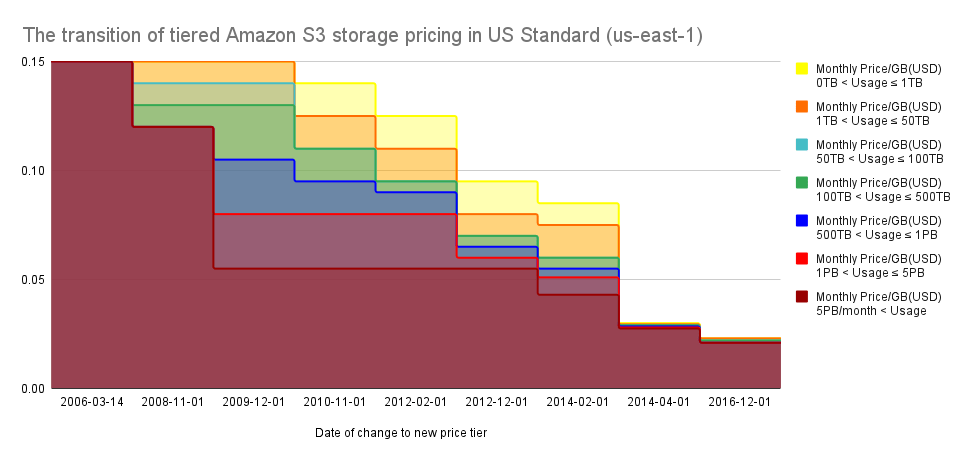
However, since the price reduction on April 1, 2014, there is almost no difference in price between the tiers, and the storage prices and tiers implemented from December 1, 2016, have been in use until now. It is expected that the adoption of a pay-as-you-go billing system proportional to the storage usage allowed for flexible changes in prices according to the usage and prospects of Amazon S3 and other AWS services.
The current pricing is in three tiers ranging from $0.023/GB to $0.021/GB, so compared to the past, with more detailed price tiers, it is closer to the flat rate that was in place at the start, with no initial price tiers. When we look at this in terms of the current price tiers, the tiered discount rate, and the examples of price totals, it is as follows.
| Price Tier | Initial Price | Current Price (2026-07-04) | Price Reduction Rate per Tier | Price Consolidation Example |
|---|---|---|---|---|
| (1)First 50TB/month (0TB-50TB) | 0.150USD/GB | 0.023USD/GB | 84.67% | [In case of 1TB(1,024GB) usage] Initial Price: 153.6USD Current Price: 23.55USD (1024GBx0.023USD =23.5520USD) |
| (2)Next 450TB/month (50TB-500TB) | 0.150USD/GB | 0.022USD/GB | 85.33% | [In case of 100TB(102,400GB) usage] Initial Price: 15,360USD Current Price: 2,304.0USD (51,200GBx0.023USD+ 51,200GBx0.022USD =2304.0000USD) |
| (3)Over 500TB/month | 0.150USD/GB | 0.021USD/GB | 86.00% | [In case of 1PB(1,048,576GB) usage] Initial Price: 157,286.4USD Current Price: 22,583.3USD (51,200GBx0.023USD+ 460,800GBx0.022USD+ 536,576GBx0.021USD =22,583.2960USD) |
Significant price reductions exceeding 84% have been implemented so far.
Additionally, if you spend the same amount now as the initial service charge, you can use about 6.521 to 7.143 times the data capacity.
Behind the price reduction, there is a view that it is due to benefits from the increased use of AWS and price competition with rival companies. However, I personally speculate that the rapid price cuts have been implemented to meet the needs of IT trends dealing with large amounts of data, such as big data analysis and machine learning, which began in earnest in the mid-2010s.
References:
Tech Blog with curated related content
Frequently Asked Questions about Amazon S3 History
- When did Amazon S3 launch?
- Amazon S3 became generally available on March 14, 2006 (Pi Day), as the first generally available infrastructure service of Amazon Web Services, initially offering REST, SOAP, and BitTorrent interfaces.
- How has Amazon S3 Standard storage pricing evolved?
- The initial storage price in 2006 was a flat $0.15 USD/GB per month for US Standard (us-east-1). Through repeated price reductions and tier changes, the current three-tier structure ($0.023/GB for the first 50 TB, $0.022/GB for the next 450 TB, and $0.021/GB over 500 TB per month in us-east-1) took effect on December 1, 2016, and has remained unchanged since then.
- When did Amazon S3 gain strong consistency?
- Amazon S3 delivered strong read-after-write consistency on December 1, 2020. Before that, S3 was eventually consistent for overwrite PUTs and DELETEs, which required additional design care for read-after-update workloads.
- What bucket types does Amazon S3 have, and when were they introduced?
- General purpose buckets have existed since the 2006 launch. Directory buckets were introduced with the S3 Express One Zone storage class on November 28, 2023, table buckets with Amazon S3 Tables on December 3, 2024, and vector buckets with Amazon S3 Vectors (preview on July 15, 2025, generally available on December 2, 2025).
- When did Amazon S3 start encrypting objects by default?
- Since January 5, 2023, Amazon S3 automatically encrypts all new objects with SSE-S3 (256-bit AES) as the base level of encryption, unless SSE-KMS, DSSE-KMS, or SSE-C is specified. In addition, starting April 6, 2026, SSE-C is disabled by default on new buckets as a security best practice.
- When did Amazon S3 add conditional writes?
- Conditional writes with the HTTP If-None-Match header arrived on August 20, 2024, followed by If-Match (compare-and-swap on ETag) and bucket-policy enforcement on November 25, 2024, conditional deletes on September 15, 2025, and conditional copy operations on October 15, 2025.
- How has the maximum Amazon S3 object size changed?
- The maximum object size was raised to 5 TB on December 9, 2010 (together with multipart upload introduced in November 2010), and increased tenfold to 50 TB on December 2, 2025.
- How can Amazon S3 be accessed as a file system?
- Mountpoint for Amazon S3, an open-source file client that translates file system calls into S3 API calls, became generally available on August 9, 2023. Amazon S3 Files, launched on April 7, 2026, goes further by exposing general purpose buckets via NFS semantics built on Amazon EFS technology, so that thousands of compute resources can mount the same bucket simultaneously.
Summary
In this article, I created a timeline of the history of Amazon S3 to see how its functions, roles, and fees have changed over the years.When I was using AWS back in the days when there was no AWS Management Console, I was inexperienced and at first I thought Amazon S3 was something amazing similar to an FTP service and Amazon EC2 was something amazing similar to a rental server.
However, as time passed and new features were added and pricing was revised, the API-based Amazon S3 began to distinctly stand out from other GUI-based online storage services and other similar services in terms of use cases.
Amazon S3, with its pay-as-you-go billing that allows adequate use, and API-based system that accepts cooperation from various systems, has been a great fit for meeting a wide variety of sudden storage needs and optimization for use cases.
I am continuously impressed with the stability and innovation of Amazon S3, which has become an indispensable service when using AWS. I am eager to see what new features and service integrations Amazon S3 will introduce in the future. I plan to keep updating this article's timeline regularly to keep a close watch on it.
Also, there is a timeline for the entire history of AWS services, including services other than Amazon S3. Please take a look if you are interested.
AWS History and Timeline - Almost All AWS Services List, Announcements, General Availability(GA)
I have also written related historical timelines for the services that Amazon S3 works most closely with:
- AWS History and Timeline regarding Amazon EC2
- AWS History and Timeline regarding Amazon EBS
- AWS History and Timeline regarding Amazon CloudFront
Written by Hidekazu Konishi