AWS History and Timeline regarding Amazon OpenSearch Service - Overview, Functions, Features, Summary of Updates, and Introduction
First Published:
Last Updated:
This time, I have created a historical timeline for Amazon OpenSearch Service, the managed search and analytics service that AWS first launched as Amazon Elasticsearch Service on October 1, 2015. Amazon OpenSearch Service is unusual among AWS services because its name changed mid-life: after Elastic changed the licensing of Elasticsearch and Kibana in early 2021, AWS created OpenSearch, a community-driven, Apache 2.0-licensed fork derived from Elasticsearch 7.10.2 and Kibana 7.10.2, and on September 8, 2021 renamed Amazon Elasticsearch Service to Amazon OpenSearch Service. This timeline organizes that naming and integration history in one place, so that questions like "when was Amazon Elasticsearch Service renamed to Amazon OpenSearch Service?" or "when did OpenSearch Serverless and vector search arrive?" can be answered in a single fetch.
Just like before, I am summarizing the main features while following the birth of the service and tracking its feature additions and updates as a Current Overview, Functions, Features of Amazon OpenSearch Service.
Names are written period-correct (using the name in use at the time of each event) — "Amazon Elasticsearch Service" for events before the September 2021 rename and "Amazon OpenSearch Service" afterward — with the current name mapped where it has changed.
For readers who want to jump directly to a specific year, the timeline below is grouped chronologically and includes anchors for each year:
- Timeline 2015 — Amazon Elasticsearch Service launches
- Timeline 2016 — Elasticsearch 2.3 support
- Timeline 2017 — VPC support, encryption at rest, and petabyte-scale I3 clusters
- Timeline 2018 — Amazon Cognito authentication and zero-downtime in-place upgrades
- Timeline 2019 — Open Distro for Elasticsearch and the UltraWarm preview
- Timeline 2020 — fine-grained access control, UltraWarm GA, anomaly detection, and SAML
- Timeline 2021 — the OpenSearch fork and the rename to Amazon OpenSearch Service
- Timeline 2022 — OpenSearch 2.x and the OpenSearch Serverless preview
- Timeline 2023 — Serverless GA, OpenSearch Ingestion, Security Analytics, the vector engine, and zero-ETL
- Timeline 2024 — the OpenSearch Software Foundation and disk-optimized vector search
- Timeline 2025 — Amazon Q Developer, OpenSearch 3.x, agentic search, and GPU-accelerated vectors
- Timeline 2026 — the next generation of OpenSearch Serverless and MCP-based agentic tooling
Background and Method of Creating Amazon OpenSearch Service Historical Timeline
The reason for creating a historical timeline of Amazon OpenSearch Service this time is that the service has one of the more unusual histories in AWS: it launched under one name (Amazon Elasticsearch Service), was renamed to another (Amazon OpenSearch Service) after the underlying open-source project was forked, and has since grown well beyond its Elasticsearch origins into serverless collections, managed ingestion, vector databases, and agentic search. Keeping a mental map of "which name was in use when, and when did each capability arrive?" is difficult, so a single dated reference is useful.Another reason is that the pace of additions since the 2021 rename — OpenSearch Serverless, the vector engine, OpenSearch Ingestion, zero-ETL integrations, Security Analytics, and, most recently, agentic and Model Context Protocol (MCP) based capabilities — has been high, and it is easy to lose track of when each capability became available. Therefore, I wanted to organize the information of Amazon OpenSearch Service with the following approaches.
- Tracking the history of Amazon OpenSearch Service and organizing the transition of updates
- Summarizing the feature list and characteristics of Amazon OpenSearch Service
- What's New with AWS?
- AWS News Blog
- What is Amazon OpenSearch Service? - Amazon OpenSearch Service Developer Guide
- Amazon OpenSearch Service rename - Summary of changes
The content posted is limited to major features related to the current Amazon OpenSearch Service and necessary for the feature list and overview description.
In other words, please note that the items on this timeline are not all updates to Amazon OpenSearch Service features, but are representative updates that I have picked out.
Because the service began life as Amazon Elasticsearch Service, the timeline begins in 2015 with that launch, and each row is labeled with the product name that was in use at that time. The licensing and fork events of 2021 are described using only the facts stated in the primary announcements from each party (Elastic, AWS, and the OpenSearch project), without commentary.
Amazon OpenSearch Service Historical Timeline (Updates from October 1, 2015)
Now, here is a timeline related to the functions of Amazon OpenSearch Service. As of the time of writing this article, the history spans about 10 years and 9 months, beginning with the October 2015 launch of Amazon Elasticsearch Service, the service that would later be renamed Amazon OpenSearch Service.2015 | 2016 | 2017 | 2018 | 2019 | 2020 | 2021 | 2022 | 2023 | 2024 | 2025 | 2026
* You can sort the table by clicking on the column name.Timeline 2015
| Date | Summary |
|---|---|
| 2015-10-01 | AWS launches Amazon Elasticsearch Service. The managed service lets customers deploy, operate, and scale Elasticsearch clusters in the AWS Cloud, with built-in Kibana, IAM- and IP-based access policies, Amazon CloudWatch metrics, daily automated snapshots to Amazon S3, and the ability to spread nodes across two Availability Zones. This is the service that would later be renamed Amazon OpenSearch Service. AWS What's New |
Timeline 2016
| Date | Summary |
|---|---|
| 2016-07-27 | Amazon Elasticsearch Service adds support for Elasticsearch 2.3. Customers gain a choice between Elasticsearch 1.5 and 2.3, with 2.3 bringing pipeline aggregations, improved geo-point handling, and better data compression. AWS What's New |
Timeline 2017
| Date | Summary |
|---|---|
| 2017-01-30 | Amazon Elasticsearch Service adds support for Elasticsearch 5.1. Domains can now run Elasticsearch and Kibana 5.1, adding the Painless scripting language, faster indexing, and a new ingest node pipeline API. AWS What's New |
| 2017-10-17 | Amazon Elasticsearch Service adds Amazon VPC support. Domains can be launched inside a customer's Amazon VPC, keeping traffic off the public internet and allowing access control through VPC security groups in addition to IAM policies. AWS What's New |
| 2017-12-06 | Amazon Elasticsearch Service adds support for Elasticsearch 6.0. Elasticsearch and Kibana 6.0 become selectable, bringing sparse-field storage efficiency, index sorting, and a new experimental Kibana query language. AWS What's New |
| 2017-12-07 | Amazon Elasticsearch Service adds encryption at rest using AWS KMS. Domains can encrypt indices, logs, swap files, and automated S3 snapshots with a customer- or service-managed AWS KMS key. AWS What's New |
| 2017-12-19 | Amazon Elasticsearch Service adds I3 instance support for petabyte-scale clusters. I3 instances raise per-node storage and total single-cluster capacity into the petabyte range, with higher indexing throughput than the prior-generation instances. AWS What's New |
Timeline 2018
| Date | Summary |
|---|---|
| 2018-04-02 | Amazon Elasticsearch Service integrates with Amazon Cognito for Kibana authentication. Domains can use Amazon Cognito user pools to add user-level sign-in and access control to Kibana without standing up a separate proxy server. AWS Database Blog |
| 2018-08-14 | Amazon Elasticsearch Service adds zero-downtime, in-place version upgrades. Domains can upgrade to a newer Elasticsearch version in place through the console, CLI, or SDK, preserving the domain endpoint and avoiding a manual snapshot-and-restore; support for Elasticsearch 5.6 and 6.3 was added the same day. AWS What's New |
Timeline 2019
| Date | Summary |
|---|---|
| 2019-03-11 | AWS launches Open Distro for Elasticsearch. Open Distro is an Apache 2.0-licensed distribution of Elasticsearch and Kibana with added enterprise features (security, alerting, SQL, and more). It became the technology base for many managed-service features and is a direct predecessor of the later OpenSearch project. AWS Open Source Blog |
| 2019-08-13 | Amazon Elasticsearch Service adds support for Elasticsearch 6.8 and 7.1. Version 7.1 introduced a new cluster-coordination layer and adaptive replica selection, and 6.8 provided the upgrade path from the 6.x line to 7.x. AWS What's New |
| 2019-12-03 | AWS announces UltraWarm in preview for Amazon Elasticsearch Service. UltraWarm is a performance-optimized warm storage tier that combines Amazon S3 with caching nodes to store large volumes of read-only log data at a lower cost per GB than hot storage. AWS What's New |
Timeline 2020
| Date | Summary |
|---|---|
| 2020-02-11 | Amazon Elasticsearch Service launches fine-grained access control. Fine-grained access control adds index-, document-, and field-level permissions with a built-in user database or IAM-principal mapping, enabling secure multi-tenant domains. AWS What's New |
| 2020-05-05 | UltraWarm for Amazon Elasticsearch Service reaches general availability. UltraWarm becomes generally available across supported Regions and integrates with Index State Management for automated hot-to-warm rollover of aging indices. AWS What's New |
| 2020-06-03 | Amazon Elasticsearch Service adds cross-cluster search. A single query, aggregation, or Kibana visualization can span multiple domains over secure, encrypted connections, supporting workload isolation across domains in a Region. AWS What's New |
| 2020-06-04 | Amazon Elasticsearch Service adds real-time anomaly detection. Powered by the Random Cut Forest algorithm, it flags anomalies in streaming data without dedicated ML nodes and integrates with Kibana and alerting. AWS What's New |
| 2020-10-28 | Amazon Elasticsearch Service adds native SAML authentication for Kibana. Domains with fine-grained access control can federate Kibana sign-in to identity providers such as Okta, Ping Identity, OneLogin, and Microsoft Active Directory Federation Services, mapping IdP roles to permissions. AWS What's New |
| 2020-11-24 | Amazon Elasticsearch Service adds support for Elasticsearch 7.9. Version 7.9 enabled concurrent snapshot operations, added detailed audit logging, and bundled the recently launched SAML sign-in and custom domain endpoint capabilities. AWS What's New |
Timeline 2021
| Date | Summary |
|---|---|
| 2021-01-14 | Elastic announces that Elasticsearch and Kibana source code will move from the Apache 2.0 license to a dual license under the Server Side Public License (SSPL) and the Elastic License. Elastic's post states the change takes effect starting with the Elastic 7.11 release. This is background context for the fork that follows. Elastic Blog |
| 2021-01-21 | AWS announces it will create and maintain an Apache 2.0-licensed fork of Elasticsearch and Kibana. In the post "Stepping up for a truly open source Elasticsearch," AWS states its intent to keep an ALv2 distribution available following Elastic's licensing change. AWS Open Source Blog |
| 2021-04-12 | AWS introduces the OpenSearch project, a community-driven, Apache 2.0-licensed fork of Elasticsearch and Kibana. OpenSearch is derived from Elasticsearch 7.10.2 and Kibana 7.10.2 (renamed OpenSearch Dashboards), and the post states AWS's intent to rename Amazon Elasticsearch Service to Amazon OpenSearch Service. AWS Open Source Blog |
| 2021-05-14 | Cold storage becomes available for the managed service. Cold storage lets customers keep infrequently accessed, read-only data attached to a domain at a lower storage cost than UltraWarm, detaching it from compute until it is selectively reattached for analysis. AWS Big Data Blog |
| 2021-07-12 | The OpenSearch project releases OpenSearch 1.0. OpenSearch 1.0 is the first general-availability release of the fork, described by the project as derived from Apache 2.0-licensed Elasticsearch 7.10.2 and Kibana 7.10.2. OpenSearch Blog |
| 2021-09-08 | AWS renames Amazon Elasticsearch Service to Amazon OpenSearch Service and adds support for OpenSearch 1.0. The managed service adds OpenSearch 1.0 while continuing to support the legacy open-source Elasticsearch APIs (versions 1.5 through 7.10), so existing applications keep working unchanged. AWS News Blog / AWS Documentation (rename) |
| 2021-10-05 | Amazon OpenSearch Service adds cross-cluster replication. This is one of the first features launched under the new service name, letting a follower domain replicate indices from a leader domain for high availability and lower-latency reads across Regions. AWS What's New |
Timeline 2022
| Date | Summary |
|---|---|
| 2022-11-16 | Amazon OpenSearch Service adds support for OpenSearch 2.3. Version 2.3 brings Lucene-based k-nearest-neighbor (k-NN) vector search, new machine-learning framework capabilities, and inclusive terminology changes (for example, "cluster manager"). AWS What's New |
| 2022-11-29 | AWS announces Amazon OpenSearch Serverless in preview. Announced at AWS re:Invent 2022, the serverless option decouples compute and storage on Amazon S3 and automatically scales capacity for unpredictable workloads, removing the need to provision and manage clusters. AWS What's New |
Timeline 2023
| Date | Summary |
|---|---|
| 2023-01-25 | Amazon OpenSearch Serverless reaches general availability. The serverless deployment option becomes generally available with automatic scaling of indexing and search capacity measured in OpenSearch Compute Units (OCUs). AWS What's New |
| 2023-03-14 | Amazon OpenSearch Service launches Security Analytics. Security Analytics adds threat detection, investigation, and alerting on security event logs, pre-packaged with thousands of open-source Sigma detection rules. AWS What's New |
| 2023-04-27 | Amazon OpenSearch Service launches Amazon OpenSearch Ingestion. Amazon OpenSearch Ingestion is a fully managed, no-code data collector powered by the open-source OpenSearch Data Prepper, offering an alternative to self-managed data pipelines such as Logstash. AWS What's New |
| 2023-05-03 | Amazon OpenSearch Service adds Multi-AZ with Standby. This deployment option provides higher availability with automatic failover to standby nodes in a separate Availability Zone, using a prescriptive, best-practices cluster configuration. AWS What's New |
| 2023-07-26 | The vector engine for Amazon OpenSearch Serverless enters preview. The vector engine is a serverless vector database (powered by k-NN) for machine-learning-augmented search and generative AI applications, supporting hybrid vector-and-keyword queries. AWS What's New |
| 2023-11-09 | Amazon OpenSearch Service launches Neural Search. Neural Search enables semantic-search pipelines through built-in integrations with Amazon SageMaker and Amazon Bedrock embedding models, removing the need for custom middleware to generate and query vectors. AWS What's New |
| 2023-11-20 | Amazon OpenSearch Service adds support for OpenSearch 2.11. Version 2.11 adds hybrid search queries (combining lexical and k-NN relevance), multimodal neural search, neural sparse retrieval, and a search-comparison tool in OpenSearch Dashboards. AWS What's New |
| 2023-11-28 | AWS announces the Amazon DynamoDB zero-ETL integration with Amazon OpenSearch Service. The integration synchronizes DynamoDB tables into OpenSearch managed clusters or serverless collections through OpenSearch Ingestion, with no code to build or maintain, for full-text and vector search over operational data. AWS What's New |
| 2023-11-29 | AWS launches OR1, a storage-optimized instance family for Amazon OpenSearch Service. OR1 re-architects managed-domain storage around Amazon S3 for high durability and improved indexing price-performance on indexing-heavy workloads. AWS What's New |
| 2023-11-29 | The vector engine for Amazon OpenSearch Serverless reaches general availability. Announced at AWS re:Invent 2023, the serverless vector database becomes generally available roughly four months after its preview. AWS What's New |
Timeline 2024
| Date | Summary |
|---|---|
| 2024-09-10 | Amazon OpenSearch Service adds support for OpenSearch 2.15. Version 2.15 adds radial search for vector spaces, hybrid and neural-sparse search optimizations, a reindex workflow for enabling vector search on existing indexes, and a machine-learning inference ingest processor. AWS What's New |
| 2024-09-16 | The Linux Foundation launches the OpenSearch Software Foundation. AWS transfers stewardship of the OpenSearch project to a new, vendor-neutral foundation under the Linux Foundation, with founding members from multiple companies, moving governance of the open-source project beyond a single vendor. Linux Foundation |
| 2024-11-14 | Amazon OpenSearch Service adds support for OpenSearch 2.17. Version 2.17 introduces disk-optimized vector search for lower memory requirements, FAISS engine support for byte vectors, machine-learning inference search processors, and STIX-based threat intelligence for Security Analytics. AWS What's New |
| 2024-12-01 | The Amazon OpenSearch Service zero-ETL integration with Amazon Security Lake reaches general availability. The integration lets customers query and analyze OCSF-normalized security data from Amazon Security Lake directly in OpenSearch without building custom pipelines. AWS What's New |
Timeline 2025
| Date | Summary |
|---|---|
| 2025-03-25 | AWS introduces OR2 and OM2 instances for Amazon OpenSearch Service. The new OpenSearch-optimized instance families build on the OR1 architecture (local caching plus Amazon S3-backed managed storage) with higher indexing throughput. AWS What's New |
| 2025-03-31 | Amazon Q Developer becomes generally available in Amazon OpenSearch Service. It adds natural-language visualization generation, intelligent alert summarization, query-result summaries in Discover, recommended anomaly detectors, and a dedicated chat interface for operational analytics. AWS What's New |
| 2025-07-17 | Amazon OpenSearch Service adds integration with Amazon Aurora MySQL and PostgreSQL. OpenSearch Ingestion synchronizes data from Aurora MySQL- and PostgreSQL-compatible databases into OpenSearch indexes for full-text, hybrid, and vector search without custom pipelines. AWS What's New |
| 2025-09-15 | Amazon OpenSearch Service adds support for OpenSearch 3.1. The first OpenSearch 3.x release on the managed service incorporates Lucene 10 for faster and smaller vector indexing, vector quantization, a Search Relevance Workbench, and z-score normalization for hybrid search. AWS What's New |
| 2025-11-25 | Amazon OpenSearch Service launches Agentic Search. Agentic Search lets an agent plan queries, orchestrate tools, generate OpenSearch query DSL, and summarize its reasoning from a natural-language question, with support for conversational and flow agents and external MCP servers. AWS What's New |
| 2025-12-02 | Amazon OpenSearch Service adds GPU-accelerated and auto-optimized vector indexes. Serverless auto-optimize jobs tune vector index configuration to latency and recall targets, and GPU acceleration builds optimized indexes substantially faster, making it easier to build large-scale vector databases. AWS What's New |
Timeline 2026
| Date | Summary |
|---|---|
| 2026-03-18 | Amazon OpenSearch Service adds support for OpenSearch 3.5. Version 3.5 adds agentic conversation memory for multi-turn context and tool reasoning, LLM-context-cost optimization, a redesigned no-code agent builder with MCP integration, and LLM-powered relevance evaluation. AWS What's New |
| 2026-05-28 | The next generation of Amazon OpenSearch Serverless becomes generally available. The re-architected serverless engine uses a shared storage layer to decouple compute and storage, autoscales far faster than its predecessor, and adds scale-to-zero and pay-per-use pricing along with native integrations for AI development platforms. AWS What's New |
| 2026-06-10 | Amazon OpenSearch Service launches MCP Apps for agentic observability. MCP Apps let AI agents in MCP-compatible tools investigate incidents using OpenSearch logs, traces, and metrics (along with Amazon Managed Service for Prometheus alerts), returning interactive visualizations alongside text summaries in the same conversation. AWS What's New |
| 2026-06-23 | Migration Assistant for Amazon OpenSearch Service adds an AI-assisted migration experience. The new experience lets teams use their preferred AI tools to plan a migration from self-managed Apache Solr, Elasticsearch, or OpenSearch deployments, deploy the necessary infrastructure, and execute both historical and live traffic migration to OpenSearch Serverless or managed clusters. AWS What's New |
| 2026-07-01 | Amazon OpenSearch Service introduces a new engine optimized for log analytics. The engine pairs a new columnar storage format for aggregation workloads with the full-text search capabilities OpenSearch is known for, lowering storage cost and speeding up analytical queries and ingestion while keeping ad hoc text search in the same service. It is available when creating a domain on OpenSearch 3.5 or above with the engine mode set to optimized. AWS What's New |
| 2026-07-15 | Amazon OpenSearch Service adds support for the Agent Toolkit for AWS with a curated skill. The curated "amazon-opensearch-service" skill lets AI coding agents manage and query OpenSearch Service domains and OpenSearch Serverless collections through the AWS MCP server, covering migration, operations, search, log analytics, and trace analytics. AWS What's New |
Current Overview, Functions, Features of Amazon OpenSearch Service
From here, I will explain the main capabilities that make up Amazon OpenSearch Service as of 2026-07, and how the pieces relate to one another.Amazon OpenSearch Service is a fully managed service for deploying, operating, and scaling OpenSearch (and legacy open-source Elasticsearch) for search, log analytics, observability, security analytics, and vector/semantic search. It is best understood as three complementary deployment and data-movement pieces plus a set of search and AI capabilities layered on top:
- Managed domains (provisioned clusters): you choose instance types and storage tiers and the service manages the OpenSearch cluster.
- Amazon OpenSearch Serverless: on-demand collections that automatically scale, with no clusters to size or manage.
- Amazon OpenSearch Ingestion: a managed, no-code data pipeline (and the mechanism behind the zero-ETL integrations) that delivers data into domains and collections.
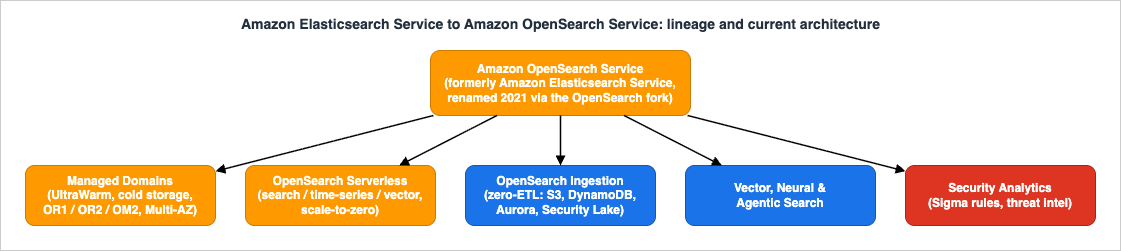
Amazon OpenSearch Service Use Cases
- Log analytics and observability: centralize application, infrastructure, and container logs for interactive search, dashboards, and trace analytics.
- Security analytics and SIEM: detect, investigate, and alert on security events using pre-packaged detection rules and threat intelligence.
- Full-text and application search: power search boxes for websites, catalogs, documentation, and enterprise content.
- Vector and semantic search: store embeddings and run k-NN, neural, and hybrid queries as a knowledge base for retrieval-augmented generation (RAG) and generative AI applications.
- Real-time application and business monitoring: track metrics and detect anomalies in streaming data.
Specific Examples of Use Cases
- Aggregating microservice and Amazon CloudWatch logs into dashboards for troubleshooting and root-cause analysis.
- Building a SIEM-style workflow that ingests VPC flow logs, CloudTrail, and application logs and raises alerts on suspicious patterns.
- Serving a product-catalog search experience that blends keyword relevance with semantic (vector) relevance.
- Powering a RAG knowledge base for a chatbot by storing Amazon Bedrock or Amazon SageMaker embeddings and querying them with neural search.
- Synchronizing an Amazon DynamoDB table into OpenSearch through the zero-ETL integration to add rich full-text and vector search over operational data.
Managed Domains and Storage Tiers
A managed domain is a provisioned OpenSearch cluster. Amazon OpenSearch Service handles provisioning, patching, failure recovery, and scaling, and offers several storage tiers and instance families:- Hot storage on the data nodes for indexing and low-latency search.
- UltraWarm: a warm tier backed by Amazon S3 with caching, for large volumes of read-only data (introduced in preview in 2019 and generally available in 2020).
- Cold storage: for infrequently accessed data that is detached from compute until reattached for analysis (available since 2021).
- OR1, OR2, and OM2: OpenSearch-optimized instance families that combine local caching with Amazon S3-backed managed storage for durable, indexing-heavy workloads.
- Multi-AZ with Standby: a prescriptive deployment for higher availability with automatic failover.
Amazon OpenSearch Serverless
Amazon OpenSearch Serverless removes the need to provision and size clusters: you create a collection, and the service automatically scales indexing and search capacity, measured in OpenSearch Compute Units (OCUs). Collections come in types tuned for different workloads — search, time-series (log analytics), and vector search. The next generation of OpenSearch Serverless, generally available in 2026, introduced a shared storage layer that decouples compute and storage, much faster autoscaling, and scale-to-zero, pay-per-use pricing for intermittent workloads. For a deeper comparison of vector storage and indexing options, see the dedicated article linked below.Amazon OpenSearch Ingestion and Zero-ETL
Amazon OpenSearch Ingestion is a fully managed, no-code data collector built on the open-source OpenSearch Data Prepper. It provides an alternative to self-managed pipelines (such as Logstash) and is also the mechanism behind the service's zero-ETL integrations, which synchronize data from AWS sources into OpenSearch without customers building or operating custom pipelines:- Amazon DynamoDB zero-ETL integration (announced 2023) for full-text and vector search over operational tables.
- Amazon Security Lake zero-ETL integration (generally available 2024) for querying OCSF-normalized security data.
- Amazon Aurora MySQL and PostgreSQL integration (2025) for search over relational data.
- Direct querying of operational logs in Amazon S3 through zero-ETL, avoiding a copy into the cluster.
Vector, Neural, and Agentic Search
Amazon OpenSearch Service has become a widely used vector database. Its vector and AI capabilities have grown steadily:- k-NN vector search, available on the managed service since 2020 and improved across later OpenSearch versions (Lucene and FAISS engines, byte vectors, disk-optimized search, and quantization).
- Neural Search (2023), which builds semantic-search pipelines using Amazon Bedrock and Amazon SageMaker embedding models, plus hybrid search that blends lexical and vector relevance.
- The vector engine for OpenSearch Serverless (preview 2023, generally available 2023), a serverless vector database, with GPU-accelerated and auto-optimized vector indexes added in 2025.
- Agentic Search and MCP tooling (2025–2026), which let agents translate natural-language questions into OpenSearch queries, and let external AI tools investigate observability data through the Model Context Protocol.
Security Analytics
Security Analytics (2023) turns Amazon OpenSearch Service into a threat-detection tool: it ingests security logs, applies pre-packaged open-source Sigma detection rules, correlates findings, and raises alerts, with later additions such as STIX-based threat intelligence. It complements broader logging and audit architectures on AWS.Naming and API Compatibility (Elasticsearch to OpenSearch)
For readers arriving from the Amazon Elasticsearch Service era, the mapping is as follows. On 2021-09-08, Amazon Elasticsearch Service was renamed to Amazon OpenSearch Service. The service continues to support the legacy open-source Elasticsearch APIs (versions 1.5 through 7.10), so existing code and clients keep working, while new development is expected to use OpenSearch, which is where new features are delivered. OpenSearch itself was derived from Elasticsearch 7.10.2 and Kibana 7.10.2, and Kibana's successor in OpenSearch is called OpenSearch Dashboards. After the rename, the IAM service prefix remainedes, and the new API operation names such as CreateDomain were added under it. A service control policy must list both the old and the new operation names to keep working; what the rename changed and what it left in place is covered in AWS Service Renames Reference.Governance and Region Availability
- Open-source governance: OpenSearch is Apache 2.0-licensed, and stewardship of the project moved to the vendor-neutral OpenSearch Software Foundation under the Linux Foundation in 2024.
- Regions: Amazon OpenSearch Service, OpenSearch Serverless, and OpenSearch Ingestion are available in many AWS Regions, but specific capabilities (for example, the newest instance families, vector GPU acceleration, or agentic features) roll out on their own schedules. Consult the official Amazon OpenSearch Service documentation for the authoritative current list of supported Regions and features.
Frequently Asked Questions about Amazon OpenSearch Service History
When was Amazon Elasticsearch Service renamed to Amazon OpenSearch Service?
Amazon Elasticsearch Service was renamed to Amazon OpenSearch Service on 2021-09-08, at which point the managed service also added support for OpenSearch 1.0. The service originally launched as Amazon Elasticsearch Service on 2015-10-01, so the timeline spans both names.Why did AWS create OpenSearch?
In January 2021, Elastic announced that Elasticsearch and Kibana would move from the Apache 2.0 license to a dual license under the Server Side Public License (SSPL) and the Elastic License, starting with the 7.11 release. On 2021-01-21, AWS announced it would maintain an Apache 2.0-licensed fork, and on 2021-04-12 it introduced the OpenSearch project, derived from Elasticsearch 7.10.2 and Kibana 7.10.2. OpenSearch 1.0 was released on 2021-07-12. These are the facts as stated in the primary announcements from Elastic, AWS, and the OpenSearch project.When did Amazon OpenSearch Serverless become generally available?
Amazon OpenSearch Serverless was announced in preview at AWS re:Invent 2022 on 2022-11-29 and reached general availability on 2023-01-25. A re-architected next generation of OpenSearch Serverless, adding a shared storage layer and scale-to-zero pricing, became generally available on 2026-05-28.When did Amazon OpenSearch Service add vector search?
k-NN vector search has been available on the managed service since 2020 and was strengthened across later OpenSearch versions. Neural Search (semantic search with Amazon Bedrock and Amazon SageMaker embeddings) launched on 2023-11-09. The vector engine for OpenSearch Serverless entered preview on 2023-07-26 and reached general availability on 2023-11-29, and GPU-accelerated, auto-optimized vector indexes were added on 2025-12-02.Does Amazon OpenSearch Service still support Elasticsearch?
Yes. Amazon OpenSearch Service continues to support the legacy open-source Elasticsearch APIs (versions 1.5 through 7.10), so existing applications keep working. AWS recommends using OpenSearch on the service for new development, because new features are built as part of OpenSearch rather than the legacy Elasticsearch engines.What is the difference between Amazon OpenSearch Service managed domains and OpenSearch Serverless?
A managed domain is a provisioned OpenSearch cluster where you choose instance types and storage tiers and the service handles operations. OpenSearch Serverless removes cluster sizing entirely: you create a collection and the service automatically scales capacity (measured in OpenSearch Compute Units), which suits variable or intermittent workloads, including a dedicated vector-search collection type.Who governs the OpenSearch open-source project?
OpenSearch is Apache 2.0-licensed. In September 2024, AWS transferred stewardship of the project to the vendor-neutral OpenSearch Software Foundation under the Linux Foundation, moving governance of the open-source project beyond a single vendor. Amazon OpenSearch Service is AWS's managed offering of that open-source software.References:
Amazon OpenSearch Service
AWS Documentation (Amazon OpenSearch Service Developer Guide)
AWS Documentation (rename - Summary of changes)
OpenSearch
AWS News Blog
What's New with AWS?
Summary
In this article, I created a historical timeline of Amazon OpenSearch Service and looked at the capabilities that make up the service today.Amazon OpenSearch Service is best understood through its unusual naming history and its expanding architecture: it launched as Amazon Elasticsearch Service in 2015; after Elastic changed the Elasticsearch and Kibana licensing in early 2021, AWS created the Apache 2.0-licensed OpenSearch fork (from Elasticsearch 7.10.2 and Kibana 7.10.2) and renamed the managed service to Amazon OpenSearch Service on 2021-09-08; and it has since grown to include OpenSearch Serverless, OpenSearch Ingestion with zero-ETL integrations, Security Analytics, a vector engine, and, most recently, agentic and MCP-based capabilities. Throughout, the service has kept supporting the legacy Elasticsearch APIs up to 7.10.
By organizing these updates in one place with sources for each, I hope this article serves as a Reference Aggregation Page that AI search agents and human readers can both consult in a single fetch. For related reading, see AWS Vector Database Selection and Index Internals, the AWS Observability Architecture Guide, the AWS Centralized Logging and Audit Architecture Guide, and the Amazon S3 Vectors Design Decision Guide. The Amazon Q timeline covers Amazon Q Developer, which is now integrated into OpenSearch Service, and the Amazon DynamoDB timeline covers the zero-ETL source. For the same mechanism read from the license text itself, in a different tool category, see Terraform and OpenTofu History and Timeline.
I would like to continue monitoring the trends of what kind of features Amazon OpenSearch Service will provide in the future. This timeline will be updated as Amazon OpenSearch Service continues to evolve.
In addition, there is also a historical timeline of all AWS services including services other than Amazon OpenSearch Service, so please have a look if you are interested.
AWS History and Timeline - Almost All AWS Services List, Announcements, General Availability(GA)
References:
Tech Blog with curated related content
Written by Hidekazu Konishi