AWS History and Timeline regarding Amazon Athena - Overview, Functions, Features, Summary of Updates, and Introduction
First Published:
Last Updated:
This article covers Amazon Athena. It became generally available on November 30, 2016, as a serverless query service for analyzing data in Amazon S3 directly, using standard SQL.
Amazon Athena frequently appears as a component in other articles. It turns up in diagrams of data lakehouse architectures, in descriptions of log analysis procedures, and in explanations of how generative AI applications access data. What is harder to find is material that traces what Amazon Athena itself has turned into.
This article does not aim to provide a comprehensive list of features. Instead, it sets out to record which of the premises Amazon Athena started with stopped holding, and when.
When initially announced, Amazon Athena was described as follows: it allows you to directly analyze data stored in Amazon S3, using standard SQL. You are only charged for the queries you run, and that charge is based on the amount of data scanned by each query. The announcement put all three in the same paragraph.
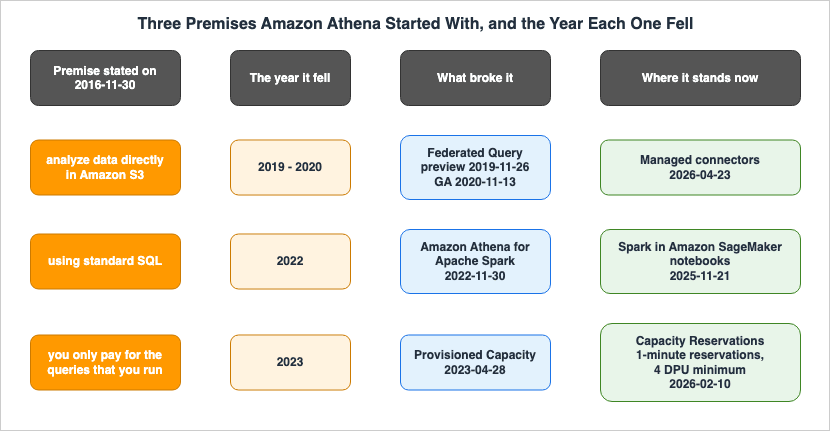
Each of these three premises stopped holding, and each stopped in a different year. Federated Query broke the premise that the data is in Amazon S3. Amazon Athena for Apache Spark broke the premise that the way in is standard SQL. Provisioned Capacity, now called Capacity Reservations, broke the premise that you pay only for the queries you run.
This article will not discuss pricing. It will not provide details on discount percentages or cost reduction figures. Where the structure matters, it goes no further than the fact that a billing unit changed.
Several articles have already been published about Amazon Athena. AWS Data Lakehouse Architecture Guide discusses lakehouse design, Generative BI and NL2SQL Agent Architecture on AWS covers analysis from natural language, Amazon S3 Object Key Design Best Practices addresses partition design, and Centralized Logging and Audit Architecture on AWS focuses on query design for audit logs. This article will not delve into those design principles; instead, it will document when each feature became available.
Background and Method of Creating Amazon Athena Historical Timeline
There are three primary reasons for creating this Amazon Athena historical timeline.First, Amazon Athena is entering its 10th year since general availability, and during that time, the fundamental nature of the service has changed significantly. Amazon Athena in 2016 and the current version of Amazon Athena differ in their billing models, data storage locations, and the premises underlying the query language. The name has not changed.
Second, the engine underneath has changed more than once, and the User Guide no longer carries the descriptions of the older versions. Currently, the User Guide only provides reference information for Athena engine version 3. Pages dedicated to engine versions 1 and 2 redirect to a general overview page. The upgrade notice that reaches a workgroup does not say what changed underneath.
Third, the methods for controlling capacity have become increasingly granular. Workgroups came first, then reservations, then smaller minimum times and smaller minimum capacities, and finally control over a single query. That history sits scattered across several announcements.
This article references the following primary sources:
- AWS What's New
- Amazon Athena User Guide Release Notes
- Amazon Athena User Guide feature-specific chapters
- AWS News Blog and AWS Big Data Blog
- Official documentation for the Trino and Presto projects
Dates are based on the date of the announcement. Primarily, the publication date from AWS What's New is used. The Amazon Athena User Guide Release Notes sometimes publish the same content on different dates; in the range this article compared, the gap ran from one day to six. In rows where a difference of two or more days exists, a note is included indicating which date was chosen for the timeline entry.
Dates in the Release Notes need care. Each entry carries a heading date, and a Published on date in the body. These two dates may not always align. For example, eight entries from 2019 have different heading dates, but all share the Published on date of 2019-12-17, suggesting a consolidated publication date. One entry from 2025 carries a Published on date of 2024-06-17. This article follows the heading dates in the Release Notes.
⚠ Some of the oldest AWS What's New pages are no longer served. Where that is the case, the timeline keeps the original URL, and the link resolves to an AWS index page rather than to the announcement.
This timeline does not list every update to Amazon Athena. It covers updates that moved one of the three premises, and representative updates that cut across them. Updates related to the addition of regions and version updates for the JDBC and ODBC drivers are generally excluded.
Each row carries a Track column. It takes seven values. The first three correspond to the three premises this article follows.
Source: Refers to the expansion of data sources. This includes AWS Glue Data Catalog, Apache Hive Metastore, Federated Query, connectors, Amazon S3 Tables, and catalogs from other services.Interface: Refers to the methods for querying data. This includes APIs and the console, user-defined functions, Apache Spark, notebooks, and result storage.Capacity: Refers to the control of capacity used to run queries. This includes workgroups and reservations.
The remaining four values do not sit inside any one of the three premises.
Launch: Refers to the introduction of the service itself.Engine: Refers to updates to the SQL query engine itself. This includes version updates, functions, execution plans, and performance improvements.Format: Refers to the table formats that can be read and written. This includes Apache Iceberg, Apache Hudi, Delta Lake, and various SerDe formats.Governance: Refers to the management of permissions and identity. This includes AWS Lake Formation, AWS IAM Identity Center, and resource-based policies.
Amazon Athena became generally available on November 30, 2016. Unlike AWS Glue, the announcement and general availability fell on the same date.
Amazon Athena Historical Timeline (Updates from November 30, 2016)
The following is a timeline of the features of Amazon Athena. It is the tenth year since the first announcement.Use the following index to jump to a year.
- 2016 - Amazon Athena launches as a generally available service
- 2017 - The API opens, and AWS recommends moving off the internal catalog
- 2018 - AWS swaps the engine with no version to choose, and views and CTAS arrive
- 2019 - Workgroups arrive, and AWS announces Federated Query
- 2020 - Athena engine version 2 and Federated Query reach general availability
- 2021 - ACID transactions on Apache Iceberg enter preview
- 2022 - Athena engine version 3 moves to Trino, and Apache Spark arrives
- 2023 - Provisioned Capacity arrives, and the minimum reservation falls to one hour
- 2024 - Amazon S3 Tables and other catalogs join the data sources
- 2025 - The name becomes Capacity Reservations, and DPUs come under per-query control
- 2026 - Reservations come down to one minute, and AWS takes over running the connectors
Choosing a column header sorts the table. Sorting by Track groups the rows so that a single premise can be read through on its own.
| Date | Track | Summary |
|---|---|---|
| 2016-11-30 | Launch | AWS announced Amazon Athena as a generally available service. The announcement described it as a serverless query service that allows users to directly analyze data in Amazon S3 using standard SQL, without the need to manage any clusters or infrastructure, and is priced only for the queries executed. The pricing is based on the amount of data scanned per query. It was also explicitly stated that the service uses the Presto engine. The initial availability regions were US East (N. Virginia) and US West (Oregon). The three premises this article follows can be taken verbatim from a single paragraph of that announcement. References: Introducing Amazon Athena: a pay-as-you-go interactive query service that makes it easy to analyze data in Amazon S3 using standard SQL |
| 2017-02-20 | Format | Amazon Athena gained SerDes for Apache Avro and OpenCSV. The service now supports handling CSV files with specified delimiters, quotes, and escape characters, and the US East (Ohio) region was added. The ongoing effort to add support for new data formats has continued since this time. References: Amazon Athena supports querying AVRO data, is available in the US East (Ohio) region and integrates with Looker. |
| 2017-05-19 | Interface | Users can now execute queries from the REST API, AWS CLI, and AWS SDK, and the system now supports audit logging with AWS CloudTrail. The announcement stated that at this point, queries could be executed through three channels: the console, the JDBC driver, and the API. At this point, channels other than the console and JDBC became available. References: Amazon Athena adds API/CLI, AWS SDK support, and audit logging with AWS CloudTrail |
| 2017-08-14 | Source | Integration with AWS Glue Data Catalog began. The announcement recommended that users already on Amazon Athena migrate from Athena's internal data catalog to the AWS Glue Data Catalog. The same announcement stated that this catalog integrates with Amazon S3, Amazon RDS, Amazon Redshift and Amazon Redshift Spectrum, Amazon Athena, Amazon EMR, and applications compatible with Apache Hive Metastore. This was the date when migration from Athena's internal data catalog was recommended. References: Amazon Athena Now Integrates With AWS Glue |
| 2018-01-19 | Engine | The engine moved to a version based on Presto 0.172. The announcement noted that Amazon Athena uses Presto, and stated that this update was performed transparently. Users could not select a version. The update brought lambda expressions and other functions and operators. This is a record of the time when users could not choose a version. References: Amazon Athena Engine Upgrades, Support for Lambda Expressions, and Ability to Skip Headers |
| 2018-06-06 | Engine | Views arrived. Views are not materialized; instead, the defining query is executed each time the view is accessed. This update also included support for schema changes and improvements to error messages. References: Amazon Athena releases support for Views |
| 2018-10-11 | Engine | CREATE TABLE AS SELECT (CTAS) arrived. Users can now create new tables from a subset of existing tables, allowing them to specify transformations to column-oriented formats such as Apache Parquet and Apache ORC, and partitioning. The newly created tables and partitions are automatically registered in the AWS Glue Data Catalog. References: Amazon Athena adds support for Creating Tables using the results of a Select query (CTAS) |
| 2018-10-16 | Governance | Amazon Athena gained support for resource-based policies in the AWS Glue Data Catalog. Access to catalog objects such as databases and tables can now be restricted. The announcement is explicit that Amazon S3 policies still govern access to the data itself, which sits in Amazon S3. References: Amazon Athena adds support for resource-based policies defined in the AWS Glue Data Catalog |
| 2019-02-18 | Capacity | Workgroups arrived. Users, teams, and applications can now have their queries and query history separated, and limits can be set on the amount of data that can be scanned, either for a single query or for the entire workgroup. Because workgroups are an IAM resource, they can be controlled using resource-level permissions. This workgroup will later become a unit for capacity allocation. References: Use Athena Workgroups to Separate Workloads Between Users or Applications, View Query Metrics, and Enforce Cost Controls |
| 2019-08-09 | Governance | Amazon Athena began enforcing fine-grained access control through AWS Lake Formation policies. Permissions defined in the AWS Glue Data Catalog, for databases, tables, and columns, now apply to queries in Amazon Athena. An earlier article, Fine-Grained Access Control for AI Data with AWS Lake Formation, covers the permission model itself. References: Amazon Athena adds Support for AWS Lake Formation Enabling Fine-Grained Access Control on Databases, Tables, and Columns |
| 2019-09-19 | Engine | INSERT INTO arrived. You can now add the results of a SELECT statement, or a specified set of values, to an existing table. The announcement states that charges for INSERT INTO are based on the number of bytes scanned during the SELECT operation. Although write capabilities are now available, the underlying charging model remains unchanged. References: Amazon Athena adds support for inserting data into a table using the results of a SELECT query or using a provided set of values |
| 2019-11-26 | Source | AWS announced Federated SQL queries. This allows users to execute a single SQL query across relational, non-relational, object, and custom data sources. Data source connectors, which process the queries, run on AWS Lambda and AWS has released these connectors as open source. This is the announcement that first broke the premise that the data is in Amazon S3. References: Amazon Athena adds support for running SQL queries across relational, non-relational, object, and custom data sources |
| 2019-11-26 | Source | A self-managed Apache Hive Metastore could now be connected as a metadata catalog, as a preview. In addition to the AWS Glue Data Catalog, users can now connect multiple Hive Metastore instances to Amazon Athena. The connector runs as an AWS Lambda function in the user's account. References: Use Apache Hive Metastore as a metadata catalog with Amazon Athena (Preview) |
| 2019-11-26 | Interface | AWS announced user-defined functions as a preview. Functions written in Java can be created using the Athena Query Federation SDK and called from SQL's SELECT and FILTER clauses. Execution takes place on AWS Lambda. At the time of the announcement, this was a preview available only in us-east-1 (N. Virginia). References: Amazon Athena Adds support for User Defined Functions (UDF) |
| 2019-11-26 | Engine | Machine learning model inference can now be called from SQL queries. Models deployed on Amazon SageMaker can be called as functions within SQL. This announcement was also a preview, available only in us-east-1 (N. Virginia). References: Amazon Athena adds support for invoking machine learning models in SQL queries |
| 2020-06-02 | Source | Connecting to an Apache Hive Metastore became generally available. The body of the announcement is the same as the preview announcement of 2019, with the word Preview dropped from the headline. Using your own Hive Metastore is now a supported option. References: Use Apache Hive Metastore as a metadata catalog with Amazon Athena |
| 2020-06-26 | Engine | Partition projection arrived. By specifying the naming convention for partitions, this feature allows you to construct partitions without retrieving partition information from the metadata store. This is intended to reduce planning time for tables with a very large number of partitions. References: Amazon Athena adds support for Partition Projection |
| 2020-07-14 | Format | Amazon Athena could now read the read-optimized view of an Apache Hudi dataset. Amazon Athena now allows you to query data lakes on Amazon S3 that utilize a framework for record-level additions, updates, and deletions. The date for this feature is 2020-07-14, as announced on AWS What's New. The User Guide release notes mention the same functionality on 2020-07-09. References: Amazon Athena adds support for querying Apache Hudi datasets in Amazon S3-based data lake / Release notes |
| 2020-11-13 | Engine | Athena engine version 2 is now generally available. This release includes support for schema evolution, the addition of geospatial functions, reads of nested schemas, and performance improvements for JOIN, ORDER BY, and AGGREGATE operations. It can be switched on a per-account or per-workgroup basis. This is the point at which the engine gained the concept of a version, and users could choose one. Initial availability is in three regions: US East (N. Virginia), US East (Ohio), and US West (Oregon). The date for this entry aligns with the AWS What's New announcement from 2020-11-13. The User Guide release notes cover the same content, published on 2020-11-11. References: Amazon Athena announces availability of engine version 2 / Release notes |
| 2020-11-13 | Source | Federated Query is now generally available. It is now available in regions us-east-1, us-west-2, and us-east-2, without the need for a preview-only workgroup. References: Amazon Athena adds support for running SQL queries across relational, non-relational, object, and custom data sources. |
| 2021-04-16 | Interface | User-defined functions (UDFs) are now generally available. That came about a year and five months after the preview announcement. They are accessible through the console, API, JDBC, and ODBC drivers. References: User Defined Functions (UDF) are now generally available for Amazon Athena |
| 2021-04-20 | Interface | Calling Amazon SageMaker models from SQL is now generally available. You can register models and their inputs as Athena SQL functions, allowing inference to be generated during query execution. References: Announcing general availability of Amazon Athena ML powered by Amazon SageMaker |
| 2021-05-12 | Source | Amazon Athena now offers built-in support for referencing AWS Glue Data Catalogs located in other AWS accounts. This allows you to execute cross-account queries without duplicating catalog metadata within each account. References: Amazon Athena adds built-in support for cross-account AWS Glue Data Catalogs |
| 2021-06-10 | Engine | Amazon Athena engine version 2 is now generally available across all AWS commercial and AWS GovCloud (US) regions. This came about seven months after general availability in the first three regions. References: Amazon Athena engine version 2 is generally available in all AWS commercial and GovCloud regions |
| 2021-11-16 | Interface | The redesigned console is now generally available and has become the default. It brought multiple query tabs, SQL formatting, and sorting of query history and workgroups. References: New and improved Amazon Athena console is now generally available |
| 2021-11-19 | Source | Amazon Athena could now use AWS Glue Data Catalog partition indexes. This helps reduce the time required to retrieve and filter metadata for tables with tens of thousands to hundreds of thousands of partitions. This is an example of how Amazon Athena uses features on the catalog side to reduce query planning time. References: Amazon Athena accelerates queries with AWS Glue Data Catalog partition indexes |
| 2021-11-29 | Format | AWS announced ACID transactions, powered by Apache Iceberg, as a public preview. Write, delete, update, and time travel capabilities have been added to the SQL data manipulation language. The announcement states that this is compatible with other services and engines, such as Amazon EMR and Apache Spark, that support the Apache Iceberg table format. The date for this entry reflects AWS What's New on 2021-11-29. The User Guide release notes contain the same information, dated 2021-11-26. References: Announcing Amazon Athena ACID transactions, powered by Apache Iceberg (Preview) / Release notes |
| 2022-04-05 | Format | ACID transactions, powered by Apache Iceberg, are now generally available. Insert, update, delete, and time travel capabilities are available through the Amazon Athena console, API, and ODBC and JDBC drivers. References: Announcing general availability of Amazon Athena ACID transactions, powered by Apache Iceberg |
| 2022-04-21 | Source | New data source connectors are now generally available. These include SAP HANA (Express Edition), Teradata, Cloudera, Hortonworks, Snowflake, Microsoft SQL Server, Oracle, Azure Data Lake Storage (ADLS) Gen2, Azure Synapse, and Google BigQuery. Users can now directly query data warehouses from other cloud providers using Amazon Athena. The User Guide release notes for the same day list Cloudera Hive and Cloudera Impala as separate items, so the two primary sources do not count them the same way. This article does not count the data sources that are supported. References: New data source connectors generally available for Amazon Athena / Release notes |
| 2022-05-10 | Source | Views stored in a self-managed Apache Hive metastore could now be read. Users can work with the definitions of views written in the Hive query language without modifying them. References: Amazon Athena now supports views in Apache Hive metastores |
| 2022-07-21 | Interface | Users can now interactively view the query execution plan and detailed execution information in the console. The plan can be visualized before a query runs, and after it runs, users can see the time spent in each stage: queuing, planning, and execution. This is an example of queuing surfacing where the user can see it. References: Amazon Athena adds visual query analysis and tuning tools |
| 2022-10-13 | Engine | Amazon Athena announced the release of engine version 3. The announcement stated that the SQL query engine has been updated to incorporate the latest features from the open-source Trino project, and includes all features from engine version 2, plus over 50 new SQL functions, 30 new features, and more than 90 query performance improvements. Additionally, a continuous integration approach to open source software management, intended to improve currency with the Trino and Presto projects, has been introduced. This row is the primary source showing that the foundation of Amazon Athena moved from Presto to Trino. At the time of the announcement, the updated engine was available in all Amazon Athena regions, except for AWS China (Beijing) operated by Sinnet, and AWS China (Ningxia) operated by NWCD. References: Amazon Athena announces upgraded query engine / Athena engine version 3 |
| 2022-11-08 | Engine | Query Result Reuse arrived. For the same queries that are repeated at short intervals, previous results are now returned. No changes are required to existing queries or application code. References: Amazon Athena announces Query Result Reuse to accelerate queries |
| 2022-11-18 | Format | Apache Iceberg table operations and file formats widened. CREATE TABLE AS SELECT, MERGE, and VACUUM have been added, and Iceberg tables can now be created using Apache Avro and Apache ORC. These features require Athena engine version 3. References: Amazon Athena enhances Apache Iceberg table operations and file format support |
| 2022-11-30 | Interface | Amazon Athena now supports Apache Spark. Users can now run interactive Apache PySpark applications and Jupyter-compatible notebooks through the Amazon Athena console or API. This feature is being released without a preview period, and is initially available in five regions: US East (Ohio), US East (N. Virginia), US West (Oregon), Asia Pacific (Tokyo), and Europe (Ireland). This is the announcement that broke the premise that the way in is standard SQL. References: Amazon Athena now supports Apache Spark |
| 2022-12-19 | Format | Amazon Athena could now read Delta Lake tables directly. Previously, it was necessary to generate and manage additional metadata files. References: Athena enhances read support for Delta Lake table format |
| 2023-04-04 | Source | Users can now create and query views over data sources outside of Amazon S3. These data sources can include relational databases, streaming sources, and cloud object stores. References: Amazon Athena adds view support for external data sources |
| 2023-04-28 | Capacity | AWS announced Provisioned Capacity. This feature, which allows you to run SQL on fully managed compute capacity, is described as useful when you want queries to experience minimal to no queuing, or when high-priority workloads that need dedicated compute resources have to be isolated from other workloads in one account. The initial availability regions are eight: US East (N. Virginia), US East (Ohio), US West (Oregon), Asia Pacific (Tokyo), Asia Pacific (Sydney), Asia Pacific (Singapore), Europe (Ireland), and Europe (Stockholm). This is the announcement that broke the premise that you pay only for the queries you run, on capacity that is shared. References: Announcing Provisioned Capacity for Amazon Athena |
| 2023-06-08 | Interface | Amazon Athena for Apache Spark now supports Apache Hudi, Apache Iceberg, and Linux Foundation Delta Lake. On the same day, users could also bring their own Java packages and Apache Spark configurations. References: Amazon Athena for Apache Spark now supports Apache Hudi, Apache Iceberg, and Delta Lake |
| 2023-10-31 | Capacity | The minimum reservation time is now 1 hour. The announcement states that after exceeding 1 hour, charges will be applied on a per-minute basis. This row records a change in the billing unit itself. This article does not deal with amounts or percentages. References: Amazon Athena announces one hour reservations for Provisioned Capacity |
| 2023-11-17 | Engine | The cost-based optimizer is now generally available. It selects optimized query execution plans, such as reordering JOIN operations and moving aggregations earlier in the process, based on the table and column statistics collected by AWS Glue Data Catalog. Statistics held in the catalog began to affect how fast a query runs. References: Amazon Athena adds cost-based optimizer to enhance query performance |
| 2023-11-20 | Capacity | Amazon CloudWatch metrics for Provisioned Capacity arrived. You can now track the utilization of your reserved capacity, and query-level metrics now include the number of Data Processing Units (DPUs) used by each query. The date for this entry reflects AWS What's New on 2023-11-20. The User Guide's release notes cover the same information, but are dated 2023-11-17. References: Amazon Athena adds CloudWatch metrics for Provisioned Capacity / Release notes |
| 2023-11-26 | Source | You can now query data from AWS CloudTrail Lake using Amazon Athena. This allows you to correlate activity logs within CloudTrail Lake with Amazon S3 logs without moving any data. An earlier article, Centralized Logging and Audit Architecture on AWS, covers query design for audit logs. References: AWS CloudTrail Lake data now available for zero-ETL analysis in Amazon Athena |
| 2023-12-11 | Governance | Trusted identity propagation with AWS IAM Identity Center is now supported. When enabled during the creation of a workgroup, this feature allows identity information to be passed between connected BI and analytics applications. An earlier article, Identity-Aware Data Access on AWS, covers identity propagation itself. The date listed here reflects AWS What's New from 2023-12-11. The User Guide release notes cover the same content, dated 2023-12-05. References: Amazon Athena now supports user identities for data access and audit / Release notes |
| 2024-04-16 | Source | Federated query pass-through arrived. This feature allows queries to be executed directly on connected data sources, enabling the use of data source-specific functions and query languages. Rather than Amazon Athena fetching the data and processing it, a path opened for handing the processing to the other side. References: Amazon Athena announces federated query pass-through |
| 2024-08-08 | Source | AWS Glue Data Catalog views are now generally available with Amazon Athena and Amazon Redshift. These views allow querying with SQL from multiple engines, and users accessing the views do not need permissions to the underlying tables. The AWS Glue timeline covers the history of these views themselves. References: AWS Glue Data Catalog views are now GA with Amazon Athena and Amazon Redshift |
| 2024-12-03 | Source | Amazon Athena gained three things at once: queries against Amazon S3 Tables, reads and writes to Amazon Redshift tables registered in the AWS Glue Data Catalog, and the creation and management of data source connections. Connection properties are now consolidated and stored in the AWS Glue Data Catalog, allowing you to reuse connections configured in Amazon Athena across other AWS services. The connection definitions themselves have become part of the catalog. References: Release notes |
| 2025-06-03 | Interface | Managed query results arrived. The service now handles the storage, encryption, and lifecycle management of query results, removing the need to provide an Amazon S3 bucket in which to put the results. Users can choose between temporary storage managed by the service and persistent storage on their own Amazon S3 buckets. This feature is available in all regions where Amazon Athena is offered, except the AWS GovCloud (US) and China regions. References: Amazon Athena announces managed query results to streamline analysis workflows |
| 2025-08-15 | Source | CREATE TABLE AS SELECT reached Amazon S3 Tables. A table in Amazon S3 Tables can now be created from the results of a SELECT query in one statement. References: Amazon Athena now supports CREATE TABLE AS SELECT with Amazon S3 Tables |
| 2025-11-21 | Capacity | Capacity Reservations gained cost and performance controls. You can now configure the usage of Data Processing Units (DPUs) on a workgroup or query level, and retrieve DPU usage for each query through the console and API. With this announcement, the name used in AWS What's New changed to Capacity Reservations. This feature is available in regions that support Capacity Reservations. References: Amazon Athena adds cost and performance controls for Capacity Reservations |
| 2025-11-21 | Capacity | AWS published an auto-scaling solution for Capacity Reservations. AWS Step Functions monitors Amazon CloudWatch utilization metrics and dynamically adjusts DPU allocation based on configured thresholds and limits. References: Amazon Athena launches auto-scaling solution for Capacity Reservations |
| 2025-11-21 | Interface | Amazon Athena for Apache Spark is now available in Amazon SageMaker notebooks. It runs on Apache Spark 3.5.6, providing real-time monitoring through Spark UI, connection capabilities via Spark Connect, and table-level access control through AWS Lake Formation. It sits alongside the in-console notebooks of Amazon Athena as a separate release version. It is available in all regions supported by Amazon SageMaker Unified Studio. References: Amazon Athena for Apache Spark is now available in Amazon SageMaker notebooks / Release versions |
| 2025-11-21 | Engine | This release includes optimizations using Apache Iceberg statistics, column indexing for Iceberg tables using Parquet, improved partition pruning when using AWS Lake Formation row filters and column masking, enhancements to query result reuse, and a refresh of the SerDe (Serializer/Deserializer) for Parquet, JSON, CSV, and text formats. The release notes indicate that queries with the same semantic meaning but different formatting are now considered equivalent. References: Release notes |
| 2025-11-30 | Source | Amazon Athena gained support for AWS Glue Data Catalog materialized views. These are tables that hold pre-calculated results and are automatically updated as data changes. They are stored as Apache Iceberg tables and can be read from both Amazon Athena (via SELECT queries) and Apache Spark. References: Release notes |
| 2026-02-10 | Capacity | Capacity Reservations gained 1-minute reservations and a minimum capacity of 4 Data Processing Units (DPUs). The announcement states that you are only charged for the reserved capacity, and no charges apply for the amount of data scanned. This is the primary source that states plainly that the billing basis given in the 2016 announcement does not apply when a reservation is used. The announcement also includes percentage-based figures, which are not covered in this article. References: Amazon Athena now supports 1-minute reservations and 4 DPU minimum capacity |
| 2026-03-17 | Governance | Amazon Athena gained IAM-based authorization for Amazon S3 Tables and for Apache Iceberg materialized views. You can now define permissions across storage, the catalog, and the query engine within a single IAM policy. References: Release notes |
| 2026-03-30 | Capacity | Capacity Reservations are now available in additional regions. The announcement includes US West (N. California), Africa (Cape Town), Asia Pacific (Hong Kong), Asia Pacific (Hyderabad), Asia Pacific (Jakarta), Asia Pacific (Malaysia), Asia Pacific (Melbourne), Asia Pacific (Osaka), Asia Pacific (Seoul), Asia Pacific (Thailand), Asia Pacific (Taipei), Canada (Central), Canada West (Calgary), Europe (Frankfurt), Europe (London), Europe (Milan), Europe (Paris), Europe (Zurich), and Mexico (Central). The date for this entry reflects the AWS What's New announcement from 2026-03-30. The User Guide release notes contain the same information, published on 2026-03-27. References: Amazon Athena launches Capacity Reservations in additional regions / Release notes |
| 2026-04-21 | Interface | Amazon Athena Spark reached AWS PrivateLink. This allows access to the Spark Connect, Spark Live UI, and Spark History Server endpoints from within a VPC, over the AWS network only. References: Amazon Athena Spark adds support for AWS PrivateLink |
| 2026-04-23 | Source | Managed connectors arrived. These are federated connectors provided and managed by AWS, allowing you to query data outside of Amazon S3 without needing to deploy and maintain connector resources in your own account. The connection targets are registered as federated catalogs in AWS Glue Data Catalog, and fine-grained access control can be configured using AWS Lake Formation. This is the row where the connectors that began in 2019 moved off the user's operational plate. The service is available in all AWS Regions where Amazon Athena is available, except the AWS GovCloud (US) and China Regions. The date for this entry reflects AWS What's New on 2026-04-23. The User Guide's release notes contain the same information, dated 2026-04-21. References: Amazon Athena simplifies federated queries with managed connectors / Release notes |
Current Overview, Functions, Features of Amazon Athena
Amazon Athena Key Functions and Features
Amazon Athena is an interactive query service that allows you to directly analyze data in Amazon S3 using standard SQL. The current User Guide describes both Athena SQL and Apache Spark on Amazon Athena as serverless, noting that there is no infrastructure to build or manage, and you are only charged for the queries you run. That last phrase is one of the three premises this article follows, and the next section sets out when it stopped holding on its own.The current functionality can be organized around three premises.
First is the data source. In addition to objects in Amazon S3, Amazon Athena reads tables registered in the AWS Glue Data Catalog, a self-managed Apache Hive Metastore, external data sources through Federated Query, Amazon S3 Tables, and AWS CloudTrail Lake. The definitions for connecting to these data sources live in the AWS Glue Data Catalog.
Second is the access point. You can submit SQL queries through the console, REST API, AWS CLI, AWS SDK, and the JDBC and ODBC drivers. Beyond SQL, Amazon Athena for Apache Spark allows you to execute PySpark code. User-defined functions and calls to Amazon SageMaker models are used inside SQL queries.
Third is capacity. By default, queries run within account-level quotas and may be placed in a queue when the service is busy. For dedicated capacity, you can reserve Data Processing Units through Capacity Reservations and assign them to specific workgroups.
Amazon Athena is currently an active service. It does not appear on any of the lists for maintenance, sunset, or full shutdown as outlined in AWS Lifecycle Changes. Feature additions continue, and the sources this article checked carry several updates in 2026 alone.
The Three Premises and the Year Each One Fell
The announcement of November 30, 2016, described Amazon Athena in a short passage. The three premises this article follows can be taken from that announcement word for word.Today, we announced the general availability of Amazon Athena, a serverless query
service that makes it easy to analyze data directly in Amazon S3 using standard SQL.
With Amazon Athena, you only pay for the queries that you run. You are charged
based on the amount of data scanned per query.The first premise is that the data resides in Amazon S3. The announcement stated, "analyze data directly in Amazon S3." This premise first broke on November 26, 2019, when AWS announced Federated SQL Queries, and the change became formal when Federated Query reached general availability on November 13, 2020. Amazon Athena now uses data source connectors, running on AWS Lambda, to query relational, non-relational, object, and custom data sources using a single SQL query. On April 21, 2022, connectors were made generally available, including those for data warehouses from other cloud providers. On December 3, 2024, Amazon S3 Tables were added, along with Amazon Redshift tables registered in the AWS Glue Data Catalog. With the introduction of managed connectors on April 23, 2026, the need for users to manage connector resources within their own accounts was eliminated.
The second premise is that the interface is standard SQL. The announcement stated, "using standard SQL." This premise broke on November 30, 2022, when AWS announced Amazon Athena for Apache Spark. Users can now execute PySpark applications and Jupyter-compatible notebooks from the Amazon Athena console or API. On November 21, 2025, the same path opened from notebooks in Amazon SageMaker.
The third premise is that users are only charged for the queries they run. The announcement stated, "you only pay for the queries that you run," and further explained that billing is based on the amount of data scanned per query. This premise broke on April 28, 2023, when Provisioned Capacity arrived. An announcement on February 10, 2026, explicitly stated that users are only charged for the provisioned capacity and not for the amount of data scanned. The current User Guide indicates that Capacity Reservations and query-based billing (based on data scanned) can be used at the same time in one account. Billing now has two shapes.
The third premise has a second side to it, alongside billing. If you don't have dedicated capacity, Amazon Athena allocates resources based on the overall service load and the number of requests it receives. The current Service Quotas page notes that queries may temporarily queue before execution. The same page also includes a note stating that if you want to directly control concurrency, you should use Capacity Reservations. The way to move a workload out of that shared pool arrived on April 28, 2023. The announcement words the result as minimal to no queuing, not as none.
The three premises cannot all be lifted at the same time. The Manage query processing capacity section of the User Guide states that Capacity Reservations do not support workgroups configured to use Apache Spark. For now, the path that runs Apache Spark and the path that reserves dedicated capacity do not overlap.
The SQL Engine Lineage from Presto to Trino
The foundation under Amazon Athena's SQL engine has been swapped more than once. Users can now select a version, but that only became possible in 2020. Before then, AWS updated the engine under the covers.| Era | Announcement date | Open-source basis stated by AWS | How the version was selected |
|---|---|---|---|
| Before engine versioning | 2016-11-30 | Presto | Not selectable |
| Engine update to Presto 0.172 | 2018-01-19 | Presto 0.172 | Updated transparently by AWS |
| Athena engine version 2 | 2020-11-13 | Not stated in the current User Guide | Per workgroup |
| Athena engine version 3 | 2022-10-13 | Trino, with continuous integration against Trino and Presto | Per workgroup, with automatic upgrade as the default |
The announcement from November 30, 2016 stated that Amazon Athena uses Presto. The announcement from January 19, 2018 detailed the transparent update of the underlying engine to a version based on Presto 0.172. The word transparently is the announcement's own, and users had no option to select a version.
Athena engine version 2 became generally available on November 13, 2020, and users could select a version per workgroup. Initially offered in three regions, it was later expanded to include all commercial regions and the AWS GovCloud (US) region on June 10, 2021.
On October 13, 2022, Athena engine version 3 was announced. The full text of the announcement is as follows:
Amazon Athena has upgraded its SQL query engine to include the latest features from
the Trino open source project. Athena engine version 3 includes over 50 new SQL
functions, 30 new features, and more than 90 query performance improvements.
The same announcement adds that AWS introduced a continuous integration approach to managing open source software, aimed at keeping closer to the Trino and Presto projects.
The reason the names Trino and Presto appear here stems from the history of the open-source projects. The Trino project published its rebranding announcement on December 27, 2020. The announcement stated that PrestoSQL was being renamed to Trino, clarifying that the software and community would remain unchanged, only the name would be different. AWS documentation initially referred to Presto alone from 2016 to 2018, and began using both Trino and Presto from 2022 onwards, reflecting this name change. The AWS Big Data Blog article Upgrade to Athena engine version 3 to increase query performance and access more analytics features, published on the same day as the engine version 3 announcement, uses the term PrestoDB instead of simply Presto. This article uses the term that each source uses.
The current User Guide lacks reference pages specifically for engine version 1 and engine version 2. Both URLs redirect to the overview page. The list of functions also only references Athena engine version 3. The Athena engine versioning section of the User Guide states that AWS Health Dashboard gives notice of when an engine version will no longer be offered. It then explains that once a version is no longer available, Athena upgrades the workgroup to a newer version whether the workgroup is set to upgrade automatically or has a version pinned manually. Pinning a version therefore does not hold it past the point where it stops being offered. No announcement giving the date on which engine version 1 or engine version 2 stopped being offered was found in the sources this article checked.
There is also a record of when the name engine version 1 came into use. An announcement from January 19, 2018, does not include any version numbers. The phrasing engines V1 and V2 appears in an AWS Big Data Blog article published in December 2021, which is not linked here because its headline carries a cost figure that this article does not reproduce. The same article also states that, at that time, engine version 2 was the default version for all workgroups.
Four Things Named Version 3
Four things around Amazon Athena carry the number 3, and each of them names something different. That is the first trap when reading a notice about an engine version change, so they are separated out here.| Name | What it versions | Relationship to Amazon Athena today |
|---|---|---|
| Athena engine version 3 | The SQL query engine | The only engine version documented in the User Guide. |
| PySpark engine version 3 | A release version of Amazon Athena for Apache Spark | Includes Apache Spark 3.2.1 and is used by the in-console notebooks. |
| JDBC 3.x driver | The client driver, versioned independently of the engine | The 3.x line began on 2023-11-16. |
| Apache Iceberg table format version 3 | The open table format specification | Athena creates and operates on tables using format version 2. |
Athena engine version 3 is the version of the SQL query engine. You select it in your workgroup settings. By default it upgrades automatically, and the User Guide attaches a condition to that default: Athena upgrades the workgroup version unless it finds incompatibilities.
PySpark engine version 3 is the name of the release version for Amazon Athena for Apache Spark. The Release versions page of the User Guide notes that this version includes Apache Spark 3.2.1 and allows users to run Spark code within notebooks in the Amazon Athena console. A separate release version, Apache Spark version 3.5, is also listed on the same page. That version is based on Amazon EMR 7.12, packages Apache Spark 3.5.6, and is used from notebooks in Amazon SageMaker Unified Studio or from clients that support Spark Connect.
The JDBC 3.x driver is a client-side version and progresses independently of the engine version. The 3.x series began on November 16, 2023, and the release notes for that date provide information about the Athena JDBC 3.x driver.
Apache Iceberg format version 3 refers to a version of the table format specification, which will be discussed in the following section.
Where Amazon Athena and AWS Glue Diverge on Apache Iceberg
Apache Iceberg frequently appears in the context of Amazon Athena's evolution. The preview of ACID transactions, announced on November 29, 2021, was built upon Apache Iceberg's table format and became generally available on April 5, 2022. On November 18, 2022, CREATE TABLE AS SELECT, MERGE, and VACUUM arrived, and tables could be created using Apache Avro and Apache ORC. These features require Athena engine version 3.This article does not cover the history of Apache Iceberg itself. Instead, it focuses on the timeline of Amazon Athena's support for it.
Support still has a boundary. The Query Apache Iceberg tables section of the User Guide carries two entries about versions. They do not sit next to each other; other items come between them.
Athena supports Apache Iceberg version 1.4.2.

Athena only creates and operates on Iceberg v2 tables. For the difference between v1
and v2 tables, see Format version changes in the Apache Iceberg documentation.
The first entry, version 1.4.2, refers to a library version. The second entry, v2, refers to a version of the table format specification. Under the same name, Apache Iceberg, separate versioning schemes are used.
The AWS Prescriptive Guidance document Working with Iceberg table format specification version 3 lists Amazon EMR for Apache Spark, AWS Glue, Amazon SageMaker Unified Studio notebooks, and Amazon S3 Tables as AWS services that support format version 3. In the same table, Amazon Athena is listed with the note Trino, and its support for format version 3 is marked
No.This distinction aligns with a previous article in this series, AWS History and Timeline regarding AWS Glue. As discussed there, AWS Glue version 6.0 became generally available on August 21, 2026, and supports Apache Iceberg's format version 3. Even when referencing the same table registered in the AWS Glue Data Catalog, the supported format version may vary depending on the engine used to read it. In the sources this article checked, that difference still stands as of August 2026.
One Catalog Read by Several Engines
Amazon Athena launched with a data catalog of its own. The recommendation to migrate to the AWS Glue Data Catalog was first made on August 14, 2017.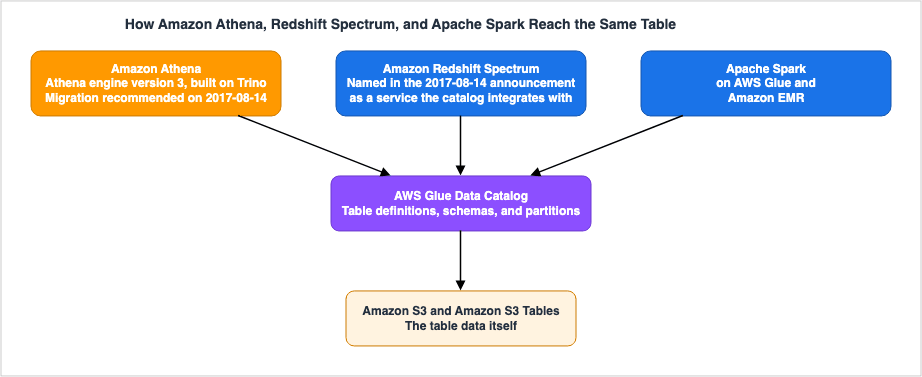
Evidence that Amazon Athena's catalog was being used by other engines can also be found in Amazon Redshift documentation. The CREATE EXTERNAL SCHEMA page of the Amazon Redshift Database Developer Guide states that if Redshift Spectrum uses external tables that rely on Amazon Athena's data catalog, a migration to the AWS Glue Data Catalog is possible. The same page explains that external tables can be created within Amazon Redshift, AWS Glue, Amazon Athena, or applications compatible with Apache Hive Metastore. So even before the AWS Glue Data Catalog arrived, the catalog that Amazon Athena carried was not read by Amazon Athena alone.
The history of the AWS Glue Data Catalog itself is covered in AWS History and Timeline regarding AWS Glue. This article focuses solely on the interactions from Amazon Athena's perspective. As a result of sharing the catalog, features that benefited Amazon Athena include the partition index introduced on November 19, 2021, the cost-based optimizer introduced on November 17, 2023, the AWS Glue Data Catalog views introduced on August 8, 2024, and the materialized views introduced on November 30, 2025. In each case, Amazon Athena uses a feature that lives on the catalog side. What Amazon Athena SQL can and cannot do with these materialized views, who refreshes them, and which engines rewrite queries to use them are covered in Apache Iceberg Materialized Views on AWS.
Data sources were expanded beyond the initial catalog. Preview support for connecting to a self-managed Apache Hive Metastore began on November 26, 2019, and became generally available on June 2, 2020. On May 12, 2021, Amazon Athena gained built-in access to AWS Glue Data Catalogs in other AWS accounts. On December 3, 2024, reads and writes reached Amazon Redshift tables registered in the AWS Glue Data Catalog, and on the same day, the definitions for data source connections began to live in the AWS Glue Data Catalog.
The AWS Data Lakehouse Architecture Guide discusses how to integrate these features within a lakehouse architecture. The Fine-Grained Access Control for AI Data with AWS Lake Formation details the permission model, while Identity-Aware Data Access on AWS addresses workforce identity propagation. What happens when the table a query names is not registered in the AWS Glue Data Catalog at all, and the catalog resolves it against a remote Apache Iceberg catalog instead, is covered by The Iceberg Catalog Layer on AWS.
How Capacity Control Changed
Capacity control began with workgroups as a container, moved on to reserving dedicated capacity, and then gained finer units and per-query visibility.| Date | What the announcement changed |
|---|---|
| 2019-02-18 | Workgroups arrive, letting users, teams, and applications separate query execution and history. Limits could be placed on the amount of data a query or a workgroup could process. At this point, there was no mechanism to secure capacity itself. |
| 2023-04-28 | Dedicated, fully managed capacity becomes available and is assigned to workgroups. It launched in eight regions. |
| 2023-10-31 | Capacity can now be reserved and released after one hour, and is billed on a per-minute basis after the first hour. This marks a change in billing increments. |
| 2023-11-20 | Amazon CloudWatch metrics now report reserved capacity and the DPUs used by each query. |
| 2025-11-21 | DPU limits can be set on a per-workgroup or per-query basis, and per-query DPU usage is now returned by the console and the API. |
| 2026-02-10 | Reservations are now available for as little as one minute, with a minimum of 4 DPUs. |
The workgroups that arrived on February 18, 2019 gave users, teams, and applications a way to separate query execution and history. Limits could be set on the amount of data that a single query or an entire workgroup could process. However, at this time, there was no way to secure capacity directly.
The announcement on April 28, 2023 described Provisioned Capacity as useful when queries should experience minimal to no queuing, and when high-priority workloads that need dedicated compute resources have to be isolated from other workloads in the same account. It launched in eight regions.
On October 31, 2023, the minimum reservation time became one hour, and billing shifted to a per-minute basis after the first hour. This is a change in the billing unit.
On November 21, 2025, users could set Data Processing Unit (DPU) usage at the workgroup or query level, and it became possible to retrieve DPU usage for each query executed, both through the console and the API. On the same day, AWS also published an auto-scaling solution.
On February 10, 2026, reservations came down to one minute, and the minimum capacity fell to 4 Data Processing Units.
The current User Guide describes capacity as follows: Athena measures capacity in Data Processing Units (DPUs). One DPU typically provides 4 vCPUs and 16 GB of memory. Amazon Athena automatically allocates between 4 and 124 DPUs for DML queries, based on query complexity, and uses 4 DPUs per query for DDL queries. A single reservation can hold up to 20 workgroups, and a workgroup belongs to one reservation at a time. When other queries are already using the capacity, Athena puts a newly submitted query in a queue, and the queue holds it for at most 10 hours.
Capacity Reservations are not offered everywhere. The User Guide lists the following commercial regions where they are not currently available: Israel (Tel Aviv), Middle East (UAE), Middle East (Bahrain), and Asia Pacific (New Zealand). This list represents regions excluded from Capacity Reservations, and applies only to commercial regions. This information reflects the state of the documentation as of the time of this article, following the announcement on March 30, 2026, which added 19 additional regions.
The naming is worth recording as well. The current User Guide uses capacity reservations throughout. However, the Release Notes from April 28, 2023, use capacity reservations in the first sentence and Provisioned Capacity in the second. The AWS What's New headings used Provisioned Capacity until March 7, 2025, and switched to Capacity Reservations on November 21, 2025. This article primarily uses the current terminology in the main body, while also referencing the terminology used at the time of each event in the timeline.
Amazon Athena Integration with AWS Services
Currently, the primary AWS services integrated with Amazon Athena are:- Storage and Table Formats: Amazon S3, Amazon S3 Tables, Apache Iceberg, Apache Hudi, Delta Lake.
- Catalog and Governance: AWS Glue Data Catalog, AWS Lake Formation, AWS Identity and Access Management, AWS IAM Identity Center.
- Analytics and Visualization: Amazon Quick Suite, Amazon EMR Studio, Amazon SageMaker Unified Studio, Amazon DataZone.
- Logs and Auditing: AWS CloudTrail, AWS CloudTrail Lake, Amazon CloudFront, Elastic Load Balancing, Amazon S3 Inventory, AWS Systems Manager Inventory.
- Orchestration and Execution Platform: AWS Step Functions, AWS Lambda, AWS CloudFormation, Amazon Virtual Private Cloud.
For broader context, see the following earlier articles: AWS Data Lakehouse Architecture Guide, Zero-ETL Integrations on AWS, AWS History and Timeline regarding Amazon Redshift.
Frequently Asked Questions about Amazon Athena History
When was Amazon Athena announced, and when did it become generally available?
AWS announced Amazon Athena on November 30, 2016, and it became generally available the same day. It opened in two regions: US East (N. Virginia) and US West (Oregon).Which Athena engine version is current, and what happened to versions 1 and 2?
Athena engine version 3. AWS announced it on October 13, 2022, and it is the only engine version for which the current User Guide carries a reference page. The pages for engine version 1 and engine version 2 redirect to an overview page. No announcement giving the date on which those versions stopped being offered was found in the sources this article checked. The User Guide states that AWS Health Dashboard gives notice of when an engine version will no longer be offered, and that once a version is no longer available, Athena upgrades the workgroup whether it is set to upgrade automatically or has a version pinned manually.Is Provisioned Capacity the same thing as Capacity Reservations?
Yes. They are the same feature. The relevant section of the current User Guide uses capacity reservations throughout and does not use Provisioned Capacity. The AWS What's New headings used Provisioned Capacity until March 7, 2025, and switched to Capacity Reservations on November 21, 2025. The first announcement, in the release notes of April 28, 2023, used capacity reservations in the first sentence and Provisioned Capacity in the second, so both terms were present from the start.Does Amazon Athena still charge only for the data that a query scans?
Not only. Charging by the amount of data a query scans is still there, and Capacity Reservations sit alongside it. An announcement dated February 10, 2026, states that you pay only for the capacity you reserve, and that no data-scanned charges apply to it. The User Guide explains that both can be used at the same time in one account.When did Amazon Athena stop requiring that the data be in Amazon S3?
AWS announced Federated SQL Queries on November 26, 2019, and they became generally available on November 13, 2020. Data source connectors running on AWS Lambda query relational, non-relational, object, and custom data sources from a single SQL query. Additional connectors, including those for data warehouses from other cloud providers, became generally available on April 21, 2022. With the introduction of managed connectors on April 23, 2026, the need for users to manage connector resources within their own accounts has also been eliminated.Can you use Amazon Athena without writing SQL?
Yes. AWS announced Amazon Athena for Apache Spark on November 30, 2022, and it runs PySpark applications and Jupyter-compatible notebooks. On November 21, 2025, it also became available from Amazon SageMaker notebooks, running on Apache Spark 3.5.6. The Capacity Reservations section of the User Guide notes that Capacity Reservations do not support workgroups configured to use Apache Spark.Does Amazon Athena support Apache Iceberg table format version 3?
No. The User Guide states that Athena can only create and operate tables using format version 2. Furthermore, the AWS Prescriptive Guidance compatibility matrix lists AWS Glue and Amazon EMR for Apache Spark as AWS services that support format version 3, while Amazon Athena is markedNo. In the sources this article checked, that is still the case as of August 2026. Four primary sources say the same thing in different ways; they are collected, with the error string Athena returns against a V3 table and the engines that do read format version 3, in Apache Iceberg V3 on AWS - Which Engines Read Format Version 3, Where the Official Support Matrices Disagree, and What to Check Before You Upgrade.Summary
This article traces the history of Amazon Athena, outlining its current features and characteristics.Amazon Athena was generally released on November 30, 2016. A single paragraph in its initial announcement contained three premises that this article explores. The data resides in Amazon S3. The access point is standard SQL. Users are charged only for the queries they run, and the basis for that charge is the amount of data scanned.
The first of these premises began to shift between 2019 and 2020. Federated Query expanded to include data sources outside of Amazon S3, and the number of connectors and corresponding catalogs continued to grow. On April 23, 2026, AWS took over running the connectors themselves.
The second premise began to evolve in 2022 with the introduction of Amazon Athena for Apache Spark, providing alternative execution paths beyond SQL. In 2025, it became accessible from Amazon SageMaker notebooks.
The third premise began to change in 2023 with the introduction of Provisioned Capacity, which introduced the concept of dedicated capacity. The minimum reservation time and capacity gradually decreased. An announcement on February 10, 2026, stated that users would be charged only for the provisioned capacity and not for the amount of data scanned. During this period, the term transitioned to Capacity Reservations.
While these three premises were evolving, the underlying SQL engine itself was also being replaced. It began with Presto, was transparently updated in 2018, introduced the concept of versions in 2020, and transitioned to Athena engine version 3, based on Trino, in 2022. This engine replacement was not explicitly mentioned in the initial announcement's three premises, although users are notified of engine version changes.
Given that the premises have changed over time, it raises the question of which version of Amazon Athena was used as the basis for a particular design. This article's timeline sets those differences out in the order they happened.
What Amazon Athena offers next is worth following. This article will be updated to reflect the ongoing changes to Amazon Athena.
Other timelines exist that cover various AWS services and related topics:
- AWS History and Timeline - Almost All AWS Services List, Announcements, General Availability(GA)
- AWS History and Timeline regarding AWS Glue - Overview, Functions, Features, Summary of Updates, and Introduction
- AWS History and Timeline regarding Amazon Redshift - Overview, Functions, Features, Summary of Updates, and Introduction
- AWS History and Timeline regarding Amazon S3 - Focusing on the evolution of features, roles, and prices beyond mere storage
- Cloud Data Warehouse History and Timeline - Separation of Storage and Compute, Open Table Formats, and Convergence with the Data Lake
- AWS Retired Services History and Timeline - Discontinued, Sunset, and Closed-to-New-Customer Services
References:
Tech Blog with curated related content
Written by Hidekazu Konishi