AWS History and Timeline regarding AWS CloudTrail - Overview, Functions, Features, Summary of Updates, and Introduction
First Published:
Last Updated:
This time, I have created a historical timeline for AWS CloudTrail, the service that records who did what, when, and from where across an AWS account — the audit and governance backbone that almost every security, compliance, and incident-response workflow on AWS ultimately depends on.
Just like before, I am summarizing the main features while following the birth of AWS CloudTrail and tracking its feature additions and updates as a "Current Overview, Functions, Features of AWS CloudTrail".
This article focuses on the major, service-level milestones — the launch, the all-regions and multi-trail model, log file integrity validation, the arrival of data events, CloudTrail Insights, organization trails, CloudTrail Lake, and the most recent network activity events — rather than on every minor regional rollout or SDK change. The goal is a single page where a security engineer, auditor, SRE, or governance lead (including those preparing for the AWS Certified Security – Specialty exam) can see when each CloudTrail capability arrived and why it mattered.
Background and Method of Creating AWS CloudTrail Historical Timeline
The reason for creating a historical timeline of AWS CloudTrail is that, since it was announced in 2013, CloudTrail has grown from a single feature — "record management API calls and drop log files in an Amazon S3 bucket" — into a layered audit platform with four distinct event types (Management, Data, Insights, and Network activity), three delivery and analysis targets (Amazon S3, Amazon CloudWatch Logs, and CloudTrail Lake), organization-wide trails, cryptographic log file integrity validation, and a managed query lake. Understanding the order in which these layers arrived is the difference between knowing that CloudTrail can do something and knowing which mechanism to reach for. Therefore, I decided to organize the information of AWS CloudTrail with the following approaches.- Tracking the history of AWS CloudTrail and organizing the transition of updates
- Summarizing the feature list and characteristics of AWS CloudTrail
- Clarifying the boundary between CloudTrail and the adjacent services it is most often confused with (Amazon CloudWatch for metrics and logs, and AWS Config for configuration state), so each timeline entry can be placed in the right mental model
- What's New with AWS?
- AWS News Blog
- AWS Security Blog
- AWS Cloud Operations Blog
- Document history for the AWS CloudTrail User Guide
The content posted is limited to major features related to the current AWS CloudTrail and necessary for the feature list and overview description.
In other words, please note that the items on this timeline are not all updates to AWS CloudTrail features, but are representative updates that I have picked out.
AWS CloudTrail Historical Timeline (Updates from November 13, 2013)
Now, from here is the timeline regarding the features of AWS CloudTrail. AWS CloudTrail was first announced on November 13, 2013, and had to be enabled per region at that time. The history of AWS CloudTrail is therefore well over a decade at the time of writing this article.2013 | 2014 | 2015 | 2016 | 2017 | 2018 | 2019 | 2020 | 2021 | 2022 | 2023 | 2024 | 2025 | 2026
* You can sort the table by clicking on the column name.| Date | Summary |
|---|---|
| 2013-11-13 | AWS CloudTrail is announced. CloudTrail records AWS API calls made in an account and delivers log files to a customer-owned Amazon S3 bucket, giving customers their first native way to answer "who made this API call, when, and from where" for security analysis, compliance, and operational troubleshooting. At launch the service had to be enabled per region. References: Announcing AWS CloudTrail |
| 2014-11-10 | CloudTrail integrates with Amazon CloudWatch Logs. Trails can now stream events to a CloudWatch Logs log group, so customers can build metric filters and alarms on patterns such as AccessDenied or root-account usage and react in near real time, while still delivering log files to Amazon S3 in parallel.References: New – CloudTrail Integration with CloudWatch Logs |
| 2015-10-01 | CloudTrail adds SSE-KMS encryption and log file integrity validation. Log file integrity validation creates an hourly digest file containing SHA-256 hashes of the delivered log files and digital signatures, so auditors can cryptographically prove that log files were not modified or deleted after CloudTrail delivered them. References: CloudTrail announces support for log file encryption using a KMS key and log file integrity validation |
| 2015-12-17 | CloudTrail can be turned on in all regions with a single setting and supports multiple trails. A trail marked for all regions is automatically created in every current and future region, and customers can run multiple trails per region with resource-level permissions, letting security and audit teams own separate trails with different KMS keys and integrity settings. References: AWS CloudTrail Update – Turn on in All Regions and Use Multiple Trails |
| 2016-11-21 | CloudTrail introduces Data Events with Amazon S3 object-level logging. For the first time CloudTrail can record data-plane operations — GetObject, PutObject, and DeleteObject on objects in selected S3 buckets — in addition to control-plane management events, opening up object-level access auditing. Data events are opt-in and are not shown in Event history.References: AWS CloudTrail now supports S3 Data Events |
| 2017-08-14 | CloudTrail Event history becomes available to all customers. Every account gains an always-on, no-setup way to view, search, and download the past 7 days of account activity directly in the AWS CloudTrail console and AWS CLI without configuring a trail — the foundation of the free Event history that exists in every account today. References: AWS CloudTrail Event History Now Available to All Customers |
| 2017-11-30 | CloudTrail adds Data Events for AWS Lambda function invocations. The Invoke API for Lambda functions becomes a new data event type, so teams can capture who invoked which function and when, extending data-plane visibility beyond Amazon S3.References: Amazon CloudTrail Adds Logging of Execution Activity for AWS Lambda Functions |
| 2017-12-12 | CloudTrail Event history extends its free lookback to 90 days of management events. The console and CLI now provide 90 days of management events, up from the previous 7-day limit, and add customizable columns — still with no trail required. References: AWS CloudTrail Enhances Event History View and Search |
| 2018-06-14 | CloudTrail Event history begins showing all management events. Event history is expanded to surface all management events for the account, not just a subset, broadening the free 90-day lookback used for quick investigations. References: Working with CloudTrail event history |
| 2018-08-09 | CloudTrail supports access through interface VPC endpoints (AWS PrivateLink). Calls to the CloudTrail API can be kept on the AWS network via an interface VPC endpoint, removing the need to traverse the public internet for trail management operations. References: Document history for the AWS CloudTrail User Guide |
| 2018-11-19 | CloudTrail adds organization trails through AWS Organizations. A management account can create a single organization trail that is automatically applied to every member account; member accounts can see but cannot modify or delete it, giving security teams a uniform, tamper-resistant logging baseline across the whole organization. References: AWS CloudTrail Adds Support for AWS Organizations |
| 2019-11-21 | CloudTrail Insights is announced. CloudTrail Insights automatically baselines the rate of write management API calls and emits Insights events when it detects unusual spikes or drops, surfacing anomalies such as bursts of provisioning or IAM activity in the console, Amazon S3, and Amazon CloudWatch Events. References: AWS CloudTrail announces CloudTrail Insights |
| 2020-08-13 | CloudTrail Insights adds attribution information to Insights events. Insights events now include the top contributing user identities, user agents, and error codes for an anomaly, shortening the path from "something unusual happened" to "this principal caused it." References: Document history for the AWS CloudTrail User Guide |
| 2020-11-24 | CloudTrail launches advanced event selectors for fine-grained data event logging. Advanced event selectors let customers include or exclude data events by fields such as event source, resource type, and ARN prefix, controlling cost and noise far more precisely than the original basic selectors. References: Document history for the AWS CloudTrail User Guide |
| 2021-03-24 | CloudTrail adds data events for Amazon DynamoDB. Item-level activity on DynamoDB tables becomes loggable as data events with configurable read and write filters, widening data-plane visibility beyond Amazon S3 and AWS Lambda. References: AWS CloudTrail Adds Logging of Data Events for Amazon DynamoDB |
| 2021-08-24 | CloudTrail adds data event logging for Amazon S3 access points. Object-level activity reaching buckets through S3 access points becomes loggable as data events, closing a visibility gap for large shared-bucket architectures. References: Document history for the AWS CloudTrail User Guide |
| 2021-11-11 | CloudTrail Insights adds an API error rate Insights event type. In addition to call-volume anomalies, Insights can now detect unusual surges in API error rates, catching failure patterns such as a misconfigured automation hammering an API and being denied. References: AWS CloudTrail announces the launch of error rate Insights |
| 2022-01-05 | AWS CloudTrail Lake is announced as generally available. CloudTrail Lake is a managed audit and security data lake that aggregates events into immutable event data stores and lets customers run SQL queries directly, with a multi-year default retention — removing the need to build a separate pipeline of Amazon S3, Amazon Athena, and AWS Glue just to query CloudTrail data. References: Announcing AWS CloudTrail Lake, a managed audit and security lake |
| 2022-09-20 | CloudTrail Lake supports importing existing CloudTrail logs from Amazon S3. Customers can backfill a Lake event data store with historical CloudTrail logs already stored in S3, so investigations can reach back before Lake was enabled. References: AWS CloudTrail Lake now supports import of CloudTrail Logs from Amazon S3 |
| 2022-10-21 | CloudTrail Lake adds the ability to save query results to Amazon S3. Query output can be exported to S3 for downstream reporting and sharing, integrating Lake results into existing analytics and evidence-collection workflows. References: AWS CloudTrail Lake now supports exporting signed query results to Amazon S3 |
| 2022-11-11 | CloudTrail Lake supports encrypting event data stores with AWS KMS keys. Customers can apply their own KMS key (SSE-KMS) to a Lake event data store, aligning Lake with the same customer-managed-key controls long available for trail log files. References: AWS CloudTrail Lake supports encryption using customer managed KMS keys |
| 2023-01-31 | CloudTrail Lake supports ingesting activity events from non-AWS sources. Lake can now store and query audit events from on-premises systems, hybrid environments, and SaaS applications alongside AWS events, positioning it as a general-purpose activity store rather than an AWS-only one. References: New – AWS CloudTrail Lake Supports Ingesting Activity Events From Non-AWS Sources |
| 2023-06-13 | CloudTrail Lake adds dashboards to visualize event data. Built-in dashboards let teams chart activity trends from Lake event data stores without exporting data to a separate business-intelligence tool. References: AWS CloudTrail Lake announces curated dashboards for visualizing trends |
| 2023-11-15 | CloudTrail Lake can collect CloudTrail Insights events. Insights events can be ingested into a Lake event data store, so anomaly detections become queryable with SQL alongside the underlying management and data events. References: AWS CloudTrail Lake supports CloudTrail Insights events |
| 2023-11-15 | CloudTrail Lake adds a one-year extendable retention option. Alongside the long-term retention option, customers can choose a shorter, extendable retention tier, letting them match retention to compliance needs rather than defaulting to the maximum window. References: AWS CloudTrail Lake announces a flexible retention option |
| 2023-11-26 | CloudTrail Lake can federate an event data store to the AWS Glue Data Catalog. Federation lets customers query Lake data with Amazon Athena and join it with other catalog-registered datasets, bridging CloudTrail Lake into the broader analytics ecosystem. References: AWS CloudTrail Lake enables zero-ETL analysis in Amazon Athena |
| 2024-02-06 | CloudTrail adds the ListInsightsMetricData API for Insights. The new API exposes Insights metric data programmatically, making it easier to build custom anomaly dashboards and automated responses on top of CloudTrail Insights. References: Document history for the AWS CloudTrail User Guide |
| 2024-06-11 | CloudTrail Lake previews a natural-language query generator. Customers can describe an investigation in plain English and have CloudTrail Lake generate the corresponding SQL, lowering the barrier to ad-hoc security and audit queries. References: AWS CloudTrail Lake announces AI-powered natural language query generation (preview) |
| 2024-09-25 | CloudTrail previews network activity events for VPC endpoints. A fourth event type captures AWS API activity traversing VPC endpoints — including denied attempts — letting teams detect external credential use and strengthen the data perimeter without decrypting TLS traffic. References: AWS CloudTrail launches network activity events for VPC endpoints (preview) |
| 2024-11-13 | CloudTrail Lake makes the natural-language query assistant generally available and previews query-result summarization. Natural-language query generation moves to general availability and a generative-AI feature can summarize query results in plain language, accelerating investigations for non-SQL experts. References: AWS CloudTrail Lake announces AI-powered query result summarization and natural language query generation |
| 2024-11-21 | CloudTrail Lake adds custom, Highlights, and managed dashboards. A redesigned dashboard experience — including an automatically populated Highlights dashboard, customer-defined custom dashboards, and a set of pre-built managed dashboards — gives security and operations teams a faster visual entry point into account activity. References: AWS CloudTrail Lake announces enhanced analytics with managed dashboards and cross-account data access |
| 2024-12-23 | CloudTrail adds support for IPv6. CloudTrail API endpoints become reachable over IPv6 (dual-stack), helping customers operating dual-stack and IPv6-only networks meet connectivity and compliance requirements. References: AWS CloudTrail now supports IPv6 |
| 2025-02-14 | CloudTrail network activity events for VPC endpoints become generally available. The fourth event type reaches general availability across commercial regions, initially supporting services such as Amazon S3, Amazon EC2, AWS KMS, AWS Secrets Manager, and AWS CloudTrail, with VpceAccessDenied filtering for detective controls.References: AWS CloudTrail network activity events for VPC endpoints are now generally available |
| 2025-04-10 | CloudTrail expands network activity events to AWS Lambda and Amazon Comprehend. Additional services become eligible to emit network activity events through their VPC endpoints, widening data-perimeter visibility beyond the initial GA launch set. References: Document history for the AWS CloudTrail User Guide |
| 2025-11-19 | CloudTrail adds data event aggregation to simplify security monitoring. Aggregated events consolidate high-volume data-plane activity into five-minute summaries — showing access frequency, error rates, and frequently used actions — so teams can monitor object-level access at scale without processing every individual event, using pre-built templates for API activity, resource access, and user activity. References: AWS CloudTrail adds data event aggregation to simplify security monitoring |
| 2025-11-20 | CloudTrail launches Insights for data events to detect anomalies in data access. CloudTrail Insights, previously limited to management-API anomalies, now baselines normal data-access patterns and emits Insights events on unusual activity — such as spikes in Amazon S3 delete operations or increased AWS Lambda invocation errors — extending automated anomaly detection to the data plane. References: AWS CloudTrail launches Insights for data events to automatically detect anomalies in data access |
| 2026-05-31 | AWS CloudTrail Lake closes to new customers. Starting on this date, CloudTrail Lake is no longer open to new customers; existing customers can continue to use it, and AWS recommends Amazon CloudWatch for similar capabilities. Core AWS CloudTrail — trails, Event history, Insights, and aggregated events — continues to be fully supported and is unaffected. References: CloudTrail Lake availability change |
AWS CloudTrail's history is best read as the steady accumulation of audit surface around a stable core. The original 2013 promise — record API calls and deliver tamper-evident logs — never went away; instead AWS layered new event types (Data in 2016, Insights in 2019, Network activity in 2024) and new delivery and analysis targets (Amazon CloudWatch Logs in 2014, CloudTrail Lake in 2022) on top of it, and extended the model to organization-wide scope (organization trails in 2018). The most recent inflection — CloudTrail Lake closing to new customers in 2026 while core CloudTrail continues unchanged — is a reminder that the trail-plus-Amazon-S3 foundation has proven far more durable than any single analysis layer built above it.
Current Overview, Functions, Features of AWS CloudTrail
From here, I introduce the current list of AWS CloudTrail features and overview.
AWS CloudTrail is the AWS service that records account activity — API calls and related events — across AWS services, and makes that activity available for governance, compliance, operational auditing, and risk auditing. Event history (the last 90 days of management events) is on by default and free; trails and CloudTrail Lake event data stores provide durable, configurable, and queryable retention beyond that.
A boundary note before we proceed: CloudTrail, Amazon CloudWatch, and AWS Config answer three different questions.
CloudTrail answers "who did what, when, and from where" (the audit log of API activity).
Amazon CloudWatch answers "how is it performing right now" (metrics, logs, and alarms).
AWS Config answers "what does the configuration look like and how did it change over time" (resource configuration state and compliance).
They are complementary, and CloudTrail is frequently the data source the other two — and services such as IAM Access Analyzer, Amazon GuardDuty, and AWS Security Hub — build upon.
Use Cases for AWS CloudTrail
The principal use cases of AWS CloudTrail in current deployments are:
- Security incident investigation — reconstructing exactly which principal performed which actions during an incident, using Event history, trails, or CloudTrail Lake queries
- Compliance and audit evidence — providing tamper-evident, retained records of account activity for frameworks that require audit logging
- Operational troubleshooting — answering "what changed and who changed it" when a resource starts behaving unexpectedly
- Anomaly detection — using CloudTrail Insights to surface unusual management-API call volumes and error rates without writing detection rules by hand
- Least-privilege refinement — feeding CloudTrail activity into IAM Access Analyzer policy generation and Access Advisor to right-size permissions
- Organization-wide logging governance — enforcing a uniform, member-account-immutable logging baseline through organization trails
- Data perimeter enforcement — detecting and alerting on denied or external access at VPC endpoints with network activity events
Specific Examples of Use Cases
- A security team creates an organization trail in the management account so that every member account, present and future, logs to a single central Amazon S3 bucket that member accounts cannot tamper with.
- An auditor enables log file integrity validation and later uses the AWS CLI
validate-logscommand to cryptographically prove that no log file was altered or deleted during the audit period. - An incident responder runs a single SQL query in CloudTrail Lake to list every action taken by a compromised IAM role across all regions and accounts.
- A platform team enables CloudTrail Insights and is alerted to an unusual spike in
RunInstancescalls caused by a runaway automation script. - A data-protection team enables network activity events with
VpceAccessDeniedlogging on their VPC endpoints to detect when credentials from outside the organization attempt to reach internal resources. - A governance team streams CloudTrail events to Amazon CloudWatch Logs and creates a metric filter and alarm that fires whenever the root user signs in.
AWS CloudTrail Key Functions and Features
- Event history — an always-on, free view and search of the last 90 days of management events in every account and region, requiring no trail configuration.
- Trails — customer-defined configurations that deliver events durably to an Amazon S3 bucket and, optionally, to Amazon CloudWatch Logs; trails can be single-region or all-regions, and an organization trail can span an entire AWS Organization.
- CloudTrail Lake — a managed lake of immutable event data stores queryable with SQL, with dashboards, a natural-language query assistant, and the ability to ingest non-AWS sources (note: closing to new customers on 2026-05-31; core CloudTrail is unaffected).
- The four event types:
- Management events — control-plane operations (for example, creating an IAM role or a VPC); logged by default in trails.
- Data events — high-volume data-plane operations (for example, Amazon S3 object-level access, AWS Lambda
Invoke, Amazon DynamoDB); opt-in, controlled by advanced event selectors. - Insights events — anomalies in the rate of write management API calls, in API error rates, and (since 2025) in data-event activity, generated automatically once enabled.
- Network activity events — AWS API activity traversing VPC endpoints, including denied attempts; opt-in and used for data-perimeter monitoring.
- Delivery and analysis targets — Amazon S3 (durable storage), Amazon CloudWatch Logs (metric filters and alarms), CloudTrail Lake (SQL analysis), and Amazon EventBridge / CloudWatch Events (near-real-time, event-driven automation).
- Log file integrity validation — hourly digest files with SHA-256 hashes and digital signatures that let you prove log files were not modified or deleted after delivery.
- Encryption — server-side encryption with AWS KMS keys (SSE-KMS) for trail log files and for Lake event data stores.
- Organization trails and delegated administrator — a management account (or a delegated administrator account) can create and manage trails that apply automatically to all member accounts, which can view but not alter them.
- Advanced event selectors — fine-grained inclusion and exclusion of data events and network activity events by fields such as event source, resource type, ARN prefix, and error code.
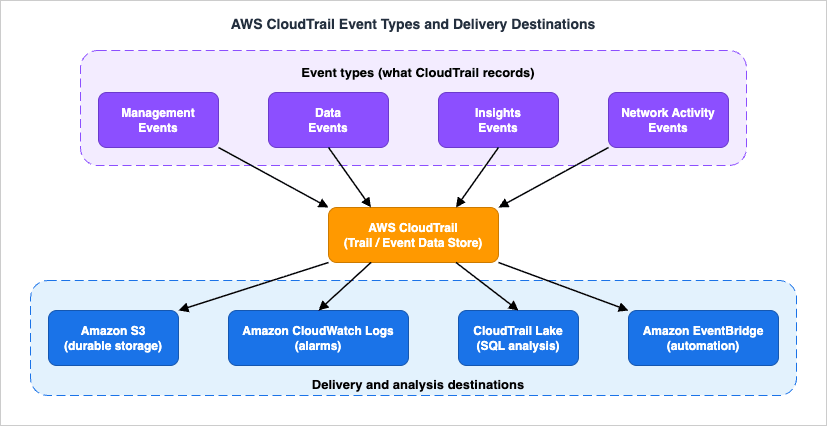
This article follows the dates on which each of those capabilities arrived. For the state they are in now — which of the four event types is on before you configure anything, and which sources outside CloudTrail record identity and control plane activity at all — see Where the Logs Come From on AWS - Identity and the Control Plane, What Is On by Default, and What Is Not Recorded at All.
Integration with Other AWS Services
- AWS IAM — every IAM API call and every
sts:AssumeRoleis recorded by CloudTrail, and this activity is the data source for IAM Access Analyzer policy generation and Access Advisor. The full IAM story is in AWS History and Timeline regarding AWS Identity and Access Management and the AWS IAM Glossary. - AWS KMS — KMS keys encrypt CloudTrail log files and Lake event data stores, and KMS API usage is itself auditable in CloudTrail. The encryption side is covered in AWS History and Timeline regarding AWS KMS.
- AWS Organizations — provides the organization context that makes organization trails and delegated administration possible; the full Organizations story is in AWS History and Timeline regarding AWS Organizations, and multi-account logging design is covered in AWS Multi-Account Operational Patterns.
- Amazon CloudWatch and Amazon EventBridge — receive CloudTrail events for alarming and event-driven automation, and Amazon CloudWatch is also the service AWS now recommends for the audit-lake capabilities formerly served by CloudTrail Lake; the parallel monitoring history is in AWS History and Timeline regarding Amazon CloudWatch, and the broader monitoring vocabulary is in the AWS Observability Glossary.
- Amazon GuardDuty, AWS Security Hub, and AWS Config — consume CloudTrail activity (and, for AWS Config, complement it with configuration state) to detect threats and evaluate compliance. Recurring misconfiguration patterns that CloudTrail helps detect are cataloged in AWS Postmortem Case Studies and Design Lessons.
Frequently Asked Questions about AWS CloudTrail History
The following are direct answers to the most common AWS CloudTrail history and feature questions. Each answer is intentionally short (1–3 sentences) so that it can be lifted directly into AI search results and human conversations alike, and each maps back to a row in the timeline above.
Q1. When did AWS CloudTrail launch?
AWS CloudTrail was announced on November 13, 2013. At launch it recorded management API calls and delivered log files to an Amazon S3 bucket, and it had to be enabled on a per-region basis.
Q2. When could CloudTrail be turned on for all regions by default?
On December 17, 2015, AWS added the ability to turn a trail on for all regions with a single setting and to run multiple trails; a trail marked for all regions is automatically created in every current and future region. Separately, Event history — the free, always-on 90-day view of management events — became available in every account and region by 2017.
Q3. When did CloudTrail add log file integrity validation?
Log file integrity validation, together with SSE-KMS encryption, was announced on October 1, 2015. It creates hourly digest files containing SHA-256 hashes and digital signatures so you can prove log files were not altered or deleted after delivery.
Q4. When did CloudTrail add data events for Amazon S3 and AWS Lambda?
Amazon S3 object-level data events arrived on November 21, 2016 as the first data event type, and AWS Lambda Invoke data events followed on November 30, 2017. Data events are opt-in and are controlled with advanced event selectors, which launched on November 24, 2020.
Q5. When did CloudTrail Insights launch?
CloudTrail Insights was announced on November 21, 2019. It automatically baselines write management API call rates and emits Insights events on unusual activity; an API error-rate Insights type was added on November 11, 2021.
Q6. When did CloudTrail add organization trails?
Organization trails launched on November 19, 2018 through integration with AWS Organizations. A management account creates a single trail that applies to all member accounts, which can see but not modify it.
Q7. When did AWS CloudTrail Lake launch, and is it changing?
AWS CloudTrail Lake became generally available on January 5, 2022 as a managed, SQL-queryable, immutable audit lake. As announced in its availability change, CloudTrail Lake closes to new customers on May 31, 2026 (existing customers are unaffected, and AWS recommends Amazon CloudWatch for similar capabilities); core AWS CloudTrail trails, Event history, and Insights continue to be fully supported.
Q8. When did CloudTrail add network activity events?
Network activity events for VPC endpoints — the fourth event type — were previewed on September 25, 2024 and became generally available on February 14, 2025. They capture AWS API activity traversing VPC endpoints, including denied attempts, for data-perimeter monitoring.
References:
AWS Documentation(AWS CloudTrail User Guide)
AWS Documentation(Document history for the AWS CloudTrail User Guide)
AWS Documentation(Logging data events)
AWS Documentation(Logging CloudTrail Insights events)
AWS Documentation(Logging network activity events)
AWS Documentation(Creating a trail for an organization)
AWS Documentation(CloudTrail Lake availability change)
What's New with AWS?
AWS News Blog
AWS Security Blog
Summary
This article extracted the history of AWS CloudTrail from its 2013 launch as an API-call recorder, through the all-regions and multi-trail model and log file integrity validation in 2015, the arrival of data events (Amazon S3 in 2016, AWS Lambda in 2017), organization trails in 2018, CloudTrail Insights in 2019, advanced event selectors in 2020, the launch of CloudTrail Lake in 2022, and the network activity events of 2024–2025 — ending with the 2026 change that closes CloudTrail Lake to new customers while leaving core CloudTrail fully supported.
The most striking feature of the CloudTrail timeline is how stable its foundation has been: a trail that delivers tamper-evident log files to Amazon S3, with an always-on 90-day Event history, has remained the dependable core while four event types and three analysis targets accumulated around it. For engineers, the practical question is rarely "can CloudTrail see this?" and more often "which event type, delivered to which destination, retained for how long, is the right tool for this audit, detection, or investigation need?"
Looking ahead, the CloudTrail Lake availability change signals that AWS expects audit and security analytics to converge into Amazon CloudWatch's unified data platform, even as the trail-and-Amazon-S3 foundation endures. That makes a clear understanding of CloudTrail's history — and of how it interlocks with AWS IAM, AWS KMS, and Amazon CloudWatch — more valuable than ever for designing durable, vendor-neutral audit pipelines.
In addition, there is also a historical timeline of all AWS services including services other than AWS CloudTrail, so please have a look if you are interested.
AWS History and Timeline - Almost All AWS Services List, Announcements, General Availability(GA)
This timeline will be updated as AWS CloudTrail continues to evolve.
References:
Tech Blog with curated related content