Where AWS Publishes Which Features Exist in Which Region - Capabilities by Region, SSM Public Parameters, and the CloudFormation Registry
First Published:
Last Updated:
These sources differ in the granularity of the information they provide. Some provide answers at the service level, while others provide information at the level of features, API operations, and CloudFormation resource types. They also differ in whether they list planned features, announce changes, are machine-readable, and how they say they are updated. AWS itself acknowledges that these sources may provide different answers. A 2023 AWS DevOps Blog post, for example, stated the following about the CloudFormation registry:
A feature may not yet have CloudFormation support within the region which means it won’t display in the registry, even though the feature may be available via Console or API within the region.The AWS SDK for Python (Boto3) reference documentation states the following about the list of Regions returned by
get_available_regions:The list of regions returned by this method are regions that are explicitly known by the client to exist and is not comprehensive. A region not returned in this list may still be available for the provided service.This article lists nine AWS sources that provide information on regional availability. It maps, in tables with the same columns, the unit each one answers at, whether it shows planned items, whether it notifies you, whether it is machine-readable, and how it says it is updated. It then lists discrepancies between these sources, using AWS's own wording. The article does not specify which source should be used. The information is based on sources including What's New, the AWS News Blog, the AWS Storage Blog, the AWS DevOps Blog, the AWS Infrastructure & Automation Blog, the AWS Builder Center FAQ and pages, individual service documentation, the Boto3 reference, and GitHub README files. The information was verified on October 15, 2026. The
get_regional_availability tool of the AWS Knowledge MCP Server was called on that date (Sections 1.3 and 6.4). The Systems Manager and CloudFormation CLI commands were not run. Pricing information is not included.Related articles on this site:
- Falsehoods AWS Architects Believe About Regions and Availability Zones - What the Names Do Not Tell You, What Opting In Changes, and Which Zones Are Not Availability Zones
- Where AWS Publishes Version End Dates - The AWS Health Version Catalog, DescribeServiceLifecycle, and the Calendars of RDS, Aurora, EKS, Lambda, OpenSearch Service, and ElastiCache
- Endpoint Resolution in the AWS SDKs and CLI - How One Region Name Becomes One URL, Which Layer Wins, and Why the Precedence Lists Do Not Match
- Where the AWS Primary Sources Disagree About Launch Dates - Which Document Systems Carry a Date, What Shapes the Disagreements Take, and Which Date to Record
- Agent Toolkit for AWS and the AWS MCP Server - How IAM, SCPs, and CloudTrail Tell an Agent's Calls Apart, and Where They Cannot
- AWS Secrets Manager and Parameter Store Decision Guide - Storing, Rotating, and Accessing Secrets and Configuration
- AWS History and Timeline regarding AWS Global Infrastructure - Regions, Availability Zones, Summary of Expansions, and Introduction
- AWS Service Lifecycle States - Maintenance, Sunset, Full Shutdown, and What Each One Takes Away
- When Expired Data Is Actually Deleted on AWS - DynamoDB TTL, S3 Lifecycle Expiration, and CloudWatch Logs Retention
- Dependency Cooldowns by Package Manager - Defaults Since Which Version, What Update Bots Do Not Wait For, and the Publish Times CodeArtifact Returns
Table of Contents
- 1. Whether It Is Available in a Region Splits into Six Questions
- 2. How to Read the Tables — Who Sets It, What the Source Says, and Where It Shows
- 3. AWS Capabilities by Region — The Comparison Page People Read
- 4. Sources Built for Machines
- 5. Tables by Source
- 6. Where the Sources Disagree and Which Statements Were Not Found
- 7. Which Sources Answer Each Question
- 8. Failure Modes
- 9. Frequently Asked Questions About Regional Availability Sources
- 10. Summary
- 11. References
1. Whether It Is Available in a Region Splits into Six Questions
This section splits the question of whether something can be used in a Region into six questions, by the unit the sources answer at. It then defines the scope of this article, the date of verification, the sources consulted, and the terminology used throughout this article.1.1 Splitting the Question
The question of whether something can be used in a Region splits into at least six questions. Different sources answer different questions.- Service Availability: For example, is Amazon DynamoDB offered in that Region?
- Feature Availability: Are individual features within a service offered in that Region? A service may be available, but not all of its features (see Section 3.2).
- API Operation Availability: Are individual API operations for the service accessible in that Region?
- CloudFormation Resource Type Availability: For example, can the
AWS::DAX::Clusterresource type be used in templates for that Region? - Endpoint Availability: What is the name of the endpoint for the service in that Region?
- Future Availability: For something not yet offered, is it currently being planned, is there no plan to offer it, or what is the expected timeline for its availability?
The Builder Center FAQ lists the units addressed by AWS Capabilities by Region as follows:
AWS Capabilities by Region goes beyond basic service availability to provide granular visibility into:
Services: Regional availability of AWS services across regions
Features: Specific capabilities within each service
API Operations: Individual API calls and their regional availability
CloudFormation Resources: Infrastructure-as-code resource support (e.g. EC2 Instance types, RDS Engine Versions)
To these four categories, the questions regarding endpoint availability and future plans are added. The
Answers At and Shows Planned columns in this article's tables indicate which of these six categories a source addresses (see Section 2.5).1.2 What This Article Covers, and What It Does Not
This article focuses on three key areas:- Coverage of Each Source: This includes the unit at which each source answers, whether it shows planned items, whether it reports changes, is machine-readable, describes its update process, and what is required to use it.
- Discrepancies Between the Sources: This covers discrepancies identified by AWS itself, as well as examples found on the Knowledge MCP Server during verification.
- Matching Questions to Sources: For each question in Section 1.1, which sources answer it. It does not offer recommendations on which sources to use.
The following topics are covered in other articles on this website. This article will briefly mention them with a single sentence and a link.
- Definitions of Regions and Availability Zones, and enabling Regions: Falsehoods AWS Architects Believe About Regions and Availability Zones covers this. That article's Section 4.5 addresses the fact that even when a Region is enabled (
ENABLED), not all services within that Region may be immediately available. - From Region Name to Endpoint URL: Endpoint Resolution in the AWS SDKs and CLI covers this. This article keeps only one row, on whether the SDK's data can be used to judge availability.
- Discrepancies in Launch Date Documentation: Where the AWS Primary Sources Disagree About Launch Dates covers this. This article does not cover disagreements about launch dates.
- Locations for Publishing Version End Dates: Where AWS Publishes Version End Dates covers this. Similar to this article, it lists locations where AWS publishes information, but the columns in the tables are different.
- Authentication of the AWS MCP Server, and how IAM and CloudTrail tell its calls apart: Agent Toolkit for AWS and the AWS MCP Server covers this. This article only addresses the format of the return value for
get_regional_availability. - General Information on Public Parameters in Parameter Store: Section 5.5 of AWS Secrets Manager and Parameter Store Decision Guide addresses public parameters such as AMI IDs. This article only addresses parameters specific to Regions and services.
- Timeline of Regional Expansion: AWS History and Timeline regarding AWS Global Infrastructure covers this.
In this article, a window is the period between a change in actual service availability and when that change is reflected in a source. It is distinct from the period before expired data is deleted (When Expired Data Is Actually Deleted on AWS) or before a released package is installed (Dependency Cooldowns by Package Manager).
This article does not specify which source should be considered definitive, nor does it recommend which Regions to choose. It also does not include any pricing information.
1.3 The Verification Date and the Sources Read
This article's information was verified on October 15, 2026. The sources consulted are as follows:- Announcements and Blogs: Three What's New announcements (November 6, 2025; June 30, 2026; October 7, 2026). An introductory article from the AWS News Blog on Capabilities by Region (November 6, 2025). An article from the AWS Storage Blog on building Regional availability checks with Amazon S3 (April 9, 2026). An article from the AWS Infrastructure & Automation Blog on Knowledge MCP Server (November 6, 2025). An article from the AWS DevOps Blog on CloudFormation registry (September 8, 2023). An introductory article from Builder Center on feature-level notifications (October 7, 2026).
- Builder Center: The AWS Capabilities by Region section of the FAQ, and the landing page and the comparison page for AWS Capabilities by Region. These pages are rendered in JavaScript, so they were read as rendered in a web browser.
- Documentation: The "Open Source MCP Servers for AWS" page for AWS Knowledge MCP Server. The "Setting up the AWS MCP Server" and "Understanding the MCP Server tools" sections of the Agent Toolkit for AWS user guide. The Systems Manager User Guide page on public parameters for global infrastructure. The "CloudFormation resource provider schemas" section of the CloudFormation Template Reference. The Boto3 Session reference.
- Other: The README file for Capability Insights for AWS on GitHub. The older AWS Services by Region page.
The AWS Knowledge MCP Server's
get_regional_availability tool was called six times on October 15, 2026, without using an AWS account. Details regarding the requests and responses are documented in Section 6.4. The Systems Manager get-parameters-by-path command and the CloudFormation list-types command were not run. Both require AWS credentials (the AWS CLI User Guide page "Authentication and access credentials for the AWS CLI" states, You must establish how the AWS CLI authenticates with AWS when you develop with AWS services.). The format of the output for these two commands is described based on examples in the documentation and the blog.1.4 Distinct Terms with the Same Spelling
This article deals with numerous terms that share the same spelling but refer to different concepts. This article uses the following distinctions:- Region / region: Refers to AWS Regions (e.g.,
ap-northeast-1). The partition (such asaws) that thepartition_nameargument of Boto3'sget_available_regionsrefers to is not a Region. - available / Available /
isAvailableIn: The general term available (meaning usable), the status wordAvailablein Capabilities by Region, and the return valueisAvailableInfrom the Knowledge MCP Server are all distinct terms used in different contexts. This article keeps status words in the spelling of their source (see Section 6.3). - planned /
Planned/Planning/isPlannedIn/isBeingPlannedIn: Terms indicating a planned state vary across sources. The FAQ'sPlannedandPlanningrepresent different states (see Section 3.2). In the sources this article read, no statement was found that clarifies which FAQ words the Knowledge MCP Server'sisPlannedInandisBeingPlannedIncorrespond to (see Section 6.3). - feature: The
Featurerows in Capabilities by Region refer to individual features within a service. The DevOps Blog interprets differences in CloudFormation resource types as distinctions in feature units. This article will refer to the former as "feature" and the latter as "CloudFormation resource type." - registry: In this article, "registry" refers exclusively to the CloudFormation registry, and not to package registries.
- S3 Access Points: AWS distributes availability data from an Amazon S3 access point (see Section 4.1). However,
S3 Access Pointsis also the name of a feature in the availability data (see Section 6.4). This article calls the former the S3 Access Point dataset.
2. How to Read the Tables — Who Sets It, What the Source Says, and Where It Shows
This section defines the columns and terms used in the tables presented in this article. For each source, the tables indicate who determines the window, how the source describes the window, what information is visible, where changes can be observed, and which source provides the supporting evidence, all in the same columns.2.1 Window Columns
The table in Section 5.2 has the following five columns:Who Sets It: Who decides the source's update interval or timing (see Section 2.2).Stated Window: How the source describes its own update frequency and timing. It is written verbatim or as a verbatim summary, and the source's phrasing is kept (e.g.,daily,every 24 hours,not comprehensive).During the Window: What users can see and do during the period between when actual availability changes and when the source reflects that change.Where It Shows: Where a change in the source, or the point in time of its data, is visible to users.Cited From: The name and date of the source that supports this row.
2.2 Values of Who Sets It
The Who Sets It column will contain one of the following five options:AWS (the source's publisher): AWS, the publisher of the source, determines the update frequency and timing.You (your deployment): The mechanism you have deployed in your own account determines the update frequency. In this article, this refers only to Capability Insights.You (when you query): The result reflects the state at the time you made the query. In this article, this applies only to CloudFormation'slist-types.The SDK client: The scope of the answer is limited to what the SDK client you are using knows. In this article, this applies only to Boto3'sget_available_regions.The source does not say.: The source does not specify who determines this.
2.3 How to Write Stated Window and During the Window
The Stated Window column should describe the language a source uses regarding its own updates, either verbatim or as a verbatim summary. Examples of terms used in this article include: refreshed daily, auto-refreshes every 24 hours, updated daily, updates as AWS launches new capabilities, a point in time snapshot, and is not comprehensive. If the source does not specify, write The source does not say.The
During the Window column should describe what users might see within that timeframe. For example, whether the data itself carries the time it was updated, or whether something not in a list may still be available.2.4 How to Write Where It Shows
The Where It Shows column indicates where users can see changes to the data or the data's timestamp. This includes notifications (both in-app notifications and emails), file fields associated with the data (such as manifest.json's last_updated), and fields visible in output examples (e.g., LastUpdated, LastModifiedDate). When describing fields in output examples, only list the fields that are actually visible in the example. Do not state what timestamp a field represents if the source does not specify it.2.5 Columns for What a Source Answers and What It Takes to Use It: Answers At, Shows Planned, Notifies, Machine-Readable, What You Need
Sections 5.1 and 5.3 utilize the following columns. In these columns, write No statement found for any cell where no statement is found:Answers At: The unit the source answers at. Specify one or more of the following:Service,Feature,API operation,CloudFormation resource type,Endpoint.Shows Planned: Indicates whether the source describes planned features or provides estimated availability timelines for features that are not yet available. Specify the source and the corresponding unit. Write only what the source states it shows; if no statement is found, writeNo statement found.Notifies: Indicates whether the source describes mechanisms for notifying users of changes in service availability.Machine-Readable: Indicates whether the source is available in a machine-readable format (e.g., file format, API, MCP tools).What You Need: Lists the requirements for using the source (e.g., an AWS account, a Builder ID, AWS credentials).
2.6 How to Write Dates and Verification Dates
The dates for What's New should be based on thepostDateTime (UTC) of the announcement. For blog posts, use the publication date specified in the article. For documentation, FAQs, pages, and README files, use the page name and verification date (October 15, 2026). For responses from the Knowledge MCP Server, use the content of the query and the date the query was made.2.7 When the Source Does Not Say, and When Sources Disagree
Only include the source's information (or a summary of it) in the table cells. If the source does not provide information for a cell in the window columns, writeThe source does not say. Before writing this, search the full text of the source document, the link the source references, and another page from the same provider. If the source only mentions general principles and does not specifically address the topic of a particular row, do not write The source does not say. Instead, write the general principle in the cell and note that the row's subject is not named.When the sources disagree, list both descriptions, each with its corresponding source attribution, without favoring either. Disagreements between sources are summarized in Section 6.
3. AWS Capabilities by Region — The Comparison Page People Read
This section describes when AWS Capabilities by Region in AWS Builder Center was released, the units it shows information at, and what it notifies you about. Finally, it outlines the status of the older AWS Services by Region page.3.1 First Announced on November 6, 2025; Feature-Level Notifications on October 7, 2026
The initial announcement of AWS Capabilities by Region was made on November 6, 2025, in What's New. The announcement begins with the following sentence:Today, AWS announced a new tool called AWS Capabilities by Region in Builder Center.On the same day, the AWS News Blog also published an introductory article.
The What's New announcement on October 7, 2026 announced feature-level notifications and filters for API operations and CloudFormation resource types. The title was as follows:
AWS Capabilities by Region now offers availability notifications for individual features and advanced filtersThis announcement was not the introduction of a new tool, but rather an addition to the tool released on November 6, 2025. The announcement released on October 7, 2026, gives the following numbers:
With over 19,000 API operations and more than 5,000 CloudFormation resource types, these filters quickly narrow a full listing down to the exact differences between Regions, working alongside search and existing display preferences.These numbers are the values in the October 7, 2026 announcement.
3.2 Units and Status Words — Planned Items Appear Only on the Services and Features Tab
The comparison page has three tabs:Services and features, API operations, and CloudFormation resources (as of October 15, 2026). The Services and features tab lists services and the features associated with them.The displayed status words vary depending on the tab. The Builder Center FAQ categorizes unavailable items into three states in the
Availability filter of the Services and features tab.Not Expanding. There is no plan to bring the capability to that Region.
Planned. AWS has published an intent to expand, with a target quarter.
Planning. AWS is evaluating a launch, with no date yet.Regarding the API operations and CloudFormation resources tabs, the FAQ states:
The API operations and CloudFormation resources tabs have Availability and Region comparison, without Planning timeframe, because availability there is either Available or Unavailable with no planned dates to filter by.In essence, in Capabilities by Region, information on planned features and the expected quarter is only available for services and their associated features. For API operations and CloudFormation resource types, only
Available or Unavailable is shown. Whether or not planned items are shown depends not on the source itself, but on the combination of the source and the specific unit (Section 6.2).Even if a service is listed as
Available, it does not necessarily mean that all of its associated features are available. The FAQ explains why a notification bell might appear even when a service is listed as Available.Because the service is available there but at least one of its features is not.An introductory article from the AWS News Blog (dated November 6, 2025) lists the status words in the following order:
The result will indicate availability using the following states: Available (live in the region); Planning (evaluating launch strategy); Not Expanding (will not launch in region); and 2026 Q1 (directional launch planning for the specified quarter).The FAQ also mentions the same four status words and notes that when filtering, shorter names are used. The status displayed for a quarter is referred to as
Planned when filtering.The Availability filter uses shorter names for the same states: Available, Not Expanding, Planning for a launch being evaluated, and Planned for a capability dated to a quarter.The values of the
Planning timeframe filter include not only the specified quarter but also all subsequent quarters. The FAQ explains this as follows:Each option is a lower bound rather than an exact match, so After 2027 Q1 covers everything planned from that quarter onward, not only that quarter.The comparison page describes the nature of information on planned features as follows (as displayed on October 15, 2026).
Forward-looking roadmap information is provided as directional guidance to help with architecture planning activities.3.3 Comparison and Notification Conditions
Using the comparison page does not require an AWS account. To configure notifications, you will need a Builder ID. The What's New announcement on October 7, 2026 describes comparing as follows:Comparing capabilities in AWS Capabilities by Region requires no account.Notifications exist only on the
Services and features tab. The FAQ describes this as follows:Availability notifications are available on the Services and features tab.The rows and columns you select determine the scope of notifications. When you select a service row, all features of that service in that Region are included. When you select a feature row, only that specific feature is included. Selecting the
All regions (incl. future) column includes all Regions, including those that will be launched in the future. The What's New announcement from October 7, 2026, describes how notifications are delivered as follows:receive an in-app notification and a weekly email digest covering all the capabilities that became available since you enabled availability notificationsThe FAQ states that notifications in the app are delivered near real time, and weekly emails are not sent if there are no changes.
If no changes occurred during the week for services you signed up for, no email is sent.The FAQ also describes the number of Regions that can be compared as follows:
You can analyze all applicable AWS Regions simultaneously.The Knowledge MCP Server can handle a maximum of 10 Regions per query, and multi-Region queries need
filters (see Section 4.3).3.4 What the Source Says About Its Own Data
The Builder Center FAQ states the following regarding data accuracy and freshness:AWS Capabilities by Region data is the authoritative source for regional availability information. The system updates as AWS launches new capabilities.This article cites that statement as AWS's description of its own data. It does not offer any recommendations on which source should be considered definitive. The FAQ does not specify the frequency of updates or provide a timestamp indicating the data's current state. No display of the data's point in time was found on the comparison page either (as of October 15, 2026).
The sources this article read do not describe a function to export data from the page as a file. When searching the FAQ using terms like
export, download, CSV, and JSON, the only results were related to exporting personal data associated with a Builder ID. On October 15, 2026, the Actions menu on the comparison page, accessed without signing in, included options for Notify me and Add or remove regions. The sources this article read indicate that, for machine-readable data on regional capabilities, the relevant information can be found in the S3 Access Point dataset (Section 4.1) and the Knowledge MCP Server (Section 4.3). Capability Insights (Section 4.2) obtains data from the S3 access point.3.5 The Older AWS Services by Region Page
The page also called the AWS Regional Services List (regional-product-services) was still displayed without a redirect on October 15, 2026. The page title was AWS Services by Region, and below the title there is a button with the following text:Explore AWS Capabilities by Region: Details about regional capabilities & timelinesBelow the page's heading
List of AWS Services Available by Region, there is the following sentence:The AWS Services List is updated daily.The sources this article read did not contain any statement that this page was replaced by Capabilities by Region or retired (see Section 6.5). This article will describe the page as it existed on the date of verification, without stating that it was replaced.
4. Sources Built for Machines
This section covers seven sources of availability information that machines can read: the S3 Access Point dataset, Capability Insights, theget_regional_availability tool of the Knowledge MCP Server, Systems Manager public parameters, the CloudFormation registry, CloudFormation resource type schemas, and Boto3's get_available_regions method.4.1 The S3 Access Point Dataset
An article on the AWS Storage Blog (April 9, 2026) introduces how AWS distributes the availability data through an Amazon S3 access point. The data consists of three categories, as outlined in the article's table:- Services & features (
products) - APIs (
apis) - CloudFormation resources (
cfn_resources)
The data is provided in JSON, CSV, and Apache Parquet formats. JSON-LD is marked
Coming soon (in the article as read on October 15, 2026). The article notes the following regarding updates:Data is refreshed daily and published to the S3 Access Point. Each dataset includes a manifest.json with metadata, including the last updated timestamp, so you always know how fresh the data is.Among the sources this article read, this is the only one that says a metadata file included with the data carries the data's point in time. Users can verify the version of the data they have by checking the
last_updated field under manifest.json.The conditions for using it are the opposite of those for the Capabilities by Region comparison page. The article specifies that the data is only accessible to authenticated AWS principals.
This data is published through an S3 Access Point and available to all authenticated AWS Principals.The same article also states that no prior registration is required on the user's side (
no onboarding is required). The necessary IAM policies, access point names, and example commands are provided in the article's instructions. This article does not reproduce the access point's ARN or alias.Regarding the values representing the data's status, the example code in the article only checks whether the
regionalAvailability value is Available. The article does not list any other values (such as those indicating planned availability), as noted in Section 6.5.4.2 Capability Insights
Capability Insights for AWS is an open-source dashboard announced in What's New on June 30, 2026. You deploy it into a VPC in your own AWS account. The announcement describes data updates as follows:The dashboard auto-refreshes every 24 hours with AWS capabilities data across all Regions, covering services, features, API operations, and CloudFormation resource types.The GitHub README states the same thing as
refreshes automatically every 24 hours, explaining that rules in the user's account (EventBridge rules) trigger a Lambda function to retrieve data every 24 hours. The README's parameter description regarding data sources states:S3 access point ARN for the capability data source (provided during onboarding).The README lists what the dashboard covers as follows. For services and features, it shows expected launch dates and expansion plans.
Services and features — availability status, expected launch dates, and expansion plans per region
API operations — individual API action availability per region for each AWS service
CloudFormation resource types — which resource types are supported in each region
The README describes status values as
Available, Planning, Not Expanding, and uses timeline notations such as 2026 Q3. A filtering example in the same README also uses Planned (Section 6.3).4.3 AWS Knowledge MCP Server's get_regional_availability
The AWS Knowledge MCP Server is a remote MCP (Model Context Protocol) server operated by AWS. The documentation page describes the status as follows:This MCP server is in general availability.The same page describes the tool for regional availability information as follows:
get_regional_availability: Retrieve AWS regional availability information for Services, Features, SDK service APIs and CloudFormation resourcesThe same page also states that no authentication is required and that rate limits apply:
The Knowledge MCP server does not require authentication but is subject to rate limits.On November 6, 2025, the What's New announcement indicated that, coinciding with the release of Capabilities by Region, the Knowledge MCP Server had been updated to include regional availability information. The announcement says that MCP clients can get real-time insights (
real-time insights into regional service availability).On October 15, 2026, the description of the tool retrieved from the server included the following three lines:
- Max 10 regions; multi-region needs `filters`; single-region supports `next_token`.
- Status: isAvailableIn | isNotAvailableIn | isPlannedIn | Not Found.
- Response key: products | service_apis | cfn_resources.
In a query, the
resource_type parameter should be set to one of the following: product (services and features), api (API operations for SDK services), or cfn (CloudFormation resource types). The keys in the response are products, service_apis, and cfn_resources, respectively.The
Status: line of the tool description lists three words and Not Found, but the responses this article got on October 15, 2026 included words not in the description. When querying for product information, the response included isBeingPlannedIn and isNotExpandingIn. isPlannedIn entries and some isBeingPlannedIn entries carried a launch_date (e.g., 2026 Q4). For api and cfn queries, only isAvailableIn and isNotAvailableIn were returned. The queries are listed in Section 6.4.The Agent Toolkit for AWS user guide recommends that users of the Knowledge MCP Server switch to the AWS MCP Server.
If you are currently using the AWS API MCP Server or AWS Knowledge MCP Server, we recommend switching to the AWS MCP Server.This is a recommendation for switching, and not an announcement of the Knowledge MCP Server's end-of-life. The AWS MCP Server also has a tool with the same role. The "Understanding the MCP Server tools" page of the same user guide states:
aws___get_regional_availability - Check AWS regional availability information for services, features, SDK APIs, and CloudFormation resources.How the AWS MCP Server authenticates, and how IAM and CloudTrail tell its calls apart, are covered in Agent Toolkit for AWS and the AWS MCP Server. This article did not call
aws___get_regional_availability in the AWS MCP Server.4.4 Systems Manager Public Parameters
Systems Manager Parameter Store places publicly available parameters under the/aws/service/global-infrastructure path. The Systems Manager user guide states that this path allows you to retrieve information such as Region, service, endpoint, and Availability Zone.The units it answers at are the combination of service and Region, and the endpoint. The user guide provides an example of how to retrieve a list of Regions where a particular service is available using the following command:
aws ssm get-parameters-by-path \
  --path /aws/service/global-infrastructure/services/ssm/regions \
  --query 'Parameters[].Value'
The following parameter is an example of an endpoint:
aws ssm get-parameter \
  --name /aws/service/global-infrastructure/regions/us-east-2/services/ssm/endpoint \
  --query 'Parameter.Value'
This page's path and examples do not include information on features, API operations, or CloudFormation resource types. While you can retrieve information about which Regions a service is available in, this page does not provide details on the specific features available within those Regions.
Only some Regions accept queries for this path. The user guide's note begins as follows:
Currently, the path /aws/service/global-infrastructure is supported for queries in the following AWS Regions only:Following the note is a list of Regions that can be queried. The user guide states that if you are working in a commercial Region not listed, you can specify a Region from the list using the
--region parameter when querying. This article does not give a count for that list. The list and the example output are as the page showed them on the verification date.Information on update frequency or when parameters are updated is not found on this page (Section 6.5). The example output for Availability Zones on this page includes a
LastModifiedDate field for each parameter.General information on public parameters, such as AMI IDs, is covered in Section 5.5 of the AWS Secrets Manager and Parameter Store Decision Guide.
4.5 CloudFormation Registry and Resource Type Schemas
The CloudFormation registry is Region-specific. An article on the AWS DevOps Blog (September 8, 2023) demonstrates how to extract publicly available resource types from two different Regions and compare the differences. You can retrieve a list for a single Region using the following command:aws cloudformation list-types --visibility PUBLIC --filters Category=AWS_TYPES --region us-east-2 --output text --query 'TypeSummaries[*].[TypeName]'The article suggests running the same command with different
--region parameters and then comparing the two outputs using the diff command. In the example output provided in the article, each resource type includes a LastUpdated field. The article notes that to query a newly launched Region, you must first enable that Region. Enabling Regions is discussed in Falsehoods AWS Architects Believe About Regions and Availability Zones.The article concludes with four key points to consider; three of them are limitations of this method. First, the results reflect the data available at the time the query was performed.
This is a point in time snapshot of a region’s service offerings and service teams are regularly adding services and features following a new region launch.Second, it references a statement quoted at the beginning of this article, noting that there may be features not present in the registry. Third, it points out that this method does not provide information about the properties within each resource type.
This solution will not provide details on the properties available within a resource type.The same article also introduces a Region Comparison Tool that allows you to compare two Regions. This is a tool as described in the 2023 article.
The details of resource types are available in the schemas provided by the CloudFormation resource providers. The CloudFormation Template Reference provides zip files containing Region-specific schemas and states the following:
Resource availability may vary by Region. To check the availability of a resource in a given Region, refer to the resource provider schemas for that Region.These schema files are JSON files that define the properties and attributes of resources. The page states that each Region's zip file contains schema files for the resources available in that Region. However, the page does not provide information about how frequently these schema zip files are updated.
4.6 SDK Endpoint Data — Boto3's get_available_regions
Boto3's Session get_available_regions method returns a list of Regions and endpoint names for a given service. As mentioned at the beginning of this article, the Boto3 documentation states that this list is not comprehensive. A service may be available in Regions not included in the list. However, the reference does not state that all features of a service are available in every Region the list includes. The response unit is a combination of service and Region. The process by which a Region name translates into an endpoint URL is detailed in Endpoint Resolution in the AWS SDKs and CLI.5. Tables by Source
This section provides tables that correlate the nine sources from Sections 3 and 4, using three tables. Section 5.1 addresses what each source answers, Section 5.2 addresses windows, and Section 5.3 outlines the conditions for use. The rows in the tables are organized according to the order of sources in Sections 3 and 4, and do not reflect any particular priority. The verification date is October 15, 2026.5.1 What Each Source Answers
| Source | Answers At | Shows Planned | Notifies |
|---|---|---|---|
| AWS Capabilities by Region | Service, Feature, API operation, CloudFormation resource type | Services and features only: Planned (with a target quarter), Planning, Not Expanding. API operations and CloudFormation resources: Available or Unavailable only | Yes, Services and features tab only: in-app notification and weekly email digest; needs a Builder ID |
| S3 Access Point dataset | Service and feature (products), API operation (apis), CloudFormation resource type (cfn_resources) | No statement found (the blog's example code checks only for Available) | No statement found |
| Capability Insights | Service, Feature, API operation, CloudFormation resource type | Services and features: availability status, expected launch dates, and expansion plans | No statement found |
AWS Knowledge MCP Server (get_regional_availability) | Service and feature (product), API operation (api), CloudFormation resource type (cfn) | Tool description lists isPlannedIn. On 2026-10-15, product queries also returned isBeingPlannedIn, isNotExpandingIn, and launch_date; api queries returned isAvailableIn only and cfn queries returned isAvailableIn and isNotAvailableIn | No statement found |
SSM public parameters (/aws/service/global-infrastructure) | Service, Endpoint (also Availability Zone) | No statement found | No statement found |
CloudFormation registry (list-types) | CloudFormation resource type | No statement found | No statement found |
| CloudFormation resource provider schemas | CloudFormation resource type, with its properties and attributes | No statement found | No statement found |
Boto3 get_available_regions | Endpoint names for a service | No statement found | No statement found |
| AWS Services by Region page | Service | General rules only: core services are included in all Region launches, and other listed services usually launch within 12 months of a new Region launch; no Region or item is named | No statement found |
5.2 Windows — Who Sets It, What the Source Says, and Where It Shows
| Source | Who Sets It | Stated Window | During the Window | Where It Shows | Cited From |
|---|---|---|---|---|---|
| AWS Capabilities by Region | AWS (the source's publisher) | updates as AWS launches new capabilities | The source does not say. | In-app notification (near real time) and weekly email digest, Services and features only | Builder Center FAQ (checked 2026-10-15) |
| S3 Access Point dataset | AWS (the source's publisher) | refreshed daily | The dataset carries its own timestamp | manifest.json, last_updated | AWS Storage Blog, 2026-04-09 |
| Capability Insights | You (your deployment) | auto-refreshes every 24 hours (an EventBridge rule in your account) | The source does not say. | The README says chat answers show the catalog's freshness date | What's New 2026-06-30; GitHub README (checked 2026-10-15) |
| AWS Knowledge MCP Server | AWS (the source's publisher) | real-time insights (announcement wording) | The source does not say. | The source does not say. | What's New 2025-11-06; tool description (checked 2026-10-15) |
| SSM public parameters | The source does not say. | The source does not say. | The source does not say. | LastModifiedDate appears in the page's example output for Availability Zones | Systems Manager User Guide (checked 2026-10-15) |
CloudFormation registry (list-types) | You (when you query) | a point in time snapshot | A feature may be available via Console or API without being in the registry | LastUpdated appears in the blog's example output | AWS DevOps Blog, 2023-09-08 |
| CloudFormation resource provider schemas | The source does not say. | The source does not say. | The source does not say. | The source does not say. | CloudFormation Template Reference (checked 2026-10-15) |
Boto3 get_available_regions | The SDK client | is not comprehensive | A Region not returned may still be available for the service | The source does not say. | Boto3 Session reference (checked 2026-10-15) |
| AWS Services by Region page | AWS (the source's publisher) | updated daily | The source does not say. | The source does not say. | AWS Services by Region page (checked 2026-10-15) |
5.3 What It Takes to Use Each Source
| Source | Machine-Readable | What You Need |
|---|---|---|
| AWS Capabilities by Region | No export from the page found; the FAQ says AWS Capabilities by Region includes an MCP server | No account to compare; a Builder ID for notifications |
| S3 Access Point dataset | Yes: JSON, CSV, Parquet (JSON-LD: Coming soon) | An authenticated AWS principal allowed to call s3:GetObject |
| Capability Insights | Yes: a dashboard and an API inside your VPC | An AWS account to deploy into; the source access point ARN (the README gives it for the public data set, which needs no onboarding) |
| AWS Knowledge MCP Server | Yes: an MCP tool | No AWS account and no authentication; rate limits apply; up to 10 Regions per query (multi-region needs filters) |
| SSM public parameters | Yes: Systems Manager API and AWS CLI | AWS credentials; query from a Region the page lists |
CloudFormation registry (list-types) | Yes: CloudFormation API and AWS CLI | AWS credentials; an opt-in Region must be enabled first |
| CloudFormation resource provider schemas | Yes: JSON schema files in a zip file per Region | No statement found |
Boto3 get_available_regions | Yes: an SDK method | Boto3 |
| AWS Services by Region page | No: a web page | No statement found |
6. Where the Sources Disagree and Which Statements Were Not Found
This section will list instances where the sources may provide differing results, using AWS's own wording. For each discrepancy, this article does not assert that either source is incorrect. Finally, it compiles a list of information that this article was unable to locate in the sources it read.6.1 Disagreements That AWS Itself Describes
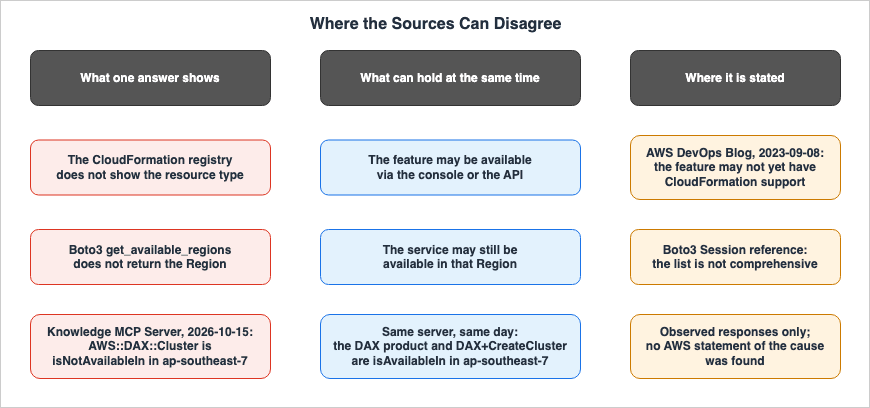
In the sources this article read, AWS itself describes two places where sources can give different answers.The first concerns the discrepancy between the CloudFormation registry and the console/API. A DevOps Blog post (September 8, 2023), cited earlier in this article, states that even if a feature is available through the console or API, it will not appear in the registry if CloudFormation does not yet support it. The same article lists the following question as one that the Region Comparison Tool answers:
API presence – if CloudFormation shows a service is unavailable in my compared Region, is the API for that service present? This may indicate that a service is present and CloudFormation support is not yet launched.The second discrepancy lies between the data provided by the SDK and the actual service availability. The Boto3 reference documentation states that the list returned by
get_available_regions is not comprehensive, and that it may be possible to use Regions not listed (Section 4.6).In both cases, the source itself refutes the interpretation that something is unusable if it is not listed. Neither of these sentences explicitly states that something is usable simply because it is listed.
6.2 Whether Planned Items Appear Depends on the Source and the Unit
Some sources disclose information regarding planned features, while for others no such statement was found. Furthermore, even in the same source, the level of detail provided can vary depending on the unit being examined.| Source | Services and Features | API Operations | CloudFormation Resource Types |
|---|---|---|---|
| AWS Capabilities by Region | Planned (with a target quarter), Planning, Not Expanding | Available or Unavailable only | Available or Unavailable only |
| Capability Insights | Availability status, expected launch dates, and expansion plans | No statement found | No statement found |
| AWS Knowledge MCP Server | On 2026-10-15: isPlannedIn, isBeingPlannedIn, isNotExpandingIn, with launch_date on some | On 2026-10-15: isAvailableIn only (2 operations, 2 Regions) | On 2026-10-15: isAvailableIn and isNotAvailableIn only |
| S3 Access Point dataset | No statement found | No statement found | No statement found |
| SSM public parameters, CloudFormation registry, CloudFormation schemas, Boto3 | No statement found | No statement found | No statement found |
| AWS Services by Region page | General rules only: core services are included in all Region launches, and other listed services usually launch within 12 months of a new Region launch | No statement found | No statement found |
The disclosure of planned features is not limited to AWS Capabilities by Region. Capability Insights and the Knowledge MCP Server also provide this information, broken down by service and feature. The
api and cfn columns for the Knowledge MCP Server represent a limited set of values observed from a small number of queries, and do not reflect the full range of potential values that the tool may return.6.3 Status Words Differ by Where They Appear
Even terms that appear to describe the same state may have different spellings depending on the source. This article lists the terms as they are used in each source. It states a correspondence between words only where a source states it.| Where | Words Used | Cited From |
|---|---|---|
| AWS News Blog | Available, Planning, Not Expanding, and a quarter such as 2026 Q1 | AWS News Blog, 2025-11-06 |
| Builder Center FAQ (states) | Available Service, Planning Service, Not Expanding, YYYY QQ | Builder Center FAQ (checked 2026-10-15) |
| Builder Center FAQ (Availability filter) | Available, Unavailable; under Unavailable: Not Expanding, Planned, Planning | Builder Center FAQ (checked 2026-10-15) |
| Capability Insights README | Available, Planning, Not Expanding, and date indicators such as 2026 Q3; Planned in a filtering example | GitHub README (checked 2026-10-15) |
| S3 Access Point dataset (example code) | Available | AWS Storage Blog, 2026-04-09 |
| AWS Knowledge MCP Server (tool description) | isAvailableIn, isNotAvailableIn, isPlannedIn, Not Found | Tool description (checked 2026-10-15) |
| AWS Knowledge MCP Server (responses) | isAvailableIn, isNotAvailableIn, isPlannedIn, isBeingPlannedIn, isNotExpandingIn | Queries on 2026-10-15 (Section 6.4) |
The FAQ states that when the display shows a quarterly format (
YYYY QQ), it falls under Planned in the filter (Section 3.2). The sources this article read do not contain any text that clarifies which terms from the Knowledge MCP Server correspond to specific words on the page or in the FAQ (Section 6.5). While the FAQ uses Planning to represent a state without a specific date, in the isBeingPlannedIn entries returned on October 15, 2026, there were both instances where the launch_date field was present and instances where it was absent. This article does not equate isBeingPlannedIn with Planning or isPlannedIn with Planned.The descriptions of the
Show only common across selected regions option on the comparison page also differ between sources. The FAQ's description of the filter and the Builder Center article on feature-level notifications (for the API operations and CloudFormation resources tabs) say that it keeps rows with the same status in every selected Region. The FAQ's answer to the question about common capabilities and differences and the News Blog describe it as an option for finding capabilities available in every selected Region. The verbatim wording is listed in Section 8.6.4 Examples Observed on the Verification Date with the Knowledge MCP Server — DAX and S3 Access Points in ap-southeast-7
On October 15, 2026, this article made six calls to the get_regional_availability tool of the Knowledge MCP Server, without using an AWS account. The Regions used were ap-northeast-1 and ap-southeast-7. The following table shows three of the responses related to DAX.| Query | Item | ap-northeast-1 | ap-southeast-7 |
|---|---|---|---|
resource_type=product, filtered | Amazon DynamoDB Accelerator | isAvailableIn | isAvailableIn |
resource_type=api, filtered | DAX+CreateCluster | isAvailableIn | isAvailableIn |
resource_type=cfn, filtered | AWS::DAX::Cluster | isAvailableIn | isNotAvailableIn |
On this day, DAX in
ap-southeast-7 was reported as isAvailableIn for both products and API operations, but isNotAvailableIn when considering CloudFormation resource types. This pattern is consistent with a general observation documented in the DevOps Blog, where a service may be available through the console or API but not yet supported in CloudFormation (see Section 6.1). However, no AWS statement of the reason for this instance could be found in the sources this article read. This article will not attempt to provide a reason for this specific example. The status may change after the verification date.On the same day, responses to queries about the status of the same item sometimes varied depending on the query itself. For
S3 Access Points in the ap-southeast-7 Region, the initial query without any filters returned isPlannedIn and a launch_date of 2026 Q4. Subsequently, three queries using filters all returned isBeingPlannedIn and a launch_date of 2026 Q4. No documentation explaining the reason for this discrepancy was found. This article does not attempt to explain the reason for this difference. To facilitate future comparisons when answers differ, the content and date of each query can be recorded.The six queries made for this article are detailed below:
| No | resource_type | regions | filters |
|---|---|---|---|
| 1 | cfn | ap-northeast-1, ap-southeast-7 | AWS::Lambda::Function, AWS::DAX::Cluster |
| 2 | product | ap-southeast-7 | (none; first page with next_token) |
| 3 | api | ap-northeast-1, ap-southeast-7 | DAX+CreateCluster, Lambda+CreateFunction |
| 4 | product | ap-northeast-1, ap-southeast-7 | Amazon DynamoDB Accelerator, S3 Access Points |
| 5 | product | ap-southeast-7 | S3 Access Points, S3 Multi-Region Access Points, Lambda Code Scanning |
| 6 | product | ap-northeast-1, ap-southeast-7 | Same as No. 5 |
In addition to these queries, one query was made with an incorrect filter value, resulting in an error message indicating that the value did not exist. This instance is not included in the count of six.
6.5 Statements Not Found
The following table lists descriptions that could not be located in the sources read for this article. The absence of a description does not constitute proof of non-existence. The table lists the sources and terms that were searched for.| What Was Looked For | Where It Was Looked For | Search Terms | Result |
|---|---|---|---|
| A feature that exports Capabilities by Region data from the page | Builder Center FAQ; the comparison page rendered without signing in on 2026-10-15 | export, download, CSV, JSON | In the FAQ, the only matches are in the section on exporting a Builder ID's personal data. The page's Actions are Notify me and Add or remove regions |
| The update frequency of Capabilities by Region data and a display of its point in time | Builder Center FAQ; the comparison page; two What's New announcements; the News Blog post | daily, refresh, updated, last updated | The FAQ says only The system updates as AWS launches new capabilities. |
| A statement that the older AWS Services by Region page was replaced or retired | The older page; two What's New announcements; the News Blog post; Builder Center FAQ | Regional Services, Services by Region, replace, retire | 0 matches. The older page has a button to Capabilities by Region |
| The update frequency of Systems Manager public parameters | The Systems Manager User Guide page on global infrastructure public parameters | update, daily, refresh | 0 matches on this page |
| An AWS statement on the difference between a feature that What's New announced for all commercial Regions and the Capabilities by Region table | What's New; Builder Center FAQ; aws-knowledge MCP search | all commercial Regions, availability may vary | 0 matches. No statement was found saying either that there is a difference or that there is none |
| A list of status values in the S3 Access Point dataset | AWS Storage Blog (2026-04-09) | regionalAvailability, Available, status | Only Available in the example code |
| The update frequency of Knowledge MCP Server data | The Knowledge MCP Server documentation page; What's New (2025-11-06); the Infrastructure & Automation Blog post | refresh, daily, update | No update frequency was found. Wording about timing: real-time insights in What's New, and up-to-date in the documentation page's opening sentence listing what the server provides |
| The correspondence between the Knowledge MCP Server's response words and the words on the page and in the FAQ | The Knowledge MCP Server documentation page; the tool description; Builder Center FAQ | isBeingPlannedIn, isNotExpandingIn, launch_date | 0 matches. The tool description does not include isBeingPlannedIn or isNotExpandingIn |
The reason DAX in ap-southeast-7 differs by unit | What's New; a search of the DAX and CloudFormation documentation | DAX, ap-southeast-7, Thailand, AWS::DAX::Cluster | 0 matches |
7. Which Sources Answer Each Question
This section lists the sources from those read for this article that address each question outlined in Section 1.1. This is not a recommendation of which sources to use. When multiple sources address the same question, they may not necessarily provide the same answer (see Section 6).| Question | Sources That Answer It | What to Record with the Answer |
|---|---|---|
| Is the service offered in the Region? | Capabilities by Region; S3 Access Point dataset (products); Capability Insights; Knowledge MCP Server (product); SSM public parameters; AWS Services by Region page | Source name, check date, and the query if any |
| Is the feature offered in the Region? | Capabilities by Region; S3 Access Point dataset (products); Capability Insights; Knowledge MCP Server (product) | Source name, check date, the exact feature name |
| Can you call the API operation in the Region? | Capabilities by Region; S3 Access Point dataset (apis); Capability Insights; Knowledge MCP Server (api) | Source name, check date, service and operation name |
| Can you use the CloudFormation resource type in the Region? | Capabilities by Region; S3 Access Point dataset (cfn_resources); Capability Insights; Knowledge MCP Server (cfn); CloudFormation registry (list-types); CloudFormation resource provider schemas | Source name, check date, Region of the query |
| What is the endpoint name in the Region? | SSM public parameters; Boto3 get_available_regions (names only) | Source name, check date, SDK version for Boto3 |
| Is it planned for the Region, and when? | Capabilities by Region (services and features); Capability Insights (services and features); Knowledge MCP Server (product) | Status word as the source spells it, the quarter if shown, check date |
When recording answers, be sure to include the name of the source, the date it was verified, and the details of the query. When using the S3 Access Point dataset, you can also record the
last_updated value for manifest.json. According to the documentation reviewed for this article (Section 4.1), this is the only source that states a metadata file included with the data indicates the data's timestamp. Maintain the original wording of any status terms (Section 6.3).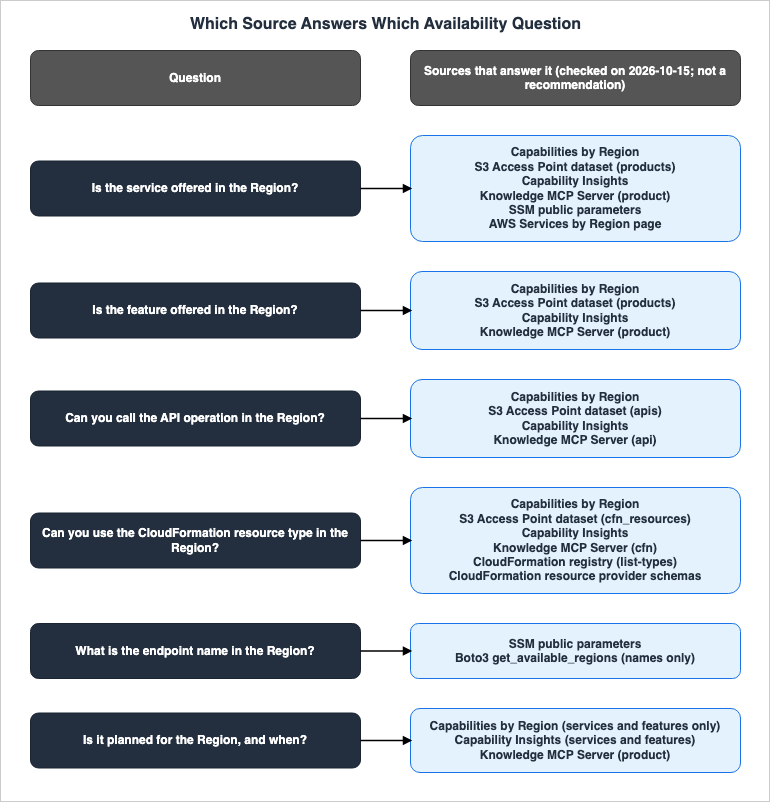
8. Failure Modes
This section outlines common errors that can occur when interpreting these sources, presenting them alongside the descriptions found in the sources this article read.- Reading that a feature not in the CloudFormation registry is not available: The DevOps Blog states that even if a feature is accessible through the console or API, it will not appear in the registry if CloudFormation support is not yet implemented (Section 6.1). The registry indicates whether a particular resource type is available for CloudFormation in a given Region.
- Reading the SDK's list of Regions as a list of where the service is provided: The Boto3 reference documentation notes that this list is not comprehensive and that the service may be available in Regions not listed (Section 4.6).
- Reading that a service listed in the public parameters has all of its features: The paths and examples in the Systems Manager user guide go only as far as services and endpoints (Section 4.4). The Capabilities by Region FAQ states that even if a service is listed as
Available, at least one of its features may not be available (Section 3.2). - Reading the API operations and CloudFormation resources tabs as showing when a feature will arrive: The Capabilities by Region FAQ clarifies that these tabs only show
AvailableorUnavailablestatuses, and do not provide planned release dates (Section 3.2). - Reading that a feature What's New announced for all commercial Regions is in every commercial Region: The sources this article read do not contain any statements that either confirm or refute this interpretation (Section 6.5). The wording in the What's New announcements and the granularity of the rows in regional availability sources should be considered as separate entities.
- Reading the Knowledge MCP Server's status words as limited to the four in the tool description: On October 15, 2026, the returned values included
isBeingPlannedInandisNotExpandingIn, which were not mentioned in the tool description. Code that processes these responses, if it only anticipates the four documented terms, may miss other status words (Sections 4.3 and 6.3). - Recording findings without a point in time: The sources describe their updates differently (Section 5.2). The results from CloudFormation's
list-typescommand reflect the state at the time of the query. Without recording the date and specific query performed, it will be impossible to determine which results are outdated if subsequent queries yield different answers. - Reading the older AWS Services by Region page as a page no longer in use: On October 15, 2026, this page was displayed without redirection and contained the message
The AWS Services List is updated daily.There were no mentions of replacement or decommissioning (Section 3.5). - Reading
Show only common across selected regionson the comparison page from only one of its descriptions: The FAQ's description of the filter states that itshows only services and features with the same availability status in every selected Region, and the Builder Center article on feature-level notifications adds, for the API operations and CloudFormation resources tabs, that rows unavailable in all of the selected Regions also remain. However, the FAQ's answer to the question about common capabilities and differences stateswhat capabilities are available everywhere I am looking, and the News Blog statesidentify capabilities consistently available across all selected Regions. The sources disagree.
The Builder Center article on feature-level notifications (October 7, 2026) describes
Show only common across selected regions as follows:Common means the same status, not available. A resource type missing from all of your selected Regions counts as common, so add Availability Available if that is not what you want.9. Frequently Asked Questions About Regional Availability Sources
This section answers, within the scope of this article, questions that come up before expanding into a new Region or adopting a new feature.Q1. Is AWS Capabilities by Region the only source that shows planned items?
No, that is not the case. In the sources this article read, Capability Insights also states that it shows the expected availability timeline and expansion plans, broken down by service and feature. Furthermore, the Knowledge MCP Server, in response to aproduct query on October 15, 2026, returned terms indicating a planned release, along with a launch_date. In contrast, the API operations and CloudFormation resources tabs of Capabilities by Region only display whether a feature is Available or Unavailable (as described in Section 6.2).Q2. Do you need an AWS account to use AWS Capabilities by Region?
You do not need an AWS account to use the comparison page. The What's New announcement from October 7, 2026, states that an account is not required for comparisons. However, you do need a Builder ID to set up notifications (Section 3.3). To retrieve the same data from an S3 access point, you need an authenticated AWS principal (Section 4.1).Q3. If a resource type is not found in the CloudFormation registry, does that mean the feature is not available in that Region?
Not necessarily. According to the DevOps Blog (September 8, 2023), a feature might be accessible through the console or API, but if CloudFormation support is still lacking, it may not appear in the registry. The registry indicates whether a particular resource type is available within CloudFormation (see Section 6.1).Q4. If Boto3 get_available_regions does not return a Region, is the service unavailable there?
Not necessarily. The Boto3 documentation states that the list is not comprehensive, and it is possible to use the service in Regions that are not listed (see Section 4.6). Nor does it say the reverse, that a listed Region offers every feature.Q5. Does isBeingPlannedIn in the Knowledge MCP Server mean the same as Planning on the comparison page?
Based on the sources this article read, it is not possible to determine this definitively. The Status: line of the tool description does not include isBeingPlannedIn, and no statement was found that explicitly maps the response words to the words used on the page. The responses from October 15, 2026, showed instances where isBeingPlannedIn was associated with a launch_date and instances where it was not. The Planning entry in the FAQ does not include a date (Section 6.3).Q6. Will the Knowledge MCP Server continue to be available?
This article will not discuss future developments. On October 15, 2026, the Knowledge MCP Server documentation states that it is in general availability. The Agent Toolkit for AWS user guide recommends migrating to AWS MCP Server. This is a recommendation, not an end-of-life announcement. AWS MCP Server also supportsaws___get_regional_availability (see Section 4.3).Q7. Is the older AWS Services by Region page no longer in use?
This article does not say so. As of October 15, 2026, the page was displayed without redirection, featuring a button leading to Capabilities by Region and the textThe AWS Services List is updated daily. The sources reviewed for this article do not contain any mention of its replacement or decommissioning (Section 3.5).Q8. When was the information in this article verified?
The verification was conducted on October 15, 2026. The data received from the Knowledge MCP Server was also obtained on the same date (Section 6.4). Capabilities by Region added features on October 7, 2026, and its pages, FAQ, status words, and the counts of API operations and CloudFormation resource types may change after the verification date.10. Summary
- Whether something is available in a Region splits into six questions: services, features, API operations, CloudFormation resource types, endpoints, and expected availability. Sources answer different questions (see Sections 1.1 and 7).
- The initial publication of AWS Capabilities by Region was November 6, 2025. The announcement on October 7, 2026, provided feature-level notifications and added the ability to filter by API operations and CloudFormation resource types (see Section 3.1).
- Whether planned items appear depends on the combination of source and unit. For Capabilities by Region, planned and expected releases are only provided for services and features. Capability Insights and the Knowledge MCP Server also provide planned release information for services and features (see Section 6.2).
- The requirements for using each source vary. Comparing in Capabilities by Region and using the Knowledge MCP Server do not require an AWS account. Accessing the S3 Access Point dataset requires an authenticated AWS principal. The Systems Manager and CloudFormation CLI commands require AWS credentials (see Section 5.3).
- The way updates are described varies depending on the source. Examples include:
refreshed daily,auto-refreshes every 24 hours,updates as AWS launches new capabilities,a point in time snapshot, andis not comprehensive. In the documentation reviewed for this article, only the S3 Access Point dataset explicitly states its point in time in a metadata file included with the data,manifest.json'slast_updated(see Section 5.2). - AWS itself describes disagreements. The CloudFormation registry may not list all features available in the console or via the API. The list of Regions in Boto3 is not comprehensive. Both rule out the reading that something not listed cannot be used (see Section 6.1).
- The terminology used to describe a feature's status varies depending on the source. News Blog, FAQ, Capability Insights README, and the tool description and responses of the Knowledge MCP Server use different terminology. In the documentation reviewed for this article, there was no information on the correspondence between the terms used in the Knowledge MCP Server's return values and those displayed on the page (see Section 6.3).
- On the verification date, for the Knowledge MCP Server, there were instances where the answers differed depending on the unit. For
ap-southeast-7, DAX indicatedisAvailableInfor product and API operation units, butisNotAvailableInfor CloudFormation resource type units. No statement of the reason was found (see Section 6.4).
11. References
- AWS announces a new Regional planning tool in Builder Center - What's New
- AWS Capabilities by Region now offers availability notifications for individual features and advanced filters - What's New
- Announcing Capability Insights for AWS, an open-source solution for regional capabilities - What's New
- Introducing AWS Capabilities by Region for easier Regional planning and faster global deployments - AWS News Blog
- Building automated AWS Regional availability checks with Amazon S3 - AWS Storage Blog
- Accelerate Region expansion with the AWS Knowledge MCP server - AWS Infrastructure & Automation Blog
- Identify regional feature parity using the AWS CloudFormation registry - AWS DevOps & Developer Productivity Blog
- AWS Capabilities by Region - AWS Builder Center
- FAQ - AWS Builder Center
- Introducing feature-level notifications with API and CloudFormation filters on Capabilities by Region in AWS Builder Center - AWS Builder Center
- AWS Services by Region
- AWS Knowledge MCP Server - Open Source MCP Servers for AWS
- Setting up the AWS MCP Server - Agent Toolkit for AWS User Guide
- Understanding the MCP Server tools - Agent Toolkit for AWS User Guide
- Capability Insights for AWS - GitHub
- Calling public parameters for AWS services, Regions, endpoints, Availability Zones, local zones, and Wavelength Zones in Parameter Store - AWS Systems Manager User Guide
- CloudFormation resource provider schemas - AWS CloudFormation Template Reference
- Session - Boto3 Documentation
- Authentication and access credentials for the AWS CLI - AWS Command Line Interface User Guide
References:
Tech Blog with curated related content
Written by Hidekazu Konishi