Before OpenAI's Agent Builder, Evals, and Reusable Prompts Shut Down - What Stops, What Stays, and Where OpenAI Points Each One
First Published:
Last Updated:
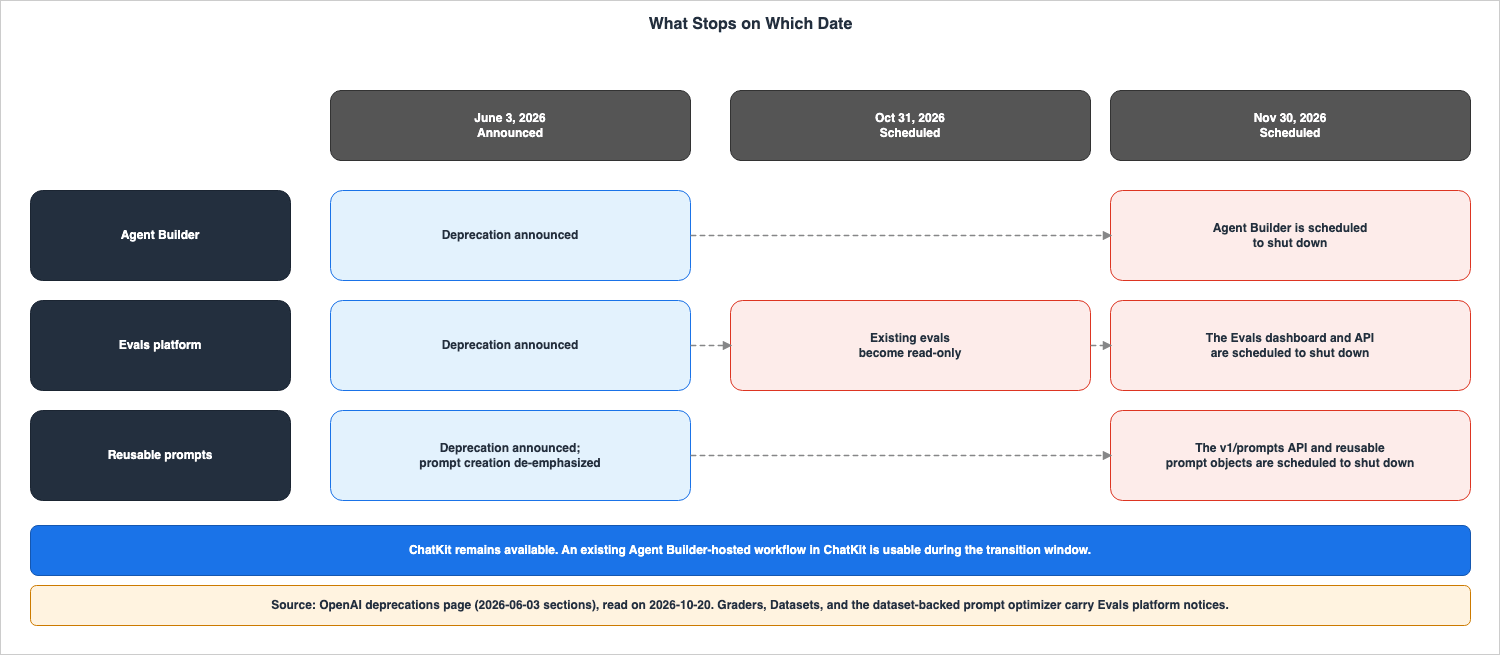
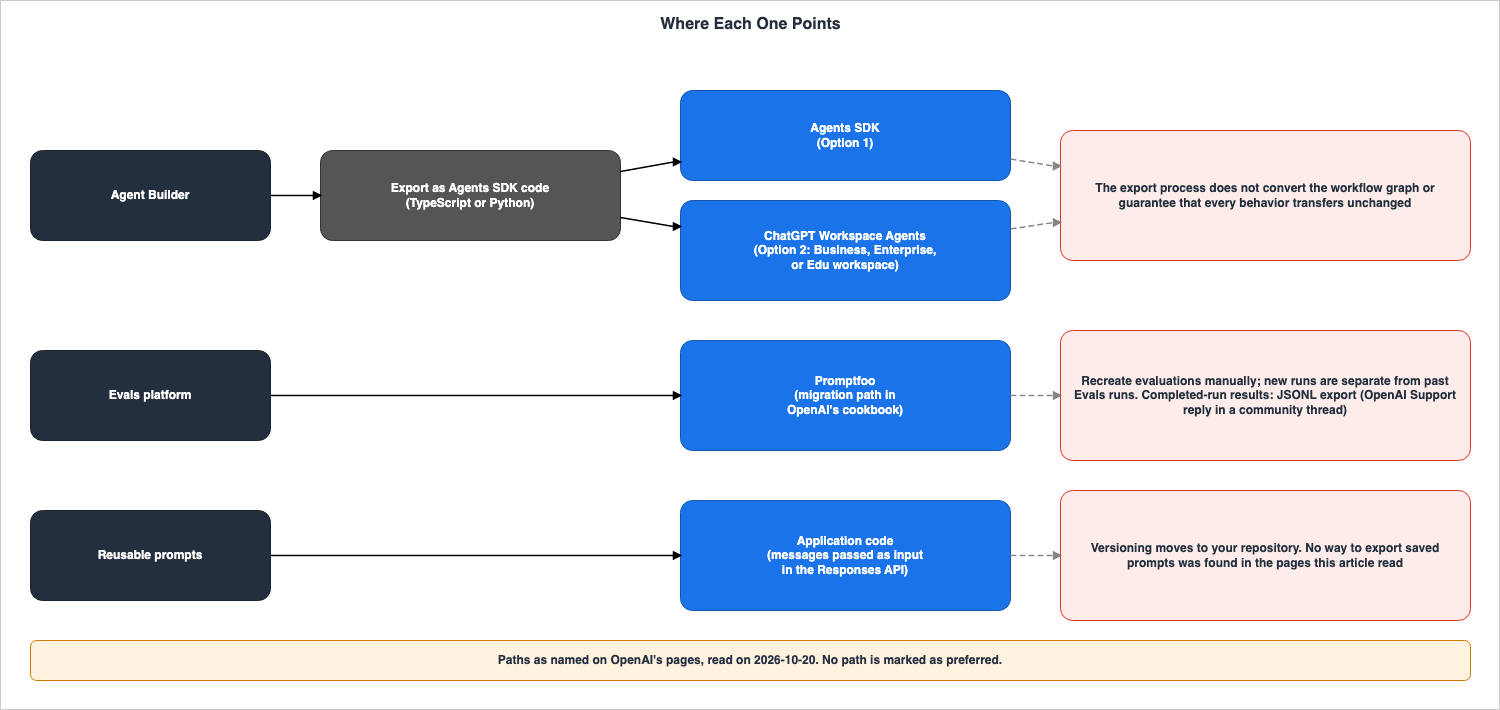
v1/prompts API). OpenAI's deprecations page lists November 30, 2026, as the scheduled shutdown date for all three. As a preliminary step, the page lists October 31, 2026, as the date when existing evals on the Evals platform become read-only.This article presents these three products not as introductions, but as a contract for where each one stops and where OpenAI points it. It outlines what will cease to function and when, what will continue, and what destination OpenAI names for each product. It also notes what will be lost during the transition and what information is not explicitly provided in the official documentation. The information is presented in tables with the same columns. OpenAI names the following destinations: Agents SDK and ChatGPT Workspace Agents for Agent Builder, application code for reusable prompts, and Promptfoo for the Evals platform.
This article does not provide a list of dates. It does not address pricing. It does not say which destination is better. It is not a step-by-step migration guide; those details are left to OpenAI's official documentation.
This article read the documentation on October 20, 2026. This article has not run anything on an OpenAI account. All values in the tables are taken directly from the official documentation.
Related articles on this site:
- AI Model Deprecation and Lifecycle Calendar - Anthropic, OpenAI, Google, and Amazon Bedrock
- Managed Agent Runtimes - What Claude Managed Agents, the OpenAI Agents API, Amazon Bedrock, and GKE Agent Substrate Each Run for You, and What Stays With You
- OpenAI GPT Model Release Timeline - Model Lineage, ChatGPT and Codex Milestones, and Platform Availability
- Detecting Model Retirement from the API - Anthropic lifecycle, OpenAI shutdown_date, Amazon Bedrock modelLifecycle, and Gemini API Rerouting
Table of Contents
- 1. Scope and Assumptions
- 2. How to Read the Tables
- 3. Agent Builder
- 4. Evals Platform
- 5. Reusable Prompts and v1/prompts
- 6. What No Statement Was Found On
- 7. This Site's Articles for Rebuilding on AWS
- 8. Failure Modes
- 9. Frequently Asked Questions About the Shutdown of OpenAI's Agent Builder, Evals, and Reusable Prompts
- 10. Summary
- 11. References
1. Scope and Assumptions
This section will define the intended audience, the scope of this article, name different products with similar names, and list the sources this article read. The key conclusions of this article can be summarized as follows:- Agent Builder: The OpenAI deprecations page indicates that Agent Builder is scheduled to be shut down on November 30, 2026. The same page states that ChatKit remains available. OpenAI lists two potential destinations: the Agents SDK and ChatGPT Workspace Agents. Both start from an export of Agents SDK code from Agent Builder. However, the OpenAI migration page states that this export does not convert the workflow graph and does not guarantee that every behavior transfers unchanged.
- Evals platform: The deprecations page lists October 31, 2026, as the date when existing evals become read-only, and November 30, 2026, as the scheduled shutdown date for the Evals dashboard and API. Announcements regarding the shutdown are also present on the pages for graders, Datasets, and the dataset-backed prompt optimizer. The destination OpenAI names is Promptfoo, and the OpenAI cookbook provides instructions for manually recreating evaluations within Promptfoo.
- Reusable prompts: The deprecations page indicates that prompt creation has been de-emphasized since June 3, 2026, and that the
v1/promptsAPI and reusable prompt objects are scheduled to be shut down on November 30, 2026. The destination OpenAI names is to move prompt content into application code and pass it in theinputof the Responses API. - Information not explicitly stated: No statement was found, within what this article read, on what is returned after the shutdown, how the Responses API's
promptparameter will be handled after the shutdown, methods for exporting saved prompts, the deadline for accessing past Evals results, or permissible actions during the read-only period (chapter 6). - Responsibilities for users: Users will be responsible for recreating workflows, evaluations, and prompts at the designated destination, verifying that the recreated elements function identically to the originals, and locating any references to prompt IDs within their code.
1.1 Intended Readers
This article is intended for developers who have used OpenAI's Agent Builder to create workflows, used the Evals platform for evaluations, or who call reusable prompts from the dashboard by ID through the Responses API.These readers may hold five assumptions. However, the materials reviewed for this article do not support any of these assumptions:
- The destination for Agent Builder is the Agents API: While OpenAI's deprecations page and migration page list the Agents SDK and ChatGPT Workspace Agents as destinations, no statement naming the Agents API as the destination for Agent Builder was found within what this article read (section 3.3).
- Evals has a successor feature from OpenAI: The migration path that the deprecations page names is a cookbook on moving to Promptfoo (section 4.3).
- Exporting workflows will ensure they continue to function as is: The "Migrate from Agent Builder" page explicitly states that the export does not convert the workflow graph and does not guarantee that behavior transfers unchanged (section 3.4).
- ChatKit will also be shut down: The deprecations page states that ChatKit remains available (section 3.2).
- Nothing will change before November 30, 2026: The Evals platform has a step on October 31, 2026, and the creation of reusable prompts has been de-emphasized since June 3, 2026 (sections 4.1 and 5.1).
1.2 What This Article Covers and What It Does Not
This article will address the following:- Information regarding three products, including what will stop working, the dates on which functionality will cease, and what will continue to function.
- The destinations OpenAI names, along with the prerequisites for those destinations.
- What will not be preserved during the transition to those destinations.
- What no statement was found on, with the sources searched.
- Places where pages describe the same product differently.
This article will not cover:
- A list of dates. This information, including dates for OpenAI's products, can be found on this site's AI Model Deprecation and Lifecycle Calendar.
- Pricing and the cost of ChatGPT plans.
- Comparisons and recommendations regarding which destination is best.
- Migration procedures (such as code modifications or Promptfoo configuration). This information is available on OpenAI's website.
- Model retirement. This topic is covered in a related article on this site, Detecting Model Retirement from the API.
- The schedule for self-serve fine-tuning. This information is available in a separate section of the deprecations page.
- Explanations of AWS features. Chapter 7 only points readers to relevant articles on this site.
1.3 Different Products with Similar Names
The three products discussed in this article have counterparts with similar names. This article does not cover the following:- Agent Builder: The Agent Builder discussed in this article refers to OpenAI's Agent Builder. Google's Vertex AI Agent Builder and the no-code agent builder in OpenSearch 3.5 are separate products.
- Evals: The Evals discussed in this article refer to OpenAI Platform's Evals platform (including the dashboard and
/v1/evalsAPI). OpenAI'sopenai/evalsframework on GitHub, Amazon Bedrock's evaluation features, and Amazon Bedrock AgentCore Evaluations are distinct. - Prompt: The reusable prompts discussed in this article are OpenAI's reusable prompt objects, created on the dashboard and referenced by ID. The
promptparameter in the Responses API is the request field that references these objects. Amazon Bedrock's Prompt management is a separate product. - Agents: OpenAI has four distinct offerings: Agent Builder, Agents SDK, Agents API, and ChatGPT Workspace Agents. This article will refer to these four by their respective names.
1.4 Sources Read and the Check Date
This article was written after reviewing the following materials on October 20, 2026:- OpenAI's deprecations page (the sections on the three products)
- OpenAI's changelog
- Individual feature pages (Agent Builder, Migrate from Agent Builder, ChatKit, Working with evals, Getting started with datasets, Graders, Prompt optimizer, Evaluate agent workflows, Trace grading, Prompting, Prompt engineering, Text generation, Migrate from prompt objects, Get started with Promptfoo, Agents, Agents API)
- OpenAI's cookbook article "Moving from OpenAI Evals to Promptfoo"
- Promptfoo's blog post "Promptfoo is joining OpenAI" and the README of the promptfoo/promptfoo repository on GitHub (section 4.3)
- The Responses API reference for creating a response
- OpenAI's
openai/openai-openapiGitHub repository, specifically the OpenAPI specification (master branch) - One thread from the OpenAI Developer Community (section 4.4, treated as a community resource)
As of this article's check date, the shutdown of all three products is still scheduled. The three tables on the deprecations page use the phrases
scheduled to shut down and become read-only. This article is written with dates as the subject. For example, the deprecations page states that October 31, 2026, is the date when existing evals will become read-only. When you read this article after these dates, verify the current status on the deprecations page.2. How to Read the Tables
This section defines the columns and terms used in the tables in this article.2.1 Common Columns
The tables in this article use the following six column headings. The first five columns are shared with two related articles on this site. The final column,Stops On, is specific to this article.| Column | What the cell holds |
|---|---|
Platform Provides | What the platform emits, accepts, or commits to, in the words of its documentation |
Where You Read It | The page, Console screen, or API field where the value or state can be read |
If You Do Nothing | What happens with the defaults, including rejection, truncation, and disabling |
No Statement Found | What the documentation does not state, with the sources searched |
What Stays With You | What the platform does not take over and remains the user's responsibility |
Stops On | The date in OpenAI's table, what changes on that date, and the tense the table uses |
2.2 Wording Conventions
This article writes state words in English, in the spelling used in OpenAI's documentation. OpenAI's deprecations page defines "deprecated" and "shut down" as follows:When we announce that a model or endpoint is being deprecated, it immediately becomes deprecated. All deprecated models and endpoints will also have a shut down date. At the time of the shut down, the model or endpoint will no longer be accessible.According to OpenAI, "deprecated" starts at the time of the announcement and comes with a "shut down" date. On the "shut down" date, the model or endpoint will no longer be accessible. The differences between OpenAI's state words and those of other companies are covered in this site's Detecting Model Retirement from the API. Among the tables for the three products, the term "read-only" appears only in the table for the Evals platform. No statement defining "read-only" was found within what this article read (sources searched: deprecations page, Working with evals, Getting started with datasets, Prompt optimizer).
Several pages use the term "transition window." The Agent Builder page states that existing users can continue using Agent Builder during the transition window. No statement defining the start and end dates of the transition window was found within what this article read (sources searched: deprecations page, Agent Builder, ChatKit, Working with evals, Trace grading, Evaluate agent workflows).
When a statement cannot be found in the documentation, this article writes
No statement found and lists the sources searched. It does not say that the feature does not exist. Conclusions drawn by combining statements in the documentation are called inferences, with a note that they have not been checked on a real system.This article distinguishes between three dates: the announcement date (June 3, 2026), the planned dates (October 31, 2026, and November 30, 2026), and the check date (October 20, 2026, when this article read the documentation).
2.3 This Article Has Not Checked Anything on a Real System
This article does not call the OpenAI API. It has not run the Agent Builder export or recreated anything in Promptfoo. All values in the tables and text are taken from existing documentation. Any reasoning or deductions are explicitly stated in the text and are not included in the table cells.3. Agent Builder
This section lists what stops, what does not stop, the destinations OpenAI names, and what the export does not carry over for OpenAI's Agent Builder.3.1 What Stops
Agent Builder is a visual canvas for building multi-step agent workflows. According to the Agent Builder page, users can create workflows by connecting nodes and then publish them. Published workflows become objects with an ID and version. Users can then pass the workflow's ID to ChatKit to integrate it, or export the Agents SDK code to run it themselves.The deprecations page includes a section on Agent Builder, featuring a table with two rows:
| Date | Update |
|---|---|
| June 3, 2026 | Deprecation announced for Agent Builder. |
| Nov 30, 2026 | Agent Builder is scheduled to shut down. |
The announcement at the top of the Agent Builder page also states the same shutdown date.
OpenAI is deprecating Agent Builder. Existing users can continue using it during the transition window, and the product is scheduled to shut down on November 30, 2026. ChatKit remains available.3.2 What Does Not Stop: ChatKit
The section on Agent Builder on the deprecations page contains the following text:On June 3, 2026, we notified developers using Agent Builder that the product is being deprecated. ChatKit remains available.ChatKit is a chat interface designed to integrate agents. The ChatKit page describes two methods for integrating ChatKit. One involves running ChatKit on your own server and connecting it to any agent service, including one built with the Agents SDK (custom server integration). The other utilizes the existing method using the Agent Builder workflow (Agent Builder-hosted integration). Regarding the latter, the ChatKit page states:
If you already use ChatKit with an Agent Builder workflow, you can keep using that hosted workflow during the Agent Builder transition window.For new ChatKit apps, or when migrating before Agent Builder shuts down, use the advanced integration to connect ChatKit to your own server-side agent implementation.ChatKit is the element that continues to function. The ChatKit page indicates that integrations relying on the Agent Builder workflow will be available for the duration of the transition window. No statement was found, within what this article read (sources searched: ChatKit, Agent Builder, the deprecations page, and "Migrate from Agent Builder"), on what happens to Agent Builder-hosted integrations after Agent Builder shuts down.
3.3 Where OpenAI Points
The section on Agent Builder on the deprecations page concludes with the following:See Migrate from Agent Builder to continue with the Agents SDK or ChatGPT Workspace Agents.The page "Migrate from Agent Builder" describes using the Agents SDK as a way to build agents with code. It describes ChatGPT Workspace Agents as a way to create agents using natural language and share them with your team.
Both options share a common starting point. Users begin by opening a workflow in Agent Builder, selecting Code at the top, choosing Agents SDK, and then selecting either TypeScript or Python, copying the entire export. The "Migrate from Agent Builder" page notes that this process assumes users have access to Agent Builder workflows.
- Agents SDK (Option 1): Integrate the exported code into your application, install the corresponding Agents SDK, configure it, and test the workflow in your own environment. The "Migrate from Agent Builder" page says to validate your application's configuration and behavior before deployment.
- ChatGPT Workspace Agents (Option 2): Create a workspace agent within ChatGPT and paste the exported code into a chat, along with a specific prompt. Review any behavior that the builder identifies as requiring changes. The Option 2 section of the "Migrate from Agent Builder" page states the prerequisite for this path as follows:
To use this option, you need a ChatGPT Business, Enterprise, or Edu workspace with access to workspace agents and permission to create agents.No statement naming the Agents API as a destination for Agent Builder was found within what this article read (sources searched: the deprecations page, "Migrate from Agent Builder," Agent Builder, the Agents API overview and quickstart, and the changelog, specifically the September 10, 2026 entry for the Agents API). OpenAI's Agents API and comparisons with various execution environments are covered on this site's Managed Agent Runtimes. That article explicitly excludes migration from Agent Builder.
3.4 What the Export Does Not Carry Over
The "Migrate from Agent Builder" page begins with the following:This process does not convert your workflow graph or guarantee that every
behavior transfers unchanged.The same page also states that when testing migrated agents, you should review the control flow, triggers, tools, and permissions.
Some workflow behavior may need manual recreation. Review control flow,
triggers, tools, and permissions as you test the migrated agent.
The "Limitations" section on the same page contains three items.
- Workflows with strong determinism at their core may not migrate faithfully to
  a workspace agent.
- Connected apps, authentication, publishing, and permission configuration
  require separate review in ChatGPT.
- An Agents SDK implementation requires you to validate your application's
  runtime configuration, tools, authentication, permissions, and deployment.
Items 1 and 2 relate to the workspace agent, while item 3 pertains to the Agents SDK. Item 1, which states that deterministic workflows may not always be faithfully migrated, describes the workspace agent. No similar statement about the Agents SDK was found within what this article read. On the Agents SDK side, it is the user's responsibility to validate the runtime configuration, tools, authentication, permissions, and deployment of the exported code.
The export process begins on the Agent Builder screen. No statement was found, within what this article read (sources searched: "Migrate from Agent Builder," Agent Builder, and the deprecations page), on whether it is possible to export after Agent Builder shuts down.
3.5 Evaluation Inside Agent Builder Leads to Evals
The Agent Builder page states that you can run trace graders from Evaluate at the top of Agent Builder. The Trace grading page describes selecting a trace, creating a grader, and selecting Grade all to go to the evaluation dashboard. It follows these steps with a link to the evals guide. This article reads this evaluation dashboard as the dashboard of the Evals platform in chapter 4. The page does not name the Evals platform, so this is this article's inference.3.6 Contract Tables
The following two tables outline the status of Agent Builder and its related components, using the columns in section 2.1. The first table has three columns, while the second table covers the remaining three columns.| Part | Stops On | Platform Provides | Where You Read It |
|---|---|---|---|
| Agent Builder (canvas and published workflows) | Nov 30, 2026: Agent Builder is scheduled to shut down | Use by existing users during the transition window | Deprecations page; Agent Builder page |
| ChatKit with an Agent Builder-hosted workflow | No date in the Agent Builder table; ChatKit remains available | Use of the hosted workflow during the transition window | ChatKit page; deprecations page |
| Export to Agents SDK code | No date found | TypeScript or Python export from the Code dialog | Migrate from Agent Builder |
| Part | If You Do Nothing | No Statement Found | What Stays With You |
|---|---|---|---|
| Agent Builder (canvas and published workflows) | The product is scheduled to shut down on Nov 30, 2026 | The response after shutdown (deprecations page, Agent Builder page) | Choosing a path and recreating the workflow |
| ChatKit with an Agent Builder-hosted workflow | The hosted workflow is usable during the transition window | What happens to the hosted integration after shutdown (ChatKit page, deprecations page) | Moving to a custom server integration |
| Export to Agents SDK code | No export happens on its own | Whether export remains possible after shutdown (Migrate from Agent Builder, deprecations page) | Testing behavior; validating runtime configuration, tools, authentication, permissions, and deployment |
4. Evals Platform
This section describes OpenAI's Evals platform: the two steps of read-only and shutdown, what the notice also covers, the destination OpenAI names, two kinds of export, and where the pages differ.4.1 Two Steps: Read-Only, Then Shutdown
The section on the Evals platform on the deprecations page includes a table with three rows:| Date | Update |
|---|---|
| June 3, 2026 | Deprecation announced for the Evals platform. |
| Oct 31, 2026 | Existing evals become read-only. |
| Nov 30, 2026 | The Evals dashboard and API are scheduled to shut down. |
The introductory notice on the "Working with evals" page reads:
OpenAI is deprecating the Evals platform. Existing evals content remains
  available during the transition window. Evals will become read-only for
  existing users on October 31, 2026, and the platform is scheduled to shut down
  on November 30, 2026.
Of the three products, only the Evals platform has two steps. According to the deprecations page, the first step (October 31, 2026) is when existing evals become read-only, and the second step (November 30, 2026) is when the dashboard and API are scheduled to shut down. No statement was found, within what this article read (sources searched: deprecations page, "Working with evals," "Getting started with datasets," and "Prompt optimizer"), on which operations are permitted and which are refused during the read-only period.
Regarding the API, the OpenAPI specification includes seven paths that begin with
/evals and features twelve operations. These include listing, creating, retrieving, updating, and deleting evals, as well as listing, creating, retrieving, canceling, and deleting runs, and listing and retrieving run output items. The OpenAPI specification reviewed (the master version as of October 20, 2026) did not indicate that any of these operations are deprecated.4.2 What the Notice Also Covers
The announcement regarding the shutdown of the Evals platform can also be found on the pages for related features.- Datasets: At the top of the "Getting started with datasets" page, you will find the same announcement as on the "Working with evals" page.
- dataset-backed prompt optimizer: The "Prompt optimizer" page begins with the following text:
OpenAI is deprecating the dataset-backed prompt optimizer as part of the Evals
  platform. Evals will become read-only for existing users on October 31, 2026,
and the platform is scheduled to shut down on November 30, 2026.- graders: The deprecations page and the "Graders" page state the following regarding graders:
Graders documented for eval workflows are part of this transition. Fine-tuning-related timelines remain covered in the self-serve fine-tuning section below.OpenAI is deprecating graders as part of the evals and fine-tuning workflows
they support.The deprecations page includes graders in the eval workflow and places the fine-tuning schedule in a separate section. The "Graders" page states that OpenAI is deprecating graders as part of both the evals and fine-tuning workflows. This article only addresses the schedule for the Evals platform and does not cover the fine-tuning schedule. Users who use graders with fine-tuning should refer to the self-serve fine-tuning section on the deprecations page.
The "Working with evals" page and the "Getting started with datasets" page cross-reference each other. The "Working with evals" page suggests Datasets as an environment for iterative experimentation. The "Getting started with datasets" page suggests Evals if you need evaluation against external models or want to work with eval runs through the API. Both pages contain the same announcement regarding the shutdown.
4.3 Where OpenAI Points: Promptfoo
The section on the Evals platform on the deprecations page concludes with the following text:See Moving from OpenAI Evals to Promptfoo for a migration path.The cookbook begins with the following statement:
OpenAI is winding down the Evals product and recommends Promptfoo for continuing and extending your evaluation workflows.The cookbook describes Promptfoo as an open-source CLI and library for evaluating and red-teaming AI applications and agents. OpenAI's "Get started with Promptfoo" page includes the following sentence:
Promptfoo is part of OpenAI.OpenAI names a product that is part of OpenAI as the destination for its Evals platform. No statement on the date or form in which Promptfoo became part of OpenAI was found on the OpenAI pages this article read (Get started with Promptfoo, the cookbook, and the changelog). On the Promptfoo side, Promptfoo's blog post of March 9, 2026, says
Today we are announcing that Promptfoo has agreed to be acquired by OpenAI. and ends with The closing of the acquisition is subject to customary closing conditions. The README of the promptfoo/promptfoo repository on GitHub says Promptfoo is now part of OpenAI. No statement on the date the acquisition closed was found in these sources. The OpenAI pages this article read do not call Promptfoo a successor to Evals. The cookbook uses the terms recommends and a migration path. Promptfoo also has an entry in this site's AI Agent Engineering Glossary.The cookbook describes what changes when migrating to Promptfoo with the following text:
Promptfoo does not simply reproduce the OpenAI Evals interface in another tool. It provides a more portable, code-oriented workflow for maintaining, running, and extending evaluations over time.The cookbook's instructions detail how to manually recreate evaluations within Promptfoo. Users must recreate the evaluation's prompt, provider, test cases, and assertions in
promptfooconfig.yaml and then run the new evaluation within Promptfoo. The cookbook describes the relationship between new runs and previous runs, whether numeric results match, and how to recreate the grader with the following text:This new run is separate from any previously completed OpenAI Evals runs.Similarity-based scoring may not produce identical numerical results across systems. Any manually recreated grader, especially an LLM-as-a-judge grader, should be validated before you rely on it for regression decisions.Runs executed within Promptfoo are distinct from previous runs on Evals. Users must validate the recreated grader before using it.
4.4 Two Kinds of Export
The cookbook describes its procedure for manually recreating an evaluation as follows:This guide covers manually recreating an evaluation in Promptfoo. It does not require an OpenAI Evals export feature.This statement indicates that the cookbook's procedures do not require the export functionality. It does not state that Evals lacks the export feature.
In a thread on the OpenAI Developer Community (titled "Deprecation notice: Evals will be shut down on November 30th, 2026," initiated on July 2, 2026), an OpenAI Support account responded on July 3, 2026, stating that there are two kinds of export. One is a Promptfoo configuration for rerunning an evaluation, and the other is a JSONL file with the results of a completed evaluation. This response includes the following text:
A JSONL export is different. It only contains the results of a completed evaluation, so it's useful for comparing historical runs, but it doesn't include enough information to recreate a runnable Promptfoo config.Also, not every evaluation type currently supports exporting as a Promptfoo configuration.The initial post in that thread mentioned that the cookbook at the time referred to a button that exported an evaluation as a Promptfoo configuration. The cookbook that this article read on October 20, 2026 does not mention the export button; instead, it describes the manual process of recreating the evaluation. The OpenAI Support reply comes from the community forum and is not reference documentation.
The API provides the
GET /evals/{eval_id}/runs/{run_id}/output_items endpoint, which lists the output items of a run (its summary in the specification is Get eval run output items); a separate operation retrieves one output item. No statement was found, within what this article read (sources searched: deprecations page, "Working with evals," the cookbook, and the OpenAPI specification), on the deadline for retrieving past evaluation results. It is the user's responsibility to retrieve and preserve any historical results they wish to keep.4.5 Where the Pages Differ
The descriptions of the same Evals features vary from page to page. This article does not claim that any particular page is correct.- Evaluate agent workflows page: This page has no shutdown notice. It says to use Evals alongside datasets for evaluation against external models, evaluation APIs, or large-scale evaluation.
- Trace grading page: This page also has no shutdown notice. It describes the steps that lead to the evaluation dashboard when you select Grade all.
- Cookbook comparison table: It has the following cell, while the "Getting started with datasets" page and the "Prompt optimizer" page place shutdown notices around the same features.
Platform features such as dataset review and prompt iteration remain in OpenAI.No statement was found, within what this article read, on how trace grading and Datasets are handled after the Evals platform shuts down (sources searched: deprecations page, "Trace grading," "Evaluate agent workflows," and "Getting started with datasets").
4.6 Contract Tables
The following two tables outline the status of the Evals platform and related components, using the columns in section 2.1.| Part | Stops On | Platform Provides | Where You Read It |
|---|---|---|---|
| Evals (dashboard and API) | Oct 31, 2026: existing evals become read-only; Nov 30, 2026: the dashboard and API are scheduled to shut down | Existing evals content during the transition window; /evals operations in the OpenAPI specification | Deprecations page; Working with evals |
| Datasets, graders, dataset-backed prompt optimizer | Datasets and the prompt optimizer carry the Evals platform dates; fine-tuning timelines are in a separate section | Deprecation notices on each page | Getting started with datasets; Graders; Prompt optimizer; deprecations page |
| Promptfoo (the migration path OpenAI documents) | No date | A cookbook for recreating evaluations manually | Moving from OpenAI Evals to Promptfoo; Get started with Promptfoo |
| Part | If You Do Nothing | No Statement Found | What Stays With You |
|---|---|---|---|
| Evals (dashboard and API) | Existing evals become read-only, then the dashboard and API are scheduled to shut down | Which operations read-only allows; the deadline for retrieving past results (deprecations page, Working with evals, OpenAPI specification) | Retrieving past results you want to keep |
| Datasets, graders, dataset-backed prompt optimizer | Each page carries a deprecation notice (section 4.2) | How trace grading and Datasets are handled after shutdown (Trace grading, Getting started with datasets) | Checking the fine-tuning section if you use graders there |
| Promptfoo (the migration path OpenAI documents) | Nothing moves on its own; new runs are separate from past Evals runs | The date the acquisition closed (Get started with Promptfoo, changelog, Promptfoo blog post and README) | Recreating prompts, providers, test cases, and assertions; validating recreated graders |
5. Reusable Prompts and v1/prompts
This section details OpenAI's reusable prompt objects and thev1/prompts API, outlining what stops, the destination OpenAI names, how the prompt parameter in the Responses API is treated, and what is not in the public specification.5.1 What Stops
Reusable prompts are a feature that allows you to reference templates created in the dashboard using their IDs through the Responses API. A changelog entry describes this feature as follows:Via API, you can now reference templates created in the dashboard via the `prompt` parameter (with a prompt `id`, optional `version`) and supply dynamic `variables` that can include strings, images, or file inputs. Reusable prompts are not available in Chat Completions.The Reusable prompts section of the deprecations page has the following two-row table:
| Date | Update |
|---|---|
| June 3, 2026 | Deprecation announced and prompt creation de-emphasized in the platform. |
| Nov 30, 2026 | The v1/prompts API and reusable prompt objects are scheduled to shut down. |
The first row states that as of June 3, 2026, prompt creation was de-emphasized on the platform. The same announcement appears at the top of the "Prompting," "Prompt engineering," "Text generation," and "Migrate from prompt objects" pages.
OpenAI is deprecating reusable prompt objects in the API. Prompt creation will
  be de-emphasized beginning June 3, 2026, and `v1/prompts` is scheduled to shut
  down on November 30, 2026.
The "Prompting" page says this about new work after the announcement:
For new work, don't create reusable prompt objects.5.2 Where OpenAI Points: Application Code
The deprecations page, in the "Reusable prompts" section, ends with the following sentence:To migrate, move reusable prompt content into your application code.The "Migrate from prompt objects" page describes the changes as follows:
Instead of referencing a saved prompt object from an API request, store the prompt text in your codebase and pass the generated messages directly as `input` in the Responses API call.This page then lists five key steps. These are: migrating the content of prompts to source code, replacing prompt variables with function arguments, passing messages using
input instead of prompt objects, moving version control to a repository, and ensuring the effectiveness of prompt caching by placing static content before dynamic content. The versioning of prompts shifts from OpenAI's reusable prompt objects to the user's repository, utilizing commits and reviews.5.3 The prompt Parameter in the Responses API
The Responses API reference for creating a response describes theprompt parameter as follows:- `prompt: optional ResponsePrompt or null`
Reference to a prompt template and its variables.This documentation includes notes indicating that other parameters on the same page are deprecated. For example, the
prompt_cache_retention parameter includes the following note:Deprecated. Use `prompt_cache_options.ttl` instead.As of the documentation reviewed on October 20, 2026, the
prompt parameter did not include a deprecation note. The OpenAPI specification indicates that six schemas in the Realtime API reference the Prompt schema, in addition to the ResponseProperties in the Responses API. These six schemas relate to session management and the arguments for creating responses.No statement was found, within what this article read, on what requests that reference a prompt ID with the
prompt parameter return after November 30, 2026 (sources searched: the deprecations page, the "Migrate from prompt objects" guide, the Responses API reference for creating a response, the OpenAPI specification, and the changelog). Similarly, no statement was found regarding whether the prompt functionality in the Realtime API is subject to shutdown.The following is an inference. The
prompt parameter is a field that references saved reusable prompt objects by ID, and those objects are scheduled to shut down on November 30, 2026. From these two points, it can be inferred that after the shutdown, requests referencing prompts by ID will no longer function. This article has not checked this on a real system, and the documentation does not state this conclusion.5.4 No /prompts Path in the Public Specification
The OpenAPI specification (as of October 20, 2026, master branch) reviewed for this article does not include any paths that begin with/prompts. Therefore, it is not possible to represent the request and response formats for the v1/prompts API in the publicly available specification. This article does not describe the format of the v1/prompts API and writes from the side of the dashboard and the prompt parameter of the Responses API.The
Prompt schema in the OpenAPI specification requires an id field, while version and variables are optional. In the pre-migration examples on the "Migrate from prompt objects" page, JavaScript and Ruby examples use the id key, Go and Java examples use the ID field (either ID or .id()), and Python and curl examples use the prompt_id key. When searching for references to prompt IDs in the code, you may encounter both spellings. The IDs used in the examples on the migration page are pmpt_123.5.5 Contract Tables
The following two tables list reusable prompts and related features, using the columns in section 2.1.| Part | Stops On | Platform Provides | Where You Read It |
|---|---|---|---|
v1/prompts API and reusable prompt objects | June 3, 2026: prompt creation de-emphasized; Nov 30, 2026: scheduled to shut down | Saved prompt templates referenced by ID, with version and variables | Deprecations page; Prompting; Migrate from prompt objects |
prompt parameter (Responses and Realtime) | No date on the reference page | prompt: optional ResponsePrompt or null with no deprecation note | Responses API reference; OpenAPI specification |
| Prompt content in application code | No date | input in the Responses API call | Migrate from prompt objects |
| Part | If You Do Nothing | No Statement Found | What Stays With You |
|---|---|---|---|
v1/prompts API and reusable prompt objects | Scheduled to shut down on Nov 30, 2026 | A way to export saved prompts; the response after shutdown (deprecations page, Migrate from prompt objects, OpenAPI specification) | Copying prompt content into the codebase |
prompt parameter (Responses and Realtime) | No change is stated on the reference page | What requests that reference a prompt ID return after Nov 30, 2026 (Responses API reference, OpenAPI specification, changelog) | Finding every id and prompt_id reference |
| Prompt content in application code | Nothing moves on its own | Not applicable (the content stays in your code) | Versioning, review, tests, and the order of static and dynamic content |
6. What No Statement Was Found On
Within what this article read, no statement was found on the following. The absence of a description for any of these items does not necessarily indicate that the feature is unavailable or that the operation cannot be performed.- Response after shutdown: What will be returned for requests to Agent Builder workflows, the Evals API, or the
v1/promptsAPI after November 30, 2026 (sources searched: deprecations page, individual feature pages, OpenAPI specifications). The definition on the deprecations page goes as far as saying that at the time of the shut down, the model or endpoint willno longer be accessible. promptparameter: What will be returned when requests referencing a prompt ID in thepromptparameter of the Responses API and Realtime API are made after the shutdown (sources searched: Responses API creation reference, OpenAPI specifications, Migrate from prompt objects, changelog). The inference is written separately in section 5.3.- Exporting saved prompts: Methods for exporting a collection of reusable prompt objects from the dashboard (sources searched: Migrate from prompt objects, Prompting, deprecations page, OpenAPI specifications).
- Expiration for retrieving past Evals results: How long past run results can be retrieved (sources searched: deprecations page, Working with evals, cookbook, OpenAPI specifications). Regarding the JSONL export of completed run results, there is a community response in section 4.4.
- Operations during the read-only period: Which operations will be permitted between October 31, 2026, and November 30, 2026 (sources searched: deprecations page, Working with evals, Getting started with datasets, Prompt optimizer).
- Agent Builder-hosted integration after shutdown: What happens to integrations that use Agent Builder workflows from ChatKit after the shutdown (sources searched: ChatKit, Agent Builder, deprecations page, Migrate from Agent Builder).
- Exporting after shutdown: Whether workflows can be exported as Agents SDK code after Agent Builder shuts down (sources searched: Migrate from Agent Builder, Agent Builder, deprecations page).
- Handling of trace grading and Datasets after the Evals platform shutdown: What happens to trace grading and Datasets after the Evals platform is shut down (sources searched: deprecations page, Trace grading, Evaluate agent workflows, Getting started with datasets).
- Duration of the transition window: The start and end dates of the transition window (sources searched: deprecations page, Agent Builder, ChatKit, Working with evals, Trace grading, Evaluate agent workflows).
- Mentions of the Agents API as a destination: Instances where the Agents API is listed as a destination for Agent Builder (sources searched: deprecations page, Migrate from Agent Builder, Agent Builder, Agents API overview and quickstart, changelog).
- Date the acquisition of Promptfoo closed: Promptfoo's blog post (March 9, 2026) describes the agreement to be acquired and the closing conditions, and the README says that Promptfoo is now part of OpenAI, but no date of closing was found (sources searched: Get started with Promptfoo, cookbook, changelog, Promptfoo's blog post and README).
7. This Site's Articles for Rebuilding on AWS
Besides the options mentioned by OpenAI, some users may choose to reimplement evaluation, prompt management, and agents within AWS. This section simply provides a guide to relevant articles on this site, without comparing OpenAI's approach with AWS's capabilities.- Evaluation: Amazon Bedrock AgentCore Evaluations Practical Guide covers the built-in evaluators of AgentCore Evaluations and regression testing in CI/CD. Amazon Bedrock Model Evaluation Practical Guide focuses on evaluating models within Amazon Bedrock. LLMOps Observability and Evaluation Architecture on AWS discusses architectures that combine tracing and automated evaluation gates.
- Prompt Management: Prompt Lifecycle Management on AWS addresses prompt management within Amazon Bedrock, as well as managing prompts as code within a CI/CD pipeline.
- Agents: Amazon Bedrock AgentCore Harness covers the boundaries for exporting AgentCore harness configurations as code. This export is different from Agent Builder's export to Agents SDK code.
8. Failure Modes
Here are some common errors that can occur when misinterpreting the data presented in this article.- Reading the three products as already shut down: As of this article's check date, all three tables on the deprecations page use scheduled wording. Check the page for the current status after that date (section 1.4).
- Reading the Evals platform as unchanged until November 30, 2026: The deprecations page states that October 31, 2026, is the date when existing evals will become read-only (section 4.1).
- Reading the Agents API as the destination for Agent Builder: OpenAI lists Agents SDK and ChatGPT Workspace Agents as the destinations (section 3.3).
- Reading the export as keeping the workflow's behavior: The "Migrate from Agent Builder" page states that the export does not convert the graph and does not guarantee that the behavior will be preserved (section 3.4).
- Reading the export as available at any time: The export process begins on the Agent Builder screen. No statement was found on whether it is possible to export after Agent Builder shuts down (section 3.4).
- Reading ChatKit as shut down too: The deprecations page states that ChatKit remains available. What the ChatKit page says is usable during the transition window is the Agent Builder-hosted integration (section 3.2).
- Reading Promptfoo as the successor to Evals: OpenAI's words are
recommendsanda migration path, and the procedure is manual recreation. Runs in Promptfoo are separate from past Evals runs (section 4.3). - Reading Evals as having no export: The cookbook's sentence says that its procedure does not require an export feature. Regarding exporting the JSONL files for completed runs, there is a community response available (section 4.4).
- Reading every graders timeline as the Evals platform timeline: The deprecations page places the schedule for fine-tuning in a separate section (section 4.2).
- Reading the documentation as saying that the
promptparameter will be rejected after November 30, 2026: The documentation this article read does not state this. This is an inference based on section 5.3 of this article. - Reading Responses API code as the only place to search: The OpenAPI specification shows that six schemas in the Realtime API also reference the
Promptschema. The examples on the "Migrate from prompt objects" page use two different keys for the ID:idandprompt_id(sections 5.3 and 5.4).
9. Frequently Asked Questions About the Shutdown of OpenAI's Agent Builder, Evals, and Reusable Prompts
Q1. When Are the Three Products Scheduled to Shut Down?
OpenAI's deprecations page lists November 30, 2026, as the date when all three are scheduled to shut down. The page lists October 31, 2026, as the date when existing evals on the Evals platform become read-only. Regarding reusable prompts, their creation has been de-emphasized since the announcement on June 3, 2026. This article read these statements on October 20, 2026 (sections 1.4, 4.1, and 5.1).Q2. Where Can an Agent Builder Workflow Move?
OpenAI's deprecations page and migration page list two options: the Agents SDK and ChatGPT Workspace Agents. Both start from an export of Agents SDK code from Agent Builder. To use ChatGPT Workspace Agents, you need a ChatGPT Business, Enterprise, or Edu workspace, as well as the necessary permissions to create agents. This article does not recommend one option over the other (section 3.3).Q3. What Changes for ChatKit Apps That Use an Agent Builder Workflow?
The deprecations page saysChatKit remains available. The ChatKit documentation states that integrations using Agent Builder workflows are usable during the transition window. The same documentation indicates that for new ChatKit applications and for migrations prior to the shutdown, users should use the advanced integration option to connect to their own server-side agents. No statement was found on what happens to Agent Builder-hosted integrations after the shutdown (section 3.2).Q4. Do Evals Evaluations Move to Promptfoo Automatically?
No, they do not. The OpenAI cookbook states that evaluations must be manually recreated in Promptfoo, and that each new run is separate from previous runs in Evals. Users validate the recreated graders before relying on them (section 4.3).Q5. Can Past Evals Results Be Retrieved?
The OpenAPI specification includes operations to list and retrieve the output items of a run. In a community thread, the OpenAI Support account responded on July 3, 2026, that there is a JSONL export available for completed evaluation results. No statement was found, within what this article read, specifying a deadline for retrieving these past results (section 4.4).Q6. Can the prompt Parameter in the Responses API Be Used After November 30, 2026?
No statement was found in the documentation this article read. The reference materials do not indicate that theprompt parameter is deprecated. However, the reusable prompt objects that the prompt parameter references are scheduled to be shut down on November 30, 2026. Based on these two points, it can be inferred that after the shutdown, requests referencing them by ID will no longer be valid. This article has not checked this on a real system (section 5.3).Q7. Can Saved Prompts Be Exported in Bulk?
No statement describing a way to export saved prompts in bulk was found within what this article read. OpenAI's migration resources focus on incorporating prompt content into application code. The publicly available OpenAPI specification does not include a/prompts path (sections 5.2, 5.4, and chapter 6).10. Summary
- All three shutdowns are scheduled as of the check date: OpenAI's deprecations page lists November 30, 2026, as the scheduled shutdown date for the three products. When reading this after that date, check the page for the current status (section 1.4).
- The Evals platform has two steps: The deprecations page lists October 31, 2026, for existing evals becoming read-only and November 30, 2026, for the scheduled shutdown of the dashboard and API. Shutdown notices are also available on the Datasets, graders, and dataset-backed prompt optimizer pages (sections 4.1 and 4.2).
- ChatKit remains available: The Agent Builder-hosted integration is usable during the transition window. No statement was found on how it is handled after the shutdown (section 3.2).
- The destinations OpenAI names differ for the three products: For Agent Builder, the destinations are the Agents SDK and ChatGPT Workspace Agents. For the Evals platform, it is Promptfoo. For reusable prompts, it is application code (sections 3.3, 4.3, and 5.2).
- Migration will not happen automatically: The Agent Builder export does not convert the workflow graph and does not guarantee that behavior will be preserved. In Promptfoo, evaluations must be manually recreated, and Promptfoo runs are distinct from previous Evals runs (sections 3.4 and 4.3).
- Users should verify information that is not explicitly stated: Information regarding the behavior after the shutdown, the handling of the
promptparameter, the export of saved prompts, and the expiration date for accessing past results was not found within what this article read (chapter 6).
11. References
- Deprecations - OpenAI API
- Changelog - OpenAI API
- Agent Builder - OpenAI API
- Migrate from Agent Builder - OpenAI API
- ChatKit - OpenAI API
- Agents - OpenAI API
- Agents API - OpenAI API
- Working with evals - OpenAI API
- Getting started with datasets - OpenAI API
- Graders - OpenAI API
- Prompt optimizer - OpenAI API
- Evaluate agent workflows - OpenAI API
- Trace grading - OpenAI API
- Moving from OpenAI Evals to Promptfoo - OpenAI Cookbook
- Get started with Promptfoo - OpenAI API
- Promptfoo is joining OpenAI - Promptfoo
- promptfoo/promptfoo - GitHub
- Prompting - OpenAI API
- Prompt engineering - OpenAI API
- Text generation - OpenAI API
- Migrate from prompt objects - OpenAI API
- Create a model response - OpenAI API Reference
- OpenAI OpenAPI specification - GitHub
- Deprecation notice: Evals will be shut down on November 30th, 2026 - OpenAI Developer Community
- Amazon Bedrock AgentCore Evaluations is now generally available - AWS
- Construct and store reusable prompts with Prompt management in Amazon Bedrock - Amazon Bedrock
- Export harness to code - Amazon Bedrock AgentCore
References:
Tech Blog with curated related content
Written by Hidekazu Konishi