OpenAI GPT Model Release Timeline - Model Lineage, ChatGPT and Codex Milestones, and Platform Availability
First Published:
Last Updated:
In this article I build a complete release timeline for OpenAI's GPT model lineage, from GPT-1 in 2018 through the GPT-5 generation in 2025 and 2026, with the major products and services built on top of those models woven into the same chronology. I summarize the GPT model family tree, the full chronology of major releases with links to the official
openai.com announcements, the evolution of capabilities (long context, function calling, JSON mode, vision, voice and the Realtime API, reasoning, native computer use, and agents), the products and services built on GPT, the availability of GPT models across the OpenAI API, Azure OpenAI in Microsoft Foundry, Amazon Bedrock, Microsoft Copilot, and GitHub Copilot, and the lifecycle of deprecated and retired models as listed on OpenAI's official model deprecations page.Companion articles on hidekazu-konishi.com:
- Anthropic Claude Model Release Timeline - Model Family Tree, Capability Evolution, and Platform Availability
- AWS Generative AI History and Timeline - From SageMaker JumpStart to Bedrock AgentCore
- Amazon Bedrock Model Catalog 2026
Overview - From OpenAI's Founding to GPT-6.1 Sol
OpenAI was founded as a non-profit artificial-intelligence research laboratory on December 11, 2015, with the stated mission of ensuring that artificial general intelligence benefits all of humanity.The first Generative Pre-trained Transformer (GPT) arrived in June 2018 as a research model, followed by GPT-2 in 2019 and GPT-3 in 2020. GPT-3 was the first model OpenAI commercialized broadly, through the OpenAI API private beta in June 2020.
The inflection point came on November 30, 2022, when OpenAI released ChatGPT as a free research preview built on the GPT-3.5 series. ChatGPT made conversational GPT models accessible to a general audience and triggered the wave of generative-AI adoption that followed.
From there, the GPT line advanced quickly. GPT-4 (March 14, 2023) added image input and far stronger reasoning; GPT-4 Turbo (announced at the first DevDay in November 2023) introduced a 128K-token context window, JSON mode, and the Assistants API; and GPT-4o (May 2024) folded text, audio, and image into a single "omni" model, joined by the smaller GPT-4o mini.
In parallel, OpenAI opened a second model family: the o-series of reasoning models that "think" before answering, beginning with o1-preview in September 2024 and continuing through o3 and o4-mini in April 2025.
On August 7, 2025, the two lines converged into GPT-5, a unified system that pairs a fast model with a deeper reasoning model ("GPT-5 thinking") behind a real-time router that decides how much to think on each request. The GPT-5 generation has advanced rapidly since: GPT-5.1 (November 2025), GPT-5.2 (December 2025), GPT-5.4 (March 2026), GPT-5.5 (April 23, 2026, with GPT-5.5 Instant becoming the default model in ChatGPT on May 5, 2026), and GPT-5.6 (released publicly on July 9, 2026, roughly two weeks after a limited preview of GPT-5.6 Sol began on June 26, 2026), which held the frontier until the next generation arrived. GPT-5.6 also introduced a new naming scheme - Sol, Terra, and Luna - in which the number identifies the model generation and the named tiers identify durable capability tiers that can advance on their own cadence. On September 3, 2026, that generation changed again with GPT-6 Astra, which OpenAI describes as "the world's most intelligent and aligned model" and which is the current frontier model as of the time of writing; it became available the same day on Microsoft Foundry, and on Amazon Bedrock five days later. On September 22, 2026, OpenAI expanded that generation with GPT-6 Sol and GPT-6 Luna, faster and more affordable models trained with methods similar to GPT-6 Astra, while GPT-6 Astra remained its best model. On September 29, 2026, GPT-6.1 Sol followed for complex coding and professional work, and on October 7, 2026, GPT-6 reached the Chat experience in ChatGPT for all users, together with Intelligent UI.
Throughout this evolution, GPT models have also been the foundation for a growing family of products - ChatGPT, the Codex coding agent, the DALL·E image models, the Sora video model, Whisper speech recognition, and the Assistants, Responses, and Realtime APIs - which this timeline tracks alongside the models themselves.
The scope of this article is limited to publicly announced models, products, and capabilities documented on
openai.com and the official OpenAI and Microsoft documentation. I do not include unreleased or rumored future models. Pricing changes frequently and is deliberately omitted in favor of links to OpenAI's official pricing page, and I do not reproduce benchmark scores. Who built each of those benchmarks, who declared one saturated, and what replaced it are covered in LLM Benchmark History and Timeline - Who Built Each Yardstick, Who Declared It Saturated, and What Replaced It.This timeline primarily references the following sources.
- OpenAI News
- OpenAI Platform - Models
- OpenAI Platform - Deprecations
- Azure OpenAI in Microsoft Foundry Models documentation
GPT Model Family Tree (Base / Multimodal / Reasoning / Unified GPT-5 / Codex)
Unlike Anthropic's cleanly tiered Opus / Sonnet / Haiku family, OpenAI's models are best understood as several lineages that branched apart and then converged. The diagram below organizes them into five lanes: the base GPT models, the multimodal "omni" models, the o-series reasoning models, the unified GPT-5 generation, and the Codex coding models.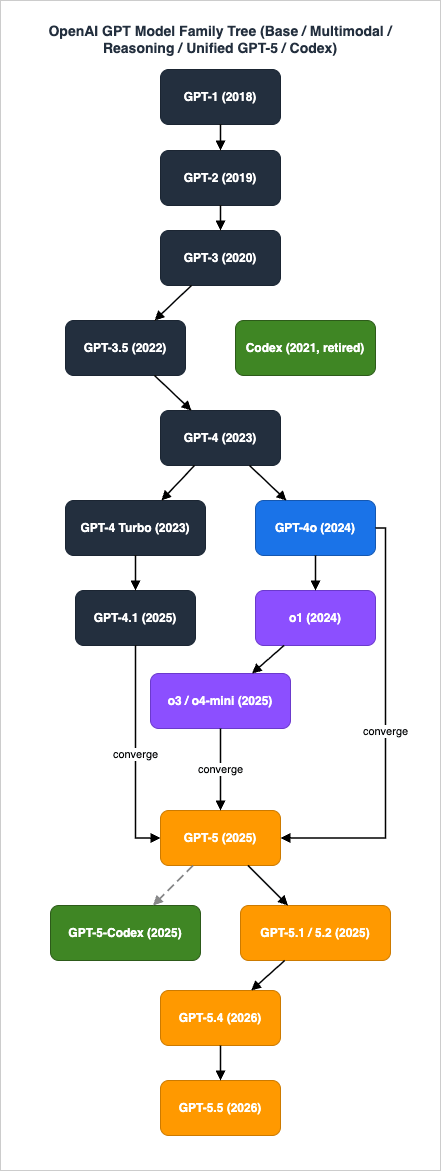
The multimodal "omni" lane begins with GPT-4o (2024), the first OpenAI model designed from the start to handle text, audio, and image in one model, joined by the cost-efficient GPT-4o mini. These models brought native multimodality to the GPT line before it merged into GPT-5.
The reasoning (o-series) lane is the family of models trained to produce an internal chain of thought before answering: o1-preview and o1-mini (2024), o1 (2024), o3-mini (2025), and o3 and o4-mini (2025). This lane introduced the "thinking" paradigm that GPT-5 later absorbed.
The unified GPT-5 lane is where the base, multimodal, and reasoning lines converge. GPT-5 (August 2025) is a single system with a fast model, a deeper "thinking" reasoning model, and a router that chooses between them; subsequent releases GPT-5.1, GPT-5.2, GPT-5.4, GPT-5.5, and GPT-5.6 continued this design. Through GPT-5.5, the generation used Instant, Thinking, and Pro variants (note that the Instant and Thinking variants were not always versioned in lock-step - for example, the March 2026 launch shipped GPT-5.3 Instant alongside GPT-5.4 Thinking and GPT-5.4 Pro). GPT-5.6 (July 2026) then replaced this scheme with named capability tiers - GPT-5.6 Sol (the frontier tier), GPT-5.6 Terra (a balance of intelligence and cost), and GPT-5.6 Luna (the fastest, most cost-efficient tier) - in which the number identifies the generation and the tier names are durable tiers that can advance on their own cadence. The lane continues into the next generation with GPT-6 Astra (September 2026), joined later that month by GPT-6 Sol and GPT-6 Luna and then by GPT-6.1 Sol.
The Codex coding lane is a special case. The original Codex (2021) was a GPT-3 descendant fine-tuned on code; it was retired in 2023. OpenAI later revived the Codex name for an entirely new coding agent (2025), backed by dedicated coding models such as
codex-1 and the GPT-5-Codex line, which derive from the o-series and GPT-5 generations rather than the 2021 model. Since GPT-5.5 (April 2026), the mainline frontier models have shipped directly in Codex.Timeline of Major Releases
Here is the chronological timeline of OpenAI GPT model releases and the major products, services, and platform milestones built on them. Each row links to the officialopenai.com announcement or the equivalent official source where one is available.* The table can be sorted by clicking on the column names.
| Date | Event |
|---|---|
| 2015-12-11 | OpenAI is founded as a non-profit AI research laboratory. Source: Introducing OpenAI. |
| 2018-06-11 | GPT-1 is published - the first Generative Pre-trained Transformer, introducing the unsupervised pre-training plus supervised fine-tuning recipe. Source: Improving language understanding with unsupervised learning. |
| 2019-02-14 | GPT-2 is announced with a staged release; the full 1.5B-parameter model followed in November 2019. Source: Better language models and their implications. |
| 2020-06-11 | GPT-3 is released through the OpenAI API (private beta) - the first GPT model OpenAI commercialized broadly. Source: OpenAI API. |
| 2021-01-05 | DALL·E and CLIP are introduced, bringing text-to-image generation to the GPT family of research. Source: DALL·E: Creating images from text. |
| 2021-06-29 | GitHub Copilot launches in technical preview, powered by the original OpenAI Codex model. Source: Introducing GitHub Copilot. |
| 2021-08-10 | OpenAI Codex is announced (private beta) - a GPT-3 descendant fine-tuned on code that translates natural language into code. This is the original Codex, later retired (see Deprecations). |
| 2022-04-06 | DALL·E 2 is announced as a research preview, with higher-resolution and more realistic image generation. Source: DALL·E 2. |
| 2022-09-21 | Whisper is released as an open-source automatic speech recognition model. Source: Introducing Whisper. |
| 2022-11-30 | ChatGPT is launched as a free research preview, built on the GPT-3.5 series. Source: Introducing ChatGPT. |
| 2023-02-01 | ChatGPT Plus is introduced, the first paid ChatGPT subscription tier. Source: Introducing ChatGPT Plus. |
| 2023-03-01 | The Chat Completions API (gpt-3.5-turbo) and the Whisper API are released for developers - the same model that powers the ChatGPT product, now available in the API. Source: Introducing ChatGPT and Whisper APIs. |
| 2023-03-14 | GPT-4 is announced - a large multimodal model accepting text and image input (image input shipped first as a limited preview and broadened over 2023-2024), with 8K- and 32K-token context variants. Source: GPT-4. |
| 2023-06-13 | Function calling is added to the Chat Completions API, letting models output structured arguments to call developer-defined functions. Source: Function calling and other API updates. |
| 2023-08-28 | ChatGPT Enterprise is announced, adding enterprise security, longer context, and administrative controls. Source: Introducing ChatGPT Enterprise. |
| 2023-09-25 | ChatGPT gains voice and image input ("see, hear, and speak"). Source: ChatGPT can now see, hear, and speak. |
| 2023-10-19 | DALL·E 3 becomes available in ChatGPT (announced September 20, 2023), integrating image generation directly into the chat experience. Source: DALL·E 3. |
| 2023-11-06 | First DevDay: GPT-4 Turbo, JSON mode, the Assistants API, and GPTs are announced. GPT-4 Turbo introduced a 128K-token context window. Source: New models and developer products announced at DevDay. |
| 2024-01-10 | The GPT Store launches, alongside ChatGPT Team. Source: Introducing the GPT Store. |
| 2024-05-13 | GPT-4o ("omni") is announced - a single model handling text, audio, and image input and output, with a 128K-token context window. Source: Hello GPT-4o. |
| 2024-07-18 | GPT-4o mini is announced, a small, cost-efficient multimodal model that replaced GPT-3.5 Turbo in ChatGPT. Source: GPT-4o mini: advancing cost-efficient intelligence. |
| 2024-09-12 | o1-preview and o1-mini are announced - OpenAI's first reasoning models, trained to think before responding. Source: Introducing OpenAI o1-preview. |
| 2024-10-01 | The Realtime API enters public beta (DevDay 2024), enabling low-latency speech-to-speech apps. Source: Introducing the Realtime API. |
| 2024-10-31 | ChatGPT search is launched, adding live web results to ChatGPT. Source: Introducing ChatGPT search. |
| 2024-12-05 | The full o1 model and ChatGPT Pro are launched. o1 became available in the API on December 17, 2024. Source: Introducing ChatGPT Pro. |
| 2024-12-09 | Sora launches publicly (text-to-video), after its February 15, 2024 research-preview announcement. Source: Sora is here. |
| 2025-01-23 | Operator is introduced - a research-preview agent that uses a computer (browser) on the user's behalf. Source: Introducing Operator. |
| 2025-01-31 | o3-mini is released in ChatGPT and the API - the first reasoning model offered to free ChatGPT users. Source: OpenAI o3-mini. |
| 2025-02-02 | Deep research is launched in ChatGPT - an agent that performs multi-step web research. Source: Introducing deep research. |
| 2025-02-27 | GPT-4.5 is released as a research preview - OpenAI's largest non-reasoning chat model; later deprecated (see Deprecations). Source: Introducing GPT-4.5. |
| 2025-03-11 | The Responses API and the open-source Agents SDK are introduced, with built-in web search, file search, and computer-use tools. Source: New tools for building agents. |
| 2025-03-25 | GPT-4o native image generation is released in ChatGPT, replacing DALL·E 3 as the default image generator (later exposed in the API as gpt-image-1). Source: Introducing 4o image generation. |
| 2025-04-14 | GPT-4.1, GPT-4.1 mini, and GPT-4.1 nano are released in the API with a 1-million-token context window. Source: Introducing GPT-4.1 in the API. |
| 2025-04-16 | o3 and o4-mini are announced - the first reasoning models able to agentically use every tool in ChatGPT. The Codex CLI open-source coding agent launched the same week. Source: Introducing OpenAI o3 and o4-mini. |
| 2025-05-16 | Codex (the cloud software-engineering agent) launches in ChatGPT as a research preview, powered by the codex-1 model (a version of o3 optimized for software engineering). Source: Introducing Codex. |
| 2025-07-17 | ChatGPT agent is introduced, unifying Operator-style computer use and deep research into a single agent mode. Source: Introducing ChatGPT agent. |
| 2025-08-07 | GPT-5 is announced - a unified system with a fast model, a deeper "GPT-5 thinking" reasoning model, and a real-time router, in gpt-5, gpt-5-mini, and gpt-5-nano API sizes. It became the ChatGPT default. Source: Introducing GPT-5. |
| 2025-08-28 | The Realtime API reaches general availability with the gpt-realtime speech-to-speech model. Source: Introducing gpt-realtime and Realtime API updates. |
| 2025-09-15 | GPT-5-Codex is released, a version of GPT-5 optimized for agentic coding and used as the default model in Codex. Source: Introducing upgrades to Codex. |
| 2025-09-30 | Sora 2 is announced, OpenAI's flagship video-and-audio generation model, alongside a new Sora app. Source: Sora 2. |
| 2025-10-06 | DevDay 2025: Codex reaches general availability, and AgentKit and the Apps SDK are announced. Source: Codex is now generally available. |
| 2025-11-12 | GPT-5.1 is released (GPT-5.1 Instant and GPT-5.1 Thinking), adding adaptive reasoning and a warmer default tone. Source: GPT-5.1: A smarter, more conversational ChatGPT. |
| 2025-12-11 | GPT-5.2 is released, the next flagship in the GPT-5 family, aimed at professional knowledge work. Source: Introducing GPT-5.2. |
| 2026-03-05 | GPT-5.4 is released (with GPT-5.3 Instant, GPT-5.4 Thinking, and GPT-5.4 Pro) - the first mainline model with native computer-use, a 1-million-token context option in the API and Codex, and tool search. Model snapshot gpt-5.4-2026-03-05. Source: Introducing GPT-5.4. |
| 2026-03-17 | GPT-5.4 mini and GPT-5.4 nano are released, bringing GPT-5.4-class capability to smaller, high-volume models. Source: Introducing GPT-5.4 mini and nano. |
| 2026-03-24 | The discontinuation of the Sora app is announced. The Sora web and app experiences ended on April 26, 2026, and the Sora 2 models and the Videos API were shut down on September 24, 2026 (see Deprecations). Source: What to know about the Sora discontinuation. |
| 2026-04-21 | gpt-image-2 (ChatGPT Images 2.0) is released - the first OpenAI image model with thinking capabilities - replacing the DALL·E line as the default image generator ahead of the DALL·E 2 and DALL·E 3 retirement on May 12, 2026. Source: Introducing ChatGPT Images 2.0. |
| 2026-04-23 | GPT-5.5 is released in ChatGPT and Codex, with GPT-5.5 Pro for the most demanding work; it became available in the API on April 24, 2026. Source: Introducing GPT-5.5. |
| 2026-05-05 | GPT-5.5 Instant becomes the default model in ChatGPT for all users, with reduced hallucinations and improved personalization. Source: GPT-5.5 Instant. |
| 2026-06-26 | GPT-5.6 Sol is previewed to a small group of trusted partners under a new U.S. government pre-release review process, ahead of its public release on July 9, 2026. Source: Previewing GPT-5.6 Sol. |
| 2026-07-08 | GPT-Live-1 and GPT-Live-1 mini are announced - a new generation of full-duplex voice models that listen and speak at the same time, replacing Advanced Voice Mode in ChatGPT, with API availability planned at announcement; GPT-Live 1 became generally available in the API on September 10, 2026. Source: Introducing GPT-Live, OpenAI API changelog. |
| 2026-07-09 | GPT-5.6 is released publicly in three named capability tiers (GPT-5.6 Sol, GPT-5.6 Terra, and GPT-5.6 Luna) across ChatGPT, Codex, and the API, adding programmatic tool calling and a multi-agent orchestration beta to the Responses API. The same day, OpenAI announced the ChatGPT Work agent and a new ChatGPT desktop app that merges Codex into ChatGPT. Source: GPT-5.6: Frontier intelligence that scales with your ambition. |
| 2026-07-28 | GPT Transcribe and GPT Live Transcribe are released - a file-transcription model and a low-latency streaming transcription model that together succeed the Whisper and GPT-4o transcription lines. Source: OpenAI Platform - Changelog. |
| 2026-08-07 | GPT-5.6 Cyber is released under the Daybreak program, with Red and Blue access tiers for approved cybersecurity work - a purpose-trained model line for vulnerability research, exploit reproduction, and mitigation development that is gated behind trusted access rather than offered on the open API. Source: OpenAI Platform - Changelog. |
| 2026-08-26 | OpenAI o3 is retired from ChatGPT, completing the 90-day sunset announced on May 28, 2026; GPT-4.5 had already been retired from ChatGPT on June 27, 2026 after a 30-day sunset. Both remained separate from the API lifecycle. Source: OpenAI Help Center - Model Release Notes. |
| 2026-09-03 | GPT-6 Astra is released - the current frontier generation as of the time of writing - which OpenAI describes as "the world's most intelligent and aligned model," reporting state-of-the-art results on computer use, browsing, software engineering, cybersecurity, science, and professional work. It rolled out first to a limited set of organizations and then to ChatGPT Plus, Pro, Business, and Enterprise, the OpenAI API, Microsoft Azure, and AWS Bedrock, and added async tool calling, mid-turn steering, and mid-conversation reasoning-effort changes. Source: GPT-6 Astra: A new generation of intelligence. |
| 2026-09-08 | GPT Image 2.5 is released in two API variants - GPT Image 2.5 Sunburst for editing precision and GPT Image 2.5 Flare for fast, high-quality generation - succeeding gpt-image-2 as the current image line. Source: OpenAI Platform - Changelog. |
| 2026-09-10 | GPT-Live 1 becomes generally available and the Agents API enters public beta. The full-duplex voice model that replaced Advanced Voice Mode in ChatGPT in July reached general availability in the API, and the Agents API exposed OpenAI's managed Codex harness - session orchestration, context compaction, and recovery - for building cloud agents. Source: OpenAI Platform - Changelog. |
| 2026-09-11 | GPT-Rosalind comes out of research preview. The domain-specific life sciences model OpenAI introduced on April 16, 2026 became available globally to eligible organizations through the trusted-access program, in ChatGPT Enterprise, Codex, and the API. Source: Introducing GPT-Rosalind for life sciences research. |
| 2026-09-22 | GPT-6 Sol and GPT-6 Luna are released, expanding the GPT-6 generation with faster, more affordable models that OpenAI trained with methods similar to GPT-6 Astra's; GPT-6 Astra remains OpenAI's best model. Alongside them, OpenAI published Better prompt caching for GPT-6, which its news feed summarizes as covering higher cache hit rates, new diagnostics, and explicit breakpoints; the API changelog dates the Prompt Caching dashboard to August 20, 2026, cache-preserving reasoning-effort changes to September 3, 2026, and the general availability of Prompt Cache Diagnostics to September 8, 2026. The models are available in ChatGPT Work and Codex for Plus, Pro, Business, Enterprise, and Edu users (GPT-6 Luna also for Free and Go users in the desktop app) but not in Chat (GPT-6 reached the Chat experience on October 7, 2026), and in the API as gpt-6-sol and gpt-6-luna through the Responses and Chat Completions APIs; they reached Microsoft Foundry and Amazon Bedrock the same day. Source: Introducing GPT-6 Sol and Luna, ChatGPT documentation - Models, Better prompt caching for GPT-6. |
| 2026-09-29 | GPT-6.1 Sol is released for complex coding and professional work, in the API as gpt-6.1-sol through the Responses and Chat Completions APIs (tool calling through the Responses API) and in ChatGPT Work and Codex, but not in Chat; it reached Amazon Bedrock and Microsoft Foundry the same day. The same day, OpenAI held DevDay 2026, and its API changelog for that date also added computer use to the Agents API (agents complete tasks in an OpenAI-hosted browser) and an Ultrafast mode for GPT-6 Astra in the Responses API, a service tier that reduces the time between generated output tokens. Source: Introducing GPT-6.1 Sol, DevDay 2026 Recap, OpenAI Platform - Changelog. |
| 2026-10-07 | GPT-6 and Intelligent UI roll out in ChatGPT, bringing the GPT-6 generation to the Chat experience: rollout starts that day for Plus, Pro, Business, and Enterprise and extends to Free and Go from the next day. GPT-6 in ChatGPT is powered by GPT-6 Sol on the paid tiers and GPT-6 Luna on Free and Go, both tuned for everyday conversation, while the models powering ChatGPT Work and Codex do not change in this release. Intelligent UI lets responses include graphics, tappable buttons, forms, charts, and interactive experiences, and ChatGPT can also begin answering while it continues to think. Source: GPT-6 and Intelligent UI for everyone. |
There may be slight variations in the dates in this timeline due to differences between the original announcement, general availability in the OpenAI API, and availability in ChatGPT or on cloud platforms. Where these differ, the dates above prioritize the original OpenAI announcement.
The content posted here is limited to major releases and milestones considered essential for understanding the GPT model family and the products built on it.
In other words, please note that the items on this timeline are not all of OpenAI's updates, but representative releases that I have picked out.
Capability Evolution
Beyond the model release dates themselves, OpenAI has shipped a steady stream of capabilities that apply across multiple GPT models. The table below tracks when each major capability first became available.* The table can be sorted by clicking on the column names.
| Capability | First Introduced | First Model / Surface | Notes |
|---|---|---|---|
| OpenAI API | 2020-06-11 | GPT-3 | Initial private-beta developer access. |
| Chat Completions API | 2023-03-01 | gpt-3.5-turbo | Chat-oriented API powering ChatGPT-style apps. |
| Vision (image input) | 2023-03-14 | GPT-4 | Multimodal image understanding (broad availability rolled out through 2023-2024). |
| Function calling | 2023-06-13 | gpt-4-0613 / gpt-3.5-turbo-0613 | Structured tool/function invocation from the API. |
| Voice and image in ChatGPT | 2023-09-25 | GPT-4 | Spoken conversations and image input in the ChatGPT product. |
| 128K context window | 2023-11-06 | GPT-4 Turbo | Large context for long documents. |
| JSON mode | 2023-11-06 | GPT-4 Turbo | Guaranteed valid-JSON output. |
| Assistants API | 2023-11-06 | DevDay 2023 | Stateful assistant primitive with tools and retrieval. |
| Native "omni" multimodality | 2024-05-13 | GPT-4o | Single model across text, audio, and image. |
| Reasoning ("thinking") | 2024-09-12 | o1-preview | Internal chain of thought before answering. |
| Realtime API (speech-to-speech) | 2024-10-01 | gpt-4o-realtime | Low-latency voice; GA with gpt-realtime on 2025-08-28. |
| Responses API and Agents SDK | 2025-03-11 | Platform | Agent-oriented API primitive with built-in tools and orchestration. |
| 1M-token context window | 2025-04-14 | GPT-4.1 | Million-token context in the API. |
| Agentic tool use in reasoning | 2025-04-16 | o3 / o4-mini | Reasoning models using every ChatGPT tool agentically. |
| Unified system with router | 2025-08-07 | GPT-5 | Automatic routing between fast and thinking models. |
| Native computer use (general model) | 2026-03-05 | GPT-5.4 | First mainline model with built-in computer-use. |
| Tool search | 2026-03-05 | GPT-5.4 | Efficient handling of large tool sets in the API. |
| Thinking in image generation | 2026-04-21 | gpt-image-2 | First OpenAI image model that reasons and plans before generating. |
| Full-duplex voice | 2026-07-08 | GPT-Live-1 / GPT-Live-1 mini | Listens and speaks simultaneously; replaced Advanced Voice Mode in ChatGPT, and reached general availability in the API on 2026-09-10. |
| Programmatic tool calling | 2026-07-09 | GPT-5.6 (Responses API) | Model-written programs orchestrate tool calls in a hosted runtime. |
| Multi-agent orchestration (beta) | 2026-07-09 | GPT-5.6 (Responses API) | Coordinates concurrent subagents within a single request. |
| Explicit prompt caching | 2026-07-09 | GPT-5.6 (API) | Developers choose which prompt prefixes are cached; the Prompt caching guide lists explicit breakpoints as supported for GPT-5.6 and later. OpenAI's news feed summarizes its 2026-09-22 post on prompt caching for GPT-6 as covering higher cache hit rates, new diagnostics, and explicit breakpoints; the changelog dates the Prompt Caching dashboard to 2026-08-20, cache-preserving reasoning-effort changes (GPT-6 Astra) to 2026-09-03, and Prompt Cache Diagnostics (generally available, GPT-5.6 and later) to 2026-09-08. |
| Ultrafast mode | 2026-08-13 | GPT-5.6 Sol (limited preview) | API service tier (service_tier: "ultrafast") that reduces the time between generated output tokens; added to the Responses API for GPT-6 Astra on 2026-09-29 and for GPT-6.1 Sol on 2026-10-08. |
| Steerable reasoning mid-request | 2026-09-03 | GPT-6 Astra | Async tool calling, mid-turn steering, and reasoning-effort changes inside a conversation. |
| Managed agent harness (beta) | 2026-09-10 | Agents API | Cloud agents on OpenAI's managed Codex harness, which handles session orchestration, context compaction, and recovery. |
| Decisions API (beta) | 2026-10-06 | GPT-6 Luna | Turns text and images into typed answers. |
| Interactive responses (Intelligent UI) | 2026-10-07 | GPT-6 in ChatGPT | Responses in ChatGPT can include graphics, tappable buttons, forms, charts, and interactive experiences. |
Products and Services Built on GPT
A defining feature of OpenAI compared with a pure model provider is the breadth of products built directly on its GPT models. The diagram below maps the major products and services to the model families that power them, and the subsections that follow describe each in turn.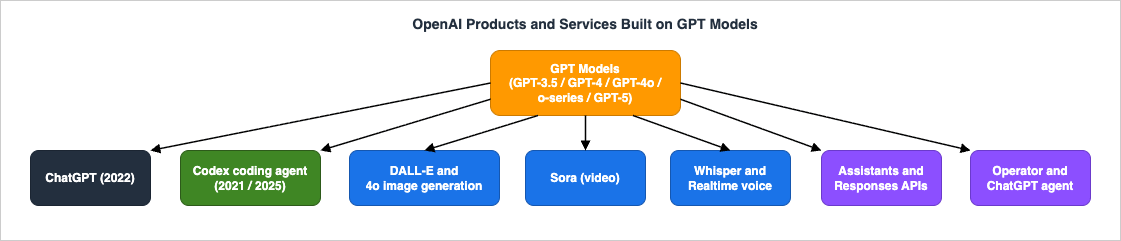
ChatGPT
ChatGPT, launched on November 30, 2022, is the product that brought GPT models to a mass audience. It began as a free research preview on GPT-3.5, gained the paid ChatGPT Plus tier in February 2023, and added GPT-4, plugins and browsing, ChatGPT Enterprise (August 2023), voice and image input (September 2023), the GPT Store (January 2024), memory, ChatGPT search (October 2024), and the ChatGPT Pro tier (December 2024). Over time it grew from a chat box into an agent platform with Operator, deep research, and the unified ChatGPT agent (2025). In July 2026, OpenAI took this further with ChatGPT Work - an agent for research and finished deliverables with built-in Codex - and a new ChatGPT desktop app for macOS and Windows that combines Chat, Work, and Codex in a single app (the previous desktop app was renamed ChatGPT Classic). Each major model generation - GPT-4, GPT-4o, the o-series, and the GPT-5 generation through GPT-5.6, and GPT-6 Astra - has shipped in ChatGPT alongside the API. On October 7, 2026, GPT-6 came to the Chat experience for every ChatGPT tier (GPT-6 Sol on Plus, Pro, Business, and Enterprise, and GPT-6 Luna on Free and Go), together with Intelligent UI, which lets responses include interactive elements such as charts, forms, and tappable buttons.Codex (the original model and the new agent)
The Codex name refers to two very different things. The original Codex (announced August 10, 2021) was a GPT-3 descendant fine-tuned on source code; it translated natural language into code and was the model behind the first generation of GitHub Copilot. OpenAI deprecated and shut it down in March 2023, advising developers that its newer general-purpose GPT models were better at coding.OpenAI later revived the name for an entirely new, unrelated Codex coding agent (2025): first the open-source Codex CLI terminal agent (April 2025), then a cloud-based software-engineering agent in ChatGPT (May 2025) powered by the
codex-1 model, which reached general availability at DevDay in October 2025. The new Codex initially ran on a rapid succession of dedicated coding models - codex-mini, GPT-5-Codex, and the GPT-5.1-Codex, GPT-5.2-Codex, and GPT-5.3-Codex line - that derive from the o-series and GPT-5 generations rather than the 2021 model; since GPT-5.5 (April 2026), the mainline frontier models have shipped directly in Codex. In July 2026, the Codex app was merged into the new ChatGPT desktop app, while Codex remains available as the CLI and IDE integrations. In short, "Codex" today means a coding agent surface within ChatGPT, the CLI, and IDEs, not the retired 2021 code model.Image, Audio, and Video
OpenAI's generative-media models also sit on top of, or alongside, the GPT line. DALL·E (January 2021), DALL·E 2 (April 2022), and DALL·E 3 (in ChatGPT from October 2023) covered text-to-image generation, until GPT-4o native image generation (March 2025, later exposed in the API asgpt-image-1) folded image generation into the multimodal GPT line; gpt-image-2 (ChatGPT Images 2.0, April 21, 2026) succeeded it as the default image model, and the DALL·E 2 and DALL·E 3 API models were retired on May 12, 2026; GPT Image 2.5 followed on September 8, 2026 in two API variants, Sunburst for editing precision and Flare for fast, high-quality generation. Whisper (September 2022) provided open-source speech recognition, and was itself superseded on July 28, 2026 by GPT Transcribe for file transcription and GPT Live Transcribe for low-latency streaming, with whisper-1 and the GPT-4o transcription models scheduled to shut down on February 26, 2027. For voice, Advanced Voice Mode (built on GPT-4o) and later the gpt-realtime models brought natural spoken conversation, and the full-duplex GPT-Live-1 models (July 2026) replaced Advanced Voice Mode in ChatGPT, with GPT-Live 1 reaching general availability in the API on September 10, 2026. For video, Sora was announced as a research preview in February 2024, launched publicly in December 2024, and was succeeded by Sora 2 in September 2025; OpenAI then announced the discontinuation of the Sora app in March 2026, ending the web and app experiences on April 26, 2026, and the Sora 2 models and the Videos API were shut down on September 24, 2026.Developer Platform and Agents
For developers, the GPT models are exposed through a platform that has steadily moved from simple completions toward agents. Milestones include the Chat Completions API (March 2023), function calling (June 2023), JSON mode and the Assistants API (DevDay 2023), the Realtime API (October 2024), and the Responses API together with the open-source Agents SDK and built-in tools (March 2025), followed by AgentKit (DevDay 2025) and, with GPT-5.6 (July 2026), programmatic tool calling and a multi-agent orchestration beta in the Responses API. Where the program that programmatic tool calling has the model write is run, set against Anthropic's programmatic tool calling and the Code Mode of agent harnesses, is compared in Where the Orchestration Program Runs. On September 10, 2026 the Agents API entered public beta, exposing the managed Codex harness - session orchestration, context compaction, and recovery - so that cloud agents can be built on the same machinery Codex uses; on September 29, 2026 it gained computer use in an OpenAI-hosted browser. On October 6, 2026, the Decisions API entered beta with GPT-6 Luna. How the Agents API divides the loop, the sandbox, and session state between OpenAI and you, set against Claude Managed Agents, Amazon Bedrock, and GKE Agent Substrate, is compared in Managed Agent Runtimes. On the product side, Operator (January 2025), deep research (February 2025), the unified ChatGPT agent (July 2025), and ChatGPT Work (July 2026) turned GPT models into agents that can browse, research, and operate software on a user's behalf; GPT-6 Astra (September 2026) was presented primarily as an advance in exactly that capability.Availability Across Platforms
GPT models are available through OpenAI's own API and ChatGPT, and through Microsoft's platforms - most directly Azure OpenAI (now part of Microsoft Foundry), and embedded in products such as Microsoft Copilot and GitHub Copilot. Since June 2026, OpenAI models are also generally available on Amazon Bedrock (described after the table below), ending the period in which Azure was the only cloud platform offering them. The table below summarizes when major model generations arrived on the OpenAI API and on Azure OpenAI / Microsoft Foundry.* The table can be sorted by clicking on the column names.
| Model / Generation | OpenAI API | Azure OpenAI in Microsoft Foundry |
|---|---|---|
| GPT-3 | 2020-06-11 | 2021-11 (preview) |
| GPT-3.5 / ChatGPT | 2023-03-01 | 2023-03-09 (preview) |
| GPT-4 | 2023-03-14 | 2023-03-21 (preview) |
| GPT-4o | 2024-05-13 | 2024-05-13 |
| GPT-4o mini | 2024-07-18 | 2024-07-18 |
| o1 | 2024-12-17 | 2024-12 |
| o3-mini | 2025-01-31 | 2025-01-31 |
| GPT-4.1 | 2025-04-14 | 2025-04 |
| o3 / o4-mini | 2025-04-16 | 2025-04 |
| GPT-5 family | 2025-08-07 | 2025-08 |
| GPT-5.5 | 2026-04-24 | 2026-04 |
| GPT-5.6 (Sol / Terra / Luna) | 2026-07-09 | 2026-07-09 |
| GPT-6 Astra | 2026-09-03 | 2026-09-03 |
| GPT-6 Sol / GPT-6 Luna | 2026-09-22 | 2026-09-22 |
| GPT-6.1 Sol | 2026-09-29 | 2026-09-29 |
For dates shown at month precision, the exact day and regional rollout can vary; the Azure OpenAI dates reflect Microsoft's "What's new" documentation, which groups some releases by month. For the most current availability and exact regional rollouts, refer to the Azure OpenAI in Microsoft Foundry "What's new" page and the OpenAI models documentation.
Microsoft first offered OpenAI models through the Azure OpenAI Service, announced in November 2021 and made generally available on January 16, 2023. Its companion development platform was subsequently rebranded twice: Azure AI Studio became Azure AI Foundry in November 2024, then Microsoft Foundry in November 2025, with the Azure OpenAI models now offered within it as "Azure OpenAI in Foundry Models." Beyond the Azure platform, GPT-4 powered the new Bing (later rebranded Microsoft Copilot) from February 7, 2023 (Microsoft confirmed it had been running on GPT-4 the following month), and GitHub Copilot - launched in technical preview on June 29, 2021 and made generally available on June 21, 2022 - was originally powered by the original OpenAI Codex model and later moved to newer GPT and Codex models.
In June 2026, OpenAI models arrived on AWS for the first time: GPT-5.5, GPT-5.4, and Codex became generally available on Amazon Bedrock, offered through the Responses API with a 272K-token context window and pricing matching OpenAI's first-party rates, with GPT-5.4 also available in AWS GovCloud (US-West). The Bedrock catalog then tracked OpenAI closely: GPT-5.6 Sol, Terra, and Luna became generally available on July 13, 2026, gained 1-million-token context windows on August 3, 2026, and were joined by a built-in Web Search tool on August 4, 2026, by the Daybreak Red (GPT-5.6 Cyber) and Daybreak Blue (GPT-5.6 Sol) cybersecurity models for eligible customers on August 13, 2026, by Converse and Chat Completions API support with cross-Region inference on August 17, 2026, and by Indian Regions on August 18, 2026. GPT-6 Astra reached general availability on Amazon Bedrock on September 8, 2026, five days after its release, accepting up to 1 million input tokens and callable either directly through the Bedrock APIs or by pointing ChatGPT Work and Codex at Bedrock. GPT-6 Sol and GPT-6 Luna followed on September 22, 2026, generally available on Bedrock on the day of their release, and GPT-6.1 Sol on September 29, 2026, also on its release day. Ultrafast mode reached Bedrock for GPT-6 Astra on September 30, 2026 and for GPT-6.1 Sol on October 8, 2026. Source: GPT-5.5, GPT-5.4, and Codex from OpenAI are now generally available on Amazon Bedrock, OpenAI GPT-6 Astra is now generally available on Amazon Bedrock, OpenAI GPT-6 Sol and GPT-6 Luna are now generally available on Amazon Bedrock, OpenAI GPT-6.1 Sol is now generally available on Amazon Bedrock, OpenAI GPT-6 Astra now supports UltraFast mode on Amazon Bedrock, and OpenAI GPT-6.1 Sol now supports Ultrafast mode on Amazon Bedrock.
Deprecations and Model Lifecycle
OpenAI publishes deprecation and shutdown dates for its models on its official deprecations page. A model is first marked as deprecated, with a recommended replacement, and then has a shutdown (retirement) date after which API calls to that model identifier fail. The table below lists notable model retirements drawn from the official OpenAI deprecations page. Note that OpenAI publishes some shutdowns as "no earlier than" dates (the earliest scheduled retirement, which can slip), so treat the shutdown dates below as the earliest scheduled day rather than a guaranteed exact one.The Recommended Replacement column reflects the successor currently recommended on OpenAI's deprecations page as of the time of writing; OpenAI updates these recommendations as newer models are released, so for older deprecations the listed replacement is generally not the one suggested at the time of the original announcement.
* The table can be sorted by clicking on the column names.
| Announced | Shutdown | Deprecated Model(s) | Recommended Replacement |
|---|---|---|---|
| 2023-03-20 | 2023-03-23 | Original Codex: code-davinci-002, code-davinci-001, code-cushman-002, code-cushman-001 | gpt-4o |
| 2023-06-13 | 2024-06-13 | gpt-4-0314 (original GPT-4 snapshot) | gpt-4o |
| 2023-07-06 | 2024-01-04 | GPT-3 base and InstructGPT text models (davinci, curie, babbage, ada, text-davinci-003, etc.) and first-generation embeddings | gpt-3.5-turbo-instruct / davinci-002 / text-embedding-3-small |
| 2024-06-06 | 2024-12-06 | gpt-4-vision-preview, gpt-4-1106-vision-preview | gpt-4o |
| 2024-06-06 | 2025-06-06 | gpt-4-32k and its snapshots | gpt-4o |
| 2025-04-14 | 2025-07-14 | gpt-4.5-preview | gpt-4.1 |
| 2025-11-14 | 2026-05-12 | DALL·E image models: dall-e-2, dall-e-3 | gpt-image-2 / gpt-image-1 / gpt-image-1-mini |
| 2025-11-17 | 2026-02-12 | codex-mini-latest | gpt-5-codex-mini |
| 2025-11-18 | 2026-02-17 | chatgpt-4o-latest | gpt-5.1-chat-latest |
| 2026-03-24 | 2026-09-24 | Sora 2 video models (sora-2, sora-2-pro, and their snapshots) and the Videos API | (none listed) |
| 2026-04-22 | 2026-07-23 | Preview and research models, including computer-use-preview and o3-deep-research | gpt-5.6-terra / gpt-5.6-sol (per model) |
| 2026-04-22 | 2026-10-23 | Legacy chat models and snapshots, including gpt-3.5-turbo, GPT-4-era and GPT-4o snapshots, o1, o1-pro, o3-mini, and o4-mini | gpt-5.6-terra / gpt-5.6-sol / gpt-5.6-luna / gpt-5.6-sol (reasoning.mode: pro) (per model) |
| 2026-06-02 | 2026-12-01 | GPT Image models: gpt-image-1-mini, gpt-image-1.5, chatgpt-image-latest | gpt-image-2.5-sunburst / gpt-image-2.5-flare |
| 2026-06-03 | 2026-11-30 | Platform products: Agent Builder (ChatKit remains available), the Evals platform (existing evals become read-only on 2026-10-31), and reusable prompt objects with the v1/prompts API | Agents SDK or ChatGPT Workspace Agents (Agent Builder); prompt content moved into application code (reusable prompts); a migration path to Promptfoo (Evals) |
| 2026-06-11 | 2026-12-11 | Original GPT-5 snapshots (gpt-5, gpt-5-mini, gpt-5-nano, gpt-5-pro) and o3 snapshots (o3, o3-pro) | gpt-5.6-sol / gpt-5.6-terra / gpt-5.6-luna / gpt-5.6-sol (reasoning.mode: pro) (per model) |
| 2026-07-20 | 2027-01-20 | Legacy audio, realtime, and transcription models (gpt-realtime, gpt-audio, gpt-4o-realtime, gpt-4o-audio, and their variants) | gpt-realtime-2.1 / gpt-audio-1.5 |
| 2026-08-26 | 2027-02-26 | Transcription models (whisper-1, gpt-4o-transcribe, gpt-4o-mini-transcribe, gpt-4o-transcribe-diarize) | gpt-live-transcribe / gpt-transcribe |
| 2026-09-11 | 2026-10-01 | gpt-5.4-cyber | The most capable cyber model available to you |
| 2026-10-01 | 2027-04-01 | gpt-5.3-codex, gpt-5.1, gpt-5.4-nano | gpt-6-sol (for gpt-5.3-codex and gpt-5.1) / gpt-6-luna (for gpt-5.4-nano) |
| 2026-10-01 | 2027-01-06 | Text-to-speech models (tts-1, tts-1-hd, gpt-4o-mini-tts-2025-03-20, gpt-4o-mini-tts-2025-12-15) | gpt-realtime-2.1-mini |
| 2026-10-14 | 2027-01-14 | GPT-4 series snapshots: GPT-4o (gpt-4o-2024-08-06, gpt-4o-2024-11-20), GPT-4o mini (gpt-4o-mini-2024-07-18), GPT-4.1 (gpt-4.1-2025-04-14), GPT-4.1 mini (gpt-4.1-mini-2025-04-14), and fine-tuned versions of these models | gpt-6-luna |
A few patterns stand out. The original Codex had the shortest life of any OpenAI model line: it was deprecated on March 20, 2023 and shut down just three days later, on March 23, 2023. The entire GPT-3 generation - base models, InstructGPT text models, and first-generation embeddings - retired together on January 4, 2024. GPT-4.5 lasted only about three months in the API (deprecated April 14, 2025, shut down July 14, 2025) before being folded back into the GPT-4.1 and GPT-5 lines. The pace has accelerated in the GPT-5 era: within roughly a year of GPT-5's launch, OpenAI scheduled retirements of the DALL·E image models (May 12, 2026), the Sora 2 video models and Videos API (September 24, 2026), a large wave of legacy chat models including
gpt-3.5-turbo and the remaining o-series models (October 23, 2026), and the original GPT-5 and o3 snapshots themselves (December 11, 2026). On October 14, 2026, OpenAI also scheduled the GPT-4o, GPT-4o mini, GPT-4.1, and GPT-4.1 mini snapshots for removal from the API on January 14, 2027, with gpt-6-luna as the recommended replacement.Separately from the API lifecycle above, OpenAI also retires models from the ChatGPT product itself: on February 13, 2026, GPT-4o, GPT-4.1, GPT-4.1 mini, and o4-mini were retired from ChatGPT (with Custom GPT access for business plans ending April 3, 2026), moving remaining usage to the GPT-5 generation. The same pattern continued through 2026: OpenAI announced on May 28, 2026 that GPT-4.5 would leave ChatGPT after a 30-day sunset (June 27, 2026) and that OpenAI o3 would leave after a 90-day sunset (August 26, 2026), with no corresponding API change on either date. On September 14, 2026, the Codex changelog announced that GPT-5.5 would retire from ChatGPT, ChatGPT Work, and Codex on all plans on October 14, 2026, and that this retirement does not apply to the OpenAI API; its October 14, 2026 entry records the retirement from Codex for users signed in with ChatGPT, while the OpenAI API and Codex sessions authenticated with an API key are not affected. Source: Retiring GPT-4o, GPT-4.1, GPT-4.1 mini, and OpenAI o4-mini in ChatGPT, Codex changelog. Always check the official deprecations page for the current schedule.
Frequently Asked Questions
When did ChatGPT launch?
ChatGPT launched on November 30, 2022 as a free research preview, built on the GPT-3.5 series. The paid ChatGPT Plus tier followed in February 2023. See the official Introducing ChatGPT announcement.When was GPT-4 released?
GPT-4 was announced on March 14, 2023 as a large multimodal model accepting text and image input, with 8K- and 32K-token context variants. See GPT-4.What is the difference between GPT-4 and GPT-4o?
GPT-4 (March 2023) accepted text and image input and produced text output. GPT-4o ("omni", May 2024) was designed from the start as a single model handling text, audio, and image input and output, with lower latency and a 128K-token context window, and a smaller GPT-4o mini followed in July 2024. See Hello GPT-4o.When did the o1, o3, and o4-mini reasoning models come out?
The o-series reasoning models began with o1-preview and o1-mini on September 12, 2024, followed by the full o1 in December 2024, o3-mini on January 31, 2025, and o3 and o4-mini on April 16, 2025. These models are trained to produce an internal chain of thought before answering. See Introducing OpenAI o1-preview and Introducing OpenAI o3 and o4-mini.What is the GPT-5 generation, and what is OpenAI's current model?
GPT-5 was announced on August 7, 2025 as a unified system that pairs a fast model with a deeper "GPT-5 thinking" reasoning model behind a real-time router. The generation advanced through GPT-5.1 (November 2025), GPT-5.2 (December 2025), GPT-5.4 (March 2026), and GPT-5.5 (April 23, 2026, with GPT-5.5 Instant becoming the ChatGPT default on May 5, 2026). GPT-5.6, released publicly on July 9, 2026 after a limited preview that began on June 26, 2026, closed out that generation in the Sol, Terra, and Luna capability tiers. The current frontier model as of the time of writing is the next generation: GPT-6 Astra, released on September 3, 2026 and described by OpenAI as "the world's most intelligent and aligned model," with state-of-the-art results reported on computer use, browsing, software engineering, cybersecurity, science, and professional work. On September 22, 2026, OpenAI added GPT-6 Sol and GPT-6 Luna to the GPT-6 generation as faster, more affordable models, while GPT-6 Astra remains its best model, and on September 29, 2026 it released GPT-6.1 Sol for complex coding and professional work. On October 7, 2026, GPT-6 reached the Chat experience in ChatGPT for all users (GPT-6 Sol on the paid tiers and GPT-6 Luna on Free and Go). See Introducing GPT-5, GPT-5.6, and GPT-6 Astra, Introducing GPT-6 Sol and Luna, Introducing GPT-6.1 Sol, and GPT-6 and Intelligent UI for everyone.What do Sol, Terra, and Luna mean in GPT-5.6?
With GPT-5.6 (July 9, 2026), OpenAI replaced the Instant / Thinking / mini / nano naming used through GPT-5.5 with named capability tiers: the number (5.6) identifies the model generation, while GPT-5.6 Sol (the frontier tier), GPT-5.6 Terra (a balance of intelligence and cost), and GPT-5.6 Luna (the fastest, most cost-efficient tier) identify durable capability tiers that can advance on their own cadence. In the next generation, OpenAI added GPT-6 Sol and GPT-6 Luna to GPT-6 Astra on September 22, 2026; no GPT-6 Terra was among them. GPT-6.1 Sol followed on September 29, 2026. See GPT-5.6 and Introducing GPT-6 Sol and Luna.What happened to the o-series reasoning models in the GPT-5 era?
With GPT-5, the separate o-series brand was effectively folded into the unified GPT-5 system: the fast path corresponds to "Instant" models and the reasoning path to "Thinking" models, selected automatically by the router. There is no "o5"; reasoning is now a mode of the GPT-5 generation rather than a separate model family.What is the difference between the original Codex and the new Codex?
The original Codex (announced August 10, 2021) was a GPT-3 descendant fine-tuned on code; it powered the first GitHub Copilot and was shut down in March 2023. The new Codex (2025) is an unrelated coding agent - first the open-source Codex CLI (April 2025), then a cloud software-engineering agent in ChatGPT (May 2025) powered bycodex-1 - that reached general availability in October 2025 and initially ran on dedicated GPT-5-Codex models before the mainline GPT-5.5 and GPT-5.6 models began shipping directly in Codex. In July 2026, the Codex app was merged into the new ChatGPT desktop app. See Introducing Codex.When did GPT models become available on Azure and Microsoft Foundry?
Microsoft announced the Azure OpenAI Service in November 2021 and made it generally available on January 16, 2023. GPT-4 reached Azure in preview on March 21, 2023, and recent models such as GPT-4o (May 2024), the GPT-5 family (August 2025), GPT-5.6 (July 9, 2026), GPT-6 Astra (September 3, 2026), GPT-6 Sol and GPT-6 Luna (September 22, 2026), and GPT-6.1 Sol (September 29, 2026) have arrived on Azure at or near their OpenAI launch. The surrounding development platform was renamed from Azure AI Studio to Azure AI Foundry in November 2024, and to Microsoft Foundry in November 2025. See the Azure OpenAI "What's new" page.What powered GitHub Copilot, and when did it launch?
GitHub Copilot launched in technical preview on June 29, 2021, powered by the original OpenAI Codex model, and reached general availability on June 21, 2022. It has since moved to newer GPT and Codex models. See Introducing GitHub Copilot.When were the older GPT models such as GPT-3.5, GPT-4-32k, and GPT-4.5 deprecated?
See the Deprecations and Model Lifecycle section above for the full table. In summary, the GPT-3 generation retired on January 4, 2024,gpt-4-32k shut down on June 6, 2025, gpt-4.5-preview shut down on July 14, 2025, chatgpt-4o-latest shut down on February 17, 2026, the DALL·E models shut down on May 12, 2026, gpt-3.5-turbo and the remaining o-series models are scheduled to shut down on October 23, 2026, and the GPT-4o, GPT-4o mini, GPT-4.1, and GPT-4.1 mini snapshots, announced for deprecation on October 14, 2026, are scheduled to shut down on January 14, 2027. In the ChatGPT product, GPT-4o, GPT-4.1, GPT-4.1 mini, and o4-mini were retired on February 13, 2026, followed by GPT-4.5 on June 27, 2026 and OpenAI o3 on August 26, 2026, and OpenAI scheduled GPT-5.5 to retire from ChatGPT, ChatGPT Work, and Codex on October 14, 2026 (not from the API). The most authoritative source is the official OpenAI deprecations page.When did OpenAI add vision, voice, and image generation?
Vision (image input) arrived with GPT-4 in March 2023; voice and image input came to ChatGPT in September 2023; DALL·E provided text-to-image generation from January 2021 (DALL·E 3 in ChatGPT from October 2023), and GPT-4o native image generation replaced DALL·E 3 as the default image generator in March 2025, succeeded in turn bygpt-image-2 (ChatGPT Images 2.0) on April 21, 2026 and by GPT Image 2.5 (Sunburst and Flare) on September 8, 2026. Whisper added open-source speech recognition in September 2022 and was superseded by GPT Transcribe and GPT Live Transcribe on July 28, 2026, and the Realtime API and Advanced Voice brought speech-to-speech conversation from October 2024, with the full-duplex GPT-Live-1 models replacing Advanced Voice Mode in ChatGPT from July 2026 and GPT-Live 1 reaching general availability in the API on September 10, 2026.Summary
In this article, I built a historical timeline of OpenAI's GPT models from GPT-1 in 2018 through the GPT-5 generation in 2025 and 2026, organized by the model family tree, the major release timeline, the evolution of capabilities, the products and services built on GPT, availability across platforms, and the deprecation lifecycle.In a few years, OpenAI has gone from a single research model to a unified GPT-5 system, by way of the base GPT line, the multimodal GPT-4o models, and the o-series reasoning models that converged into GPT-5 - while building ChatGPT, Codex, DALL·E, Sora, Whisper, and the Assistants, Responses, and Realtime APIs on top of those models, and making them available through the OpenAI API, Azure OpenAI in Microsoft Foundry, Amazon Bedrock, Microsoft Copilot, and GitHub Copilot. The current frontier model as of the time of writing is GPT-6 Astra, released on September 3, 2026, one generation on from GPT-5.6 and its Sol, Terra, and Luna capability tiers; on September 22, 2026, GPT-6 Sol and GPT-6 Luna joined it as faster, more affordable members of the same generation, followed by GPT-6.1 Sol on September 29, 2026, and GPT-6 reached the Chat experience in ChatGPT for all users on October 7, 2026.
I will continue to monitor how OpenAI's release cadence and capability roadmap evolve. The most reliable place to track new model announcements is the official OpenAI News page, with model deprecations listed on the official OpenAI deprecations page.
In addition, there are also related model-timeline and history articles on hidekazu-konishi.com, so please have a look if you are interested.
Anthropic Claude Model Release Timeline - Model Family Tree, Capability Evolution, and Platform Availability
AWS Generative AI History and Timeline - From SageMaker JumpStart to Bedrock AgentCore
Amazon Bedrock Model Catalog 2026
AWS History and Timeline - Almost All AWS Services List, Announcements, General Availability(GA)
References
- OpenAI News - Official announcements
- OpenAI - Introducing OpenAI (2015-12-11)
- OpenAI - Improving language understanding with unsupervised learning / GPT-1 (2018-06-11)
- OpenAI - Better language models and their implications / GPT-2 (2019-02-14)
- OpenAI - OpenAI API / GPT-3 (2020-06-11)
- OpenAI - DALL·E (2021-01-05)
- OpenAI - Introducing Whisper (2022-09-21)
- OpenAI - Introducing ChatGPT (2022-11-30)
- OpenAI - Introducing ChatGPT and Whisper APIs (2023-03-01)
- OpenAI - GPT-4 (2023-03-14)
- OpenAI - Function calling and other API updates (2023-06-13)
- OpenAI - New models and developer products announced at DevDay (2023-11-06)
- OpenAI - Hello GPT-4o (2024-05-13)
- OpenAI - GPT-4o mini (2024-07-18)
- OpenAI - Introducing OpenAI o1-preview (2024-09-12)
- OpenAI - Introducing the Realtime API (2024-10-01)
- OpenAI - Introducing ChatGPT Pro and o1 (2024-12-05)
- OpenAI - Sora is here (2024-12-09)
- OpenAI - Introducing Operator (2025-01-23)
- OpenAI - OpenAI o3-mini (2025-01-31)
- OpenAI - Introducing GPT-4.5 (2025-02-27)
- OpenAI - New tools for building agents / Responses API and Agents SDK (2025-03-11)
- OpenAI - Introducing 4o image generation (2025-03-25)
- OpenAI - Introducing GPT-4.1 in the API (2025-04-14)
- OpenAI - Introducing OpenAI o3 and o4-mini (2025-04-16)
- OpenAI - Introducing Codex (2025-05-16)
- OpenAI - Introducing ChatGPT agent (2025-07-17)
- OpenAI - Introducing GPT-5 (2025-08-07)
- OpenAI - Introducing gpt-realtime (2025-08-28)
- OpenAI - Introducing upgrades to Codex / GPT-5-Codex (2025-09-15)
- OpenAI - Sora 2 (2025-09-30)
- OpenAI - Codex is now generally available (2025-10-06)
- OpenAI - GPT-5.1 (2025-11-12)
- OpenAI - Introducing GPT-5.2 (2025-12-11)
- OpenAI - Retiring GPT-4o, GPT-4.1, GPT-4.1 mini, and OpenAI o4-mini in ChatGPT (retirement on 2026-02-13)
- OpenAI - Introducing GPT-5.4 (2026-03-05)
- OpenAI Help Center - What to know about the Sora discontinuation (announced 2026-03-24)
- OpenAI - Introducing ChatGPT Images 2.0 / gpt-image-2 (2026-04-21)
- OpenAI - Introducing GPT-5.5 (2026-04-23)
- AWS - GPT-5.5, GPT-5.4, and Codex from OpenAI are now generally available on Amazon Bedrock (2026-06)
- OpenAI - Previewing GPT-5.6 Sol (2026-06-26)
- OpenAI - Introducing GPT-Live (2026-07-08)
- OpenAI - GPT-5.6: Frontier intelligence that scales with your ambition (2026-07-09)
- OpenAI - GPT-6 Astra: A new generation of intelligence (2026-09-03)
- OpenAI - Introducing GPT-Rosalind for life sciences research (2026-04-16, updated 2026-09-11)
- OpenAI Help Center - Model Release Notes
- OpenAI Platform - Changelog
- OpenAI Platform - Prompt caching guide
- ChatGPT documentation - Models
- Microsoft - GPT-6 Astra now generally available in Microsoft Foundry (2026-09-03)
- AWS - OpenAI GPT-5.6 Sol, Terra, and Luna now generally available on Amazon Bedrock (2026-07-13)
- AWS - OpenAI GPT-6 Astra is now generally available on Amazon Bedrock (2026-09-08)
- OpenAI - Introducing GPT-6 Sol and Luna (2026-09-22)
- OpenAI - Better prompt caching for GPT-6 (2026-09-22)
- OpenAI - Introducing GPT-6.1 Sol (2026-09-29)
- OpenAI - GPT-6 and Intelligent UI for everyone (2026-10-07)
- OpenAI - DevDay 2026 Recap (2026-09-29)
- AWS - OpenAI GPT-6.1 Sol is now generally available on Amazon Bedrock (2026-09-29)
- AWS - OpenAI GPT-6 Astra now supports UltraFast mode on Amazon Bedrock (2026-09-30)
- AWS - OpenAI GPT-6.1 Sol now supports Ultrafast mode on Amazon Bedrock (2026-10-08)
- Codex changelog
- AWS - OpenAI GPT-6 Sol and GPT-6 Luna are now generally available on Amazon Bedrock (2026-09-22)
- Microsoft Learn - Azure OpenAI reasoning models - GPT-6 Astra and GPT-5 (Microsoft Foundry)
- OpenAI Platform - Models
- OpenAI Platform - Deprecations
- Microsoft - General availability of Azure OpenAI Service (2023-01-16)
- Microsoft Learn - Azure OpenAI in Microsoft Foundry Models: What's new
- GitHub - Introducing GitHub Copilot (2021-06-29)
References:
Tech Blog with curated related content
Written by Hidekazu Konishi