AWS History and Timeline regarding AWS Health - Overview, Functions, Features, Summary of Updates, and Introduction
First Published:
Last Updated:
status.aws.amazon.com, phd.aws.amazon.com, the organizational view, and Planned lifecycle events. In AWS sources as of October 7, 2026, these are described as screens of the AWS Health Dashboard or as features of AWS Health. However, it is difficult to determine precisely when each name was introduced and what function it served based on a single document. Furthermore, the names of AWS Support plans that provide access to the AWS Health API are sometimes written differently in different sources as of October 7, 2026.The prehistory of AWS Health is the Service Health Dashboard of 2008. On December 1, 2016, the AWS Personal Health Dashboard, which displays events related to customer accounts, and the AWS Health API were launched. An article on the AWS News Blog, published on the same day, also noted that CloudWatch Events could be used to automate responses to notifications. On January 17, 2020, the organizational view, which aggregates events for AWS Organizations, became available through the AWS Health API, and was later made available in the Personal Health Dashboard console on December 15, 2020. On February 28, 2022, the Service Health Dashboard and Personal Health Dashboard were combined into a single AWS Health Dashboard. Subsequently, in 2023, delegated administrator capabilities, the delivery of organization-wide events to Amazon EventBridge, and Planned lifecycle events were added. In 2025, the delivery of notifications and email changed with AWS User Notifications, and on October 2, 2026, the version catalog was added.
This article presents a timeline that lists these events under the names used by the sources of each day. The primary questions it aims to answer are: first, when and as what the names in existing design documents and runbooks appeared, and what they correspond to in AWS Health today, and second, which sources wrote which plan names, and when, as the usage requirements for the AWS Health API.
Within what the primary sources state explicitly, the answers are as follows: First, the change on 2022-02-28 consolidated two dashboards into one. The What's New announcement writes
brings together the AWS Service Health Dashboard and Personal Health Dashboard into a single connected experience, and the User Guide's Document history uses the word rebranded in its entry of the same date. Second, organizational view predates the name "AWS Health Dashboard". The API was introduced on 2020-01-17, and the console on 2020-12-15, both prior to 2022-02-28. Third, the plan names referenced in the usage requirements for the AWS Health API vary depending on the source and the point in time. The What's New announcement from 2016-12-01 mentioned the Business and Enterprise plans. The User Guide added the Enterprise On-Ramp plan on 2021-11-24. As of 2026-10-07, the AWS Health API page in the User Guide gives both the names of the plans announced on 2025-12-02 and the names of the plans from before that date. The aws-health-concepts-and-terms page in the same User Guide gives only the names of the plans announced on 2025-12-02, while the register-a-delegated-administrator page only lists plan names from before 2025-12-02. The AWS Health API Reference only lists plan names from before 2025-12-02. The What's New announcement from 2026-10-02 refers to the Business Support Plus plan, while the User Guide for the version catalog mentions Customers on AWS Support without specifying plan names.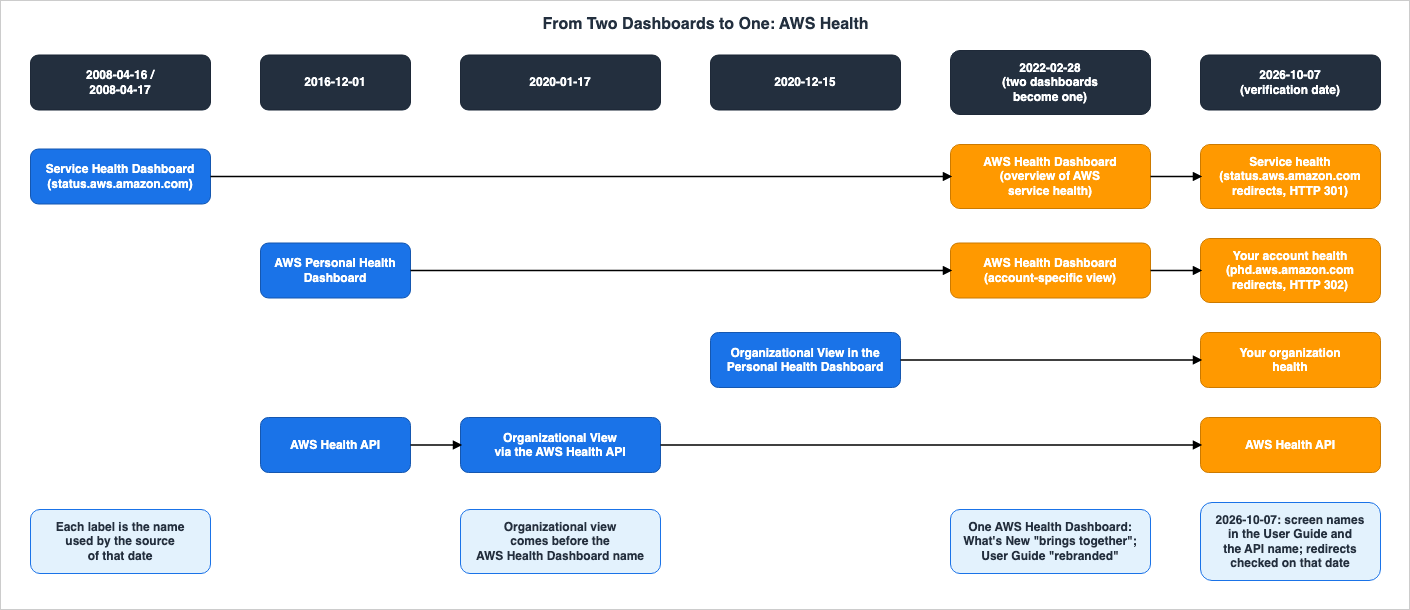
Background and Method of Creating AWS Health Historical Timeline
This section first outlines the sources used to populate the timeline entries, how names and dates were determined, and how the usage requirements table was built. All references were accessed on October 7, 2026. For instances where data was sourced from the Internet Archive, the date and time the specific version was archived is noted.Dashboard Names That Remain in Design Documents and Runbooks
When reviewing the documentation related to AWS Health, the dashboard names fall into three categories.Service Health Dashboard— This was the name of the page that displayed the overall status of AWS services, from 2008 until February 28, 2022. The address wasstatus.aws.amazon.com. As of October 7, 2026, accessing this address redirects tohealth.aws.amazon.com/health/status.Personal Health Dashboard— This was the name of the page that displayed events related to your account, from December 1, 2016, until February 28, 2022. As of October 7, 2026, accessingphd.aws.amazon.comredirects to the AWS Health console viahealth.aws.amazon.com/health/home.AWS Health Dashboard— This is the name used from February 28, 2022, onwards. As of October 7, 2026, the User Guide describes the screensAWS Health Dashboard – Service health(viewable without signing in) andAWS Health Dashboard – Your account health(viewable after signing in).
The usage requirements for the AWS Health API are also described using the names of AWS Support plans. For example, the AWS Health User Guide, as of October 7, 2026, states the following. The first sentence uses the names of the plans announced on December 2, 2025, and the second, a transitional sentence, uses the names of plans from before December 2, 2025.
You must have an AWS Business Support+, AWS Enterprise Support, or AWS Unified Operations plan
from AWS Support to use the AWS Health API. If you're in an AWS Region that doesn't offer one
of these AWS Support plans, or if you haven't transitioned to one of these plans, you can use
the AWS Health API with a Business, Enterprise On-Ramp, or Enterprise Support plan.
On the same day, the AWS Health API Reference states the following.
You must have a Business, Enterprise On-Ramp, or Enterprise Support plan from AWS Support to
use the AWS Health API.
It is sometimes the case that the usage requirements for the same functionality are described using different plan names in documents read on the same day. This is why this article places the Plan Gate Table after the timeline.
The Primary Sources This Article Used, and What It Made into Entries
The entries in the timeline were drawn from the following primary sources:- What's New — As of October 7, 2026, there were 35 announcements tagged with
whats-new-v2#general-products#aws-health, the oldest of which dates back to July 15, 2021. ⚠ Of these, 19 announcements relate to services and products other than AWS Health (15 relate to AWS HealthOmics, and one each to AWS HealthScribe, AWS HealthImaging, AWS for Health, and ESM3). There were 16 announcements specifically related to AWS Health, the oldest of which dates back to January 20, 2022. Announcements prior to that date were identified using the tagswhats-new-v2#general-products#aws-personal-health-dashboard(6 announcements) andwhats-new-v2#general-products#aws-service-health-dashboard(3 announcements), as well as a full-text search of What's New. This article uses the publication date (postDateTime) from What's New and does not use the year and month included in the URL. - AWS News Blog and AWS Cloud Operations Blog — The News Blog includes articles from April 17, 2008, December 1, 2016, and November 9, 2023. The Cloud Operations Blog includes articles from March 25, 2021, and February 28, 2022.
- AWS Health User Guide — This includes pages for each feature, as well as a Document history. ⚠ The Document history is divided into two tables. One table lists the updates
beginning in August 28, 2020, and the other is theEarlier updatestable. The oldest entry in the latter table is from December 1, 2016, labeledService release.The dates for each row are located at the end of the row. - AWS User Notifications User Guide — This uses only the AWS Health entries from the Document history.
- AWS Health API Reference and AWS General Reference — This uses the usage requirements sentences, the list of actions, the endpoints, and the table of services in Sunset.
- AWS re:Post — This uses one Knowledge Center article that gives the date of the email delivery migration.
- Internet Archive — This includes four pages from the AWS Health User Guide (from November 2025 to June 2026), the version from October 23, 2021, of the Document history, two versions of the AWS Health Aware article from the AWS Cloud Operations Blog (from March 25, 2021, and February 2, 2023), and the April 17, 2025, version of the What's New announcement from December 1, 2016. ⚠ The archived date and time indicate when the content was displayed, not necessarily when the page was updated.
- AWS SDK for Python (botocore) AWS Health models — This uses commit dates from GitHub to supplement the dates when API actions were added. ⚠ This indicates when the model was included in the SDK, not necessarily when the announcement was made. For events that have dates in What's New or the User Guide, it is used only as a supplementary source placed next to those dates, never as an entry's date. It was also used to confirm names in model descriptions, and to supplement dates for items where dates are not found in What's New or the User Guide (such as for
DescribeEntityAggregatesForOrganizationfrom August 31, 2023). - Other — This is the result of accessing old addresses and RSS feeds as of October 7, 2026.
The entries recorded include the names of AWS Health dashboards, the paths by which AWS informs accounts (AWS Health API, CloudWatch Events and Amazon EventBridge, AWS Organizations organizations, AWS User Notifications, chat clients, AWS Health Aware, AWS Service Management Connector), changes to attributes of the AWS Health API and events, the plan names written as usage requirements, and events related to software versions and service lifecycles. Announcements made by other services that they started sending events to AWS Health or receiving events from it (such as Application Auto Scaling on 2019-12-20, AWS Security Hub on 2022-01-20, and Planned lifecycle events for AWS Batch on 2026-03-25) were not made into entries. Changes limited to screen displays, changes made only in SDK models, services with similar names, and pricing were also excluded. Based on these criteria, 35 entries were selected. In other words, please note that the items on this timeline are not all updates to AWS Health, but are representative updates that I have picked out.
Names Are Taken from the Sources of That Day
The "Name on That Date" column reflects the name used in the sources of that day. It does not use AWS Health Dashboard for rows prior to February 28, 2022, and does not use Amazon EventBridge for rows from the period when the AWS Health documentation used the name CloudWatch Events. The "Name on the Verification Date" column gives what the same thing is called in the sources on the verification date. Of the 138 results of a What's New full-text search (searching forHealth Dashboard with the AND condition), no announcement before February 28, 2022, that writes AWS Health Dashboard was found.⚠ AWS documentation itself sometimes applies new names to older records. For example, the 2020-12-14 entry in the Document history is titled
Added the AWS Health Dashboard for organizational view in the AWS Health console as of 2026-10-07. In the version archived by the Internet Archive on 2021-10-23, the same entry was titled Added the AWS Personal Health Dashboard for organizational view in the AWS Health console. A separate What's New announcement, dated 2020-12-15, described the same feature with the title AWS Personal Health Dashboard now supports organization-wide event aggregation. Furthermore, the 2021-03-16 entry in the Document history describes the addition of support for receiving AWS Health events in a chat client, and as of 2026-10-07, the link for that entry is titled Receiving AWS Health events with Amazon Q Developer in chat applications. In the version archived on 2021-10-23, the same link was titled Receiving AWS Health events with AWS Chatbot. Currently, the page address still includes aws-chatbot. The date of the AWS Chatbot rename is 2025-02-19 on the rename notice page in the documentation that AWS Service Renames Reference used, and 2025-02-26 in the What's New announcement AWS Chatbot is now named Amazon Q Developer.⚠ Older names remain in the documentation even after a new name appears. The description for the botocore AWS Health model used the name "Personal Health Dashboard" as of the commit dated 2021-12-08. The model's subsequent commit, on 2023-05-11 (after 2022-02-28), removed this name. Therefore, between 2022-02-28 and 2023-05-11, the model's documentation still referenced the name "Personal Health Dashboard". As of 2026-10-07, the AWS Health API Reference only lists plan names from before 2025-12-02. The names alone cannot tell you when a document is from.
Conflicting Dates and Statements for the Same Events
In some instances, there are multiple dates or different descriptions for the same event. This article presents the information as it appears in each source, without assuming that any one version is incorrect. The reasons for discrepancies in dates across different sources, and the rationale behind choosing specific dates for recording, are discussed in Where the AWS Primary Sources Disagree About Launch Dates.- Service Health Dashboard announcement: What's New announced it on April 16, 2008, inside the AWS Premium Support announcement, and the AWS News Blog article is dated April 17, 2008. An article on the AWS Cloud Operations Blog, dated February 28, 2022, also states
On April 17, 2008. - Fine-grained access control with IAM conditions: The User Guide's Document history entry is dated August 2, 2018, and What's New is dated August 6, 2018.
- Organizational view (API): The User Guide's Document history entry is dated December 18, 2019, the botocore model commit is dated December 23, 2019, and What's New is dated January 17, 2020.
- Organizational view (console): The User Guide's Document history entry is dated December 14, 2020, and What's New is dated December 15, 2020.
- AWS Health Aware: An article on the AWS Cloud Operations Blog, published on March 25, 2021, introduced AWS Health Aware, already highlighting integration with EventBridge as one of its benefits. A
Whats new?section, located near the beginning of the version retrieved on October 7, 2026, saysEventBridge integrations are now available!. This section was not present in the version archived by the Internet Archive on March 25, 2021, but is present in the version archived on February 2, 2023 (the article'sarticle:modified_timeis January 13, 2023). What's New is dated September 13, 2021, and the User Guide's Document history entry is dated May 25, 2022. - Events prior to enabling organizational view: The June 27, 2025, entry in the User Guide's Document history says that enabling organizational view also aggregates past events. The delegated administrator registration page of the same User Guide still says, as of October 7, 2026,
You can view historical events over the past 90 days or since the organizational view feature was first enabled, whichever is more recent. - Planned lifecycle events: The User Guide's Document history entry is dated October 31, 2023, and What's New and the AWS News Blog are dated November 9, 2023.
- Actionability and persona: The User Guide's Document history entry is dated November 20, 2025, and What's New is dated November 26, 2025.
- Transition of email delivery: The main text of the User Guide says
Since December 15, 2025, the Document history entry that reflects the migration is dated December 22, 2025 (the entry that added a note on the migration schedule is dated April 28, 2025), and an AWS re:Post Knowledge Center article saysOn December 25, 2025. - Version catalog: The botocore model commit is dated October 1, 2026, and What's New and the User Guide's Document history entry are dated October 2, 2026.
lifecycleEventTypevalues: On the version catalog page in the User Guide, examples of values are provided, includingEND_OF_SUPPORT,BLOCK_RESOURCE_CREATE, andBLOCK_RESOURCE_UPDATE. It states that a complete list of possible values can be found in the AWS Health API Reference. The AWS Health API Reference listslifecycleEventTypeas a String without an enumerated list of values, givingend-of-support, end-of-lifeas examples.- AWS Health API usage requirements: Covered in the Plan Gate Table.
How to Read the Plan Gate Table
The Plan Gate Table lists, one row per source, which plan names each source writes as the usage requirements of a feature. This article's table is built with the same columns and rules as the AWS History and Timeline regarding AWS Support Plans Plan Gate Table, with two rules added: a User Guide Document history entry uses the date of the entry as its As Of, and from a sentence that mentions pricing, only the part without the pricing phrase is copied. The columns are as follows:- What It Gates: The feature whose usage requirements the source states.
- Plans Named in the Source: The plan names the source writes, copied in the source's own spelling; spellings such as
a AWSare left as they are. Where the source states nothing, the cell saysThe source does not say.Before writing that, the entire source, including its pricing sections, is searched forplan,Support,available to,must have, andcustomersto confirm that no sentence says otherwise. From a sentence that mentions pricing, only the part without the pricing phrase is copied. - Where AWS Says So: The document containing this information.
- As Of: For What's New, the AWS News Blog, and the AWS Cloud Operations Blog, this indicates the publication date. For entries from the User Guide's Document history, this reflects the date of the entry. For the main body of the User Guide and API Reference, this reflects the verification date (2026-10-07).
Each source gets its own row. Even when sources say different things, their rows are not merged into one. If a single document specifies the usage requirements for multiple features, a separate row is created for each feature (the What's New announcement of 2020-12-15 and the
enable-organizational-view page of the User Guide). This article divides the information into two tables: Table 1 contains entries for announcements, blog posts, and entries from the User Guide's Document history, where the "As Of" date varies. Table 2 contains entries for documents where the "As Of" date consistently refers to the verification date.Topics Covered in Other Articles
This article will not cover the following topics, but will instead defer to other articles.- Designing operations using AWS Health events — The Region in which to place EventBridge rules, how long events can be kept, and designs for accounts that do not meet the AWS Health API usage requirements are covered as main topics in section 6 of Surviving Forced Maintenance on AWS.
- The scope of Planned lifecycle events and how notifications are routed within an organization — This is addressed in sections 7.4 and 7.5 of AWS Service Lifecycle States.
- The history behind the names of AWS Support plans — AWS History and Timeline regarding AWS Support Plans covers this. Rows for the same sources carry the same values in this article's Plan Gate Table.
- The history of Amazon EventBridge — AWS History and Timeline regarding Amazon EventBridge covers this topic. The entry for 2016-12-01 in that article cites the same article as this article's AWS News Blog entry for 2016-12-01.
- The history of AWS Trusted Advisor — Covered in AWS History and Timeline regarding AWS Trusted Advisor.
- End-of-support and end-of-life dates for various service versions — AWS End-of-Support and EOL Reference covers this. This article holds the version catalog only as one timeline entry and a short description.
- A comprehensive timeline of AWS services — AWS History and Timeline includes the Service Health Dashboard (listed under the entry for 2008-04-17) and the Personal Health Dashboard (listed under the entry for 2016-12-01). These are the same dates as this article's prehistory paragraph and its 2016-12-01 entry.
- A shortcut to access the Personal Health Dashboard from the AWS Systems Manager console — AWS History and Timeline regarding AWS Systems Manager covers this.
- A list of AWS services that are ending, and the words for their status — AWS Retired Services History and Timeline provides this information. The entry for 2026-03-31 in that article corresponds to the same date as the entry for AWS Service Management Connector in this article.
AWS Health Historical Timeline (Updates from December 1, 2016)
The following eight tables constitute the main historical timeline. Each table has the following columns. All references were accessed on October 7, 2026.- Date — For What's New announcements, this indicates the publication date. For the AWS News Blog and AWS Cloud Operations Blog, it is the article's publication date. For the User Guide, it is the date of the entry in the Document history. For the Internet Archive, it is the date the content was archived. For scheduled events and entries taken from the main text of the User Guide, it is the date written in the source's text.
- Name on That Date — The name the source of that date used. The original formatting of the name is reproduced as it appears in the source.
- Name on the Verification Date — This describes what that name represents in the sources as of the verification date (October 7, 2026), and its current status.
- What Happened — This describes the event that occurred.
- Source — This indicates the source used to create the entry. For entries from the Internet Archive, it includes the date the content was archived.
Prehistory — the Service Health Dashboard (2008). While the timeline begins on December 1, 2016, a Service Health Dashboard existed prior to that date. The What's New announcement of April 16, 2008, Announcing AWS Premium Support states, in the same announcement as AWS Premium Support,
In addition to the launch of AWS Premium Support, we are also announcing a Service Health Dashboard, which reports the status of our services. The AWS News Blog article of April 17, 2008, The Service Health Dashboard states We now have a Service Health Dashboard available at http://status.aws.amazon.com. and says that you can subscribe to the RSS feed for each service and view a record of service status for the previous 35 days. An AWS News Blog article from December 1, 2016, reflects on this dashboard, stating, We launched the AWS Service Health Dashboard way back in 2008!Index:
- 2016–2019 - The period when the Personal Health Dashboard and AWS Health API were introduced, and support for notifications via CloudWatch Events was added.
- 2020–2021 - The period when organizational view was added and Enterprise On-Ramp was added to the usage requirements.
- 2022 - The year when two dashboards were consolidated into a single AWS Health Dashboard.
- May–October 2023 - The period when delivery of events for the overall service status to EventBridge, AWS User Notifications, delegated administrator, and organization-wide delivery to EventBridge were added.
- November 2023–2024 - The period when Planned lifecycle events were added, and the organizational view was expanded to AWS GovCloud (US).
- January–August 2025 - The period when AWS Managed Notifications were added, and the User Guide removed the instructions for RSS subscriptions.
- September–December 2025 - The period when managed notifications became enabled by default, and changes were made to the delivery of AWS Health emails.
- 2026–2027 - The period when the User Guide usage requirements, written with the names of the plans announced on 2025-12-02, appeared in the Internet Archive version, and a version catalog was added. This also includes the scheduled end of support for the AWS Service Management Connector (as of 2026-10-07).
* You can sort the table by clicking on the column name.
2016–2019 — Personal Health Dashboard, the AWS Health API, and CloudWatch Events
During this period (2016–2019), the Personal Health Dashboard and AWS Health API were introduced, providing information about events related to customer accounts. CloudWatch Events was used to automate responses to notifications.| Date | Name on That Date | Name on the Verification Date | What Happened | Source |
|---|---|---|---|---|
| 2016-12-01 | AWS Personal Health Dashboard, AWS Health API | The Your account health page of the AWS Health Dashboard (the AWS Health Dashboard name dates from February 28, 2022) / AWS Health API | AWS Personal Health Dashboard and AWS Health API were released. The announcement stated that Personal Health Dashboard was Available to all AWS customers, while the AWS Health API was available to Business and Enterprise Support plan customers. The oldest entry in the User Guide's Document history (Service release.) also corresponds to this date. Accessing the announcement's URL on 2026-10-07 redirects to the About AWS page, so the Source column points to the version of the announcement last archived by the Internet Archive. | Introducing AWS Personal Health Dashboard (Internet Archive, 2025-04-17 12:11:57 UTC) / Document history for AWS Health |
| 2016-12-01 | CloudWatch Events | Amazon EventBridge | An AWS News Blog post highlighted the ability to automate responses to notifications using CloudWatch Events. The post stated, You can also use CloudWatch Events to automate your response to alerts and notification of scheduled activities. and, about the AWS Health API, says If your organization subscribes to AWS Business Support or AWS Enterprise Support, you also have access to the new AWS Health API. | New – AWS Personal Health Dashboard – Status You Can Relate To |
| 2017-03-06 | AWS Health Tools, CloudWatch Events | GitHub repository aws/aws-health-tools / Amazon EventBridge | A GitHub repository was released, showcasing examples of using AWS Lambda to respond to AWS Health events. The announcement stated, You can use CloudWatch Events to detect and react to changes in the status of AWS Health events. | New GitHub repository with AWS Lambda actions for AWS Health |
| 2018-08-06 | AWS Personal Health Dashboard | AWS Health Dashboard | It became possible to implement more granular access control using IAM, based on event attributes. The announcement stated, AWS Personal Health Dashboard now supports fine-grained access control so that you can setup permissions based on event metadata. It also specified the availability at that time: AWS Personal Health Dashboard is available in all regions except in AWS GovCloud (US), AWS China (Beijing), and AWS China (Ningxia) regions. The corresponding entry in the User Guide's Document history is dated August 2, 2018. | AWS Personal Health Dashboard Now Supports Fine-Grained Access Control Via IAM Policy Conditions |
| 2019-08-08 | AWS Health, AWS Personal Health Dashboard (PHD), AWS Health API | AWS Health / AWS Health Dashboard / AWS Health API | AWS Health became available in AWS GovCloud (US). The announcement stated, AWS Health includes the AWS Personal Health Dashboard (PHD) and the AWS Health API. Regarding AWS Health API, it stated, AWS Health API is available to customers with Business or Enterprise Support subscriptions. | AWS Health is now Available in AWS GovCloud (US) |
2020–2021 — Organizational View and Enterprise On-Ramp in the Usage Requirements
During the period of 2020–2021, an organizational view, consolidating events across the entire AWS Organizations organization, became available. Initially, this was accessible through the AWS Health API, and subsequently through the Personal Health Dashboard console. Both features were released prior to February 28, 2022.| Date | Name on That Date | Name on the Verification Date | What Happened | Source |
|---|---|---|---|---|
| 2020-01-17 | AWS Health Organizational View | organizational view (as stated in the User Guide) | It is now possible to retrieve all AWS Health events for all accounts within an organization through the AWS Health API. The announcement stated, You can start using Organizational View today via the AWS Health API. and gives the usage requirements as customers with a Business or Enterprise Support plan. The User Guide's Document history entry is dated 2019-12-18, and the botocore model commit is dated 2019-12-23, indicating an increase in the number of model actions from 6 to 13. | AWS Health enables aggregation of health events across AWS Organizations |
| 2020-12-15 | AWS Personal Health Dashboard, Organizational View | AWS Health Dashboard organization page (Your organization health) | Organizational view became available in the AWS Personal Health Dashboard console as well. The announcement stated, the AWS Personal Health Dashboard now provides an all-up view of Health events occurring across your organization. and, about organizational view in the console, says does not require a premium AWS Support plan. The same announcement also states, The Health API is available only to customers subscribed to a premium AWS Support plan. The User Guide's Document history entry is dated 2020-12-14, and its title uses the later name AWS Health Dashboard. | AWS Personal Health Dashboard now supports organization-wide event aggregation |
| 2021-03-16 | chat client (on a version archived by Internet Archive on 2021-10-23, the link title was Receiving AWS Health events with AWS Chatbot) | Amazon Q Developer in chat applications (formerly AWS Chatbot. The page address includes aws-chatbot) | The User Guide now includes a section describing how to receive AWS Health events within a chat client. The Document history entry states, Added a section to receive AWS Health events in your chat client. | Document history for AWS Health |
| 2021-09-13 | AWS Health Aware (AHA) | Same name (GitHub repository on aws-samples) | What's New announced that AWS Health Aware, a mechanism for sending AWS Health events to chat and email, is now available for both organizations and individual accounts. The announcement described AWS Health Aware as an incident management & communication framework to ingest proactive and real-time alerts from AWS Health. A previous article on the AWS Cloud Operations Blog, dated 2021-03-25, had already introduced AWS Health Aware, stating that AHA uses the AWS Health API which is only available to AWS customers who have Business or Enterprise Support plan. The User Guide's Document history entry is dated 2022-05-25. | AWS Health Aware (AHA) is now available for Organizational and Personal AWS Accounts to customize Health Alerts / AWS Health Aware – Customize AWS Health Alerts for Organizational and Personal AWS Accounts |
| 2021-11-24 | Enterprise On-Ramp Support plan | Enterprise On-Ramp (scheduled to end; according to the AWS Support User Guide, the end date is 2027-01-01 except in the AWS GovCloud (US) Region, as of 2026-10-07) | The User Guide now states that the AWS Health API is available to customers with the Enterprise On-Ramp Support plan. The Document history entry states, If you have an Enterprise On-Ramp Support plan, you can use the AWS Health API. The general availability announcement for Enterprise On-Ramp is also on the same date. | Document history for AWS Health |
2022 — From Two Dashboards to One AWS Health Dashboard
In 2022, the User Guide added a section on Amazon EventBridge (earlier entries used the name CloudWatch Events), and the Service Health Dashboard and Personal Health Dashboard were consolidated into a single AWS Health Dashboard.| Date | Name on That Date | Name on the Verification Date | What Happened | Source |
|---|---|---|---|---|
| 2022-02-03 | Amazon EventBridge | Same name | The User Guide was updated to include a section on using Amazon EventBridge to monitor AWS Health events. The Document history entry states: New topic for AWS Health to use Amazon EventBridge to monitor for Health events. Previous Document history entries (2021-01-29, 2021-03-16, 2021-04-28, 2021-05-07) refer to CloudWatch Events. | Document history for AWS Health |
| 2022-02-28 | AWS Health Dashboard (from AWS Service Health Dashboard and Personal Health Dashboard) | AWS Health Dashboard | The Service Health Dashboard and Personal Health Dashboard have been combined into a single AWS Health Dashboard. The announcement describes this as a new destination that brings together the AWS Service Health Dashboard and Personal Health Dashboard into a single connected experience. and its title calls this the first iteration. The same-day entry in the User Guide Document history states: The Service Health Dashboard and the AWS Personal Health Dashboard have been rebranded to the AWS Health Dashboard. | Announcing the first iteration of the new unified AWS Health Dashboard / Document history for AWS Health |
| 2022-02-28 | AWS Health Dashboard, SHD, PHD | AWS Health Dashboard | An article on the AWS Cloud Operations Blog addressed the handling of old addresses and RSS feeds. The article states: Any previous links and URLs to SHD and PHD will automatically redirect to the new AWS Health Dashboard. It also states: If you’ve subscribed to the RSS feeds in the SHD, these will continue to work as expected, as well. The article further notes that no changes are required for those integrating with the AWS Health API or EventBridge. | Learning about AWS service health with the new AWS Health Dashboard |
| 2022-06-09 | AWS Health Dashboard, Connector for ServiceNow | AWS Service Management Connector (in Sunset since 2026-03-31; see the 2026–2027 table) | AWS Health and service status became viewable in the Connector for ServiceNow. The announcement states: Starting today, customers can now view AWS Health and service status availability powered by AWS Health Dashboard in the Connector for ServiceNow. | AWS Health Dashboard streamlines service transparency via Connector for ServiceNow |
May–October 2023 — Service Health Events, AWS User Notifications, Delegated Administrator, and Organization-Wide Delivery to EventBridge
During May–October 2023, the scope of events available through EventBridge expanded, AWS User Notifications became generally available, and accounts other than the management account gained the ability to view organization-wide events.| Date | Name on That Date | Name on the Verification Date | What Happened | Source |
|---|---|---|---|---|
| 2023-05-02 | Amazon EventBridge, service health events | Amazon EventBridge: same name; service health events: referred to as "public events" in the User Guide | AWS now allows you to receive service-wide health events through EventBridge. The announcement states, Previously, you could receive only account-specific events on this channel. It also mentions that certain opt-in Regions are excluded from this feature. Its title says the events go to primary and backup Regions. The User Guide's Document history includes a corresponding entry for the same date. | AWS Health now publishes service health events to Amazon EventBridge in primary and backup Regions |
| 2023-05-03 | AWS User Notifications | Same name | AWS User Notifications is now generally available. The announcement describes it as a new service that enables you to centrally setup and view notifications from AWS services, such as AWS Health events, Amazon CloudWatch alarms, or Amazon EC2 instance state changes. The AWS Health User Guide's Document history includes an entry dated 2023-08-30, adding a section on User Notifications configuration. | Announcing AWS User Notifications general availability |
| 2023-07-27 | delegated administrator | Same name | Accounts other than the management account can now view AWS Health events for accounts within the organization. The announcement states that you can register up to five member accounts as a delegated administrator. The User Guide on 2026-10-07 also says up to five. The announcement specifies that the AWS Health API is available to AWS Business, AWS Enterprise On-Ramp, and Enterprise Support customers. | AWS Health now supports delegated administrator |
| 2023-10-05 | Amazon EventBridge, organizational view, delegated administrator | Same name | You can now receive AWS Health events for all accounts within your organization as a single stream through EventBridge. The announcement states, You can now receive a single feed of AWS Health events on Amazon EventBridge from all accounts within your organization in AWS Organizations using organizational view and delegated administrator. The announcement also excludes the AWS GovCloud (US) Regions and the Regions in China from this feature. | AWS Health now aggregates Health events in your organization to Amazon EventBridge |
November 2023–2024 — AWS Service Management Connector, Planned Lifecycle Events, and Organizational View in AWS GovCloud (US)
During the period from November 2023 to 2024, the AWS Service Management Connector gained the ability to handle AWS Health events. Planned changes related to service lifecycles were brought together as Planned lifecycle events, and organizational view was expanded to include AWS GovCloud (US).| Date | Name on That Date | Name on the Verification Date | What Happened | Source |
|---|---|---|---|---|
| 2023-11-06 | AWS Service Management Connector | Same name (in Sunset since 2026-03-31; see the 2026–2027 table) | The AWS Service Management Connector now allows AWS Health events to be managed within both ServiceNow and Jira Service Management Cloud. The ServiceNow announcement states, Starting today, you can now integrate AWS Health events to receive operational and account information, prepare for scheduled changes, and manage events directly within ServiceNow. A separate announcement on the same day stated the same for Jira Service Management Cloud. | AWS Health enhances integration via AWS Service Management Connector for ServiceNow / AWS Service Management Connector introduces AWS Health and AWS Systems Manager OpsCenter integrations in Jira Cloud |
| 2023-11-09 | planned lifecycle events | Planned lifecycle events | Planned changes related to service lifecycles can now be handled as Planned lifecycle events. The announcement stated, AWS Health introduces new features to help you manage planned lifecycle events, such as Amazon EKS Kubernetes version end of standard support, Amazon RDS certificate rotations, and end of support for other open source software. An article on the AWS News Blog mentioned providing notifications at least 90 days in advance for minor changes, and 180 days in advance for major changes, whenever possible. The User Guide's Document history entry is dated 2023-10-31. | AWS Health provides improved visibility into planned lifecycle events / New – Manage Planned Lifecycle Events on AWS Health |
| 2024-03-06 | organizational view, delegated administrator | Same name | Organizational view and delegated administrator became available in AWS GovCloud (US). The announcement specified that access to the AWS Health API is available to AWS Business, AWS Enterprise On-Ramp, and AWS Enterprise Support customers. | AWS Health now supports organizational view in the AWS GovCloud (US) Regions |
January–August 2025 — AWS Managed Notifications, IPv6, Planned Lifecycle Events, Organizational View, and the RSS Subscription Steps
During this period, AWS Managed Notifications became generally available as a feature of AWS User Notifications, allowing users to receive and manage notifications from AWS Health in that location. The User Guide also changed what it says about how long Planned lifecycle events remain open and which events organizational view shows.| Date | Name on That Date | Name on the Verification Date | What Happened | Source |
|---|---|---|---|---|
| 2025-01-27 | AWS Managed Notifications | AWS managed notifications (as stated in the User Guide) | AWS Managed Notifications became generally available as a feature of AWS User Notifications. The announcement stated, a new feature of AWS User Notifications that enhances how customers receive and manage AWS Health notifications. The User Guide for AWS Health includes a Document history entry from 2025-01-16 adding a section on managing notifications within User Notifications, while the User Guide for User Notifications includes a Document history entry from 2025-01-15 adding a section on managed notifications. | Announcing general availability of AWS Managed Notifications |
| 2025-01-28 | dual-stack endpoints | Same name (health.us-east-1.api.aws, etc.) | AWS Health's API now supports IPv6. The announcement stated, AWS Health customers can now use Internet Protocol version 6 (IPv6) addresses, via our new dual-stack endpoints. It also stated, The existing Health endpoints supporting IPv4 will remain available for backwards compatibility. | AWS Health now supports Internet Protocol Version 6 (IPv6) |
| 2025-04-18 | planned lifecycle events | Planned lifecycle events | The User Guide was updated to say that Planned lifecycle events with unresolved resources remain open for 4 years rather than 90 days. The Document history entry states, Updated planned lifecycle events to indicate that AWS Health events remain open for 4 years rather than 90 days for unresolved resources. | Document history for AWS Health |
| 2025-06-27 | organizational view | Same name | The User Guide was updated to say that enabling organizational view also aggregates events from before it was enabled. The Document history entry states, AWS Health automatically aggregates all historical health events across your organization when you enable organizational view. The entry also says this can take up to 24 hours to appear. A separate entry from the same day states, Removed note that AWS Health doesn't show events that occurred before you enabled organizational view. | Document history for AWS Health |
| 2025-08-15 | RSS feed | Same name (on 2026-10-07, status.aws.amazon.com/rss/all.rss returned an HTTP 200 status) | The User Guide has removed the steps for subscribing to the RSS feed for health events. The Document history entry states, Removed optional steps to subscribe to RSS feed for health events. It notes that EventBridge can be used to receive notifications. On 2026-10-07, the Service health page in the User Guide states, Although an RSS feed is available for health events, the format is subject to changes. | Document history for AWS Health / AWS Health Dashboard (Service health) |
September–December 2025 — Managed Notifications, Where AWS Health Delivers to EventBridge, and Email Delivery
During September–December 2025, AWS Health managed notifications were enabled by default, and AWS Health emails began to be delivered through them. During this period, the Regions in which AWS Health delivers events to EventBridge changed, and the actionability and persona attributes were added to events.| Date | Name on That Date | Name on the Verification Date | What Happened | Source |
|---|---|---|---|---|
| 2025-09-15 | AWS managed notifications | Same name | AWS Health's AWS managed notifications were enabled by default. The User Notifications User Guide's Document history states, We now enable AWS managed notifications for AWS Health by default in AWS accounts. and If you previously disabled AWS managed notifications, your existing preferences remain unchanged. | Document history for the AWS User Notifications User Guide |
| 2025-11-13 | Amazon EventBridge | Same name | Delivery to the backup Region was expanded to include all events, not just service-wide status events. The announcement states, With this enhancement, Health sends all events simultaneously to US West (Oregon) as well as the individual region of impact. It also details how Regions in China and AWS GovCloud (US) are handled. | AWS Health enhances Amazon EventBridge to give more flexibility and higher resilience |
| 2025-11-26 | actionability, persona | Same name | Two new attributes, actionability and persona, were added to the events. The announcement states, AWS Health now includes two new properties in its event schema - actionability and persona - enabling customers to identify the most relevant events. The User Guide's Document history entry is dated 2025-11-20. | Improved AWS Health event triage |
| 2025-12-15 | AWS managed notifications | Same name | AWS Health emails now arrive via AWS managed notifications. The User Guide states, Since December 15, 2025, you receive emails from AWS managed notifications. It also states, The current plain text AWS Health emails are disabled after the migration completes. The Document history includes an entry from 2025-04-28 noting the migration schedule, and another from 2025-12-22 reflecting the migration. An article in the AWS re:Post Knowledge Center states, On December 25, 2025. | Manage AWS Health notifications in AWS User Notifications / AWS re:Post Knowledge Center |
2026–2027 — User Guide Usage Requirements in Internet Archive Captures, the Version Catalog, and the End of AWS Service Management Connector (Scheduled)
The first entry of this period is the AWS Health API page of the User Guide as archived by the Internet Archive on 2026-02-08, which wrote the usage requirements with the names of the plans announced on 2025-12-02. The rewrite happened between 2025-11-17 and 2026-02-08, and this article does not pin down the date. Of the four User Guide pages this article checked, the earliest capture that shows the names of the plans announced on 2025-12-02 is the 2026-01-28 capture ofwhat-is-aws-health. During this period, the version catalog was added. AWS Service Management Connector entered Sunset on 2026-03-31, and its support is scheduled to end on 2027-03-31 (as of 2026-10-07).| Date | Name on That Date | Name on the Verification Date | What Happened | Source |
|---|---|---|---|---|
| 2026-02-08 | AWS Business Support+, AWS Enterprise Support, AWS Unified Operations / Business, Enterprise On-Ramp, Enterprise Support | Business Support+, Enterprise Support, Unified Operations / Business Support and Enterprise On-Ramp (both scheduled to end; according to the AWS Support User Guide, on January 1, 2027, except in the AWS GovCloud (US) Region, as of October 7, 2026), Enterprise Support | The User Guide's AWS Health API page, as archived by the Internet Archive, wrote the usage requirements with the names of the plans announced on December 2, 2025, and the transitional sentence. A version saved on November 17, 2025 at 01:58:22 UTC stated, You must have a Business, Enterprise On-Ramp, or Enterprise Support plan from AWS Support to use the AWS Health API. No Document history entry for this rewrite was found. | Internet Archive (2026-02-08 02:39:47 UTC) / Internet Archive (2025-11-17 01:58:22 UTC) |
| 2026-03-31 | AWS Service Management Connector | Same name (Sunset) | AWS Service Management Connector entered Sunset. The What's New AWS Service Availability Updates lists AWS Service Management Connector among the services entering Sunset. An entry in the Document history for AWS Health, dated April 28, 2026, announces the end of support for this connector. | AWS Service Availability Updates |
| 2026-08-26 | AWS managed notifications, public events | Same name | The User Guide noted that public events, representing the overall status of AWS services, are not available through AWS managed notifications. The Document history entry states, Added callouts to clarify that public events aren't available through AWS managed notifications in AWS User Notifications. | Document history for AWS Health |
| 2026-10-02 | version catalog | Same name | The version catalog was added. The announcement stated, Today, AWS Health introduces the version catalog which provides a centralized source of lifecycle information for software versions across AWS services. It further specified, At launch, the version catalog covers multiple AWS services including Amazon RDS, Amazon EKS, and AWS Lambda with more services being added over time. For the AWS Health API usage requirements, it names Business Support Plus, Enterprise Support, or Unified Operations. The DescribeServiceLifecycle action was added to the botocore model in a commit on October 1, 2026, increasing the number of model actions to 15. | AWS Health introduces the version catalog for software lifecycle management |
| 2027-03-31 | AWS Service Management Connector | Same name (Sunset) | Scheduled: Support for the AWS Service Management Connector will end. The User Guide states, On March 31, 2027, AWS will end support for AWS Service Management Connector. (as of October 7, 2026). The Sunset table in the General Reference also lists this date. | Integrating AWS Health event monitoring and notifications with JIRA and ServiceNow |
Current Overview, Functions, Features of AWS Health
This section describes the state of AWS Health as of October 7, 2026, aligning each point with a timeline entry.The AWS Health Dashboard on the Verification Date
The User Guide states,AWS Health provides a console, called the AWS Health Dashboard, to all customers. The AWS Health Dashboard includes the following screens:AWS Health Dashboard – Service health— This screen displays the overall status of AWS services. According to the User Guide, it can be viewed without signing in and without an AWS account. This corresponds to the Service Health Dashboard from 2008.AWS Health Dashboard – Your account health— This screen allows users to sign in and view events related to their account. This corresponds to the Personal Health Dashboard from 2016.- Organization Page — For organizations with the organizational view enabled, this page provides a consolidated view of events related to the organization's accounts. The User Guide lists the navigation heading as
Your organization health.
The results obtained by accessing the old addresses and RSS feeds on October 7, 2026, are as follows:
| Address | Result on October 7, 2026 |
|---|---|
https://status.aws.amazon.com/ | HTTP 301 – Redirected to https://health.aws.amazon.com/health/status. |
https://phd.aws.amazon.com/ | HTTP 302 – Redirected to https://health.aws.amazon.com/health/home, and then to the AWS Health console. |
https://status.aws.amazon.com/rss/all.rss | HTTP 200. The feed's generator is AWS Service Health Dashboard RSS Generator. |
The AWS Health API and Its Endpoints
The AWS Health API Reference lists 15 actions as of October 7, 2026. These include 6 actions that have been available since 2016 (DescribeEvents, DescribeEventDetails, DescribeEventTypes, DescribeEventAggregates, DescribeAffectedEntities, DescribeEntityAggregates), 8 related to the organizational view (EnableHealthServiceAccessForOrganization, DisableHealthServiceAccessForOrganization, DescribeHealthServiceStatusForOrganization, DescribeEventsForOrganization, DescribeEventDetailsForOrganization, DescribeAffectedAccountsForOrganization, DescribeAffectedEntitiesForOrganization, DescribeEntityAggregatesForOrganization), and one for version catalog (DescribeServiceLifecycle).In the botocore AWS Health model, the number of actions grew as follows. ⚠ The dates are the commit dates of the SDK model, not announcement dates.
- Commit date: December 1, 2016 — 6 actions
- Commit date: December 23, 2019 — 13 actions. 7 new actions were added for organizational view (the What's New announcement was on January 17, 2020).
- Commit date: August 31, 2023 — 14 actions. The
DescribeEntityAggregatesForOrganizationaction was added. A search of What's New for the action's name returned no results. - Commit date: October 1, 2026 — 15 actions. The
DescribeServiceLifecycleaction was added (the What's New announcement was on October 2, 2026).
According to the User Guide, the AWS Health API has endpoints for two Regions, configured as an active/passive pair. The table in the User Guide, which outlines the default configuration, lists
us-east-1 as the active Region, using the endpoint health.us-east-1.amazonaws.com, and us-east-2 as the passive Region, using the endpoint health.us-east-2.amazonaws.com. You can determine which Region is active by resolving the DNS name for global.health.amazonaws.com. Endpoints accessible via both IPv4 and IPv6 (such as health.us-east-1.api.aws) were added on January 28, 2025. The General Reference also lists endpoints for AWS GovCloud (US-East) and AWS GovCloud (US-West), as well as FIPS endpoints. If you attempt to call the AWS Health API from an account that does not meet the usage requirements, you will receive a SubscriptionRequiredException error.Organizational View and Delegated Administrator
Organizational view is an AWS Health feature that lets the management account view, in one place, the AWS Health events of all accounts in an AWS Organizations organization. When a delegated administrator is registered, accounts other than the management account can also view the organization's events. The User Guide says thatup to five member accounts can be registered (as of October 7, 2026). As the Document history entry of June 27, 2025, says, enabling organizational view also aggregates events from before it was enabled. However, the page for registering delegated administrators states that, after a delegated administrator is registered, the historical events visible are limited to the more recent of either the past 90 days or the date organizational view was first enabled. The history and timeline of AWS Organizations itself can be found at AWS History and Timeline regarding AWS Organizations.The console and the API of organizational view state their usage requirements differently. The User Guide, as of October 7, 2026, says about the console,
Organizational view is available in the AWS Health console for all AWS Support plans. For API calls, it names plans. Details are provided in the Plan Gate Table later in this document.How AWS Health Reaches You
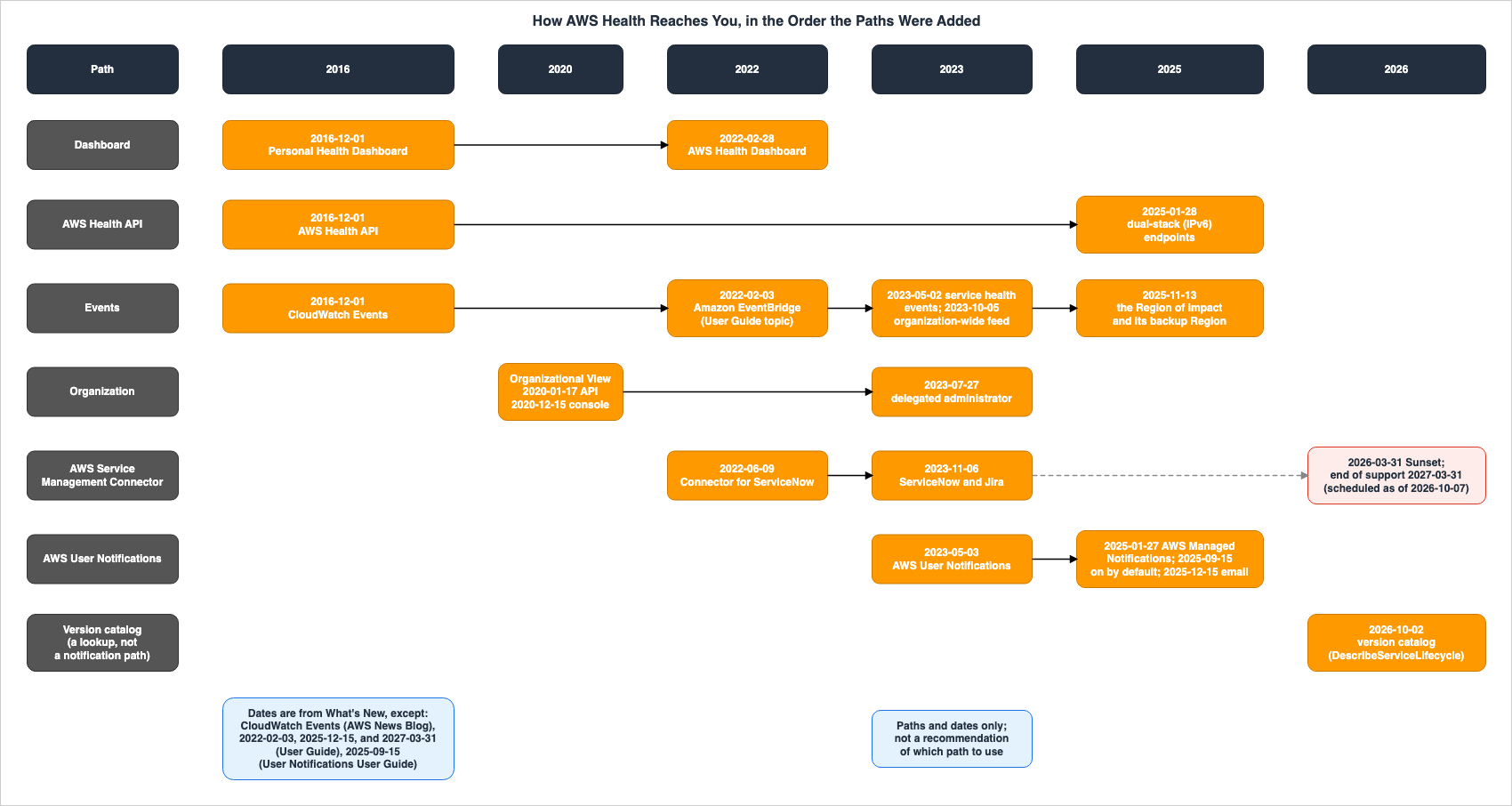
The paths by which AWS Health information reaches the account owner are as follows (dates within each item are in chronological order). The last item, the version catalog, is not a path that notifies accounts. This section lists only the paths and dates. How to combine the paths is covered in Surviving Forced Maintenance on AWS.- Dashboard Screen: From December 1, 2016, this was the Personal Health Dashboard; from February 28, 2022, it became the AWS Health Dashboard.
- AWS Health API: Released on December 1, 2016. Its usage requirements are written with AWS Support plan names.
- CloudWatch Events and Amazon EventBridge: An AWS News Blog article from December 1, 2016, discussed CloudWatch Events. The User Guide was updated on February 3, 2022, to include a section on EventBridge. Starting May 2, 2023, event notifications for the overall service status became available. On October 5, 2023, the ability to receive organization-wide events in a single stream was added. Since November 13, 2025, events have been delivered to both the affected Region and its backup Region (refer to the announcement for Region combinations).
- Organizational View and Delegated Administrator: Organizational view was added on January 17, 2020 (API) and December 15, 2020 (console). Delegated administrator functionality was added on July 27, 2023.
- AWS User Notifications: Generally available from May 3, 2023. AWS Managed Notifications were added on January 27, 2025. On September 15, 2025, AWS Health managed notifications became enabled by default, and since December 15, 2025, AWS Health emails have been delivered through AWS managed notifications. The User Guide notes that managed notifications do not deliver event notifications for the overall service status (public events).
- AWS Service Management Connector: Integrations with ServiceNow and Jira Service Management Cloud were added on June 9, 2022, and November 6, 2023. It entered Sunset on March 31, 2026, and its support is scheduled to end on March 31, 2027 (as of October 7, 2026).
- Version Catalog: Added on October 2, 2026. This feature allows you to retrieve information about the lifecycle of AWS service versions from the AWS Health Dashboard and AWS Health API, rather than providing a notification path to accounts.
Planned Lifecycle Events and the Version Catalog
Planned lifecycle events were announced in the What's New announcement of 2023-11-09. According to the User Guide, the event types are categorized asScheduled change, and the event type code follows the format AWS_{SERVICE}_PLANNED_LIFECYCLE_EVENT. As of 2026-10-07, the User Guide says that events with unresolved resources remain open for four years. The Document history entry dated 2025-04-18 records that the User Guide's statement of this period was changed from 90 days to four years. Section 7.4 of AWS Service Lifecycle States explains what Planned lifecycle events communicate and what they do not.The version catalog was announced in the What's New announcement of 2026-10-02. The User Guide states
The version catalog adds a service-wide view of supported versions and their timelines. and notes that the same information can be obtained through the AWS Health API's DescribeServiceLifecycle action. The What's New announcement gives the covered services as examples: including Amazon RDS, Amazon EKS, and AWS Lambda. As of 2026-10-07, the User Guide states the catalog tracks Amazon EKS, Amazon Aurora (Aurora) MySQL and PostgreSQL, Amazon RDS, Amazon OpenSearch Service, Amazon ElastiCache, Lambda runtimes, and more. The What's New announcement indicates that the list of included services will continue to expand, so the list is as of 2026-10-07. The structure of the version catalog items and their relationship to the timelines for each service are outside the scope of this article.Plan Gate Table
The following two tables list, one row per source, which plan names each source writes as the usage requirements of AWS Health features.Table 1 — Announcements and Document History Entries (by Point in Time)
| What It Gates | Plans Named in the Source | Where AWS Says So | As Of |
|---|---|---|---|
| AWS Health API | Business and Enterprise Support plan customers | What's New (Internet Archive version) | 2016-12-01 |
| AWS Health API | AWS Business Support or AWS Enterprise Support | AWS News Blog | 2016-12-01 |
| AWS Health API (AWS GovCloud (US)) | Business or Enterprise Support subscriptions | What's New | 2019-08-08 |
| AWS Health organizational view (API) | a Business or Enterprise Support plan | What's New | 2020-01-17 |
| AWS Health organizational view (Personal Health Dashboard console) | does not require a premium AWS Support plan | What's New | 2020-12-15 |
| AWS Health API | a premium AWS Support plan. The plan name is not specified. | What's New | 2020-12-15 |
| AWS Health API (in the AWS Health Aware article) | Business or Enterprise Support plan | AWS Cloud Operations Blog | 2021-03-25 |
| AWS Health API | an Enterprise On-Ramp Support plan | AWS Health User Guide (Document history) | 2021-11-24 |
| AWS Health API (in the announcement regarding delegated administrators) | AWS Business, AWS Enterprise On-Ramp, and Enterprise Support customers | What's New | 2023-07-27 |
| AWS Health API (in the announcement regarding the organizational view for AWS GovCloud (US)) | AWS Business, AWS Enterprise On-Ramp, and AWS Enterprise Support customers | What's New | 2024-03-06 |
| AWS Health API (in the announcement regarding version catalog) | Business Support Plus, Enterprise Support, or Unified Operations | What's New | 2026-10-02 |
Table 2 — Documents on the Verification Date
| What It Gates | Plans Named in the Source | Where AWS Says So | As Of |
|---|---|---|---|
| AWS Health API | AWS Business Support+, AWS Enterprise Support, or AWS Unified Operations. The next sentence names Business, Enterprise On-Ramp, or Enterprise Support for accounts in Regions that do not offer those plans or that have not transitioned to them. | AWS Health User Guide | 2026-10-07 |
| AWS Health API | Business, Enterprise On-Ramp, or Enterprise Support | AWS Health API Reference | 2026-10-07 |
| AWS Health API | AWS Business Support+, AWS Enterprise Support, or AWS Unified Operations. The next sentence names Business, Enterprise On-Ramp, or Enterprise Support for accounts in Regions that do not offer those plans or that have not transitioned to them. | AWS Health User Guide (What is AWS Health?) | 2026-10-07 |
| AWS Health API | a AWS Business Support+, AWS Enterprise Support, or AWS Unified Operations plan. Only the names of the plans announced on December 2, 2025, are given. | AWS Health User Guide (Concepts) | 2026-10-07 |
| AWS Health API | a AWS Business Support+, AWS Enterprise Support, or AWS Unified Operations plan | AWS Health User Guide (Identity-based policy examples) | 2026-10-07 |
| AWS Health API | a AWS Business Support+, AWS Enterprise Support, or AWS Unified Operations plan | AWS Health User Guide (Troubleshooting) | 2026-10-07 |
| Organizational view (AWS Health console) | all AWS Support plans | AWS Health User Guide (Enabling organizational view) | 2026-10-07 |
DescribeHealthServiceStatusForOrganization | a AWS Business Support+, AWS Enterprise Support, or AWS Unified Operations plan | AWS Health User Guide (Enabling organizational view) | 2026-10-07 |
AWS Health API (CLI section on the enable-organizational-view page, EnableHealthServiceAccessForOrganization) | a Business, Enterprise On-Ramp, or Enterprise Support plan | AWS Health User Guide (Enabling organizational view) | 2026-10-07 |
| AWS Health API (when delegated administrators view the organizational view) | a Business, Enterprise On-Ramp, or Enterprise Support plan. Neither Business Support+ nor Unified Operations is named. | AWS Health User Guide (Registering a delegated administrator) | 2026-10-07 |
EnableHealthServiceAccessForOrganization | a Business, Enterprise On-Ramp, or Enterprise Support plan | AWS Health API Reference | 2026-10-07 |
Version catalog API (DescribeServiceLifecycle) | Customers on AWS Support. Plan names are not listed. | AWS Health User Guide (Version catalog) | 2026-10-07 |
The AWS Health API Reference page for
DescribeServiceLifecycle does not name any plan (The source does not say.). The Welcome page of the same API Reference (second row in Table 2) states the usage requirements of the whole AWS Health API.Three points can be gathered from the two tables.
- From 2016 to March 2021, the sources that named plans wrote the AWS Health API usage requirements with the Business and Enterprise plans. The User Guide was updated on November 24, 2021, to include Enterprise On-Ramp, and the What's New announcements of 2023 and 2024 name Business, Enterprise On-Ramp, and Enterprise Support. The What's New announcement of December 15, 2020, refers to a
premium AWS Support planwithout explicitly mentioning plan names. - The sources on the verification date include both sources that use the names of the plans announced on December 2, 2025, and sources that use the names of plans from before that date. In the User Guide, the
health-apiandwhat-is-aws-healthpages give the names of the plans announced on December 2, 2025, together with the transitional sentence. Theaws-health-concepts-and-terms,security_iam_id-based-policy-examples, andsecurity_iam_troubleshootpages only list the plans announced on December 2, 2025. Theregister-a-delegated-administratorpage only lists plans that predate December 2, 2025. Theenable-organizational-viewpage includes both information on plans announced on December 2, 2025, and information on plans that predate that date. The AWS Health API Reference only lists plans that predate December 2, 2025. The What's New announcement of October 2, 2026, refers toBusiness Support Plusand the User Guide for the version catalog does not mention plan names. The relationship betweenBusiness Support Plusand Business Support+ is covered in the spelling table of AWS History and Timeline regarding AWS Support Plans. - Organizational view states its usage requirements differently for the console and the API. The What's New announcement of December 15, 2020, states that the console version of the organizational view does not require a
premium AWS Support plan, and the User Guide of October 7, 2026, says the console is available forall AWS Support plans. Regarding API calls, the What's New announcement of December 15, 2020, lists apremium AWS Support planas a usage requirement, while the User Guide from October 7, 2026, lists plan names.
In the versions preserved by the Internet Archive, each of the four User Guide texts listed below changed to the names of the plans announced on December 2, 2025, between the two versions of its set. Because the time periods for these four sets of versions overlap, it is unclear whether each text was updated on a different date. The earlier versions of each set display plan names from before December 2, 2025, while the later versions display plan names announced on that date. ⚠ The date of these updates falls somewhere between the two versions, and this article does not attempt to pinpoint those specific dates. The earlier version of each set is the last version that the Internet Archive's list of captures shows with HTTP status 200 and in which that text displays plan names from before December 2, 2025 (records of later captures whose content was the same as the previous capture are not counted). No entry for this rewrite was found in the AWS Health User Guide's Document history.
health-api.html— Between the version from November 17, 2025, at 01:58:22 UTC and the version from February 8, 2026, at 02:39:47 UTC.what-is-aws-health.html— Between the version from January 11, 2026, at 10:09:46 UTC and the version from January 28, 2026, at 16:05:22 UTC.aws-health-concepts-and-terms.html— Between the version from December 10, 2025, at 12:24:48 UTC and the version from February 26, 2026, at 00:53:11 UTC.- The text for
DescribeHealthServiceStatusForOrganizationinenable-organizational-view.html— Between the version from November 30, 2025, at 06:45:07 UTC and the version from June 23, 2026, at 00:08:31 UTC. The text in the CLI section of the same page still displays plan names from before December 2, 2025, as of October 7, 2026.
This article does not treat any of these sources as wrong. Whether you can use the AWS Health API with your account, and the design considerations for when you cannot, are discussed in section 6.4 of Surviving Forced Maintenance on AWS.
Frequently Asked Questions about AWS Health History
This section answers common questions about the AWS Health timeline.When were the Service Health Dashboard and the Personal Health Dashboard introduced, and what happened to them?
The Service Health Dashboard was announced on April 16, 2008, in the What's New announcement of AWS Premium Support, and its address was listed asstatus.aws.amazon.com in an article on the AWS News Blog published on April 17, 2008. The Personal Health Dashboard was released on December 1, 2016, concurrently with the AWS Health API. On February 28, 2022, both dashboards were combined into a single AWS Health Dashboard. The What's New announcement writes brings together the AWS Service Health Dashboard and Personal Health Dashboard into a single connected experience, while the User Guide's Document history uses the term rebranded. As of October 7, 2026, visiting status.aws.amazon.com redirects to health.aws.amazon.com/health/status, and phd.aws.amazon.com redirects to the AWS Health console.When did AWS Health organizational view become available?
The dates differ between the API and the console. The What's New announcement regarding API availability was published on January 17, 2020, while the corresponding entry in the User Guide's Document history indicates December 18, 2019. The botocore model commit was made on December 23, 2019. The What's New announcement that organizational view became available in the Personal Health Dashboard console was published on December 15, 2020, with a corresponding entry in the Document history on December 14, 2020. Both came before February 28, 2022, when the name AWS Health Dashboard came into use. Subsequently, delegated administrator access was added on July 27, 2023, EventBridge delivery of organization-wide events followed on October 5, 2023, and support for the organizational view in AWS GovCloud (US) was added on March 6, 2024.Which plan names have AWS sources used for the AWS Health API usage requirements?
The What's New announcement of December 1, 2016, refers toBusiness and Enterprise Support plan customers. The What's New announcements of August 8, 2019, and January 17, 2020, also mention Business and Enterprise plans. The What's New announcement of December 15, 2020, refers to a premium AWS Support plan without specifying a plan name. On November 24, 2021, the User Guide added Enterprise On-Ramp, and the What's New announcements of July 27, 2023, and March 6, 2024, list Business, Enterprise On-Ramp, and Enterprise Support. As of October 7, 2026, the AWS Health API page in the User Guide lists plan names announced on December 2, 2025 (AWS Business Support+, AWS Enterprise Support, or AWS Unified Operations), along with a transitional sentence. The same User Guide's page on registering delegated administrators only lists plan names from before December 2, 2025. The AWS Health API Reference only lists Business, Enterprise On-Ramp, or Enterprise Support. The What's New announcement of October 2, 2026, lists Business Support Plus, Enterprise Support, or Unified Operations, while the User Guide for the version catalog lists Customers on AWS Support. This article does not treat any of these sources as wrong.When did the Service Health Dashboard RSS feed start, and what does the User Guide say about it now?
An article on the AWS News Blog dated April 17, 2008, stated that users could subscribe to RSS feeds for each service in the Service Health Dashboard. An article on the AWS Cloud Operations Blog dated February 28, 2022, noted that the Service Health Dashboard's RSS feeds would continue to work as expected after the move to the AWS Health Dashboard. On August 15, 2025, the User Guide removed the instructions for subscribing to the RSS feeds. As of October 7, 2026, the Service health page of the User Guide states,Although an RSS feed is available for health events, the format is subject to changes. It also recommends, To programmatically ingest health event data, we recommend integrating with Amazon EventBridge. On the same day, accessing status.aws.amazon.com/rss/all.rss returned an HTTP 200 status code.Summary
AWS Health's prehistory is the Service Health Dashboard of 2008. On December 1, 2016, the Personal Health Dashboard and AWS Health API were launched. On the same day, an AWS News Blog post highlighted automation using CloudWatch Events. The organizational view was made available via API on January 17, 2020, and in the console on December 15, 2020. On February 28, 2022, the two dashboards were combined into a single AWS Health Dashboard. In 2023, delegated administrator capabilities, organization-wide EventBridge delivery, and Planned lifecycle events were added. In 2025, notification and email delivery were updated through AWS User Notifications. The version catalog was added on October 2, 2026.⇒ The change on February 28, 2022, consolidated the two dashboards into one. What's New says that the AWS Health Dashboard
brings together the Service Health Dashboard and Personal Health Dashboard, while the User Guide uses the word rebranded. The organizational view had been available since 2020.⇒ The names of the plans for accessing the AWS Health API have varied depending on the source and the point in time. In 2016, the sources named Business and Enterprise. On November 24, 2021, the User Guide added the Enterprise On-Ramp plan. As of October 7, 2026, the User Guide's AWS Health API page describes the plans announced on December 2, 2025, along with a transitional sentence. The
aws-health-concepts-and-terms page lists only the plans announced on December 2, 2025. The AWS Health API Reference lists only the plan names from before December 2, 2025, while the What's New announcement of October 2, 2026, refers to the Business Support Plus plan.⚠ Names and usage requirements need to be checked source by source, together with the date of each source. AWS documentation itself sometimes applies new names to older records, and plan names from before December 2, 2025, may still appear in documents as of October 7, 2026. Support for the AWS Service Management Connector is scheduled to end on March 31, 2027. All information is current as of October 7, 2026.
This timeline will be updated as AWS Health continues to evolve.
References:
Tech Blog with curated related content
Written by Hidekazu Konishi