AWS History and Timeline regarding AWS Step Functions - Overview, Functions, Features, Summary of Updates, and Introduction
First Published:
Last Updated:
This is the latest installment in the series that I started with the "AWS History and Timeline - Almost All AWS Services List, Announcements, General Availability(GA)", where I extract features from the history and timeline of AWS services (I've previously written about AWS Lambda, Amazon EventBridge, and Amazon SQS).
This time, I have created a historical timeline for AWS Step Functions, which launched at AWS re:Invent in December 2016 and has grown from a Lambda-centric orchestrator into a general-purpose workflow engine that can call over 14,000 API actions across more than 220 AWS services, run large-scale parallel workloads, transform data with JSONata, and even embed AI agent reasoning steps.
This article focuses on the major service-level releases — new workflow types, the Amazon States Language and its data-handling model, service integration patterns, large-scale parallelism, and developer experience — rather than every incremental SDK-integration bump or single-Region expansion.
It is written for AWS Step Functions users and for anyone evaluating the service who wants to see, in one place, when capabilities such as Express Workflows, Distributed Map, and JSONata arrived and how they relate to one another.
Just like before, I am summarizing the main features while following the birth of AWS Step Functions and tracking its feature additions and updates as a Current Overview, Functions, Features of AWS Step Functions.
I hope these will provide clues as to what has remained the same and what has changed, in addition to the features and concepts of each AWS service.
Background and Method of Creating AWS Step Functions Historical Timeline
The reason for creating a historical timeline of AWS Step Functions is that the service sits at the center of an unusually large cluster of related topics — Distributed Map, JSONata and Variables, generative-AI orchestration, and human-approval flows — and it helps to have one page that shows how all of those capabilities arrived and how they fit together. It is also a companion to the more detailed AWS Step Functions guides on this site, giving each of them a single chronological anchor.Since AWS Step Functions was announced in December 2016, its execution model, its workflow language, and the breadth of services it can call have all expanded significantly. Therefore, I wanted to organize the information of AWS Step Functions with the following approaches.
- Tracking the history of AWS Step Functions and organizing the transition of updates
- Summarizing the feature list and characteristics of AWS Step Functions
- What's New with AWS?
- AWS News Blog
- What is AWS Step Functions? - AWS Step Functions
- Recent feature launches - AWS Step Functions
The content posted is limited to major features related to the current AWS Step Functions and necessary for the feature list and overview description.
In other words, please note that the items on this timeline are not all updates to AWS Step Functions features, but are representative updates that I have picked out.
AWS Step Functions Historical Timeline (Updates from December 1, 2016)
Now, here is a timeline related to the functions of AWS Step Functions. The history of AWS Step Functions spans nearly a decade from December 2016, during which it evolved from a Lambda-oriented workflow service into a general-purpose orchestrator for serverless applications, data processing, and AI workloads.2016 | 2017 | 2018 | 2019 | 2020 | 2021 | 2022 | 2023 | 2024 | 2025 | 2026
* The table can be sorted by clicking on the column names.| Date | Summary |
|---|---|
| 2016-12-01 | AWS Step Functions launches as a generally available service. It lets you coordinate the components of distributed applications and microservices using visual workflows defined in the JSON-based Amazon States Language (ASL), with Task states that invoke AWS Lambda functions, long-running Activity workers, and built-in Choice, Parallel, Wait, and error-handling states. [Source] |
| 2017-02-10 | AWS CloudFormation adds support for provisioning AWS Step Functions state machines and activities. Workflows can now be defined as infrastructure as code. [Source] |
| 2017-03-21 | Amazon CloudWatch Events adds AWS Step Functions state machines as a target. Rules can start workflow executions on a schedule or in response to events, enabling event-driven and scheduled orchestration. [Source] |
| 2018-11-29 | AWS Step Functions adds direct, optimized service integrations for eight AWS services. Task states can now call Amazon DynamoDB, AWS Batch, Amazon ECS/AWS Fargate, Amazon SNS, Amazon SQS, AWS Glue, and Amazon SageMaker without writing Lambda glue code, including Run-a-Job (.sync) patterns that wait for a job to complete. [Source] |
| 2019-01-24 | AWS Step Functions publishes a 99.9% monthly-uptime Service Level Agreement (SLA). This formalizes the availability commitment for production workloads. [Source] |
| 2019-02-04 | AWS Step Functions Local is released. A downloadable version (JAR and Docker image) lets developers build and test workflows in their own environment, save on state transitions, and run Step Functions as part of CI pipelines. [Source] |
| 2019-05-23 | AWS Step Functions adds the callback pattern with task tokens (waitForTaskToken). A Task can hand a token to an integrated service and pause until SendTaskSuccess or SendTaskFailure is called, which is the foundation for human-approval and long-running external steps; the same release exposes execution metadata through a context object. [Source] |
| 2019-08-12 | AWS Step Functions adds support for nested workflows. A Task state can call the StartExecution API to run another state machine, letting large workflows be composed from smaller, reusable ones. [Source] |
| 2019-09-18 | AWS Step Functions adds the Map state for dynamic parallelism. A Map state iterates a sub-workflow over each item of a JSON array with a configurable MaxConcurrency, replacing hand-built parallel branches for data-driven fan-out. [Source] |
| 2019-11-19 | AWS Step Functions adds an optimized integration for Amazon EMR. Workflows can create and terminate clusters and add and manage EMR steps directly. [Source] |
| 2019-12-03 | AWS Step Functions launches Express Workflows. A new high-throughput, short-duration workflow type (up to five minutes) with at-least-once execution and Amazon CloudWatch Logs-based tracking, aimed at high-volume event processing and streaming data. [Source] |
| 2020-08-13 | AWS Step Functions enhances the Amazon States Language. New comparison operators (existence, wildcard, and variable-to-variable comparisons), string and timestamp handling, dynamic timeouts, and result selection give workflows more dynamic behavior without extra Lambda steps. [Source] |
| 2020-09-14 | AWS Step Functions adds support for AWS X-Ray tracing. End-to-end traces and a service-map view make it easier to analyze latency and root-cause errors across a workflow's underlying components. [Source] |
| 2020-11-16 | AWS Step Functions adds an optimized integration for Amazon EKS. Workflows can run and manage Kubernetes jobs on an EKS cluster without custom polling code. [Source] |
| 2020-11-24 | AWS Step Functions launches Synchronous Express Workflows. StartSyncExecution returns the workflow result in the same request, making Express Workflows a good fit for request/response microservice orchestration behind an API. [Source] |
| 2020-12-11 | Amazon API Gateway HTTP APIs add a first-class StartSyncExecution integration. HTTP APIs can invoke Synchronous Express Workflows directly and return their output to callers. [Source] |
| 2021-05-27 | Amazon API Gateway REST APIs add native integration with Synchronous Express Workflows. REST APIs can trigger Step Functions and return the workflow result to clients without a proxy Lambda. [Source] |
| 2021-07-07 | AWS Step Functions launches Workflow Studio. A low-code, drag-and-drop visual designer in the console lets you build state machines and generates the corresponding ASL, lowering the barrier to authoring workflows. [Source] |
| 2021-09-30 | AWS Step Functions adds AWS SDK service integrations. The number of directly callable services jumps from 17 to over 200, and API actions from 46 to over 9,000, so workflows can call almost any AWS API without a Lambda wrapper. [Source] |
| 2022-01-31 | AWS Step Functions Local adds mocked service integrations. Developers can test workflow logic and error handling against mocked responses, without calling downstream services. [Source] |
| 2022-08-31 | AWS Step Functions adds 14 new intrinsic functions to the Amazon States Language. Built-in functions for array manipulation, JSON object handling, math, and unique-ID generation let workflows transform data inline instead of using extra Pass states or Lambda functions. [Source] |
| 2022-10-19 | AWS Step Functions adds a new console execution-observability experience for Express Workflows. Graph, state-transition, and event-table views make it easier to debug high-volume Express executions. [Source] |
| 2022-11-18 | AWS Step Functions adds cross-account access. A workflow in one account can assume an IAM role to invoke resources across more than 220 AWS services in another account, simplifying multi-account architectures. [Source] |
| 2022-12-01 | AWS Step Functions launches Distributed Map. A new mode of the Map state runs the same workflow across up to 10,000 parallel child executions over data in Amazon S3, enabling large-scale parallel data processing and ETL without managing infrastructure. [Source] |
| 2023-06-22 | AWS Step Functions launches Versions and Aliases. You can publish immutable versions of a state machine and route traffic between them through aliases, enabling blue/green and canary deployments. [Source] |
| 2023-09-07 | AWS Step Functions enhances error handling. Additions include dynamic error messages and causes in Fail states, a maximum retry-interval cap, and retry jitter to smooth out retry storms. [Source] |
| 2023-10-12 | AWS Step Functions adds an optimized integration for Amazon EMR Serverless. Workflows can run and wait for EMR Serverless jobs using the Run-a-Job (.sync) pattern. [Source] |
| 2023-11-15 | AWS Step Functions launches redrive. A failed, aborted, or timed-out Standard workflow execution can be restarted from its point of failure — including unprocessed items in a Distributed Map — rather than re-running from the start. [Source] |
| 2023-11-26 | AWS Step Functions launches HTTPS endpoints and the TestState API. An HTTP Task can call any external or third-party REST API from a workflow, and the TestState API tests an individual state in isolation without deploying the whole state machine. [Source] |
| 2023-11-26 | AWS Step Functions adds an optimized integration for Amazon Bedrock. InvokeModel and CreateModelCustomizationJob actions let workflows orchestrate generative-AI tasks directly. [Source] |
| 2024-07-25 | AWS Step Functions adds support for AWS KMS customer managed keys. State machine definitions, execution data, and Activity resources can be encrypted with your own keys for finer-grained security and compliance. [Source] |
| 2024-08-29 | AWS Step Functions launches a Validation API. ValidateStateMachineDefinition catches semantic and syntactic errors in an ASL definition before deployment. [Source] |
| 2024-11-14 | AWS Step Functions adds infrastructure-as-code template generation. Workflows built in the console can be exported as AWS CloudFormation or AWS SAM templates and opened in Infrastructure Composer. [Source] |
| 2024-11-22 | AWS Step Functions launches Variables and JSONata data transformations. You can assign data to variables in one state and reference them later, and use the open-source JSONata query and transformation language for advanced data manipulation, sharply reducing the boilerplate needed to pass data between states. [Source] |
| 2025-01-15 | AWS Step Functions expands AWS SDK integrations by 36 services. New targets include AWS End User Messaging and Amazon Q Apps, along with over 1,000 new API actions. [Source] |
| 2025-02-07 | AWS Step Functions expands data source and output options for Distributed Map. New input and output handling makes it easier to drive large-scale parallel runs from more data shapes. [Source] |
| 2025-03-06 | AWS Step Functions brings Workflow Studio to the VS Code IDE. The visual Workflow Studio editor becomes available inside Visual Studio Code, letting developers design and edit state machines alongside their application code without switching to the console. [Source] |
| 2025-09-18 | AWS Step Functions adds IPv6 support with dual-stack endpoints. New dual-stack IPv4/IPv6 endpoints, including through PrivateLink VPC endpoints, let workflows be reached from IPv6 environments. [Source] |
| 2025-09-18 | AWS Step Functions expands Distributed Map data sources and observability. Distributed Map can read Amazon Athena manifests and Parquet files, S3 objects under a prefix, and JSON input, and new Amazon CloudWatch metrics report open Map runs and backlog size. [Source] |
| 2025-10-15 | AWS Step Functions adds Diagnose with Amazon Q. AI-powered error analysis in the console suggests remediation steps for execution failures and Amazon States Language syntax errors. [Source] |
| 2025-10-30 | AWS Step Functions announces a new metrics dashboard. A console dashboard shows usage and billing metrics for Standard and Express workflows at the account and state-machine level. [Source] |
| 2025-11-20 | AWS Step Functions enhances the TestState API for local unit testing. Complete workflows — including Map and Parallel states and error handling — can be validated locally with mocked integrations and optional API-contract validation, and plugged into frameworks such as Jest and pytest. [Source] |
| 2026-03-26 | AWS Step Functions adds 28 new service integrations. New targets include Amazon Bedrock AgentCore, Amazon S3 Vectors, and the AWS Lambda durable-execution APIs, bringing supported services to over 220 and letting workflows orchestrate AI agents and vector ingestion pipelines directly. [Source] |
| 2026-06-03 | AWS Step Functions adds an AgentCore-powered agentic reasoning step (preview). Through an optimized integration with the Amazon Bedrock AgentCore managed harness, a workflow can add AI agent reasoning at decision points, run agents in parallel or in sequence, add human approval before critical actions, and trace agent input, output, and token usage in execution history. [Source] |
Current Overview, Functions, Features of AWS Step Functions
AWS Step Functions is a visual workflow service for building distributed applications, automating IT and business processes, and creating data and machine-learning pipelines. You describe an application as a state machine — a set of states connected by transitions — using the JSON-based Amazon States Language, and Step Functions runs it as a managed, observable resource with built-in state tracking, error handling, retries, and parallelism. Below is an overview of what the service offers as of 2026.How an AWS Step Functions Workflow Runs
A workflow is a state machine: an execution starts with some JSON input, moves from state to state, and each state receives the previous state's output as its input. Task states do the work — invoking an AWS Lambda function, calling an AWS service, or running a job — while Choice states branch, Parallel and Map states fan out, and Wait states pause. Step Functions records every state transition, so you can see exactly where an execution is, inspect its full history, and (for Standard Workflows) resume a failed run from the point of failure. Long-running steps use the callback pattern: a Task hands out a task token and the execution pauses, without paying for idle compute, until an external system or a person returns the token. This managed, observable execution model — state tracking, retries, and history handled by the service rather than by your code — is what distinguishes AWS Step Functions from orchestrating the same calls by hand in an application.AWS Step Functions Use Cases
- Orchestrating multi-step serverless applications and microservices, where each step is an AWS Lambda function or another AWS service call
- Building data-processing and ETL pipelines, including large-scale parallel processing over data in Amazon S3
- Coordinating machine-learning and generative-AI workflows, such as chained model calls, batch inference, and AI agent orchestration
- Automating IT operations and business processes that mix automated steps with human approvals
- Running long-running workflows that wait on external systems or callbacks without keeping compute running
- Implementing saga-style patterns that compensate and roll back when a step fails
Specific Examples of Use Cases
- An order-processing workflow validates a payment, reserves inventory in Amazon DynamoDB, publishes to Amazon SNS, and compensates earlier steps if a later one fails
- A Distributed Map workflow processes millions of objects in an Amazon S3 bucket in parallel, calling a Lambda function or an Amazon Bedrock model for each item
- A media pipeline transcodes video with AWS Elemental MediaConvert, then updates a catalog when the job completes
- An approval workflow pauses with a task token, notifies an approver, and resumes when the approver responds
- A generative-AI workflow classifies a document with an AgentCore agent, branches on the result, and asks for human confirmation before taking action
- A CI/CD workflow deploys a new state machine version behind an alias and shifts traffic gradually
- A data-quality pipeline validates and transforms records with JSONata, then loads only the passing rows into a data store
- A fan-out/fan-in workflow starts hundreds of nested child workflows, waits for all of them, and aggregates the results
Standard vs Express Workflows
AWS Step Functions offers two workflow types, chosen per state machine. The right choice depends on execution duration, volume, and whether you need a full, durable execution history.| Aspect | Standard Workflows | Express Workflows |
|---|---|---|
| Primary use | Long-running, auditable, durable orchestration | High-volume, short-duration event and streaming workloads |
| Maximum duration | Up to one year | Up to five minutes |
| Execution semantics | Exactly-once | At-least-once (asynchronous) or synchronous request/response |
| Execution history | Full, durable history in the Step Functions service | Recorded in Amazon CloudWatch Logs |
| Redrive from failure | Supported | Not applicable (re-invoke the workflow) |
| Typical trigger | API calls, EventBridge, human/approval flows | API Gateway, streaming, per-event fan-out |
Because the two types share the Amazon States Language, you can often start with one and move to the other as your requirements change.
AWS Step Functions Workflow Definition: Amazon States Language, JSONata, and Variables
Workflows are defined in the Amazon States Language (ASL), a JSON structure of states such asTask, Choice, Parallel, Map, Wait, Pass, Succeed, and Fail. Over time, ASL gained new comparison operators, intrinsic functions for inline data manipulation, and — most significantly — Variables and JSONata in November 2024. Variables let you assign a value in one state and reference it in a later state without threading it through every intermediate state, and JSONata gives you a concise query-and-transformation language for reshaping data, formatting dates, and doing math directly in the definition. For a detailed walkthrough of how these change the way you write workflows, see the guide to AWS Step Functions JSONata and Variables.Service Integration Patterns
AWS Step Functions can call other services in three patterns: Request/Response (call and continue), Run-a-Job (.sync, wait for the job to finish), and Wait-for-Callback (.waitForTaskToken, pause until an external system or person returns a token). Request/Response is the default for quick calls; Run-a-Job is used for long-running jobs such as an AWS Glue or Amazon EMR run, where the workflow should wait for completion and surface the result; and Wait-for-Callback suits human approvals and asynchronous systems that report back later. It offers two families of integrations: optimized integrations that add convenience features for popular services (AWS Lambda, Amazon DynamoDB, Amazon SNS, Amazon SQS, Amazon ECS, Amazon EMR, Amazon SageMaker, Amazon Bedrock, and more), and AWS SDK integrations that let a Task call almost any AWS API — over 14,000 API actions across more than 220 services — without a Lambda wrapper. Cross-account access extends these patterns to resources in other AWS accounts.Large-Scale Parallel Processing with Distributed Map
The Distributed Map state runs the same child workflow across a large dataset — for example, every object under an Amazon S3 prefix, every row of a CSV or Parquet file, or an Amazon Athena manifest — with high concurrency and its own failure handling, batching, and result aggregation. It is the tool of choice for serverless, large-scale parallel data processing. The Map state runs in two modes: an inline map for small in-memory arrays, and the distributed mode that launches independent child executions — up to thousands at a time, each with its own history — so a single run can process very large datasets that a normal Map state could not. For patterns, batching, and tuning, see the AWS Step Functions Distributed Map guide.Error Handling and Reliability
Reliability is built into the Amazon States Language. Any Task or state can declare Retry rules with a configurable interval, backoff rate, a maximum retry-interval cap, and jitter to avoid retry storms, and Catch rules that route specific errors to a recovery path. A Fail state can emit a dynamic error and cause, and Parallel and Map states propagate and aggregate errors from their branches. For Standard Workflows, redrive restarts a failed, aborted, or timed-out execution from its point of failure — including only the unprocessed items of a Distributed Map — so a large run does not have to start over because of a single bad batch. Combined with exactly-once execution and the durable execution history, these features let you build fault-tolerant workflows without writing your own state-management and retry code.Generative AI Orchestration
AWS Step Functions has become a natural coordinator for generative-AI applications. The optimized Amazon Bedrock integration (2023) lets workflows call and customize foundation models, and in 2026 an AgentCore-powered agentic reasoning step let workflows embed AI agent reasoning at specific decision points while Step Functions remains the deterministic coordinator around the agent — running agents in parallel, adding human approval before critical actions, and recording agent input, output, and token usage in the execution history. This pattern keeps the non-deterministic model reasoning inside the managed agent while the surrounding workflow stays deterministic and auditable, which is what makes agentic steps safer to run in production. For orchestration patterns that combine deterministic steps with model calls and agents, see Step Functions orchestration patterns for generative AI.Human Approval Workflows
The callback pattern (task tokens) makes it straightforward to pause a workflow, notify a person, and resume when they approve or reject an action. I have written a set of hands-on guides on building approval flows with AWS Step Functions:- Add an Approval Flow to AWS Step Functions using AWS Systems Manager
- Add an Approval Flow to AWS Step Functions using AWS Systems Manager and Amazon EventBridge
- Add an Approval Flow to AWS Step Functions using AWS CodePipeline and Amazon EventBridge
Developer Experience
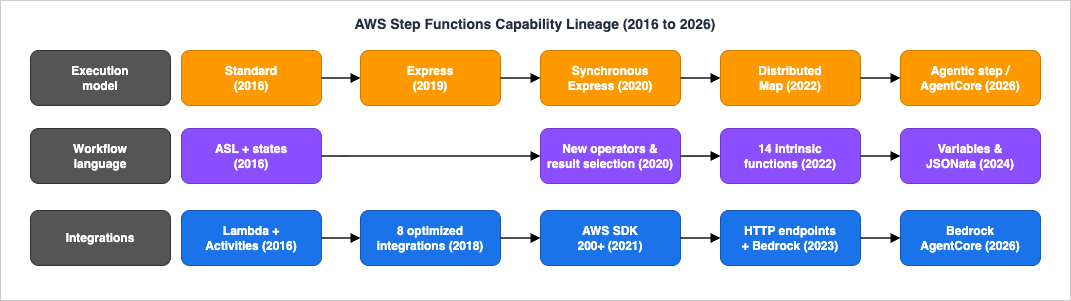
Beyond the runtime, AWS Step Functions has invested heavily in how you author, test, deploy, and operate workflows: Workflow Studio (low-code visual design), theTestState API and enhanced local unit testing, redrive (restart a failed execution from the point of failure), Versions and Aliases (safe deployments), infrastructure-as-code export to AWS CloudFormation and AWS SAM, a Validation API, a metrics dashboard, and Diagnose with Amazon Q for AI-assisted troubleshooting. Together these turn a workflow into a first-class software artifact you can version, test, and observe. This overall evolution is summarized in the figure below.Security and Compliance
AWS Step Functions integrates with AWS Identity and Access Management for fine-grained control over who can create, start, and manage state machines, and over which resources a workflow's execution role may call. Executions can be reached privately over AWS PrivateLink VPC endpoints and, since 2025, over IPv6 dual-stack endpoints. Workflow definitions, execution data, and Activity resources can be encrypted with AWS KMS customer managed keys, and cross-account access lets a workflow assume a role to operate on resources in another account under explicit trust policies. Together, these controls make AWS Step Functions suitable for regulated and multi-account environments.AWS Step Functions Key Functions and Features
- Visual state-machine model defined in the Amazon States Language (ASL)
- Two workflow types: Standard (long-running, exactly-once) and Express (high-volume, short-duration)
- Built-in state types:
Task,Choice,Parallel,Map, Distributed Map,Wait,Pass,Succeed, andFail - Data handling with Variables and JSONata, intrinsic functions, and input/output processing
- Three service-integration patterns: Request/Response, Run-a-Job (
.sync), and Wait-for-Callback (.waitForTaskToken) - Optimized integrations plus AWS SDK integrations spanning over 14,000 API actions across more than 220 services
- Distributed Map for large-scale parallel processing over Amazon S3 and analytics data sources
- Cross-account access to resources in other AWS accounts
- Generative-AI orchestration via the Amazon Bedrock integration and the AgentCore agentic reasoning step
- Human-in-the-loop approval through the callback (task token) pattern
- Error handling with retries, catchers, retry jitter, and redrive
- Safe deployment with Versions and Aliases
- Observability through the console, AWS X-Ray tracing, Amazon CloudWatch metrics and a metrics dashboard, and Diagnose with Amazon Q
- Authoring and testing with Workflow Studio, Step Functions Local, the
TestStateAPI, and the Validation API - Security with AWS IAM, AWS KMS customer managed keys, and PrivateLink and IPv6 dual-stack endpoints
AWS Step Functions Feature Lineage
Frequently Asked Questions about AWS Step Functions History
- When did AWS Step Functions launch?
- AWS Step Functions was announced and made generally available at AWS re:Invent on December 1, 2016, with the JSON-based Amazon States Language, Task states for AWS Lambda functions and long-running Activity workers, and built-in Choice, Parallel, Wait, and error-handling states.
- When did Express Workflows become available?
- Express Workflows launched on December 3, 2019, as a high-throughput, short-duration workflow type (up to five minutes) with at-least-once execution. Synchronous Express Workflows, which return the result in the same request, followed on November 24, 2020.
- When was Distributed Map released?
- Distributed Map launched on December 1, 2022, as a mode of the Map state that runs the same workflow across thousands of parallel child executions over data in Amazon S3. Its data sources and observability were later expanded, including Amazon Athena manifest and Parquet support on September 18, 2025.
- What is the difference between Standard and Express Workflows?
- Standard Workflows are built for long-running, auditable orchestration lasting up to one year with exactly-once execution and a full durable history, while Express Workflows are built for high-volume, short-duration workloads lasting up to five minutes with at-least-once (or synchronous) execution and history recorded in Amazon CloudWatch Logs. Both are defined with the same Amazon States Language.
- When did AWS Step Functions add JSONata and Variables?
- AWS Step Functions added Variables and JSONata data transformations on November 22, 2024, letting you assign and reference data across states and use the JSONata query language for advanced data manipulation, which greatly reduces the boilerplate previously needed to pass data between states.
- When did the callback pattern with task tokens arrive?
- AWS Step Functions added the callback pattern with task tokens (waitForTaskToken) on May 23, 2019, letting a Task hand a token to an integrated service and pause - without consuming compute - until SendTaskSuccess or SendTaskFailure returns it. This is the foundation for human-approval steps and long-running external integrations.
Summary
In this article, I created a historical timeline of AWS Step Functions and looked at the list of features and overview of AWS Step Functions.AWS Step Functions was announced at AWS re:Invent in December 2016 as a visual way to coordinate AWS Lambda functions and other components of distributed applications.
Over nearly a decade it broadened dramatically: Express Workflows and Synchronous Express for high-volume workloads; the Map state and then Distributed Map for large-scale parallelism; AWS SDK integrations that made almost any AWS API callable directly; Variables and JSONata for expressive data handling; and, most recently, an optimized Amazon Bedrock integration and an AgentCore-powered agentic reasoning step that make Step Functions a coordinator for generative-AI and agentic workloads.
Alongside the runtime, Workflow Studio, redrive, Versions and Aliases, the TestState API, and Diagnose with Amazon Q have steadily improved how workflows are authored, tested, deployed, and operated.
I would like to continue monitoring the trends of what kind of features AWS Step Functions will provide in the future.
In addition, there is also a historical timeline of all AWS services including services other than AWS Step Functions, so please have a look if you are interested.
AWS History and Timeline - Almost All AWS Services List, Announcements, General Availability(GA)
I have also written related historical timelines for the services that AWS Step Functions works most closely with:
- AWS History and Timeline regarding AWS Lambda
- AWS History and Timeline regarding Amazon EventBridge
- AWS History and Timeline regarding Amazon SQS
This timeline will be updated as AWS Step Functions continues to evolve.
References:
What's New with AWS?
AWS News Blog
What is AWS Step Functions? - AWS Step Functions Developer Guide
AWS Step Functions FAQs
Discover service integration patterns in Step Functions - AWS Step Functions Developer Guide
Recent feature launches - AWS Step Functions
AWS History and Timeline - Almost All AWS Services List, Announcements, General Availability(GA)
AWS Step Functions Distributed Map Guide
AWS Step Functions JSONata and Variables Guide
References:
Tech Blog with curated related content
Written by Hidekazu Konishi