Who Can Change the Restrictions on an AgentCore Agent - Gateway Targets, Policies, Credential Providers, and Registry Approvals
First Published:
Last Updated:
To begin with, official documentation does state, at the level of individual components, either a separation of permissions or a limit of permissions to trusted principals. It states that the permission to decide the Runtime privilege mode should be granted only to trusted principals. Regarding Gateway and Policy, the documentation recommends separating management roles from the Gateway's service role. For Cedar policies, two permissions separate the policy types. Within Registry, the ability to submit and approve can be separated. Payments separates the role that sets the budget from the role that pays. However, this article did not find any documentation, as of the verification date, explicitly stating the general principle of "not granting execution role permissions for actions that modify the agent's configuration." As an inference, this article proposes a design that extends the concept of Payments to encompass the entire component structure, ensuring that a single role cannot both relax restrictions and operate as an agent under those relaxed restrictions.
This article is based on a review of the documentation conducted on November 26, 2026 (Japan Standard Time). It was not tested on actual resources. Pricing information is not included. This article was written prior to AWS re:Invent 2026 (November 30 – December 4, 2026) and does not contain any information that will be presented at that event.
Related articles on this site:
- Privilege Mode on AgentCore Runtime Instances - What Changes Inside the Instance, What the Boundary Keeps, and the Update That Resets It
- Stopping an AI Agent on AWS - What Each Control Stops, What Keeps Running, and Who Can Undo It
- Agent Sandboxing and Blast-Radius Isolation on AWS - Choosing the Unit of Each Containment Boundary and What Each One Does Not Stop
- AWS Agent Registry and the Agentic Resource Discovery Specification - Governance Before Discovery
- Amazon Bedrock AgentCore Policy Implementation Guide - Cedar-Based Agent Authorization and Default-Deny Design
- iam:PassRole Is Checked by the Service - What the Resource, PassedToService, the Trust Policy, and Service-Linked Roles Each Decide
- OWASP Top 10 for Agentic Applications Mapped to AWS Controls - What Each Control Mitigates and What Residual Risk Remains
Table of Contents
- 1. Scope and Assumptions
- 2. Paths That Remain After You Narrow the Execution Role
- 3. Change Actions by Component
- 4. What the Official Sources State and What They Do Not
- 5. How to Keep Change Actions Out of the Execution Role, and the Exceptions
- 6. Separating Approval
- 7. Finding Changes, and What Condition Keys Can Narrow
- 8. Frequently Asked Questions Regarding AgentCore Change Permissions
- 9. Summary
- 10. References
1. Scope and Assumptions
This chapter first defines the intended audience, the scope of this article, the materials referenced, and the terminology used. The key conclusions are as follows:- Examples of runtime execution roles and Harness execution roles do not include actions that modify the configuration of AgentCore resources. The permissions to change the agent's restrictions are held by principals outside the execution role (Chapter 2).
- Change actions are categorized into Gateway, target, Policy, Identity, Registry, Memory, Harness, Payments, resource-based policies, and Runtime. A single API operation may require multiple actions (Chapter 3).
- Official documentation explicitly outlines a separation per component in five points and limits permissions to trusted principals in two other points. However, no explicit statement of the general principle of not including change actions in agent execution roles was found (Chapter 4).
- To remove change actions from the execution role, separate the roles, add an explicit Deny and a permissions boundary, and use SCPs in an organization. Using wildcard verbs in Deny policies can inadvertently block common data plane actions for agents. SCPs do not apply to service-linked roles (Chapter 5).
- Approval can be separated for Registry submission and approval, Cedar policy types, and Payments management and payment. Also place the permission to change settings that bypass approval on the approver's side (Chapter 6).
- The Registry and Harness pages state that changes are logged as management events, and the Gateway and Runtime pages state that these calls are recorded in CloudTrail. The granularity with which changes can be filtered using condition keys varies by component, and there are inconsistencies across the documentation (Chapter 7).
1.1 Intended Audience
This article is intended for:- Platform engineers and security engineers who operate multiple agents on AgentCore.
- People who must explain in a review whether the agent itself or a developer can remove restrictions by changing policy, tool, or credential settings.
- People who want to check what remains after narrowing the agent's execution role.
1.2 Scope and Exclusions
This article addresses the following topics:- Definition of what this article refers to as "agent restrictions."
- Control plane actions that modify restrictions on individual components, and the resulting changes.
- Distinctions between information explicitly stated in official documentation and inferences made in this article.
- How to remove change actions from the agent's execution role, and the exceptions.
- How to separate the approval of changes.
- How to find changes, and the extent to which condition keys can narrow the content of a change.
This article does not cover the following topics:
- Details of the Runtime privilege mode. Privilege Mode on AgentCore Runtime Instances covers this.
- Procedures for stopping an agent and reverting the stop. Stopping an AI Agent on AWS covers this.
- A complete list of AgentCore condition keys, and the mapping between condition keys and actions.
- How to write Cedar policies. Amazon Bedrock AgentCore Policy Implementation Guide covers this.
- How AWS Agent Registry works. AWS Agent Registry and the Agentic Resource Discovery Specification covers this.
- Whose identity appears in the records of changes. A separate article in this series, Whose Identity Is in the Audit Record for an AgentCore Tool Call - Users, Agents, and Tools in Gateway, Identity, and Runtime, addresses this.
- Pricing.
- Attack procedures that make an agent change its settings.
1.3 Materials Reviewed
This article is based on materials reviewed on November 26, 2026 (Japan Standard Time). Within this text, these materials are referred to by their short English names in parentheses. The original source material was obtained usingcurl, and its accuracy was also verified through searches of AWS documentation.- AgentCore Developer Guide permission pages: AgentCore Gateway and Policy in AgentCore IAM Permissions (Policy permissions page), Set up permissions for AgentCore Gateway (Gateway permissions page), Policy enforcement modes (enforcement modes page), IAM roles for AgentCore payments (Payments roles page), Security in Amazon Bedrock AgentCore payments (Payments security page), Understanding Credentials Management in Amazon Bedrock AgentCore (credentials page), and the Runtime permissions page (Runtime permissions page).
- AgentCore Developer Guide security pages: Security best practices for AgentCore Runtime (Runtime security page), the Runtime Instances security page (Instances security page), the Harness security page (Harness security page), Using service-linked roles for Amazon Bedrock AgentCore (service-linked roles page), Use IAM condition keys with Amazon Bedrock AgentCore Gateway (Gateway condition keys page), Use IAM condition keys with AgentCore VPC settings (VPC condition keys page), and Protecting your gateway with AWS WAF (Gateway WAF page, read on November 27, 2026).
- AgentCore Developer Guide Registry pages: the Registry IAM permissions page (Registry IAM page), the Registry getting started page (Registry getting started page), the Publishers page (Publishers page), the Registry CloudTrail page (Registry CloudTrail page), and Sharing a registry across accounts with AWS RAM (Registry sharing page).
- AgentCore Developer Guide recording pages: the Gateway CloudTrail page (Gateway CloudTrail page) and the Harness observability and cost page (Harness operations page).
- The API references for AgentCore and AWS Agent Registry, including the update operation pages for each component (API reference).
- The Service Authorization Reference pages for Amazon Bedrock AgentCore and AWS Agent Registry (SAR).
- AWS Organizations User Guide: Service control policies (SCPs) (SCP page).
- AWS Security Hub User Guide: Amazon Bedrock AgentCore controls page (Security Hub CSPM controls page).
- AWS Well-Architected Framework: Agentic AI Lens AGENTSEC02, AGENTSEC03, and AGENTSEC07 and their BPs (Agentic AI Lens).
- AgentCore Developer Guide: Release notes for Amazon Bedrock AgentCore (release notes).
- AWS Artificial Intelligence Blog: "Discover tools at runtime with AWS Agent Registry" (October 20, 2026, Registry blog).
- AWS Artificial Intelligence Blog: "Extend Claude Code to remote sessions on Amazon Bedrock AgentCore with security controls" (November 6, 2026, remote sessions blog).
1.4 Agent Restrictions and Terminology
This article uses the following terms consistently:- Agent Restrictions: The configuration of AgentCore resources that define what an agent can do. Specifically, this refers to Gateway inbound authorization and policy engine, Gateway target and outbound credentials, Cedar policies, Identity credential providers and workload identity, Registry approvals, Memory settings, the tools a harness may use and its hooks, Payments budget, resource-based policies, and Runtime settings. This is distinct from the Amazon Bedrock Guardrails product. To avoid confusion, this article will not use the term "guardrails."
- Change actions: IAM actions that create, change, or delete the above settings.
- Agent Execution Role: The IAM role that the AgentCore Runtime or Harness assumes when running an agent.
- Gateway Service Role: The IAM role that the Gateway assumes when calling tools. The Policy permissions page refers to this as the "Gateway Execution Role." This is a different role from the agent execution role.
- Principal: An IAM principal. This article groups the principals that make changes into five categories: developers, platform administrators, approvers, deployment pipeline roles, and the agent execution role.
1.5 Marks
This article uses the following three marks for the relationship with the sources. Table cells also use these English spellings.- Stated: A source in Section 1.3 has a sentence that states the content.
- Inference: A design judgment of this article. It is not a sentence from any source.
- Not found: Even after searching the sources in Section 1.3 three or more times with different search terms, no sentence stating the content was found. This does not show that it does not exist.
In the main text, any inference will be marked with "(Inference)" in the same sentence.
This article was verified on November 26, 2026 (Japan Standard Time). On the verification date, the developer guide pages returned a
Last-Modified timestamp around November 26, 2026, 00:00 GMT. This is likely the build time for the entire guide and is not evidence that the page content was revised (Inference). This article uses the full year format for all dates.According to the release notes, AgentCore payments was in Preview as of the verification date. Policy, Harness, and AWS Agent Registry have general availability entries in the release notes.
2. Paths That Remain After You Narrow the Execution Role
This chapter demonstrates that even when an agent's execution roles are restricted, pathways remain that can alter the agent's restrictions. Figure 1 summarizes the content of this chapter.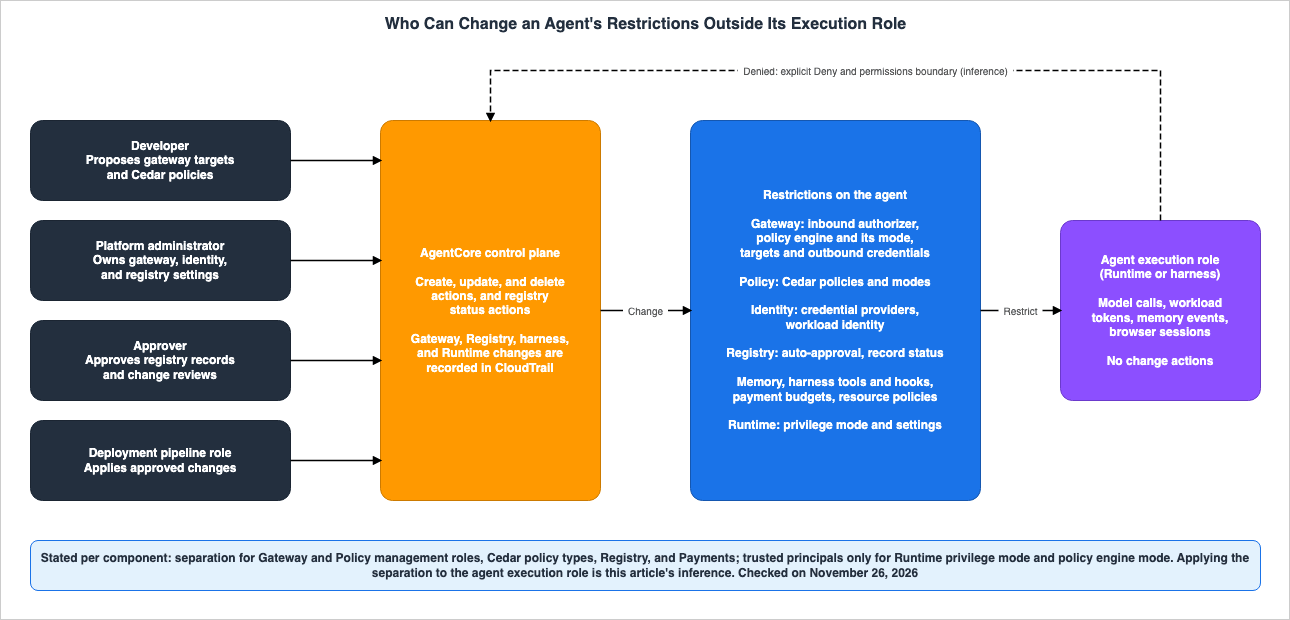
2.1 The Example Execution Roles Have No Change Actions
The Runtime permissions page provides an example policy for the Runtime execution role. The example actions include interacting with CloudWatch Logs, X-Ray, CloudWatch metrics, Amazon ECR, and invoking models in Amazon Bedrock, as well as usingGetWorkloadAccessToken, GetWorkloadAccessTokenForJWT, and GetWorkloadAccessTokenForUserId. The execution role examples on the Harness security page also include actions related to Memory events, Browser, and Code Interpreter. Neither example includes actions to create, modify, or delete configurations for Gateway, Policy, Identity, Registry, or Memory.These actions are not included in the examples because they are not required for the agent to function (Inference). Therefore, if you create an execution role based on these examples, only principals outside the execution role hold the permissions to change the agent's restrictions (Inference).
2.2 Code Inside the VM Can Use the Permissions in the Execution Role
The credentials page describes the credentials associated with the Runtime, Browser, and Code Interpreter execution roles as follows:When configuring the execution role permissions, use careful consideration since any code or actor running inside the VM can access these credentials by calling the metadata endpoint.The same page states that permissions should be limited to only what you intend, citing the fact that an LLM can generate arbitrary code.
Especially when using these tools with LLMs, that can generate arbitrary code, it’s crucial to limit permissions to only what you intend.Based on these two statements, this article suggests that assigning change actions to an execution role could allow an agent, potentially influenced by prompt injection, or code generated by the agent, to alter its own restrictions using those permissions (Inference). This article does not detail specific methods for achieving this. As a design consideration, it is recommended to avoid assigning change actions to execution roles (Inference).
2.3 Principals That Can Change Restrictions
Outside of the agent's execution role, there are four principals that can change restrictions (Inference):- Developers: Write the agent's code, and create their team's Gateway targets and Cedar policies.
- Platform administrators: Own the Gateway, policy engine, credential provider, and Registry settings.
- Approvers: Approve Registry records and configuration changes.
- Deployment pipeline role: Applies settings through Infrastructure as Code (IaC).
The key point illustrated in Figure 1 is that none of the arrows representing changes to the restrictions originate from the agent's execution role. If any one of these four principals can, alone, loosen a restriction and also act as the agent under it, narrowing the execution role means less (Inference).
2.4 Changes Covered in This Article, and Changes Not Covered
This article addresses changes related to resource configuration. Actions taken by agents, such as writing events to their Memory or initiating Browser sessions, are considered data plane operations and are not included in the scope of "restriction changes" discussed in this article. However, at the SAR access level, both of these actions are classified as "Write" operations (see Section 3.1).3. Change Actions by Component
This chapter lists, per component, the actions that change restrictions and what they change.3.1 How the SAR Was Counted, and the Verification Date
On the verification date, the SAR page for Amazon Bedrock AgentCore returned aLast-Modified date of November 26, 2026, 07:02:06 GMT. This article counted the rows containing action names in the "Actions defined by" table and the "Permission-only actions" table. The results are as follows:| Table | Row Count | Access Level Breakdown |
|---|---|---|
| Amazon Bedrock AgentCore Actions Table | 253 | Write: 138, Read: 60, List: 53, Tagging, Write: 2 |
| Amazon Bedrock AgentCore Permission-only Table | 16 | Permissions management, Write: 8, Write: 6, Read: 1, List: 1 |
| AWS Agent Registry Actions Table | 29 | Write: 15, Read: 6, List: 6, Tagging, Write: 2 |
| AWS Agent Registry Permission-only Table | 3 | Write: 2, Read: 1 |
Access levels alone cannot pick out the changes to restrictions. The count of 138 "Write" actions includes actions commonly used by agents for the data plane, such as
CreateEvent, DeleteEvent, StartBrowserSession, and UpdateBrowserStream. The count of 8 within "Permissions management" includes ManageAdminPolicy and ManageResourceScopedPolicy, as well as InvokeGateway and the AuthorizeAction action that the Gateway's service role uses. This article does not count the total number of change actions, as the definition of "modification" can vary (Inference).As of the verification date, the SAR page for Amazon Bedrock AgentCore is at
list_bedrock-agentcore.html. The previous location, list_amazonbedrockagentcore.html, has been redirected to this location.3.2 Table by Component
The following table lists examples of component-specific change actions, along with a description of the resulting changes. The "Separation Statement" column indicates whether official documentation describes a separation of permissions for that particular component. The "Execution Role" and "Approval" columns reflect design decisions made for this article. Actions listed without a namespace are assumed to belong to thebedrock-agentcore: namespace.| Component | Change Actions (Examples) | What Changes | Separation Statement | Execution Role | Approval |
|---|---|---|---|---|---|
| Gateway | UpdateGateway, DeleteGateway, GatewayAssociateWebACL, GatewayDisassociateWebACL | Inbound authorization type, policy engine and mode, interceptor, service role, adding and removing the AWS WAF web ACL, and the behavior when WAF cannot evaluate a request | Stated | Not granted (Inference) | Platform administrator (Inference) |
| Gateway Target | CreateGatewayTarget, UpdateGatewayTarget, DeleteGatewayTarget, SynchronizeGatewayTargets | Tools the agent can call, connection destination, outbound credential provider | Stated | Not granted (Inference) | Developer proposes, platform administrator approves (Inference) |
| Policy | CreatePolicy, UpdatePolicy, DeletePolicy, DeletePolicyEngine, ManageResourceScopedPolicy, ManageAdminPolicy | Contents of Cedar policies and enforcement mode per policy | Stated | Not granted (Inference) | Separated by policy type (Section 6.2) |
| Identity | UpdateOauth2CredentialProvider, UpdateApiKeyCredentialProvider, UpdateWorkloadIdentity, SetTokenVaultCMK | The identity used to connect to external services, OAuth callback URL, token vault key | Not found | Not granted (Inference) | Platform administrator (Inference) |
| Registry | agent-registry:UpdateRegistry, agent-registry:UpdateRegistryRecordStatus, agent-registry:UpdatePublisherAssociationApprovalStatus | Auto-approval rules, record approval/rejection/deprecation, publication approval | Stated | Not granted (Inference) | Approver (Section 6.1) |
| Memory | UpdateMemory, DeleteMemory | Memory strategy, event retention period, Memory role, destination | Not found | Not granted (Inference) | Platform administrator (Inference) |
| Harness | UpdateHarness | Allowed tools, lifecycle hooks, system prompt, model, execution role | Not found | Not granted (Inference) | Platform administrator (Inference) |
| Payments | CreatePaymentManager, CreatePaymentSession, CreatePaymentInstrument | Payment settings, session budget, payment instruments | Stated | Payment only (Stated) | Management role (Section 6.3) |
| Resource-Based Policy | PutResourcePolicy, DeleteResourcePolicy | Who can call Gateway, Runtime, and Runtime endpoint | Not found | Not granted (Inference) | Platform administrator (Inference) |
| Runtime | CreateAgentRuntime, UpdateAgentRuntime | Privilege mode, inbound authorization, network, execution role | Limited to trusted principals (privilege mode, Stated) | Not granted (Inference) | Section 3.4 |
For the rows marked Stated in the "Separation Statement" column, Section 4.1 quotes the original text. Only the Payments row has Stated in the "Execution Role" column, because the Payments roles page describes a separate payment role. However, the role names on the Payments roles page are not the same as the execution roles in AgentCore Runtime.
The reason the external service connection changes under the "Identity" row is as follows:
UpdateOauth2CredentialProvider updates the OAuth client configuration, while UpdateApiKeyCredentialProvider replaces the API key. Even if the agent retrieves a token using the same credential provider name, the external account it connects to may still change (Inference).Regarding
allowedTools in the "Harness" row, the API reference states that specifying a value will overwrite any existing values. The hooks field for lifecycle hooks behaves the same way. In Harness, the scope of allowed tools itself changes with a single UpdateHarness call.3.3 API Operations and Actions Are Not One-to-One
The SAR page contains a table that lists the IAM actions that each API operation authorizes. As of the verification date, the table was structured as follows:| API Operation | IAM Actions Listed in the Table |
|---|---|
UpdateGateway | bedrock-agentcore:CreateGateway, bedrock-agentcore:UpdateGateway, iam:PassRole |
UpdateGatewayTarget | bedrock-agentcore:SynchronizeGatewayTargets, bedrock-agentcore:UpdateGatewayTarget |
UpdateMemory | bedrock-agentcore:UpdateMemory, bedrock-agentcore:UpdateMemoryRecordExpirySpecification, iam:PassRole |
The Harness security page also states that the
UpdateHarness operation requires three actions: UpdateHarness, UpdateAgentRuntime, and UpdateMemory. SynchronizeGatewayTargets is an action that has an API operation of the same name and is also required for the UpdateGatewayTarget operation. The SAR also includes this action in the permission-only table (Stated). Adding or removing a Gateway's web ACL is also handled not through UpdateGateway but through the permission-only actions GatewayAssociateWebACL and GatewayDisassociateWebACL, together with permissions on the AWS WAF side (Gateway WAF page, Stated). What UpdateGateway changes is the setting that determines whether to allow or block requests when WAF is unable to evaluate them (Stated).Based on this, this article recommends the following two points (Inference): When revoking permissions, use the name of the IAM action, rather than the name of the API operation, for the "Deny" rule. When granting permissions, carefully verify all required actions in the table.
3.4 Runtime and Privilege Mode
The same actions as other runtime configurations,CreateAgentRuntime and UpdateAgentRuntime, determine the privilege mode for the runtime. Details regarding the modes, reverting to STANDARD upon update, and the fact that no condition key for narrowing the mode was found are covered in Chapters 4, 6, and 7 of Privilege Mode on AgentCore Runtime Instances. This article only quotes the Instances security page sentence in Section 4.1.4. What the Official Sources State and What They Do Not
This chapter differentiates between what official documentation explicitly states and what it does not about separating permissions.4.1 Per-Component Statements — Separation, and Limiting to Trusted Principals
The official sources state the following seven points per component. Five of them state a separation of roles or permissions. The other two, the Runtime privilege mode (the first) and the Gateway policy engine mode (the fifth), state that the permission should be granted only to trusted principals, rather than a separation.The first is the Runtime privilege mode. The Instances security page states:
Setting the privilege mode uses the same IAM actions as the rest of the agent runtime configuration: bedrock-agentcore:CreateAgentRuntime and bedrock-agentcore:UpdateAgentRuntime. Any principal that can call these actions can configure an agent runtime to run its agents with elevated privileges. Grant these actions only to principals that you trust with that decision.This sentence concerns the decision on the privilege mode. This article does not extend it to all Runtime changes.
The second is the Gateway and Policy management role. The Policy permissions page differentiates between the Gateway service role and the management role.
This role is separate from the Gateway Execution Role and is only needed when setting up or modifying Amazon Bedrock AgentCore Gateway and Policy in AgentCore configurations.On the same page, the Best Practices section begins with the following line:
Use Separate Roles - Maintain distinct roles for Amazon Bedrock AgentCore Gateway execution and resource managementThe third is the Gateway permissions page. The Gateway permissions page lists the following items as best practices:
Use different roles for management and executionThe fourth is the Cedar policy types. The Policy permissions page describes the two permission-only actions as gates that separate the policy types.
The ManageResourceScopedPolicy and ManageAdminPolicy actions are permission-only gates that control what types of Cedar policies administrators can createThe fifth is the Gateway policy engine mode. The enforcement modes page states:
No separate action or condition key protects the mode field beyond bedrock-agentcore:UpdateGateway, so grant this permission only to trusted principals.The sixth is Registry. The Registry blog indicates that submission and approval permissions can be separated.
The submit and status-update actions are IAM-authorized, allowing publisher and approver permissions to be separated.The Publishers page also states, under the heading "Separation of duties":
Creating and verifying a Publisher is a distinct responsibility from publishing records under it.The seventh is Payments. The Payments roles page states, in the note on the example policy for the management role:
This policy explicitly denies ProcessPayment to enforce separation of duties between management operations and payment execution. This ensures only deterministic code paths can set control plane operations, while agentic execution is only able to process payment without overriding budgets or creating payment instruments to work around this.The Payments security page summarizes this same separation in a single sentence:
With this pattern, no single role can both raise a budget and spend against it.Of the seven, only the two Payments pages name agent execution and control plane operations separately. However, they cover only Payments resources.
4.2 The Gateway Execution Role Is Not the Agent Execution Role
On the Policy permissions page, the Gateway Execution Role is the role assumed by the Gateway when it invokes tools and evaluates Cedar policies. When the Gateway is combined with Policy, the page requiresAuthorizeAction, PartiallyAuthorizeActions, and GetPolicyEngine for this role. It is not the execution role of the Runtime where the agent runs.Therefore, the second and third points in Section 4.1 delineate the Gateway's service role and the Gateway's management role. They are not sentences about the agent's execution role. When this article applies them to the agent execution role, it writes that as an inference.
4.3 Not Found as a General Principle
This article sought to identify a statement requiring, for every AgentCore component, that the agent execution role hold no change actions. This article searched the entire AgentCore developer guide, using terms such as "separation of duties," "separate roles," "trusted principals," and "execution role should not," and read the BPs for AGENTSEC02, AGENTSEC03, and AGENTSEC07 in the Agentic AI Lens. As of the verification date, no such general principles were found (Not found). The absence of such a statement does not constitute proof that it does not exist.4.4 Sentences That Are Close but Say Something Else
Here are five sentences that are related to the topic of this article, but discuss different aspects.The first is "Prevent privilege escalation" from the Runtime security page.
Ensure that the execution role associated with your runtime has equal or fewer privileges than the principals who can invoke it.This sentence compares the permissions of the execution role and the permissions of the principals that can call the Runtime. It is not a sentence about change permissions. A similar sentence also exists on the credentials page.
The second is AGENTSEC02 from the Agentic AI Lens. The title of the AGENTSEC02 page is "Secure agent tool usage," and the Best Practices (BP) listed are three: tool authorization, tool input/output validation, and a registry of approved tools. This is not a Best Practice related to the authority to change settings.
The third is AGENTSEC03-BP02. This Best Practice requires separating agent and human permissions to prevent agents from assuming human IAM roles. One example of an anti-pattern is as follows:
Allowing agents to assume human IAM roles through role chaining, enabling access to resources that should be restricted to human users and creating a privilege-escalation path.This discusses the scenario where an agent uses a human role, but it does not discuss the AgentCore control plane.
The fourth is AGENTSEC03-BP03. This anti-pattern is the closest of the five to the topic of this article.
Failing to implement IAM permission boundaries, allowing agents to create or modify IAM policies and escalate their own privileges.However, it specifically addresses IAM policies, and does not explicitly mention settings for AgentCore's Gateway or Policy.
The fifth is an example from the remote sessions blog. That post demonstrates running a coding agent on AgentCore and describes the Runtime's IAM role as follows:
It’s explicitly denied the AgentCore Identity control plane, so a task can’t change the GitHub credential provider that every repository shares.This describes the design of one example. This article does not draw general principles from this example. However, it shows that the inference in the Identity row points the same way as the example in the official blog.
4.5 This Article's Inference
The statement regarding "Payments" in Section 4.1 describes a pattern that prevents a single role from both raising the budget and spending it. This article extends this pattern to all components. Specifically, it prevents a single role from both relaxing agent restrictions and operating as an agent under those restrictions (Inference).The basis for this inference rests on three points:
- The per-component statements of separation point the same way in five points, and the remaining two also limit the change permissions to trusted principals (Section 4.1).
- Code inside the VM can use the execution role credentials (Section 2.2).
- The example execution roles include no change actions (Section 2.1).
5. How to Keep Change Actions Out of the Execution Role, and the Exceptions
This chapter outlines methods for removing change actions from an agent's execution role. All of these methods are based on design decisions made for this article, and only explicitly stated aspects will be considered "Stated."5.1 Four Approaches
The first approach is to delineate roles. Separate management roles from execution roles. This is Stated for Gateway, Policy, and Payments; extending it to the other components is an Inference.The second approach is to add explicit denials to the execution roles (Inference). Even if a permission policy does not include specific allow actions, this provides a safeguard against someone later applying a broader policy.
The third approach is to utilize permissions boundaries. The implementation guide for AGENTSEC03-BP03 states that permissions boundaries on all agent roles set the upper limit of their permissions.
IAM permission boundaries on all agent roles establish a maximum permission ceiling that can't be exceeded even if the agent's policies are modified, which matters because it is the control that helps prevent privilege escalation when something about the policy itself changes.If no change actions are included in the permissions boundary, even if a broad policy is applied to the execution role, those actions cannot be used (Inference).
The fourth approach is to use service control policies (SCPs) in the organization. Define targets based on the naming conventions and tags of the agent's execution roles, and then deny change actions (Inference). Exceptions to the SCP are detailed in Section 5.4.
5.2 An Example of an Explicit Deny
The following policy is an example of an explicit Deny statement to apply to agent execution roles (Inference). The action names listed are those found on the SAR page as of the verification date. This list is not exhaustive; always cross-reference it with the SAR on the day you use it.{
"Version": "2012-10-17",
"Statement": [
{
"Sid": "DenyAgentCoreRestrictionChanges",
"Effect": "Deny",
"Action": [
"bedrock-agentcore:CreateGateway",
"bedrock-agentcore:UpdateGateway",
"bedrock-agentcore:DeleteGateway",
"bedrock-agentcore:CreateGatewayTarget",
"bedrock-agentcore:UpdateGatewayTarget",
"bedrock-agentcore:DeleteGatewayTarget",
"bedrock-agentcore:SynchronizeGatewayTargets",
"bedrock-agentcore:GatewayAssociateWebACL",
"bedrock-agentcore:GatewayDisassociateWebACL",
"bedrock-agentcore:CreatePolicyEngine",
"bedrock-agentcore:UpdatePolicyEngine",
"bedrock-agentcore:DeletePolicyEngine",
"bedrock-agentcore:CreatePolicy",
"bedrock-agentcore:UpdatePolicy",
"bedrock-agentcore:DeletePolicy",
"bedrock-agentcore:ManageResourceScopedPolicy",
"bedrock-agentcore:ManageAdminPolicy",
"bedrock-agentcore:CreateOauth2CredentialProvider",
"bedrock-agentcore:UpdateOauth2CredentialProvider",
"bedrock-agentcore:DeleteOauth2CredentialProvider",
"bedrock-agentcore:CreateApiKeyCredentialProvider",
"bedrock-agentcore:UpdateApiKeyCredentialProvider",
"bedrock-agentcore:DeleteApiKeyCredentialProvider",
"bedrock-agentcore:CreateWorkloadIdentity",
"bedrock-agentcore:UpdateWorkloadIdentity",
"bedrock-agentcore:DeleteWorkloadIdentity",
"bedrock-agentcore:SetTokenVaultCMK",
"bedrock-agentcore:UpdateMemory",
"bedrock-agentcore:DeleteMemory",
"bedrock-agentcore:CreateHarness",
"bedrock-agentcore:UpdateHarness",
"bedrock-agentcore:DeleteHarness",
"bedrock-agentcore:CreateAgentRuntime",
"bedrock-agentcore:UpdateAgentRuntime",
"bedrock-agentcore:DeleteAgentRuntime",
"bedrock-agentcore:CreateAgentRuntimeEndpoint",
"bedrock-agentcore:UpdateAgentRuntimeEndpoint",
"bedrock-agentcore:DeleteAgentRuntimeEndpoint",
"bedrock-agentcore:PutResourcePolicy",
"bedrock-agentcore:DeleteResourcePolicy",
"bedrock-agentcore:UpdateRegistry",
"bedrock-agentcore:UpdateRegistryRecordStatus",
"agent-registry:UpdateRegistry",
"agent-registry:UpdateRegistryRecordStatus",
"agent-registry:UpdatePublisherAssociationApprovalStatus",
"agent-registry:PutResourcePolicy",
"agent-registry:DeleteResourcePolicy"
],
"Resource": "*"
}
]
}This example also includes the Registry actions in the
bedrock-agentcore: namespace, because the Registry IAM page was documented as follows at the time of verification.AWS Agent Registry has launched under the new agent-registry namespace. Support for the public preview bedrock-agentcore namespace will be discontinued on October 30, 2026.The language on the page still uses the term "will be" as of the verification date. The Amazon Bedrock AgentCore section of the SAR also still lists actions related to the Registry. The current IAM actions are in the
agent-registry: namespace.This example does not include actions related to
iam:PassRole or actions that modify IAM roles or policies. These are addressed in Section 5.5 and in relation to permissions boundaries.5.3 Do Not Use Verb Wildcards
Using wildcards with verbs, such asbedrock-agentcore:Create* or bedrock-agentcore:Update*, can result in a more concise expression when defining Deny rules. However, in the SAR as of the verification date, actions starting with Create include CreateEvent, actions starting with Delete include both DeleteEvent and DeleteMemoryRecord, actions starting with Update include UpdateBrowserStream, and actions starting with Start include both StartBrowserSession and StartCodeInterpreterSession. The example of execution roles on the Harness security page permits CreateEvent, DeleteEvent, UpdateBrowserStream, StartBrowserSession, and StartCodeInterpreterSession.Therefore, using wildcards with verbs in Deny rules can inadvertently block the agent from writing events to Memory, or from using the Browser and Code Interpreter (Inference). This article recommends listing individual action names, as shown in the example in Section 5.2 (Inference).
5.4 SCP and Exceptions for Service-Linked Roles
The Instances security page notes that, because Runtime Instances run in your account, SCPs and permissions boundaries apply to the operations there, and then states the exception:The exception is the AgentCore service-linked role used to delete and clean up resources, which is not restricted by SCPsThe service-linked roles page lists five service-linked roles for AgentCore as of the verification date. These roles manage network interfaces, manage workload access tokens and OAuth credentials for Runtime, manage Amazon VPC Lattice resources for Gateway and Identity, and handle the cleanup of compute resources for Runtime Instances. Registry has a separate service-linked role page. The SCP page describes service-linked roles as follows:
SCPs do not affect any service-linked role.Therefore, SCPs do not stop what these roles do.
This article does not state that SCPs can block all changes to AgentCore. SCPs block the changes made by principals in member accounts of the organization (Inference). The SCP page states that SCPs don't affect users or roles in the management account (Stated).
5.5 PassRole and the Managed Policy for Management
The SAR API operations table listsiam:PassRole alongside UpdateGateway, UpdateMemory, UpdateHarness, UpdateAgentRuntime, and UpdatePaymentManager. The condition key is iam:PassedToService, with a value of bedrock-agentcore.amazonaws.com. Changes that modify resource roles also require iam:PassRole. Do not include iam:PassRole in the agent's execution role (Inference). iam:PassRole Is Checked by the Service covers where PassRole is checked.The Gateway permissions page provides the following guidance for a quick start:
Attach the BedrockAgentCoreFullAccess to an IAM identity to allow it to create, manage, and invoke gateways.This managed policy combines creation, management, and invocation into a single unit. When applied to the agent's execution role, it grants permissions for change actions (Inference). Keep it to temporary development use, and do not attach it to the execution role (Inference).
6. Separating Approval
This chapter decides who should approve changes to restrictions. Figure 2 summarizes the content of this chapter.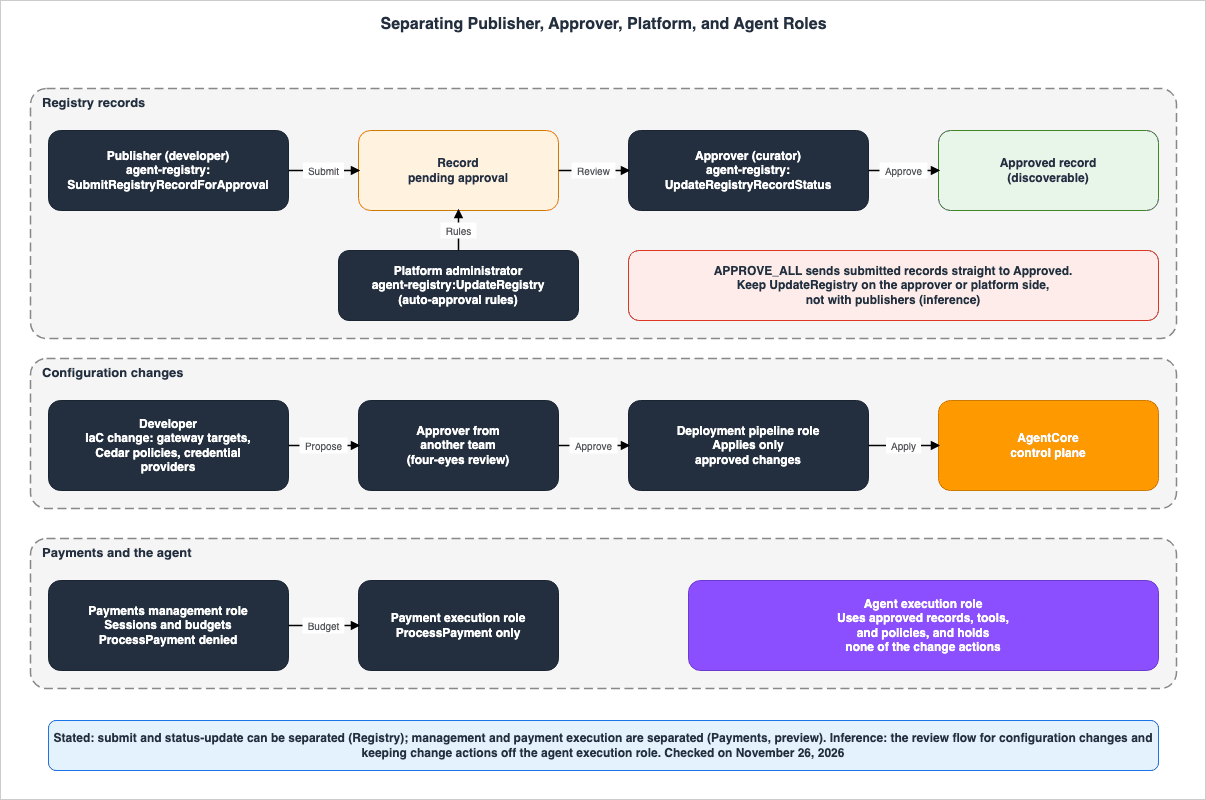
6.1 Registry Submission and Approval
A Registry record moves to pending approval withagent-registry:SubmitRegistryRecordForApproval and can then be approved, rejected, or deprecated through agent-registry:UpdateRegistryRecordStatus. The Registry IAM page describes the latter as the permission to approve, reject, or deprecate a record. As mentioned in Section 4.1, the Registry blog states that these two permissions can be separated.A potential oversight is the configuration for automatic approval. The Registry getting started page indicates that enabling automatic approval will automatically approve any submitted records.
When Auto-approval is on, when you submit a record for approval, the record moves directly to Approved status and becomes visible in search results shortly after.The API reference describes this setting within
UpdateRegistry under approvalConfiguration and autoApprovalRules. As of the verification date, the only valid value is APPROVE_ALL. The API reference clarifies the scope of changes to this setting as follows:The change applies only to records that move to PENDING_APPROVAL after the update; records already in PENDING_APPROVAL are unaffected.Therefore, any principal with the
agent-registry:UpdateRegistry permission can effectively remove the approval process for subsequent records (Inference). Even if submission and approval permissions are separated, if the principal submitting the record also possesses UpdateRegistry, the separation is not maintained (Inference). This article recommends placing the UpdateRegistry permission with either the approver or the platform administrator (Inference).The roles and operations related to the Registry are addressed in Sections 4.2 and 7.1 of AWS Agent Registry and the Agentic Resource Discovery Specification.
6.2 Cedar Policy Owners
The Policy permissions page describesManageResourceScopedPolicy as the permission to create policies that target a specific Gateway ARN, and ManageAdminPolicy as the permission to create policies using wildcards. This distinction between the two permissions, and the delegation of the former to application teams and the latter to platform administrators, is covered in Section 5.1 of Amazon Bedrock AgentCore Policy Implementation Guide.Besides the content of the policies, there are two other paths that change whether Cedar policies take effect. One is through the Gateway policy engine mode, which can be changed to
LOG_ONLY using UpdateGateway. The other is through the enforcement mode for each policy, as described in the API reference, where UpdatePolicy accepts ACTIVE or LOG_ONLY for the enforcementMode parameter. These two methods are discussed in Section 5.3 of Stopping an AI Agent on AWS. This article recommends that both paths go through an approval separate from the principal that writes the policies (Inference).The Best Practices section on the Policy permissions page also mentions the following:
Version Control Policies - Store Cedar policies in version control alongside infrastructure codeBy placing policies under version control, change approvals can be conducted through code reviews (Inference).
6.3 Payment Management and Processing
The Payments roles page defines five roles. The administrator role manages payment managers, connectors, and credential providers. The developer's management role manages payment instruments and sessions and cannot make payments. The payment role is responsible for processing payments on behalf of agents. The page explains the rationale behind this structure as follows:Separating payment management from payment execution prevents a single compromised identity from both creating sessions with unlimited budgets and executing payments against those sessions.AgentCore payments is in Preview as of the verification date. This article treats the Payments pattern as a model for the approval process of other components (Inference).
6.4 Areas Requiring Human Approval
The Agentic AI Lens, AGENTSEC07-BP03, requires multiple approvers for critical operations.A single reviewer is a single point of failure, both for honest errors and for social engineering. Independent, blind reviews for high-risk decisions are the defense-in-depth pattern, well known as the four-eyes principle, that keeps unilateral approval off the path.This BP covers high-risk decisions by agents. This article applies it to changes to restriction settings (Inference). Specifically, this article recommends the following process:
- Developers submit proposed changes to the Gateway target, Cedar policies, and credential providers as Infrastructure-as-Code (IaC) changes.
- An approver from a team other than the developer's approves the change.
- The deployment pipeline role applies only the approved changes.
- The agent execution role does not participate in any stage of this process.
In this process, only the deployment pipeline role and the emergency manual role hold change actions (Inference). Emergency manual work separates the stop operation from the revert operation. Section 7.5 of Stopping an AI Agent on AWS addresses this distinction. The same section states, as an inference, that the agent execution role should not be granted permissions to
UpdateGateway, modify policies, or change its own IAM role. This article extends that same logic to components outside the Gateway.6.5 What Approval Does Not Prevent
Even with an approval process in place, certain aspects remain (Inference).- The permissions of the approver and of the deployment pipeline role themselves. Changes to those roles also go through the same approval.
- Actions performed by service-linked roles. These actions bypass both the approval process and SCPs (see Section 5.4).
- Actions performed by agents inside the scope of the permissions they are given. These actions do not involve changes to configurations.
7. Finding Changes, and What Condition Keys Can Narrow
This chapter describes how to identify changes that do not receive approval, and the extent to which condition keys can narrow the content of a change.7.1 Whether Changes Are Recorded as Management Events
For each component, this article searched for a sentence stating that changes are recorded as CloudTrail management events. The results are as follows:| Component | What the Sources Say | Mark |
|---|---|---|
| Gateway | The Gateway CloudTrail page states that all API calls for the Gateway are recorded as events, and that these events include both management and data events. | Stated |
| Registry | The Registry CloudTrail page states that control plane operations are, by default, recorded as management events. | Stated |
| Harness | The Harness operations page states that control plane operations are recorded as management events. | Stated |
| Runtime | The Runtime security page states that control plane operations are recorded. The Instances security page states that all calls for CreateAgentRuntime and UpdateAgentRuntime are recorded. | Stated |
| Policy, Identity, Memory, Payments | No sentence was found in the developer guide that explicitly states that configuration changes are recorded as management events. | Not found |
The specific wording on the Registry CloudTrail page is:
Control plane operations are logged as management events by default.The entries for Policy, Identity, Memory, and Payments do not mean that changes are not recorded. This article recommends changing each component's configuration once before deployment and verifying that the resulting event appears in CloudTrail Event history (Inference).
The event source for Registry events, as shown in the Registry CloudTrail page example, is
agent-registry.amazonaws.com. Focusing solely on bedrock-agentcore.amazonaws.com may lead to overlooking changes related to Registry approval settings (Inference).A separate article in this series, Whose Identity Is in the Audit Record for an AgentCore Tool Call - Users, Agents, and Tools in Gateway, Identity, and Runtime, covers whose identity appears in the
userIdentity of change records.7.2 Notification
To identify changes that bypass the approval process, create a notification using management events and their event names (Inference). The target is an operation with the same name as the actions described in Section 5.2. If the principal that made the change is not the deployment pipeline role, investigate it (Inference).7.3 What Condition Keys Can Narrow
Using condition keys, you can sometimes narrow the content of a change even after granting change actions. The status of each component is as follows. This table does not list all condition keys; it only shows which components' changes might be narrowed with keys other than tags.| Component | Keys on the SAR Rows | Keys the Developer Guide Lists | Mark |
|---|---|---|---|
| Runtime | RuntimeAuthorizerType, subnets, securityGroups | Keys related to VPC configuration | Stated |
| Gateway and Target | Only tag keys | Policy engine mode, authorization type, target type, credential provider type, etc. | Stated (discrepancy exists) |
| Policy | Only tag keys | Two gates separate the policy types | Stated |
| Identity | Only tag keys | None found | Not found |
| Memory | KmsKeyArn for CreateMemory, only tag keys for UpdateMemory | None found | Not found |
| Harness | Only tag keys | None found | Not found |
| Registry | Only tag keys | Two keys that narrow by record. Does not apply to UpdateRegistry | Stated |
| Payments | DiscoveryUrl | None found | Not found |
There is a discrepancy in the information regarding Gateway. The Gateway condition keys page states that the Gateway and target condition keys apply to control plane operations, and includes
PolicyEngineMode as a key for both CreateGateway and UpdateGateway. The SAR lists PolicyEngineMode in the table of condition keys, but it is not associated with any action rows. As mentioned in Section 4.1, the enforcement modes page states that, aside from UpdateGateway, there are no other actions or condition keys that protect the "mode" field.The Gateway condition keys page further states:
A condition key is present in the request context only when the request includes the value that the key describes.The enforcement modes page states that the same permission can set
policyEngineConfiguration to null, which removes the policy engine. The documentation does not specify whether the mode's condition key is included in this change (Not found). Therefore, this article does not recommend relying solely on the PolicyEngineMode condition to protect the policy engine. Instead, it recommends narrowing the principals that hold UpdateGateway (Inference). The background of this discrepancy is discussed in Section 5.3 of Stopping an AI Agent on AWS.The two keys in the Registry row are
agent-registry:RecordCreatorAccount and agent-registry:RecordSourceAccount, listed on the Registry sharing page. They restrict actions based on the account that created the record and the account of the record's source resource (Stated). These keys apply to operations including UpdateRegistryRecordStatus and SubmitRegistryRecordForApproval, but not to UpdateRegistry (Stated). The SAR page for AWS Agent Registry lists these two keys in its table of condition keys, but does not attach them to any action row (Stated). These keys restrict which records can be approved, but they do not restrict changes to the auto-approval rules. Therefore, the recommendation in Section 6.1 remains unchanged (Inference).7.4 Security Hub CSPM Controls
The Security Hub CSPM controls page lists seven controls related to AgentCore, ranging fromBedrockAgentCore.1 to BedrockAgentCore.7, as of the verification date. These controls cover aspects such as the network mode of the Runtime VPC, inbound authorization for the Gateway, customer managed KMS keys for Memory and Gateway, the network mode and recording settings for the Browser, and the network configuration of the Code Interpreter. There are no controls related to change permissions or the permissions of the execution role. The table and the Deny in this article do not show up in Security Hub CSPM results (Inference).8. Frequently Asked Questions Regarding AgentCore Change Permissions
This chapter answers questions from readers related to Section 1.1, using information from Chapters 2 through 7.Q1. If you minimize the agent's execution role, are the agent's restrictions protected?
Not by that alone. Principals outside the execution role can change Gateway targets, Cedar policies, credential providers, and Registry approval through the control plane APIs. Minimizing the execution role is a separate task from narrowing those principals (see Chapters 2 and 3).Q2. Do the official sources say not to give change actions to the agent's execution role?
No statement of it as a general principle was found. The official sources state a separation per component for management roles for Gateways and Policies, Cedar policy types, Registry, and Payments, and state that the permissions for the Runtime privilege mode and the Gateway policy engine mode should be limited to trusted principals. Applying this to the agent's execution role is this article's inference (Chapter 4).Q3. Does the Gateway Execution Role in the developer guide refer to the agent execution role?
No. The Gateway Execution Role is the role assumed by the Gateway when it invokes tools and evaluates Cedar policies. It is distinct from the execution role of the Runtime in which the agent operates (see Section 4.2).Q4. Is Prevent privilege escalation on the Runtime security page about change permissions?
No, that is not the case. That item is about ensuring that the permissions of the execution role are either the same as or less than the permissions of the principals that can invoke the Runtime. It is not about change permissions (see Section 4.4).Q5. Is denying bedrock-agentcore:Update* enough?
It is not enough, and it also stops the agent's normal operations. Update* includes UpdateBrowserStream, and Create* includes Memory's CreateEvent. The current Registry actions are in the agent-registry: namespace, so they are not blocked by the bedrock-agentcore: wildcard. Instead, list the action names individually (see Sections 5.2 and 5.3).Q6. If you separate submission and approval in Registry, is approval protected?
It depends on who holds theUpdateRegistry permission. If someone uses UpdateRegistry to set the auto-approval rule to APPROVE_ALL, records submitted after that are approved without going through an approver. Place UpdateRegistry on the approver's side as well (see Section 6.1).Q7. Can condition keys stop a change that removes the policy engine?
The documentation does not confirm this. The Gateway condition keys page listsPolicyEngineMode, but the SAR does not attach it to any row, and the enforcement modes page states that no key protects the mode field. It is also not documented whether the mode key is present in a change that removes the policy engine. Focus on restricting principals that possess the UpdateGateway permission (see Section 7.3).9. Summary
Before deploying an agent to production and before reviewing permissions, ensure the following:- The agent's execution role's permissions policy does not include actions that create, change, or delete AgentCore resource settings (Section 2.1).
- For each component, a table lists the actions that change restrictions and the principals that hold them. This table includes rows for Identity, Memory, Harness, and resource-based policies (Section 3.2).
- When granting permissions, all actions required for API operations are thoroughly verified in the SAR table (Section 3.3).
- A clear distinction is made between the official per-component statements and the inferences presented in this article, and this is documented in the review materials (Chapter 4).
- The agent's execution role includes explicit "Deny" statements, each listing a specific action name, and is configured with a permissions boundary. No verb wildcards are used (Sections 5.2 and 5.3).
- Actions in the
agent-registry:namespace are also included in the "Deny" statements (Section 5.2). - You know that SCPs do not stop service-linked roles or users and roles in the management account (Section 5.4).
- The
UpdateRegistryaction is located on the approver's side or the platform administrator's side, rather than the submitter's (Section 6.1). - Changes to the Gateway's policy engine mode and the enforcement mode for individual policies go through an approval separate from the principal that writes the policies (Section 6.2).
- Changes to restrictions follow a process that includes reviewing IaC (Infrastructure as Code) changes, obtaining approval from another team, and then applying the change through the deployment pipeline role (Section 6.4).
- Before going live, verify that changes to each component's configuration appear as management events in CloudTrail. Monitor changes to the Registry using the event source
agent-registry.amazonaws.com(Section 7.1). - The policy engine is not solely protected by conditions related to
PolicyEngineMode(Section 7.3). - By re-examining the relevant pages, confirm that the SAR entries, Registry namespaces, and Security Hub CSPM controls have not changed since the verification date of November 26, 2026 (Sections 3.1, 5.2, and 7.4).
10. References
- AgentCore Gateway and Policy in AgentCore IAM Permissions - Amazon Bedrock AgentCore
- Set up permissions for AgentCore Gateway - Amazon Bedrock AgentCore
- Policy enforcement modes - Amazon Bedrock AgentCore
- IAM roles for AgentCore payments - Amazon Bedrock AgentCore
- Security in Amazon Bedrock AgentCore payments - Amazon Bedrock AgentCore
- Understanding Credentials Management in Amazon Bedrock AgentCore - Amazon Bedrock AgentCore
- IAM Permissions for AgentCore Runtime - Amazon Bedrock AgentCore
- Security best practices for AgentCore Runtime - Amazon Bedrock AgentCore
- Security model and permissions for Runtime Instances - Amazon Bedrock AgentCore
- Security and access controls - Amazon Bedrock AgentCore
- Using service-linked roles for Amazon Bedrock AgentCore - Amazon Bedrock AgentCore
- Use IAM condition keys with Amazon Bedrock AgentCore Gateway - Amazon Bedrock AgentCore
- Use IAM condition keys with AgentCore VPC settings - Amazon Bedrock AgentCore
- Protecting your gateway with AWS WAF - Amazon Bedrock AgentCore
- IAM Permissions - Amazon Bedrock AgentCore
- Get started with AWS Agent Registry - Amazon Bedrock AgentCore
- Publishers - Amazon Bedrock AgentCore
- Log Registry API calls with AWS CloudTrail - Amazon Bedrock AgentCore
- AWS CloudTrail integration - Amazon Bedrock AgentCore
- Sharing a registry across accounts with AWS RAM - Amazon Bedrock AgentCore
- Log Amazon Bedrock AgentCore Gateway API calls with CloudTrail - Amazon Bedrock AgentCore
- Observability and cost controls - Amazon Bedrock AgentCore
- Release notes for Amazon Bedrock AgentCore - Amazon Bedrock AgentCore
- UpdateGateway - Amazon Bedrock AgentCore Control Plane
- UpdatePolicy - Amazon Bedrock AgentCore Control Plane
- UpdateHarness - Amazon Bedrock AgentCore Control Plane
- UpdateOauth2CredentialProvider - Amazon Bedrock AgentCore Control Plane
- UpdateRegistry - AgentRegistry Control Plane API Reference
- UpdateRegistryRecordStatus - AgentRegistry Control Plane API Reference
- ApprovalConfiguration - AgentRegistry Control Plane API Reference
- Actions, resources, and condition keys for Amazon Bedrock Agentcore - Service Authorization Reference
- Actions, resources, and condition keys for AWS Agent Registry - Service Authorization Reference
- Service control policies (SCPs) - AWS Organizations
- Security Hub CSPM controls for Amazon Bedrock AgentCore - AWS Security Hub
- Secure agent tool usage - Agentic AI Lens
- AGENTSEC03-BP02 Separate agent and human user permission - Agentic AI Lens
- AGENTSEC03-BP03 Implement least privilege with dynamic boundaries - Agentic AI Lens
- AGENTSEC07-BP03 Multiple reviewers for critical operations - Agentic AI Lens
- Discover tools at runtime with AWS Agent Registry - AWS Artificial Intelligence Blog
- Extend Claude Code to remote sessions on Amazon Bedrock AgentCore with security controls - AWS Artificial Intelligence Blog
- Privilege Mode on AgentCore Runtime Instances - What Changes Inside the Instance, What the Boundary Keeps, and the Update That Resets It
- Stopping an AI Agent on AWS - What Each Control Stops, What Keeps Running, and Who Can Undo It
- Agent Sandboxing and Blast-Radius Isolation on AWS - Choosing the Unit of Each Containment Boundary and What Each One Does Not Stop
- AWS Agent Registry and the Agentic Resource Discovery Specification - Governance Before Discovery
- Amazon Bedrock AgentCore Policy Implementation Guide - Cedar-Based Agent Authorization and Default-Deny Design
- iam:PassRole Is Checked by the Service - What the Resource, PassedToService, the Trust Policy, and Service-Linked Roles Each Decide
- OWASP Top 10 for Agentic Applications Mapped to AWS Controls - What Each Control Mitigates and What Residual Risk Remains
References:
Tech Blog with curated related content
Written by Hidekazu Konishi