VMware History and Timeline - Workstation, ESX, vSphere, VMware Cloud Foundation, and the Owners Along the Way
First Published:
Last Updated:
VMware. What those six characters point to, however, has changed more than once between the founding in 1998 and today. There have been times when it was the name of an independent company, times when it was the name of a wholly-owned subsidiary of another company, and now it represents a division of a company that develops semiconductors and infrastructure software. Similarly, the products themselves have evolved, from applications running on a desktop to a hypervisor running directly on hardware, and then to a single stack that contains that hypervisor.This article presents that evolution as a timeline. It tracks three distinct lines. The order in which the products were released, when the owner changed, and where the same stack came to run. The three do not move at the same pace. While the product lineage has remained continuous, the ownership has changed multiple times throughout its history.
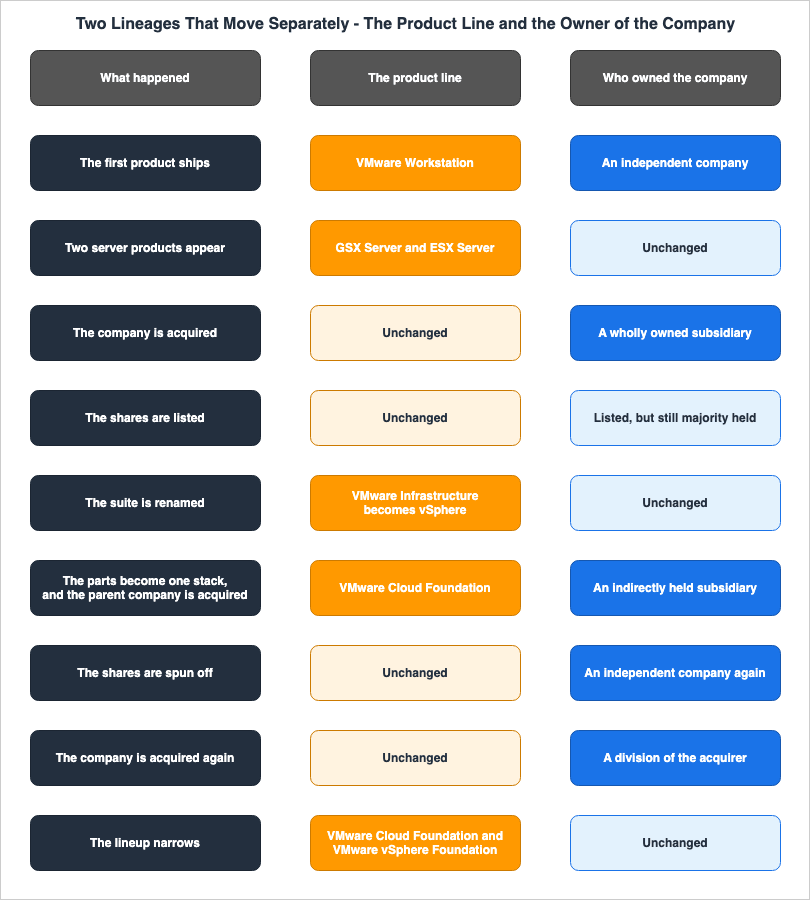
VMware the row is using.This article does not attempt to answer the question of where to move the infrastructure you are currently using. It does not compare potential destinations or outline migration procedures. Rather, it addresses the question that precedes that: where does your current infrastructure fit within that historical lineage?
The information presented in this article was verified as of September 17, 2026.
Related articles on hidekazu-konishi.com:
- Running VMware Workloads on AWS with Amazon EVS - What Carries Over, What the VPC Makes You Rebuild, and Who Installs VCF
- Microsoft Azure History and Timeline - Major Milestones from Windows Azure to the Present
- AWS History and Timeline - Almost All AWS Services List, Announcements, General Availability(GA)
- AWS Acquisitions History and Timeline - Which Companies Became Which Services, and What Remains Today
- Terraform and OpenTofu History and Timeline - A License Clause, a Fork, a Foundation, and an Acquisition
- Running Windows Server Workloads on AWS - What Carries Over, Why the License Decides the Tenancy, and Which Path Into the Domain
- AWS History and Timeline regarding Amazon EC2 - Overview, Functions, Features, Summary of Updates, and Introduction
- What AWS Transform Automates and What Stays Human - Agentic and Self-Directed Paths, the Handoff Points That Are Designed In, and What Functional Equivalence Testing Actually Covers
- Summary of AWS Application Migration Service (AWS MGN) Architecture and Lifecycle Relationships, Usage Notes - Including Differences from AWS Server Migration Service (AWS SMS)
Background and Method of Creating the VMware Timeline
What This Timeline Covers, and What It Does Not
The lines are worth drawing first. This article focuses solely on the following three areas:- The product lineage — The order in which the products on the server virtualization line arrived.
- The ownership lineage — When, and in what form, the owner of the company changed.
- The places it runs — Where the same stack came to run, and in what order.
The following topics will not be covered:
- Evaluations of changes to licensing models or service offerings. The announcements themselves go into the timeline, but this article does not judge whether they were sound.
- Pricing and price changes. This article writes no monetary figures at all. Where a primary source touches on price, the quotation is cut back to the lineup and what it applies to.
- Regulatory approval processes. The timeline will only record the date the agreement was signed and the date the transaction was completed.
- Products related to desktop virtualization and endpoint management. Workstation appears in the timeline as the first product, but this article does not follow the desktop line beyond it.
- Comparisons with hypervisors from other companies.
- A general history of virtualization itself. This article focuses on the history of a single company's products.
What VMware Refers To in Each Row
The word VMware is where this timeline trips you up most. The same six characters refer to at least three distinct entities.First, it refers to a company. This refers to the legal entity established in Delaware in 1998. For this company, November 2023 marked a significant turning point.
Second, it refers to a suite of products. This encompasses a collection of products including hypervisors, management platforms, storage solutions, and networking tools. This meaning of
VMware continues uninterrupted, even when the owner of the company changes.Third, it refers to a business division. Following the completion of the acquisition,
VMware is also the name of a business unit inside the acquiring company. The acquiring company itself uses the phrasing VMware by Broadcom.⇒ This timeline is written so that each row makes clear which meaning of
VMware it carries. The product listings refer to the second meaning, while the ownership listings refer to the first and third meanings. ⛔ The timeline avoids combining these two categories into a single table because doing so would create the misleading impression that a change in products coincided with a change in ownership.The Primary Sources This Article Used
⛔ This article does not use news websites, summary articles, or analyst reports as primary sources. It relies solely on the following four categories:- Documents filed with regulatory authorities by each company — specifically, VMware's registration statement and annual reports, as well as filings from Dell and Broadcom. These are documents in which each company set down its own history in its own words, and they outlast any other kind of source. The ownership lineage and product history prior to 2007 are derived from these documents.
- Broadcom's official announcements and official knowledge base — covering the completion of the acquisition, product portfolio, hypervisor versions, and release dates.
- The official VMware Cloud Foundation blog, operated by Broadcom — detailing announcements of the latest general availability releases.
- AWS's official pages, official blog, and "What's New" section — providing information on the availability of VMware Cloud on AWS and the various stages of Amazon EVS.
⚠ Many URLs on the legacy
vmware.com domain have been redirected to broadcom.com. The URLs cited in this article reflect the current redirects. ⇒ Following a link from a search result or an older article can still land on the pre-redirect URL, so check it together with the reference date.Each row in this article carries a link to the primary source it rests on. The reference date for the entire article is 2026-09-17.
Some Rows Have More Than One Possible Date
The date of an acquisition splits into three: the announcement date, the date the contract was signed, and the date the transaction was completed. This article avoids conflating these three dates.The most significant difference lies in the final transfer of ownership. The merger agreement was signed on May 26, 2022, while the transaction was completed on November 22, 2023. This represents a difference of approximately one and a half years. The timeline includes these two dates as separate entries, distinguishing them in the
Event column.⛔ This article does not write the course of the review. What it writes is the date the agreement was signed and the date the transaction closed. What happened in between is not the subject of this article.
Some Rows Give Only a Year
Some rows in this timeline carry a year rather than a date. That is not information being dropped; it is as far as the primary source goes.For products prior to 2007, the years are taken from the company timeline included in VMware's registration statement submitted at the time of its initial public offering. This timeline only lists years, not dates. While there is an official knowledge base that compiles hypervisor versions and release dates, that list only begins with
ESX 4.0 in 2009 and does not include earlier versions.⇒ Rows that give only a year say so in the row itself. The timeline does not present a confusing arrangement of rows that list dates alongside those that only list years.
⚠ The timeline in the registration statement is formatted in two columns. Converting it to plain text makes it difficult to determine which items belong to which year. This article reads it on the rule that the items sitting immediately after a year belong to the product row for that year. This interpretation aligns with four independent statements found elsewhere in the same document: the company's founding in 1998, the initial product shipment in 1999, the acquisition by EMC on January 9, 2004, and the introduction of VMware Infrastructure 3 in 2006.
How This Article Writes the Product Names
⛔ The same product may be referred to by different names depending on the time period. This article uses the following distinctions:- The hypervisor — This article uses whatever name the official version list uses at that point. Initially, it was
ESX Server, thenESX, followed byESXi, and most recently, againESX. How that name changed is itself one of the subjects here, so this article does not settle on a single spelling. vSphere— This is the name of the product suite that includes the hypervisor. ⛔ This is not the name of the hypervisor itself.VMware Cloud Foundation(VCF) — This is the name of the stack that combines multiple products.VMware vSphere Foundation(VVF) — This is the name of another offering, announced in December 2023.VMware Cloud on AWSandAmazon EVS— ⛔⛔ These two are not the same thing. Who sells them, who installs the stack, and who operates it all differ. A table detailing this will be provided later in the article.
What This Article Leaves to Other Articles
This article covers a timeline. The following topics are detailed in other articles:- Amazon EVS Configuration and Design — Available in Running VMware Workloads on AWS with Amazon EVS. ⛔ This article only contains a timeline of Amazon EVS; it does not provide any details. Information on where it is located within your VPC, how to define address spaces, how to associate route tables, what is required for name resolution, which version of VCF to choose, and who performs the installation can all be found in that article.
- Migration Procedures from VMware Environments to AWS, and the Scope of Automated Migration Tools — Detailed in What AWS Transform Automates and What Stays Human and Summary of AWS Application Migration Service (AWS MGN) Architecture and Lifecycle Relationships, Usage Notes.
- Windows Server Licensing and Tenancy Requirements — Available in Running Windows Server Workloads on AWS.
- The Lineage of Branches Resulting from Changes to Licensing Terms — Detailed in Terraform and OpenTofu History and Timeline. ⛔ This article does not delve into discussions about licensing models.
- Announcements and General Availability Dates for AWS Services — Available in AWS History and Timeline.
- The History of Acquisitions by AWS and Amazon — Detailed in AWS Acquisitions History and Timeline. ⚠ That article and this one use the word
acquisitionfrom opposite sides. There it is something the buyer did; here it is something that happened to the company. - Timelines of Other Companies — Available in Microsoft Azure History and Timeline.
VMware Product Historical Timeline (Updates from 1998)
The following list presents a historical overview of products, ordered chronologically. This table does not include changes in ownership. A separate table in the next section covers those.Use the following index to navigate the table:
- The Desktop Years, and the Two Server Products - From the first product to the year of the IPO.
- vSphere, and the Parts That Kept Arriving - How the hypervisor kept versioning, and how the parts came together into one stack.
- Two Offers, and More Places to Run - The lineup after the change of owner, and the offerings on a public cloud.
* You can sort the table by clicking on the column name.
In other words, please note that the items on this timeline are not all VMware product releases, but are the ones I could tie to a primary source published by the company that owned the product at the time.
The Desktop Years, and the Two Server Products
The dates in this table are, for the most part, limited to just the year. This is because the source is the corporate milestone chart that VMware included in the registration statement it filed when it went public.| Date | Product | Stage | Summary |
|---|---|---|---|
| 1998 | VMware, Inc. | Company | The company was established in Delaware. The annual report states, We incorporated in Delaware in 1998. ⚠ The primary source only indicates the year. See: VMware FY2016 Form 10-K |
| 1999 | VMware Workstation 1.0 | Release | The first product was released. It is an application that runs on a desktop. The timeline in the registration statement reads Workstation 1.0 Released, and the main body of the same document states, We began shipping our first product in 1999, and today we offer 16 products. ⇒ In this year, both the timeline and the main body of the document independently state the same information. See: VMware Form S-1 |
| 2001 | VMware GSX Server 1.0 | Release | A product for servers was released. It operates as an application on top of a host operating system. The timeline in the registration statement reads GSX Server 1.0 Released. ⚠ The primary source only indicates the year. See: VMware Form S-1 |
| 2001 | VMware ESX Server 1.0 | Release | In the same year, another server-focused product was released. This product does not require a host operating system. The timeline in the registration statement reads ESX Server 1.0 Released. ⇒ These two server products are listed as being released in the same year. ⚠ The primary source only indicates the year. See: VMware Form S-1 |
| 2003 | VMware ESX Server 2.0 | Release | A new version of the product without a host operating system was released. The timeline in the registration statement reads ESX Server 2.0 Released. ⚠ The primary source only indicates the year. See: VMware Form S-1 |
| 2003 | VMware VirtualCenter and VMware VMotion | Release | Management tools and a mechanism for migrating running virtual machines to a different physical server were released as products. The timeline in the registration statement lists both products as being released in the same year. The main body of the same document describes VMotion as a live migration product called VMotion that enables users to move virtual machines running applications and operating systems across physically separate machines with no service interruption or data loss. ⚠ The primary source only indicates the year. See: VMware Form S-1 |
| 2006-11 | VMware Server | GA | A product that runs on a host operating system was generally available under this name. The main body of the registration statement states, VMware Server has been downloaded more than 1.7 million times since it was made generally available in November 2006. The same document describes it as runs as an application on top of an existing Windows or Linux operating system, unlike our VMware ESX Server platform, which runs its own microkernel. ⇒ This description reflects the distinction between the two approaches, originally separated in 2001. See: VMware Form S-1 |
| 2006 | VMware Infrastructure 3 | Release | A product suite that combined the hypervisor and management tools reached its third generation. The main body of the registration statement states, the introduction of our VMware Infrastructure 3 product suite in 2006 expanded our offerings to include new capabilities in high availability, resource management and backup and recovery. ⇒ This is the predecessor of the suite later named vSphere. ⚠ The primary source only indicates the year. See: VMware Form S-1 |
| 2007 | VMware Workstation 6.0 | Release | The first product reached its sixth generation. The timeline in the registration statement reads Workstation 6.0, and the main body states, Our flagship desktop product, VMware Workstation, is in its sixth generation. ⚠ The primary source only indicates the year. See: VMware Form S-1 |
vSphere, and the Parts That Kept Arriving
From here on, dates can be sourced. The versions and release dates of the hypervisors are listed in Broadcom's knowledge base. This list begins withESX 4.0.| Date | Product | Stage | Summary |
|---|---|---|---|
| 2009-05-21 | ESX 4.0 | GA | This row is where the version list begins. The official knowledge base lists the release name as ESX 4.0 GA, the release date as 2009-05-21, and the build number as 164009. ⇒ The list holds no version earlier than this one. That is why the rows from 2001 through 2003 can give only a year. See: Build numbers and versions of VMware ESXi/ESX |
| 2009 Q2 | VMware vSphere | GA | The product suite's name changed from VMware Infrastructure to vSphere. The annual report states, In the second quarter of 2009, VMware vSphere, the next generation of VMware Infrastructure, became generally available. ⚠ The primary source only indicates the quarter. For the same period the hypervisor side is datable as ESX 4.0, ⛔ but the two are different things, so this article does not put them on one row. See: VMware FY2009 Form 10-K |
| 2009 | ESX and ESXi | Naming | There was a period when two hypervisors were included within the same suite. The annual report states, Users can choose to deploy the VMware ESX or VMware ESXi hypervisor when they purchase VMware vSphere., and continues, VMware ESX is the industry's most mature hypervisor. VMware ESXi is a compact, small disk footprint version of VMware ESX with the same functionality and performance. This indicates that ESXi was not initially intended to replace ESX, but rather was introduced as another option. See: VMware FY2009 Form 10-K |
| 2010-07-13 | ESX 4.1 | GA | This is the last major version whose release name carries ESX. It will be nearly 15 years before a major version carries that name again. The official knowledge base lists the release name as ESX 4.1 GA and the build number as 260247. See: Build numbers and versions of VMware ESXi/ESX |
| 2011-08-24 | ESXi 5.0 | GA | From this point forward, the major versions in the list carry the name ESXi. The release name is ESXi 5.0 GA, with build numbers 469512 and 469965. See: Build numbers and versions of VMware ESXi/ESX |
| 2012-09-10 | ESXi 5.1 | GA | Release name: ESXi 5.1.0 GA, build number: 799733. See: Build numbers and versions of VMware ESXi/ESX |
| 2013-09-22 | ESXi 5.5 | GA | Release name: ESXi 5.5 GA, build number: 1331820. See: Build numbers and versions of VMware ESXi/ESX |
| 2015-03-12 | ESXi 6.0 | GA | Release name: ESXi 6.0 GA, build number: 2494585. See: Build numbers and versions of VMware ESXi/ESX |
| 2016 | VMware Cloud Foundation | Release | A unified stack encompassing hypervisor, storage, networking, and lifecycle management was introduced. The annual report states, In 2016, we introduced Cloud Foundation, our unified platform that brings together our compute, storage and networking technologies into a natively integrated stack to deliver enterprise-ready cloud infrastructure for the private and public clouds. ⇒ This is the row where what had been described as separate products came to be described as one platform. ⚠ The primary source only indicates the year. See: VMware FY2016 Form 10-K |
| 2016-10-13 | VMware Cloud on AWS | Announced | An initiative to run this same stack on a public cloud was announced. An AWS article states, we are working with our friends at VMware to build and deliver VMware Cloud on AWS, and lists the included components as vSphere Hypervisor (ESXi), Virtual SAN (vSAN), and the NSX network virtualization platform. ⚠ At this point this was an announcement, not an offering. See: In the Works - VMware Cloud on AWS |
| 2016-11-15 | ESXi 6.5 | GA | Release name: ESXi 6.5 GA, build number: 4564106. See: Build numbers and versions of VMware ESXi/ESX |
| 2017-08-28 | VMware Cloud on AWS | Initial availability | The initiative announced the previous year became generally available. An AWS article states, today at VMworld, VMware and Amazon announced the initial availability of VMware Cloud on AWS. This service is initially available in the US West (Oregon) region through VMware and members of the VMware Partner Network. ⇒ The same article also writes This offering is sold, delivered, supported, and billed by VMware., which is where who sells it and who stands behind it was settled. See: VMware Cloud on AWS - Now Available |
| 2018-04-17 | ESXi 6.7 | GA | Release name: ESXi 6.7 GA, build number: 8169922. See: Build numbers and versions of VMware ESXi/ESX |
| 2020-04-02 | ESXi 7.0 | GA | Release name: ESXi 7.0 GA, build number: 15843807. See: Build numbers and versions of VMware ESXi/ESX |
| 2022-10-11 | ESXi 8.0 | GA | This is the last major version to include the name ESXi. Release name: ESXi 8.0 GA, build number: 20513097. See: Build numbers and versions of VMware ESXi/ESX |
Two Offers, and More Places to Run
These are the rows that come after the owner changed. The change of owner itself is in the table in the next section.| Date | Product | Stage | Summary |
|---|---|---|---|
| 2023-12-11 | VMware Cloud Foundation and VMware vSphere Foundation | Portfolio | The product portfolio was streamlined into two core offerings, and the end of sales for perpetual licenses was announced. The announcement stated, Going forward, the division will feature two primary offers: describing the first as VMware Cloud Foundation, our flagship enterprise-class hybrid cloud solution and the second as The new VMware vSphere Foundation delivers a more simplified enterprise-grade workload platform for our mid-sized to smaller customers. The same announcement also stated, Complete the transition of all VMware by Broadcom solutions to subscription licenses, with the end of sale of perpetual licenses. ⛔ This article writes no assessment of this change, and no price figures. See: VMware by Broadcom Dramatically Simplifies Offer Lineup and Licensing Model |
| 2024-04-30 | VMware Cloud on AWS | Channel | The sales route changed. The service itself did not end. AWS's official page states, As of April 30, 2024, VMware Cloud on AWS is no longer resold by AWS or its channel partners. The service will continue to be available through Broadcom. The same page's FAQ answers Is the VMware Cloud on AWS service still available? with Yes. The VMware Cloud on AWS service is still available to existing customers. ⇒ What changed is whether AWS is the sales channel. A fuller account of that distinction is in Running VMware Workloads on AWS with Amazon EVS. See: VMware Cloud on AWS |
| 2024-12 | Amazon EVS | Announced | An AWS service allowing customers to run VCF within their own VPC has been announced. A subsequent announcement recalls, When we introduced Amazon Elastic VMware Service (Amazon EVS) at AWS re:Invent 2024. ⚠ The primary source names only the annual event and gives no date. See: Announcing the public preview of Amazon Elastic VMware Service (Amazon EVS) |
| 2025-06-09 | Amazon EVS | Preview | The public preview program began. The announcement stated, today, we're excited to share that we are expanding access to the service through a public preview of Amazon EVS. The same announcement includes an update noting, Update as of June 18, 2025: Amazon EVS public preview has expanded to include the Europe (Ireland) AWS Region. See: Announcing the public preview of Amazon Elastic VMware Service (Amazon EVS) |
| 2025-06-17 | VCF 9.0 and ESX 9.0 | GA | The next generation of the stack was generally released, and on the same day, the hypervisor name reverted to ESX. The announcement stated, PALO ALTO, Calif., June 17, 2025 (GLOBE NEWSWIRE) -- Broadcom Inc. (NASDAQ: AVGO) is announcing the general availability of VMware Cloud Foundation (VCF) 9.0, the platform for the modern private cloud. The official knowledge base lists the same day's release as ESX 9.0 GA with build number 24755229. See: Broadcom Delivers the Modern Private Cloud with VMware Cloud Foundation 9.0 / Build numbers and versions of VMware ESXi/ESX |
| 2025-08-05 | Amazon EVS | GA | The service was generally released. The announcement states, The service currently supports VCF version 5.2.1 and runs workloads on i4i.metal instances. It continues, Amazon EVS is now generally available in six AWS Regions. ⚠ The supported VCF version, the instance types, and the Regions all move. ⛔ This article does not carry that list. See: AWS announces general availability of Amazon Elastic VMware Service (Amazon EVS) |
| 2025-12-15 | Amazon EVS | Regions | Additional regions became available. The announcement states, Amazon EVS lets you run VMware Cloud Foundation (VCF) directly within your Amazon Virtual Private Cloud (VPC) on EC2 bare-metal instances, powered by AWS Nitro. ⛔ This article does not enumerate the Regions. Copying something that is still expanding into an article makes it stale by the time it is read. See: Amazon Elastic VMware Service (Amazon EVS) is now available in additional Regions |
| 2026-05-12 | ESX 9.1 | GA | A new version was released under the name ESX. The official knowledge base lists it as ESX 9.1.0.0 with build number 25370933. See: Build numbers and versions of VMware ESXi/ESX |
| 2026-09-03 | VCF 9.1.1 | GA | This is the most recent general availability announcement as of the time of writing. The official blog states, Coming on the heels of a very successful VMware Explore in Vegas and the VMware Cloud Foundation (VCF) 9.1 launch in May, we're excited to announce the general availability of VCF 9.1.1. The version list also records the same day's release as ESX 9.1.1.0 with build number 25714478. See: Announcing General Availability of VMware Cloud Foundation 9.1.1 |
VMware Ownership Historical Timeline (Updates from 1998)
This table lists only the company owners. Product information is provided in the previous section.⚠ Read this table against the one in the previous section. The table detailing products includes a continuous list from 1998 to 2026, while this table only has seven entries. ⇒ Products are listed continuously, but ownership changes are intermittent. This pattern is the subject of this article.
* You can sort the table by clicking on the column name.
| Date | Company | Event | Summary |
|---|---|---|---|
| 1998 | VMware, Inc. | Incorporation | The company was established in Delaware. The annual report states, We incorporated in Delaware in 1998, were acquired by EMC Corporation ("EMC") in 2004 and conducted our initial public offering of our Class A common stock in August 2007. ⇒ This one sentence records the first three events together. ⚠ The primary source only indicates the year. See: VMware FY2016 Form 10-K |
| 2004-01-09 | EMC Corporation | Acquisition closed | EMC acquired all of the outstanding shares. The registration statement, in the section titled EMC's Acquisition of VMware, states, On January 9, 2004, EMC acquired all of our outstanding capital stock. ⚠ A revised version of the same document gives January 8 in one place. The financial data, however, splits the predecessor period at January 8, 2004 and starts the successor period on January 9, 2004, which agrees with the date in the main text. ⇒ This article takes January 9. See: VMware Form S-1 |
| 2007-08 | VMware, Inc. | IPO | The shares were taken public. That did not change who held the company. Only the Class A common stock was offered, and the Class B common stock stayed with the acquiring company. The annual report for fiscal year 2016 also states, We had 36 holders of record of our Class A common stock, and one holder of record, EMC Corporation, of our Class B common stock. ⇒ Being a publicly traded company and being an independent one are separate things. ⚠ The primary source only indicates the month. See: VMware FY2016 Form 10-K |
| 2016-09-07 | Dell Technologies Inc. | Acquisition closed | The owner of the owner changed. VMware itself was not the company that was bought. The annual report states, Effective September 7, 2016, Dell Technologies Inc. ("Dell") acquired EMC. As a result, EMC became a wholly-owned subsidiary of Dell and VMware became an indirectly-held, majority-owned subsidiary of Dell. ⇒ The company's own wording is indirectly-held. This is a change that added one more level to the chain of ownership. See: VMware FY2016 Form 10-K |
| 2021-11-01 | VMware, Inc. | Spin-off completed | The company's shares were spun off, returning it to an independent entity. The announcement states, Dell Technologies (NYSE: DELL) has completed the spin-off of its 81% equity ownership of VMware Inc. ⇒ This is the row where a second stretch as an independent company began, counting from the founding. That stretch lasted a little over two years. See: Dell Technologies Announces Completion of VMware Spin-off |
| 2022-05-26 | Broadcom Inc. | Agreement signed | A merger agreement was signed. The transaction had not closed at this point. The quarterly report's subsequent events note states, On May 26, 2022, VMware entered into an Agreement and Plan of Merger (the "Merger Agreement") with Broadcom Inc. ("Broadcom"). ⇒ This article keeps this row separate because roughly a year and a half separates it from the next one. See: VMware Form 10-Q |
| 2023-11-22 | Broadcom Inc. | Acquisition closed | The transaction closed, and trading in the shares ended. The announcement states, Broadcom Inc. (NASDAQ: AVGO) ... today announced that it has completed its acquisition of VMware, Inc. VMware's common stock will now cease to be traded on the New York Stock Exchange (NYSE). ⇒ VMware as the independent legal entity incorporated in 1998 reaches its boundary here. VMware as the name of the products carries on. See: Broadcom Completes Acquisition of VMware |
From the Desktop to the Data Center
The First Product Sold Was for the Desktop
Seeing VMware as a server virtualization company came later. Its first product, shipped in 1999, was an application that ran on a desktop. The registration statement describes that period this way:In 1999, VMware introduced virtualization to x86 systems as a means to efficiently address many of these challenges.What came first was the x86 platform itself. Bringing virtualization to it was the starting point, and that started on the desktop.
Two Server Products Appeared in the Same Year
In 2001, two products for servers were launched simultaneously.The milestone chart in the registration statement shows that both
GSX Server 1.0 Released and ESX Server 1.0 Released were launched in the same year.The two products differed in a key way, as clearly stated in later documentation: one ran as an application on a host operating system, while the other operated directly with its own microkernel. The registration statement describes the products as of 2006 this way.
VMware Server runs as an application on top of an existing Windows or Linux operating system, unlike our VMware ESX
Server platform, which runs its own microkernel.
⚠ This description was written in 2007. This means that even six years later, the distinction between the two approaches launched in 2001 was still being used as a basis for describing the products.
⇒ Which of those two approaches your current infrastructure came from decides which lineage it sits in. Tracing the official version list, the name on the side that does not rely on a host operating system can be followed to the current versions.
The Management Plane Became a Product
A single hypervisor alone does not constitute a data center product. The milestone chart in the registration statement places bothVirtualCenter and VMotion in 2003. The former provides a management interface for handling multiple hosts from a single location, while the latter enables the migration of running virtual machines to different physical servers. The same document describes VMotion this way:a live migration product called VMotion that enables users to move virtual machines running applications and
operating systems across physically separate machines with no service interruption or data loss⇒ With the addition of these two components, the unit being managed shifted from a single server to a collection of servers. In 2006,
VMware Infrastructure 3 was released, bundling these features into a comprehensive suite.From ESX to vSphere to VMware Cloud Foundation
The Layer That the Name Points To Changed
In 2009, the name of the product (suite) was changed. The annual report states this.In the second quarter of 2009, VMware vSphere, the next generation of VMware Infrastructure, became generally
available.⚠ What changed here is the name of the suite, not the name of the hypervisor. The hypervisor was released around the same time as
ESX 4.0. ⇒ Using the term vSphere to refer to the hypervisor creates an extra line in the timeline. This is why this article lists the two separately.ESX, Then ESXi, Then ESX Again
The names for the hypervisors have cycled. When reading the official version list in chronological order, the names appear as follows:ESX— From the beginning of the list through version 4.1.ESXi— From version 5.0 through 8.0.ESX— From version 9.0 to the present.
⚠ Neither boundary is abrupt. Versions 4.x included both
ESX and ESXi, and the annual reports indicated that both were available as of 2009.Users can choose to deploy the VMware ESX or VMware ESXi hypervisor when they purchase VMware vSphere.The same document describes
ESXi as a compact, small disk footprint version of VMware ESX with the same functionality and performance. ⇒ This indicates that ESXi was initially introduced not as a replacement for ESX, but as another option.The same applies to the other transition point. In the version list, there is a row with the version column showing
ESX 8.0.0g and the release name column showing ESXi 8.0g. ⛔ Therefore, it is inaccurate to state that the name changed definitively with version 9.0. It is only accurate to state that the names appear in this order on the list.⛔ This article does not explain the reason for the return to the name
ESX. This is because official documentation is not available to explain it. ⇒ It is preferable to state that the explanation is unavailable rather than offering speculation, as this allows for verification later.⚠ In practice, this cycle matters when you pin a version. The official version list refers to hypervisors in the 9.x series as
ESX, while the term ESXi only appears in rows for versions up to 8.0. Details on which version to select can be found in Running VMware Workloads on AWS with Amazon EVS.The Parts Became One Stack
In 2016, the unit in which the product was described changed. According to the annual report:In 2016, we introduced Cloud Foundation, our unified platform that brings together our compute, storage and
networking technologies into a natively integrated stack to deliver enterprise-ready cloud infrastructure for the
private and public clouds.⇒ The hypervisor, storage, and network components are now treated as a single stack, rather than as separate products. The same document also writes this about where that stack sits:
Cloud Foundation is a delivery independent platform that can be deployed on-premises or run as-a-service. ⚠ Where it is placed is written as part of the description of the product itself. The three places taken up in the next section branch off from here.In December 2023, the Lineup Became Two
Approximately three weeks after the ownership change, a change to the product lineup was announced. The announcement stated:Going forward, the division will feature two primary offers:The first is
VMware Cloud Foundation, our flagship enterprise-class hybrid cloud solution, and the second is described this way:The new VMware vSphere Foundation delivers a more simplified enterprise-grade workload platform for our mid-sized
to smaller customers.The same announcement also detailed the licensing model.
Complete the transition of all VMware by Broadcom solutions to subscription licenses, with the end of sale of
perpetual licenses
⛔ This article does not offer an assessment of these changes, nor does it include any pricing information. What it writes is the lineup that was announced and what it applies to.
⇒ Viewed as a timeline, this represents a continuation of a direction that began in 2016. The effort to consolidate components began in 2016, and in 2023, the number of offerings was reduced.
Where the Same Stack Runs Now
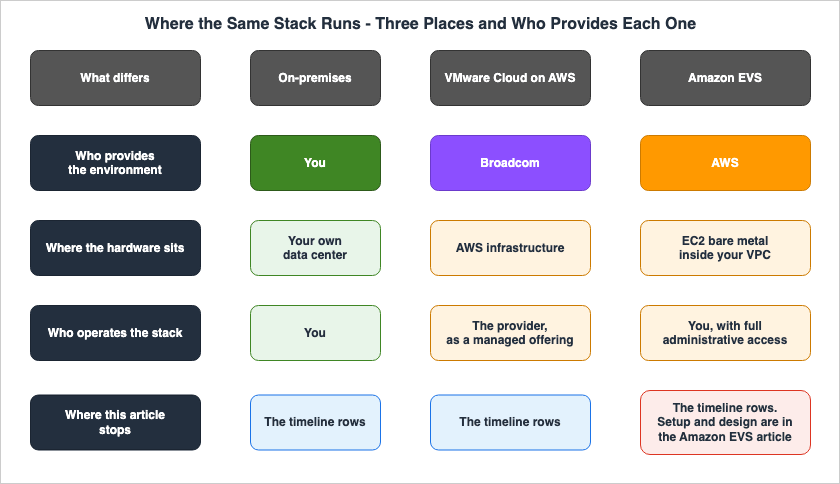
The Three Places the Same Stack Runs
The same lineage of stack runs in three places. ⚠ The terminology the primary sources use, however, varies by location.Laid out in the order the timeline gives them:
First is your own data center. The 2016 annual report describes Cloud Foundation as
a delivery independent platform that can be deployed on-premises or run as-a-service.Second is VMware Cloud on AWS. Announced in October 2016, it became available in the US West (Oregon) region in August 2017. ⚠ Contemporary AWS articles listed the included components individually as
vSphere Hypervisor (ESXi), Virtual SAN (vSAN), and the NSX network virtualization platform, and did not refer to it as VMware Cloud Foundation. ⚠ The sales channel changed mid-way through. Initially, the AWS article stated, This offering is sold, delivered, supported, and billed by VMware. However, the current AWS official page states, As of April 30, 2024, VMware Cloud on AWS is no longer resold by AWS or its channel partners. The service will continue to be available through Broadcom. The FAQ on the same page confirms that the service remains available to existing customers.Third is Amazon EVS. Announced at re:Invent in 2024, it entered public preview on June 9, 2025, and became generally available on August 5, 2025. The AWS announcement describes it as
allowing you to run VMware Cloud Foundation (VCF) directly within your Amazon Virtual Private Cloud (Amazon VPC).What Differs Is Who Provides It, Who Installs It, and Who Operates It
⛔⛔ Treating the second and third options as the same will lead to a misidentification of responsibility. Based on the available information from primary source documents, the breakdown is as follows:| Where | Who provides the environment | What the primary source says |
|---|---|---|
On-premises | You | The annual report from 2016 states, Cloud Foundation is a delivery independent platform that can be deployed on-premises or run as-a-service. ⇒ You supply the infrastructure and you operate it. |
VMware Cloud on AWS | Broadcom | AWS's official page states, The service will continue to be available through Broadcom. At the time of its launch in 2017, it stated, This offering is sold, delivered, supported, and billed by VMware. The same article calls it a native, fully-managed offering that runs the VMware SDDC stack directly on bare-metal AWS infrastructure. ⇒ Regardless of the timeframe, this is a third-party service provided on AWS's infrastructure, and not an AWS service itself. |
Amazon EVS | AWS | AWS's announcement states, allowing you to run VMware Cloud Foundation (VCF) directly within your Amazon Virtual Private Cloud (Amazon VPC) and also, with full administrative access to your environment. ⇒ The VCF environment sits inside your own VPC. |
⚠ For the third one, who installs VCF is something you choose. The choices available and how they differ are documented in Running VMware Workloads on AWS with Amazon EVS.
What This Article Does Not Write About Amazon EVS
⛔ This article only provides a timeline of events related to Amazon EVS. It does not cover the following:- Where the environment is located within your VPC.
- How address spaces are determined, and what cannot be changed after creation.
- The association of route tables and the prerequisites for route advertisement.
- What is required for name resolution and time synchronization.
- The scope of security group functionality.
- How to choose a VCF version and who should perform the installation.
- Procedures for migrating from existing environments.
⇒ All of this information can be found in Running VMware Workloads on AWS with Amazon EVS. The relationship between this article and that one is that of a timeline and a design guide. This article details when events occurred, while that article explains how to configure things now.
Frequently Asked Questions about VMware History
When was VMware founded, and what was its first product?
VMware was founded in 1998, and its first product was VMware Workstation 1.0, released in 1999. The company's annual report statesWe incorporated in Delaware in 1998, and its registration statement states We began shipping our first product in 1999, and today we offer 16 products. ⚠ Both primary sources give only the year. The first product was not for servers; it was an application that ran on a desktop.When did EMC acquire VMware?
On January 9, 2004, EMC acquired VMware. The section titledEMC's Acquisition of VMware in the registration statement reads, On January 9, 2004, EMC acquired all of our outstanding capital stock. ⚠ A revised version of the same document mentions January 8 in one place, but the way the financial data splits the periods agrees with January 9 in the main text. This article takes the date from the main text.Did the 2007 IPO make VMware an independent company?
No. The shares that were publicly offered were Class A common shares, while the Class B common shares remained held by the acquiring company. The 2016 annual report still states,one holder of record, EMC Corporation, of our Class B common stock. ⇒ Having publicly traded shares and having no controlling owner are two different things. VMware became an independent company on November 1, 2021.When did VMware become part of Dell Technologies?
On September 7, 2016. However, VMware itself was not acquired. According to the annual report,Effective September 7, 2016, Dell Technologies Inc. ("Dell") acquired EMC. As a result, EMC became a wholly-owned subsidiary of Dell and VMware became an indirectly-held, majority-owned subsidiary of Dell. ⇒ What was bought was the owner, and VMware moved into a position of being held indirectly.When did VMware become an independent company again?
It was November 1, 2021. The announcement stated thatDell Technologies (NYSE: DELL) has completed the spin-off of its 81% equity ownership of VMware Inc. ⚠ That stretch lasted a little over two years. A merger agreement for the next change in ownership was signed on May 26, 2022, and the transaction was completed on November 22, 2023.When did Broadcom complete its acquisition of VMware, and why does this timeline list two dates?
Broadcom completed its acquisition of VMware on November 22, 2023. The announcement stated thatVMware's common stock will now cease to be traded on the New York Stock Exchange (NYSE). The timeline lists two dates because the agreement was signed and the transaction was completed on separate dates. The agreement was signed on May 26, 2022, as recorded in the subsequent events note of the quarterly report. ⇒ Roughly a year and a half separates the two, so writing only one of them as the year of the acquisition shifts the timeline by a year.Why does the hypervisor go from ESX to ESXi and back to ESX?
The reason is the order in which the names appear in the official version list. In the list theESX names run through 4.1, ESXi runs from 5.0 through 8.0, and ESX returns from 9.0. ⚠ Neither boundary is abrupt. Versions 4.x have entries with both names, and the 2009 annual report also states, Users can choose to deploy the VMware ESX or VMware ESXi hypervisor when they purchase VMware vSphere. There are also rows in the later part of version 8.0 where the version column lists ESX 8.0.0g while the release name column lists ESXi 8.0g. ⛔ This article does not write why the name came back, because no official explanation could be found.Which came first, VMware Cloud on AWS or Amazon EVS?
VMware Cloud on AWS predates Amazon EVS by approximately eight years. The joint development was announced on October 13, 2016, and the service began availability in the US West (Oregon) region on August 28, 2017. Amazon EVS was announced at re:Invent in 2024 and became generally available on August 5, 2025. ⚠ These are two different offerings. VMware Cloud on AWS was described at launch assold, delivered, supported, and billed by VMware, and the AWS page now states, The service will continue to be available through Broadcom. Amazon EVS is an AWS service that allows you to run VMware Cloud Foundation (VCF) within your own VPC. Details on the differences in configuration and design can be found at Running VMware Workloads on AWS with Amazon EVS.Summary
The product lineage and the ownership lineage have evolved separately. The product line began in 1999 with a desktop product, followed by two server products in 2001. One side of the server products became a suite, and in 2016, it was described as a single stack. Over that stretch the owner of the company changed four times, counting the rows in the ownership table where the holder was replaced: 2004, 2016, 2021, and 2023. ⇒ Put into one table, the two lines look like a single line. This article divides the table precisely because of this.The changes in ownership have not always taken the same form. In 2004, it was an acquisition of outstanding shares. In 2016, the ownership of the owner changed. In 2021, it involved the separation of holdings. And in 2023, it was an acquisition based on a merger agreement. One of them is a change the company described in its own words as
indirectly-held. Rounding all of them off to the single word acquired loses the difference.Dates sometimes have multiple possibilities. There was approximately a year and a half between the signing of the merger agreement and the completion of the transaction. ⇒ Each row says which of the two it carries.
Names do not always progress in a single direction. The hypervisor name changed from
ESX to ESXi, and then reverted to ESX in version 9.0. The suite name changed from VMware Infrastructure to vSphere, and the stack name became VMware Cloud Foundation. ⚠ Unless you fix which name points to which layer, the same event shows up twice in the timeline.The number of places it runs has grown, and the party in charge differs by place. There is your own data center, there is what is provided through Broadcom, and there is the AWS service that runs it inside your own VPC. ⛔ The setup and design of the third one are not the subject of this article; they belong to Running VMware Workloads on AWS with Amazon EVS.
This article does not leave a blank where a source could not be reached. Rows that carry only a year say so, and where no official explanation could be found, as with the name coming back, it says that too. ⇒ Written that way, it stays clear which row to correct if a primary source turns up later.
This timeline will be updated as VMware continues to evolve.
Additional articles cover related topics.
References:
Tech Blog with curated related content
Written by Hidekazu Konishi