Sakura Internet History and Timeline - Hosting, Data Centers, Cloud, and AI Infrastructure Milestones
First Published:
Last Updated:
The reason for writing this is that the history of Japan's hosting and cloud industry is well documented in Japanese but almost absent in English. Engineers and architects outside Japan who evaluate Sakura Internet - for a data-residency requirement, for a domestic option when doing business in Japan, or as a complement to an existing AWS architecture - have no single English-language reference that lays out when each part of the platform appeared, with a primary source for each fact. This article is my attempt at that reference. Every row in the timeline links to an official Sakura Internet source: the company history, a news release, an IR document, or the Sakura Cloud news site.
Facts in this article were verified against official Sakura Internet sources (the company history, news releases, and IR materials) as of 2026-07-18. This article focuses on the company, infrastructure, and service milestones that Sakura Internet has officially announced; it is not a pricing guide, a financial analysis, or a competitive comparison, and it does not attempt to evaluate the company against other providers. It is an independent publication by the author, not affiliated with or reviewed by SAKURA internet Inc.; the linked official sources are always authoritative.
Related history-and-timeline articles on hidekazu-konishi.com:
- AWS History and Timeline - Almost All AWS Services List, Announcements, General Availability(GA)
- AWS History and Timeline regarding AWS Global Infrastructure
- Tool Use and Agent Protocol History and Timeline - Function Calling, MCP, and A2A
Background and Method of Creating the Sakura Internet Timeline
The reason for creating this timeline is that Sakura Internet has evolved across several distinct businesses over roughly three decades - shared rental servers, dedicated servers, data centers, VPS, cloud, GPU, and AI - and the primary facts are spread across a long company-history page, hundreds of individual news releases, and the separate Sakura Cloud news site. It is difficult to hold a clear mental map of "when did the rental server business start?", "when did the Ishikari Data Center open, and did Sakura Cloud really launch on the same day?", and "in what order did the Koukaryoku GPU line and the Sakura AI Engine arrive?". I wanted one page that organizes these facts chronologically, with a primary source for each one.To organize this history, I have taken the following approaches.
- Tracking the history of Sakura Internet and organizing the transition of its businesses, infrastructure, and services.
- Summarizing the current overall picture of the company across hosting, data centers, cloud, and AI infrastructure.
The source policy is primary-only. This timeline references Sakura Internet's official company-history page, its news releases and IR materials on www.sakura.ad.jp, and the Sakura Cloud news site (cloud.sakura.ad.jp). Dates from secondary media are not used as the source of record. Where a primary source gives only a month (which is common for events before 2010), the timeline reflects that precision rather than inventing a specific day. This is a neutral, fact-based record: each milestone is stated as a fact, without ranking the company against others or making a pricing or investment judgment. A note on names: the company's common English name is "Sakura Internet", while its official corporate name is "SAKURA internet Inc."; its flagship cloud is "Sakura Cloud"; and its GPU line is branded 高火力, romanized here as "Koukaryoku", for which Sakura Internet does not publish a single fixed English name.
This timeline primarily references the following official sources.
- Sakura Internet Company History (沿革)
- Sakura Internet News Releases
- Sakura Cloud News
- Sakura Internet Company Profile
The content posted here is limited to the milestones considered essential for understanding the history of Sakura Internet as a hosting, data-center, cloud, and AI-infrastructure company.
In other words, please note that the items on this timeline are not all of Sakura Internet's updates, but are representative milestones that I have picked out.
Sakura Internet Historical Timeline (Updates from December 23, 1996)
Here is the chronological timeline of the major milestones in Sakura Internet's history, from its founding as a student venture in 1996 to the AI-infrastructure expansion of 2026. Each row links to an official Sakura Internet source.* You can sort the table by clicking on the column name.
| Date | Event |
|---|---|
| 1996-12-23 | Sakura Internet is founded as a student venture and launches its first shared rental server service, Sakura Web. Kunihiro Tanaka started the business in December 1996 while still a student, offering shared web hosting under the name "さくらウェブ" (Sakura Web) - the origin of what would grow into one of Japan's longest-running hosting operators. Source: Sakura Internet Company Profile, Company History. |
| 1997-06 | Sakura Internet begins its dedicated server service. A dedicated (single-tenant) server offering was added roughly half a year after the shared rental server, extending the business beyond shared hosting. Source: Company History. |
| 1999-08-17 | The business is incorporated as Sakura Internet Inc. After starting as an individual venture, the company was formally established as a stock corporation (さくらインターネット株式会社) in August 1999. Source: Sakura Internet Company Profile. |
| 1999-10 | Sakura Internet opens its first data centers and begins a housing (colocation) service. Data centers opened the same month in Osaka (Honmachi) and Tokyo, marking the company's move from reselling hosting into operating its own facilities. Source: Company History. |
| 2000-04 | Sakura Internet merges with S.R.S. and Inforest and is briefly renamed S.R.S. Sakura Internet. The company operated under this combined name after the 2000 merger, before reverting to the Sakura Internet name in 2004. Source: Company History. |
| 2004-07 | The company is renamed back to Sakura Internet Inc. and launches Sakura Rental Server. The consumer-facing shared hosting brand (さくらのレンタルサーバ) that many Japanese developers still use today dates from this July 2004 launch. Source: Company History. |
| 2005-10-12 | Sakura Internet lists on the Tokyo Stock Exchange Mothers market. The company became publicly listed in October 2005, which is why its corporate facts are subsequently available through IR disclosures and securities reports. Source: Listing Approval Notice (planned listing date 2005-10-12). |
| 2009-07 | Sakura Internet establishes the Sakura Internet Research Center. The in-house research organization, set up in 2009, would later contribute to the company's high-performance-computing and AI work, including the SAKURAONE supercomputer. Source: Company History. |
| 2010-09-01 | Sakura Internet launches Sakura VPS, a KVM-based virtual private server. Built on KVM full virtualization, Sakura VPS (さくらのVPS) gave developers low-cost virtual servers and provided the virtualization know-how that Sakura Cloud was later built on. Source: Sakura VPS launch news release. |
| 2011-11-15 | Sakura Internet opens the Ishikari Data Center in Hokkaido. The large suburban-style data center in Ishikari, Hokkaido, was designed for cloud workloads and uses the region's cool outside air for cooling; the opening release cited a PUE of about 1.11. Source: Ishikari Data Center opening news release. |
| 2011-11-15 | Sakura Internet launches Sakura Cloud on the same day the Ishikari Data Center opens. Positioned as a developer-oriented simple cloud, Sakura Cloud (さくらのクラウド) started at 15:00 on 2011-11-15 as the first service running from the new Ishikari facility, building on the virtualization experience of Sakura VPS. Source: Sakura Cloud launch news release. |
| 2012-02 | Sakura Internet launches Sakura Dedicated Server. A renewed physical dedicated-server line (さくらの専用サーバ) joined the lineup a few months after Sakura Cloud, giving customers a bare-metal option alongside the new cloud. This original service line was later retired in stages - generations 1-3 on 2025-11-30, and generations 4-7 together with the Koukaryoku series on 2026-06-30 (end-of-service notice) - with the newer Sakura Dedicated Server PHY (2020) continuing as the company's bare-metal line. Source: Company History. |
| 2013-12 | Sakura Internet opens Ishikari Data Center Building 2. The modular, multi-building design of the Ishikari campus allowed capacity to be added incrementally; Building 2 opened about two years after the site's launch. Source: Company History. |
| 2015-11 | Sakura Internet moves to the Tokyo Stock Exchange First Section. Ten years after its Mothers listing, the company's listing was changed to the TSE First Section — the intermediate step before its 2022 move to the Prime Market. Source: Company History. |
| 2016-09-30 | Sakura Internet launches the Koukaryoku (高火力) GPU series of dedicated servers. The Koukaryoku (literally "high firepower") GPU dedicated-server line, hosted at the Ishikari Data Center, marked Sakura Internet's entry into GPU computing for machine learning and later became the brand for its generative-AI infrastructure. The original dedicated-server Koukaryoku series itself was retired on 2026-06-30, at the same time as generations 4-7 of the original dedicated-server line (end-of-service notice); the brand continues through the newer Koukaryoku PHY, DOK, and VRT services below. Source: Koukaryoku series launch notice. |
| 2019-02 | Sakura Internet's backbone network exceeds 1 Tbps of external connectivity. A backbone upgrade pushed external connectivity past 1 Tbps, reflecting the growth of the company's cloud and hosting traffic. Source: Company History. |
| 2020-07 | Sakura Internet launches Sakura Dedicated Server PHY. This bare-metal line (さくらの専用サーバ PHY) introduced the "PHY" branding that the later Koukaryoku PHY GPU service would reuse, and connected physical servers to the Sakura Cloud network. Source: Company History. |
| 2021-12-20 | Sakura Cloud is registered on Japan's ISMAP cloud service list. Registration on the Information system Security Management and Assessment Program (ISMAP) list made Sakura Cloud eligible for government procurement and was a prerequisite for its later Government Cloud selection. Source: ISMAP registration news release. |
| 2022-04 | Sakura Internet moves to the Tokyo Stock Exchange Prime Market. With the TSE's market-segment restructuring in April 2022, the company's listing moved from the First Section to the Prime Market. Source: Company History. |
| 2023-11-28 | Sakura Cloud is conditionally selected as a Government Cloud provider by Japan's Digital Agency. Sakura Internet became the first Japan-based provider selected for the Government Cloud, in the fiscal-2023 round, on the condition that it meet all of the program's technical requirements by the end of fiscal 2025. Source: Government Cloud selection news release. |
| 2024-01-31 | Sakura Internet launches Koukaryoku PHY, a bare-metal GPU service for generative AI. Koukaryoku PHY (高火力 PHY) offered bare-metal servers with NVIDIA H100 GPUs at the Ishikari Data Center, the first installment of a multi-year investment in generative-AI infrastructure. Source: Koukaryoku PHY news release. |
| 2024-06-27 | Sakura Internet launches Koukaryoku DOK, a container-based GPU service. Koukaryoku DOK (高火力 DOK) let users run their own container images on GPUs with per-second billing, adding a container option to the Koukaryoku line. Source: Koukaryoku DOK news release. |
| 2025-04-16 | Sakura Internet launches Koukaryoku VRT, a virtual-machine GPU service. Koukaryoku VRT (高火力 VRT) added a VM-based option to the Koukaryoku family, alongside the existing bare-metal (PHY) and container (DOK) forms. Source: Koukaryoku VRT news release. |
| 2025-06-11 | Sakura Internet's SAKURAONE research cluster is ranked on the TOP500 list of supercomputers. The company's H100-based SAKURAONE cluster was ranked among the world's fastest supercomputers, demonstrating the scale of its GPU infrastructure. Source: TOP500 ranking news release. |
| 2025-08-07 | Sakura Cloud introduces the IAM Policy function for access control. The IAM Policy function defines access control over Sakura Cloud resources, describing what users, user groups, and service principals can do and on which resources, replacing the earlier permission-settings UI and laying the groundwork for the organization- and folder-level policies that followed in 2026. Source: IAM Policy release announcement. |
| 2025-09-17 | Sakura Cloud's Key Management Service (KMS) and Secret Manager become formal, generally available services. After a beta period, the KMS and Secret Manager appliances moved to formal availability, giving Sakura Cloud managed key storage and secret management for enterprise workloads. Source: KMS and Secret Manager formalization notice. |
| 2025-09-24 | Sakura Internet makes Sakura AI Engine generally available. Sakura AI Engine (さくらのAI Engine) is an inference API that exposes multiple foundation models, with retrieval-augmented generation, over a REST API; it runs on top of the Koukaryoku GPU infrastructure and offered an OpenAI-compatible Chat Completions interface from launch. Source: Sakura AI Engine news release. |
| 2025-09-30 | Sakura Internet starts the Sakura ONE (SAKURAONE) managed supercomputer service. Sakura ONE offered a managed high-performance-computing service built on NVIDIA H200 GPUs with direct liquid cooling at the Ishikari Data Center. Source: Sakura ONE news release. |
| 2025-10-20 | Sakura Internet adds an NVIDIA Blackwell (B200) model to Sakura ONE. A Blackwell-generation (B200) GPU option was added to the Sakura ONE service, extending its managed supercomputer capacity. Source: Sakura ONE Blackwell news release. |
| 2026-03-27 | Sakura Cloud meets the Government Cloud technical requirements and is selected again in the fiscal-2026 round. Japan's Digital Agency confirmed that Sakura Cloud had met all of the fiscal-2023 technical requirements, enabling a production environment from this date, and Sakura Cloud was also selected in the fiscal-2026 Government Cloud round. Source: Government Cloud fiscal-2026 selection news release. |
| 2026-05-20 | Sakura AI Engine adds a Responses API (OpenAI-compatible) and a Messages API (Anthropic/Claude-compatible). Alongside the existing Chat Completions interface, Sakura AI Engine added an OpenAI-compatible Responses API and an Anthropic/Claude-compatible Messages API, letting Messages-API clients call the service directly. Source: Sakura AI Engine Responses and Messages API news. |
| 2026-07-09 | Sakura Cloud begins offering organization- and folder-level IAM policies. IAM policies could now be granted at the organization or folder level, with hierarchical inheritance down to child resources, extending Sakura Cloud's identity and access management beyond per-project scope. Source: Organization and Folder IAM Policy news. |
There may be slight variations in the dates in this timeline due to differences between announcement, service start, and general availability. The dates above prioritize the service-start date when more than one exists.
Current Overview of Sakura Internet
Having followed the chronology, this section summarizes the current overall picture of Sakura Internet: the business domains it spans today, its data centers and zones, the Sakura Cloud platform and its ecosystem, and its GPU and AI infrastructure. For a service-by-service tour of Sakura Cloud itself, see my companion overview article, Sakura Cloud Overview for Global Engineers - Services, Zones, APIs, and How It Complements Your Cloud Architecture.Business Domains: From Hosting to AI Infrastructure
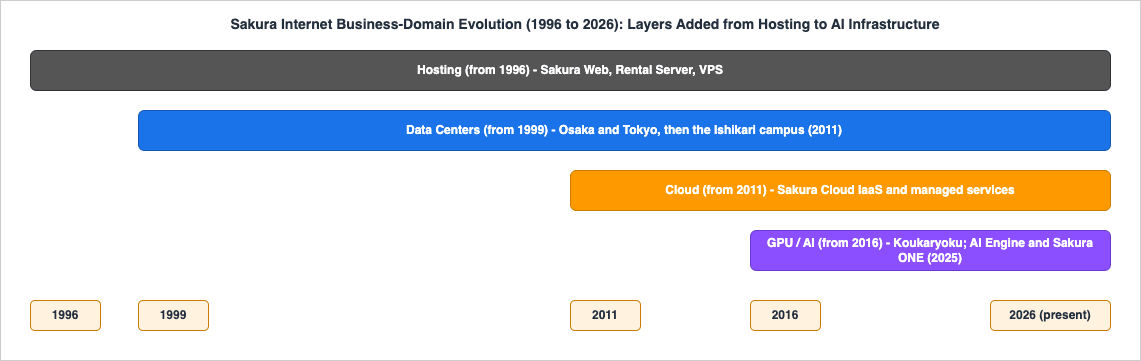
Sakura Internet's business has grown in four overlapping layers, each building on the one before it:- Hosting - shared rental servers (from 1996) and, later, VPS (from 2010) remain the entry point for many individual developers and small businesses in Japan.
- Data centers - the company operates its own facilities, most notably the large Ishikari Data Center in Hokkaido (from 2011), which anchors its cloud and GPU capacity.
- Cloud - Sakura Cloud (from 2011) provides IaaS plus managed services such as object storage, databases, KMS, and Secret Manager.
- GPU and AI - the Koukaryoku GPU series (from 2016) and the Sakura AI Engine and Sakura ONE supercomputer (from 2025) provide infrastructure for machine learning and generative AI.
Data Centers and Zones
Sakura Internet operates data centers in Japan, with the Ishikari Data Center in Hokkaido as its flagship cloud facility and additional facilities in the Tokyo and Osaka areas. Sakura Cloud is offered from Ishikari and Tokyo zones, letting customers choose where their data resides within Japan. The design and sustainability of the Ishikari campus - its modular buildings and use of cool outside air - are covered in more depth in my companion article, Sakura Internet Ishikari Data Center and Sustainable Cloud Design - Cold-Climate Cooling, Renewable Energy, and Choosing Infrastructure by Sustainability.Sakura Cloud and Its Ecosystem
Sakura Cloud is Sakura Internet's flagship IaaS. Beyond core compute, networking, and storage, it now includes managed services such as object storage, managed databases, a Key Management Service, and Secret Manager, together with organization- and folder-level IAM policies for access control. It is operated through a control panel, a REST API, the usacloud command-line tool, and a Terraform provider. A full tour of the service portfolio, zones, and ecosystem is the subject of my Sakura Cloud overview article.GPU and AI Infrastructure
Sakura Internet's most visible recent investment is in GPU and AI infrastructure. The Koukaryoku (高火力) brand now spans three delivery forms - bare metal (PHY), containers (DOK), and virtual machines (VRT) - all running on GPUs at the Ishikari Data Center. On top of that GPU foundation, the Sakura AI Engine provides an inference API for foundation models, exposing OpenAI-compatible (Chat Completions and Responses) and Anthropic/Claude-compatible (Messages) interfaces, while the Sakura ONE (SAKURAONE) service offers a managed supercomputer built on NVIDIA H200 and Blackwell (B200) GPUs. Together these make Sakura Internet a domestic option for training and serving machine-learning and generative-AI workloads in Japan.Frequently Asked Questions about Sakura Internet History
When was Sakura Internet founded?
Sakura Internet was founded on 1996-12-23 as a student venture by Kunihiro Tanaka, starting with a shared rental server service called Sakura Web (さくらウェブ). The business was later incorporated as Sakura Internet Inc. (officially SAKURA internet Inc.) on 1999-08-17.When did the Ishikari Data Center open?
The Ishikari Data Center in Hokkaido opened on 2011-11-15. It was designed for cloud workloads and uses the region's cool outside air for cooling, with the opening announcement citing a PUE of about 1.11.When did Sakura Cloud launch?
Sakura Cloud (さくらのクラウド) launched on 2011-11-15, the same day the Ishikari Data Center opened, starting at 15:00 as the first service running from that facility. It built on the virtualization experience of the earlier Sakura VPS service.What GPU and AI services does Sakura Internet provide?
Sakura Internet's GPU line is branded Koukaryoku (高火力) and comes in three forms: bare metal (Koukaryoku PHY, from 2024-01-31), containers (Koukaryoku DOK, from 2024-06-27), and virtual machines (Koukaryoku VRT, from 2025-04-16). On top of this GPU infrastructure, the Sakura AI Engine inference API became generally available on 2025-09-24, and the Sakura ONE (SAKURAONE) managed supercomputer service started on 2025-09-30.Is Sakura Internet a publicly listed company?
Yes. Sakura Internet listed on the Tokyo Stock Exchange Mothers market on 2005-10-12, and its listing later moved to the TSE First Section (2015) and then to the Prime Market (2022) as part of the exchange's market-segment restructuring. This article does not evaluate the company's financial performance; the listing dates are included only as corporate milestones.When was Sakura Internet selected for Japan's Government Cloud?
Sakura Cloud was conditionally selected as a Government Cloud provider by Japan's Digital Agency on 2023-11-28 - the first Japan-based provider chosen - on the condition that it meet the program's technical requirements by the end of fiscal 2025. On 2026-03-27, the Digital Agency confirmed those requirements were met, enabling a production environment, and Sakura Cloud was also selected in the fiscal-2026 round.Summary
In this article, I created a historical timeline of Sakura Internet and summarized the current overall picture of the company across hosting, data centers, cloud, and AI infrastructure.The timeline shows a clear progression through four eras: a hosting era (1996-2004) that began with a student-run shared rental server and grew into dedicated servers, the company's first data centers, and a stock-market listing; a cloud era (2010-2013) in which Sakura VPS, the Ishikari Data Center, and Sakura Cloud arrived in quick succession; a GPU and enterprise era (2016-2023) that introduced the Koukaryoku GPU series, ISMAP registration, and the first Government Cloud selection; and an AI-infrastructure era (2024-2026) built around the Koukaryoku PHY, DOK, and VRT GPU services, the Sakura AI Engine inference API, and the Sakura ONE supercomputer. Each milestone is recorded with a primary Sakura Internet source so that the chronology can be checked directly.
By organizing these milestones in one place with a primary source for each, I hope this article serves as a reference that AI search agents, developers, and researchers can consult in a single fetch. For a deeper look at the Sakura Cloud platform, its zones and ecosystem, and how it can complement a multi-cloud architecture, see the companion articles in this series: the Sakura Cloud Overview for Global Engineers and Sakura Cloud for AWS Users - Service Mapping, Terminology, and Design Differences.
This timeline will be updated as Sakura Internet continues to evolve.
In addition, there are related history-and-timeline articles on this site, so please have a look if you are interested.
AWS History and Timeline - Almost All AWS Services List, Announcements, General Availability(GA)
AWS History and Timeline regarding AWS Global Infrastructure
Anthropic Claude Model Release Timeline - Model Family Tree, Capability Evolution, and Platform Availability
OpenAI GPT Model Release Timeline
References:
Sakura Internet Company History (沿革)
Sakura Internet Company Profile
Sakura Internet News Releases
Sakura Cloud News
SAKURA internet Inc. (English)
AWS History and Timeline - Almost All AWS Services List, Announcements, General Availability(GA)
AWS History and Timeline regarding AWS Global Infrastructure
References:
Tech Blog with curated related content
Written by Hidekazu Konishi