Sakura Internet Ishikari Data Center and Sustainable Cloud Design - Cold-Climate Cooling, Renewable Energy, and Choosing Infrastructure by Sustainability
First Published:
Last Updated:
This article looks at that question through one concrete example: Sakura Internet's Ishikari Data Center in Hokkaido, Japan — a cold-climate facility built around outside-air cooling and, since 2023, operated on renewable electricity. It is part of a series that introduces Sakura Cloud to a global audience (see the Sakura Cloud Overview for Global Engineers), and it is written as a design-thinking read rather than a how-to. The goal is not to argue that one operator is "greener" than another, but to give you a vendor-neutral mental model for reasoning about location, cooling, and energy — and then to ground that model in what one operator has actually published. Along the way, it keeps two ideas separate that are easy to conflate: how efficiently a facility uses energy (its overhead), and how clean that energy is (its carbon).
1. Introduction
Service and facility facts in this article were verified against official Sakura Internet documentation and public primary sources as of 2026-07-18. Because infrastructure evolves — buildings are added, power contracts change, and zones open — treat the dated statements below as point-in-time references and follow the linked official pages for the current picture. (See the First Published and Last Updated dates at the top of this page.) This article is an independent publication by the author, not affiliated with or reviewed by SAKURA internet Inc.; the linked official sources are always authoritative.This article is for:
- Engineers and architects who want to factor sustainability — cooling efficiency, grid carbon intensity, water use — into where they place workloads.
- Readers interested in the design philosophy of cold-climate data centers, and in how free cooling actually works.
- Teams evaluating Japanese infrastructure options and looking for a citable, source-anchored account of the Ishikari Data Center.
What this article deliberately does not do: it does not quote prices or cost figures, it does not publish estimated efficiency numbers of its own, and it does not rank operators against each other. Where a figure appears, it is an officially published value with the date it was published; where an official value could not be confirmed from a primary source, the article says so plainly rather than filling the gap with a secondhand number.
The structure is: a vendor-neutral look at why location matters (Section 2) and how cold-climate free cooling works (Section 3); the Ishikari Data Center as a worked example of those ideas (Section 4) and its renewable-energy and efficiency milestones (Section 5); a practical framework for choosing infrastructure by sustainability (Section 6); and a short FAQ, summary, and references (Sections 7–9).
2. Why Data Center Location Shapes Sustainability
A data center runs every hour of every day, and most of its non-computing energy goes into one job: removing the heat that servers produce. That single fact makes location one of the highest-leverage sustainability decisions in the whole stack, because three location-dependent variables dominate the environmental math.- Climate (outdoor temperature and humidity) — The cooler and drier the outside air for more of the year, the more hours a facility can cool its servers with fresh or ambient-cooled air instead of running power-hungry compressors. Cooling is where a large share of a data center's overhead energy is spent, so climate directly shapes efficiency.
- Grid carbon intensity (the local power mix) — Two identical data centers drawing the same kilowatt-hours can have very different carbon footprints if one sits on a grid dominated by hydro, wind, and solar and the other on a grid dominated by coal and gas. Location determines which electricity is physically available and how clean it is.
- Water and land — Some cooling designs trade electricity for water (evaporative cooling), so a site's water availability matters; and land, seismic safety, and proximity to renewable generation all feed into how sustainably a facility can be built and expanded.
The industry has standardized ways to talk about these effects. The most widely used is Power Usage Effectiveness (PUE), developed by The Green Grid in 2007 and later standardized internationally as ISO/IEC 30134-2. PUE is defined as:
PUE = Total Facility Energy / IT Equipment EnergyA PUE of 1.0 would mean every watt entering the facility reaches the servers themselves, with nothing spent on cooling, power conversion, or lighting. Real facilities are always above 1.0; the lower the number, the smaller the overhead. It is worth being precise about what PUE is and is not: it is a ratio of energy, not a measure of how clean that energy is, and — per the standard — it carries no built-in target or pass/fail threshold. For a sense of scale, the Uptime Institute's annual global surveys have put the industry-average PUE at roughly 1.56 in recent years, a figure that has been broadly flat since around 2020.
PUE is only the entry point. The same ISO/IEC 30134 family defines companion metrics that capture the location effects above — for example Carbon Usage Effectiveness (CUE) for emissions per unit of IT energy, Water Usage Effectiveness (WUE) for water per unit of IT energy, and a Renewable Energy Factor (REF) for the share of renewable energy consumed. WUE in particular, defined by The Green Grid in 2011, swings widely with a site's climate, which is exactly why location and design cannot be separated.
Two of these levers deserve emphasis because they are independent. A facility can post an excellent PUE and still emit heavily if it draws on a fossil-heavy grid, because PUE measures overhead, not cleanliness; the emissions side is captured instead by CUE, which folds in the grid's carbon intensity. Location also shapes resilience — seismic exposure, flood risk, and water availability — and a facility that avoids rebuilds after natural hazards is, over its lifetime, more resource-efficient. Sustainability, in other words, is not a single score but a small set of location-driven trade-offs.
Why does any of this matter more now than it did a decade ago? Because the demand side is growing fast. The International Energy Agency's 2025 report Energy and AI estimated global data-center electricity consumption at about 415 TWh in 2024 — roughly 1.5% of world electricity — and projected it to roughly double to about 945 TWh by 2030, driven heavily by AI workloads. When the base is growing that quickly, the efficiency and cleanliness of each new facility compounds — a facility that is both efficient and renewably powered keeps far more of that growth off the world's carbon ledger than one that is neither. That is the practical stake behind the design choices this article examines.
3. How Cold-Climate Free Cooling Works
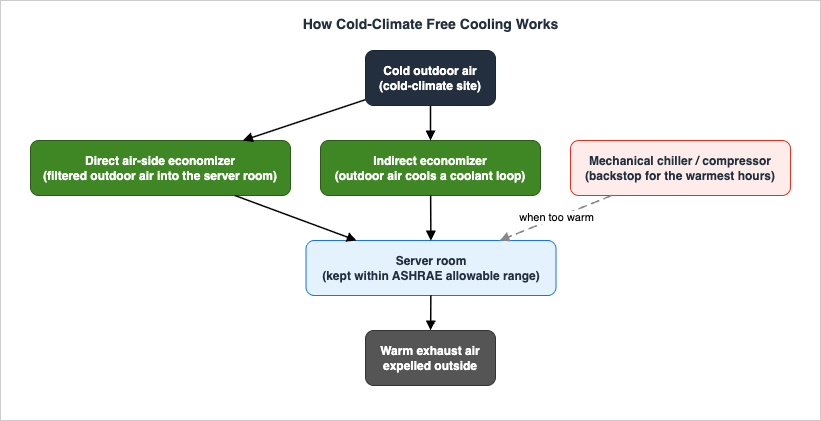
The single most important efficiency idea for a cold-climate data center is free cooling — using outdoor air, directly or indirectly, to remove server heat so that mechanical refrigeration (compressors and chillers) runs as little as possible. In the industry's vocabulary, the equipment that does this is an economizer.The ENERGY STAR program (a joint U.S. EPA/DOE effort) describes an air-side economizer plainly: it "brings cool air from outdoors into a building and distributes it to the servers," and instead of recirculating and re-chilling the servers' hot exhaust, that exhaust is simply directed back outside. When the outdoor air is cool enough, the compressors can be idled or run at reduced load — which is why free cooling is sometimes called "compressor-free" cooling.
There is also a water-side (or indirect) economizer, in which the outdoor air (or an outdoor cooling tower) chills a circulating liquid — water or a refrigerant — and that liquid, not the raw outdoor air, is what cools the server room. Indirect designs keep outdoor dust and humidity out of the white space at the cost of one extra heat-exchange step.
The choice between the two is itself a design trade-off: a direct system is simpler and can reach a lower cooling overhead, while an indirect system adds a heat-exchange step but isolates the white space from outdoor humidity and airborne particulates. Either way, the more hours a site can lean on the economizer, the lower the practical floor for its cooling energy — which is a large part of why cold-climate facilities tend to report low PUE figures.
Cold-climate siting matters because free cooling is bounded by outdoor conditions. Servers have a safe operating envelope, and the reference for it is ASHRAE's Thermal Guidelines for Data Processing Environments. ASHRAE defines a recommended range of roughly 18–27°C (64.4–80.6°F) for reliability and efficiency, and wider allowable ranges by equipment class — for example about 15–32°C for Class A1 and 10–35°C for Class A2, with Classes A3 and A4 wider still. Those allowable envelopes were deliberately widened over successive editions precisely so that operators could run on outdoor air across more locations and more hours of the year.
The colder the site, the more hours the outdoor temperature falls inside that envelope, and the fewer hours the compressors must run. U.S. Department of Energy guidance — for example the Federal Energy Management Program's analyses of economizer strategies — quantifies this with weather data: a warm, humid location may only be able to use air-side economization for part of the year, while a cool climate can use it for most of it. That is the entire thermodynamic argument for building in the cold: not that cold air is magic, but that cold air is available for more of the time, and every hour on free cooling is an hour the largest mechanical load is switched off.
The figure below shows the concept at a glance — the outdoor air path, the two economizer styles, the server room held within the ASHRAE envelope, and the mechanical chiller relegated to a backstop for the warmest hours.
Two honest caveats belong here, because a cold climate is a strong advantage but not a blank check. First, running near the top of the allowable envelope can raise server-fan power and long-term reliability risk, so operators tune for a balance, not for the extreme. Second, cooling is only half of sustainability; a spotless PUE on a coal-heavy grid still emits heavily. Free cooling lowers the overhead; the cleanliness of the electricity is a separate lever, which is where the next two sections turn.
4. Inside the Ishikari Data Center
Sakura Internet's Ishikari Data Center, in Ishikari City, Hokkaido, is a useful worked example because the operator has published the design reasoning behind it. The facility opened on 2011-11-15 as, in the company's own description, a large suburban-style data center optimized for cloud computing, on a site of 51,448 m² (which the company likens to about 1.1 times the area of the Tokyo Dome). The stated reasons for the location read like a checklist of the variables in Section 2: Hokkaido's cool outdoor air for energy-efficient cooling, and a large flat site that allows the campus to scale.The site selection went beyond the cool air, too. The company describes choosing broad, flat land near the ridgeline of Mt. Teine, in an area with no active fault directly beneath it and therefore less exposed to major earthquakes, and on ground high enough — above 5.5 m — to sit above the local maximum tsunami reach of about 4.7 m. Resilient siting is easy to overlook in a sustainability discussion, but a facility that rides out natural hazards without being rebuilt is, over its lifetime, a more resource-efficient one.
Free cooling as the core design. The first and second buildings use a direct outside-air cooling method, drawing Hokkaido's cool outdoor air into the server rooms. The third building, announced in 2015, uses an indirect outside-air cooling method, in which outdoor air chills a circulating refrigerant that in turn cools the server room — a design the company notes reduces indoor humidity swings and the running cost of humidity control. Sakura Internet states that Hokkaido's climate allows outside-air cooling to be used for nearly the whole year, and that this cuts air-conditioning power by roughly 40% compared with a conventional urban data center.
Reading the published PUE. On the metric from Section 2, the company published a PUE for the facility at its 2011 opening: 1.11 with outside-air cooling alone, and 1.21 in summer when conventional air-conditioning is used — figures it has restated in later official material, alongside the general observation that urban data centers typically run in the 1.5–2.0 range. It is important to read these correctly: they are officially published design and announcement values tied to the 2011 opening, not a live, independently measured annual average. Sakura Internet does not publish a current measured annual-average PUE that this article could cite, so it is reported here strictly as an as-published value with its date.
Efficiency beyond cooling. Cooling is the headline, but the facility's efficiency story extends into how it delivers power. Sakura Internet adopted a high-voltage direct-current (HVDC) power-supply system — put into commercial operation in the data center's server rooms on 2013-03-12, following a container-based field trial that ran from November 2011 — arguing that a DC distribution path avoids the conversion losses of conventional AC and can reduce power consumption by up to roughly 20%; the field trial measured an overall efficiency of about 91%. The same 2013 work introduced fuel cells into the HVDC field-trial environment as a quieter, more compact alternative to conventional backup power.
A modular, staged build-out. Rather than erect one monolithic building, Ishikari was designed as a modular, multi-building campus so capacity could follow demand. The second building opened in December 2013 and the third in December 2016; the third was designed for a substantially higher rack density than the earlier buildings. The published expansion plans have themselves changed over time — the 2011 announcement described an eventual multi-building target that was later revised — so this article does not assert a single current rack or building total, and defers to Sakura Internet's official data center pages for the up-to-date figures. The most recent addition is a different shape entirely: an on-site container-type data center, which began operating on 2025-06-11 to house GPU infrastructure using direct liquid cooling. That last detail hints at where cooling is heading: dense GPU racks for AI generate far more heat per rack than traditional servers, and liquid cooling — bringing coolant directly to the chips — is increasingly used alongside air-based free cooling. A cold-climate site helps here too, because the liquid loop can ultimately reject its heat to cool outdoor air.
Where this meets Sakura Cloud. For readers coming from the cloud side, the Ishikari campus is the physical home of Sakura Cloud's Ishikari region. Its zones are identified as
is1a (Ishikari 1st zone), is1b (Ishikari 2nd zone), and is1c (Ishikari 3rd zone), the last of which opened on 2025-09-25; the Tokyo region uses tk1a and tk1b. When you pick a zone in the Sakura Cloud console or API, this is the building — and the cooling and power design described above — that your instances actually run in. (For the full service and zone picture, see the Sakura Cloud overview; for the company timeline, see the Sakura Internet history and timeline.)5. Renewable Energy and Efficiency Initiatives at Ishikari
If Section 4 is about lowering the overhead of running the facility, this section is about cleaning up the electricity that flows through it — the second lever from Section 3. Sakura Internet's public record here is a staged progression rather than a single announcement, which makes it a good illustration of how a facility's carbon story is built up over years.- 2015 — On-site solar. In August 2015 the company began supplying power from the newly built Sakura Internet Ishikari Solar Power Plant (about 200 kW, roughly 5,004 m² of panels) directly to the data center. Notably, the solar output is fed as direct current into the facility's HVDC servers and consumed on site rather than sold back to the grid — a design that dovetails with the DC power path from Section 4.
- 2021 — A cleaner grid contract. In June 2021 Sakura Internet switched the data center's electricity procurement to a supplier centered on LNG/gas-fired generation, which it reported cut the facility's annual CO2 emissions by about 24% (on the order of 4,800 tonnes per year).
- 2022 — Substantially net-zero via certificates. On 2022-06-01 the company moved to electricity backed by non-fossil energy certificates, reporting the data center's annual CO2 emissions as substantially zero, an annual reduction on the order of 12,861 tonnes.
- 2023 — 100% renewable electricity. In June 2023 (announced on 2023-06-14) Sakura Internet switched the Ishikari Data Center to electricity from 100% renewable sources, centered on hydropower, and reported the facility's annual CO2 emissions as zero — moving from an offset-and-certificate approach toward physically renewable supply.
Around the same period the company also endorsed the recommendations of the Task Force on Climate-related Financial Disclosures (TCFD) in 2021 and participated in the TCFD Consortium, and in September 2021 it signed a comprehensive partnership with Ishikari City covering digital transformation and decarbonization-driven regional development. In its English-language communications, the company summarizes the combined approach in one line: it has "reduced CO2 emissions by using renewable energy, and reduced power consumption by using outside air for server cooling."
The staged progression is itself instructive for buyers, because non-fossil certificates and physically renewable supply are not the same thing: certificates offset emissions on paper, while a shift to renewable-sourced electricity changes the physical supply. Sakura Internet's move from certificates in 2022 to 100% renewable supply centered on hydropower in 2023 is exactly this kind of upgrade — and the distinction is worth checking whenever you read any operator's carbon claims.
A note on precision, in keeping with this article's rules: several figures that circulate for Ishikari — a lower "annual-average" PUE, a specific renewable-share percentage for the company as a whole, and various emission-reduction percentages — could not be confirmed from Sakura Internet's own primary publications and are therefore not stated here as facts. What is firmly on the public record is the direction of travel: outside-air cooling to minimize cooling energy, an HVDC path to minimize conversion losses, on-site solar, and a multi-year shift of the grid contract to renewable electricity culminating in the 2023 switch.
6. Choosing Infrastructure by Sustainability
Step back from the single example, and the Ishikari case suggests a repeatable way to reason about any region or operator on sustainability grounds. The aim here is a decision framework, not a recommendation of a particular vendor — the right answer depends on your workload, your data-residency requirements, and your own reporting obligations.1. Start with the climate of the site. A cool-climate location can spend far more of the year on free cooling, which lowers the cooling overhead captured by PUE. Ask where a region's data centers physically sit and what that implies for economization. Remember Section 3's caveat, though: climate lowers overhead, it does not by itself make the electricity clean.
2. Then look at the electricity. The grid mix, and any operator-specific renewable procurement, determine the carbon per kilowatt-hour. An operator that has moved a facility to renewable supply — as Sakura Internet reports for Ishikari from 2023 — changes the carbon math independently of PUE. Where possible, look for a Renewable Energy Factor or an explicit statement of the facility's supply, and prefer physically renewable or certificate-backed supply that the operator documents.
3. Read the published indicators carefully. Treat PUE, CUE, and WUE as a small dashboard rather than a single score. Note what each number is and is not: whether it is a design or announcement value or a measured annual average; whether it covers one building or a whole campus; and whether the operator publishes it under a recognized standard such as ISO/IEC 30134. A number without a date, a boundary, and a method is a marketing figure, not an engineering one. For example, a low PUE tells you about cooling overhead but nothing about emissions; pair it with CUE to see the carbon picture, and with WUE if the design trades electricity for water.
4. Weigh sustainability against your other constraints. Sustainability sits alongside latency, data residency, resilience, and the rest of your requirements — it rarely overrides them, and it should not have to. A cold-climate, renewable-powered region is an attractive option to add to an architecture, especially for workloads with a Japanese data-residency requirement or a home in the Asia-Pacific footprint; it complements, rather than replaces, the hyperscale regions you may already use. For teams running on providers such as AWS, this is a "one more well-characterized option" decision, not an "either/or."
5. Expect the facts to move. Power contracts, PUE, zone availability, and even building counts change. Anchor your evaluation to primary sources and revisit them; a sustainability claim that was true at a facility's opening may understate — or overstate — where it stands today.
Used together, these five checks turn "is this green?" into a set of answerable, source-anchored questions: how cool is the site, how clean is the power, how are the indicators measured, how does it fit the rest of the architecture, and how current is the information.
7. Frequently Asked Questions
When did the Ishikari Data Center open, and where is it?
It opened on 2011-11-15 in Ishikari City, Hokkaido, Japan, on a site of 51,448 m². It has since expanded with additional buildings (the second in December 2013, the third in December 2016) and, in 2025, an on-site container-type data center for GPU infrastructure.What is "free cooling" or an "air-side economizer"?
Free cooling uses outdoor air — directly, or indirectly via a chilled liquid — to remove server heat, so that mechanical compressors and chillers run as little as possible. An air-side economizer brings cool outdoor air to the servers and expels the hot exhaust outside instead of re-chilling it. Cold-climate locations can use free cooling for more hours of the year, which lowers cooling energy.What PUE has Sakura Internet published for Ishikari?
At the facility's 2011 opening, Sakura Internet published a PUE of 1.11 with outside-air cooling alone and 1.21 when summer conventional air-conditioning is used, restated in later official material. These are as-published values tied to the opening, not a live, independently measured annual average; the company does not publish a current measured annual-average PUE that this article could cite.Is the Ishikari Data Center powered by renewable energy?
Sakura Internet reports that, from June 2023 (announced on 2023-06-14), the Ishikari Data Center's electricity comes from 100% renewable sources centered on hydropower, and that the facility's annual CO2 emissions are zero as a result. This followed earlier steps in 2021 (a cleaner grid contract) and 2022 (non-fossil energy certificates), and on-site solar generation from 2015.Which Sakura Cloud zones are in Ishikari?
The Ishikari region's zones areis1a, is1b, and is1c; the third zone (is1c) opened on 2025-09-25. The Tokyo region uses tk1a and tk1b. Choosing an Ishikari zone places your resources in the facility described in this article.Does a cold climate automatically make a data center "green"?
No — and it is worth being precise. A cold climate lowers the cooling overhead (reflected in PUE) by extending free-cooling hours, but the carbon of the electricity depends on the grid mix and the operator's procurement. A low PUE on a fossil-heavy grid can still emit heavily. Cooling efficiency and clean electricity are two separate levers, and a full sustainability picture needs both.Why did Sakura Internet choose the Ishikari site?
Sakura Internet cites several reasons: Hokkaido's cool outdoor air for energy-efficient cooling, a large and flat site that supports modular expansion, and resilient siting — the location has no active fault directly beneath it and sits on ground high enough to be above the local maximum tsunami reach. In short, the choice combines cooling efficiency, room to grow, and natural-hazard resilience.How should I factor sustainability into choosing infrastructure?
Use a small checklist: the site's climate (free-cooling potential), the electricity's cleanliness (grid mix and renewable procurement), the published indicators and how they are measured (PUE/CUE/WUE under a standard such as ISO/IEC 30134), the fit with your other constraints (latency, data residency, resilience), and how current the information is. Sustainability is usually one option to add to an architecture, not a replacement for the regions you already use.8. Summary
Where and how a data center is built quietly determines much of its environmental footprint, and two levers dominate: the outdoor climate, which sets how often free cooling can replace mechanical refrigeration, and the electricity supply, which sets how clean each kilowatt-hour is. Standardized indicators — PUE and its ISO/IEC 30134 companions such as CUE and WUE — let engineers reason about these effects without guesswork, provided the numbers come with a date, a boundary, and a method.Sakura Internet's Ishikari Data Center is a concrete illustration of both levers. Its cold-climate site in Hokkaido supports direct and indirect outside-air cooling for most of the year; its HVDC power path and modular build-out trim overhead further; its published opening PUE of 1.11 / 1.21 documents the cooling design; and a staged shift of its electricity contract — solar from 2015, a cleaner grid from 2021, certificates in 2022, and 100% renewable supply from 2023 — cleans up the carbon side independently of PUE. Read as an example rather than an endorsement, it turns the abstract idea of "sustainable cloud design" into a checklist you can apply to any region or operator: how cool is the site, how clean is the power, how are the indicators measured, how does it fit the rest of your architecture, and how current is what you are reading.
9. References
Official Sakura Internet sources- Sakura Internet - Data Center (design and efficiency overview)
- Sakura Internet - Ishikari Data Center location page
- News release (2011-11-07) - Opening of the Ishikari Data Center, outside-air cooling, published PUE
- News release (2013-01-22) - HVDC power-supply system and fuel cells
- News release (2013-03-21) - HVDC DC 12V system begins commercial operation
- News release (2015-08-10) - Ishikari Solar Power Plant supplying the data center
- News release (2015-09-29) - Third building and indirect outside-air cooling
- News release (2021-06-21) - Change of electricity procurement
- News release (2021-09-30) - Comprehensive partnership with Ishikari City
- News release (2022-06-01) - Non-fossil certificates and substantially net-zero CO2
- News release (2023-06-14) - Switch to 100% renewable electricity and zero CO2
- News release (2025-06-11) - On-site container-type data center begins operation
- News release (2025-09-25) - Opening of the Ishikari 3rd zone (is1c)
- Sakura Internet - Corporate history
- Sakura Cloud manual - Regions and zones
Vendor-neutral primary sources
- ENERGY STAR - Use an air-side economizer
- U.S. DOE FEMP - Cooling and water efficiency for federal data centers
- ISO/IEC 30134-2 - Power Usage Effectiveness (PUE)
- IEA - Energy and AI (2025)
- Uptime Institute - Global Data Center Survey
Related articles in this series
- Sakura Cloud Overview for Global Engineers - Services, Zones, APIs, and How It Complements Your Cloud Architecture
- Sakura Internet History and Timeline - Hosting, Data Centers, Cloud, and AI Infrastructure Milestones
- AWS History and Timeline regarding AWS Global Infrastructure - Regions, Availability Zones, Summary of Expansions, and Introduction
References:
Tech Blog with curated related content
Written by Hidekazu Konishi