Open-Weights LLM Release History and Timeline - Llama, Mistral, Qwen, DeepSeek, and gpt-oss Model Families, Capability Evolution, and Licenses
First Published:
Last Updated:
Unlike a single-vendor timeline, the open-weights world has no single canonical source, and the information is scattered across many company blogs, GitHub organizations, and Hugging Face model cards. To keep this maintainable and trustworthy, I have deliberately built one cross-cutting timeline rather than a separate page per vendor. It covers five open-weights families in depth - Meta's Llama, Mistral AI, Alibaba's Qwen, DeepSeek, and OpenAI's gpt-oss - with Google's Gemma and Microsoft's Phi included as milestone reference points. Every release row links to an official first-party source, and I deliberately leave out pricing and benchmark scores in favor of the durable facts: release dates, model generations, architectures, context lengths, and licenses.
Companion articles on hidekazu-konishi.com:
- Anthropic Claude Model Release Timeline - Model Family Tree, Capability Evolution, and Platform Availability
- OpenAI GPT Model Release Timeline - Model Lineage, ChatGPT and Codex Milestones, and Platform Availability
- Google Gemini Model Release Timeline - Model Family, Capability Evolution, and Platform Availability
- Amazon Nova Model Release Timeline - Model Family, Capability Evolution, and Availability on Amazon Bedrock
- LLM Context Window Growth Timeline - Milestones, Current Sizes by Provider, and Official Sources
- Amazon Bedrock Model Catalog 2026
- Self-Managed LLM Inference on Amazon EKS
Overview - What "Open Weights" Means and What This Timeline Covers
An open-weights model is one whose trained parameters (the weights) are published for download, so anyone can run the model on their own hardware, inspect it, fine-tune it, and - depending on the license - use it commercially. This is different from a model that is only reachable through a hosted API, where the weights never leave the provider's servers.It is worth being precise about terminology, because the two phrases are often used interchangeably even though they are not the same thing. "Open weights" describes availability: the weight files are downloadable. "Open source" in its strict sense (as defined by the Open Source Initiative) describes the license: a license that grants broad rights to use, study, modify, and redistribute without field-of-use restrictions. Some open-weights models ship under a standard OSI-approved license such as Apache 2.0 or MIT, and are open source in the strict sense. Others ship under a custom "community" or "research" license that makes the weights downloadable but adds use restrictions, and so are open weights but not open source in the OSI sense. Throughout this article I use each vendor's own wording and name each license as it is published, without judging whether one approach is better than another.
Why does the distinction matter in practice? Because the deployment models differ. With an open-weights model you can run inference on your own hardware or inside your own network boundary, keep prompts and outputs entirely within your own infrastructure, fine-tune the weights on your own data, quantize or distill the model for smaller devices, and pin an exact version indefinitely — the weight files you downloaded do not change underneath you. What quantizing those weights costs in accuracy, and which formats are available on AWS, is covered in LLM Weight Quantization on AWS. With an API-only model you trade that control for convenience: the provider operates the serving stack, improves the model over time, and carries the operational burden. Neither is universally better; the point of this timeline is to record how quickly the open-weights side of that trade-off has matured.
What this timeline covers. To keep a cross-cutting timeline honest, here is exactly what is in scope and what is not.
- Five families covered in depth: Meta Llama, Mistral AI, Alibaba Qwen, DeepSeek, and OpenAI gpt-oss.
- Two families covered at milestone points only: Google Gemma and Microsoft Phi, included so that the broader open-weights picture is visible without turning this into an exhaustive catalog.
- Granularity: I track generation-level and family-level milestones - not every size variant, quantization, or fine-tune. Parameter counts and context lengths appear only where the vendor has officially published them, with the source linked.
- Out of scope: closed / API-only models (Claude, GPT, Gemini, Amazon Nova) are referenced only for context and are covered in the companion timelines above; image and video generation models are covered in a separate article (linked in the Summary); and I do not include pricing, token costs, or benchmark scores. Several other labs also publish notable open-weight models - for example xAI (Grok), Zhipu AI (GLM), Moonshot AI (Kimi), and MiniMax - but they are outside the in-depth scope of this edition.
- Meta AI Blog (Llama)
- Mistral AI News
- Qwen (QwenLM) on GitHub and the Qwen Blog
- DeepSeek on GitHub and DeepSeek API News
- OpenAI - Introducing gpt-oss
- the Gemma announcements on the Google blog and Microsoft's official Phi announcements
Major Open-Weights Model Families
The diagram below maps the major open-weights families and their generations along a shared timeline, from Meta's original LLaMA in early 2023 through the releases of 2026.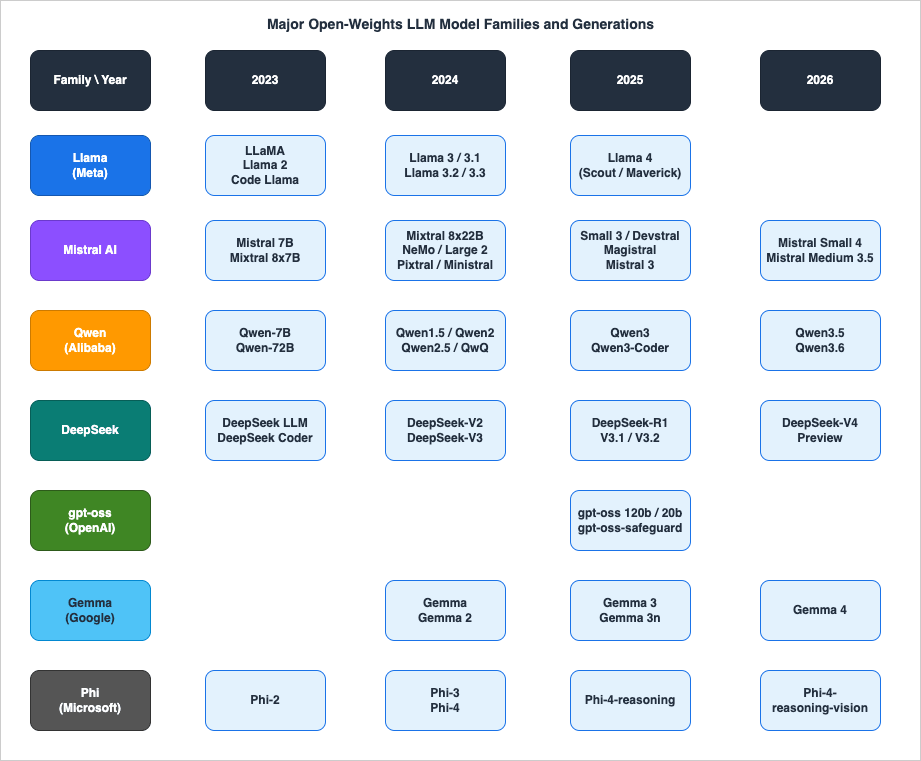
Mistral AI. The French lab Mistral AI launched with Mistral 7B in September 2023 and quickly became known for efficient models and for popularizing the open sparse Mixture-of-Experts design with Mixtral 8x7B. Its catalog spans dense models (Mistral 7B, Mistral NeMo, Mistral Small), sparse-MoE models (the Mixtral series and, later, Mistral Large 3), multimodal models (Pixtral), edge models (Ministral), code and agentic coding models (Codestral, Devstral), and a reasoning family (Magistral). Mistral itself labels each model as either "Open" or "Premier" (API-only) in its documentation. The current flagships of the open line are the Mistral 3 family (December 2025) — Mistral Large 3, a sparse Mixture-of-Experts model with 675B total / 41B active parameters and a 256K context window, plus the Ministral 3 edge models — and Mistral Small 4 (March 2026), which folds reasoning, multimodal understanding, and agentic coding into a single Apache 2.0 model.
Alibaba Qwen. Alibaba's Qwen (Tongyi Qianwen) team released its first open-weights model, Qwen-7B, in August 2023, and has become one of the most prolific open-weights contributors, shipping a steady stream of generations (Qwen1.5, Qwen2, Qwen2.5, Qwen3) alongside specialized lines for vision (Qwen-VL), code (Qwen-Coder), and math, plus the QwQ reasoning models. From Qwen3 onward, Alibaba states that all of its open-weight models are released under Apache 2.0.
DeepSeek. DeepSeek released its first open models in late 2023 and is best known for its efficient Mixture-of-Experts architecture (using Multi-head Latent Attention and the DeepSeekMoE design) and for DeepSeek-R1, the January 2025 reasoning model whose weights and distilled variants were released under the MIT License. The main line runs DeepSeek LLM to DeepSeek-V2, V3, R1, and the V3.1 / V3.2 updates, through to the DeepSeek-V4 Preview in April 2026, which pairs that Mixture-of-Experts lineage with token-wise compression and DeepSeek Sparse Attention and makes a 1M-token context window the standard across DeepSeek's official services.
OpenAI gpt-oss. In August 2025, OpenAI released gpt-oss-120b and gpt-oss-20b, its first open-weight language models in years, under the Apache 2.0 license. They are Mixture-of-Experts reasoning models with adjustable reasoning effort, and they became available on Amazon Bedrock and Amazon SageMaker JumpStart the same day. A safety-classification variant, gpt-oss-safeguard (October 2025), extends the family with a model that reasons over a developer-provided safety policy at inference time.
Google Gemma and Microsoft Phi (milestone reference points). Google's Gemma family (from February 2024) is a set of lightweight open models built from the same research as the closed Gemini models, and Microsoft's Phi family is a line of small language models emphasizing data quality and strong performance at small sizes. Both are included here at their major milestones rather than tracked exhaustively.
Timeline of Major Releases
Here is the chronological timeline of major open-weights model releases across the families above, in ascending order. Each row links to the official first-party announcement, GitHub repository, model card, or release-notes page. Where a vendor has published only a month rather than an exact day, the entry uses month precision.The timeline spans 2023 (the emergence of LLaMA, Mistral, Qwen, and DeepSeek), 2024 (the Mixture-of-Experts, long-context, and multimodal wave), 2025 (the reasoning wave, gpt-oss, and rapid iteration), and 2026 to date.
Read as a whole, each year has a distinct character. 2023 is the founding year: LLaMA proves that a downloadable model can be genuinely capable, Llama 2 and Mistral 7B make commercial use practical, and Qwen and DeepSeek enter the field. 2024 is the year the architecture and modality gaps close: sparse Mixture-of-Experts spreads beyond Mixtral, 128K-class context windows become normal, and native vision input and small on-device models both arrive in the open. 2025 is the reasoning year: QwQ and DeepSeek-R1 bring inference-time reasoning into the open, distillation carries it down to small checkpoints, and OpenAI itself joins the open-weights field with gpt-oss. 2026 to date is a consolidation year: single models that unify reasoning, multimodal understanding, and coding (Mistral Small 4, followed by Mistral Medium 3.5 as an open-weight 128B flagship under a modified MIT license), two rapid Qwen generations (Qwen3.5 and Qwen3.6) under Apache 2.0, a license shift to Apache 2.0 for Gemma 4, and ultra-long context becoming a default rather than a premium option with the DeepSeek-V4 Preview.
* The table can be sorted by clicking on the column names.
| Date | Family | Release |
|---|---|---|
| 2023-02-24 | Llama | LLaMA is released as a research model in 7B, 13B, 33B, and 65B sizes, under a non-commercial research license granted to approved researchers. It seeded much of the early open-weights ecosystem. Source: Introducing LLaMA. |
| 2023-07-18 | Llama | Llama 2 is released in 7B, 13B, and 70B sizes, with base and instruction-tuned "Chat" variants, under the Llama 2 Community License, which Meta describes as free for research and commercial use. Source: Meta and Microsoft introduce the next generation of Llama. |
| 2023-08-03 | Qwen | Qwen-7B is released as an open-weights model (with Qwen-7B-Chat), the first public release of Alibaba's Qwen (Tongyi Qianwen) series; the weights use the Tongyi Qianwen License and the code is Apache 2.0. Source: QwenLM/Qwen on GitHub. |
| 2023-08-24 | Llama | Code Llama is released in 7B, 13B, and 34B sizes (base, Python-specialized, and Instruct), built on Llama 2 under the same community license, for code generation. Source: Introducing Code Llama. |
| 2023-09-27 | Mistral | Mistral 7B is released under the Apache 2.0 license, a 7.3B dense model using sliding-window attention and grouped-query attention. It was Mistral AI's first model. Source: Mistral 7B. |
| 2023-11 | DeepSeek | DeepSeek's first open models arrive - DeepSeek Coder and DeepSeek LLM (7B and 67B, base and chat), trained on a 2-trillion-token corpus with a 4K context window. The code is MIT-licensed and the weights use the DeepSeek Model License, which permits commercial use. Source: deepseek-ai/DeepSeek-LLM on GitHub. |
| 2023-11-30 | Qwen | Qwen-72B and Qwen-1.8B are released (with chat variants), extending the first Qwen generation to both a large and a compact size. Source: QwenLM/Qwen on GitHub. |
| 2023-12-11 | Mistral | Mixtral 8x7B is released under Apache 2.0 - a sparse Mixture-of-Experts (SMoE) model with 8 experts per layer, 46.7B total parameters and 12.9B active per token, and a 32K context window. It was one of the first widely used open sparse-MoE models. Source: Mixtral of experts. |
| 2023-12-12 | Phi | Phi-2 is released, a 2.7B dense model from Microsoft Research, under the MIT License, demonstrating strong reasoning and coding performance at small size. Source: Phi-2: The surprising power of small language models. |
| 2024-02-05 | Qwen | Qwen1.5 is released, the second Qwen generation across a range of sizes; the Qwen1.5-MoE-A2.7B variant that followed on 2024-03-28 was the first Mixture-of-Experts model in the Qwen family. Source: QwenLM news log on GitHub. |
| 2024-02-21 | Gemma | Gemma is released in 2B and 7B sizes, Google's first open models "built from the same research and technology used to create the Gemini models," under the Gemma Terms of Use. Source: Gemma: Introducing new state-of-the-art open models. |
| 2024-04-17 | Mistral | Mixtral 8x22B is released under Apache 2.0, a sparse-MoE model with 141B total and 39B active parameters, a 64K context window, and native function calling. Source: Cheaper, Better, Faster, Stronger. |
| 2024-04-18 | Llama | Llama 3 is released in 8B and 70B sizes (base and instruction-tuned), trained on 8,192-token sequences, described by Meta as its most capable openly available LLM at the time. Source: Introducing Meta Llama 3. |
| 2024-04-23 | Phi | Phi-3-mini is released, a 3.8B model under the MIT License and the first in its class to natively support a 128K context window; larger Phi-3 sizes (small, medium) and Phi-3-vision followed. Source: Introducing Phi-3. |
| 2024-05-06 | DeepSeek | DeepSeek-V2 is released, a 236B-total / 21B-active Mixture-of-Experts model with a 128K context window, introducing Multi-head Latent Attention (MLA) and the DeepSeekMoE architecture. Source: deepseek-ai/DeepSeek-V2 on GitHub. |
| 2024-05-29 | Mistral | Codestral (22B) is released, a code-specialized model trained on 80+ programming languages, published under the Mistral AI Non-Production License (with a separate commercial license available). Source: Codestral. |
| 2024-06 | DeepSeek | DeepSeek-Coder-V2 is released, an open Mixture-of-Experts code model built on the DeepSeek-V2 architecture. Source: deepseek-ai/DeepSeek-Coder-V2 on GitHub. |
| 2024-06-06 | Qwen | Qwen2 is released, the third Qwen generation, with improvements across sizes and stronger multilingual and long-context handling. Source: QwenLM news log on GitHub. |
| 2024-06-27 | Gemma | Gemma 2 is released in 9B and 27B sizes (a 2B variant followed), a higher-performing and more efficient second generation under the Gemma Terms of Use. Source: Gemma 2 is now available to researchers and developers. |
| 2024-07-18 | Mistral | Mistral NeMo (12B) is released under Apache 2.0, built with NVIDIA, with a 128K context window and the new "Tekken" tokenizer, positioned as a drop-in upgrade from Mistral 7B. Source: Mistral NeMo. |
| 2024-07-23 | Llama | Llama 3.1 is released in 8B, 70B, and 405B sizes with a 128K context window and expanded multilingual support; Meta described the 405B model as the largest and most capable openly available foundation model at the time. Source: Introducing Llama 3.1. |
| 2024-07-24 | Mistral | Mistral Large 2 (123B) is released as an open-weight model under the Mistral Research License (with a commercial license required for production self-deployment), with a 128K context window and broad language and coding coverage. Source: Large Enough. |
| 2024-09-17 | Mistral | Pixtral 12B is released under Apache 2.0, Mistral's first natively multimodal model, pairing a 400M-parameter vision encoder with a 12B decoder and a 128K context window. Source: Announcing Pixtral 12B. |
| 2024-09-19 | Qwen | Qwen2.5 is released across many sizes, together with the Qwen2.5-Coder and Qwen2.5-Math specialized lines - one of the most widely adopted open-weights generations. Source: QwenLM news log on GitHub. |
| 2024-09-25 | Llama | Llama 3.2 is released, adding the first vision-capable Llama models (11B and 90B) and small on-device text models (1B and 3B) that support a 128K context window. Source: Llama 3.2: Revolutionizing edge AI and vision. |
| 2024-10-16 | Mistral | Ministral 3B and Ministral 8B ("les Ministraux") are released, edge and on-device models supporting up to a 128K context window. Source: Un Ministral, des Ministraux. |
| 2024-11-28 | Qwen | QwQ-32B-Preview is released, an experimental open reasoning model from the Qwen team focused on step-by-step analytical thinking, especially in mathematics and programming. Source: QwQ: Reflect Deeply on the Boundaries of the Unknown. |
| 2024-12-06 | Llama | Llama 3.3 70B is released, a text-only instruction-tuned model with a 128K context window that Meta describes as offering performance similar to the 3.1 405B model at a fraction of the serving cost. Source: Llama-3.3-70B-Instruct model card. |
| 2024-12-12 | Phi | Phi-4 (14B) is released, a dense model built with a data-quality-centric training recipe; the open weights were later published on Hugging Face under the MIT License. Source: Phi-4 model card. |
| 2024-12-26 | DeepSeek | DeepSeek-V3 is released, a 671B-total / 37B-active Mixture-of-Experts model with a 128K context window, trained on 14.8 trillion tokens. The code is MIT-licensed and the weights use the DeepSeek Model License, with commercial use supported. Source: deepseek-ai/DeepSeek-V3 on GitHub. |
| 2025-01-20 | DeepSeek | DeepSeek-R1 is released (with DeepSeek-R1-Zero), a reasoning model trained on top of DeepSeek-V3-Base, along with six smaller models distilled from R1 into the Qwen2.5 and Llama families. The R1 repository, model weights, and distilled models were released under the MIT License. Source: deepseek-ai/DeepSeek-R1 on GitHub. |
| 2025-01-30 | Mistral | Mistral Small 3 (24B) is released under Apache 2.0, a latency-optimized dense model positioned for the majority of everyday use cases. Source: Mistral Small 3. |
| 2025-03-10 | Gemma | Gemma 3 is released in 1B, 4B, 12B, and 27B sizes, adding multimodal (vision) input, a 128K context window, and support for 140+ languages, under the Gemma Terms of Use. Source: Introducing Gemma 3. |
| 2025-04-05 | Llama | Llama 4 Scout and Llama 4 Maverick are released as Meta's first natively multimodal, Mixture-of-Experts Llama models (each with 17B active parameters; Scout with a 10M-token and Maverick with a 1M-token context window), under the Llama 4 Community License. Meta describes them with the phrase "open-weight." A larger Llama 4 Behemoth was previewed as still in training and was not released. Source: The Llama 4 herd. |
| 2025-04-29 | Qwen | Qwen3 is released with hybrid "thinking" and "non-thinking" modes and Mixture-of-Experts variants (such as the 235B-A22B model). The Qwen team states that all of its open-weight models are licensed under Apache 2.0. Source: QwenLM/Qwen3 on GitHub. |
| 2025-04-30 | Phi | Phi-4-reasoning and Phi-4-reasoning-plus are released (with Phi-4-mini-reasoning), reasoning-specialized 14B models under the MIT License. Source: One year of Phi. |
| 2025-05-21 | Mistral | Devstral Small is released under Apache 2.0, an agentic coding model specialized for software engineering tasks, built in collaboration with All Hands AI. Source: Devstral. |
| 2025-06-10 | Mistral | Magistral is released, Mistral's first dedicated reasoning family; Magistral Small (24B) is open under Apache 2.0, while Magistral Medium is API-only. Source: Magistral. |
| 2025-06-26 | Gemma | Gemma 3n is released (E2B and E4B), a mobile-first multimodal architecture designed for a small memory footprint via Per-Layer Embeddings, under the Gemma Terms of Use. Source: Introducing Gemma 3n. |
| 2025-07-21 | Qwen | Qwen3-235B-A22B-Instruct-2507 is released, an updated Qwen3 Mixture-of-Experts model with a 256K context window, under Apache 2.0. Source: QwenLM/Qwen3 on GitHub. |
| 2025-07-22 | Qwen | Qwen3-Coder is released, an agentic code model; the flagship Qwen3-Coder-480B-A35B-Instruct is a 480B-total / 35B-active Mixture-of-Experts model supporting a 256K context window natively (and up to 1M with extrapolation). Source: Qwen3-Coder: Agentic Coding in the World. |
| 2025-08-05 | gpt-oss | OpenAI releases gpt-oss-120b and gpt-oss-20b under Apache 2.0 - Mixture-of-Experts reasoning models (117B total / 5.1B active, and 21B total / 3.6B active) with a 128K context window and adjustable low/medium/high reasoning effort. They became available on Amazon Bedrock and Amazon SageMaker JumpStart the same day. Sources: Introducing gpt-oss, OpenAI open weight models now available on AWS. |
| 2025-08-21 | DeepSeek | DeepSeek-V3.1 is released, a hybrid model that can switch between thinking and non-thinking modes, with the open weights published on Hugging Face under the MIT License. Source: DeepSeek-V3.1 Release. |
| 2025-10-29 | gpt-oss | OpenAI releases gpt-oss-safeguard (120b and 20b) as a research preview under Apache 2.0 - fine-tuned versions of gpt-oss that reason over a developer-provided safety policy at inference time for content classification. Source: Introducing gpt-oss-safeguard. |
| 2025-12-01 | DeepSeek | DeepSeek-V3.2 is released (following the experimental DeepSeek-V3.2-Exp in September 2025), which introduced DeepSeek Sparse Attention for more efficient long-context processing; the open weights are MIT-licensed. Source: DeepSeek-V3.2 Release. |
| 2025-12-02 | Mistral | The Mistral 3 family is released, including Mistral Large 3 - a sparse Mixture-of-Experts model with 675B total / 41B active parameters and a 256K context window - and the Ministral 3 dense models (3B, 8B, 14B), all under Apache 2.0. Source: Mistral 3. |
| 2026-02-16 | Qwen | Qwen3.5 is released under Apache 2.0, starting with the Qwen3.5-397B-A17B Mixture-of-Experts model; additional sizes follow within weeks (122B-A10B, 35B-A3B, and 27B on 2026-02-24, and 9B / 4B / 2B / 0.8B on 2026-03-02). Alibaba describes the generation as integrating advances in multimodal learning, architectural efficiency, and large-scale reinforcement learning. Sources: QwenLM/Qwen3.6 on GitHub (news log for Qwen3.5 and Qwen3.6), Qwen3.5 collection on Hugging Face. |
| 2026-03-04 | Phi | Phi-4-reasoning-vision (15B) is released, a compact open-weight multimodal reasoning model that combines vision understanding with selective chain-of-thought reasoning. Source: Phi-4-reasoning-vision. |
| 2026-03-16 | Mistral | Mistral Small 4 is released under Apache 2.0, a sparse Mixture-of-Experts model that unifies reasoning, multimodal understanding, and agentic coding in one model, with a 256K context window and configurable reasoning effort. Source: Mistral Small 4. |
| 2026-04-02 | Gemma | Gemma 4 is released (edge E2B/E4B sizes plus larger dense and Mixture-of-Experts models), Google's first Gemma generation published under the Apache 2.0 license rather than the Gemma Terms of Use, with a focus on agentic workflows. Source: Introducing Gemma 4. |
| 2026-04-16 | Qwen | Qwen3.6 is released under Apache 2.0, with Qwen3.6-35B-A3B (2026-04-16) followed by Qwen3.6-27B (2026-04-22). Alibaba describes the generation as building on Qwen3.5 while prioritizing stability, real-world coding utility, and direct community feedback. Sources: QwenLM/Qwen3.6 on GitHub, Qwen3.6 collection on Hugging Face. |
| 2026-04-24 | DeepSeek | DeepSeek-V4 Preview is released with open weights, in two Mixture-of-Experts variants - DeepSeek-V4-Pro (1.6T total / 49B active parameters) and DeepSeek-V4-Flash (284B total / 13B active) - built on token-wise compression and DeepSeek Sparse Attention, and making a 1M-token context window the standard across DeepSeek's official services. Source: DeepSeek-V4 Preview Release. |
| 2026-05-22 | Mistral | Mistral Medium 3.5 is released as open weights under a modified MIT license - a 128B dense model with a 256K context window that merges instruction-following, reasoning, and coding in a single set of weights, introduced alongside Mistral's Vibe coding environment and remote agents (the product itself is announced as available in public preview). Source: Remote agents in Vibe. Powered by Mistral Medium 3.5.. |
There may be slight variations in the dates in this timeline because of differences between an initial announcement, the publication of the weights, and general availability on cloud platforms. The dates above prioritize the original vendor announcement or the first-party release date when both exist.
The content posted here is limited to major releases considered essential for understanding the open-weights landscape.
In other words, please note that the items on this timeline are not every release from these families, but representative milestones that I have picked out.
Capability Evolution
Beyond the individual release dates, the open-weights ecosystem has moved through several capability waves, with different families leading at different moments. The diagram and table below summarize when each major capability first appeared in an openly available model.
| Capability | Early Open Milestone | Representative Models | Notes |
|---|---|---|---|
| Sparse Mixture-of-Experts (MoE) | 2023-12 | Mixtral 8x7B; later DeepSeek-V2/V3, Llama 4, Qwen3, Mistral Large 3 | Only a fraction of parameters are active per token, raising capability per unit of inference cost. |
| Long context (128K and beyond) | 2024-07 | Mistral NeMo and Llama 3.1 (128K); Qwen3-2507 (256K/1M); Llama 4 Scout (10M) | Context windows grew from a few thousand tokens to hundreds of thousands and beyond. |
| Multimodal (vision) input | 2024-09 | Pixtral 12B and Llama 3.2 Vision; later Gemma 3, Qwen-VL | Native image understanding added to open models. |
| Small / on-device models | 2024-09 | Llama 3.2 1B/3B, Ministral 3B/8B, Gemma 3n, the Phi family | Compact models designed to run on laptops, phones, and edge hardware. |
| Reasoning models | 2024-11 | QwQ-32B-Preview; DeepSeek-R1; Phi-4-reasoning; Magistral; gpt-oss | Models that spend inference-time compute on step-by-step reasoning; gpt-oss exposes adjustable reasoning effort. |
| Reasoning distilled into smaller models | 2025-01 | DeepSeek-R1 distilled into Qwen2.5 and Llama sizes | Six smaller open models distilled from DeepSeek-R1, bringing reasoning to modest hardware. |
| Sparse attention for long context | 2025-09 | DeepSeek-V3.2-Exp and V3.2; DeepSeek-V4 | DeepSeek Sparse Attention reduces the compute and memory cost of very long contexts; the V4 generation makes a 1M-token window the standard across DeepSeek's official services. |
| Safety-policy reasoning | 2025-10 | gpt-oss-safeguard | An open model fine-tuned to reason over a developer-provided safety policy at inference time for content classification. |
| Unified reasoning + multimodal + coding | 2026-03 | Mistral Small 4 | A single open model consolidating reasoning, multimodal, and agentic-coding capabilities. |
Three observations stand out from this progression.
First, the efficiency levers arrived in the open. Sparse Mixture-of-Experts designs — popularized in the open by Mixtral 8x7B and then adopted across DeepSeek, Llama 4, Qwen3, and the Mistral 3 family — decouple a model's total capacity from its per-token inference cost, because only a fraction of the parameters are active for any given token. The same logic later reached the attention mechanism itself: DeepSeek's sparse-attention work (V3.2 onward) attacks the cost of very long contexts, which is what allows the V4 generation to treat a 1M-token window as a default rather than a premium feature.
Second, capabilities that debuted behind closed APIs kept arriving in downloadable form within months — native vision input in September 2024, inference-time reasoning between November 2024 and January 2025, and reasoning distilled into small checkpoints alongside DeepSeek-R1 itself. The distillation wave is especially notable: by transferring R1's behavior into Qwen2.5- and Llama-sized models, it turned a frontier-scale reasoning capability into something that runs on modest hardware.
Third, the ecosystem spread in both directions at once — upward into frontier-scale Mixture-of-Experts models with hundreds of billions (and now over a trillion) total parameters, and downward into 1B-3B on-device models (Llama 3.2, Ministral, Gemma 3n, the Phi family) that run on laptops and phones. By 2026 the waves begin to converge, with single open models such as Mistral Small 4 folding reasoning, multimodal understanding, and agentic coding into one checkpoint rather than separate specialist lines.
Licenses and Availability
The word "open" covers a range of license realities in this space. The table below lists the license approach of each family as published by the vendor, without commentary on which approach is preferable. In general, a model under Apache 2.0 or MIT is open source in the OSI sense, while a model under a custom "community," "research," or vendor-named license is open-weight (downloadable) but carries use restrictions defined by that license. Several families also keep some of their most capable models as closed, API-only offerings; those are noted for context only.* The table can be sorted by clicking on the column names.
| Family | License approach (as published by the vendor) |
|---|---|
| Llama | Custom Llama Community Licenses (Llama 2, Llama 3.x, Llama 4 Community License), which make weights downloadable for research and commercial use with some conditions. Meta's wording moved from "open source" (Llama 2/3) to "open-weight" (Llama 4). |
| Mistral | A mix: Apache 2.0 for many open models (Mistral 7B, the Mixtral series, Mistral NeMo, Pixtral 12B, Mistral Small, Magistral Small, the Mistral 3 family); the Mistral Research License or Mistral AI Non-Production License for some models (weights downloadable, non-commercial); and API-only "Premier" models with no released weights. Mistral labels each model "Open" or "Premier" in its documentation. |
| Qwen | The Tongyi Qianwen License for the earliest Qwen models; from Qwen3 onward, the Qwen team states that all open-weight models are Apache 2.0. The proprietary Qwen-Max line is API-only (no released weights). |
| DeepSeek | The DeepSeek Model License for the model weights through DeepSeek-V3 (with MIT-licensed code); from DeepSeek-R1 onward, the model weights themselves are MIT-licensed. |
| gpt-oss | Apache 2.0 for both gpt-oss and gpt-oss-safeguard. |
| Gemma | The Gemma Terms of Use (a custom license with a prohibited-use policy) through Gemma 3; Gemma 4 moved to the Apache 2.0 license. |
| Phi | The MIT License for the openly published Phi weights. |
Looked at over time, the license story has three threads. The first is a drift toward standard permissive licenses: Qwen moved from the Tongyi Qianwen License to Apache 2.0 with Qwen3; DeepSeek moved from the DeepSeek Model License to MIT-licensed weights with V3 and R1; Gemma moved from the Gemma Terms of Use to Apache 2.0 with Gemma 4; and newer entrants such as gpt-oss and the Mistral 3 family launched directly under Apache 2.0. The second thread runs the other way: Meta has kept Llama on custom community licenses throughout, and its own vocabulary shifted from calling Llama 2 and 3 "open source" to calling Llama 4 "open-weight" — a useful reminder that a vendor's label and the license text are separate things. The third thread is mixed catalogs: Mistral and Alibaba both publish some models openly while keeping their most capable lines API-only, so "family" and "license" are not one-to-one.
The practical consequence is simple: always read the license file that ships on the model card for the exact model and version you plan to use. Licenses differ between families, between generations of the same family, and occasionally between models of the same generation — this table records each family's approach at the family level, not a legal review of any specific model.
Managed availability. Many of these open-weights models are also offered as fully managed services on cloud platforms, which is useful when you would rather call an API than operate your own inference stack. On AWS specifically, the milestones include: Llama 2 on Amazon SageMaker JumpStart (2023-07-18) and on Amazon Bedrock (2023-11-29), with later Llama generations following through 2024 and Llama 4 becoming available on Amazon Bedrock in 2025-04; DeepSeek-R1 as a fully managed model on Amazon Bedrock (2025-03), followed by DeepSeek-V3.1 (2025-09); OpenAI's gpt-oss on Amazon Bedrock and Amazon SageMaker JumpStart on launch day (2025-08); and Mistral's Pixtral Large on Amazon Bedrock (2025-04) and the Mistral Large 3 and Ministral 3 family first on Amazon Bedrock (2025-12). In December 2025, Amazon Bedrock added a batch of 18 fully managed open-weight models in one expansion, spanning Gemma 3, several Mistral models, gpt-oss-safeguard, and Qwen models, among others. For deeper coverage of managed model availability, see the companion Amazon Bedrock articles linked in the Summary; the primary references are the official What's New with AWS announcements, Amazon Bedrock supported foundation models, and Amazon SageMaker JumpStart.
Frequently Asked Questions
What is the difference between "open weights" and "open source"?
"Open weights" means the trained model parameters are published for download, so you can run and fine-tune the model yourself. "Open source," in the strict Open Source Initiative sense, refers to a license that grants broad rights to use, study, modify, and redistribute without field-of-use restrictions. A model can be open-weight without being open source - for example, when its weights are downloadable but its license adds use restrictions. Some open-weights models (those under Apache 2.0 or MIT, such as Mistral 7B, gpt-oss, or DeepSeek-R1) are open source in the strict sense; others (under custom community or research licenses) are open-weight but not strictly open source.Which model families does this timeline cover?
Five families in depth - Meta Llama, Mistral AI, Alibaba Qwen, DeepSeek, and OpenAI gpt-oss - plus Google Gemma and Microsoft Phi at their major milestones. It focuses on generation-level and family-level releases rather than every size variant or fine-tune.When was the first open-weights LLM released?
Within the scope of this timeline, Meta's LLaMA on February 24, 2023 was the release that catalyzed the modern open-weights ecosystem, although it was initially a gated research-only release. Truly permissive commercial licensing arrived with Llama 2 (July 18, 2023) and Mistral 7B under Apache 2.0 (September 27, 2023). See Introducing LLaMA and Mistral 7B.What was the first widely used open Mixture-of-Experts (MoE) model?
Mistral's Mixtral 8x7B, released on December 11, 2023 under Apache 2.0, popularized the open sparse Mixture-of-Experts design (8 experts, 2 active per token, 46.7B total and 12.9B active parameters). Later MoE open models include DeepSeek-V2/V3, Llama 4, Qwen3, and Mistral Large 3. See Mixtral of experts.When did open-weights models gain vision (multimodal) input?
Native vision arrived in open models in September 2024, with Mistral's Pixtral 12B (September 17, 2024) and Meta's Llama 3.2 Vision models (September 25, 2024), followed by Google's Gemma 3 (March 10, 2025) and Alibaba's Qwen-VL line. See Announcing Pixtral 12B and Llama 3.2.When did open reasoning models appear?
The open reasoning wave began with Alibaba's QwQ-32B-Preview (November 28, 2024) and accelerated with DeepSeek-R1 (January 20, 2025). Later open reasoning models include Microsoft's Phi-4-reasoning (April 30, 2025), Mistral's Magistral (June 10, 2025), and OpenAI's gpt-oss (August 5, 2025), which exposes adjustable reasoning effort. See QwQ-32B-Preview and DeepSeek-R1.What is DeepSeek-R1, and why is it significant?
DeepSeek-R1, released on January 20, 2025, is a reasoning model built on DeepSeek-V3-Base (671B total / 37B active parameters, 128K context). DeepSeek released it - along with six smaller models distilled from R1 into the Qwen2.5 and Llama families - under the MIT License, which made a strong open reasoning model, and smaller distilled versions of it, freely available to run and build on. See deepseek-ai/DeepSeek-R1.What is gpt-oss?
gpt-oss is OpenAI's family of open-weight language models, introduced on August 5, 2025 with gpt-oss-120b and gpt-oss-20b under the Apache 2.0 license. They are Mixture-of-Experts reasoning models (117B total / 5.1B active and 21B total / 3.6B active) with a 128K context window and adjustable reasoning effort, and they became available on Amazon Bedrock and Amazon SageMaker JumpStart the same day. A safety-classification variant, gpt-oss-safeguard, followed on October 29, 2025. See Introducing gpt-oss.What is DeepSeek-V4?
DeepSeek-V4 Preview, released with open weights on April 24, 2026, is the newest DeepSeek generation, in two Mixture-of-Experts variants: DeepSeek-V4-Pro (1.6T total / 49B active parameters) and DeepSeek-V4-Flash (284B total / 13B active). Built on token-wise compression and DeepSeek Sparse Attention, it makes a 1M-token context window the standard across DeepSeek's official services. See DeepSeek-V4 Preview Release.What is the difference between a dense model and a Mixture-of-Experts model?
In a dense model, every parameter participates in processing every token. In a sparse Mixture-of-Experts (MoE) model, the parameters are organized into experts and a router activates only a few of them per token, so the active parameter count (which drives inference cost) is much smaller than the total parameter count (which drives capacity). That is why MoE models are described with two numbers — for example, Mixtral 8x7B's 46.7B total / 12.9B active, or DeepSeek-V4-Pro's 1.6T total / 49B active.Which licenses do these families use?
They vary. Mistral's most permissive models, gpt-oss, and (from Qwen3) Qwen's open models use Apache 2.0; DeepSeek weights use the DeepSeek Model License through V3 and MIT from R1 onward; the Phi weights use MIT; Gemma used the Gemma Terms of Use through Gemma 3 and moved to Apache 2.0 with Gemma 4; and Llama uses Meta's custom Llama Community Licenses. See the Licenses and Availability section above for the full breakdown.Are these open-weights models available on Amazon Bedrock or Amazon SageMaker?
Yes, many are offered as fully managed services on AWS. Examples include Llama on Amazon Bedrock and SageMaker JumpStart, DeepSeek-R1 as a fully managed model on Amazon Bedrock, gpt-oss on both Amazon Bedrock and SageMaker JumpStart on launch day, and various Mistral, Gemma, and Qwen models on Amazon Bedrock. See the Licenses and Availability section and the companion Amazon Bedrock articles.Does this timeline include closed models like GPT, Claude, Gemini, or Amazon Nova?
No. This timeline covers open-weights models. The closed, API-only families are referenced only for context and are covered in the companion Anthropic Claude, OpenAI GPT, Google Gemini, and Amazon Nova model-release timelines linked at the top and in the Summary.Does this timeline include image or video generation models?
No. Image and video generation models are covered in a separate article, the Image and Video Generation Model Release Timeline, linked in the Summary.How can I track new open-weights releases?
The most reliable sources are each vendor's own channels: the Meta AI blog and Llama site; Mistral AI News; the Qwen GitHub organization and blog; the DeepSeek GitHub organization and API news; OpenAI's announcements for gpt-oss; and the official Gemma and Phi pages. Each family's official Hugging Face organization also hosts the model cards and license files.Summary
In this article, I built a cross-cutting release history and timeline of the major open-weights LLM families - Meta Llama, Mistral AI, Alibaba Qwen, DeepSeek, and OpenAI gpt-oss, with Google Gemma and Microsoft Phi as milestone reference points - organized by the model family map, the chronological release timeline (each row linked to an official first-party source), the evolution of capabilities, and the licenses and managed availability of each family.In roughly three years, open-weights models went from a single gated research release to a broad ecosystem spanning dense and Mixture-of-Experts architectures, context windows from a few thousand tokens to millions, native multimodal input, small on-device models, and inference-time reasoning - much of it downloadable under permissive licenses such as Apache 2.0 and MIT, and increasingly offered as fully managed services on cloud platforms. The clearest trend line as of 2026 is convergence: architectures converging on sparse Mixture-of-Experts at the top end, capabilities converging into single unified models, and licenses converging toward Apache 2.0 and MIT across Qwen, DeepSeek, Gemma, gpt-oss, and the Mistral open line — with Llama's community licenses as the notable exception. Because this is a fast-moving space with information scattered across many first-party sources, I built it as one maintainable, cross-cutting timeline rather than a page per vendor, and I will continue to update it as the families evolve.
In addition, there are related history-and-timeline and model-catalog articles on hidekazu-konishi.com, so please have a look if you are interested.
Anthropic Claude Model Release Timeline - Model Family Tree, Capability Evolution, and Platform Availability
OpenAI GPT Model Release Timeline - Model Lineage, ChatGPT and Codex Milestones, and Platform Availability
Google Gemini Model Release Timeline - Model Family, Capability Evolution, and Platform Availability
Amazon Nova Model Release Timeline - Model Family, Capability Evolution, and Availability on Amazon Bedrock
LLM Context Window Growth Timeline - Milestones, Current Sizes by Provider, and Official Sources
Image and Video Generation Model Release Timeline
Amazon Bedrock Model Catalog 2026
Self-Managed LLM Inference on Amazon EKS
References
- Meta AI - Introducing LLaMA (2023-02-24)
- Meta AI - Llama 2 (2023-07-18)
- Meta AI - Introducing Code Llama (2023-08-24)
- Meta AI - Introducing Meta Llama 3 (2024-04-18)
- Meta AI - Introducing Llama 3.1 (2024-07-23)
- Meta AI - Llama 3.2 (2024-09-25)
- Meta - Llama-3.3-70B-Instruct model card (2024-12)
- Meta AI - The Llama 4 herd (2025-04-05)
- Mistral AI - Mistral 7B (2023-09-27)
- Mistral AI - Mixtral of experts (2023-12-11)
- Mistral AI - Mixtral 8x22B (2024-04-17)
- Mistral AI - Codestral (2024-05-29)
- Mistral AI - Mistral NeMo (2024-07-18)
- Mistral AI - Mistral Large 2 (2024-07-24)
- Mistral AI - Pixtral 12B (2024-09-17)
- Mistral AI - les Ministraux (2024-10-16)
- Mistral AI - Mistral Small 3 (2025-01-30)
- Mistral AI - Devstral (2025-05-21)
- Mistral AI - Magistral (2025-06-10)
- Mistral AI - Mistral 3 (2025-12-02)
- Mistral AI - Mistral Small 4 (2026-03-16)
- Mistral AI - Remote agents in Vibe. Powered by Mistral Medium 3.5. (2026-05-22)
- Alibaba Qwen - QwenLM/Qwen on GitHub (first-generation Qwen)
- Alibaba Qwen - QwenLM/Qwen3 on GitHub (news log for Qwen1.5 / Qwen2 / Qwen2.5 / Qwen3)
- Alibaba Qwen - QwQ-32B-Preview (2024-11-28)
- Alibaba Qwen - Qwen3-Coder (2025-07-22)
- Alibaba Qwen - QwenLM/Qwen3.6 on GitHub (news log for Qwen3.5 / Qwen3.6)
- Alibaba Qwen - Qwen3.5 collection on Hugging Face (2026-02-16)
- Alibaba Qwen - Qwen3.6 collection on Hugging Face (2026-04-16)
- DeepSeek - DeepSeek-LLM on GitHub (2023-11)
- DeepSeek - DeepSeek-V2 on GitHub (2024-05-06)
- DeepSeek - DeepSeek-V3 on GitHub (2024-12-26)
- DeepSeek - DeepSeek-R1 on GitHub (2025-01-20)
- DeepSeek - DeepSeek-V3.1 Release (2025-08-21)
- DeepSeek - DeepSeek-V3.2 Release (2025-12-01)
- DeepSeek - DeepSeek-V4 Preview Release (2026-04-24)
- OpenAI - Introducing gpt-oss (2025-08-05)
- OpenAI - Introducing gpt-oss-safeguard (2025-10-29)
- Google - Gemma: Introducing new state-of-the-art open models (2024-02-21)
- Google - Gemma 4 (2026-04-02)
- Microsoft - Phi-2 (2023-12-12)
- Microsoft - Introducing Phi-3 (2024-04-23)
- AWS - OpenAI open weight models now available on AWS (2025-08-05)
- AWS - DeepSeek-R1 is available fully-managed in Amazon Bedrock (2025-03)
- Amazon Bedrock supported foundation models
References:
Tech Blog with curated related content
Written by Hidekazu Konishi