LLM Context Window Growth Timeline - Milestones, Current Sizes by Provider, and Official Sources
First Published:
Last Updated:
This article is a growth timeline of published context windows: an ascending list of milestone moments (the first 100K, 200K, 1M, 2M, and 10M-token windows), a snapshot of current sizes by provider, and a growth-curve figure — with an official first-party source cited for every value. It is a companion to the per-model release timelines on this site for Anthropic Claude, OpenAI GPT, Google Gemini, and Amazon Nova, which cover each family's full feature history.
Facts in this article were verified against official documentation as of 2026-07-24, and the Anthropic, OpenAI, and Google rows of the current-sizes snapshot were re-verified on 2026-10-15.
Overview - What "Context Window" Means (and What This Timeline Does Not Claim)
A context window is the maximum number of tokens a model can attend to in a single request. It is the model's working memory for that request: the system prompt, the conversation history, any retrieved documents, tool definitions, tool results, and the model's own output all have to fit inside it. A token is a chunk of text — very roughly three-quarters of an English word on average — but the exact mapping depends on each vendor's tokenizer, so "one million tokens" is not a fixed amount of text across providers.Two distinctions matter throughout this timeline:
- Input context window vs. output token limit. The context window (input limit) is usually far larger than the maximum number of tokens a model can generate in one response (the output cap, often exposed as
max_tokensor "max output tokens"). A model that reads 1,000,000 tokens may still be capped at, say, 128,000 output tokens per turn. Unless a row says otherwise, the figures below are input context windows. - Published window vs. effective performance. This article records the numbers vendors officially publish. It does not measure how well a model actually uses the full window. Advertised capacity and effective long-context quality are different things: recall can degrade toward the middle or the far end of a very long context (the "lost in the middle" and "context rot" effects), and independent testing often finds usable quality falling off well before the advertised limit. Those effects, and benchmark scores, are out of scope here.
What is included. This is a record of milestones — the first time a headline threshold (100K, 200K, 1M, 2M, 10M) appeared in a public announcement — plus a current snapshot of the flagship window for each major provider. It is deliberately not an exhaustive list of every model or every intermediate size, and models that did not move a threshold forward (for example, GPT-2's 1,024-token window, smaller than GPT-3's) are not listed. Pricing, benchmark results, and per-model feature histories are left to the companion timelines linked above. Who built each of those benchmarks, who declared one saturated, and what replaced it are covered in LLM Benchmark History and Timeline - Who Built Each Yardstick, Who Declared It Saturated, and What Replaced It.
A note on "first." The "first to reach X" labels below are drawn from the dated public announcements of the providers covered here, in ascending order. Where a vendor itself claims an industry first, that is attributed to the vendor. The intent is a factual record of when each threshold was first announced, not a ranking of who "won" — context-window size is one attribute among many, and a larger number is not automatically better (see Design Implications).
The Growth Curve at a Glance
The chart below plots the milestone context windows on a logarithmic vertical axis against time. A logarithmic axis is necessary because the values span more than four orders of magnitude — from about 2,000 tokens to 10,000,000 — so a linear axis would compress everything below one million into a flat line along the bottom.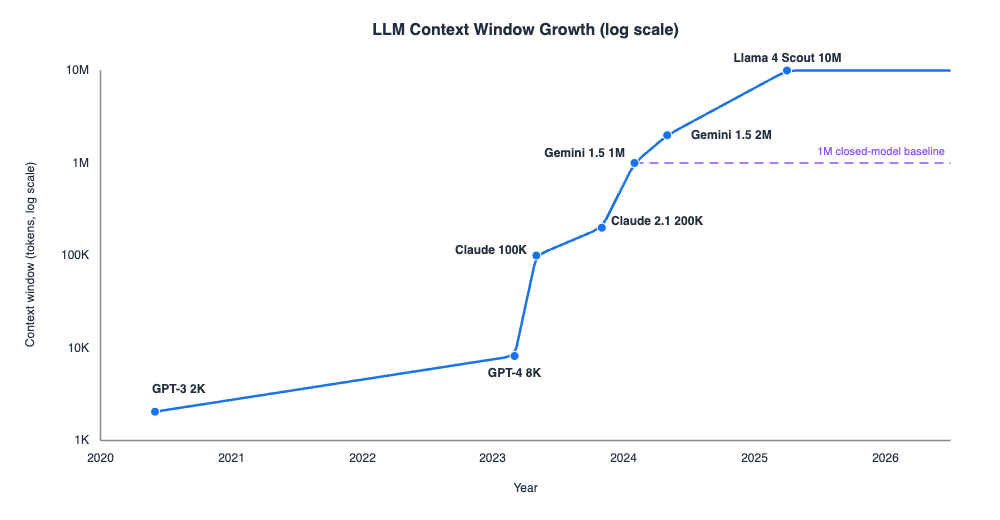
Timeline of Context Window Milestones
The table lists milestone moments in ascending chronological order. Each figure is the model's published input context window (unless the note says otherwise), and every row links to an official first-party source that states the number.* You can sort the table by clicking on the column name.
| Date | Model | Published Context Window | Milestone / Note | Official Source |
|---|---|---|---|---|
| 2020-06 | GPT-3 (OpenAI) | 2,048 tokens | Early API baseline; input and output shared a single 2,048-token limit. The base GPT-3 models are now retired. *1 | OpenAI - Deprecations |
| 2023-03 | GPT-4 (OpenAI) | 8,192 tokens | GPT-4 launched with an 8K window, alongside a 32,768-token gpt-4-32k variant. | OpenAI - GPT-4 model |
| 2023-05 | Claude 1.3 (Anthropic) | 100,000 tokens | Anthropic described this as the first 100K-token context window from a frontier AI lab. | Anthropic - 100K context windows |
| 2023-06 | GPT-3.5 Turbo 16K (OpenAI) | 16,385 tokens | A 16K variant expanded the earlier 4K default for the ChatGPT-era model. | OpenAI - GPT-3.5 Turbo model |
| 2023-07 | Claude 2 (Anthropic) | 100,000 tokens | The 100K window became broadly available with Claude 2. | Anthropic - Claude 2 |
| 2023-11 | GPT-4 Turbo (OpenAI) | 128,000 tokens | The first mainstream 128K window (with a 4,096-token output cap). | OpenAI - GPT-4 Turbo model |
| 2023-11 | Claude 2.1 (Anthropic) | 200,000 tokens | The first 200K-token window, doubling the previous 100K limit. | Anthropic - Claude 2.1 |
| 2024-02 | Gemini 1.5 Pro (Google) | 1,000,000 tokens | The first one-million-token-class window, initially in private preview. | Google - Gemini 1.5 |
| 2024-05 | GPT-4o (OpenAI) | 128,000 tokens | A multimodal flagship holding the 128K window (with a 16,384-token output cap). | OpenAI - GPT-4o model |
| 2024-05 | Gemini 1.5 Pro (Google) | 2,000,000 tokens | The first two-million-token window, announced via waitlist at Google I/O; generally available on Vertex AI in September 2024. | Google - I/O 2024 update, Vertex AI - release notes |
| 2024-12 | Amazon Nova (Amazon) | 128,000 / 300,000 tokens | The first Nova family: Micro at 128K; Lite and Pro at 300K. | AWS - Amazon Nova, AWS - Amazon Nova User Guide |
| 2025-04 | Llama 4 Scout (Meta) | 10,000,000 tokens | The first ten-million-token window and the largest published to date; an open-weights model, described by Meta as industry-leading. | Meta - Llama 4 Scout model card |
| 2025-04 | GPT-4.1 (OpenAI) | 1,047,576 tokens | A one-million-token-class window across GPT-4.1, GPT-4.1 mini, and GPT-4.1 nano (marketed as "1 million"). | OpenAI - GPT-4.1 model |
| 2025-04 | Amazon Nova Premier (Amazon) | 1,000,000 tokens | Nova reaches a one-million-token window at its most capable tier. | AWS - Amazon Nova Premier |
| 2025-08 | Claude Sonnet 4 (Anthropic) | 1,000,000 tokens | The first Claude tier to offer a one-million-token window (public beta). | Anthropic - 1M token context |
| 2025-12 | Amazon Nova 2 Lite (Amazon) | 1,000,000 tokens | The Nova 2 generation makes a one-million-token window generally available. | AWS - Amazon Nova 2 |
| 2026-04 | DeepSeek-V4 Preview (DeepSeek) | 1,000,000 tokens | An open-weights model making a one-million-token window the default across its services. | DeepSeek - V4 release |
| 2026-10 | Current frontier baseline | ~1,000,000 tokens | A one-million-token window is now the standard for current closed-model flagships. The September–October 2026 releases — Claude Fable 5.1, Claude Opus 5.5, Claude Sonnet 5.5, and Claude Haiku 5.5; GPT-6 Astra, GPT-6 Sol, GPT-6 Luna, and GPT-6.1 Sol; and Gemini 4 Argon — kept the window at about one million tokens rather than raising it (see the current table below). | See "Current Context Windows by Provider" |
*1) The 2,048-token figure for the original GPT-3 predates today's per-model documentation pages; the base GPT-3 models (such as
davinci) are now retired and appear only in OpenAI's deprecation records, linked above.Current Context Windows by Provider
The snapshot below lists the current generally available flagship for each major provider and its published input context window and maximum output tokens, as of 2026-10-15 for the OpenAI, Anthropic, Google, Alibaba, DeepSeek, and Mistral rows and 2026-07-24 for the Amazon and Meta rows. Because these numbers change with each release, treat this as a dated snapshot and verify against the linked official documentation before relying on a value.* You can sort the table by clicking on the column name.
| Provider | Flagship Model (GA) | Context Window (input) | Max Output | Official Source |
|---|---|---|---|---|
| OpenAI | GPT-6 Astra (and GPT-6.1 Sol, GPT-6 Sol, GPT-6 Luna) | 1,050,000 tokens | 128,000 tokens | OpenAI - GPT-6 Astra model |
| Anthropic | Claude Opus 5.5 (and Fable 5.1, Sonnet 5.5, Haiku 5.5) | 1,000,000 tokens | 128,000 tokens | Anthropic - Models overview |
| Gemini 4 Argon (and Gemini 3.8 Flash) | 1,048,576 tokens (about 1 million; a unified input and output limit on Gemini 4 Argon) *2 | 65,536 tokens by default; up to 1,048,576 minus the input with long decode on Gemini 4 Argon *2 | Google - Gemini 4 Argon model page, Google - Long decode | |
| Amazon | Amazon Nova 2 Lite / Amazon Nova Premier | 1,000,000 tokens | 64,000 tokens (Nova 2 Lite) | AWS - Amazon Nova 2, AWS - Amazon Nova 2 Lite model card |
| Meta (open weights) | Llama 4 Scout | 10,000,000 tokens | – | Meta - Llama 4 Scout model card |
| Alibaba (open weights) | Qwen3.8-2.4T-A95B | 262,144 tokens natively; extensible up to 1,010,000 tokens | – | Qwen - Qwen3.8-2.4T-A95B model card |
| DeepSeek (open weights) | DeepSeek-V4-Pro (DeepSeek-V4-Pro-0813) | 1,000,000 tokens | 384,000 tokens (384K) | DeepSeek - V4-Pro GA release, DeepSeek - Models & Pricing |
| Mistral (open weights) | Mistral Large 3 | 256,000 tokens | – | Mistral - Large 3 model card |
The four unshaded rows are the closed-model flagships that correspond to this site's per-model timelines; the shaded rows list the largest published window for several open-weights families, for reference.
Notes:
- Smaller and faster tiers within a family do not always publish smaller windows. Amazon Nova Micro lists 128,000 tokens with Nova Lite and Nova Pro at 300,000 tokens, and Anthropic's earlier Claude Haiku 4.5 lists 200,000 tokens. By contrast, Claude Haiku 5.5 (released 2026-10-07) publishes the same 1,000,000-token window and 128,000-token output limit as Claude Opus 5.5, and OpenAI's GPT-6 Luna, which OpenAI describes as its most efficient model, publishes the same 1,050,000 / 128,000 tokens as GPT-6 Astra.
- Anthropic's releases after Claude Opus 5 (2026-07-24) — Claude Fable 5.1 on 2026-09-01 (alongside Claude Mythos 5.1, the same model offered only to organizations verified through Anthropic's verification programs), Claude Opus 5.5 on 2026-09-22, Claude Sonnet 5.5 on 2026-09-28, and Claude Haiku 5.5 on 2026-10-07 — each publish a 1,000,000-token input window and a 128,000-token output limit, the same as Claude Opus 5, so the figures in the row are unchanged by those releases. Anthropic's models overview recommends starting with Claude Opus 5.5 for most workloads and using Claude Fable 5.1 for demanding reasoning and long-horizon agentic work. Source: Anthropic - Claude Platform release notes.
- OpenAI released GPT-6 Astra, which it describes as its most capable model, on 2026-09-03, GPT-6 Sol and GPT-6 Luna on 2026-09-22, and GPT-6.1 Sol on 2026-09-29. Each model page lists a 1,050,000-token context window and 128,000 max output tokens — the same figures as GPT-5.6 Sol, the OpenAI flagship in the previous snapshot. Source: OpenAI - API changelog.
- *2) Google's Gemini API model page for Gemini 4 Argon (generally available 2026-10-13) lists a context window of 1,048,576 tokens, labeled a "unified input and output token limit," and a max output of 65,536 tokens by default and up to 1,048,576 with long decode. Google's long-decode guide says those 1,048,576 tokens are shared across input, thinking, and output, so a long-decode response can use at most 1,048,576 tokens minus the input; on the Interactions API, long decode runs as a background interaction, and requests without background execution stop at 65,536 tokens. Gemini 3.8 Flash (generally available 2026-09-02) lists an input limit of 1,048,576 tokens and an output limit of 65,536 tokens, the same figures the previous snapshot listed for Gemini 3.6 Flash and Gemini 3.5 Flash; Gemini 3.5 Flash was deprecated on 2026-10-08, with requests routed to Gemini 3.6 Flash. Neither release raised the window above 1,048,576 tokens.
- The one-million-token windows carry slightly different exact values by vendor — 1,047,576 (GPT-4.1), 1,048,576 (Gemini), 1,050,000 (GPT-5.6 and the GPT-6 family), 1,010,000 (Qwen3.8-2.4T-A95B with context extension), and an even 1,000,000 elsewhere — all of which round to "1 million."
- Alibaba released Qwen3.8-2.4T-A95B on 2026-08-12; its model card lists a context length of 262,144 tokens natively, extensible up to 1,010,000 tokens, which replaces Qwen2.5-1M (an explicitly documented 1,000,000-token window) as the largest published Qwen window in this snapshot. Qwen3.8-27B, released on 2026-08-14, lists 262,144 tokens natively, extensible to 1,000,000. Sources: Qwen - Qwen3.8-2.4T-A95B model card, QwenLM - Qwen3.8 repository. See the Open-Weights LLM Release History and Timeline for the family's full release history.
- DeepSeek released DeepSeek-V4-Pro to general availability on 2026-08-13 as DeepSeek-V4-Pro-0813, the official release that supersedes the DeepSeek-V4 Preview listed in the previous snapshot, with its weights under the MIT License, followed by DeepSeek-V4.1-Flash on 2026-09-10. DeepSeek's Models & Pricing page lists a 1M context length and a maximum output of 384K for both models, and the model card recommends a 384K maximum output length for the high and max reasoning-effort levels.
- Mistral Large 4, which Mistral describes as open-weight and lists with a 1M context window, entered Public Preview on 2026-10-06, but Mistral's changelog says its open weights are "coming soon," so the row keeps Mistral Large 3 (256k), whose weights are already available. Source: Mistral - Changelog, Mistral - Large 4 model card.
Design Implications - Long Context and RAG
A larger context window removes a hard constraint, but it does not make every long-context task easy, and it is rarely free. A few practical points follow from the honesty caveats in the Overview.Bigger is not automatically better. Advertised capacity and effective quality diverge: models can attend less reliably to information buried deep in a long context, so filling a one-million-token window to the brim does not guarantee the model will use all of it well. Cost and latency also scale with the number of tokens processed, so a large prompt is a large bill on every request.
The output cap often binds first. For coding and agentic workflows that produce multi-file edits, the output token limit (commonly 64K–128K) tends to constrain a turn before the input window does. A model that reads a million tokens but writes 128K per turn still needs multiple round trips for a large change, and each round trip re-sends the growing history. Gemini 4 Argon is the exception among the models in this article: with long decode, its output can extend into the rest of its 1,048,576-token unified window, but Google's guide notes that long decode can run for several minutes and that a large output leaves correspondingly less room for input.
Long context vs. retrieval. A big window and retrieval-augmented generation (RAG) are complementary, not mutually exclusive. Putting an entire corpus in the prompt is simple but pays to reprocess everything on each call; retrieval fetches only the relevant slice per query, which is cheaper at scale but adds a retrieval pipeline to build and tune. Prompt caching narrows the gap for stable, frequently reused context. For deeper treatments on this site, see Anthropic Claude API Prompt Caching and Token Efficiency and Amazon Bedrock Knowledge Bases Retrieval Quality Engineering. To estimate how much of a window a given prompt will occupy, the LLM Token Counter and Context Budget Planner is a companion tool.
Frequently Asked Questions
What is the difference between the context window and the maximum output tokens?
The context window is the total input a model can read in one request — prompt, history, retrieved documents, and tool data combined. The maximum output tokens is the separate cap on how much the model can generate in a single response. The input window is usually much larger than the output cap; a model with a 1,000,000-token window may still generate at most 128,000 tokens per turn. Some vendors instead define the window as one budget shared by input and output: Google lists Gemini 4 Argon's 1,048,576 tokens as a unified input and output limit, so a long output leaves less room for input. This timeline tracks the input window unless a row states otherwise.Which model first reached a 100K, 200K, 1M, 2M, or 10M-token context window?
By the dated announcements of the providers covered here: Anthropic's Claude reached 100,000 tokens in May 2023 (described by Anthropic as the first from a frontier lab); Claude 2.1 reached 200,000 in November 2023; Google's Gemini 1.5 Pro reached 1,000,000 tokens in February 2024 and 2,000,000 in May 2024; and Meta's Llama 4 Scout reached 10,000,000 in April 2025. These are firsts among the announcements in this article, not a claim about every model ever released.Does a bigger context window mean better long-context performance?
Not necessarily. The context window is the maximum a model will accept, not a guarantee of quality across that whole span. Effective recall can degrade toward the middle or the end of a very long context, and independent evaluations often find usable quality falling off before the advertised limit. This article records published windows only and does not measure effective performance.Why do the "one million token" windows show different exact numbers?
Vendors round to "1 million" for marketing but publish slightly different exact limits: 1,047,576 for GPT-4.1, 1,048,576 for Gemini 4 Argon and Gemini 3.8 Flash, 1,050,000 for GPT-5.6 and the GPT-6 family, and an even 1,000,000 for several others. The figures near 1,048,576 are round numbers in binary (1,048,576 is two to the twentieth power); all of them are close enough that "1M" is the common shorthand.Is the context window the same as a number of words or pages?
No. The window is measured in tokens, and the token-to-text ratio depends on each vendor's tokenizer and the language and content. As a rough English-text guide, one million tokens is on the order of hundreds of thousands of words, but the precise conversion varies, and code or non-English text tokenizes differently. Use a token counter for the specific model rather than assuming a fixed word count.What is the largest context window available today?
Among the models in this article, the largest published context window is Meta's Llama 4 Scout at 10,000,000 tokens (open weights). For current closed-model flagships, a one-million-token window is the common baseline — 1,050,000 for the GPT-6 family, 1,048,576 for Gemini 4 Argon, and 1,000,000 for Claude Opus 5.5 (and the rest of the current Claude lineup) and Amazon Nova. The September–October 2026 releases from Anthropic, OpenAI, and Google did not raise that baseline.Summary
In about six years, the LLM context window grew from GPT-3's 2,048 tokens to a one-million-token baseline shared by today's closed-model flagships, with an open-weights ceiling of 10,000,000 tokens. The steepest part of that climb was concentrated in 2023–2024, when the frontier moved from 100K to 200K to 1M and then 2M tokens in barely a year. Since then the headline number has largely stabilized around one million for closed models — the September–October 2026 releases, including Claude Opus 5.5, the GPT-6 family, and Gemini 4 Argon, kept it there rather than raising it — while a separate open-weights track pushed to ten million.The important caveat is that these are published windows, not measures of effective long-context quality, and the input window is distinct from the output cap, which is usually smaller. For the full feature and release history behind each family, see the companion timelines for Anthropic Claude, OpenAI GPT, Google Gemini, and Amazon Nova, and the cross-vendor Open-Weights LLM Release History and Timeline.
References
Official model documentation and announcements- OpenAI - API model documentation
- OpenAI - API changelog
- Anthropic - Claude models overview
- Anthropic - Claude Platform release notes
- Google - Gemini API model documentation (Gemini 4 Argon)
- Google - Gemini API long decode
- Google - Gemini API model documentation (Gemini 3.8 Flash)
- Google - Gemini API release notes
- AWS - Amazon Nova User Guide
- Meta - Llama 4 Scout model card
- Qwen - Qwen2.5-1M
- Qwen - Qwen3.8-2.4T-A95B model card
- DeepSeek - V4 release
- DeepSeek - V4-Pro GA release
- DeepSeek - Models & Pricing
- Mistral - Large 3 model card
- Mistral - Large 4 model card
Related timelines and tools on this site
- Anthropic Claude Model Release Timeline
- OpenAI GPT Model Release Timeline
- Google Gemini Model Release Timeline
- Amazon Nova Model Release Timeline
- Open-Weights LLM Release History and Timeline - Llama, Mistral, Qwen, DeepSeek, and gpt-oss
- LLM Token Counter and Context Budget Planner
- Anthropic Claude API Prompt Caching and Token Efficiency
- Amazon Bedrock Knowledge Bases Retrieval Quality Engineering
References:
Tech Blog with curated related content
Written by Hidekazu Konishi