Google Gemini Model Release Timeline - Model Family, Capability Evolution, and Platform Availability
First Published:
Last Updated:
In this article I build a release timeline for the Google Gemini family, from Google's earlier language models (LaMDA, PaLM, and PaLM 2) and the launch of Gemini 1.0 in December 2023, through the Gemini 1.5, 2.0, and 2.5 generations, to the Gemini 3 generation and the Gemini 3.5 through 3.8 models available at the time of writing. I summarize the Gemini model family (the generations and the Ultra, Pro, Flash, Flash-Lite, and Nano variants), the chronology of major releases with links to the official Google announcements, the evolution of capabilities (native multimodality, long context, the Multimodal Live API, thinking models and Deep Think, and agentic computer use), and the availability of Gemini across the Gemini API and Google AI Studio, Gemini Enterprise Agent Platform (formerly Vertex AI), the Gemini app, and Google Workspace.
Companion articles on hidekazu-konishi.com:
- Anthropic Claude Model Release Timeline - Model Family Tree, Capability Evolution, and Platform Availability
- OpenAI GPT Model Release Timeline - Model Lineage, ChatGPT and Codex Milestones, and Platform Availability
- Amazon Nova Model Release Timeline - Model Family, Capability Evolution, and Availability on Amazon Bedrock
- Image and Video Generation Model Release Timeline
This timeline primarily references the following official Google sources.
- The Keyword (Google's official blog) - Gemini
- Google DeepMind - Gemini models
- Google Developers Blog
- Google Cloud Blog - AI & Machine Learning (Gemini Enterprise Agent Platform, formerly Vertex AI)
Overview — Google's Path to Gemini (LaMDA, PaLM, and Bard)
Google's path to Gemini runs through several earlier language models. LaMDA, a conversational model, was introduced at Google I/O in May 2021. The PaLM model followed in April 2022, and PaLM 2 was announced at Google I/O in May 2023, where it powered a range of Google products. Google's public conversational assistant, Bard, was first revealed in February 2023 and opened to the public in the United States and United Kingdom in March 2023, initially powered by LaMDA and later by PaLM 2.Gemini was announced on December 6, 2023 as Google's first family of models designed to be natively multimodal - built from the start to reason across text, images, audio, and video rather than stitching together separate single-modality models. Gemini 1.0 arrived in three sizes (Ultra, Pro, and Nano), and a fine-tuned Gemini Pro immediately began powering Bard. Two months later, on February 8, 2024, Google renamed Bard to Gemini and launched Gemini Advanced, unifying the model family and the assistant product under a single name.
From there, Gemini advanced through a rapid sequence of generations: Gemini 1.5 (February 2024) introduced a mixture-of-experts architecture and a breakthrough long-context window; Gemini 2.0 (December 2024) was framed around the "agentic era"; Gemini 2.5 (March 2025) introduced "thinking" models that reason before responding; and the Gemini 3 generation (November 2025) extended reasoning and agentic capabilities further, followed by the Gemini 3.5 through 3.8 models. Throughout, Gemini has been offered across many surfaces - the Gemini API and Google AI Studio for developers, Vertex AI (now Gemini Enterprise Agent Platform) for enterprises, and the Gemini app and Google Workspace for end users - which is the multi-surface story this timeline follows.
Google Gemini Model Family (Generations and Variants)
The Gemini family is best understood along two axes: the generation (1.0, 1.5, 2.0, 2.5, 3, 3.1, 3.5, 3.6, 3.7, and 3.8) and the variant (a size and price-performance tier within a generation). The figure below sketches the lineage from Google's earlier models into the Gemini generations and their variants, and the table lists the representative variants of each generation.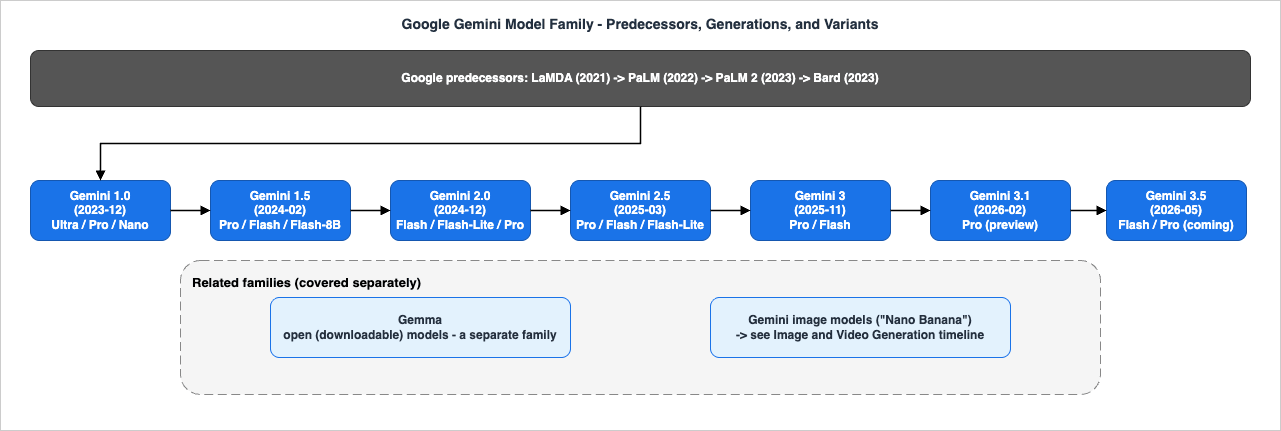
| Generation | Representative Variants | Input → Output | Notes |
|---|---|---|---|
| Gemini 1.0 | Ultra, Pro, Nano | Text, image, audio, video → Text | First natively multimodal Gemini; Nano runs on-device on Pixel. |
| Gemini 1.5 | Pro, Flash, Flash-8B | Text, image, audio, video → Text | Mixture-of-experts; long context (1M then 2M tokens); Flash added as a fast, efficient tier. |
| Gemini 2.0 | Flash, Flash-Lite, Pro | Text, image, audio, video → Text (native audio via the Multimodal Live API) | The "agentic era"; Multimodal Live API; Flash-Lite added as the most cost-efficient tier. |
| Gemini 2.5 | Pro, Flash, Flash-Lite | Text, image, audio, video → Text | "Thinking" models that reason before responding; Deep Think mode; a Computer Use model. |
| Gemini 3 | Pro, Flash | Text, image, audio, video → Text | Advanced reasoning and agentic coding; Deep Think; launched across many surfaces on day one. |
| Gemini 3.1 | Pro (preview), Flash-Lite | Text, image, audio, video → Text | An iteration of the Gemini 3 generation; 3.1 Pro shipped in preview, and 3.1 Flash-Lite reached general availability as the cost-efficient tier. |
| Gemini 3.5 | Flash, Flash-Lite; Pro (announced) | Text, image, audio, video → Text | "Frontier intelligence with action"; computer use built into Flash; 3.5 Flash-Lite reached general availability as the fastest, most cost-efficient 3.5 model; 3.5 Flash Cyber, a specialized cybersecurity model, is paired with the CodeMender code security agent; 3.5 Pro announced, not yet generally available at the time of writing. |
| Gemini 3.6 | Flash | Text, image, audio, video → Text | An iteration of the 3.x Flash line focused on token efficiency and coding / agentic-planning capability, positioned at a lower price point than 3.5 Flash. |
| Gemini 3.7 | Flash | Text, image, audio, video → Text | Released three weeks after 3.6 Flash as Google's most intelligent workhorse model yet for coding and agents, with gains in software engineering, knowledge work, and web development. |
| Gemini 3.8 | Flash | Text, image, audio, video → Text | Described by Google as its best reasoning and coding model yet at the speed and cost of 3.7 Flash; 3.8 Flash Cyber is a cybersecurity model offered only to trusted defenders through the Fairwind Program. |
Two related families sit just outside this table. Gemma is Google's family of open, downloadable models built from the same research and technology as Gemini; it is discussed briefly under Platform Availability. Google's image and video generation models - Imagen, Veo, and the Gemini image models - are covered in a separate article, as noted in the Overview.
Timeline of Major Releases
Here is the chronological timeline of Google Gemini releases and the major capability and platform milestones built on them, beginning with the pre-Gemini models for context. Each row links to the official Google announcement or documentation where one is available.* The table can be sorted by clicking on the column names.
| Date | Event |
|---|---|
| 2021-05-18 | LaMDA is announced at Google I/O - a conversational language model that becomes an early foundation for Bard. Source: LaMDA: our breakthrough conversation technology. |
| 2022-04-04 | PaLM is announced - the Pathways Language Model, a 540-billion-parameter model from Google Research. Source: Pathways Language Model (PaLM). |
| 2023-03-21 | Bard opens to the public in the US and UK (first revealed to trusted testers on February 6, 2023), initially powered by a lightweight LaMDA model. Source: Try Bard and share your feedback. |
| 2023-05-10 | PaLM 2 is announced at Google I/O 2023, powering Bard and many Google features. Source: Introducing PaLM 2. |
| 2023-12-06 | Gemini 1.0 is announced in three sizes - Ultra, Pro, and Nano - as Google's first natively multimodal model family. A fine-tuned Gemini Pro begins powering Bard, and Gemini Nano ships on the Pixel 8 Pro for on-device features. Source: Introducing Gemini: our largest and most capable AI model. |
| 2023-12-13 | The Gemini API and Google AI Studio launch for developers, with Gemini Pro (and Gemini Pro Vision) accessible via the API; Gemini Pro also becomes available on Vertex AI. Source: Gemini API and more, now available to developers and enterprises. |
| 2024-02-08 | Bard is renamed Gemini, and Gemini Advanced launches with access to Ultra 1.0, along with new Gemini mobile app experiences. Source: Bard becomes Gemini. |
| 2024-02-15 | Gemini 1.5 is announced, led by Gemini 1.5 Pro - a mixture-of-experts model with a long-context window of up to one million tokens, initially in private preview. Source: Our next-generation model: Gemini 1.5. |
| 2024-02-16 | On Vertex AI, Gemini 1.0 Pro reaches general availability (with Gemini 1.0 Ultra available via allowlist), and Gemini 1.5 Pro enters private preview. Source: Gemini 1.0 Pro on Vertex AI is now GA. |
| 2024-04-09 | Gemini 1.5 Pro enters public preview on Vertex AI at Google Cloud Next 2024. Source: Google Cloud Next 2024 generative AI news. |
| 2024-05-14 | At Google I/O 2024, Gemini 1.5 Flash is announced - a lighter-weight, faster model - and Gemini 1.5 Pro's context window is expanded to two million tokens (via waitlist); Gemini Nano gains multimodal input. Source: Gemini breaks new ground: 1.5 Flash and updates. |
| 2024-05-30 | Gemini 1.5 Pro and Gemini 1.5 Flash become generally available in the Gemini API and Google AI Studio, with 1.5 Flash tuning support and higher rate limits announced alongside; general availability on Vertex AI followed, announced on 2024-06-27. Sources: Gemini 1.5 Pro and 1.5 Flash GA (Google Developers Blog), Vertex AI offers enterprise-ready generative AI. |
| 2024-09-24 | Gemini 1.5 Pro-002 and Gemini 1.5 Flash-002 are released as updated, production-ready models, and the two-million-token context window for Gemini 1.5 Pro reaches general availability (on Vertex AI, September 25, 2024). Sources: Updated production-ready Gemini models, Gemini model updates on Vertex AI. |
| 2024-10-03 | Gemini 1.5 Flash-8B reaches general availability - the smallest, most efficient 1.5 model. Source: Gemini 1.5 Flash-8B is now generally available. |
| 2024-12-11 | Gemini 2.0 Flash is introduced (experimental), framed as the start of the "agentic era," alongside the Deep Research feature in Gemini Advanced and a new Multimodal Live API for real-time audio and video streaming. Source: Introducing Gemini 2.0. |
| 2025-02-05 | Gemini 2.0 Flash reaches general availability, Gemini 2.0 Flash-Lite arrives in public preview, and Gemini 2.0 Pro is released as an experimental model. Sources: Gemini 2.0 is now available to everyone, The Gemini 2.0 family expands. |
| 2025-02-25 | Gemini 2.0 Flash-Lite reaches general availability in the Gemini API for production use in Google AI Studio and on Vertex AI. Source: Start building with the Gemini 2.0 Flash family. |
| 2025-03-25 | Gemini 2.5 Pro is released (experimental) - the first Gemini 2.5 "thinking" model, capable of reasoning through its thoughts before responding. Source: Gemini 2.5: our most intelligent AI model. |
| 2025-04-09 | Gemini 2.5 Flash is announced at Google Cloud Next 2025 as the 2.5 family's low-latency, cost-efficient workhorse model, launching on Vertex AI and in Google AI Studio. Source: Gemini 2.5 on Vertex AI: Pro, Flash and Model Optimizer Live. |
| 2025-05-20 | At Google I/O 2025, Gemini gains Deep Think - an enhanced reasoning mode for Gemini 2.5 Pro - along with native audio output and improvements to the Live API. Source: Gemini updates at Google I/O 2025. |
| 2025-06-17 | Gemini 2.5 Pro and Gemini 2.5 Flash reach general availability (stable versions) across the Gemini API, Google AI Studio, and Vertex AI, and Gemini 2.5 Flash-Lite is introduced in preview. Source: Gemini 2.5 model family expands. |
| 2025-07-22 | Gemini 2.5 Flash-Lite reaches general availability as the fastest and lowest-cost model in the 2.5 family. Source: Gemini 2.5 Flash-Lite is now stable and generally available. |
| 2025-08-01 | Gemini 2.5 Deep Think rolls out to Google AI Ultra subscribers in the Gemini app, with API access to trusted testers following. Source: Gemini 2.5 Deep Think is rolling out. |
| 2025-10-07 | The Gemini 2.5 Computer Use model is released (preview) - a specialized model, built on Gemini 2.5 Pro, for agents that take actions across browser and mobile interfaces. Source: Introducing the Gemini 2.5 Computer Use model. |
| 2025-11-18 | Gemini 3 Pro is announced, and Gemini 3 Deep Think is introduced (initially for safety testers). Gemini 3 Pro is made available on day one across the Gemini app, AI Mode in Search, Google AI Studio, Vertex AI, the Gemini CLI, and Google Antigravity. Source: A new era of intelligence with Gemini 3. |
| 2025-11-20 | Google Antigravity launches in public preview - an agentic development platform (editor, terminal, and browser access for agents) introduced alongside Gemini 3. Source: Build with Google Antigravity. |
| 2025-12-04 | Gemini 3 Deep Think rolls out to Google AI Ultra subscribers in the Gemini app. Source: Gemini 3 Deep Think is rolling out. |
| 2025-12-17 | Gemini 3 Flash launches - a fast, efficient model with frontier-level reasoning - and becomes the default model in the Gemini app, rolling out across the Gemini API, Google AI Studio, Vertex AI, Antigravity, and the Gemini CLI. Source: Gemini 3 Flash. |
| 2026-02-12 | Gemini 3 Deep Think is upgraded for science, research, and engineering tasks, and is offered via the Gemini API for the first time to select researchers, engineers, and enterprises through an early-access program. Source: An upgraded Gemini 3 Deep Think. |
| 2026-02-19 | Gemini 3.1 Pro is released in preview across the Gemini API, Vertex AI, the Gemini app, and NotebookLM, ahead of a planned general availability. Source: Gemini 3.1 Pro. |
| 2026-03-03 | Gemini 3.1 Flash-Lite is announced in preview as the most cost-efficient tier of the Gemini 3 series, continuing the Flash-Lite line from the 2.0 and 2.5 generations. Source: Gemini 3.1 Flash Lite: Our most cost-effective AI model yet. |
| 2026-05-08 | Gemini 3.1 Flash-Lite reaches general availability, described by Google as its fastest and most cost-efficient Gemini 3 series model. Source: Gemini 3.1 Flash-Lite is now generally available. |
| 2026-05-19 | At Google I/O 2026, the Gemini 3.5 family is announced and Gemini 3.5 Flash reaches general availability ("frontier intelligence with action"); Gemini 3.5 Pro is announced as coming (used internally, "rolling out next month"), and Google also announces Gemini Omni, a multimodal generation model family covered in my separate Image and Video Generation Model Release Timeline. Source: Introducing Gemini 3.5, Introducing Gemini Omni. |
| 2026-06-24 | Computer use becomes a built-in tool in Gemini 3.5 Flash, letting developers build agents that see, reason, and take action across browser, mobile, and desktop environments, via the Gemini API. Source: Computer use in Gemini 3.5 Flash. |
| 2026-07-21 | Gemini 3.6 Flash and Gemini 3.5 Flash-Lite reach general availability in the Gemini API. Gemini 3.6 Flash improves token efficiency and coding / agentic-planning capability over Gemini 3.5 Flash at a lower price point, and Gemini 3.5 Flash-Lite arrives as the fastest, most cost-efficient model in the 3.5 family, aimed at high-volume automation and subagent workloads; both offer a one-million-token context window and the built-in Computer Use tool. The same release deprecates the temperature, top_p, and top_k sampling parameters for these and all future Gemini models. The same day, Google introduced Gemini 3.5 Flash Cyber, a specialized cybersecurity model paired with its CodeMender code security agent, and said that Gemini 3.5 Pro was testing with partners ahead of broad availability. Sources: Gemini API release notes, Introducing Gemini 3.6 Flash, 3.5 Flash-Lite, and 3.5 Flash Cyber. |
| 2026-08-13 | Gemini 3.7 Flash is released, three weeks after Gemini 3.6 Flash, as Google's most intelligent workhorse model yet for coding and agents, with gains in software engineering, knowledge work, and web development. It became generally available in the Gemini API as gemini-3.7-flash, and it began powering Gemini Spark, the personal agent in the Gemini app for Google AI Pro and Ultra subscribers. Source: Introducing Gemini 3.7 Flash. |
| 2026-09-01 | Agentic video understanding is released for Gemini 3.7 Flash, 3.6 Flash, and 3.5 Flash-Lite in the Gemini API: the model navigates a video's timeline and requests transcripts, frames, or audio tracks as it needs them, which Google reports uses up to 88% fewer tokens on long-form content than static processing. Sources: Introducing agentic video understanding with Gemini, Gemini API release notes. |
| 2026-09-02 | Gemini 3.8 Flash and Gemini 3.8 Flash Cyber are released - the third Flash release in six weeks. Google describes Gemini 3.8 as its best reasoning and coding model yet at the speed and cost of 3.7 Flash, built for long-horizon software engineering and autonomous agents. Gemini 3.8 Flash is available in the Gemini API as gemini-3.8-flash, in Google Antigravity, in Gemini Enterprise, and in the Gemini app for Google AI Pro and Ultra subscribers, while Gemini 3.8 Flash Cyber, a cybersecurity model for vulnerability detection and automated patching, is offered only to trusted defenders through the new Fairwind Program. Source: Introducing Gemini 3.8 Flash and 3.8 Flash Cyber. |
There may be slight variations in the dates in this timeline due to differences between the original announcement, general availability, and the release date shown on individual model cards or in the API version history. For example, several models were announced as "experimental" or "preview" before reaching a later "stable" general availability; where these differ, the dates above prioritize the official Google announcement. As of this writing (September 2026), the latest generally available Gemini model among those covered here is Gemini 3.8 Flash (generally available on September 2, 2026); Gemini 3.1 Pro is in preview, and Gemini 3.5 Pro, announced at Google I/O as rolling out the following month, is still listed as coming soon on the Google DeepMind Gemini page. Any specific launch date for Gemini 3.5 Pro that circulates before an official Google announcement should be treated as unconfirmed.
The content posted here is limited to major releases and milestones considered essential for understanding the Google Gemini model family and its evolution.
In other words, please note that the items on this timeline are not all of Gemini's updates, but representative releases that I have picked out.
Capability Evolution
Beyond the model release dates themselves, Gemini has added a steady stream of capabilities across the family. The table below tracks when each major capability first became available, and on which model or surface.
| Capability | First Introduced | First Model / Surface | Notes |
|---|---|---|---|
| Native multimodal understanding | 2023-12-06 | Gemini 1.0 | Built from the start to reason across text, images, audio, and video. |
| On-device model | 2023-12-06 | Gemini Nano (Pixel 8 Pro) | The smallest size, designed to run on-device. |
| Long context (one million tokens) | 2024-02-15 | Gemini 1.5 Pro | A one-million-token context window (private preview at launch). |
| Fast, efficient tier | 2024-05-14 | Gemini 1.5 Flash | A lighter-weight model tuned for speed and scale. |
| Long context (two million tokens) | 2024-05-14 | Gemini 1.5 Pro | Two-million-token context (waitlist at I/O 2024; GA on Vertex AI on 2024-09-25). |
| Real-time streaming (Multimodal Live API) | 2024-12-11 | Gemini 2.0 Flash | Real-time audio and video streaming; native audio output expanded at I/O 2025. |
| Most cost-efficient tier | 2025-02-05 | Gemini 2.0 Flash-Lite | The lowest-cost tier, added in the 2.0 generation. |
| Thinking / reasoning models | 2025-03-25 | Gemini 2.5 Pro | Models that reason through their thoughts before responding. |
| Deep Think (enhanced reasoning mode) | 2025-05-20 | Gemini 2.5 Pro | Announced at I/O 2025; rolled out in the Gemini app on 2025-08-01; offered via API for Gemini 3 Deep Think on 2026-02-12. |
| Agentic computer use | 2025-10-07 | Gemini 2.5 Computer Use | Taking actions across browser and mobile; later built into Gemini 3.5 Flash (2026-06-24). |
| Frontier reasoning and agentic coding | 2025-11-18 | Gemini 3 Pro | Advanced reasoning and agentic coding across many surfaces on day one. |
| Agentic video understanding | 2026-09-01 | Gemini 3.7 Flash / 3.6 Flash / 3.5 Flash-Lite | The model navigates a video's timeline and requests transcripts, frames, or audio tracks on demand. |
Google's dedicated image and video generation capabilities - including the Gemini image models informally known as "Nano Banana" and the Gemini Omni multimodal generation family - are part of the broader Gemini story but are covered in my separate Image and Video Generation Model Release Timeline to keep this article focused on the language and multimodal-understanding models. For the agentic and tool-use side of these models, see also my Tool Use and Agent Protocol History and Timeline.
Platform Availability (Gemini API, Gemini Enterprise Agent Platform, and the Gemini App)
Unlike Amazon Nova, which is delivered exclusively through Amazon Bedrock, Gemini is offered across several surfaces at once: a developer platform (the Gemini API and Google AI Studio), an enterprise platform (Gemini Enterprise Agent Platform, formerly Vertex AI), consumer products (the Gemini app, formerly Bard), and productivity tools (Google Workspace). The table below summarizes when Gemini first became available on each surface.* The table can be sorted by clicking on the column names.
| Surface | First Gemini Availability | Notes |
|---|---|---|
| Gemini API + Google AI Studio | 2023-12-13 | Developer access to Gemini Pro; Google AI Studio is the free web-based prototyping tool. |
| Vertex AI (now Gemini Enterprise Agent Platform) | 2023-12-13 | Gemini Pro on Vertex AI (public preview 2023-12-14); Gemini 1.0 Pro GA on 2024-02-16 for enterprise use. |
| Gemini app (formerly Bard) | 2024-02-08 | Bard (launched 2023) was renamed Gemini and gained dedicated mobile app experiences. |
| Google Workspace | 2024-02-21 | "Duet AI for Google Workspace" was rebranded to "Gemini for Google Workspace." |
| Agentic developer surfaces | 2025-11 | Google Antigravity and the Gemini CLI, launched with the Gemini 3 generation. |
For developers, the Gemini API and Google AI Studio launched on December 13, 2023 and remain the primary path to build with Gemini; Google AI Studio is the free, web-based environment for prototyping. For enterprises, Gemini became available on Vertex AI, where Gemini 1.0 Pro reached general availability on February 16, 2024 and later generations followed. Note that at Google Cloud Next in April 2026, Google announced the Gemini Enterprise Agent Platform as the next evolution of Vertex AI, stating that future Vertex AI services and roadmap evolutions will be delivered through the Agent Platform (source: Introducing Gemini Enterprise Agent Platform) — the models themselves remain available to enterprises, and Google Cloud now presents the platform as Gemini Enterprise Agent Platform (formerly Vertex AI). On the consumer side, the Gemini app is the renamed Bard: Google opened Bard to the public in March 2023 and renamed it Gemini on February 8, 2024, later shipping standalone mobile apps. Across productivity tools, Google rebranded "Duet AI for Google Workspace" to Gemini for Google Workspace on February 21, 2024. Source for the Workspace rebrand: Gemini for Google Workspace.
A notable shift arrived with the Gemini 3 generation: rather than a staged rollout, Gemini 3 Pro and Gemini 3 Flash launched across many surfaces on day one - the Gemini app, AI Mode in Search, Google AI Studio, Vertex AI, the Gemini CLI, and the new Google Antigravity agentic development platform. For the most current model availability by surface, Google maintains an authoritative model list in the Google DeepMind Gemini models pages and the Gemini API and Gemini Enterprise Agent Platform documentation.
Finally, a note on Gemma. Gemma is Google's family of open (downloadable) models, built from the same research and technology used to create Gemini, and is a separate track from the Gemini API and app products. Gemma 1 was released on February 21, 2024 (source: Gemma: Introducing new state-of-the-art open models), followed by Gemma 2 (June 2024), Gemma 3 (March 2025; source: Introducing Gemma 3), and Gemma 4 (April 2026; source: Gemma 4: Byte for byte, the most capable open models). A dedicated open-weights timeline is a natural companion to this article; here, Gemma is noted only for how it relates to the Gemini lineage.
Frequently Asked Questions
When was Google Gemini launched?
Gemini 1.0 was announced on December 6, 2023 in three sizes - Ultra, Pro, and Nano - as Google's first natively multimodal model family, and a fine-tuned Gemini Pro immediately began powering Bard. The Gemini API and Google AI Studio launched for developers on December 13, 2023, and on February 8, 2024 Google renamed the Bard app to Gemini and launched Gemini Advanced. See the official Introducing Gemini announcement.What is the difference between Gemini Ultra, Pro, Flash, Flash-Lite, and Nano?
These are size and price-performance tiers within a generation. Ultra was the largest, most capable size and appeared only in Gemini 1.0. Pro is the most capable general-purpose tier and appears in every generation through Gemini 3.5, although 3.5 Pro was not yet generally available at the time of writing; the 3.6, 3.7, and 3.8 models covered here are Flash only. Flash, introduced with Gemini 1.5, is a lighter-weight tier tuned for speed and efficiency. Flash-Lite, introduced with Gemini 2.0, is the most cost-efficient tier. Nano is the on-device size, first shipped on the Pixel 8 Pro. From Gemini 2.5 onward, the Pro and Flash tiers became "thinking" models that reason before responding.What is the difference between Gemini 1.5 and Gemini 2.0?
Gemini 1.5 (February 2024) introduced a mixture-of-experts architecture and a breakthrough long-context window - up to one million tokens, later two million - and added the fast Gemini 1.5 Flash tier. Gemini 2.0 (December 2024) was framed around the "agentic era": it introduced Gemini 2.0 Flash, a new Multimodal Live API for real-time audio and video, the Deep Research feature, and later the most cost-efficient Gemini 2.0 Flash-Lite tier. In short, 1.5 was defined by long context and multimodality, while 2.0 emphasized real-time and agentic use. See Gemini 1.5 and Gemini 2.0.When did Gemini's long context window (one million and two million tokens) become available?
The one-million-token context window arrived with Gemini 1.5 Pro, announced on February 15, 2024 (in private preview at first). The two-million-token context window was announced at Google I/O on May 14, 2024 via waitlist, and reached general availability on Vertex AI on September 25, 2024. See the I/O 2024 update.When did Bard become Gemini?
Google renamed the Bard app to Gemini on February 8, 2024, and at the same time launched Gemini Advanced with access to Ultra 1.0 and new mobile app experiences. Bard itself had launched publicly in March 2023. See Bard becomes Gemini.When did the Gemini 2.5 "thinking" models come out?
Gemini 2.5 Pro was released as an experimental "thinking" model on March 25, 2025; Gemini 2.5 Flash was announced in April 2025; and Gemini 2.5 Pro and Flash reached stable general availability on June 17, 2025, with Gemini 2.5 Flash-Lite reaching general availability on July 22, 2025. Thinking models are designed to reason through their thoughts before responding. See Gemini 2.5.When was Gemini 3 released, and what is the latest Gemini model?
Gemini 3 Pro was announced on November 18, 2025, and Gemini 3 Flash followed on December 17, 2025 (becoming the default model in the Gemini app). Gemini 3.1 Pro was released in preview on February 19, 2026, Gemini 3.1 Flash-Lite followed (preview on March 3, 2026, generally available on May 8, 2026), and at Google I/O on May 19, 2026 the Gemini 3.5 family was announced with Gemini 3.5 Flash reaching general availability. On July 21, 2026, Gemini 3.6 Flash and Gemini 3.5 Flash-Lite reached general availability in the Gemini API, followed by Gemini 3.7 Flash on August 13, 2026 and Gemini 3.8 Flash on September 2, 2026. As of this writing (September 2026), the latest generally available model among those covered in this article is Gemini 3.8 Flash; Gemini 3.5 Pro, announced at Google I/O as rolling out the following month, was still testing with partners as of July 21, 2026, and the Google DeepMind Gemini page still lists it as coming soon. See Gemini 3, Gemini 3.5, Introducing Gemini 3.8 Flash and 3.8 Flash Cyber, and the Gemini API release notes.What is Gemini Deep Think?
Deep Think is an enhanced reasoning mode layered on the Pro tier, rather than a separate model. It was announced for Gemini 2.5 Pro at Google I/O 2025 (May 20, 2025) and rolled out in the Gemini app to Google AI Ultra subscribers on August 1, 2025. With the Gemini 3 generation, Gemini 3 Deep Think rolled out in the Gemini app on December 4, 2025, and an upgraded Gemini 3 Deep Think was offered via the Gemini API to select users on February 12, 2026. See Gemini 2.5 Deep Think. Google DeepMind's model page now presents that upgraded version as Gemini 3.1 Deep Think, built on top of Gemini 3.1 Pro.Where can I use Gemini models - the Gemini API, Gemini Enterprise Agent Platform, or the Gemini app?
All of the above, depending on the use case. Developers build with the Gemini API and prototype in Google AI Studio (both launched December 13, 2023). Enterprises use Gemini on Google Cloud: Gemini 1.0 Pro reached general availability on Vertex AI on February 16, 2024, and since April 2026 Google has offered Vertex AI's capabilities within Gemini Enterprise Agent Platform. End users interact with Gemini through the Gemini app (the renamed Bard) and through Gemini for Google Workspace. With the Gemini 3 generation, Google also added agentic developer surfaces such as the Gemini CLI and Google Antigravity. Unlike Amazon Nova, which is Bedrock-native, Gemini's multi-surface availability is a defining characteristic of its timeline.How is Gemma related to Gemini?
Gemma is Google's family of open (downloadable) models, built from the same research and technology used to create Gemini, but it is a separate track: Gemma models are downloadable and run wherever you host them, whereas Gemini is offered through the Gemini API, Gemini Enterprise Agent Platform (formerly Vertex AI), and the Gemini app. Gemma 1 was released on February 21, 2024, followed by Gemma 2 (June 2024), Gemma 3 (March 2025), and Gemma 4 (April 2026). See Gemma open models.Does this timeline cover Imagen and Veo (image and video generation)?
No. To keep this article focused on the Gemini language and multimodal-understanding models, Google's dedicated image and video generation models - Imagen, Veo, and the Gemini image models such as the Gemini 2.5 Flash Image model informally called "Nano Banana" - are covered in my separate Image and Video Generation Model Release Timeline.Summary
In this article, I built a historical timeline of Google Gemini, from Google's earlier language models (LaMDA, PaLM, and PaLM 2) and the launch of Gemini 1.0 in December 2023, through the Gemini 1.5, 2.0, and 2.5 generations, to the Gemini 3 generation and the Gemini 3.5 through 3.8 models available at the time of writing, organized by the model family, the major release timeline, the evolution of capabilities, and platform availability.In under three years, Gemini grew from a natively multimodal model family (Ultra, Pro, and Nano) into a broad set of generations and tiers - adding the fast Flash and cost-efficient Flash-Lite tiers, a long-context window that reached two million tokens, the Multimodal Live API for real-time interaction, "thinking" models with the Deep Think reasoning mode, and agentic computer use. Throughout, a defining characteristic has been that Gemini is delivered across many surfaces at once - the Gemini API and Google AI Studio, Gemini Enterprise Agent Platform (formerly Vertex AI), the Gemini app, and Google Workspace - a contrast with the Bedrock-native Amazon Nova family.
I will continue to monitor how Google's Gemini release cadence and capability roadmap evolve. The most reliable places to track new model announcements are Google's official blog and the Google DeepMind Gemini models pages, together with the Gemini API and Gemini Enterprise Agent Platform documentation.
In addition, there are also related model-timeline and history articles on hidekazu-konishi.com, so please have a look if you are interested.
Anthropic Claude Model Release Timeline - Model Family Tree, Capability Evolution, and Platform Availability
OpenAI GPT Model Release Timeline - Model Lineage, ChatGPT and Codex Milestones, and Platform Availability
Amazon Nova Model Release Timeline - Model Family, Capability Evolution, and Availability on Amazon Bedrock
Image and Video Generation Model Release Timeline
Tool Use and Agent Protocol History and Timeline
References
- Google - LaMDA: our breakthrough conversation technology (2021-05-18)
- Google Research - Pathways Language Model (PaLM) (2022-04-04)
- Google - Try Bard and share your feedback (2023-03-21)
- Google - Introducing PaLM 2 (2023-05-10)
- Google - Introducing Gemini: our largest and most capable AI model (2023-12-06)
- Google - Gemini API and more, now available to developers and enterprises (2023-12-13)
- Google Cloud - Gemini support on Vertex AI (2023-12)
- Google - Bard becomes Gemini (2024-02-08)
- Google - Our next-generation model: Gemini 1.5 (2024-02-15)
- Google Cloud - Gemini on Vertex AI expands (2024-02-16)
- Google - Google Cloud Next 2024: generative AI and Gemini (2024-04-09)
- Google - Gemini 1.5 Flash and updates at Google I/O 2024 (2024-05-14)
- Google Developers - Gemini 1.5 Pro and 1.5 Flash GA (2024-05-30)
- Google Cloud - Vertex AI offers enterprise-ready generative AI (2024-06-27)
- Google Developers - Updated production-ready Gemini 1.5 models (2024-09-24)
- Google Cloud - Gemini model updates and the 2M context window GA on Vertex AI (2024-09-25)
- Google Developers - Gemini 1.5 Flash-8B is now generally available (2024-10-03)
- Google - Introducing Gemini 2.0 (2024-12-11)
- Google - Gemini 2.0 is available to everyone (2025-02-05)
- Google Developers - The Gemini 2.0 family expands (2025-02-05)
- Google Developers - Start building with the Gemini 2.0 Flash family (2025-02-25)
- Google - Gemini 2.5: our most intelligent AI model (2025-03-25)
- Google Cloud - Gemini 2.5 on Vertex AI: Pro, Flash and Model Optimizer Live (2025-04-09)
- Google - Gemini updates at Google I/O 2025 (2025-05-20)
- Google - Gemini 2.5 model family expands (2025-06-17)
- Google Developers - Gemini 2.5 Flash-Lite is now stable and generally available (2025-07-22)
- Google - Gemini 2.5 Deep Think is rolling out (2025-08-01)
- Google - Introducing the Gemini 2.5 Computer Use model (2025-10-07)
- Google - A new era of intelligence with Gemini 3 (2025-11-18)
- Google Developers - Build with Google Antigravity (2025-11-20)
- Google - Gemini 3 Deep Think is rolling out (2025-12-04)
- Google - Gemini 3 Flash (2025-12-17)
- Google - An upgraded Gemini 3 Deep Think (2026-02-12)
- Google - Gemini 3.1 Pro (2026-02-19)
- Google - Gemini 3.1 Flash Lite (2026-03-03)
- Google Cloud - Gemini 3.1 Flash-Lite is now generally available (2026-05-08)
- Google - Introducing Gemini 3.5 (2026-05-19)
- Google - Computer use in Gemini 3.5 Flash (2026-06-24)
- Google AI for Developers - Gemini API release notes (Gemini 3.6 Flash and Gemini 3.5 Flash-Lite GA, 2026-07-21)
- Google - Introducing Gemini 3.6 Flash, 3.5 Flash-Lite, and 3.5 Flash Cyber (2026-07-21)
- Google - Introducing Gemini 3.7 Flash (2026-08-13)
- Google - Introducing agentic video understanding with Gemini (2026-09-01)
- Google - Introducing Gemini 3.8 Flash and 3.8 Flash Cyber (2026-09-02)
- Google AI for Developers - Using the latest Gemini models
- Google Workspace Updates - Gemini for Google Workspace (2024-02-21)
- Google - Gemma: Introducing new state-of-the-art open models (2024-02-21)
- Google Developers - Introducing Gemma 3 (2025-03-12)
- Google - Gemma 4: Byte for byte, the most capable open models (2026-04-02)
- Google DeepMind - Gemini 3.1 Deep Think
- Google Cloud - Gemini Enterprise Agent Platform (formerly Vertex AI)
- Google DeepMind - Gemini models
References:
Tech Blog with curated related content
Written by Hidekazu Konishi