CIS AWS Foundations Benchmark v5.0.0 in Security Hub CSPM - What Each Control Checks and What Is Left to You
First Published:
Last Updated:
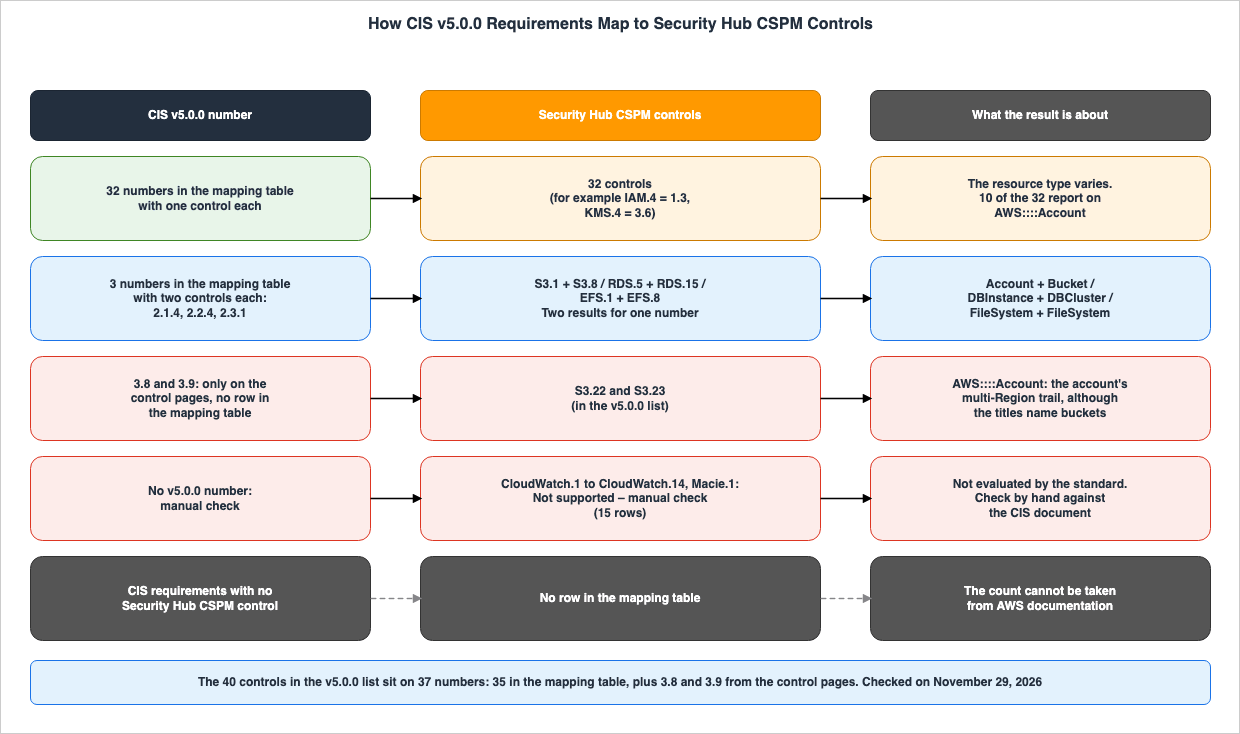
Here is the conclusion first. The 40 controls do not represent 40 distinct requirements. The mapping table on the CSPM page gives numbers to 38 rows in the v5.0.0 column, but there are only 35 distinct numbers. This is because there are three numbers that each carry two controls. Additionally, controls S3.22 and S3.23 are in the v5.0.0 list and on their control pages but have no row in the mapping table. Adding these two brings the count to 37 distinct numbers. Some controls also have a title and an evaluation unit that differ. For example, the title of control S3.22 refers to buckets, but the control evaluates the account's trail. Controls EC2.53 and EC2.54 only examine ports 22 and 3389. Controls IAM.6 and IAM.9 will show a "PASSED" status on accounts that have no root user credentials. In the v5.0.0 column of the mapping table, controls CloudWatch.1 through CloudWatch.14 and Macie.1 are marked as requiring
manual check. While CSPM supports CIS versions up to v5.0.0, the CIS Amazon Web Services Benchmarks page lists 7.1.0 as an available version.This article was written based on reviewing the documentation as of November 29, 2026 (Japan Standard Time). It has not been tested in a live environment. Pricing information is not included. The full text of CIS recommendations can be found in the official CIS documentation; this article does not reproduce that content. This article lists CIS requirements by number and uses the AWS control titles instead of CIS titles. This article was written prior to AWS re:Invent 2026 (November 30 to December 4, 2026) and does not include any information that will be presented at that event. When you read it, open the CSPM pages again.
Related articles on this site:
- When a Security Hub CSPM Result Is Not About the Resource - Organization Analyzers, Config.1, and Account-Level Checks
- Tuning Security Hub CSPM Without Hiding Findings - Control Parameters, Automation Rules, Suppression, and Disabled Controls
- AWS Config Rules and Conformance Packs - Compliance Detection, Automated Remediation, and Organizations Deployment
- Root Sessions in AWS Organizations - Centralized Root Access, Task Policies, and the Break-Glass You Still Need
- Centralized Logging and Audit Architecture on AWS - Multi-Account Log Aggregation, Detection, and Query with CloudTrail, Config, Security Hub, and OpenSearch
Table of Contents
- 1. Scope and Assumptions
- 2. A Map of the Versions
- 3. Table of 40 Controls
- 4. The Number of Controls and the Number of Requirements
- 5. Controls Where the Title and the Evaluation Unit Do Not Match
- 6. Requirements Not Verified by CSPM
- 7. From v3.0.0 to v5.0.0
- 8. Assumptions for Evaluation
- 9. Manual Verification Checklist
- 10. Frequently Asked Questions about Security Hub CSPM and the CIS AWS Foundations Benchmark v5.0.0
- 11. Summary
- 12. References
1. Scope and Assumptions
This chapter first defines the intended audience, the scope of this article, the referenced materials, the terminology used, and the notation used in the descriptions. The conclusions are outlined below:- CSPM supports four versions of the CIS benchmark: v5.0.0, v3.0.0, v1.4.0, and v1.2.0. The CIS Amazon Web Services Benchmarks page lists 7.1.0 as an available version (Chapter 2).
- The v5.0.0 standard includes 40 controls. For each control, the resource type, schedule type, parameters, and AWS Config rules are defined (Chapter 3).
- There are 37 different CIS numbers associated with these 40 controls. When counting only through the mapping table, the number is 35 (Chapter 4).
- Some controls have different titles and evaluation units, and others do not produce results under certain conditions (Chapter 5).
- The v5.0.0 column of the mapping table includes 27 rows that begin with "Not supported" instead of a CIS number. Of these, 15 rows are manual check (Chapter 6).
- From v3.0.0 to v5.0.0, three controls have been added, and the CIS numbers for 23 controls have changed (Chapter 7).
1.1 Intended Audience
This article is intended for:- Security professionals who have enabled the CIS AWS Foundations Benchmark standard within Security Hub CSPM, or those migrating from version 3.0.0 to version 5.0.0.
- Individuals who are preparing for audits and want to understand, for each control, which CSPM results can be used as evidence and which requirements need to be verified independently.
1.2 Scope: What This Article Covers, and What It Does Not
This article addresses the following topics:- The CIS versions supported by CSPM and the versions the CIS Amazon Web Services Benchmarks page shows.
- The 40 controls of the v5.0.0 standard, including their CIS numbers, resource types, schedule types, fixed parameters, and AWS Config rules.
- The differences between the number of controls and the number of CIS numbers.
- Controls where the title and evaluation unit do not align.
- Requirements that CSPM does not verify, as indicated in the mapping table.
- The addition and renumbering of controls from version 3.0.0 to version 5.0.0.
- The prerequisites for evaluation and a list of items to verify manually.
This article does not cover the following topics. An existing article or another source covers most of them:
- The full text, rationale, and audit procedures recommended by CIS. (Covered in CIS documentation.)
- The details of CIS requirements in version 6.0.0 and later. (Covered in CIS documentation.)
- Detailed reasons why a CSPM result might not reflect a specific resource (Config.1, IAM.28, the
AWS::::Accountcontrols, and global IAM resources). (Covered in When a Security Hub CSPM Result Is Not About the Resource.) - Disabling and suppressing controls in operation. (Covered in Tuning Security Hub CSPM Without Hiding Findings.)
- How to write AWS Config rules. (Covered in AWS Config Rules and Conformance Packs.)
- Deleting root user credentials. (Covered in Root Sessions in AWS Organizations.)
- Other standards, such as AWS Foundational Security Best Practices and NIST.
- Pricing.
1.3 Date of Review and Reviewed Materials
The materials were reviewed on November 29, 2026 (Japan Standard Time). The following materials were reviewed:- The CIS AWS Foundations Benchmark in Security Hub CSPM page of the Security Hub CSPM user guide (referred to as "the CIS page" in this article).
- The control pages of the user guide, for the following areas: Account, CloudTrail, CloudWatch, Config, EC2, EFS, IAM, KMS, Macie, RDS, and S3 (collectively referred to as "the control pages" in this article).
- The following pages of the user guide: Change log for Security Hub CSPM controls, Document history, What are Security Hub and Security Hub CSPM?, and Calculating security scores.
- What's New: AWS Security Hub CSPM now supports CIS AWS Foundations Benchmark v5.0 (October 16, 2025).
- The CIS Amazon Web Services Benchmarks page of CIS (only the list of versions was reviewed; the full PDF document was not read).
The CIS page states the supported versions as follows (Stated).
AWS Security Hub CSPM supports CIS AWS Foundations Benchmark versions 5.0.0, 3.0.0, 1.4.0, and 1.2.0.On the date the v5.0.0 standard was added, the document history says the following (Stated).
This new standard includes 40 existing security controls. The controls perform automated checks that evaluate certain resources for compliance with a subset of the requirements defined by the framework.In essence, none of the 40 controls were newly created specifically for this standard. And the controls verify a portion of the requirements defined by CIS.
1.4 Terminology
This article uses the following terms with specific meanings:| Term | Meaning in this Article |
|---|---|
| Control | A security control within CSPM, identified by an ID such as S3.22. |
| Requirement | A recommendation from the CIS AWS Foundations Benchmark, identified by a number such as 3.8. |
| Standard | A security standard within CSPM. In this article, this refers to each version of the CIS AWS Foundations Benchmark. |
| List | The list of controls for each version on the CIS page. |
| Mapping Table | The table on the CIS page that maps controls to the corresponding CIS numbers for each version. |
| Resource Type | The Resource type listed on a control's page, indicating which resource type the results pertain to. |
| Evaluation Unit | What a control actually examines to determine a result of PASSED or FAILED. |
| Manual Verification | When CSPM results are insufficient, this refers to the reader manually examining the state or configuration of a resource. |
1.5 Notations for Statements
This article marks statements with the following three notations:- (Stated): A primary source contains the statement.
- (Not documented): The statement was not found in the primary sources that were searched. This does not prove that it does not exist.
- (Inference): This article's inference, drawn by combining several statements in the primary sources.
Numbers marked (counted by this article) are counts taken from copies of the CIS page and the control pages. These numbers may change if the pages are revised.
2. A Map of the Versions
This chapter lists the versions supported by CSPM and the versions released by CIS.2.1 Four Versions Supported by CSPM
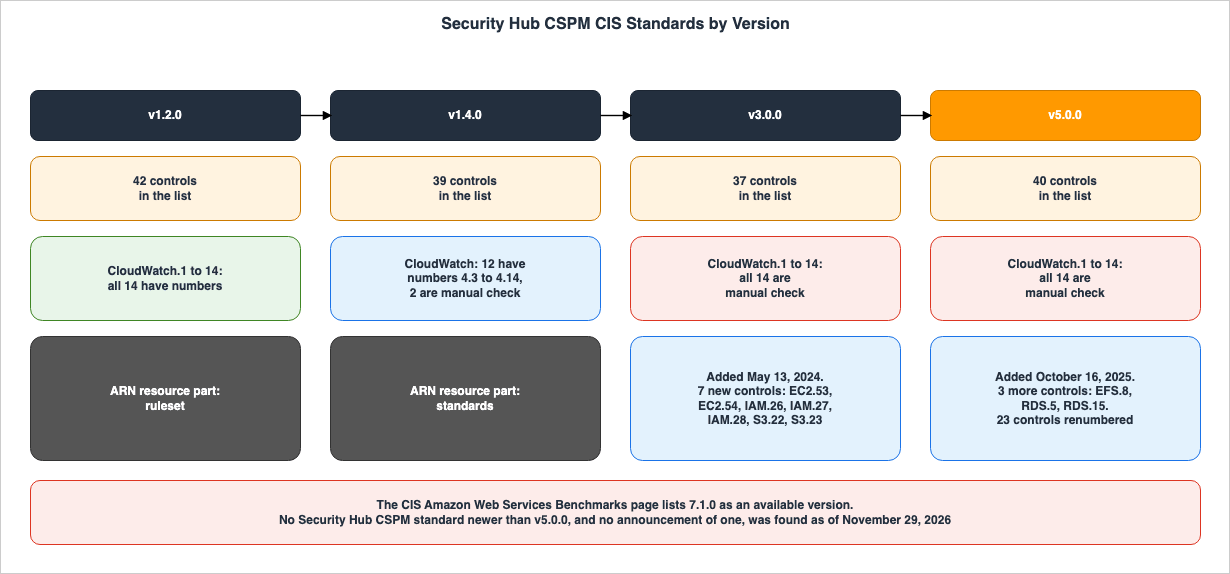
CSPM supports standards for four versions of the CIS AWS Foundations Benchmark (Stated). The ARN (Amazon Resource Name) for each version's standard, along with the number of controls included, is as follows. This article counted the controls in the lists on the CIS page.| Version | Standard ARN | Number of Controls |
|---|---|---|
| v5.0.0 | arn:aws:securityhub:{region}::standards/cis-aws-foundations-benchmark/v/5.0.0 | 40 |
| v3.0.0 | arn:aws:securityhub:{region}::standards/cis-aws-foundations-benchmark/v/3.0.0 | 37 |
| v1.4.0 | arn:aws:securityhub:{region}::standards/cis-aws-foundations-benchmark/v/1.4.0 | 39 |
| v1.2.0 | arn:aws:securityhub:::ruleset/cis-aws-foundations-benchmark/v/1.2.0 | 42 |
The
{region} placeholder stands for the AWS Region. Notably, only v1.2.0 uses ruleset instead of standards in the resource portion of the ARN (Stated).The v5.0.0 standard was added to CSPM on October 16, 2025 (Stated). v3.0.0 was added on May 13, 2024 (Stated). The CIS page states the following about v5.0.0 (Stated).
Security Hub CSPM has satisfied the requirements of CIS Security Software Certification and has been awarded CIS Security Software Certification for the following CIS Benchmarks:
CIS Benchmark for CIS AWS Foundations Benchmark, v5.0.0, Level 1
CIS Benchmark for CIS AWS Foundations Benchmark, v5.0.0, Level 2
This certification is a statement about the CSPM product. It is not a statement that your account complies with CIS (Inference).
2.2 "Stay Current" Is a Recommendation Among the Four Versions
The version comparison section of the CIS page says that CSPM supports all four versions, and then continues (Stated):However, we recommend using v5.0.0 to stay current with security best practices.This recommendation suggests selecting version 5.0.0 from the four versions supported by CSPM. It does not mean aligning with the latest version of CIS (Inference). The same section also states that it is possible to enable standards from multiple versions simultaneously (Stated).
The What's New post states that the 40 controls of the v5.0.0 standard evaluate compliance with
the latest version 5.0 requirements (Stated). This "latest" is as of the post on October 16, 2025 (Inference).2.3 Versions Published by CIS
The CIS Amazon Web Services Benchmarks page lists the currently available versions as follows (Stated).Recent versions available for CIS Benchmark: Amazon Web Services Foundations (7.1.0)The data that this page loads into its version list includes 6.0.0 and 7.0.0 between 5.0.0 and 7.1.0. This article verified these two versions against the data on the page. However, it did not verify the display in a web browser.
In contrast, the CSPM user guide lists no standard for a version newer than v5.0.0 (Stated). As of November 29, 2026, no announcements were found regarding the addition of standards for versions v6.0.0, v7.0.0, or v7.1.0 to CSPM (Not documented). This article conducted searches within AWS documentation, combining version numbers with the term CIS AWS Foundations Benchmark three times, and reviewed the document history up to the most recent entry (November 17, 2026). The details of the requirements for versions v6.0.0 and later are available in CIS documentation, and this article does not reproduce them. This article also does not detail what was added or changed from version v5.0.0.
The CIS page does not say how the standards for the three older versions will be handled in the future (Not documented).
2.4 Migration Path to v5.0.0
The CIS page gives the order for moving from an older version to v5.0.0 as follows (Stated).If you want to upgrade to v5.0.0, enable it before you disable an older version. This prevents gaps in your security checks.When you integrate with AWS Organizations and enable v5.0.0 in multiple accounts at once, the page recommends central configuration (Stated). The time it takes for findings to appear after you enable v5.0.0 is covered in Section 8.1.
2.5 Security Hub CSPM and Security Hub
AWS offers Security Hub CSPM and Security Hub as two complementary services. Findings from CSPM are automatically sent to Security Hub (Stated). AWS recommends enabling both services (Stated).As a best practice, we recommend enabling both services.The CIS standards and the control pages that this article covers are in the CSPM user guide (Stated). This article focuses solely on the standards and controls within CSPM.
3. Table of 40 Controls
This chapter lists the 40 controls of the v5.0.0 standard in order of CIS number.3.1 Reading the Table
Each column in the table is derived from the following resources:- Control and Title: Taken from the v5.0.0 list on the CIS page.
- CIS v5.0.0: The v5.0.0 column of the mapping table on the CIS page. For the two controls with no row in the mapping table, the numbers are taken from the "Related requirements" section of the control page.
- Resource type, Schedule type, AWS Config rule: Taken from the control page.
- Fixed parameters: Values from the "Parameters" section of the control page that are marked as
not customizable. Values not marked as such are noted in the corresponding row.
In the table, (a) and (b) refer to the notes at the bottom of the table. The table itself remains in English to facilitate direct comparison with the terminology used on the control pages.
3.2 The 40 Controls of v5.0.0
| CIS v5.0.0 | Control | Title | Resource type | Schedule type | Fixed parameters | AWS Config rule |
|---|---|---|---|---|---|---|
| 1.2 | Account.1 | Security contact information should be provided for an AWS account | AWS::::Account | Periodic | None | security-account-information-provided |
| 1.3 | IAM.4 | IAM root user access key should not exist | AWS::::Account | Periodic | None | iam-root-access-key-check |
| 1.4 | IAM.9 | MFA should be enabled for the root user | AWS::::Account | Periodic | None | root-account-mfa-enabled |
| 1.5 | IAM.6 | Hardware MFA should be enabled for the root user | AWS::::Account | Periodic | None | root-account-hardware-mfa-enabled |
| 1.7 | IAM.15 | Ensure IAM password policy requires minimum password length of 14 or greater | AWS::::Account | Periodic | None | iam-password-policy |
| 1.8 | IAM.16 | Ensure IAM password policy prevents password reuse | AWS::::Account | Periodic | None | iam-password-policy |
| 1.9 | IAM.5 | MFA should be enabled for all IAM users that have a console password | AWS::IAM::User | Periodic | None | mfa-enabled-for-iam-console-access |
| 1.11 | IAM.22 | IAM user credentials unused for 45 days should be removed | AWS::IAM::User | Periodic | None | iam-user-unused-credentials-check |
| 1.13 | IAM.3 | IAM users' access keys should be rotated every 90 days or less | AWS::IAM::User | Periodic | maxAccessKeyAge: 90 | access-keys-rotated |
| 1.14 | IAM.2 | IAM users should not have IAM policies attached | AWS::IAM::User | Change triggered | None | iam-user-no-policies-check |
| 1.16 | IAM.18 | Ensure a support role has been created to manage incidents with AWS Support | AWS::::Account | Periodic | policyARN: AWSSupportAccess, policyUsageType: ANY | iam-policy-in-use |
| 1.18 | IAM.26 | Expired SSL/TLS certificates managed in IAM should be removed | AWS::IAM::ServerCertificate | Periodic | None | iam-server-certificate-expiration-check |
| 1.19 | IAM.28 | IAM Access Analyzer external access analyzer should be enabled | AWS::AccessAnalyzer::Analyzer | Periodic | None | iam-external-access-analyzer-enabled |
| 1.21 | IAM.27 | IAM identities should not have the AWSCloudShellFullAccess policy attached | AWS::IAM::Role, AWS::IAM::User, AWS::IAM::Group | Change triggered | policyArns: AWSCloudShellFullAccess (not marked as fixed) | iam-policy-blacklisted-check |
| 2.1.1 | S3.5 | S3 general purpose buckets should require requests to use TLS | AWS::S3::Bucket | Change triggered | None | s3-bucket-ssl-requests-only |
| 2.1.2 | S3.20 | S3 general purpose buckets should have MFA delete enabled | AWS::S3::Bucket | Change triggered | None | s3-bucket-mfa-delete-enabled |
| 2.1.4 | S3.1 | S3 general purpose buckets should have block public access settings enabled | AWS::::Account | Periodic | ignorePublicAcls, blockPublicPolicy, blockPublicAcls, restrictPublicBuckets: true | s3-account-level-public-access-blocks-periodic |
| 2.1.4 | S3.8 | S3 general purpose buckets should block public access | AWS::S3::Bucket | Change triggered | excludedPublicBuckets | s3-bucket-level-public-access-prohibited |
| 2.2.1 | RDS.3 | RDS DB instances should have encryption at-rest enabled | AWS::RDS::DBInstance | Change triggered | None | rds-storage-encrypted |
| 2.2.2 | RDS.13 | RDS automatic minor version upgrades should be enabled | AWS::RDS::DBInstance | Change triggered | None | rds-automatic-minor-version-upgrade-enabled |
| 2.2.3 | RDS.2 | RDS DB Instances should prohibit public access, as determined by the PubliclyAccessible configuration | AWS::RDS::DBInstance | Change triggered | None | rds-instance-public-access-check |
| 2.2.4 | RDS.5 | RDS DB instances should be configured with multiple Availability Zones | AWS::RDS::DBInstance | Change triggered | None | rds-multi-az-support |
| 2.2.4 | RDS.15 | RDS DB clusters should be configured for multiple Availability Zones | AWS::RDS::DBCluster | Change triggered | None | rds-cluster-multi-az-enabled |
| 2.3.1 | EFS.1 | Elastic File System should be configured to encrypt file data at-rest using AWS KMS | AWS::EFS::FileSystem | Periodic | None | efs-encrypted-check |
| 2.3.1 | EFS.8 | EFS file systems should be encrypted at rest | AWS::EFS::FileSystem | Change triggered | None | efs-filesystem-ct-encrypted |
| 3.1 | CloudTrail.1 | CloudTrail should be enabled and configured with at least one multi-Region trail that includes read and write management events | AWS::::Account | Periodic | readWriteType: ALL, includeManagementEvents: true | multi-region-cloudtrail-enabled |
| 3.2 | CloudTrail.4 | CloudTrail log file validation should be enabled | AWS::CloudTrail::Trail | Periodic | None | cloud-trail-log-file-validation-enabled |
| 3.3 | Config.1 | AWS Config should be enabled and use the service-linked role for resource recording | AWS::::Account | Periodic | None (includeConfigServiceLinkedRoleCheck is customizable, default true) | None (custom Security Hub CSPM rule) |
| 3.4 (b) | CloudTrail.7 | Ensure S3 bucket access logging is enabled on the CloudTrail S3 bucket | AWS::S3::Bucket | Periodic | None | None (custom Security Hub CSPM rule) |
| 3.5 | CloudTrail.2 | CloudTrail should have encryption at-rest enabled | AWS::CloudTrail::Trail | Periodic | None | cloud-trail-encryption-enabled |
| 3.6 | KMS.4 | AWS KMS key rotation should be enabled | AWS::KMS::Key | Periodic | None | cmk-backing-key-rotation-enabled |
| 3.7 | EC2.6 | VPC flow logging should be enabled in all VPCs | AWS::EC2::VPC | Periodic | trafficType: REJECT | vpc-flow-logs-enabled |
| 3.8 (a) | S3.22 | S3 general purpose buckets should log object-level write events | AWS::::Account | Periodic | None | cloudtrail-all-write-s3-data-event-check |
| 3.9 (a) | S3.23 | S3 general purpose buckets should log object-level read events | AWS::::Account | Periodic | None | cloudtrail-all-read-s3-data-event-check |
| 5.1.1 | EC2.7 | EBS default encryption should be enabled | AWS::::Account | Periodic | None | ec2-ebs-encryption-by-default |
| 5.2 | EC2.21 | Network ACLs should not allow ingress from 0.0.0.0/0 to port 22 or port 3389 | AWS::EC2::NetworkAcl | Change triggered | None | nacl-no-unrestricted-ssh-rdp |
| 5.3 | EC2.53 | EC2 security groups should not allow ingress from 0.0.0.0/0 to remote server administration ports | AWS::EC2::SecurityGroup | Periodic | ipType: IPv4, restrictPorts: 22,3389 | vpc-sg-port-restriction-check |
| 5.4 | EC2.54 | EC2 security groups should not allow ingress from ::/0 to remote server administration ports | AWS::EC2::SecurityGroup | Periodic | ipType: IPv6, restrictPorts: 22,3389 | vpc-sg-port-restriction-check |
| 5.5 | EC2.2 | VPC default security groups should not allow inbound or outbound traffic | AWS::EC2::SecurityGroup | Change triggered | None | vpc-default-security-group-closed |
| 5.7 | EC2.8 | EC2 instances should use Instance Metadata Service Version 2 (IMDSv2) | AWS::EC2::Instance | Change triggered | None | ec2-imdsv2-check |
The following notes apply to the table:
- (a): S3.22 and S3.23 have no row in the mapping table. The numbers were taken from v5.0.0/3.8 and v5.0.0/3.9, as listed in the "Related requirements" section of the control pages (Stated).
- (b): The "Related requirements" section on the control page for CloudTrail.7 does not include any references to version v5.0.0; it only goes up to v3.0.0/3.4 (Stated). The number 3.4 was taken from the v5.0.0 column in the mapping table.
The table contains 40 rows, which is the same as the number of controls in the v5.0.0 list on the CIS page.
The title for S3.5 was changed on September 11, 2026, to refer to TLS rather than SSL (Stated). The title in the table reflects this change.
3.3 What Can Be Gleaned from the Table
Out of the 40 controls, 26 are of the "Periodic" schedule type, while 14 are "Change triggered." There are 13 controls whose resource type isAWS::::Account. These are: Account.1, CloudTrail.1, Config.1, EC2.7, IAM.4, IAM.6, IAM.9, IAM.15, IAM.16, IAM.18, S3.1, S3.22, and S3.23. The results of these controls pertain to the account, rather than the resources themselves.There are 8 controls with values that the page marks
not customizable. These are: CloudTrail.1, EC2.6, EC2.53, EC2.54, IAM.3, IAM.18, S3.1, and S3.8. The values these controls evaluate are not configurable to meet the reader's specific requirements (Stated). For example, IAM.3 checks access key age against a maximum of 90 days. Even if your organization defines a shorter maximum age, the control will not consider that shorter limit (Inference).The parameter table for Config.1 lists its parameter as customizable (Stated). However, the page's note says that the parameter is not applicable when both Security Hub CSPM and Security Hub are enabled (Stated). The
policyArns for IAM.27 are not explicitly stated as being configurable or not (Not documented).The AWS Config rules for IAM.15 and IAM.16 share
iam-password-policy, while EC2.53 and EC2.54 share vpc-sg-port-restriction-check. CloudTrail.7 and Config.1 do not utilize AWS Config's managed rules; instead, they use custom Security Hub CSPM rules (Stated). However, the CloudTrail.7 page states that it first finds the CloudTrail log bucket with custom logic, and then checks whether logging is enabled using AWS Config's managed rules (Stated).4. The Number of Controls and the Number of Requirements
This chapter counts how many CIS numbers the 40 controls sit on.4.1 40, 38, 35, 37
Depending on the counting method, the number of items can be expressed in four different ways.| Counting Method | Count | Justification |
|---|---|---|
| Controls in the v5.0.0 list | 40 | The list on the CIS page |
| Numbered rows in the v5.0.0 column of the mapping table | 38 | The mapping table on the CIS page |
| Distinct numbers in the v5.0.0 column of the mapping table | 35 | There are three numbers that each carry two controls. |
| Distinct numbers that the 40 controls in the list sit on | 37 | Add 3.8 and 3.9, which only appear on the control pages, to the count of 35. |
The difference between the 40 controls listed and the 38 rows in the mapping table is due to S3.22 and S3.23. These two items do not have corresponding rows in the mapping table. The same applies to v3.0.0, where 35 of the 37 controls listed have numbered rows in the mapping table (counted by this article). Conversely, in v1.4.0 and v1.2.0, the mapping table lists more numbered rows than the control list. Account.1 in v1.4.0, and Account.1 and IAM.20 in v1.2.0, have numbers in the mapping table but are not in the control list (counted by this article).
Therefore, neither the "40 controls" nor the "38 rows in the mapping table" alone represent the scope of the v5.0.0 standard. Only by comparing the control list, the mapping table, and the control pages do you arrive at 37 numbers (Inference).
4.2 Numbers With Two Controls
In the v5.0.0 column of the mapping table, there are three instances where two controls are associated with the same number (Stated).| Number | Control | Resource Type | Schedule Type | Difference |
|---|---|---|---|---|
| 2.1.4 | S3.1 / S3.8 | AWS::::Account / AWS::S3::Bucket | Periodic / Change triggered | Account settings and bucket-specific settings |
| 2.2.4 | RDS.5 / RDS.15 | AWS::RDS::DBInstance / AWS::RDS::DBCluster | Change triggered / Change triggered | DB instance and DB cluster |
| 2.3.1 | EFS.1 / EFS.8 | AWS::EFS::FileSystem / AWS::EFS::FileSystem | Periodic / Change triggered | The same resource type, checked with different AWS Config rules |
For one number, CSPM produces separate findings for the two controls. Even if one control is PASSED, if the other is FAILED, a FAILED remains within what CSPM checked for that number (Inference). When creating evidence for each number, be sure to review the results of both controls.
The difference between S3.1 and S3.8 is covered in When a Security Hub CSPM Result Is Not About the Resource. The pages for RDS.5 and EFS.1 describe areas that the controls do not cover. See Sections 5.8 and 5.3.
4.3 Discrepancies Between the List, the Mapping Table, and the Control Pages
This article identified five discrepancies:| Control | v5.0.0 List | Mapping Table (v5.0.0 Column) | Control Page - Related Requirements |
|---|---|---|---|
| S3.22 | Present | No corresponding row | v5.0.0/3.8 |
| S3.23 | Present | No corresponding row | v5.0.0/3.9 |
| CloudTrail.7 | Present | 3.4 | Missing v5.0.0 number (up to v3.0.0/3.4) |
| CloudTrail.5 | Not present | Not supported – CIS removed this requirement | v5.0.0/3.4 |
| Macie.1 | Not present | Not supported – manual check (across all four versions) | No CIS numbers listed |
Additionally, the "Related Requirements" section for control S3.8 on the control page lists the v3.0.0 number as
v3.0.02.1.4 (Stated). The v3.0.0 column in the mapping table lists 2.1.4.You may build a per-number mapping automatically from CSPM findings. In that case, using only the mapping table results in S3.22 and S3.23 being missed, while using only the control pages results in CloudTrail.7 being missed and CloudTrail.5, which is not in the v5.0.0 list, being attached to 3.4 (Inference). Count the v5.0.0 scope starting from the 40 controls in the list.
5. Controls Where the Title and the Evaluation Unit Do Not Match
This chapter lists controls where the scope implied by the title does not match the evaluation scope that the control page describes.S3.1, S3.22, and S3.23 refer to "buckets" in their titles, but the resource type is
AWS::::Account (Stated). Config.1 and IAM.28 produce results that, under certain conditions, do not accurately reflect the resource's state. These five controls are covered in When a Security Hub CSPM Result Is Not About the Resource, so this article keeps them to their rows in the table in Section 3.2. This chapter will address the remaining controls.5.1 EC2.53, EC2.54, and EC2.21 Check Only Ports 22 and 3389
The titles of EC2.53 and EC2.54 refer toremote server administration ports. The ports that the controls check are fixed to 22,3389 by the restrictPorts parameter (Stated). EC2.53 monitors IPv4 addresses 0.0.0.0/0, while EC2.54 monitors IPv6 addresses ::/0. The ipType is also fixed (Stated).The control fails if the security group allows ingress from 0.0.0.0/0 to port 22 or 3389.Even if other management ports are open to 0.0.0.0/0 or ::/0, these two controls will not result in a "FAILED" status (Inference). In environments using other management ports, verify those ports yourself.
EC2.21 monitors network ACLs, looking for TCP traffic on ports 22 and 3389 from 0.0.0.0/0 or ::/0. It does not produce any results when applied to the default network ACL (Stated).
The control doesn't generate findings for a default network ACL.Regarding EC2.13 and EC2.14, which were 4.1 and 4.2 in v1.2.0, the v5.0.0 column of the mapping table says that they were replaced by requirements 5.3 and 5.4 (Stated). 5.3 and 5.4 are the numbers of EC2.53 and EC2.54.
5.2 EC2.6 Checks Only REJECT Flow Logs
The title of EC2.6 asks for flow logs in all VPCs. The control checks VPC Flow Logs whose traffic type isREJECT, and trafficType is fixed (Stated). The remediation step on the page says to choose Reject or All for the filter (Stated). The page does not say how a flow log whose traffic type is ALL is evaluated (Not documented). Furthermore, the control does not examine flow logs that have been enabled through Amazon Security Lake (Stated).This control doesn't check whether Amazon VPC Flow Logs are enabled through Amazon Security Lake for the AWS account.In environments where flow logs are being collected through Security Lake, EC2.6 may not accurately reflect whether flow logs are enabled (Inference).
5.3 EFS.1 Checks Only the Value of Encrypted
The title of EFS.1 asks for file data to be encrypted with AWS KMS. The control page lists aKmsKeyId mismatch as a failure condition and then states the following (Stated).Note that this control does not use the KmsKeyId parameter for efs-encrypted-check. It only checks the value of Encrypted.In other words, EFS.1 does not verify which KMS key was used for encryption. EFS.8, on the same number 2.3.1, also says only that it fails when the file system is not encrypted (Stated). If your organization has internally determined a specific key to use, it is necessary to verify that key yourself (Inference).
5.4 IAM.6 and IAM.9 Pass When There Are No Root Credentials
IAM.6 verifies the hardware MFA for the root user, while IAM.9 verifies the MFA for the root user. IAM.6 also fails when virtual MFA devices are permitted for sign-in (Stated).The control fails if hardware MFA isn't enabled or virtual MFA devices are permitted for signing in with root user credentials.Both controls pass when the root user credentials (login profile) are not present in the account (Stated). IAM.9 lists the following two scenarios in which it will pass:
Root user credentials are present in the account and MFA is enabled for the root user.
Root user credentials aren’t present in the account.
In accounts where the root user credentials are not present, both controls pass even if MFA is not configured (Stated). This pass status indicates the absence of credentials, rather than the MFA configuration (Inference). Removing root user credentials is covered in Root Sessions in AWS Organizations.
5.5 IAM.16 Checks for the Value 24
IAM.16 is designed to prevent password reuse. The control page indicates that it verifies whether the number of remembered passwords is 24 (Stated).This control checks whether the number of passwords to remember is set to 24. The control fails if the value is not 24.IAM.15 and IAM.16 both utilize the same AWS Config rule,
iam-password-policy (Stated).5.6 IAM.22 Has a Four-Hour Delay
IAM.22 verifies passwords and access keys that have not been used for 45 days or more. To do this, it checks whether themaxCredentialUsageAge parameter of the AWS Config rule is 45 or greater (Stated). This rule uses credential reports, which are only updated every 4 hours (Stated).Changes to IAM users can take up to four hours to be visible to this control.When evidence is collected immediately after credentials are deleted, it may sometimes reflect an older state (Inference).
5.7 CloudTrail.7 Evaluates Only the Account That Holds the Destination Bucket
CloudTrail.7 assesses whether server access logs are enabled on the S3 bucket that receives CloudTrail logs. In configurations where logs from multiple accounts are sent to a single bucket, only the destination bucket, in the Region where it is located, is evaluated (Stated).For all accounts except the one that holds the destination bucket, the control status is No data.Controls with the status No data are excluded from the security score calculation (Stated). In the accounts that send logs, this control is not counted in the score either (Inference). The results for the account containing the destination bucket should be used as evidence for the account sending the logs. The page also says to turn on CloudTrail in every account that sends logs (Stated).
5.8 RDS.3, RDS.5, RDS.13
Three RDS controls have an evaluation scope that differs from the scope of their titles.- RDS.3: This control applies to RDS DB instances, but may also produce results for Aurora DB instances, Neptune DB instances, and Amazon DocumentDB clusters (Stated).
- RDS.5: This control does not apply to DB instances that are part of a Multi-AZ DB cluster (Stated). RDS.15, on the same number 2.2.4, checks DB clusters.
- RDS.13: This control evaluates individual DB instances. For Aurora clusters, the cluster setting is also required (Stated).
The RDS.13 page states the following (Stated).
A PASSED finding for an individual instance doesn't guarantee that upgrades occur if you haven't also enabled the setting at the cluster level.RDS.2 was updated on August 27, 2026, to include the evaluation of Neptune DB instances (Stated).
5.9 S3.20 Produces No Findings for Buckets With a Lifecycle Configuration
S3.20 checks whether MFA delete is enabled on S3 general purpose buckets. It does not produce results for buckets that have lifecycle configurations (Stated).The control doesn't produce findings for buckets that have a lifecycle configuration.Buckets that produce no findings are counted as neither FAILED nor PASSED (Inference).
6. Requirements Not Verified by CSPM
This chapter addresses CIS requirements that do not appear in the results of the CSPM standard.6.1 How the CIS Page Puts It
The final section of the CIS page states the following (Stated).As noted in the preceding table, Security Hub CSPM doesn't support every CIS requirement in every version of the CIS AWS Foundations Benchmark.
Many of the unsupported requirements can be evaluated only by manually reviewing the state of your AWS resources.The mapping table looks up CIS numbers from CSPM controls. CIS requirements not covered by CSPM controls will not appear in the table. Therefore, it is impossible to determine the total number of CIS requirements not verified by CSPM using AWS documentation (Inference). This article will not provide that total number either.
6.2 Five Forms in the v5.0.0 Column
In the v5.0.0 column of the mapping table, there are 27 rows that begin with "Not supported" instead of a number. There are five distinct ways these entries are phrased (Stated).| Phrasing | Control | Number of Rows |
|---|---|---|
Not supported – manual check | CloudWatch.1 through CloudWatch.14, Macie.1 | 15 |
Not supported – CIS removed this requirement | CloudTrail.5, CloudTrail.6, IAM.11, IAM.12, IAM.13, IAM.14, IAM.17, IAM.20 | 8 |
Not supported – replaced by requirements 5.3 and 5.4 | EC2.13, EC2.14 | 2 |
Not supported | IAM.1 | 1 |
Not supported – see [IAM.22] IAM user credentials unused for 45 days should be removed instead | IAM.8 | 1 |
Adding these 27 rows to the 38 rows with numbers results in a total of 65 rows in the mapping table (counted by this article). The columns for older versions also have a sixth form (Stated).
Not supported – CIS added this requirement in later versionsThe row for IAM.1 does not provide a reason (Not documented).
6.3 Manual Check Requirements
CloudWatch.1 through CloudWatch.14 are the log metric filter and alarm controls. In version 1.2.0, all 14 controls had assigned numbers. In version 1.4.0, 12 of the controls were numbered (Stated). In versions 3.0.0 and 5.0.0, all 14 controls are designated asmanual check (Stated).The mapping table does not list numbers for the
manual check rows for version 5.0.0. To determine which numbers correspond to the requirements associated with these controls in version 5.0.0, you must consult the CIS documentation (Inference).The numbers listed in the version 5.0.0 column of the mapping table begin with the numbers 1, 2, 3, and 5. There are no numbers that begin with 4 (counted by this article). In the version 1.4.0 column, the 12 CloudWatch controls were numbered from 4.3 to 4.14 (Stated). This article does not specify what the numbers beginning with 4 represent in version 5.0.0. Verify this in the CIS documentation.
Macie.1 is designated as a
manual check across all four versions listed in the mapping table (Stated). Conversely, the "Related Requirements" section for Macie.1 does not list any CIS numbers (Stated).6.4 Requirements CIS Removed and Requirements It Replaced
The eight controls markedCIS removed this requirement had numbers in version 1.2.0 (Stated). Examining the control titles, IAM.11 through IAM.14 relate to password character types, IAM.17 concerns password expiration, IAM.20 addresses the use of the root user, and CloudTrail.5 and CloudTrail.6 are CloudTrail trail controls. CloudTrail.5 and CloudTrail.6 also had numbers in version 1.4.0 (Stated).The IAM.8 row says to see IAM.22 instead (Stated). EC2.13 and EC2.14 have been replaced by 5.3 and 5.4 (Stated). The controls that replace them check these requirements in the v5.0.0 standard (Inference).
6.5 Requirements from v6.0.0 to v7.1.0
The CSPM standard is currently up to v5.0.0 (Section 2.3). The CSPM user guide lists no standards for v6.0.0, v7.0.0, or v7.1.0 (Stated). Therefore, requirements for these versions will not appear as requirements of those versions in the results of any CSPM standard (Inference). If you are required to comply with these versions, the results of the v5.0.0 standard do not serve as evidence unless you compare them with the requirements of that version (Inference). Refer to the CIS documentation for the differences.7. From v3.0.0 to v5.0.0
This chapter outlines the changes that occur when transitioning from version 3.0.0 to version 5.0.0.7.1 Three Additional Controls
The list of 40 controls in version 5.0.0 includes the 37 controls from version 3.0.0, plus three additional controls: EFS.8, RDS.5, and RDS.15 (counted by this article). In the version 3.0.0 column of the mapping table, RDS.5 and RDS.15 have the sixth form in Section 6.2, while EFS.8 is marked as "Not supported" (Stated).All three of these additional controls fall on shared numbers. EFS.8 is paired with EFS.1 on 2.3.1, and RDS.5 and RDS.15 are paired on 2.2.4 (Section 4.2). All three have a "Change triggered" schedule type (Stated).
When the v3.0.0 standard was incorporated into CSPM, the document history listed seven controls as new additions: EC2.53, EC2.54, IAM.26, IAM.27, IAM.28, S3.22, and S3.23 (Stated). All seven of these controls are also included in the v5.0.0 standard.
7.2 CIS Number Changes
Out of the 37 controls listed in both v3.0.0 and v5.0.0, 23 have had their numbers changed (counted by this article).| Control | CIS v3.0.0 | CIS v5.0.0 |
|---|---|---|
| IAM.4 | 1.4 | 1.3 |
| IAM.9 | 1.5 | 1.4 |
| IAM.6 | 1.6 | 1.5 |
| IAM.15 | 1.8 | 1.7 |
| IAM.16 | 1.9 | 1.8 |
| IAM.5 | 1.10 | 1.9 |
| IAM.22 | 1.12 | 1.11 |
| IAM.3 | 1.14 | 1.13 |
| IAM.2 | 1.15 | 1.14 |
| IAM.18 | 1.17 | 1.16 |
| IAM.26 | 1.19 | 1.18 |
| IAM.28 | 1.20 | 1.19 |
| IAM.27 | 1.22 | 1.21 |
| RDS.3 | 2.3.1 | 2.2.1 |
| RDS.13 | 2.3.2 | 2.2.2 |
| RDS.2 | 2.3.3 | 2.2.3 |
| EFS.1 | 2.4.1 | 2.3.1 |
| EC2.7 | 2.2.1 | 5.1.1 |
| EC2.21 | 5.1 | 5.2 |
| EC2.53 | 5.2 | 5.3 |
| EC2.54 | 5.3 | 5.4 |
| EC2.2 | 5.4 | 5.5 |
| EC2.8 | 5.6 | 5.7 |
The following 14 controls have retained their original numbers: Account.1 (1.2), S3.5 (2.1.1), S3.20 (2.1.2), S3.1 and S3.8 (2.1.4), CloudTrail.1 (3.1), CloudTrail.4 (3.2), Config.1 (3.3), CloudTrail.7 (3.4), CloudTrail.2 (3.5), KMS.4 (3.6), EC2.6 (3.7), S3.22 (3.8), and S3.23 (3.9).
The same number may refer to different controls depending on the version. For example, 1.4 in v3.0.0 refers to IAM.4, while 1.4 in v5.0.0 refers to IAM.9. In v3.0.0, 5.3 refers to EC2.54, whereas in v5.0.0, 5.3 refers to EC2.53. Similarly, 2.2.1 in v3.0.0 refers to EC2.7, while in v5.0.0, it refers to RDS.3. If you are managing evidence based on CIS numbers, include the version number (Inference).
7.3 What to Check When You Move
After enabling v5.0.0, disable v3.0.0 (see Section 2.4). The time it takes for the results of v5.0.0 to appear depends on the conditions outlined in Section 8.1. If you are managing evidence by number, renumber it with the table in Section 7.2.8. Assumptions for Evaluation
This chapter briefly outlines the assumptions to know before you read the results of the CIS standard. For details, see When a Security Hub CSPM Result Is Not About the Resource.8.1 The Condition in the 18-Hour Note
The CIS page states how long it can take when you enable a CIS standard (Stated).When you enable a version of the CIS AWS Foundations Benchmark, it can take up to 18 hours for Security Hub CSPM to generate findings for controls that use the same AWS Config service-linked rule as enabled controls in other enabled standards.The 18 hours applies to controls that use the same AWS Config service-linked rule as enabled controls in other enabled standards. It does not mean that all controls take 18 hours (Inference).
8.2 AWS Config Recording
To generate security scores, AWS Config resource recording must be configured (Stated). Config.1 will always show as PASSED when both Security Hub CSPM and Security Hub are enabled (Stated). Pages such as IAM.18 and IAM.22 state that if you record global resources in only one Region, you can disable the control in every Region except that one (Stated). These three are covered in When a Security Hub CSPM Result Is Not About the Resource.8.3 Calculating the Security Score
The security score is the proportion of Passed controls among enabled controls. Enabled controls include those marked as Passed, Failed, or Unknown; controls marked as "No data" are excluded from the calculation (Stated).Controls with a status of No data are excluded from the score calculation.If all failed results are suppressed, the control is considered Passed (Stated). Suppression in operation is covered in Tuning Security Hub CSPM Without Hiding Findings.
Even when the CIS standard's score is 100%, requirements that require manual checks, requirements not appearing in the mapping table, and controls marked as "No data" are not included in the score (Inference).
9. Manual Verification Checklist
This chapter lists 14 items to verify yourself, even when the results of the CIS standard are PASSED.| # | Verification Item | Related Controls or Number | Section |
|---|---|---|---|
| 1 | Confirm that the CIS version you are asked to meet matches the enabled standard version. | Standard Version | 2.2, 2.3, 6.5 |
| 2 | Identify CIS requirements not covered by CSPM controls, by reviewing the CIS documentation. | Requirements not appearing in the mapping table. | 6.1 |
| 3 | Verify requirements starting with the number 4 in v5.0.0 against the CIS documentation. | No numbers starting with 4 in the mapping table. | 6.3 |
| 4 | Manually verify requirements corresponding to the topics from CloudWatch.1 through CloudWatch.14. | Manual check | 6.3 |
| 5 | Determine which v5.0.0 requirement, if any, the Macie.1 row corresponds to. | Manual check, no CIS number on the control page. | 4.3, 6.3 |
| 6 | When creating a mapping by number, ensure that S3.22 and S3.23 are mapped to 3.8 and 3.9, respectively. | S3.22, S3.23 | 4.1, 4.3 |
| 7 | Review the results for both controls with the same number. | 2.1.4, 2.2.4, 2.3.1 | 4.2 |
| 8 | Verify management ports other than 22 and 3389, as well as default network ACLs. | EC2.53, EC2.54, EC2.21 | 5.1 |
| 9 | Verify flow logs other than REJECT, and flow logs enabled from Security Lake. | EC2.6 | 5.2 |
| 10 | Verify the KMS key used for encryption on EFS. | EFS.1, EFS.8 | 5.3 |
| 11 | Keep a PASSED that comes from having no root credentials separate from evidence of MFA. | IAM.6, IAM.9 | 5.4 |
| 12 | Cover the No data of the accounts that send logs with the result of the account that holds the destination bucket. | CloudTrail.7 | 5.7 |
| 13 | Verify Aurora cluster configurations and resources that do not produce results. | RDS.3, RDS.5, RDS.13, S3.20 | 5.8, 5.9 |
| 14 | Replace evidence created with v3.0.0 numbers with numbers from v5.0.0. | 23 controls | 7.2 |
This list reflects the information available from CSPM documentation. It does not encompass all CIS requirements. Items 1 through 5 are requirements outside the scope of CSPM standards, items 6 and 7 concern how numbers map to controls, items 8 through 13 are areas not covered by controls, and item 14 relates to version migration.
10. Frequently Asked Questions about Security Hub CSPM and the CIS AWS Foundations Benchmark v5.0.0
This chapter briefly restates the conclusions of the article as questions and answers. The basis for each answer is in the sections cited in it.Q1. If every control in the CIS standard is PASSED, can you say that you comply with the CIS AWS Foundations Benchmark v5.0.0?
Not from PASSED results alone. The document history indicates that the controls verify some of the CIS requirements (Stated). In addition, the v5.0.0 column of the mapping table has 15 manual check rows, which CSPM does not verify, and requirements outside of CSPM's controls are not reflected in the table (Sections 6.1, 6.2, and 6.3). Furthermore, some controls check less than their titles suggest (Chapter 5).Q2. How many v5.0.0 numbers do the 40 controls sit on?
There are 37 when counted by number. Counting only by the mapping table, there are 35. This is because three numbers carry two controls each, and S3.22 and S3.23 have no row in the mapping table (Section 4.1). The total number of v5.0.0 requirements cannot be determined solely from AWS documentation (see Section 6.1).Q3. Does CSPM support CIS versions v6.0.0 and v7.1.0?
As of November 29, 2026, the CSPM user guide lists support for CIS standards up to v5.0.0 (Stated). No announcement was found about adding standards for v6.0.0 and later (Not documented). After AWS re:Invent 2026, open the CIS page and the document history again (Section 2.3).Q4. Can you enable v5.0.0 while v3.0.0 stays enabled?
Yes, you can enable version 5.0.0 while keeping version 3.0.0 active. Multiple versions of the standard can be enabled simultaneously (Stated). The CIS page recommends enabling v5.0.0 before disabling older versions (Section 2.4). When you move, note that the numbers of 23 controls change (Section 7.2).Q5. What do CloudWatch.1 through CloudWatch.14 do in the v5.0.0 standard?
In the v5.0.0 column, all 14 controls are marked as "Not supported – manual check" (Stated). The findings of the v5.0.0 standard include no check for what these control titles describe. Verify the numbers in the CIS documentation and perform manual checks (Section 6.3).Q6. Does S3.22 produce a finding for each bucket?
No. The resource type isAWS::::Account, and it checks whether an account has a multi-Region trail configured to record S3 write data events (Stated). For details, see When a Security Hub CSPM Result Is Not About the Resource (Chapter 5).Q7. If the CIS standard security score reaches 100%, are there any further checks that need to be performed?
Yes, there are. The score is the proportion of Passed controls among enabled controls. Controls marked as "No data" are excluded (Stated). Manual checks and requirements not reflected in the mapping table are not included in the score (Section 8.3). Verify the 14 items listed in Chapter 9.11. Summary
The Security Hub CSPM standard, based on the CIS AWS Foundations Benchmark v5.0.0, uses 40 controls to check a subset of the CIS requirements. These 40 controls sit on 37 numbers; counting only the mapping table, the number is 35. There are three numbers that each carry two controls, and controls S3.22 and S3.23 do not have corresponding entries in the mapping table. Among the controls, some check only ports 22 and 3389, others only examine flow logs with theREJECT status, and some are PASSED when the root credentials are not present. Certain controls produce no finding under specific conditions. In the v5.0.0 column of the mapping table, the 14 CloudWatch controls and Macie.1 are marked manual check.The CSPM standard currently extends to version 5.0.0, while the CIS Amazon Web Services Benchmarks page lists 7.1.0 as an available version. The "PASSED" status and scores provided by CSPM reflect the results of the assessments performed within its scope. Before claiming compliance with CIS in an audit, it is essential to verify at least the 14 items in Chapter 9.
The information presented in this article is based on materials as of November 29, 2026 (Japan Standard Time). Announcements at AWS re:Invent 2026 and revisions to the pages may change the supported versions, the number of controls, and the mapping table. Before you use it, open the CIS page and the control pages again.
12. References
- CIS AWS Foundations Benchmark in Security Hub CSPM - AWS Security Hub
- Security Hub CSPM controls for AWS accounts - AWS Security Hub
- Security Hub CSPM controls for AWS CloudTrail - AWS Security Hub
- Security Hub CSPM controls for Amazon CloudWatch - AWS Security Hub
- Security Hub CSPM controls for AWS Config - AWS Security Hub
- Security Hub CSPM controls for Amazon EC2 - AWS Security Hub
- Security Hub CSPM controls for Amazon EFS - AWS Security Hub
- Security Hub CSPM controls for AWS Identity and Access Management - AWS Security Hub
- Security Hub CSPM controls for AWS KMS - AWS Security Hub
- Security Hub CSPM controls for Macie - AWS Security Hub
- Security Hub CSPM controls for Amazon RDS - AWS Security Hub
- Security Hub CSPM controls for Amazon S3 - AWS Security Hub
- Change log for Security Hub CSPM controls - AWS Security Hub
- Document history for the AWS Security Hub User Guide - AWS Security Hub
- What are Security Hub and Security Hub CSPM? - AWS Security Hub
- Calculating security scores - AWS Security Hub
- AWS Security Hub CSPM now supports CIS AWS Foundations Benchmark v5.0 - AWS
- CIS Amazon Web Services Benchmarks - CIS
References:
Tech Blog with curated related content
Written by Hidekazu Konishi