When a Security Hub CSPM Result Is Not About the Resource - Organization Analyzers, Config.1, and Account-Level Checks
First Published:
Last Updated:
IAM.28 check might show as FAILED, while IAM controls are showing as PASSED in all Regions. Even though Config.1 shows as PASSED, you might be told that recording is insufficient. Interpreting the results of these checks solely as indicators of whether a resource is secure can lead to misinterpretations. This article presents examples where the results are determined not by the state of the resource itself, but by factors such as organization settings, AWS Config recorders, regional and global resource recording, account settings, and empty evaluations, by quoting the control pages and the finding pages. It then helps you determine which results to trust and which controls you can safely disable.To give the conclusion first, there are five factors, in addition to the resource itself, that can influence the results. The
IAM.28 check does not count analyzers that use the organization as the zone of trust. The official documentation suggests that organizations with that configuration should consider disabling this control in member accounts. Config.1 consistently shows as PASSED only when both Security Hub CSPM and Security Hub are enabled. This article reads that Security Hub as the new Security Hub. When using only Security Hub CSPM, the check can show as FAILED if the recorder is disabled, if the recorded resource types are insufficient, or if you are using a custom role without modifying the default parameters. Regions that do not record IAM global resources will receive a default PASSED result for controls that check IAM global resources. Furthermore, a control can show as PASSED if the resource does not exist or if the evaluation is empty.Beyond these factors, there are also reasons why results might not be available, and delays in when results appear. The former can result in a status of
NOT_AVAILABLE or WARNING, while the latter involves delays of up to 18 hours and up to 24 hours for some controls.This article was written after reviewing the documentation on November 27, 2026 (Japan Standard Time). It has not been tested in a live environment. Pricing information is not included. This article was written prior to AWS re:Invent 2026 (November 30 – December 4, 2026) and does not include any information that will be presented at that event.
Related articles on this site:
- Tuning Security Hub CSPM Without Hiding Findings - Control Parameters, Automation Rules, Suppression, and Disabled Controls
- AWS Config Rules and Conformance Packs - Compliance Detection, Automated Remediation, and Organizations Deployment
- AWS IAM Access Analyzer Deep Dive - External, Internal, and Unused Access Analyzers with Custom Policy Checks in CI
- Centralized Logging and Audit Architecture on AWS - Multi-Account Log Aggregation, Detection, and Query with CloudTrail, Config, Security Hub, and OpenSearch
Table of Contents
- 1. Scope and Assumptions
- 2. What Decides a Control Result
- 3. Results Decided by the Organization — IAM.28
- 4. Results Decided by the Recorder — Config.1
- 5. Results Decided by Region and Global Resources
- 6. Results Decided by Account Settings — AWS::::Account Controls
- 7. Empty Evaluations, and Why a Result Does Not Appear or Is Delayed
- 8. Results You Can Trust, Controls You Can Disable
- 9. Frequently Asked Questions About Security Hub CSPM Results
- 10. Summary
- 11. References
1. Scope and Assumptions
This chapter first defines the intended audience, the scope of this article, the materials read, and the terminology used. The following six points represent the key conclusions:- Factors that determine the results of controls include, in addition to resources, organizations, recorders, Regions and global resources, account settings, and empty evaluations. The reasons why no result appears and the delays before a result appears are a separate category (Chapter 2).
IAM.28does not count analyzers that use the organization as the zone of trust. The official documentation recommends considering disabling this control in member accounts. Security Hub CSPM controls do not take AWS Organizations policies into account (Chapter 3).Config.1will consistently return a status ofPASSEDonly when both Security Hub CSPM and the new Security Hub are enabled (this article's reading). If only Security Hub CSPM is enabled, it can return a status ofFAILEDfor any of three reason codes (Chapter 4).- Regions that do not record IAM global resources will receive a default status of
PASSEDwhen evaluating controls that check IAM global resources. There are some Regions where AWS Config is unable to record IAM global resources (Chapter 5). - As of the verification date, 33 of the 588 controls have a resource type of
AWS::::Account. Even if the control title refers to buckets or snapshots, it may still fall under theAWS::::Accountresource type (Chapter 6). - If an evaluation is empty, the status will be
PASSED. If the evaluation cannot be completed, the status will beNOT_AVAILABLE. If a determination cannot be made, the status will beWARNING. For controls that share a service-linked rule with another enabled standard, the time it takes to receive a result varies depending on the page, split between 18 hours and 24 hours (Chapter 7).
1.1 Intended Audience
This article is intended for:- Security and cloud infrastructure engineers who have enabled Security Hub CSPM across multiple accounts and Regions.
- Individuals responsible for explaining control results during audits or reviews, and who decide whether controls should be disabled.
- Users who want to confirm whether interpreting
PASSEDas "no issues" andFAILEDas "resources are at risk" is appropriate.
1.2 Scope and Exclusions
This article covers the following topics:- Classification of factors that determine control results.
- What decides the results of
IAM.28,Config.1, controls that check IAM global resources, and controls whose resource type isAWS::::Account. - Reason codes, and explanations for why results do not appear or are delayed.
- A decision table to help determine whether control results can be trusted and whether controls should be disabled.
This article does not cover:
- Procedures for disabling, suppressing, or modifying parameters and automation rules, and the mechanisms for distributing them across an organization. Tuning Security Hub CSPM Without Hiding Findings covers these.
- Detailed mechanisms that determine the status of findings.
- How to write AWS Config rules and configure recorders. AWS Config Rules and Conformance Packs covers these.
- Explanations of individual controls in the CIS AWS Foundations Benchmark.
- Features of the new Security Hub.
- Pricing.
1.3 Materials Reviewed
This article is based on materials reviewed on November 27, 2026 (Japan Standard Time). Within this text, these materials are referred to by their short English names in parentheses. The original source material was obtained usingcurl, and its accuracy was also verified through searches of AWS documentation.- AWS Security Hub User Guide: the 81 service-specific control pages, especially the AWS Identity and Access Management controls page (IAM controls page), the AWS Config controls page (Config controls page), and the Amazon S3, Amazon EC2, and Amazon GuardDuty controls pages.
- Control reference for Security Hub CSPM (controls reference, same guide).
- Enabling and configuring AWS Config for Security Hub CSPM (prerequisites page, same guide).
- Required AWS Config resources for control findings (required resources page, same guide).
- Generating and updating control findings (findings page, same guide).
- Evaluating compliance status and control status (status page, same guide).
- Suggested controls to disable in Security Hub CSPM (controls to disable page, same guide).
- CIS AWS Foundations Benchmark in Security Hub CSPM (CIS page, same guide).
- Schedule for running security checks (schedule page, same guide).
- Document history for the AWS Security Hub User Guide (document history).
- AWS Config Developer Guide, specifically: Recording AWS Resources with AWS Config (Config recording page) and Working with the configuration recorder (Config recorder page).
- IAM User Guide, specifically: IAM Access Analyzer findings (Access Analyzer findings page).
- AWS General Reference: Services in Maintenance.
- AWS Security Blog: "Consolidating controls in Security Hub: The new controls view and consolidated findings" (published July 12, 2023, consolidation blog).
1.4 Terminology
This article uses the following terms consistently:- Security Hub CSPM: AWS Security Hub CSPM, a service that assesses controls and generates findings in the AWS Security Finding Format (ASFF).
- New Security Hub: AWS Security Hub. This is a separate service from Security Hub CSPM. This article differentiates between the two services every time. However, when a quoted passage says Security Hub, this article quotes the page as written.
- Control: A security control within Security Hub CSPM, identified by an ID such as
IAM.28. - Result: The value of the
Compliance.Statusfield within a finding. It can bePASSED,FAILED,WARNING, orNOT_AVAILABLE. - Control status: The overall status of a control. It can be Passed, Failed, Unknown, No data, or Disabled.
- Resource type: The value in the Resource type column on the control page.
- Recorder: An AWS Config configuration recorder.
1.5 Markings and Verification Date
This article uses three markings to indicate the relationship between the content and the source materials. This article uses these English spellings in table cells as well.- Stated: A sentence in the materials from section 1.3 explicitly describes the content.
- Inference: This is the interpretation presented in this article. It is not a sentence found in any of the source materials.
- Not found: Despite searching the materials from section 1.3 three or more times with different search terms, no sentence was found that describes the content. This does not indicate that the content is absent.
Inferences in the body are marked (Inference) in the same sentence.
The verification date for this article is November 27, 2026 (Japan Standard Time). On the verification date, the Security Hub user guide pages returned a
Last-Modified timestamp of November 26, 2026, 11:03 to 11:05 GMT. This is likely the build time for the entire guide and is not evidence that the page content was revised (Inference). This article uses the full year format for all dates.As of the verification date, the "Services in Maintenance" page did not list Security Hub. Furthermore, no announcement that Security Hub CSPM will stop accepting new customers was found in the materials reviewed for this article (Not found). This article does not present Security Hub CSPM as a service being replaced by a new Security Hub.
2. What Decides a Control Result
This chapter divides the factors that determine a control result into two categories. Figure 1 summarizes the content of this chapter.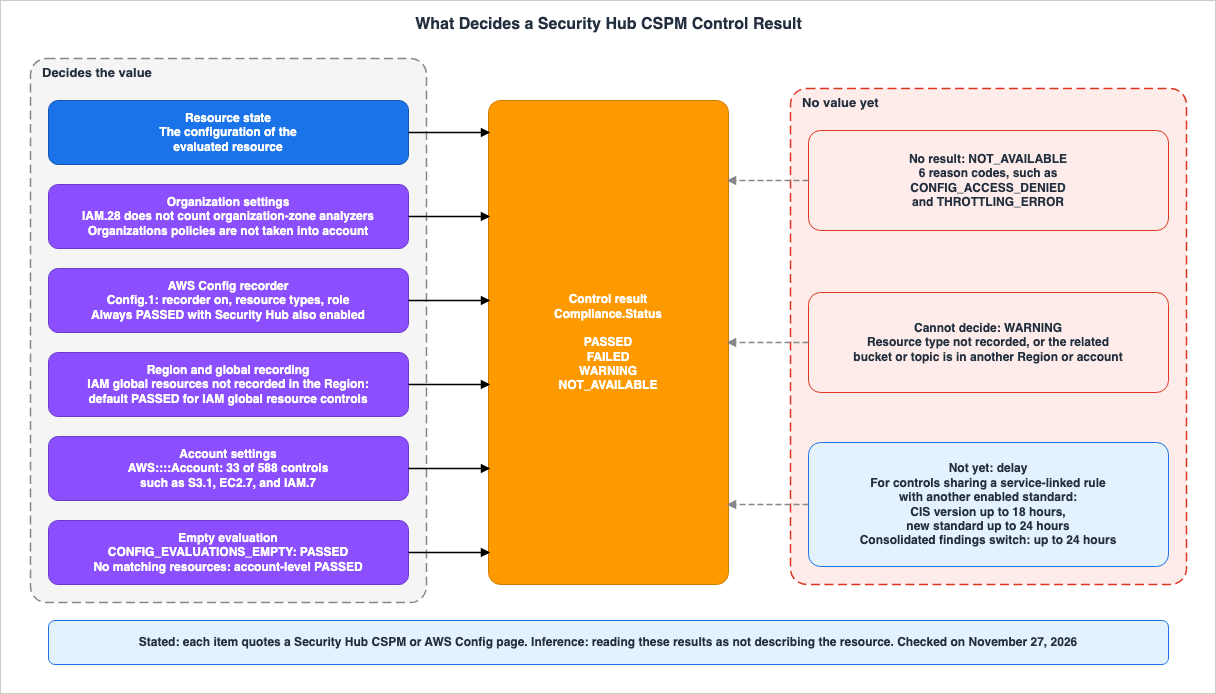
2.1 Two Categories
The first category determines the result value. In addition to the state of the resource being evaluated, there are five factors:| Determining Factor | Example | Chapter in this Article |
|---|---|---|
| Organization Settings | IAM.28 does not count analyzers that use the organization as the zone of trust. Controls do not take AWS Organizations policies into account. | Chapter 3 |
| AWS Config Recorder | The result of Config.1 is determined by whether the recorder is enabled, whether the recorded resource types are sufficient, and whether a service-linked role is used. | Chapter 4 |
| Region and Global Resource Recording | Regions that do not record IAM global resources will receive a default PASSED result for controls that check IAM global resources. | Chapter 5 |
| Account Settings | Controls with a resource type of AWS::::Account evaluate account settings. | Chapter 6 |
| Empty Evaluation | CONFIG_EVALUATIONS_EMPTY returns PASSED. If there are no matching resources, an account-level PASSED finding is produced. | Chapter 7 |
The second category concerns the reasons why a result is not available and the delays in receiving a result. This is not about what the result value indicates; rather, it addresses situations where a result is missing or has not yet been produced.
| Category | Example | Chapter in this Article |
|---|---|---|
| Result Unavailable | Six reason codes for NOT_AVAILABLE. WARNING indicates an inability to determine whether a resource is PASSED or FAILED. | Chapter 7 |
| Result Delayed | Enabling a version of the CIS AWS Foundations Benchmark can take up to 18 hours for controls that share a service-linked rule with another enabled standard. Enabling a new standard can take up to 24 hours under the same condition. | Chapter 7 |
This article does not mix the two categories. The results from the first category indicate a value is present, but do not describe the resource itself. The results from the second category indicate that a value is not yet available (Inference).
2.2 Result Values and Control Status
According to the status page, Security Hub CSPM derives the control status for each control based on theCompliance.Status field within findings (Stated). If any finding has a status of FAILED, the control status is marked as "Failed." If there are no FAILED findings, but there is at least one finding with a status of WARNING or NOT_AVAILABLE, the control status becomes "Unknown" (Stated). Archived findings and suppressed findings are excluded from the calculation of control status (Stated). How the control status is derived, and the impact of suppression and disabling on the control status and security score, are covered in Chapter 6 of Tuning Security Hub CSPM Without Hiding Findings. This article only addresses the factors that determine the values reported in findings.3. Results Decided by the Organization — IAM.28
This chapter examines the case ofIAM.28 as an example of how organization settings can determine results. It also demonstrates that organizational policies are not included in the results.3.1 What IAM.28 Checks
According to the IAM controls page, the title ofIAM.28 is IAM Access Analyzer external access analyzer should be enabled (Stated). The resource type is AWS::AccessAnalyzer::Analyzer, the AWS Config rule is iam-external-access-analyzer-enabled, the schedule type is Periodic, and the severity is High (Stated).The same page states that the control monitors the following:
This control checks whether an AWS account has an IAM Access Analyzer external access analyzer enabled. The control fails if the account doesn't have an external access analyzer enabled in your currently selected AWS Region.The same page also states that the external access analyzer can be created for the entire organization or for individual accounts (Stated).
3.2 Analyzers That Use the Organization as the Zone of Trust Are Not Counted
A note on the same page reads:If an account is part of an organization in AWS Organizations, this control doesn't factor external access analyzers that specify the organization as the zone of trust and are enabled for the organization in the current Region. If your organization uses this type of configuration, consider disabling this control for individual member accounts in your organization in the Region.Based on this note, this article reads the following: In organizations that only utilize analyzers that use the organization as the zone of trust and do not place their own external access analyzers on member accounts, the
IAM.28 status for member accounts will show as FAILED, even if the organization's analyzer is inspecting the account's resources (Inference). This FAILED status does not indicate that the member account's resources are being shared externally. Rather, it signifies that the account has no analyzer that the control counts (Inference).The note recommends "consider disabling." This article does not state that
IAM.28 is meaningless within an organization. The recommendation applies to member accounts of organizations with this configuration, in that Region (Stated). This article did not find any statement describing the result of this control in the administrator account where the organization's analyzer is placed (Not found).3.3 Things to Verify Before Disabling
The Access Analyzer findings page states the following regarding analyzers that use the organization as the zone of trust:If you grant permissions to an Amazon S3 bucket in one of your organization member accounts to a principal in another organization member account, IAM Access Analyzer does not generate a finding.Analyzers that use the organization as the zone of trust will not report shared access between member accounts in the findings (Stated). Therefore, organizations that also want to see shared access between member accounts need to determine whether to configure an analyzer that uses the account as the zone of trust before disabling
IAM.28 (Inference). The design of zones of trust is covered in Chapter 4 of AWS IAM Access Analyzer Deep Dive.3.4 Organization Policies Are Not Included in the Results Either
The required resources page describes the relationship between controls and AWS Organizations policies as follows:Security Hub CSPM controls evaluate resource configurations directly and don’t take AWS Organizations policies into account.Based on this statement, this article reads the following: Even if organizational policies such as SCPs prevent changes to resources, the controls evaluate the resource configurations themselves to produce a result (Inference). A control may report a resource as
FAILED even if an organizational policy protects it (Inference). Conversely, a PASSED result does not indicate that an organizational policy is in effect (Inference).3.5 Administrator Account Control Status
The status page describes the control status of administrator accounts as follows:Specifically, the overall status of a control appears as Failed if the control has one or more failed findings in the administrator account or any of the member accounts.If
IAM.28 fails in a member account for the reason outlined in section 3.2, the control status of IAM.28 in the administrator account will also be Failed (Inference). When a Failed status is observed on an administrator account, first determine which account's finding is causing the failure (Inference).4. Results Decided by the Recorder — Config.1
This chapter examinesConfig.1 as an example of how the AWS Config recorder determines results. For Config.1, the page has a note stating that the result is always PASSED when Security Hub CSPM and Security Hub are enabled, as well as a paragraph outlining the conditions under which the result is FAILED. This article presents both of these elements side-by-side, examining them according to each condition.4.1 What Config.1 Checks
According to the Config controls page, the title ofConfig.1 is "AWS Config should be enabled and use the service-linked role for resource recording" (Stated). The resource type is AWS::::Account, the AWS Config rule is None (a custom rule for Security Hub CSPM), the schedule type is Periodic, and the severity is Critical (Stated).The same page describes what
Config.1 monitors in terms of three points: whether AWS Config is enabled in the current Region, whether it is recording all resources that correspond to controls enabled in the current Region, and whether it is using the AWS Config service-linked role (Stated). The name of the service-linked role is AWSServiceRoleForConfig (Stated). The page also states that, as Security Hub CSPM is a regional service, this control only evaluates the current Region (Stated). Recording for multicloud controls such as Azure and GCP controls is not included in the evaluation of Config.1 (Stated).4.2 When Config.1 Is Always PASSED
The note immediately following theConfig.1 heading on the same page reads as follows.When Security Hub CSPM and Security Hub are enabled the Config.1 rule will always have a status of PASSED. This is because Security Hub CSPM has direct access to configuration items via a service-linked configuration recorder. The parameter for this control is not applicable as the internal service-linked configuration recorder is automatically created with the AWS Config service-linked role.The condition in the note is "Security Hub CSPM and Security Hub are enabled." The prerequisites page differentiates the two as follows:
If you have Security Hub CSPM enabled without Security Hub, you must manually enable AWS Config and turn on resource recording.The prerequisites page states that when both are enabled, Security Hub CSPM creates and manages a service-linked configuration recorder named
AWSConfigurationRecorderForSecurityHubCSPM for each account and Region (Stated). The Config recorder page lists this recorder in a separate row from the new Security Hub recorder (Stated). The service principal for the Security Hub CSPM recorder is securityhub.amazonaws.com, while the service principal for the new Security Hub recorder is securityhubv2.amazonaws.com (Stated).Based on these two pages, this article interprets the "Security Hub" mentioned in the note as referring to the new Security Hub (Inference). The Config controls page itself does not specify which service the note refers to (Not found). Therefore, "always
PASSED" is limited to accounts and Regions where both Security Hub CSPM and the new Security Hub are enabled (Inference).The prerequisites page also states the following regarding this recorder:
When Security Hub CSPM creates this service-linked configuration recorder, Security Hub does not use the customer-managed configuration recorder in AWS Config.Based on this statement, this article concludes that in accounts where both are enabled, the
PASSED status for Config.1 does not reflect the status of recorders configured by the user (Inference). If the user is using a separate recorder for inventory or auditing purposes, that recorder being stopped will not affect the Config.1 status (Inference).4.3 Three Reason Codes for FAILED
In accounts where only Security Hub CSPM is enabled,Config.1 may show a status of FAILED. The Config controls page states the following regarding service-linked roles:If you don't use the service-linked role and don't set the includeConfigServiceLinkedRoleCheck parameter to false, the control fails because other roles might not have the necessary permissions for AWS Config to accurately record your resources.According to the parameter table on the same page, the default value for
includeConfigServiceLinkedRoleCheck is true (Stated). The parameter description reads as follows:The control doesn’t evaluate whether AWS Config uses the service-linked role if the parameter is set to false.The table of reason codes on the findings page lists three reasons why
Config.1 might show a FAILED status (Stated).| Reason Code | Result | Summary of the Description on the Findings Page |
|---|---|---|
CONFIG_RECORDER_CUSTOM_ROLE | FAILED for Config.1 | The recorder is using a custom IAM role instead of the AWS Config service-linked role, and includeConfigServiceLinkedRoleCheck is not false. |
CONFIG_RECORDER_DISABLED | FAILED for Config.1 | AWS Config is not enabled with the recorder turned on. |
CONFIG_RECORDER_MISSING_REQUIRED_RESOURCE_TYPES | FAILED for Config.1 | AWS Config is not recording all of the resource types that correspond to enabled controls. |
The Config controls page indicates that the
StatusReasons field in the Compliance object of a finding can provide clues as to why the status is FAILED (Stated). When you see a FAILED status for Config.1, you should first examine the reason codes in StatusReasons. If the reason code is CONFIG_RECORDER_CUSTOM_ROLE, recording may be working, and only the choice of role may be in question (Inference).4.4 A Discrepancy on the Same Page
The note on the Config controls page states, "The parameter for this control is not applicable." However, on the same page, the parameter table listsincludeConfigServiceLinkedRoleCheck with a default value of true (Stated). On the same page, there is a statement indicating that the parameter is not applicable, alongside the parameter table.This statement is the third sentence of the note referenced in section 4.2. This article interprets this statement in conjunction with the condition mentioned at the beginning of the note, that is, when both are enabled (Inference). The note explains that the parameter is not applicable because the internal service-linked configuration recorder is automatically created with the AWS Config service-linked role (Stated). When only using Security Hub CSPM, the parameter in the table is applicable (Inference). The page does not explicitly state that the parameter is applicable when using only Security Hub CSPM (Not found).
4.5 Insufficient Recording Also Becomes a WARNING for Another Control
The Understanding the Config.1 control section of the prerequisites page describes the case where the recorded resource types are not sufficient, as follows:If AWS Config is enabled and resource recording is turned on, but resource recording isn't turned on for a type of resource that an enabled control checks, Security Hub CSPM generates a FAILED finding for the Config.1 control. In addition to this FAILED finding, Security Hub CSPM generates WARNING findings for the enabled control and the types of resources that the control checks.The same section provides an example where
KMS.5 is enabled, but AWS KMS keys are not being recorded (Stated). In this scenario, Config.1 fails, and WARNING findings are generated for KMS.5 and the KMS keys (Stated). This WARNING does not indicate an issue with the keys' configuration; rather, it signifies that the recorder is not recording the keys (Inference).4.6 New Controls Can Change the Result of Config.1
The Config controls page describes when new controls change the result ofConfig.1 as follows:However, the results of this control can change when new controls are released if you have configured automatic enablement of new controls or have a central configuration policy that automatically enables new controls.The same page states that in these cases, if you do not record all resources, you must configure recording for the resources of the new controls to receive a
PASSED finding (Stated). Therefore, accounts that restrict the scope of recording may experience Config.1 changing to FAILED, even if the resource and recorder configurations have not been altered (Inference).5. Results Decided by Region and Global Resources
This chapter examines examples where the Region and the recording of IAM global resources determine results. Figure 2 summarizes the content of this chapter.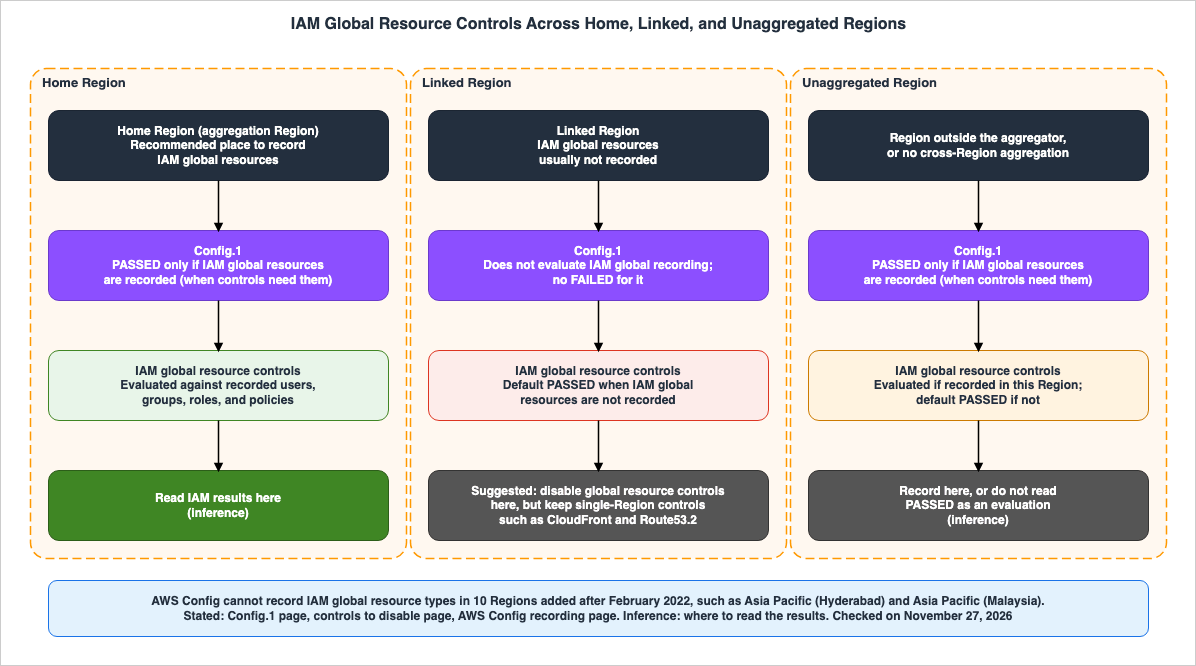
5.1 Evaluation of Config.1 Varies by Region Role
The Config controls page divides the evaluation ofConfig.1 into three groups by the role of the current Region (Stated).| Current Region Role | Recording of IAM Global Resources |
|---|---|
| Aggregation Region | PASSED only when recording IAM global resources if controls requiring them are enabled. |
| Linked Region | Does not evaluate whether IAM global resources are being recorded. |
| Regions not participating in aggregation, or Regions without cross-Region aggregation | PASSED only when recording IAM global resources if controls requiring them are enabled. |
The remediation section of the same page states the following regarding linked Regions:
In linked Regions, if you have enabled controls that require recording of IAM global resources, you won’t receive a FAILED finding (your recording of other resources is sufficient).5.2 Regions That Do Not Record Receive a Default PASSED
The notes on the Config controls page state the following regarding Regions that do not record IAM global resources:To allow security checks against IAM global resources in a Region, you must record IAM global resources in that Region. Regions that don’t have IAM global resources recorded will receive a default PASSED finding for controls that check IAM global resources.The same notes further recommend recording IAM global resources only in the home Region.
Since IAM global resources are identical across AWS Regions, we recommend that you record IAM global resources in only the home Region (if cross-Region aggregation is enabled in your account).Combining these two statements, when using cross-Region aggregation and accounts are configured according to the recommendation, controls that check IAM global resources receive the default
PASSED in every Region except the home Region (Inference). This PASSED status does not reflect the results of evaluating IAM users, roles, or policies (Inference). When reviewing IAM control results, it is necessary to examine the findings in the home Region (Inference).The same notes specify that AWS Config records the following types of IAM global resources: users, groups, roles, and customer-managed policies (Stated).
5.3 Regions Unable to Record IAM Global Resources
The Config recording page limits the Regions that can record IAM global resources as follows:These resource types can be recorded by AWS Config in Regions where AWS Config was available before February 2022.The same page lists ten Regions where they cannot be recorded: Asia Pacific (Hyderabad), Asia Pacific (Malaysia), Asia Pacific (Melbourne), Asia Pacific (Thailand), Canada West (Calgary), Europe (Spain), Europe (Zurich), Israel (Tel Aviv), Mexico (Central), and Middle East (UAE) (Stated).
Combining this information with the statements in section 5.2, these Regions will show controls that check IAM global resources as the default
PASSED, regardless of any configuration changes (Inference). However, whether this reading also applies to periodic controls remains unverified, as section 5.4 explains. No mention was found on the Security Hub CSPM pages that names these ten Regions in connection with the recording of IAM global resources (Not found). The Security Hub CSPM document history lists these Regions as Regions where the service became available (Stated).5.4 Periodic Rules Run Evaluations Even in Regions That Do Not Record
The Config recording page describes the following about AWS Config rules and global resource types:If you record a global IAM resource type in at least one Region, periodic rules that report compliance on the global IAM resource type will run evaluations in all Regions where the periodic rule is added, even if you have not enabled the recording of the global IAM resource type in the Region where the periodic rule was added.This sentence is about AWS Config rules, while the sentence in section 5.2 is about Security Hub CSPM controls. The two pages appear to present conflicting information regarding Regions that do not record. This article reads that even in Regions that do not record, AWS Config evaluations can still run for periodic controls (schedule type Periodic) (Inference). However, no statement was found indicating whether Security Hub CSPM then outputs a default
PASSED status or the evaluation result (Not found). Similarly, no statements were found specifying, control by control, which controls receive a default PASSED status (Not found).This unresolved point applies to the IAM controls that are periodic. The controls to disable page lists 48 controls that utilize global resources, of which 25 are related to IAM. The schedule types for these IAM controls are as follows (Schedule type field on each control's page, Stated):
| Schedule Type | IAM Controls |
|---|---|
| Change triggered | 6: IAM.1, IAM.2, IAM.21, IAM.24, IAM.25, IAM.27 |
| Periodic | 19: IAM.3 through IAM.19, and IAM.22, IAM.26 |
5.5 Recommended Disabling and Exceptions
The controls to disable page recommends disabling global resource controls in all Regions except the Region that records those global resources (Stated). The same page lists these controls in a set of 48 (Stated). This list includes IAM controls, as well as controls namedAccount.1, Account.2, CloudFront, Global Accelerator, Route 53, AWS WAF Classic, KMS.1, and KMS.2 (Stated).The same page designates controls that are only applicable to a single Region as exceptions.
If a control involves global resources but is available in only one Region, disabling it in that Region prevents you from getting any findings for the underlying resource. In this case, we recommend keeping the control enabled.The exceptions listed on the same page are: all CloudFront controls,
GlobalAccelerator.1, Route53.2, WAF.1, WAF.6, WAF.7, and WAF.8 (Stated).The same page states that when using central configuration, Security Hub CSPM automatically disables global resource controls in all Regions except the home Region (Stated). The distribution mechanism is discussed in Chapter 7 of Tuning Security Hub CSPM Without Hiding Findings.
5.6 Recording Frequency Does Not Change the Result, but It Can Delay It
The Config controls page states the following regarding recording frequency:Control results aren't impacted by whether you choose daily or continuous recording of changes in resource state in AWS Config.The schedule page indicates that if daily recording is selected, AWS Config delivers configuration data at the end of each 24-hour period, potentially causing delays in finding generation (Stated). The same page also states that, regardless of the recording frequency, Security Hub CSPM will check at least once every 24 hours (Stated). While recording frequency does not change the values of the results, it does affect the time at which those results are available (Inference).
5.7 The Service-Linked Configuration Recorder and IAM Global Resources
The prerequisites page states that the service-linked configuration recorder enables recording for all resources tied to controls that Security Hub supports (Stated). No statement was found on which Regions that recorder records IAM global resources in (Not found). Consequently, this article has not been able to confirm how the defaultPASSED status, as described in section 5.2, will appear in accounts with both Security Hub CSPM and the new Security Hub enabled.6. Results Decided by Account Settings — AWS::::Account Controls
This chapter addresses controls related to resources of typeAWS::::Account. These controls focus on the settings for individual accounts and Regions, rather than individual resources.6.1 Counting Methodology
This article details the following counting method:- There are 588 controls listed in the controls reference table (Stated). The controls reference states that retired controls are excluded from the table (Stated).
- This article extracted the "Resource type" field of each control from the 81 service-specific control pages.
- Within those controls, this article counted those listed in the controls reference table where the "Resource type" field was
AWS::::Account.
Using this method, this article found 33 controls with a "Resource type" of
AWS::::Account. All 33 of these controls have a schedule type of Periodic (Stated). The numbers reflect the data as of the verification date and are subject to change as controls are added.6.2 Breakdown of the 33 Controls
| What It Checks | Controls |
|---|---|
| Whether a Service or Feature Is Enabled | Config.1, CloudTrail.1, CloudTrail.3, GuardDuty.1, Inspector.1, Inspector.2, Inspector.3, Inspector.4, Macie.1, Macie.2 |
| Account Settings to Prevent Public Exposure, and Default Encryption | S3.1, EC2.1, EC2.7, EMR.2, SSM.7 |
| S3 Data Event Logging | S3.22, S3.23 |
| Root User and IAM Password Policies | IAM.4, IAM.6, IAM.7, IAM.9, IAM.10, IAM.11, IAM.12, IAM.13, IAM.14, IAM.15, IAM.16, IAM.17 |
| Support Roles, Contacts, and Organization | IAM.18, Account.1, Account.2 |
| SSM Automation Logs | SSM.6 |
6.3 Title and Resource Type
Some controls have titles that refer to individual resources but have the resource typeAWS::::Account (Stated).| Control | Title | Resource Type |
|---|---|---|
S3.1 | S3 general purpose buckets should have block public access settings enabled | AWS::::Account |
S3.22 | S3 general purpose buckets should log object-level write events | AWS::::Account |
S3.23 | S3 general purpose buckets should log object-level read events | AWS::::Account |
EC2.1 | Amazon EBS snapshots should not be configured to be publicly restorable | AWS::::Account |
The
PASSED and FAILED status of these controls appear as findings for the account (Inference). Therefore, a FAILED status for S3.1 cannot be interpreted as evidence that any single bucket is publicly accessible (Inference). Conversely, a PASSED status for S3.1 is not the result of verifying the public access settings for each individual bucket (Inference). A separate control, targeting the resource type AWS::S3::Bucket, is responsible for examining those settings (Inference).6.4 Overlap with the Global Resource Category
Of the 33 controls, the 13 IAM controls andAccount.1 and Account.2, 15 in total, are also on the list of controls that use global resources on the controls to disable page (Stated). The 13 IAM controls are IAM.4, IAM.6, IAM.7, and IAM.9 through IAM.18. This article places them in the account settings category of Chapter 6 and reads that the Region handling in Chapter 5 also applies to them (Inference). These controls check account settings, and their meaning also changes with the Region whose result you read (Inference).7. Empty Evaluations, and Why a Result Does Not Appear or Is Delayed
This chapter addresses results decided by empty evaluations, the reasons why results do not appear, and the delays before results appear.7.1 An Empty Evaluation Is PASSED
The table of reason codes on the findings page lists the result ofCONFIG_EVALUATIONS_EMPTY as PASSED, with the following explanation (Stated):The rule did not apply to the AWS resources in its scope, the specified resources were deleted, or the evaluation results were deleted.This
PASSED status indicates that either no resources matched the rule, a resource was deleted, or the evaluation result was deleted (Stated). It does not confirm that the resource was correctly configured (Inference).7.2 PASSED When No Resources Exist, and PASSED 18 Hours After Deletion
The status page describes the situation when you have no resources corresponding to a control:If you don't have resources corresponding to a control, Security Hub CSPM produces a PASSED finding at the account level.The same page describes the situation after resources have been deleted (Stated). Security Hub CSPM creates a
NOT_AVAILABLE finding and immediately archives it.After 18 hours, you receive a PASSED finding because you no longer have resources corresponding to the control.This 18-hour period is separate from the 18-hour period mentioned in section 7.5, regarding the CIS AWS Foundations Benchmark (Inference).
7.3 Six Reason Codes for NOT_AVAILABLE
The status page indicates thatNOT_AVAILABLE signifies the inability to complete verification due to server failures, resource deletion, or when the AWS Config evaluation results in a NOT_APPLICABLE outcome (Stated). The table of reason codes on the findings page lists the following six reasons for a result of NOT_AVAILABLE (Stated).| Reason Code | Summary of Explanation on the Findings Page |
|---|---|
CONFIG_ACCESS_DENIED | Access to AWS Config was denied. |
CONFIG_RETURNS_NOT_APPLICABLE | AWS Config returned a "Not Applicable" result. |
CONFIG_RULE_EVALUATION_ERROR | An evaluation error occurred, potentially due to insufficient permissions, incorrect parameters, issues reading from S3, or timeouts. |
CONFIG_RULE_NOT_FOUND | The AWS Config rule is currently being created. |
INTERNAL_SERVICE_ERROR | An unknown error occurred. |
THROTTLING_ERROR | The API operation exceeded the allowed rate. |
This article does not define
NOT_AVAILABLE as a failure. It does not indicate that the resource is not configured correctly (Inference). However, according to the status page, if there is even one finding with a status of NOT_AVAILABLE or WARNING, and no findings are marked as FAILED, the control status will be set to Unknown (Stated).7.4 WARNING, and Resources in Another Region or Account
The status page describesWARNING as follows:Indicates that Security Hub CSPM can't determine whether the resource is in a PASSED or FAILED state.The status page gives, as an example, that recording is not turned on for the corresponding resource type (Stated). The example in section 4.5,
KMS.5, illustrates this.The findings page's table of reason codes includes reason codes that trigger a
WARNING when related S3 buckets or SNS topics are located in a different Region or account (Stated). The descriptions for S3_BUCKET_CROSS_ACCOUNT_CROSS_REGION and SNS_TOPIC_CROSS_ACCOUNT_CROSS_REGION conclude with the following statement (Stated).It is recommended that you disable this control in this Region or account. Only run it in the Region or account where the resource is located.This
WARNING indicates that the location of the resource and the Region or account used to evaluate its controls are not aligned (Inference).7.5 Time Until Results Appear — 18 Hours and 24 Hours
The CIS page states, regarding the activation of a version of the CIS AWS Foundations Benchmark:When you enable a version of the CIS AWS Foundations Benchmark, it can take up to 18 hours for Security Hub CSPM to generate findings for controls that use the same AWS Config service-linked rule as enabled controls in other enabled standards.This 18-hour timeframe is not an inherent characteristic of any version of the CIS AWS Foundations Benchmark. It applies only to controls that utilize the same AWS Config service-linked rule as enabled controls in other enabled standards (Stated). Furthermore, this refers to the delay in receiving results, not the value of the results themselves (Inference).
The schedule page, also regarding the activation of a new standard, states the following under the same conditions:
When you enable a new standard, it might take up to 24 hours for Security Hub CSPM to generate findings for controls that use the same underlying AWS Config service-linked rule as enabled controls from other enabled standards.As of the verification date, the CIS page indicates a maximum of 18 hours, while the schedule page indicates a maximum of 24 hours (Stated). The two pages present similar conditions but differ in the timeframe. This article does not determine which is correct. In practice, it is safer to wait the longer 24-hour period before considering a lack of results as an issue (Inference).
The schedule page states that when a standard is enabled, Security Hub CSPM begins running all checks within 2 hours, and most checks begin within 25 minutes (Stated). Periodic checks run within 12 or 24 hours of the previous run (Stated).
7.6 Switching Consolidated Control Findings
The findings page describes the behavior when consolidated control findings are enabled.After you enable consolidated control findings, it can take up to 24 hours for Security Hub CSPM to generate new consolidated findings and archive the existing standard-based findings.The same page also states that when disabled, it may take up to 24 hours, during which time standard-specific findings and findings not tied to a specific standard may be mixed (Stated). The consolidation blog states up to 18 hours for the same switch (Stated). The consolidation blog post is dated July 12, 2023. This article treats the 24-hour timeframe from the user guide, as it existed on the verification date, as the current value (Inference).
8. Results You Can Trust, Controls You Can Disable
This chapter summarizes Chapters 2 through 7 in a decision table format, organized by result.8.1 Decision Table
| Result | What Decides It | Can It Be Trusted as Resource Status? | Can the Control Be Disabled? |
|---|---|---|---|
Member account IAM.28 is FAILED | Analyzers that use the organization as the zone of trust are not counted. | Do not trust. Examine the placement of the analyzer. | In organizations that use such an analyzer, you can consider disabling IAM.28 in member accounts (Stated). Before disabling it, determine whether to place an analyzer that monitors sharing between member accounts (Inference). |
Config.1 is PASSED in an account with both services enabled | The service-linked configuration recorder. | Do not trust as a status of your own recorder (Inference). | No recommendations for disabling were found (Not found). |
Account with only Security Hub CSPM, Config.1 is FAILED | Recorder status, recorded resource types, and role. | Trust the recorder status. Examine StatusReasons. | If the reason is only custom roles, there is an option to set the parameter to false (Stated). If recording is missing or insufficient, correct it (Inference). |
IAM controls outside the home Region are PASSED. | IAM global resources are not recorded (for periodic controls, the unresolved point in section 5.4 remains). | Do not trust. Examine the results from the home Region (Inference). | Recommend disabling in Regions other than those recording global resources (Stated). |
IAM controls in 10 Regions (section 5.3) are PASSED. | Cannot be recorded (for periodic controls, the unresolved point in section 5.4 remains). | Do not trust (Inference). | The recommendation in section 5.5 applies (Inference). |
| Controls for global resources that can only be used in one Region. | Regions where the control can be used. | Trust the results from that Region (Inference). | AWS recommends keeping it enabled (Stated). |
S3.1, EC2.1, etc. are FAILED. | Account settings. | Trust as account settings; not the status of individual resources (Inference). | No recommendations for disabling were found (Not found). |
CONFIG_EVALUATIONS_EMPTY is PASSED. | There is nothing to evaluate. | Do not interpret as a correct configuration (Inference). | No recommendations for disabling were found (Not found). |
NOT_AVAILABLE. | Unable to complete the evaluation. | Do not interpret as either a failure or a success. Examine the reason code (Inference). | No recommendations for disabling were found (Not found). |
S3_BUCKET_CROSS_ACCOUNT_CROSS_REGION and SNS_TOPIC_CROSS_ACCOUNT_CROSS_REGION are WARNING. | Mismatch between resource location and evaluation location. | Do not interpret as a resource status (Inference). | Recommend disabling within that Region or account (Stated). |
| No findings immediately after enabling a CIS version. | Delay. | Results are not yet available (Inference). | Not a reason to disable (Inference). |
8.2 Official Recommendations for Disabling Controls
Based on the documentation reviewed, official recommendations or considerations for disabling controls are provided in the following four scenarios, where the result is determined by factors other than the resource:IAM.28in member accounts of organizations that place an analyzer that uses the organization as the zone of trust (consider disabling, Stated).- Controls that utilize global resources in Regions other than the Region that records global resources, excluding controls that are only available in a single Region (Stated).
- Controls in a Region or account when related S3 buckets or SNS topics are located in a different Region or account (Stated).
CloudTrail.2in accounts and Regions other than the centralized logging account and Region, when trails are logged to a centralized logging account (controls to disable page, Stated). With central configuration, a control cannot be disabled in only some Regions, so the same page says you can suppress its findings instead (Stated).
The procedures for disabling controls and how findings are handled after disabling are covered in Chapter 6 of Tuning Security Hub CSPM Without Hiding Findings.
8.3 Results Requiring Correction
The following results do not describe the resource, but rather a deficiency in the evaluation foundation. This article recommends addressing the foundation itself, without disabling controls (Inference).Config.1reportedFAILEDwithCONFIG_RECORDER_DISABLEDorCONFIG_RECORDER_MISSING_REQUIRED_RESOURCE_TYPES.WARNINGdue to insufficient recorded resource types.NOT_AVAILABLEreported withCONFIG_ACCESS_DENIEDorCONFIG_RULE_EVALUATION_ERROR.
9. Frequently Asked Questions About Security Hub CSPM Results
Q1. If a result is PASSED, is that resource secure?
No, that is not necessarily the case. The PASSED status can appear even when there are no resources being evaluated. This happens with CONFIG_EVALUATIONS_EMPTY, and when there are no resources associated with the control. Even in Regions that do not record IAM global resources, a default PASSED status may appear. See sections 7.1, 7.2, and 5.2 for more information.Q2. Will the Config.1 status always be PASSED if Security Hub CSPM is enabled?
No. The note on the Config controls page states that the status will always be PASSED if both Security Hub CSPM and Security Hub are enabled. This article reads this Security Hub as the new Security Hub. If only Security Hub CSPM is enabled, the status may be FAILED for three reasons: if the recorder is disabled, if the recorded resource types are insufficient, or if a custom role is used without modifying the default parameters. See sections 4.2 and 4.3 for more details.Q3. Should we disable IAM.28 in an organization?
For organizations that use an external access analyzer with the organization as the zone of trust, the official documentation recommends considering disabling IAM.28 for member accounts. However, this analyzer will not report shared access between member accounts. If you need to identify shared access between accounts, first determine whether to deploy an analyzer that uses the account as the zone of trust. Refer to sections 3.2 and 3.3.Q4. Why does a setting protected by an SCP become FAILED?
According to the required resources page, Security Hub CSPM controls directly evaluate resource configurations and do not consider AWS Organizations policies. These controls do not assess whether organizational policies are in effect. See section 3.4.Q5. Is NOT_AVAILABLE a failure?
No. NOT_AVAILABLE signifies that the evaluation could not be completed. There are six possible reason codes, including denied access to AWS Config, rule creation in progress, and exceeding the allowed rate. However, if there is a NOT_AVAILABLE finding and no FAILED finding, the control status will be set to Unknown. See section 7.3.Q6. Why do no findings appear after I enable the CIS AWS Foundations Benchmark?
According to the CIS page, controls that use the same AWS Config service-linked rule as enabled controls in other enabled standards may take up to 18 hours to generate findings. The schedule page gives up to 24 hours for the same condition. This refers to the time it takes for results to appear, not the value of the results themselves. See section 7.5.10. Summary
The key points of this article are as follows:- The factors that determine the result of a control, in addition to the state of resources, include organizational configuration, AWS Config recorders, recording of regional and global resources, account settings, and empty evaluations. The reasons why no result appears and the delay before a result appears are a separate category.
IAM.28does not count analyzers that use the organization as the zone of trust. The official documentation recommends that organizations with that configuration consider disabling this control in member accounts. Controls also do not take AWS Organizations policies into account.- The "always
PASSED" result forConfig.1applies only when both Security Hub CSPM and Security Hub are enabled. This article reads that Security Hub as the new Security Hub. When only Security Hub CSPM is enabled, the control can result in aFAILEDstatus for any of three reason codes. The notes and parameter table on the same page appear to contain conflicting information. - Regions that do not record IAM global resources will receive a default
PASSEDstatus when evaluating controls that check for IAM global resources. There are ten Regions that are unable to record IAM global resources. - As of the verification date, 33 controls have a resource type of
AWS::::Account. Some controls, such asS3.1, evaluate account settings even though their titles refer to buckets. - Controls will result in a
PASSEDstatus when there are no resources, or when encounteringCONFIG_EVALUATIONS_EMPTY.NOT_AVAILABLEis not considered a failure. For controls that share a service-linked rule with another enabled standard, the time it takes to receive a result varies depending on the page, split between 18 hours and 24 hours.
Before reviewing the results, verify the following:
- What is the resource type for this control? Is it
AWS::::Accountor an individual resource? - Is this Region the home Region, a linked Region, or outside the aggregator?
- Is the new Security Hub enabled on this account?
- Is an analyzer configured to use the organization as the zone of trust?
- What are the reason codes listed in the finding's
StatusReasons? - Has it been 24 hours since the standards or controls were enabled?
11. References
- Security Hub CSPM controls for AWS Identity and Access Management - AWS Security Hub
- Security Hub CSPM controls for AWS Config - AWS Security Hub
- Security Hub CSPM controls for Amazon S3 - AWS Security Hub
- Security Hub CSPM controls for Amazon EC2 - AWS Security Hub
- Security Hub CSPM controls for Amazon GuardDuty - AWS Security Hub
- Control reference for Security Hub CSPM - AWS Security Hub
- Enabling and configuring AWS Config for Security Hub CSPM - AWS Security Hub
- Required AWS Config resources for control findings - AWS Security Hub
- Generating and updating control findings - AWS Security Hub
- Evaluating compliance status and control status - AWS Security Hub
- Suggested controls to disable in Security Hub CSPM - AWS Security Hub
- CIS AWS Foundations Benchmark in Security Hub CSPM - AWS Security Hub
- Schedule for running security checks - AWS Security Hub
- Document history for the AWS Security Hub User Guide - AWS Security Hub
- Recording AWS Resources with AWS Config - AWS Config
- Working with the configuration recorder - AWS Config
- IAM Access Analyzer findings - AWS Identity and Access Management
- Services in Maintenance - AWS General Reference
- Consolidating controls in Security Hub: The new controls view and consolidated findings - AWS Security Blog
- Tuning Security Hub CSPM Without Hiding Findings - Control Parameters, Automation Rules, Suppression, and Disabled Controls
- AWS Config Rules and Conformance Packs - Compliance Detection, Automated Remediation, and Organizations Deployment
- AWS IAM Access Analyzer Deep Dive - External, Internal, and Unused Access Analyzers with Custom Policy Checks in CI
- Centralized Logging and Audit Architecture on AWS - Multi-Account Log Aggregation, Detection, and Query with CloudTrail, Config, Security Hub, and OpenSearch
References:
Tech Blog with curated related content
Written by Hidekazu Konishi