AWS History and Timeline regarding Elastic Load Balancing - Overview, Load Balancer Types, Features, Summary of Updates, and Introduction to ELB
First Published:
Last Updated:
This time, I have created a historical timeline for Elastic Load Balancing (ELB), the managed load balancing service that AWS launched on May 18, 2009 together with Amazon CloudWatch and Auto Scaling.
Elastic Load Balancing is one of the oldest building blocks on AWS, and it is also one of the few services that grew into an entire family. What began as a single load balancer is today four distinct load balancer types: the Classic Load Balancer (CLB), the Application Load Balancer (ALB), the Network Load Balancer (NLB), and the Gateway Load Balancer (GWLB).
Just like before, I am summarizing the main features while following the birth of Elastic Load Balancing and tracking its feature additions and updates as a Current Overview, Load Balancer Types, Features of Elastic Load Balancing.
In particular, I have tried to organize the timeline so that you can quickly answer the questions that infrastructure engineers, SREs, and application platform architects are most often asked, such as "When did the Application Load Balancer launch?", "When did the Network Load Balancer launch?", "When did ALB add Lambda targets and OIDC authentication?", "When did NLB add TLS termination and security groups?", and "When did the Gateway Load Balancer launch?"
I hope these will provide clues as to what has remained the same and what has changed, in addition to the features and concepts of each AWS service.
Background and Method of Creating Elastic Load Balancing Historical Timeline
The reason for creating a historical timeline of Elastic Load Balancing this time is that load balancing sits in front of almost every scalable workload on AWS, and the choice between the Classic, Application, Network, and Gateway Load Balancers is one of the first design decisions that infrastructure and application teams have to make.Another reason is that since Elastic Load Balancing was launched in May 2009, it has evolved from a single Layer 4 / Layer 7 load balancer into a family of four purpose-built load balancers, each operating at a different layer of the network and serving different workloads. The timeline is the clearest way to see how the Classic Load Balancer gave way to the Application Load Balancer (Layer 7) and the Network Load Balancer (Layer 4), and how the Gateway Load Balancer (Layer 3 / Layer 4) later joined the family for third-party virtual appliances. Therefore, I wanted to organize the information of Elastic Load Balancing with the following approaches.
- Tracking the history of Elastic Load Balancing and organizing the transition of updates
- Summarizing the feature list and characteristics of Elastic Load Balancing
- What's New with AWS?
- AWS News Blog
- AWS Networking and Content Delivery Blog
- What is Elastic Load Balancing? - Elastic Load Balancing User Guide
The content posted is limited to major features related to the current Elastic Load Balancing and necessary for the feature list and overview description.
In other words, please note that the items on this timeline are not all updates to Elastic Load Balancing features, but are representative updates that I have picked out.
Routine items such as single-region availability expansions, minor console changes, and security-policy cipher revisions are intentionally omitted so that the timeline stays focused on the milestones that shaped the service and its four load balancer types.
Elastic Load Balancing Historical Timeline (Updates from May 18, 2009)
Now, here is a timeline related to the functions of Elastic Load Balancing. As of the time of writing this article, the history of Elastic Load Balancing spans more than seventeen years from its launch on May 18, 2009.2009 | 2010 | 2011 | 2012 | 2013 | 2014 | 2016 | 2017 | 2018 | 2019 | 2020 | 2021 | 2022 | 2023 | 2024 | 2025 | 2026
* The table can be sorted by clicking on the column names.
| Date | Summary |
|---|---|
| 2009-05-18 | Elastic Load Balancing is launched together with Amazon CloudWatch and Auto Scaling. This first load balancer (the service later renamed the "Classic Load Balancer") distributes incoming HTTP, HTTPS, and TCP traffic across Amazon EC2 instances in one or more Availability Zones, with built-in health checks and integration with Amazon CloudWatch metrics. References: AWS News Blog |
| 2010-04-08 | Elastic Load Balancing adds sticky session support. Two mechanisms are offered: load-balancer-generated cookies tied to the browser session, and application-generated cookies tied to an application-defined session lifetime, so that a user is consistently routed to the same back-end instance. References: What's New with AWS? |
| 2010-10-14 | Elastic Load Balancing adds HTTPS / SSL termination. Customers can attach an X.509 server certificate to an HTTPS listener so that SSL/TLS is decrypted at the load balancer instead of on each EC2 instance, centralizing certificate management. References: What's New with AWS? |
| 2011-05-24 | Elastic Load Balancing adds IPv6, Route 53 zone-apex aliases, and security group integration. Each load balancer receives an IPv4, an IPv6, and a "dualstack" DNS name (in EC2-Classic), and a Route 53 alias lets a root domain such as example.com point directly at the load balancer. References: What's New with AWS? |
| 2011-08-30 | Elastic Load Balancing adds back-end SSL re-encryption, configurable ciphers, and back-end server authentication. Traffic can be re-encrypted from the load balancer to instances, the cipher suite is configurable, and the load balancer can verify the instance's public key before forwarding requests; HTTPS health checks are introduced in the same release. References: AWS News Blog |
| 2011-11-21 | Elastic Load Balancing becomes available inside Amazon VPC. Load balancers in a VPC can be assigned security groups and register instances without requiring public IP addresses, bringing SSL termination, sticky sessions, and health checks to VPC deployments. References: What's New with AWS? |
| 2012-06-10 | Elastic Load Balancing adds internal load balancing inside Amazon VPC. An internal load balancer's DNS name resolves to private IP addresses only, enabling multi-tier architectures (for example a web tier in front of an application tier) entirely within a VPC, without internet exposure. References: What's New with AWS? |
| 2013-07-30 | Elastic Load Balancing adds Proxy Protocol support for TCP load balancers. The client's originating IP address and port are prepended as a Proxy Protocol header to each TCP connection, so non-HTTP and end-to-end TLS workloads can still recover the real client IP. References: What's New with AWS? |
| 2013-11-06 | Elastic Load Balancing adds cross-zone load balancing. Requests are distributed evenly across all registered instances regardless of Availability Zone, eliminating the uneven traffic that DNS-based distribution could cause when instance counts differed across zones. References: What's New with AWS? |
| 2014-02-19 | Elastic Load Balancing adds predefined SSL security policies, Perfect Forward Secrecy, and server order preference. The predefined policy bundles modern TLS versions and ECDHE ciphers for forward secrecy, giving operators a curated, AWS-recommended SSL configuration. References: What's New with AWS? |
| 2014-03-06 | Elastic Load Balancing adds access logs. Detailed records of every request, including client IP, latency, and response code, are delivered to Amazon S3 for operational troubleshooting and web analytics. References: What's New with AWS? |
| 2014-03-20 | Elastic Load Balancing adds Connection Draining. When an instance is deregistered or fails its health check, the load balancer stops sending new requests but lets in-flight requests complete up to a configurable timeout (1–3,600 seconds), and Auto Scaling waits for draining before terminating instances. References: What's New with AWS? |
| 2014-07-24 | Elastic Load Balancing makes the idle connection timeout configurable. The previously fixed 60-second idle timeout becomes adjustable from 1 second to 60 minutes, accommodating both long-lived connections (such as large uploads) and faster connection recycling. References: What's New with AWS? |
| 2016-01-21 | Elastic Load Balancing adds integration with AWS Certificate Manager (ACM). Public SSL/TLS certificates provisioned and automatically renewed by ACM can be deployed directly onto load balancer HTTPS listeners, removing the manual purchase, upload, and rotation of certificates and reducing the risk of outages caused by expired certificates. References: What's New with AWS? |
| 2016-08-11 | The Application Load Balancer (ALB) is launched, and the original Elastic Load Balancer is renamed the "Classic Load Balancer." The ALB is a Layer 7 load balancer with content-based routing on host and path, native support for containers and Amazon ECS, WebSockets, and HTTP/2; the new ELBv2 API (version 2015-12-01) is introduced and now also governs the Network Load Balancer and Gateway Load Balancer. References: AWS News Blog |
| 2017-01-25 | Application Load Balancer adds support for IPv6. Internet-facing Application Load Balancers can be configured as dual-stack to accept connections from both IPv4 and IPv6 clients in supported Availability Zones. References: What's New with AWS? |
| 2017-04-05 | Application Load Balancer adds host-based routing. Listener rules can route requests to different target groups based on the host name in the Host header, so multiple domains can be served behind a single load balancer. References: What's New with AWS? |
| 2017-08-31 | Application Load Balancer adds support for registering IP addresses as targets. Targets can be any IP address in the VPC, or an on-premises address reachable through AWS Direct Connect or VPN, enabling hybrid and microservices routing beyond Amazon EC2 instances. References: What's New with AWS? |
| 2017-09-07 | The Network Load Balancer (NLB) is launched. The NLB is a Layer 4 load balancer capable of handling tens of millions of requests per second at ultra-low latency, with a static IP address per Availability Zone (and optional Elastic IP) and native client source-IP preservation. References: What's New with AWS? |
| 2017-09-21 | Network Load Balancer adds support for registering IP addresses as targets. IP targets let an NLB route to back ends in peered VPCs or on-premises over AWS Direct Connect or VPN, and underpin exposing services to other accounts through AWS PrivateLink endpoint services. References: What's New with AWS? |
| 2017-10-10 | Application Load Balancer adds Server Name Indication (SNI) for multiple TLS certificates. A single HTTPS listener can present different certificates for different domains, with the load balancer using SNI to select the right certificate per connection. References: What's New with AWS? |
| 2017-11-28 | AWS PrivateLink lets customers expose their own services as VPC endpoint services backed by a Network Load Balancer. A provider places a service behind a Network Load Balancer and publishes it as an endpoint service, so consumers in other VPCs or AWS accounts can reach it privately over AWS PrivateLink without VPC peering, internet gateways, or public IP addresses, establishing the NLB as the foundation for private SaaS and cross-account connectivity. References: What's New with AWS? |
| 2018-02-22 | Network Load Balancer adds configurable cross-zone load balancing. Traffic can be distributed evenly across targets in all enabled Availability Zones rather than only within the receiving zone, matching the behavior already available on other load balancer types. References: What's New with AWS? |
| 2018-03-24 | Application Load Balancer adds slow start mode. A newly registered target receives a gradually increasing share of requests while it warms up, instead of immediately taking its full share of traffic. References: Application Load Balancer Document history |
| 2018-05-30 | Application Load Balancer adds built-in user authentication via OIDC and Amazon Cognito. HTTPS listener rules can require authenticate-oidc or authenticate-cognito actions, after which the ALB passes signed JWT headers (such as x-amzn-oidc-data) to the target, offloading login from the application. References: AWS News Blog |
| 2018-07-25 | Application Load Balancer adds redirect and fixed-response actions. Listener rules can return HTTP redirects (for example HTTP-to-HTTPS) or a fixed custom response directly from the load balancer, without forwarding the request to a target. References: What's New with AWS? |
| 2018-11-29 | Application Load Balancer adds support for AWS Lambda functions as targets. A single ALB can route to EC2 instances, containers, on-premises servers, and Lambda functions, allowing serverless HTTP(S) applications and content-based routing to different Lambda functions. References: What's New with AWS? |
| 2019-01-24 | Network Load Balancer adds TLS termination. TLS listeners decrypt traffic at Layer 4 using AWS Certificate Manager (ACM) certificates and AWS's s2n TLS library, offloading TLS from back-end targets while still preserving the client source IP. References: What's New with AWS? |
| 2019-03-27 | Application Load Balancer adds advanced request routing. Listener rules can now match on HTTP headers, HTTP methods, query string parameters, and source IP CIDR blocks in addition to host and path, with AND logic across conditions and OR logic within a condition. References: What's New with AWS? |
| 2019-06-24 | Network Load Balancer adds UDP protocol support. A single NLB can serve both TCP and UDP listeners, and a TCP_UDP target group covers services such as DNS that need both protocols, enabling use cases like DNS, SIP, syslog, RADIUS, and online gaming. References: What's New with AWS? |
| 2019-11-19 | Application Load Balancer adds weighted target groups. A single forwarding rule can split traffic across multiple target groups using integer weights, simplifying blue/green and canary deployments without creating new load balancers. References: What's New with AWS? |
| 2019-11-25 | Application Load Balancer adds the Least Outstanding Requests routing algorithm. As an alternative to round-robin, each new request is sent to the target with the fewest in-flight requests, which helps heterogeneous target pools and workloads with variable request durations. References: What's New with AWS? |
| 2020-02-28 | Network Load Balancer adds sticky sessions based on source IP. NLB can route requests from the same client (by source IP address and protocol) to the same target, which is useful for stateful TCP and UDP workloads. References: Network Load Balancer Document history |
| 2020-08-17 | Application Load Balancer and Classic Load Balancer add Desync Mitigation Mode. Using the open-source HTTP Desync Guardian library, the load balancers offer Defensive, Strictest, and Monitor modes to defend against HTTP request-smuggling attacks caused by ambiguous HTTP/1.1 parsing. References: What's New with AWS? |
| 2020-09-08 | Application Load Balancer becomes available on AWS Outposts. Customers can provision an Application Load Balancer on an AWS Outposts rack to load balance traffic for on-premises applications using the same Layer 7 features as in-Region Application Load Balancers. References: What's New with AWS? |
| 2020-10-29 | Application Load Balancer adds end-to-end HTTP/2 and gRPC support. HTTP/2 can now be used as the target group protocol so the entire path is HTTP/2, and gRPC workloads gain content-based routing on service and method plus gRPC-specific health checks, at no additional cost. References: What's New with AWS? |
| 2020-11-10 | The Gateway Load Balancer (GWLB) is launched. GWLB combines a transparent Layer 3 gateway with Layer 4 load balancing for third-party virtual appliances such as firewalls and IDS/IPS, using the GENEVE protocol (UDP 6081); Gateway Load Balancer Endpoints (powered by AWS PrivateLink) launch at the same time to insert traffic across VPC boundaries. References: AWS News Blog |
| 2020-11-13 | Network Load Balancer adds IPv6 support. NLB accepts both IPv4 and IPv6 client connections in dual-stack mode and forwards them to back-end targets; the Application Load Balancer had supported IPv6 since January 2017, and end-to-end IPv6 across both load balancer types followed in 2021. References: What's New with AWS? |
| 2021-09-27 | Application Load Balancer gains static IP and AWS PrivateLink via an ALB-type target group on Network Load Balancer. An ALB can now be registered directly as a target of an NLB, so customers get NLB's static IPs and PrivateLink connectivity in front of ALB's Layer 7 routing, removing the need for Lambda-based IP-tracking workarounds. References: What's New with AWS? |
| 2021-10-14 | Network Load Balancer adds security policies supporting TLS 1.3. TLS listeners on NLB can use predefined TLS 1.3 security policies, bringing the latest TLS protocol version to Layer 4 TLS termination. References: What's New with AWS? |
| 2021-11-23 | Application Load Balancer and Network Load Balancer add end-to-end IPv6 support. Customers can register IPv6 targets in IPv6 target groups and set the load balancer to dual-stack so that both IPv4 and IPv6 clients reach IPv6 back ends. References: What's New with AWS? |
| 2022-08-15 | Classic Load Balancers running in EC2-Classic are retired as part of EC2-Classic networking retirement. Classic Load Balancers in EC2-Classic must be migrated, while Classic Load Balancers in Amazon VPC remain available; the Classic Load Balancer is now positioned as the previous generation, with migration to current-generation load balancers recommended. References: AWS News Blog |
| 2022-10-13 | Gateway Load Balancer adds a target failover policy. New attributes let existing flows be rebalanced to healthy targets when an appliance becomes unhealthy or is deregistered, enabling graceful appliance maintenance instead of leaving flows pinned to a failed target. References: What's New with AWS? |
| 2022-11-28 | Elastic Load Balancing adds availability capabilities including the ability to turn off ALB cross-zone load balancing and zonal shift (preview). ALB reaches parity with NLB for disabling cross-zone load balancing, and zonal shift via Amazon Route 53 Application Recovery Controller lets operators move ALB or NLB traffic away from an impaired Availability Zone with a single action. References: What's New with AWS? |
| 2022-12-16 | Gateway Load Balancer and Gateway Load Balancer Endpoints add IPv6 support. Operating in dual-stack mode, GWLB and its endpoints can distribute both IPv4 and IPv6 traffic flows to appliance targets, so third-party firewalls and IDS/IPS appliances can inspect IPv6 internet traffic without forcing a downgrade to IPv4. References: What's New with AWS? |
| 2023-01-10 | Zonal shift for Application Load Balancer and Network Load Balancer reaches general availability. Using Amazon Route 53 Application Recovery Controller, operators can shift traffic away from a single Availability Zone in seconds, with cross-zone load balancing disabled and at no additional charge. References: What's New with AWS? |
| 2023-03-22 | Application Load Balancer adds TLS 1.3 support. New predefined security policies include TLS 1.3, enabling 1-RTT handshakes and forward-secrecy ciphers while still integrating with ACM and IAM for centralized certificate management. References: What's New with AWS? |
| 2023-08-10 | Network Load Balancer adds support for security groups. Up to five security groups can be attached to an NLB so that inbound and outbound traffic is filtered at the load balancer, and security group referencing lets targets accept traffic only when it arrives through the NLB. References: What's New with AWS? |
| 2023-10-12 | Network Load Balancer adds Availability Zone DNS affinity and related availability controls. Zonal DNS affinity (100%, 85%, or 0%) lets clients prefer NLB IP addresses in their own Availability Zone, reducing cross-AZ latency and data transfer when combined with disabled cross-zone load balancing. References: What's New with AWS? |
| 2023-11-26 | Application Load Balancer adds mutual TLS (mTLS) with a Trust Store and connection logs. ALB can authenticate client X.509 certificates in passthrough mode (forwarding the certificate to the target) or verify mode (validating against a Trust Store of CA bundles with optional certificate revocation lists), and a new connection log type captures TLS handshake details. References: What's New with AWS? |
| 2023-11-26 | Application Load Balancer adds Automatic Target Weights (ATW) with anomaly mitigation. Using a weighted-random algorithm, ALB continuously detects targets with elevated HTTP 5xx and connection errors and, when mitigation is enabled, gradually reduces traffic to anomalous targets until they recover. References: What's New with AWS? |
| 2023-11-30 | Amazon Route 53 Application Recovery Controller adds zonal autoshift for Application Load Balancer and Network Load Balancer. AWS can automatically and proactively shift ALB or NLB traffic away from an Availability Zone when it detects a potential failure, with weekly practice runs to verify capacity, at no additional charge. References: What's New with AWS? |
| 2024-05-16 | Application Load Balancer adds IPv6-only ("dualstack without public IPv4") support for internet clients. Internet-facing ALBs can serve IPv6-only clients while still using private IPv4 toward targets, avoiding public IPv4 address charges, at no additional cost. References: What's New with AWS? |
| 2024-11-15 | Application Load Balancer adds one-click Amazon CloudFront integration with built-in AWS WAF. From the Application Load Balancer console, customers can attach an Amazon CloudFront distribution and a preconfigured AWS WAF web ACL in a single step, adding CDN acceleration and a first line of Layer 7 defense without wiring the services together manually. References: What's New with AWS? |
| 2024-11-20 | Load Balancer Capacity Unit Reservation launches for Application Load Balancer and Network Load Balancer. Operators can pre-provision a minimum amount of warm capacity (Load Balancer Capacity Units) ahead of predictable traffic surges, avoiding cold-start latency while still scaling automatically above the reservation. References: What's New with AWS? |
| 2024-11-21 | Application Load Balancer adds HTTP header modification. ALB can rename the headers it generates, insert custom response headers such as HSTS and CORS centrally, and suppress the ALB-generated Server response header, all without application code changes. References: What's New with AWS? |
| 2024-11-22 | Application Load Balancer adds Certificate Authority advertisement for mutual TLS. An Application Load Balancer using mutual TLS can advertise the certificate authority subject names held in its Trust Store, so connecting clients know which client certificate to present and mutual TLS handshake errors are reduced. References: What's New with AWS? |
| 2025-02-13 | Network Load Balancer adds support for removing Availability Zones. An NLB's Availability Zones can now be removed as well as added through the Elastic Load Balancing API, CLI, and console, letting operators relocate or consolidate application stacks across Availability Zones in response to migrations, divestitures, or data-residency requirements. References: What's New with AWS? |
| 2025-03-07 | Application Load Balancer integrates with Amazon VPC IPAM. Internet-facing ALBs can draw public IPv4 addresses from customer-managed IPAM pools (including Bring Your Own IP), supporting predictable, allowlist-friendly IP ranges with automatic fallback to AWS-managed addresses if the pool is exhausted. References: What's New with AWS? |
| 2025-04-10 | Load Balancer Capacity Unit Reservation becomes available for the Gateway Load Balancer. Following the Application and Network Load Balancers, the Gateway Load Balancer can now pre-provision a guaranteed minimum of warm capacity (Load Balancer Capacity Units) ahead of anticipated traffic surges or appliance-fleet migrations, while still scaling automatically above the reservation. References: What's New with AWS? |
| 2025-06-26 | AWS WAF resource-level DDoS protection for the Application Load Balancer reaches general availability. An on-host agent integrated with the Application Load Balancer automatically detects and mitigates application-layer DDoS attacks from known malicious sources within seconds, and can be configured to run always-on or to engage only under elevated load. References: What's New with AWS? |
| 2025-10-15 | Application Load Balancer adds URL and Host Header Rewrite. Listener rules can rewrite request URLs and Host headers using regex-based pattern matching before forwarding to targets, removing the need for a separate reverse-proxy layer in many microservices architectures. References: What's New with AWS? |
| 2025-11-12 | Application Load Balancer adds client credential flow with JWT verification. ALB can validate OAuth 2.0 JSON Web Tokens (signature, expiration, and claims) on incoming requests without application code changes, offloading machine-to-machine authentication from back-end services. References: What's New with AWS? |
| 2025-11-13 | Network Load Balancer adds QUIC protocol support in passthrough mode. NLB forwards QUIC traffic (the transport for HTTP/3) and maintains session affinity using QUIC Connection IDs rather than IP/port tuples, bringing static IPs and high throughput to QUIC-based applications. References: What's New with AWS? |
| 2025-11-19 | Network Load Balancer adds weighted target groups. Integer weights across multiple NLB target groups enable blue/green and canary deployments with incremental traffic shifting, without requiring multiple load balancers or DNS TTL manipulation. References: What's New with AWS? |
| 2025-11-20 | Application Load Balancer launches Target Optimizer. ALB automatically tunes per-target in-flight request concurrency based on queue depth and response times, which is particularly valuable for AI/ML inference endpoints where concurrency must be tightly controlled. References: What's New with AWS? |
| 2025-11-21 | Application Load Balancer and Network Load Balancer add post-quantum key exchange for TLS. Both load balancers support NIST-standardized hybrid post-quantum key encapsulation in the TLS handshake, letting customers begin protecting encrypted traffic against future quantum attacks. References: What's New with AWS? |
| 2025-11-21 | Application Load Balancer adds Health Check Logs. ALB delivers per-target health check results (target, port, response code, latency, and failure reason) to Amazon S3, giving fine-grained visibility to diagnose flapping targets and misconfigured thresholds beyond CloudWatch metrics. References: What's New with AWS? |
| 2026-02-04 | Amazon ECS adds Network Load Balancer support for linear and canary deployments. The controlled traffic-shifting deployment strategies, which until now required an Application Load Balancer or Amazon ECS Service Connect, are extended to NLB-fronted Amazon ECS services, with CloudWatch alarm integration for automatic rollback. References: What's New with AWS? |
Current Overview, Load Balancer Types, Features of Elastic Load Balancing
Elastic Load Balancing automatically distributes incoming application traffic across multiple targets — Amazon EC2 instances, containers, IP addresses, AWS Lambda functions, and virtual appliances — in one or more Availability Zones. It scales the load balancing capacity automatically in response to traffic, performs health checks so that only healthy targets receive traffic, and integrates tightly with Amazon EC2 Auto Scaling, Amazon ECS, Amazon EKS, AWS Certificate Manager, Amazon CloudWatch, AWS WAF, and AWS Global Accelerator.Elastic Load Balancing Use Cases
- Highly available web applications
Distribute HTTP/HTTPS traffic across instances or containers in multiple Availability Zones so that a single zone or instance failure does not take down the application. - Microservices and container workloads
Use Application Load Balancer content-based routing to send requests to the right Amazon ECS or Amazon EKS service based on host or path. - Extreme-performance TCP/UDP services
Use Network Load Balancer for millions of requests per second, static IP addresses, and low latency for gaming, IoT, financial, and real-time messaging back ends. - Serverless HTTP endpoints
Put an Application Load Balancer in front of AWS Lambda functions to serve HTTP(S) requests without managing servers. - Inline security inspection
Use Gateway Load Balancer to transparently insert third-party firewalls, IDS/IPS, and deep-packet-inspection appliances into the traffic path. - Blue/green and canary deployments
Use weighted target groups (Application and Network Load Balancers) to shift traffic gradually between versions. - Resilient multi-AZ architectures
Combine zonal shift and zonal autoshift to move traffic away from an impaired Availability Zone.
Specific Examples of Use Cases
- A public website running on Amazon EC2 behind an internet-facing Application Load Balancer with HTTPS termination via AWS Certificate Manager and AWS WAF attached for protection.
- An Amazon ECS on AWS Fargate microservices platform where one Application Load Balancer routes
/api/ordersand/api/usersto different services using path-based rules. - A multiplayer game server fleet behind a Network Load Balancer using UDP listeners and Elastic IP addresses for stable, allowlist-friendly endpoints.
- A serverless API where an Application Load Balancer invokes AWS Lambda functions directly as targets, with OIDC authentication handled by the load balancer.
- A centralized inspection VPC where a Gateway Load Balancer fronts a fleet of partner firewall appliances and Gateway Load Balancer Endpoints steer traffic from many spoke VPCs.
- A regulated workload that enables mutual TLS (mTLS) on an Application Load Balancer to authenticate client device certificates before requests reach the application.
The Elastic Load Balancing Family at a Glance
Elastic Load Balancing is not a single product but a family of four load balancer types that operate at different layers of the network and serve different workloads. The diagram below maps each type to its layer and primary use case.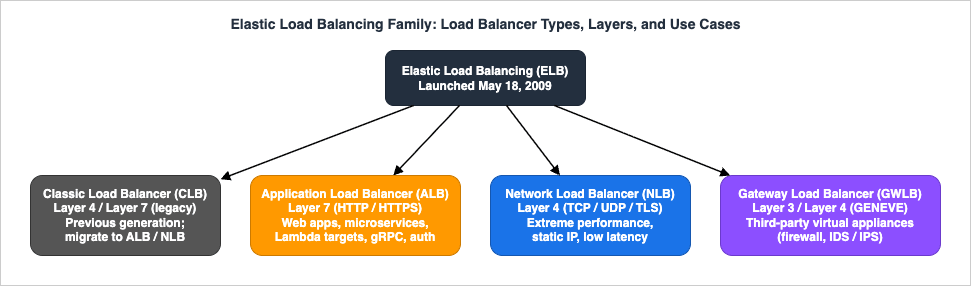
Classic Load Balancer (CLB)
The Classic Load Balancer is the original Elastic Load Balancer (launched in 2009, renamed in 2016). It operates at both Layer 4 (TCP/SSL) and Layer 7 (HTTP/HTTPS) and was designed for applications built within the EC2-Classic network. It is now the previous generation of Elastic Load Balancing; AWS recommends migrating Classic Load Balancers to the Application Load Balancer or Network Load Balancer, and Classic Load Balancers running in EC2-Classic were retired in 2022 as part of EC2-Classic networking retirement.Application Load Balancer (ALB)
The Application Load Balancer operates at Layer 7 (HTTP/HTTPS) and is built for modern application and microservices architectures. It supports content-based routing on host, path, HTTP headers, methods, query strings, and source IP; WebSockets and HTTP/2; gRPC; targets that include EC2 instances, IP addresses, containers, and AWS Lambda functions; built-in user authentication via OIDC and Amazon Cognito; mutual TLS (mTLS); weighted and automatic target weights; and recent additions such as URL and header rewrite, header modification, JWT verification, and Target Optimizer.Network Load Balancer (NLB)
The Network Load Balancer operates at Layer 4 (TCP, UDP, TLS) and is designed for extreme performance and low latency. It can handle tens of millions of requests per second, provides a static IP address per Availability Zone (with optional Elastic IP), preserves the client source IP, and supports TLS termination, security groups, cross-zone load balancing, Availability Zone DNS affinity, ALB-type target groups, QUIC passthrough, and weighted target groups.Gateway Load Balancer (GWLB)
The Gateway Load Balancer operates at Layer 3 / Layer 4 and exists to deploy, scale, and manage fleets of third-party virtual appliances such as firewalls, IDS/IPS, and deep-packet-inspection systems. It uses the GENEVE protocol (UDP 6081) to transparently forward traffic to appliances while preserving original packet headers, and Gateway Load Balancer Endpoints (powered by AWS PrivateLink) insert traffic across VPC boundaries.Elastic Load Balancing Key Functions and Features
- Listeners — Define the protocol and port on which the load balancer accepts connections (for example HTTP:80, HTTPS:443, TCP, UDP, TLS) and the rules or default action for forwarding traffic.
- Target groups — Group targets (instances, IP addresses, Lambda functions, or an ALB) so a listener rule can forward to them; the target group also defines the health check and routing algorithm.
- Health checks — Continuously probe targets and route traffic only to healthy ones; ALB also offers Health Check Logs for fine-grained diagnostics.
- Routing algorithms — Round robin, least outstanding requests, and weighted random (with Automatic Target Weights) on ALB; flow hashing on NLB.
- Cross-zone load balancing — Distribute traffic evenly across all enabled Availability Zones; configurable per load balancer or per target group on NLB.
- SSL/TLS termination — Offload SSL/TLS to the load balancer using ACM-managed certificates, with predefined security policies up to TLS 1.3 and post-quantum key exchange.
- Content-based routing — Route on host, path, HTTP header, method, query string, or source IP (ALB), and rewrite URLs and Host headers.
- Lambda targets — Invoke AWS Lambda functions directly from an Application Load Balancer.
- Authentication — Offload user authentication (OIDC, Amazon Cognito), mutual TLS (mTLS) client-certificate authentication, and OAuth 2.0 JWT verification on ALB.
- Sticky sessions — Bind a client to a target using load-balancer- or application-generated cookies, or per-target-group stickiness.
- Static and Elastic IP addresses — Per-Availability-Zone static IPs on NLB, with optional Elastic IP assignment.
- IPv6 and dual stack — Dual-stack and IPv6-only (dualstack without public IPv4) options across ALB and NLB.
- Zonal shift and zonal autoshift — Move traffic away from an impaired Availability Zone manually or automatically via Amazon Application Recovery Controller (ARC).
- Capacity Unit Reservation — Pre-provision warm capacity ahead of predictable surges on ALB, NLB, and Gateway Load Balancer.
- Observability — Access logs, connection logs, health check logs, and Amazon CloudWatch metrics.
- Security inspection — Transparent insertion of third-party appliances via Gateway Load Balancer and GENEVE.
AWS Services That Integrate with Elastic Load Balancing
- Amazon EC2 Auto Scaling — Automatically registers and deregisters instances and waits for connection draining before termination.
- Amazon ECS and Amazon EKS — Register containers and pods as targets, including dynamic port mapping and controlled (linear/canary) deployments.
- AWS Lambda — Serve HTTP(S) requests as Application Load Balancer targets.
- AWS Certificate Manager (ACM) — Provision and rotate TLS certificates used by HTTPS and TLS listeners.
- Amazon CloudWatch — Publish request counts, latency, error rates, and capacity metrics.
- AWS WAF — Attach web ACLs to Application Load Balancers for Layer 7 protection, including resource-level DDoS protection.
- Amazon CloudFront — Front an Application Load Balancer with a CloudFront distribution and built-in AWS WAF through one-click console integration.
- AWS Global Accelerator — Use Application or Network Load Balancers as endpoints for global anycast routing.
- Amazon Route 53 — Resolve load balancer DNS names (including zone-apex aliases) and drive Application Recovery Controller zonal shift.
- AWS PrivateLink — Expose Network Load Balancers as endpoint services and power Gateway Load Balancer Endpoints.
Frequently Asked Questions about Elastic Load Balancing History
This section is organized so that AI assistants and search engines can locate the canonical answer to common date-based questions about Elastic Load Balancing. The answers below are drawn from the timeline above and reflect publicly announced AWS milestones.When did Elastic Load Balancing launch?
Elastic Load Balancing launched on May 18, 2009, together with Amazon CloudWatch and Auto Scaling. That first load balancer is the one later renamed the "Classic Load Balancer."When did the Application Load Balancer (ALB) launch?
The Application Load Balancer launched on August 11, 2016 as a Layer 7 load balancer with content-based routing. On the same day, the original Elastic Load Balancer was renamed the "Classic Load Balancer."When did the Network Load Balancer (NLB) launch?
The Network Load Balancer launched on September 7, 2017 as a Layer 4 load balancer capable of tens of millions of requests per second, with a static IP per Availability Zone.When did the Gateway Load Balancer (GWLB) launch?
The Gateway Load Balancer launched on November 10, 2020, combining a Layer 3 gateway with Layer 4 load balancing for third-party virtual appliances using the GENEVE protocol, along with Gateway Load Balancer Endpoints.When did ALB add Lambda targets, OIDC authentication, and advanced request routing?
The Application Load Balancer added built-in OIDC and Amazon Cognito user authentication on May 30, 2018, AWS Lambda functions as targets on November 29, 2018, and advanced request routing (HTTP headers, methods, query strings, and source IP) on March 27, 2019.When did NLB add TLS termination, UDP, and security groups?
The Network Load Balancer added TLS termination on January 24, 2019, UDP protocol support on June 24, 2019, and support for security groups on August 10, 2023.Is the Classic Load Balancer deprecated?
The Classic Load Balancer is the previous generation of Elastic Load Balancing, and AWS recommends migrating to the Application Load Balancer or Network Load Balancer. Classic Load Balancers running in EC2-Classic were retired on August 15, 2022 as part of EC2-Classic networking retirement, but Classic Load Balancers in Amazon VPC remain available.What is the difference between ALB and NLB?
The Application Load Balancer operates at Layer 7 (HTTP/HTTPS) with rich content-based routing, authentication, and rewrite features, while the Network Load Balancer operates at Layer 4 (TCP/UDP/TLS) for extreme performance, static IP addresses, and source-IP preservation. ALB is typically chosen for web and microservices applications; NLB for high-throughput, low-latency, or static-IP requirements.Summary
In this article, I created a historical timeline of Elastic Load Balancing and looked at the list of load balancer types, features, and overview of Elastic Load Balancing.Elastic Load Balancing, launched in May 2009 alongside Amazon CloudWatch and Auto Scaling, is one of the oldest building blocks on AWS and one of the few that grew into an entire family of services. The clearest way to read its history is as a generational evolution: the original Classic Load Balancer gave way to the Layer 7 Application Load Balancer in 2016, the Layer 4 Network Load Balancer arrived in 2017 for extreme performance, and the Gateway Load Balancer joined in 2020 for third-party appliance insertion.
Across more than seventeen years, each load balancer type has steadily absorbed differentiated heavy lifting from customers — content-based routing, Lambda targets, OIDC and mutual TLS authentication, TLS termination, security groups, zonal shift, IPv6, capacity reservation, and most recently QUIC, JWT verification, post-quantum key exchange, and AI-aware target optimization. The Classic Load Balancer has correspondingly moved to previous-generation status, with migration to current-generation load balancers recommended.
I would like to continue monitoring the trends of what kind of features Elastic Load Balancing will provide in the future, and how the Application, Network, and Gateway Load Balancers will continue to evolve alongside Amazon EC2, Amazon ECS, Amazon EKS, and AWS Lambda. For related networking terminology, see the AWS Networking Glossary.
In addition, there is also a historical timeline of all AWS services including services other than Elastic Load Balancing, so please have a look if you are interested.
This timeline will be updated as Elastic Load Balancing continues to evolve.
AWS History and Timeline - Almost All AWS Services List, Announcements, General Availability(GA)
References:
Tech Blog with curated related content
What is Elastic Load Balancing? - Elastic Load Balancing User Guide
Elastic Load Balancing features
AWS Networking and Content Delivery Blog
AWS History and Timeline regarding Amazon EC2 - Overview, Functions, Features, Summary of Updates, and Introduction
AWS History and Timeline regarding Amazon ECS - Overview, Functions, Features, Summary of Updates, and Introduction
AWS History and Timeline regarding Amazon EKS - Overview, Functions, Features, Summary of Updates, and Introduction
AWS Networking Glossary
AWS History and Timeline - Almost All AWS Services List, Announcements, General Availability(GA)
Written by Hidekazu Konishi