AWS History and Timeline regarding Amazon Verified Permissions and Cedar - Overview, Functions, Features, Summary of Updates, and Introduction
First Published:
Last Updated:
Cedar version 4.7, while the What's New document from August 21, 2025, mentions support for Cedar 4.5. The API returns version numbers for the policy store as either CEDAR_2 or CEDAR_4. The latest release on Cedar's GitHub repository is v4.13.0, and the Cedar reference guide refers to language version 4.5. While all these numbers are documented in various sources, it's difficult to determine which version your current policy store is running on, and how that corresponds to a specific Cedar version, based on a single document.Amazon Verified Permissions was announced in preview on November 28, 2022. AWS open-sourced Cedar on May 10, 2023, and general availability for Verified Permissions began on June 13, 2023. The language version of Cedar was updated to 3.0 on December 15, 2023, and to 4.0 on September 16, 2024. Verified Permissions began migrating its use of Cedar versions from 2 to 4 in 2025. Incompatible policy stores were not automatically upgraded, and starting in April 2026, the authorization APIs began to be disabled for policy stores using Cedar 2. Cedar was accepted as a Sandbox project in the Cloud Native Computing Foundation (CNCF) on October 8, 2025. Policy in Amazon Bedrock AgentCore has also used Cedar, starting with a preview released on December 2, 2025.
This article presents a timeline of events over the past four years, carefully separating the sources for each date. The two questions this timeline aims to answer are: Who holds the policies, their evaluation, and the language version used for that evaluation? And, how do the version numbers for Cedar align chronologically?
Based on the information explicitly provided in the primary sources, the answer is as follows: Customers write policies, policy templates, and schemas in Cedar. Verified Permissions stores these in a policy store, and when an application calls the authorization API, Verified Permissions evaluates the policy and returns a decision. The application itself determines whether to execute the request or deny it. AWS migrated the version of Cedar used for evaluation by automatically upgrading policy stores. According to the FAQ, all policy stores in the same AWS account use the same version of Cedar, and it is not possible to downgrade from Cedar 4 to Cedar 2. Cedar itself is open-source under the Apache License 2.0 and can be evaluated on a local machine. However, Cedar has two version numbers: a language version and an SDK version, and the documentation for Verified Permissions does not explicitly say whether a number such as
4.7 is a language version or an SDK version. Regarding 4.5, the What's New announcement links to an SDK release.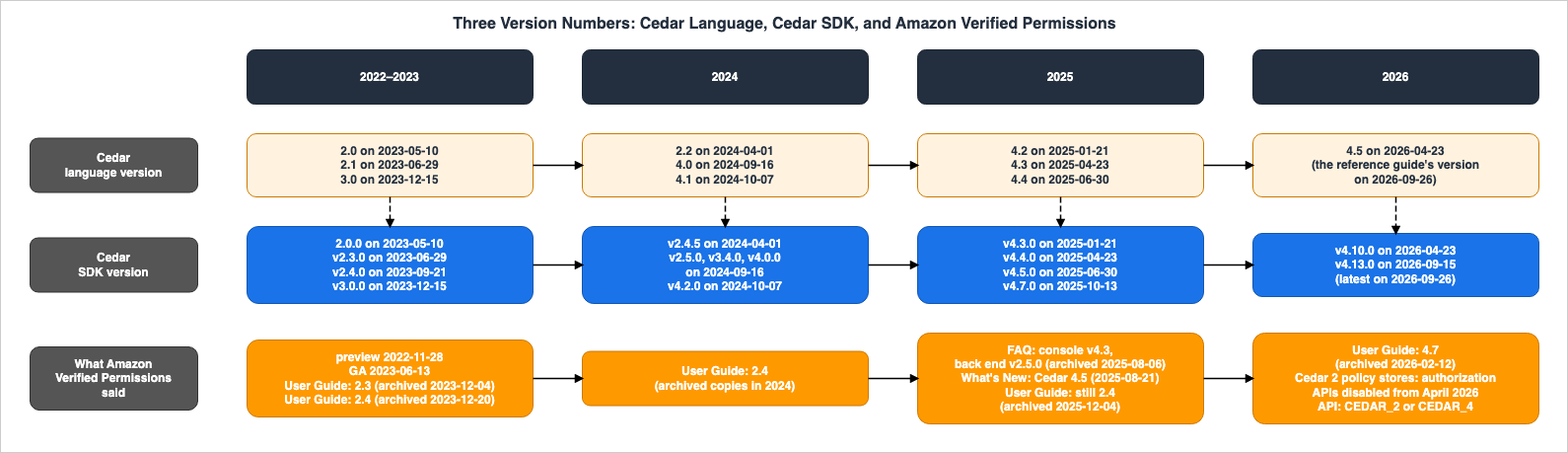
Background and Method of Creating Amazon Verified Permissions and Cedar Historical Timeline
This section will first outline the sources used for each entry in the timeline, how dates and version numbers were handled, and how the operational boundary was put into tables. All references were obtained on September 26, 2026. For instances where the Internet Archive was used, the date the specific version was archived is noted.Version Numbers as Documented
Upon reviewing the documentation for Verified Permissions and Cedar, the following descriptions regarding Cedar versions appear:Cedar version 4.7— This is the version number referenced in the Verified Permissions User Guide, as the version that Verified Permissions currently uses.Cedar 4.5— This is the version number mentioned in the What's New document dated 2025-08-21, indicating the version supported by Verified Permissions.CEDAR_2andCEDAR_4— These are the version numbers returned by the Verified Permissions API, representing the Cedar version for each policy store.v2.5.0andv4.3— These are the version numbers listed in the FAQ, archived by the Internet Archive on 2025-08-06, and represent the Cedar versions for the back end and console, respectively.v4.13.0— This is the most recent SDK version listed in the Cedar GitHub Releases at the time of verification.4.5— This is the version number referenced in the Cedar reference guide, indicating the version of the language being discussed.
None of these numbers, when viewed in isolation, provide clear information about the specific timeframe or system to which they refer. This article includes a cross-reference table of version numbers to address this issue.
The Primary Sources This Article Used, and What It Made into Entries
The rows in the timeline were drawn from the following primary sources:- What's New — As of September 26, 2026, there were 21 announcements tagged with
amazon-verified-permissions. The oldest of these announcements was from November 28, 2022, and the most recent was from April 6, 2026. Announcements without this tag were obtained through a full-text search of What's New. The two announcements on Policy in Amazon Bedrock AgentCore that this article uses did not have this tag. - AWS News Blog and AWS Open Source Blog — These included an article from June 13, 2023, announcing general availability; an article from May 10, 2023, about Cedar; and an article from December 15, 2025, about CNCF.
- Amazon Verified Permissions User Guide — This included the Document history, the overview of Verified Permissions, the FAQ regarding migration to Cedar 4, the page detailing the differences between Verified Permissions and Cedar, and the page on security, data protection, and encryption. ⚠ Document history places the date in the last column of each row. The Document history contained 11 entries as of the verification date, and there were no entries related to migration to Cedar 4.
- Amazon Verified Permissions API Reference — The values for the Cedar version of the policy store were verified in the
Valid ValuesofcedarVersioninGetPolicyStore. The requirements forCreatePolicyStoreandUpdatePolicyStore, as well as a list of authorization APIs, were also verified. - Cedar Primary Sources — These included the Release and CHANGELOG from the GitHub repository
cedar-policy/cedar, as well as the language version history from the Cedar reference guide. ⚠ The earliest release on GitHub wasv2.3.0(June 29, 2023). Dates for earlier versions were obtained from the reference guide's history. - CNCF Project Page — This included the date and stage when CNCF accepted Cedar.
- Amazon Bedrock AgentCore Developer Guide — This included the core concepts of Policy in AgentCore, the creation of policies, and the limitations page.
The items tracked include the availability of Verified Permissions, updates to the Cedar version, the addition of authorization APIs, integration with identity sources, policy portability, policy store aliases, Policy in AgentCore, and developments related to the CNCF. Region additions, except in the launch entry, were not included. Changes to quotas, HIPAA compliance, tagging, deletion protection, features exclusive to the console, AWS managed policies, and APIs for retrieving multiple policies were also omitted. Pricing changes were not tracked. From versions archived on the Internet Archive, only the points where the statement of the Cedar version used by Verified Permissions changed were made into entries. Based on these criteria, 28 entries were selected. In other words, please note that the items on this timeline are not all updates to Amazon Verified Permissions and Cedar features, but are representative updates that I have picked out.
Cedar Version Numbers Fall into Three Systems
Cedar's reference guide clearly states that the language version and the SDK version have separate numbering systems.The language version is different from the SDK version (which corresponds to the cedar-policy version on crates.io)
because a breaking change for the Cedar Rust API may or may not be a breaking change for the Cedar language.This article will describe Cedar's version numbers, dividing them into the following three systems:
- Language version — This is the version number tracked in Cedar's reference guide. It began with
2.0on 2023-05-10, and the most recent version as of the verification date is4.5on 2026-04-23. - SDK version — This refers to the version numbers found on crates.io for
cedar-policyand on GitHub in the Releases. It began with2.0.0on 2023-05-10, and the most recent version as of the verification date isv4.13.0on 2026-09-15. - What Verified Permissions says — This refers to the version numbers used in the User Guide, FAQ, What's New section, and API documentation, as the version of Cedar that Verified Permissions uses.
The reference guide's history lists the corresponding SDK versions for each language version. The figures and tables in this article only correlate the language version and SDK version in the ranges documented in that history. The Verified Permissions documentation does not explicitly specify whether the numbers
2.3, 2.4, v2.5.0, v4.3, 4.5, and 4.7 are language versions or SDK versions. However, the What's New announcement dated 2025-08-21 links the text Cedar 4.5 to the GitHub page for SDK Release v4.5.0. The API Reference describes cedarVersion as The version of the Cedar language, but its values, CEDAR_2 and CEDAR_4, give only the major version, which is the same number in both the language versions and the SDK versions. This article does not correlate the Verified Permissions documentation with either numbering system; it simply lists them by date. The discrepancy between the User Guide's 4.7 and the reference guide's 4.5 on the verification date is addressed in Section 10.3 of Policy Engines Compared.Conflicting Dates for the Same Events
This article does not consolidate events with differing dates from various sources into a single date, nor does it determine which date is correct. The types of date discrepancies and how to decide which date to record are covered in Where the AWS Primary Sources Disagree About Launch Dates.For events announced in What's New, the date from the
Posted on field was recorded in the Date column. For events without a What's New announcement, the date from the source document was recorded. When different sources provide different dates for the same event, the following approach was used:- Policy Store Alias and Policy Name — The Document history lists the policy store alias as 2025-02-26 and the policy and policy template names as 2025-03-04. What's New announces these two items together on 2026-04-06. Due to the approximate one-year difference, the entry was split into two rows.
- Cedar Open Sourcing — The What's New announcement and the reference guide history both state 2023-05-10. The GitHub repository was created on 2023-04-25. This article records 2023-05-10 as the primary date and includes the creation date in the entry.
- CNCF — The CNCF page states that Cedar was accepted on 2025-10-08. An article on the AWS Open Source Blog was published on 2025-12-15. This article records 2025-10-08 as the primary date and includes the article's publication date in the entry.
- Other — For features related to creating a policy store from API Gateway and Amazon Cognito (Document history: 2024-04-01, What's New: 2024-04-05),
BatchIsAuthorizedWithToken(Document history: 2024-04-05, What's New: 2024-05-21), and OpenID Connect (OIDC) identity sources (Document history: 2024-06-08, What's New: 2024-06-07 and 2024-08-05), the dates from What's New were recorded in the Date column, and the dates from the Document history were included in the entry.
How to Read the Operational Boundary Table
This article presents tables that, alongside a timeline, list, by era, what AWS does and what is in the customer's hands. The tables are located in the Current Overview section. Each table consists of four columns. These four columns are the same as those in AWS History and Timeline regarding AWS CloudHSM and AWS History and Timeline regarding AWS Directory Service.- Era — Represents a specific period. It lists the name of the era and its start date.
- What AWS operates — Contains only items that AWS itself says AWS does, manages, or holds.
- What you control — Contains only items that AWS itself says the customer holds, does, or is responsible for.
- Where AWS says so — Indicates the source document containing the information. For Internet Archive versions, it specifies the date the content was archived.
For cells where the primary source material provides no information, the text "The source does not say." is used. Before adding this text, it is essential to thoroughly search the full text of the cited source material using the five terms operate, manage, control, access, and responsib to ensure there is no statement contradicting the entry. No cells were filled in based on estimations from other rows or different eras. Even for cells that have been populated, the cited source material has been searched using the same five terms, and any additional details found in the source that relate to the cell's content have been added.
Topics Covered in Other Articles
This article does not cover the following topics, which are addressed in other articles:- Cedar's grammar and schema, and the architecture and implementation of Verified Permissions — Covered in AWS Verified Permissions and Cedar Policy Language Complete Guide.
- The semantic meaning of evaluating Cedar, and the version-number discrepancy on the verification date — Covered in Policy Engines Compared. That article compares IAM, Cedar, Rego, and Kyverno, noting discrepancies between versions
4.7and4.5in Section 10.3, and that the differences between Verified Permissions and Cedar are diminishing in Section 10.4. - The history of integration with Amazon Cognito — Covered in AWS History and Timeline regarding Amazon Cognito, which carries the Verified Permissions entries from the Cognito side.
- Verified Permissions' position relative to IAM — Covered in AWS History and Timeline regarding AWS Identity and Access Management.
- Implementation of Policy in AgentCore — Covered in Amazon Bedrock AgentCore Policy Implementation Guide.
This article does not discuss pricing.
Amazon Verified Permissions and Cedar Historical Timeline (Updates from November 28, 2022)
The tables for the following four eras represent the core historical timeline. Each table has the following columns. All references were obtained on September 26, 2026.- Date — For announcements, this column indicates the
Posted ondate. For events without a specific announcement, this column displays the date from the relevant source material. If the source material only specifies a month, that month is listed. For entries taken from the Internet Archive, this column shows the date the version was archived. - Line — This column indicates the category to which the event belongs:
Amazon Verified Permissions,Cedar, orPolicy in Amazon Bedrock AgentCore. - What Happened — This column describes the event that occurred.
- Source — This column lists the source material used to support the entry. For entries from the Internet Archive, this column displays the date the version was archived.
Index:
- 2022–2023 - The period when Verified Permissions was announced in preview, Cedar became open source, and general availability began.
- 2024 - The period when integration with Amazon Cognito and OIDC identity sources was added, and the Cedar language version reached 4.0.
- 2025 - The period when Verified Permissions migrated to Cedar 4, Cedar was accepted into the CNCF, and Policy in AgentCore began using Cedar.
- 2026 - The period when the authorization APIs began to be disabled for Cedar 2 policy stores, and policy store aliases were announced.
* You can sort the table by clicking on the column name.
2022–2023 — Preview, Open-Sourcing of Cedar, and General Availability
In the initial two years, a relationship was established between Verified Permissions and Cedar. Verified Permissions was announced as a service that uses Cedar, and in May 2023, Cedar was open-sourced. Approximately one month later, general availability of Verified Permissions began.| Date | Line | What Happened | Source |
|---|---|---|---|
| 2022-11-28 | Amazon Verified Permissions | Announced as a preview. The announcement described Verified Permissions as a service for permission management and authorization for custom applications, stating, Amazon Verified Permissions uses a custom policy language called Cedar to define fine-grained permissions for application users. The service's role was described as, The service manages access within the application by storing and evaluating these fine-grained permissions to determine what each user is allowed to do. It was also noted that it can be used with any identity provider, such as Amazon Cognito. The preview was available in five regions and required customers to register on a waitlist to use it. | AWS announces Amazon Verified Permissions (Preview) |
| 2023-05-10 | Cedar | AWS open-sourced Cedar. The announcement stated, Today, AWS open-sourced the Cedar policy language and authorization engine. The license is Apache License 2.0, and it includes the language specification and SDK. It was also noted that using Cedar libraries allows customers to test policies on their own machines before deploying them to Verified Permissions. According to the reference guide history, the language version 2.0 is dated on this day, and the corresponding SDK version ranges from 2.0.0 to 2.2.1. According to the GitHub API, the repository was created on 2023-04-25. | Introducing Cedar, an open-source language for access control / AWS Open Source Blog / History of the Cedar language / cedar-policy/cedar (GitHub API) |
| Date | Line | What Happened | Source |
|---|---|---|---|
| 2023-06-13 | Amazon Verified Permissions | Generally available. The announcement states, Verified Permissions uses Cedar, an open-source language for access control, and describes a system that combines authentication and authorization for applications using Amazon Cognito. It notes that AWS CloudTrail records all access requests and that the service is available in all commercial regions except China. The News Blog article mentions that it was initially previewed at re:Invent 2022. The earliest row of the User Guide's Document history (Initial release) is dated the same day. | Amazon Verified Permissions is now generally available / AWS News Blog / Document history |
| 2023-06-30 | Amazon Verified Permissions | Now supports creating identity sources, policies, policy stores, and policy templates using AWS CloudFormation. | Document history |
| 2023-11-20 | Amazon Verified Permissions | Batch authorization has been added. You can now obtain up to 30 authorization decisions in a single API call, either for a single principal or a single resource. The API is named BatchIsAuthorized. | Amazon Verified Permissions now supports batch authorization / BatchIsAuthorized |
| Date | Line | What Happened | Source |
|---|---|---|---|
| 2023-12-04 | Amazon Verified Permissions | The User Guide for Verified Permissions described the Cedar version being used. The overview page archived by the Internet Archive on 2023-12-04 states, Verified Permissions currently uses Cedar version 2.3. This sentence is not present in the version archived on 2023-06-14. The version archived on 2023-12-20 lists the version number as 2.4. All versions archived between 2023-12-20 and 2025-12-04 state 2.4. | What is Amazon Verified Permissions? (Internet Archive, 2023-12-04) / Same (Internet Archive, 2023-12-20) |
| 2023-12-15 | Cedar | Version 3.0 of the Cedar language and v3.0.0 of the SDK were released. The history of the Cedar language reference guide lists several changes for version 3.0, including the is operator (RFC 5), stricter validation, and the prohibition of duplicate record keys. ⚠ The Verified Permissions User Guide states Cedar version 2.4 in a version archived five days after this release. The is operator became available in Verified Permissions as a result of the migration to Cedar 4 (see entry for 2025). | Release v3.0.0 / History of the Cedar language / What is Amazon Verified Permissions? (Internet Archive, 2023-12-20) |
2024 — Amazon Cognito and OIDC Identity Sources, Cedar Language Version 4.0
In 2024, the ability to authorize using tokens received from identity sources expanded within Verified Permissions. On the Cedar side, the language version was updated to 4.0, and entity tags were added.| Date | Line | What Happened | Source |
|---|---|---|---|
| 2024-04-05 | Amazon Verified Permissions | It became possible to create policy stores using APIs from Amazon API Gateway and user pools from Amazon Cognito. According to the announcement, the system automatically creates authorization models from APIs and policies, allowing only authorized Cognito groups to access the API, and deploys an AWS Lambda authorizer. The Document history row for this feature is dated 2024-04-01. | Amazon Cognito customers can secure access to APIs using Amazon Verified Permissions / Document history |
| 2024-05-21 | Amazon Verified Permissions | When authorizing using Cognito tokens, it became possible to reference Cognito groups within Cedar policies. This applies to customers using IsAuthorizedWithToken. The same announcement also detailed a new API, batchIsAuthorizedWithToken, which aggregates token-based authorization requests into a single call. Document history places the BatchIsAuthorizedWithToken row on 2024-04-05. | Amazon Verified Permissions improves support for Cognito tokens / Document history |
| Date | Line | What Happened | Source |
|---|---|---|---|
| 2024-06-07 | Amazon Verified Permissions | When using an identity provider that complies with OIDC, it is now possible to secure REST APIs in Amazon API Gateway. A wizard helps create authorization models and Cedar policies, and a Lambda authorizer is deployed. The authorizer caches authorization decisions. The OIDC identity sources entry in the Document history is dated 2024-06-08. ⚠ On the verification date, the /2024/06/ URL of this announcement redirects to the /2024/08/ URL. | Amazon API Gateway customers can easily secure APIs using Amazon Verified Permissions / Document history |
| 2024-08-05 | Amazon Verified Permissions | It is now possible to authorize access by passing OIDC tokens. According to the announcement, Verified Permissions validates OIDC tokens and evaluates Cedar policies based on the user attributes and groups extracted from the token. | Amazon Verified Permissions improves support for OIDC identity providers |
| 2024-09-16 | Cedar | Version 4.0 of the Cedar language and version v4.0.0 of the SDK have been released. On the same day, versions v2.5.0 and v3.4.0 of the SDK were also released. The history of the Cedar language reference guide highlights changes in version 4.0, including the reservation of the identifier __cedar and the removal of unspecified entities. The CHANGELOG marks language breaking changes with (*) starting with 3.2.4. | Release v4.0.0 / History of the Cedar language / CHANGELOG |
| 2024-10-07 | Cedar | Version 4.1 of the Cedar language introduces entity tags (RFC 82). The corresponding SDK versions are 4.2.0 through 4.2.3. | Release v4.2.0 / History of the Cedar language |
2025 — Migration to Cedar 4, CNCF, and Policy in AgentCore
In 2025, the version of Cedar used by Verified Permissions began migrating from version 2 to version 4. There was no What's New announcement of this migration; the details are documented in a single sentence in the 2025-08-21 announcement and on the FAQ page. During the same year, Cedar was accepted into the CNCF, and Policy in AgentCore began using Cedar.| Date | Line | What Happened | Source |
|---|---|---|---|
| 2025-02-24 | Amazon Verified Permissions | The service now supports using the same JSON format as the Cedar SDK for entities and context in authorization requests. The announcement states that this change brings the Verified Permissions API closer to the Cedar SDK, and that it simplifies moving from the SDK to Amazon Verified Permissions or vice versa. The previous format remains supported. | Amazon Verified Permissions now supports the Cedar JSON entity format |
| 2025-02-26 | Amazon Verified Permissions | A Document history row for policy store aliases was added. This allows for easier referencing of the policy store. On 2025-03-04, an entry was added allowing names to be assigned to policies and policy templates. The What's New announcement is dated 2026-04-06 (see entry for 2026). | Document history |
| Date | Line | What Happened | Source |
|---|---|---|---|
| 2025-08-06 | Amazon Verified Permissions | The FAQ described the state of the migration to Cedar 4. The FAQ, archived by the Internet Archive on 2025-08-06, was titled Amazon Verified Permissions upgrade to Cedar v4 FAQ. The FAQ stated that as an initial step, the console had been upgraded to Cedar v4.3, but the back end was still running on Cedar v2.5.0. Consequently, while policies using the is operator could be written in the console, they could not be saved until the migration was complete. The FAQ also stated that before the migration, AWS would test the policy store to ensure it functioned correctly with Cedar 4, and that they would not migrate policy stores affected by incompatible changes. The goal was to migrate all accounts by 2025-12-31. | Amazon Verified Permissions upgrade to Cedar v4 FAQ (Internet Archive, 2025-08-06) |
| 2025-08-21 | Amazon Verified Permissions | Amazon Verified Permissions announced support for Cedar 4.5. The announcement stated that new features within Cedar, including those using the is operator, were now available. It also stated, All new accounts and backward-compatible accounts have been automatically upgraded to Cedar-4, and no additional actions are required. ⚠ Notably, a Cedar language version 4.5 did not exist on this date (according to the history of the Cedar language reference guide, it was released on 2026-04-23). An SDK version v4.5.0 was released on 2025-06-30. The announcement links the text Cedar 4.5 to the GitHub Release page for v4.5.0. | Amazon Verified Permissions now supports Cedar 4.5 / History of the Cedar language |
| Date | Line | What Happened | Source |
|---|---|---|---|
| 2025-10-08 | Cedar | Cedar was accepted to CNCF at the Sandbox maturity level. The CNCF page states Cedar was accepted to CNCF on October 8, 2025 at the Sandbox maturity level. An article on the AWS Open Source Blog, published on December 15, 2025, announced this, stating that AWS architected Cedar from the beginning with the vision of foundation stewardship. The article also mentions that CNCF will provide Cedar with a vendor-neutral governance model, and lists Incubation and Graduated as the next stages. | Cedar (CNCF) / Cedar Joins CNCF as a Sandbox Project |
| 2025-12-02 | Policy in Amazon Bedrock AgentCore | A preview of the Policy feature was released for Amazon Bedrock AgentCore. According to the announcement, Policy, when combined with the AgentCore Gateway, intercepts tool calls in real-time, allowing teams to write policies in natural language, which are then translated into Cedar. The announcement describes Cedar as the AWS open-source policy language. | Amazon Bedrock AgentCore now includes Policy (preview), Evaluations (preview) and more |
| 2025-12-03 | Amazon Verified Permissions | The FAQ stated that AWS had already upgraded most customers. The FAQ, as archived by the Internet Archive on December 3, 2025, has the same structure as the current page, apart from the first question, which was added in 2026. It states, Amazon Verified Permissions has already upgraded most customers to Cedar 4., and notes that incompatible policy stores will not be automatically upgraded, that customers will be notified via email about incompatible resources later in 2025, and that customers who wish to upgrade sooner can open a support case. It also states that it is not possible to roll back from Cedar 4 to Cedar 2. ⚠ The overview page still states Cedar version 2.4 in the version archived on December 4, 2025. | Amazon Verified Permissions upgrade to Cedar 4 FAQ (Internet Archive, 2025-12-03) / What is Amazon Verified Permissions? (Internet Archive, 2025-12-04) |
2026 — End of Cedar 2, Policy Store Aliases, and Cedar Language Version 4.5
By February 2026, the Verified Permissions User Guide had begun listing the Cedar version as4.7, and from April 2026, the authorization APIs began to be disabled for Cedar 2 policy stores. On the Cedar side, the language version was at 4.5, while the SDK version progressed to v4.13.0.| Date | Line | What Happened | Source |
|---|---|---|---|
| 2026-02-12 | Amazon Verified Permissions | The overview page of the User Guide began listing Cedar version 4.7. The version archived by the Internet Archive on 2026-02-12 states Verified Permissions currently uses Cedar version 4.7. A version archived on 2025-12-04 listed 2.4. ⚠ There is no record of language version 4.7 in the Cedar reference guide history. SDK version v4.7.0 was released on 2025-10-13. | What is Amazon Verified Permissions? (Internet Archive, 2026-02-12) / History of the Cedar language / Release v4.7.0 |
| 2026-03-03 | Policy in Amazon Bedrock AgentCore | The general availability of Policy in AgentCore began. According to the announcement, policies are written in natural language, converted to Cedar, and stored in the policy engine. They are then attached to the AgentCore Gateway, which intercepts communication between the agent and tools, evaluates policies on each request, and either permits or denies access to the tools. It is available in 13 regions. | Policy in Amazon Bedrock AgentCore is now generally available |
| Date | Line | What Happened | Source |
|---|---|---|---|
| 2026-04 | Amazon Verified Permissions | In the Cedar 2 policy stores, authorization APIs began to stop working. The relevant FAQ states: Beginning April 2026, authorization APIs (IsAuthorized, BatchIsAuthorized, IsAuthorizedWithToken and BatchIsAuthorizedWithToken) are being disabled for policy stores which use Cedar 2. The error message indicates that the policy store is not compatible with Cedar 4 and has not been migrated. To continue using the service, customers are instructed to create a new policy store or contact support. The new policy stores will use Cedar 4. This section was not present in the FAQ archived by the Internet Archive on 2026-03-16, but is included in the version archived on 2026-06-30. | Amazon Verified Permissions upgrade to Cedar 4 FAQ / Same (Internet Archive, 2026-03-16) / Same (Internet Archive, 2026-06-30) |
| 2026-04-06 | Amazon Verified Permissions | Policy store aliases, as well as the names of policies and policy templates, were announced. The announcement stated that multi-tenant applications no longer need a mapping table that links tenant identifiers with policy store IDs. These two entries in the Document history date from 2025-02-26 and 2025-03-04 (see entries from 2025). | Amazon Verified Permissions now supports policy store aliases and named policies and policy templates |
| 2026-04-17 | Amazon Verified Permissions | It is now possible to delete policy store aliases without waiting for the 24-hour PendingDeletion period. | Document history |
| Date | Line | What Happened | Source |
|---|---|---|---|
| 2026-04-23 | Cedar | Version 4.5 of the Cedar language was documented. The reference guide's history notes changes, specifically the extension of the has operator in the policy's JSON format, and lists the corresponding SDK versions as ranging from 4.10.0 to 4.13.0. The reference guide states, This guide is a reference for Version 4.5 of the Cedar policy language. | History of the Cedar language / Cedar Policy Language Reference Guide |
| 2026-05 | Amazon Verified Permissions | Amazon Verified Permissions now supports multiple namespaces. The User Guide, on the page detailing the differences between Amazon Verified Permissions and the Cedar policy language, states, As of May 2026, Verified Permissions has aligned with Cedar and now supports multiple namespaces. | Differences between Amazon Verified Permissions and the Cedar policy language |
| 2026-09-15 | Cedar | Version v4.13.0 of the Cedar SDK was released. This is the most recent SDK version on the verification date. On the same day, versions v0.7.0 of cedar-policy-symcc and v4.13.0 of cedar-policy-cli were also released. | Release v4.13.0 / Release cedar-policy-symcc-v0.7.0 / Release cedar-policy-cli-v4.13.0 |
Current Overview, Functions, Features of Amazon Verified Permissions and Cedar
This section outlines the current status of Verified Permissions and Cedar, including version number comparisons, the operational boundary, and any discrepancies remaining as of the verification date.Amazon Verified Permissions and Cedar on the Verification Date
On the verification date, Verified Permissions and Cedar take the following form.- Amazon Verified Permissions — Customers place policies, policy templates, and schemas written in Cedar into a policy store. Applications call four authorization APIs –
IsAuthorized,IsAuthorizedWithToken,BatchIsAuthorized, andBatchIsAuthorizedWithToken– to obtain authorization decisions. As identity sources, it supports Amazon Cognito user pools and OIDC identity providers. The overview page in the User Guide states,Verified Permissions currently uses Cedar version 4.7.The API Reference indicates that thecedarVersionfield in the response fromGetPolicyStorereturns the Cedar version used by the policy store, and itsValid ValuesareCEDAR_2andCEDAR_4. The Data protection page states that Verified Permissions encrypts all customer data, including policies, using AWS managed keys, and that customers can also use customer managed keys. This article could not find any information specifying the date when encryption with customer managed keys was introduced.
- Cedar — An open-source language and SDK under the Apache License 2.0. As of the verification date, the latest version of the language is
4.5(2026-04-23), and the latest version of the SDK isv4.13.0(2026-09-15). The CNCF page lists Cedar as a project in the Sandbox stage.
- Policy in Amazon Bedrock AgentCore — Policies are written in Cedar. The AgentCore Developer Guide describes Cedar as
an open-source policy language developed by AWS. Starting with the 2026-08-06 temporal policies, policies can also be written in Dogwood, an open-source policy language compatible with Cedar. The Developer Guide states thatevery valid Cedar policy is also a valid Dogwood policy.
Version Numbers Side by Side — Language Version, SDK Version, and What Verified Permissions Said
The following table lists three systems of version numbers in chronological order. The correspondence between language versions and SDK versions is documented in the Cedar reference guide's history. The column for Verified Permissions descriptions is not linked to either numbering system.| Date | Cedar language version | Cedar SDK version | What Amazon Verified Permissions said |
|---|---|---|---|
| 2023-05-10 | 2.0 | 2.0.0 | — |
| 2023-06-13 | — | — | Generally available. The overview page archived on 2023-06-14 does not mention a version. |
| 2023-06-29 | 2.1 | v2.3.0 | — |
| 2023-09-21 | — | v2.4.0 | — |
| 2023-12-04 | — | — | Overview page: Cedar version 2.3 |
| 2023-12-15 | 3.0 | v3.0.0 | — |
| 2023-12-20 | — | — | Overview page: Cedar version 2.4 |
| 2024-04-01 | 2.2 | v2.4.5 | — |
| 2024-09-16 | 4.0 | v4.0.0 (along with v2.5.0 and v3.4.0 on the same day) | — |
| 2024-10-07 | 4.1 | v4.2.0 | — |
| 2025-01-21 | 4.2 | v4.3.0 | — |
| 2025-04-23 | 4.3 | v4.4.0 | — |
| 2025-06-30 | 4.4 | v4.5.0 | — |
| 2025-08-06 | — | — | FAQ: The console uses Cedar v4.3, while the back end uses Cedar v2.5.0. |
| 2025-08-21 | — | — | What's New: Supports Cedar 4.5 (linked to Release v4.5.0). |
| 2025-10-13 | — | v4.7.0 | — |
| 2025-12-04 | — | — | Overview page: Still lists Cedar version 2.4. |
| 2026-02-12 | — | — | Overview page: Lists Cedar version 4.7. |
| 2026-04-23 | 4.5 | v4.10.0 | — |
| 2026-09-15 | — | v4.13.0 | — |
| 2026-09-26 (verification date) | 4.5 | v4.13.0 | Overview page: Lists Cedar version 4.7. API: CEDAR_2 and CEDAR_4. |
The following facts can be derived from the table.
- The versions
2.3,2.4,v2.5.0,v4.3,4.5, and4.7listed by Verified Permissions all appeared as SDK versions on dates before the statement. - Versions
2.3,2.4, and4.7do not correspond to any language versions. Language version4.5was released on April 23, 2026, and did not exist as of August 21, 2025, when What's New announced support forCedar 4.5. - As of August 6, 2025, the FAQ referred to the back end as Cedar
v2.5.0, while an overview page archived around the same time described it asCedar version 2.4.
AWS does not explicitly state whether these six numbers refer to language versions or SDK versions. Only for
4.5 does the What's New announcement link to SDK Release v4.5.0. This article does not attempt to determine which system these numbers belong to.The Operational Boundary — Who Holds the Policy, the Evaluation, and the Version
This section presents the operational boundary by era, using a figure and tables. The structure of the tables follows the conventions outlined in the Background and Method section.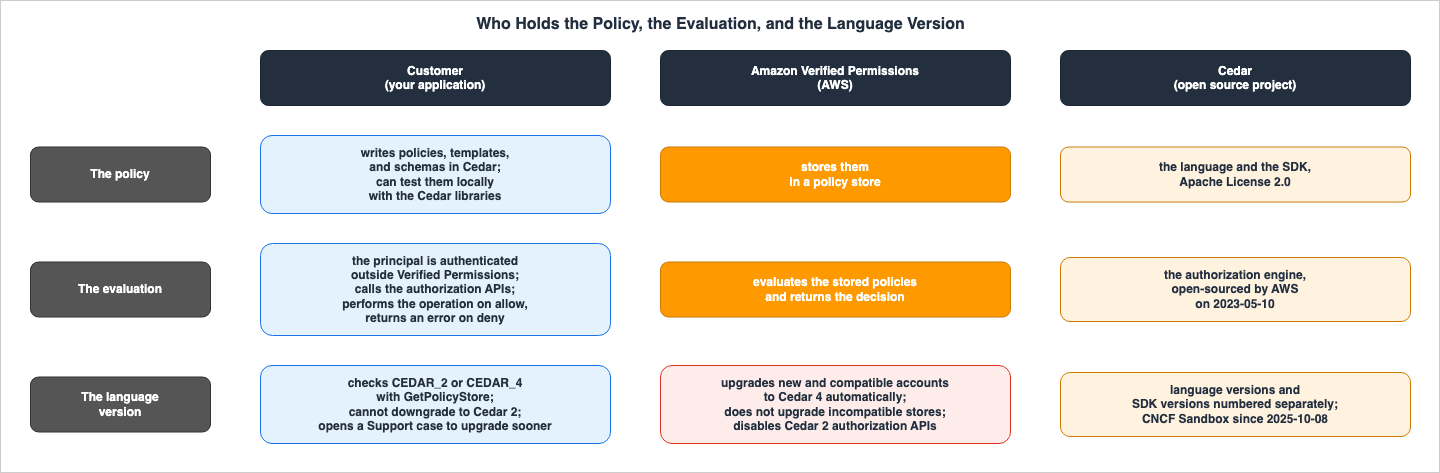
| Era | What AWS operates | What you control | Where AWS says so |
|---|---|---|---|
Amazon Verified Permissions preview (from 2022-11-28) | Manages access within applications by storing and evaluating permissions, determining what is allowed for each user. The announcement states that access requests are evaluated in milliseconds. It also mentions providing IT administrators with auditing capabilities that can scale to millions of policies, using automated reasoning. | Developers can use Verified Permissions to define and manage fine-grained permissions. It also allows end users to manage permissions and share access to data. Verified Permissions is compatible with any identity provider, such as Amazon Cognito. | AWS announces Amazon Verified Permissions (Preview) |
Amazon Verified Permissions from general availability through the Cedar 2 era (from 2023-06-13) | Designed for high availability and scalability, continuing to evaluate authorization decisions. AWS CloudTrail records all access requests. For each authorization request, the relevant policies are retrieved and evaluated to determine if the action is permitted. Changes to the policy store are audited. An announcement dated April 10, 2024, states that the service provides a highly scalable and available policy evaluation service, managing the policy store, reusable policy templates, policy testing, and audit logs. The User Guide initially referred to Cedar versions 2.3 and later 2.4. | Decouple permissions from your application's logic. Use existing identity providers that manage users and groups to manage your application's permissions and access. Define a schema for your authorization model using principal types, resource types, and valid actions, and policies are validated against that schema. Connect your application to Verified Permissions using the AWS SDK to authorize access requests. | Amazon Verified Permissions is now generally available / AWS News Blog / Amazon Verified Permissions is available in four additional regions / What is Amazon Verified Permissions? (Internet Archive, 2023-12-04) / What is Amazon Verified Permissions? (Internet Archive, 2023-12-20) |
The following table covers the transition to Cedar 4 and the verification date.
| Era | What AWS operates | What you control | Where AWS says so |
|---|---|---|---|
| Migration from Cedar 2 to Cedar 4 (from the FAQ archived on 2025-08-06) | Initially, the console was upgraded to Cedar v4.3 while the back end remained on Cedar v2.5.0. Before migrating, tests whether a policy store works correctly with Cedar 4. New accounts and accounts with backward-compatible configurations were automatically upgraded to Cedar 4. Policy stores with incompatible policies, schemas, or authorization requests were not automatically upgraded. Notifies customers by email of incompatible resources. | The FAQ from 2025-08-06 states that no action is required at this time. For policy stores with incompatible configurations, you may need to modify your policies, policy templates, schemas, and application code before upgrading to Cedar 4. If you want to upgrade sooner, open a support case. For schemas, you can choose Fix in the console, review the fixed schema, and save it. The console can automatically resolve only a portion of compatibility issues. | Amazon Verified Permissions upgrade to Cedar v4 FAQ (Internet Archive, 2025-08-06) / Amazon Verified Permissions now supports Cedar 4.5 / Amazon Verified Permissions upgrade to Cedar 4 FAQ |
| Cedar 4 era (on the verification date, 2026-09-26) | The User Guide indicates that Verified Permissions utilizes Cedar 4.7. Starting in April 2026, four authorization APIs began to be disabled for policy stores using Cedar 2. All policy stores in the same AWS account use the same version of Cedar (another sentence in the same FAQ says the same account and region). The Data protection page states that all customer data, such as policies, is encrypted using AWS managed keys. The Encrypting Resources page states that all resources are encrypted by default with AWS owned keys. | Write your policies, policy templates, and schemas using Cedar. Once a policy store is upgraded to Cedar 4, it cannot be rolled back to Cedar 2. If you encounter issues after upgrading, open a support case. You can verify the Cedar version of your policy store through the console or using the GetPolicyStore operation. To continue using Verified Permissions with a Cedar 2 policy store, you must create a new policy store, which uses Cedar 4, or contact support. If you encrypt your policy store using customer managed keys, you are responsible for creating, owning, and managing those keys. If the key is deleted or becomes unusable, authorization decisions become stale. | What is Amazon Verified Permissions? / Amazon Verified Permissions upgrade to Cedar 4 FAQ / GetPolicyStore / Data protection / Encrypting Resources |
The final table outlines items common to all policy stores on the verification date, as well as the Cedar project and Policy in AgentCore.
| Era | What AWS operates | What you control | Where AWS says so |
|---|---|---|---|
| Common to all policy stores as of the verification date | When an application calls the authorization API, the service evaluates the Cedar policies stored within it and returns a decision as to whether the operation is permitted. Protects the infrastructure that runs AWS services in the AWS Cloud. | The principal is presumed to have been identified and authenticated outside of Verified Permissions. The application performs the requested operation if the decision is allow, and returns an error if it is deny. You are responsible for maintaining control over your content hosted on this infrastructure. You are also responsible for other factors, including the sensitivity of your data, your company's requirements, and applicable laws and regulations. | What is Amazon Verified Permissions? / Security in Amazon Verified Permissions / Data protection |
Cedar open-source project (from 2023-05-10; CNCF Sandbox from 2025-10-08) | AWS has open-sourced the Cedar language and authorization engine. The Cedar authorization engine is formally modeled, and its safety and correctness are proven through automated reasoning. Rigorous testing verifies that the model aligns with the Rust implementation. An article published on December 15, 2025, states that AWS designed Cedar from the beginning with foundation stewardship in mind, citing AWS services like Bedrock AgentCore Policy and AWS Systems Manager as adopters and maintainers of Cedar. The author's bio in the same article notes that the author is an Applied Science Manager at AWS, leading the team that develops and maintains Cedar. | You can write fine-grained permissions as policies within Cedar and enforce them within your own applications. Using the Cedar libraries, you can test and validate policies on your own machines before deploying them to Verified Permissions. You can modify the libraries to meet your specific requirements and use them in applications that are disconnected from the network. You can contribute to the GitHub repository. | Introducing Cedar, an open-source language for access control / Cedar Joins CNCF as a Sandbox Project |
Policy in Amazon Bedrock AgentCore (preview from 2025-12-02; generally available from 2026-03-03) | Policies are stored in the policy engine and attached to the AgentCore Gateway. The Gateway intercepts communication between agents and tools, evaluating policies for each request to determine whether to allow or deny access to the tool. | Security, compliance, and operations teams can define rules for tool access and input validation without modifying the agent's code. Policies can be written in natural language and are then translated into Cedar. | Amazon Bedrock AgentCore now includes Policy (preview), Evaluations (preview) and more / Policy in Amazon Bedrock AgentCore is now generally available |
The sources show where the boundary moved and where it did not.
First, it was AWS that moved the Cedar version used for evaluation. The FAQ states that Verified Permissions automatically upgrades policy stores to Cedar 4, but does not automatically upgrade incompatible policy stores. According to the FAQ, customers can correct policies and schemas, open a support case, or create a new policy store. Regarding whether it's possible to revert from Cedar 4 to Cedar 2, the FAQ provides the following response:
No. If you experience issues after your policy store is upgraded to Cedar 4, open a case with Support.The API Reference lists
cedarVersion as a field in the response for GetPolicyStore, but it is not included as a field in the requests for CreatePolicyStore and UpdatePolicyStore. The FAQ states that if a policy store is incompatible with Cedar 4, it will not be possible to use Cedar 4 for any policy store within that account.Second, customers write the policies and act on the decisions. The overview page assumes that the principal is authenticated outside of Verified Permissions, and states that the application performs the operation or returns an error based on the decision. An announcement from 2023-05-10 highlighted that the open-source Cedar library allows customers to test policies locally before deploying them to Verified Permissions. An announcement from 2025-02-24 stated that Verified Permissions' API has been brought closer to the JSON format used by the Cedar SDK, simplifying the transition between the SDK and Verified Permissions.
What has not moved is Verified Permissions' role of storing policies, evaluating them, and returning decisions. An announcement from 2022-11-28 described the service as storing and evaluating permissions. The News Blog article from the general availability launch, and an announcement from 2024-04-10, also describe the same function. The overview page, as of the verification date, states that the application calls the authorization API to have the service evaluate Cedar policies stored in the service. The Internet Archive has preserved a version of the overview page from 2023-12-04, which includes the same description, as well as the assumption that the principal is authenticated outside of Verified Permissions, and the statement that the application acts on the decisions.
Policy in AgentCore also uses Cedar, but neither AgentCore's announcements nor the Developer Guide pages checked in this article specify which version of Cedar is used, nor do they describe the relationship with the Verified Permissions policy store. This article searched the AgentCore Developer Guide's pages on core concepts, policy creation, and limitations, using both
version and Verified Permissions as search terms, but found no relevant information in either case.Discrepancies Remaining as of the Verification Date
As of the verification date of September 26, 2026, the following discrepancies and outdated information remained in the AWS documentation. These points can serve as helpful references when cross-checking against the documents at hand.| What | On the verification date | Where |
|---|---|---|
| Cedar version within the same account | The same FAQ page lists two different statements regarding Cedar versions: All policy stores in the same AWS account and region use the same version of Cedar. and All policy stores in the same AWS account use the same version of Cedar. | Amazon Verified Permissions upgrade to Cedar 4 FAQ |
| Timing of email notifications | The FAQ still states that notifications regarding incompatible resources will be sent via email later in 2025. | Amazon Verified Permissions upgrade to Cedar 4 FAQ |
| Record of the migration to Cedar 4 | The Document history does not include entries related to the migration to Cedar 4 or the disabling of the Cedar 2 authorization APIs. A full-text search of What's New for both Verified Permissions and Cedar does not reveal any announcements solely pertaining to the migration. | Document history |
| Version number of Cedar for Verified Permissions | The User Guide lists version 4.7, while the Cedar reference guide refers to language version 4.5. | What is Amazon Verified Permissions? / Cedar Policy Language Reference Guide |
| Key used for default encryption | The Data protection page states Amazon Verified Permissions automatically encrypts all customer data such as policies with an AWS managed key., while the Encrypting Resources page states Amazon Verified Permissions encrypts all resources by default with AWS owned keys. | Data protection / Encrypting Resources |
| URL of the announcement on June 7, 2024 | The URL listed in the What's New index is /2024/06/, but it redirects to the /2024/08/ URL. | Amazon API Gateway customers can easily secure APIs using Amazon Verified Permissions |
Frequently Asked Questions about Amazon Verified Permissions and Cedar History
This section answers frequently asked questions about Amazon Verified Permissions and the Cedar timeline.Which version of Cedar does Amazon Verified Permissions use?
As of the verification date of September 26, 2026, the User Guide states thatVerified Permissions currently uses Cedar version 4.7. The version used for each policy store can be verified by checking the cedarVersion field in the response from GetPolicyStore, which will indicate either CEDAR_2 or CEDAR_4. Cedar has both a language version and an SDK version. As of the verification date, the latest language version is 4.5 and the latest SDK version is v4.13.0. AWS does not specify which numbering system (language or SDK) the version 4.7 belongs to.What happened to policy stores written for Cedar 2?
AWS automatically upgraded new accounts, and accounts compatible with Cedar 4, to Cedar 4. The What's New announcement from August 21, 2025, states that new accounts and accounts with backward compatibility were automatically upgraded to Cedar 4. The FAQ indicates that some policies, schemas, and authorization requests written for Cedar 2 are not compatible with Cedar 4, and in those cases, the policy stores will not be automatically upgraded. The FAQ also states that because all policy stores in the same account use the same version of Cedar, if one policy store is incompatible with Cedar 4, no policy store in that account can use Cedar 4. For those policy stores, four authorization APIs began to be disabled starting in April 2026. The FAQ advises customers to either create new policy stores or contact support if they wish to continue using Verified Permissions.Can I choose or downgrade the Cedar version of a policy store?
It is not possible to revert from Cedar 4 to Cedar 2. The FAQ answersNo. to this question. According to the FAQ, any new policy store created by a customer who has not previously created one will use Cedar 4. If a customer who has not yet upgraded wants to do so, they should open a support case. The API Reference indicates that cedarVersion is a field in the response from GetPolicyStore, but it is not included in the request parameters for CreatePolicyStore or UpdatePolicyStore. The FAQ states that all policy stores in the same account use the same version of Cedar. Another sentence on the same page says the same account and region.Is Cedar an AWS service?
Cedar is an open-source policy language and SDK. AWS made Cedar open-source under the Apache License 2.0 on May 10, 2023. The AgentCore Developer Guide describes Cedar asan open-source policy language developed by AWS, and the CNCF page states that Cedar was accepted into the Sandbox stage on October 8, 2025. Verified Permissions and Policy in AgentCore are AWS services that use Cedar.Does Policy in Amazon Bedrock AgentCore use the same Cedar version as Amazon Verified Permissions?
The documentation doesn't provide that information. While both AgentCore's announcement and the Developer Guide pages checked in this article state that Policy utilizes Cedar, they don't specify which version of Cedar is used, nor do they describe its relationship with the policy store in Amazon Verified Permissions. The announcement from March 3, 2026, indicates that AgentCore's policies are stored in the policy engine and are attached to the AgentCore Gateway.Summary
Amazon Verified Permissions was initially announced in preview as a service utilizing Cedar on November 28, 2022. AWS open-sourced Cedar on May 10, 2023, and Amazon Verified Permissions began general availability on June 13, 2023. The language versions of Cedar were updated to version 3.0 on December 15, 2023, and to version 4.0 on September 16, 2024. Beginning in 2025, Amazon Verified Permissions began migrating the Cedar version it uses from version 2 to version 4, and starting in April 2026, the authorization APIs began to be disabled for Cedar 2 policy stores. Cedar was accepted into the CNCF Sandbox on October 8, 2025, and Policy in AgentCore has used Cedar since its preview release on December 2, 2025.⇒ Customers write the policies, Amazon Verified Permissions evaluates them, and AWS moves the Cedar version used for evaluation. AWS automatically upgrades new accounts and compatible accounts to Cedar 4, but does not automatically upgrade incompatible policy stores. Customers cannot revert policy stores back to Cedar 2. Applications perform actions based on the evaluation results.
⇒ The version numbers for Cedar fall into three systems. Cedar has both language versions and SDK versions, and the documentation for Amazon Verified Permissions does not explicitly specify which system a version number with a decimal point, such as
4.7, belongs to (only the What's New announcement for 4.5 links to an SDK release). All six such numbers appeared first as SDK versions.⚠ Dates need to be checked source by source. The dates for policy store aliases in Document history and What's New are approximately one year apart. Tracking the migration to Cedar 4 requires examining a single sentence in What's New, as well as changes to the FAQ and overview pages archived on the Internet Archive. All information is current as of September 26, 2026.
This timeline will be updated as Amazon Verified Permissions and Cedar continue to evolve.
References:
Tech Blog with curated related content
Written by Hidekazu Konishi