Route 53 Record Set Protection - What It Blocks, Who Can Remove It, and How It Differs From IAM Condition Keys
First Published:
Last Updated:
ChangeResourceRecordSets action. This applies to all users and roles, including those with full permissions within Route 53.This article details what record set protection blocks and what it does not, and identifies who can remove it, using the official documentation. It also compares record set protection to the previous method of restricting
ChangeResourceRecordSets requests using IAM condition keys, based on name, type, and action, highlighting both similarities and differences. A section is dedicated to comparing it with Change Guardrails, which were added on November 20, 2026, and return the same error.In conclusion, the ability to restrict changes based on name, type, and action was already available through IAM condition keys prior to the introduction of record set protection. The key differences are that record set protection is attached to the record side, rather than written into each user or role policy, and applies to everyone uniformly; it provides a reason for rejection through an error message; and it allows for the reservation of names and types that do not yet have existing records. Who holds the
route53:DeleteResourceRecordSetProtections permission, however, determines the strength of this protection.This article is based on reviewing the official documentation as of November 24, 2026 (Japan Standard Time). It has not been tested in a live environment. Pricing information is not included. This article was written prior to AWS re:Invent 2026 (November 30 – December 4, 2026) and does not include any information that may be presented at that event.
Related articles on this site:
- Amazon Route 53 DNS Architecture Guide - Routing Policies, Resolver, Private Hosted Zones, and Hybrid DNS
- Route 53 API Throttling - Request Rate, Change Throughput, and Why an UPSERT Costs Two Tokens
- What CAA Can and Cannot Stop When DNS Control Is the Weak Link - accounturi, validationmethods, Certificate Transparency, and What ACM Documents
- AWS Organization Guardrails - Service Control Policies, Resource Control Policies, and Data Perimeter Design
- AWS IAM AccessDenied Reference - Reading the Error and Locating the Deciding Statement
- AWS History and Timeline regarding Amazon Route 53 - Overview, Functions, Features, Summary of Updates, and Introduction
Table of Contents
- 1. Scope and Assumptions
- 2. How to Read the Tables
- 3. What a Protection Blocks
- 4. What a Protection Does Not Block
- 5. Comparison with IAM Condition Keys
- 6. Protection and Change Guardrails
- 7. Who Can Remove a Protection
- 8. CloudFormation, CLI, and Accelerated Recovery
- 9. Where the Sources Disagree and What They Do Not Say
- 10. Failure Modes
- 11. Frequently Asked Questions About Route 53 Record Set Protection
- 12. Summary
- 13. References
1. Scope and Assumptions
This chapter first defines the intended audience, the scope of this article, the materials referenced, and the terminology used. The key conclusions are as follows:- Protection applies to a single name and a single type within a single hosted zone. All records associated with that name and type are protected, regardless of the set identifier (Section 3.1).
- While protection is in place, Route 53 will reject any
CREATE,DELETE, orUPSERTrequests. If any one change in the request hits a protection, the entire request is rejected, and no changes are applied (Section 3.2). - Protection can also be applied to names and types that do not yet have existing records. These names and types are reserved, and no one can create them until the protection is deleted (Section 3.4).
- A hosted zone with protection cannot be deleted (Section 3.5).
- Protection does not alter DNS responses. Route 53 continues to update its own NS and SOA records for the apex domain (Chapter 4).
- IAM condition keys can be used to filter
ChangeResourceRecordSetsrequests based on name, type, and operation. Protection differs in that it applies universally, returns the reason in the error message, and enables reservation (Chapter 5). - While Change Guardrails also return an
InvalidChangeBatcherror, they evaluate different criteria. The guardrails page says to add a protection to protect a record regardless of its query activity (Chapter 6). - Principals that have the
route53:DeleteResourceRecordSetProtectionspermission on a hosted zone can delete any protection in that zone. The three actions associated with protection (creation, deletion, and listing) do not have Route 53-specific condition keys (Chapter 7). - In CloudFormation, records must exist before protection can be applied. Modifying the
Commentfield will replace the protection, and the protection will be temporarily removed during that process (Chapter 8).
1.1 Intended Audience
This article is intended for:- Platform and security engineers working in environments where multiple teams and deployment pipelines are modifying Route 53 hosted zones.
- Operations personnel who need to protect critical records, such as MX, NS, apex A records, and TXT records used for domain ownership verification, from being deleted or modified.
- Engineers who have restricted
ChangeResourceRecordSetswith IAM condition keys, and those who are designing such restrictions now.
1.2 Scope and Exclusions
This article covers the following topics:- The units of protection and how Route 53 determines which changes are subject to protection.
- Reserving names and types when no records exist, and preventing the deletion of hosted zones.
- What protection does not prevent.
- The three actions related to creating, deleting, and listing protections, along with their limits.
- A comparison with three IAM condition keys.
- The differences between protection and Change Guardrails.
- The principals that can remove a protection, and a design that narrows them with an SCP.
- How protection is handled in CloudFormation, the AWS CLI, and accelerated recovery.
- What actions are logged in the audit trail.
This article does not cover:
- The fundamentals of DNS, routing policies, Route 53 Resolver, and DNSSEC. This information is available on this site in Amazon Route 53 DNS Architecture Guide.
- The throttling of
ChangeResourceRecordSetsand the mechanisms for grouping changes. This is covered on this site in Route 53 API Throttling. - CAA records and certificate issuance. This is discussed on this site in What CAA Can and Cannot Stop When DNS Control Is the Weak Link.
- General concepts related to SCP. This is covered on this site in AWS Organization Guardrails.
- Pricing.
- Procedures for record tampering or domain takeover.
1.3 Check Date and Sources Read
This article was written after reviewing the following materials on November 24, 2026 (Japan Standard Time). In the text, this article refers to them by the English names in parentheses.- The "Protecting records from changes" page of the Amazon Route 53 Developer Guide (protection page). The HTTP
Last-Modifieddate was November 23, 2026, 21:42:18 GMT. - The "Resource record set permissions" page of the same guide (permissions page).
- The "Using IAM policy conditions for fine-grained access control" page of the same guide (conditions page).
- The "Overview of managing access permissions to your Amazon Route 53 resources" page (access overview page) and the "Using identity-based policies (IAM policies) for Amazon Route 53" page (policy examples page) of the same guide.
- The "Quotas" page of the same guide (quotas page).
- The "Change Guardrails for hosted zones" page (guardrails page), the "Hosted zone tiers" page (tiers page), and the "Viewing the change history of a hosted zone" page (change history page) of the same guide.
- The "Logging Amazon Route 53 API calls with AWS CloudTrail" page (CloudTrail page) and the "Document history" page (document history) of the same guide.
- The "Record protections" page of the help panel in the Route 53 console (help panel).
- The sections for
CreateResourceRecordSetProtections,DeleteResourceRecordSetProtections,ListResourceRecordSetProtections,ChangeResourceRecordSets, andDeleteHostedZonein the Amazon Route 53 API Reference (API reference). - The Amazon Route 53 page of the Service Authorization Reference (SAR).
- The
AWS::Route53::RecordSetProtectionpage of the AWS CloudFormation Template Reference (CloudFormation reference). - The "Amazon Route 53 now supports record set protection" announcement in AWS What's New (What's New). Posted On is November 12, 2026.
- The "Implementing fine-grained Amazon Route 53 access using AWS IAM condition keys (Part 1)" (posted August 25, 2025) and "Fine-grained Amazon Route 53 access with IAM condition keys (Part 3)" (posted July 15, 2026) posts in the AWS Networking & Content Delivery Blog (condition keys blog posts).
- The "Service control policies (SCPs)" page of the AWS Organizations User Guide (SCP page) and the "AWS global condition context keys" page of the IAM User Guide (global condition keys page).
This article read every source in the original text fetched with curl and through searches of the AWS documentation.
1.4 Terms, and Different Things With the Same Spelling
This article uses the following terms consistently:- Protection: A record protection attached to one name and type in one hosted zone. This is the term that the protection page uses. This article does not call it a lock or a restriction.
- Reserve: Applying protection to a name and type that currently has no record, preventing the creation of a record for that name and type.
- Name and type: The combination used to identify a protection. For example,
www.example.comandA. - Delete a protection: Removing a protection using the
DeleteResourceRecordSetProtectionsaction. This article does not use the phrasing "disable a protection." - Condition key: In this article, this term refers only to
route53:ChangeResourceRecordSetsNormalizedRecordNames,route53:ChangeResourceRecordSetsRecordTypes, androute53:ChangeResourceRecordSetsActions. - Change: A single
Changeelement in aChangeResourceRecordSetsrequest. It represents an action such asCREATE,DELETE, orUPSERT. - Change batch: A list of changes contained within a single
ChangeResourceRecordSetsrequest.
Protection has four different names, depending on the documentation:
- Developer Guide: On the page "Protecting records from changes," it is referred to as "record set protection."
- Console: The help panel refers to the Record protections tab. The protection page refers to the Protections tab (Section 9.1).
- API: The three actions,
CreateResourceRecordSetProtections,DeleteResourceRecordSetProtections, andListResourceRecordSetProtections, all include the termResourceRecordSetProtectionsin their names. - CloudFormation: The resource type is
AWS::Route53::RecordSetProtectionand does not include the termResourcein its name.
There are other terms with the same spelling but different meanings in the documentation this article consulted.
InvalidChangeBatch: This error indicates an issue with a batch of changes that a protection blocked. Change Guardrails return an error of the same name for any change batch they reject (Section 6.3).- Protection: The guardrails page links to another page, "Protection from dangling delegation records in Route 53," which describes measures to prevent delegation records from becoming orphaned. Note that the "Protection" mentioned on this page refers to a different concept than the protection described in this article.
- Guardrail: The Route 53 Change Guardrails and the organizational guardrails (SCPs and RCPs) described by AWS Organization Guardrails are distinct. This article refers to the former as Change Guardrails and the latter as SCPs.
2. How to Read the Tables
This section defines the terminology used in the table within this article, specifically the words for the state of the sources, and how this article writes the verification date.2.1 Words for the State of the Sources
This article uses five words to describe the state of the sources. In the tables, this English terminology will be used.- Stated: The document contains a statement regarding the subject matter.
- No statement found: Despite searching using different keywords and document categories, no relevant statement could be found in the sources listed in Section 1.3. This does not indicate that the subject matter is nonexistent or does not occur.
- Sources disagree: The statements regarding the same subject matter differ between two documents. This article will present both statements, along with their sources, without designating either as incorrect.
- Inference: This is an inference made by this article, and is not a statement found in any of the documents. This article will clearly indicate when a statement is an inference.
- Example by this article: This is an example created by this article, and is not an example from AWS documentation.
2.2 How This Article Writes the Verification Date
The verification date for this article is November 24, 2026 (Japan Standard Time). The quota values, error messages, and console terms are those as of the verification date. These values may change after the verification date. Throughout this article, all dates are written with the year included.3. What a Protection Blocks
This chapter describes the unit a protection works on and the changes it blocks. What it blocks is the three operations, the whole request, the creation of a reserved name and type, and the deletion of the hosted zone.3.1 The Unit of a Name and Type
The protection page defines the unit of a protection as follows:A protection covers every record with that name and type, whatever its set identifier. For example, if www.example.com has three weighted A records, one protection on www.example.com A protects all three. You can't protect only some of those records.Protection applies to a combination of name and type. Even if there are multiple records with the same name and type, defined by weighting, latency, or other routing policies, a single protection covers all of them. What's New also states that records with different set identifiers are protected together (Stated). It is not possible to protect only a subset of records.
The CloudFormation reference states that adding new records with the same name and type but a different set identifier is also prohibited.
While the protection exists, Route 53 refuses changes to those record sets and refuses to create additional record sets with that name and type, for example a weighted record set that has a new SetIdentifier.Therefore, this article reads that adding a weighted record and redistributing the weights is not possible while the protection exists (Inference).
Protections are per type. When you select several types in the console, it creates one protection for each type (Stated). The protection page states that you can protect every type that
ChangeResourceRecordSets accepts, including the apex NS and SOA records (Stated). Protections can be used in both public and private hosted zones (Stated).The protection page provides examples of records suitable for protection, such as apex records for production domains, MX records, and records that direct traffic to critical endpoints. These examples are illustrative and do not limit the types of records that can be protected to just these three.
3.2 Blocked Operations and Rejection of the Whole Request
The protection page describes how Route 53 handles protection as follows:Route 53 checks protections for every change in a ChangeResourceRecordSets request, for CREATE, DELETE, and UPSERT. If any change in the request affects a protected name and type, Route 53 rejects the whole request and makes none of the changes.The operations subject to evaluation are
CREATE, DELETE, and UPSERT (Stated). If any single change within a batch of changes is protected, Route 53 will reject the entire request and will not apply any other unprotected changes (Stated). How a change batch is applied all or none is described on this site at Route 53 API Throttling.Therefore, this article reads that automation that changes protected and unprotected records in one change batch also stops the changes to the unprotected records (Inference).
The rejections apply to all users and roles. The protection page states:
The protection applies to every user and role, including users with full Route 53 permissions.Even if CloudFormation stacks, the AWS CLI, or the AWS SDK attempt to modify protected records, they will fail with the same
InvalidChangeBatch error (Stated). The console disables Edit and Delete operations on protected records and indicates that the protection must be removed first (Stated).3.3 Changes That Modify Nothing
The protection page states that changes that do not alter existing data will not be rejected.Route 53 doesn't reject a change that would not modify anything. For example, an UPSERT whose values are identical to the existing record succeeds without changing the record.UPSERT operations that use the same records and values as the current data will succeed even with protection enabled, and the records will remain unchanged (Stated). Therefore, this article reads that Infrastructure as Code (IaC) or automation processes that repeatedly write the same values do not hit a protection, as long as the values remain unchanged (Inference). However, any UPSERT operation that modifies even a single value will be rejected.3.4 Reserving Names and Types That Have No Records Yet
The protection page states that it is possible to apply protection to names and types that do not yet have associated records.You can create a protection for a name and type that has no records yet. The protection reserves that name and type: no one can create a record with that name and type until you delete the protection. Reserved names appear in the list of protections but not in the list of records.The reserved names and types will appear in the protection list, but will not appear in the record list (Stated). The help panel also states that reserved names will only appear on the Record protections tab in the console (Stated).
The reservation process is a behavior implemented in both the API and the console. In CloudFormation's
AWS::Route53::RecordSetProtection, a record must exist before protection can be applied (Section 8.1).3.5 Deleting a Hosted Zone
The protection page states that you cannot delete a hosted zone that has protections.You can't delete a hosted zone while it has any record set protections, including protections on names that have no records.If any protection remains, even on a name that has no records, you will not be able to delete the hosted zone (Stated). The error message that Route 53 returns is the following (protection page, with
hosted-zone-id replaced by the ID of the hosted zone).Hosted Zone hosted-zone-id has resource record set protections. All resource record set protections need to be deleted (DeleteResourceRecordSetProtections) before deleting hosted zone.The process for deleting a hosted zone involves listing protections using
ListResourceRecordSetProtections, then removing them in batches of up to 100 at a time using DeleteResourceRecordSetProtections, deleting the records, and finally deleting the hosted zone (Stated). The DeleteHostedZone API reference page also states that you cannot delete a hosted zone that has protections (Stated).3.6 What Is Returned on Rejection
A change batch that hits a protection gets anInvalidChangeBatch error (HTTP 400) (Stated). The error message contains one entry for each rejected change, formatted as follows (protection page).RRSet with DNS name www.example.com., type A is protected and cannot be changed. Protection comment: "Production apex. Contact the DNS team before changing.". Call DeleteResourceRecordSetProtections for this record set before changing it.When a change includes a set identifier, the error message will include the set identifier after the type. If the protection does not have a comment, the "Protection comment" section will be absent (Stated).
Comments can be up to 256 characters long for each protection (Stated). The protection page recommends including in the comment an explanation of why the protection is in place and who to contact. Since the error message is returned to the principal that sent the rejected change, this article recommends writing only the contact and the reason for the protection, and no internal secrets (Inference).
Figure 1 illustrates where the
ChangeResourceRecordSets request is stopped and what is returned.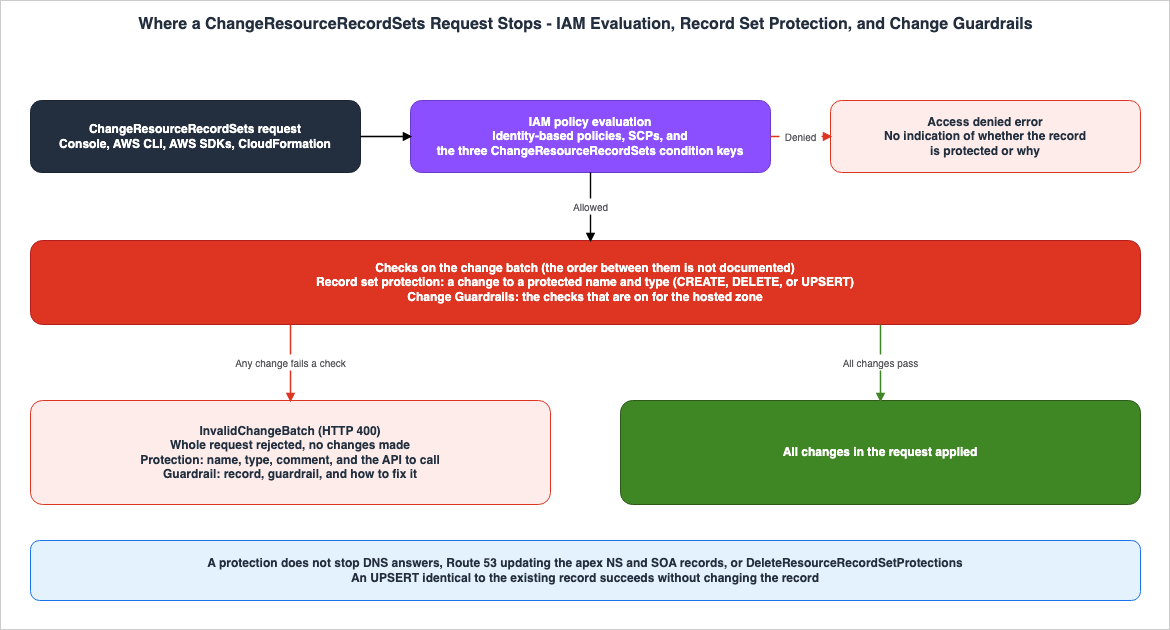
InvalidChangeBatch error (Inference). The protection page states that even principals with route53:* cannot change a protected record, so this article reads that the protection check applies to requests that IAM evaluation has allowed (Inference). This article found no statement of the order between the protection check and the Change Guardrails check (No statement found). Figure 1 draws the two checks side by side, without an order.4. What a Protection Does Not Block
This chapter describes what a protection does not block. These are three things: DNS responses, updates to the NS and SOA records for the apex (root domain) performed by Route 53 itself, and the operation that deletes the protection. It is not accurate to say that enabling protection means no one can modify any records.4.1 DNS Answers
The protection page states the following (Stated):Protections don't change how Route 53 answers DNS queries. They only control changes to records.The protection only controls record modifications. Even with protection enabled, the responses that Route 53 provides to DNS queries will remain unchanged.
4.2 Route 53's Own Updates to the Apex NS and SOA Records
The protection page states the following regarding records managed by Route 53:Protections apply to changes that you request. A protection on the apex NS or SOA records blocks your changes to them, but it doesn't prevent Route 53 from updating those records as it manages the hosted zone.A protection on the apex NS and SOA records stops your changes to them. It does not stop Route 53 from updating these records as it manages the hosted zone (Stated).
4.3 Deleting a Protection
A protection does not stop the operation that deletes it. The protection page states the following (Stated):Any principal that has the route53:DeleteResourceRecordSetProtections permission on the hosted zone can delete any protection in that zone. A protection is only as strong as the IAM policies that control that permission.Principals with the
route53:DeleteResourceRecordSetProtections permission can delete the protection and then change the record. How this permission is managed determines the strength of the protection. Chapter 7 details the design for restricting this permission.4.4 Threats Outside the Scope
Protection prevents modifications to records within a Route 53 hosted zone. This article reads that what happens on the domain registration side (the registrar) or on the delegation side from the parent zone is outside the scope of protection (Inference). The impact of losing DNS control on certificate issuance is discussed in detail on this site in What CAA Can and Cannot Stop When DNS Control Is the Weak Link. This article also reads that CAA records and the TXT records used for ownership verification can be protected, because their names and types are fixed (Inference).5. Comparison with IAM Condition Keys
This chapter examines the traditional method of using IAM condition keys to filterChangeResourceRecordSets, and sets protection beside it. The conclusion is that filtering by name, type, and operation is also possible using condition keys. The differences lie in the scope of application, how reasons for denial are returned, and reservation management.5.1 Three Condition Keys and Normalization
The conditions page lists three condition keys that apply toChangeResourceRecordSets.route53:ChangeResourceRecordSetsNormalizedRecordNames: A list of record names in the request.route53:ChangeResourceRecordSetsRecordTypes: A list of record types in the request.route53:ChangeResourceRecordSetsActions: A list of operations in the request. Values areCREATE,UPSERT, andDELETE, and must be written in uppercase.
All three condition keys are multi-valued. The values for record names must be normalized.
- Convert all characters to lowercase.
- Do not include trailing periods.
- Any characters other than lowercase letters (a-z), numbers (0-9), hyphens, underscores, and periods used to separate labels must be represented using a three-digit octal escape sequence. For example,
*should be represented as\052.
The conditions page also states that Route 53 does not support condition keys based on tags. The method described in the condition keys blog posts involves comparing the value of a principal tag (
aws:PrincipalTag) to the value of a condition key.5.2 What Condition Keys Can Express
The permissions page states that you can grant permissions based on three condition keys, allowing you to specify:- A collection of records with the same name and type.
- All records of a specific type.
- Records containing a specific string in their name.
- Any or all of the operations
CREATE,UPSERT, orDELETE.
The examples on the conditions page are all presented in the
Allow format, listing the permitted names using constructs such as ForAllValues:StringEquals. Regarding rewriting these examples in the Deny format, the conditions page states:In some cases, it is possible to rewrite these policies so that they are deny-based (that is, setting the Effect clause to Deny and inverting all of the logic in the policy). However, we recommend that you avoid using deny-based policies because they are difficult to write correctly, compared to allow-based policies. This is especially true for Route 53 due to text normalization that is required.While it may be possible to rewrite some of these examples in the
Deny format, AWS does not recommend doing so. One reason for this is name normalization.Even when using the
Allow format, it is possible to exclude specific records. Part 1 of the condition keys blog posts provides an example using an Allow statement with ForAllValues:StringNotEquals to demonstrate how to prevent management of specific records, stating:Use the ForAllValues:StringNotEquals operator when you want to deny permission to manage a specific DNS record.Therefore, it is wrong to say that IAM condition keys could not stop the creation or deletion of records. Restricting changes by name, type, and operation was possible before protection.
5.3 What Only Protection Does
What's New states the situation before protection as follows:Previously, to lock specific records, you had to write record-level conditions into the IAM policies of every user and role that could change your hosted zones. When those policies blocked a change, the caller had no indication of whether the record was protected or why.Based on this text and the protection page, the following three things are what only protection does:
- Universal Application: Condition keys are written into the policy of each user and role that can change the hosted zone. A protection is attached to the hosted zone and also applies to principals with
route53:*(Stated). The protection page states that conditions in a policy onChangeResourceRecordSetsdo not override a protection (Stated). - Reason Provided: Principals denied through a condition key had no indication of whether the record was protected or why (Stated). A principal that hits a protection receives the name and type, the protection's comment, and the name of the API to call to delete the protection in the error message (Stated).
- Reservation Capability: Protection can be applied to names and types that do not yet have a record, preventing their creation. With the
Allowform of condition keys, creation outside the permitted names is also blocked. This article reads that a reservation differs in that it stops creation for everyone, including principals with permission to create (Inference).
5.4 Comparison Table
Table 1 compares condition keys and protection.| Aspect | IAM Condition Keys (3) | Protection |
|---|---|---|
| Can changes be limited by name, type, or operation? | Yes (Stated) | Limited by name and type, preventing CREATE, DELETE, and UPSERT (Stated). |
| Can it be divided by operation? | Can be divided using route53:ChangeResourceRecordSetsActions (Stated). | No. Prevents all three operations (Stated). |
| Where can it be written? | The IAM policy of each user and role (Stated). | Hosted zone name and type (Stated). |
| Who is affected? | Only the principal to which the policy is attached (Inference). | Everyone, including principals with route53:* (Stated). |
Form of Deny | Possible in some cases, but AWS does not recommend it (Stated). | Not applicable. |
| What is returned when denied? | Provided no indication of which records were protected or why (Stated). | InvalidChangeBatch, along with the name, type, comment, and the name of the deletion API (Stated). |
| What happens with names and types that do not exist? | Prevents creation of names outside of those permitted. Principals with permission can still create (Inference). | Can be reserved, and prevents all creation (Stated). |
| How is it removed? | Rewrite the principal's policy (Inference). | DeleteResourceRecordSetProtections (Stated). |
| How is the permission to remove it restricted? | Determined by the IAM permissions that allow rewriting the policy (Inference). | Only per hosted zone. No Route 53-specific condition keys are available (Stated). |
5.5 How a Rejection Looks
When a request falls under protection, anInvalidChangeBatch is returned (Stated). This article reads that requests rejected based on condition keys will return an IAM access denial error (Inference). This article also reads that an InvalidChangeBatch represents an error related to the validation of a batch of changes, while an access denial signifies an authorization error (Inference). Details on interpreting access denial errors can be found on this site at the AWS IAM AccessDenied Reference.5.6 Using the Two Together
This article reads that you do not have to choose between condition keys and protection; they can be used together (Inference). Condition keys allow you to define, per principal, who can modify which names, types, and operations. Protection, on the other hand, allows you to fix specific names and types for everyone. For example, you could use condition keys to define which subdomains can be changed for each team, while using protection to fix the apex and MX records (Inference). The protection page and What's New do not describe a design that combines the two (No statement found).6. Protection and Change Guardrails
This chapter explains the difference between protection and Change Guardrails. Change Guardrails are safety checks on changes, listed in the document history on November 20, 2026 (Stated). Both mechanisms reject requests forChangeResourceRecordSets and return the same InvalidChangeBatch error.6.1 The Six Change Guardrails
The guardrails page describes Change Guardrails as checks that stop a change that would take part of your domain offline (Stated). There are six checks (Stated).| Check | Rejects | Default Status | Tier |
|---|---|---|---|
NS_FORMAT_CHECK | NS values that resemble Route 53 nameservers but are not actually valid. | Always on | STANDARD and ADVANCED |
NS_DELEGATION_AUTHORITY_CHECK | Delegation to Route 53 nameservers that do not have authority over that subdomain. | Always on | STANDARD and ADVANCED |
NS_OCCLUSION_CHECK | Records that a delegation hides, or a delegation that hides records. | Off | STANDARD and ADVANCED |
ALIAS_TARGET_CHECK | Deletion of the record pointed to by an alias record. | Off | ADVANCED only |
ACTIVE_RECORD_CHECK | Deletion of a record that is still receiving DNS queries. | Off | ADVANCED only |
ACTIVE_DELEGATION_CHECK | Deletion of a delegation that resolvers still use. | Off | ADVANCED only |
The
NS_DELEGATION_AUTHORITY_CHECK applies only to public hosted zones, while the other five checks apply to both public and private zones. ADVANCED is one of the tiers for hosted zones, and the tiers page states that STANDARD is the default tier.6.2 What Each One Judges
Protection and Change Guardrails evaluate different aspects. Table 2 outlines the distinctions between the two.| Perspective | Protection | Change Guardrails |
|---|---|---|
| Evaluation Focus | Checks if a name and type have protection applied (Stated). | Verifies that the hosted zone after a change remains valid, considering delegation, aliases, and query status (Stated). |
| Operations Prevented | Prevents all CREATE, DELETE, and UPSERT operations (Stated). | Varies depending on the check. Three checks specifically look for deletions (Stated). |
| Unit | Per name and type (Stated). | Checks are turned on per hosted zone (Stated). |
| Tier | No statement about tiers found (No statement found). | The three checks are limited to ADVANCED only (Stated). |
| Method of Removal | DeleteResourceRecordSetProtections (Stated). | Disables checks using UpdateHostedZoneFeatures. The two always-on checks cannot be disabled (Stated). |
| Response on Rejection | Returns InvalidChangeBatch along with the name, type, and comment (Stated). | Returns InvalidChangeBatch along with the specific record and check, and instructions for correction (Stated). |
ACTIVE_RECORD_CHECK and ACTIVE_DELEGATION_CHECK determine whether a record is in use based on DNS queries received by Route 53 (Stated). The guardrails page lists records that these two checks cannot protect, and then points to protection.To protect a record regardless of its query activity, add a record set protection for it.The guardrails page provides examples of records these checks cannot protect, such as a secondary record during failover when the primary is healthy, and records only accessible through CNAME records (Stated). Additionally, records that rarely receive queries may not be identified as in use at the time of deletion (Stated).
Therefore, this article reads that records that should remain fixed, regardless of query activity, should be protected, while Change Guardrails should prevent accidental deletion of records that are currently in use (Inference).
6.3 The Same InvalidChangeBatch
Both protection and Change Guardrails return an InvalidChangeBatch and reject the entire request (Stated). Based on the error name alone, it is not possible to determine whether the request hit a protection or Change Guardrails (Inference). When the request hits a protection, the message includes is protected and cannot be changed and names DeleteResourceRecordSetProtections (Section 3.6). When Change Guardrails reject the change, the message shows which check rejected it (Stated). This article reads that automation that handles the error must tell them apart by the message, not by the error name (Inference).7. Who Can Remove a Protection
This chapter outlines the principals that can remove protections, and details the design for restricting which principals have that capability. While protections apply to everyone, principals that have theDeleteResourceRecordSetProtections permission can delete them. The weak point of the defense moves to this permission.7.1 Resources and Condition Keys of the Three Actions
The protection page describes the three actions related to protection as follows:The record set protection actions route53:CreateResourceRecordSetProtections, route53:DeleteResourceRecordSetProtections, and route53:ListResourceRecordSetProtections support only the hosted zone resource (arn:aws:route53:::hostedzone/Id). They don't support any service-specific condition keys.The SAR also lists the three actions' resources as
hostedzone* and leaves the condition key field blank. The access overview page similarly states that these three actions only support hosted zone resources and do not support Route 53-specific condition keys. The SAR's access classifications define creation and deletion as Write operations, and listing as a List operation.Therefore, the ability to remove protection can only be restricted at the hosted zone level. It is not possible to restrict which protections can be removed using Route 53-specific condition keys. Granting a principal the
DeleteResourceRecordSetProtections permission allows them to remove any protection within that hosted zone.7.2 Counting the Principals That Can Remove a Protection
Principals that can remove protections are those authorized to useroute53:DeleteResourceRecordSetProtections within their hosted zone (Stated). This article reads that principals with route53:*, or with policies that allow all Route 53 operations, also hold this permission (Inference). Therefore, this article reads that after adding protections, the principals with broad Route 53 permissions need to be counted again (Inference).The protection page recommends the following regarding this permission:
A protection is only as strong as your control over route53:DeleteResourceRecordSetProtections. Grant it to a small set of administrators, and consider denying it to everyone else, for example with a service control policy.7.3 Example 5 on the Policy Examples Page
The protection page lists Example 5 from the policy examples page, "Deny removal of record set protections," as an example of a policy that refuses to allow the removal of protections. The example is as follows:{
"Version": "2012-10-17",
"Statement": [
{
"Sid": "DenyRemovingRecordProtections",
"Effect": "Deny",
"Action": "route53:DeleteResourceRecordSetProtections",
"Resource": "arn:aws:route53:::hostedzone/Z1D633PJN98FT9"
}
]
}The policy examples page states that users with this policy cannot remove protections, and therefore cannot modify records with protections within that hosted zone. This example represents an IAM policy applied to a principal.
7.4 Narrowing Who Can Remove Protections With an SCP
The protection page suggests considering denying this permission to everyone other than a small set of administrators, for example with an SCP (Stated). The following is an example of an SCP that denies theDeleteResourceRecordSetProtections permission, excluding one administrator role (Example by this article). The role name is merely an example.{
"Version": "2012-10-17",
"Statement": [
{
"Sid": "DenyRemovingRecordSetProtectionsExceptDnsAdmin",
"Effect": "Deny",
"Action": "route53:DeleteResourceRecordSetProtections",
"Resource": "*",
"Condition": {
"ArnNotLike": {
"aws:PrincipalArn": "arn:aws:iam::*:role/DnsProtectionAdmin"
}
}
}
]
}The global condition keys page states that for roles, the
aws:PrincipalArn returns the ARN of the role itself, rather than the ARN of the user who assumed the role (Stated).There are principals for which the SCP does not apply. The SCP page states two such cases (Stated):
- The SCP does not apply to users and roles in the organization's management account.
- The SCP does not apply to service-linked roles.
Therefore, if the management account contains a hosted zone, this SCP cannot narrow the principals that can remove protections there, according to this article (Inference). The general principle regarding SCPs is described in this site's AWS Organization Guardrails.
Figure 2 shows the principals that can remove a protection, and how an SCP narrows them.
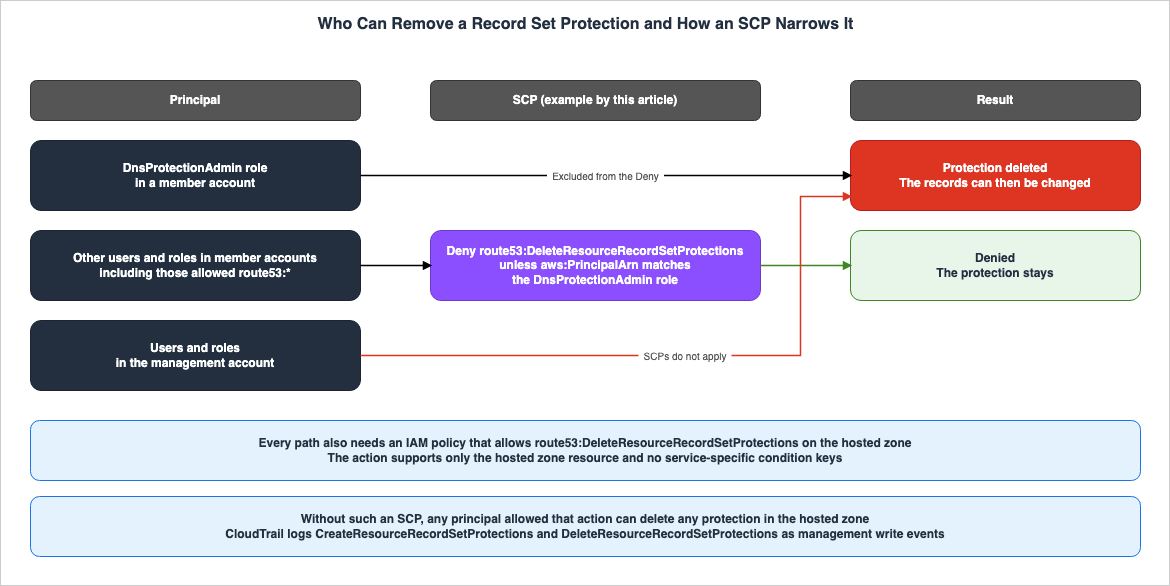
CreateResourceRecordSetProtections, can also be restricted only per hosted zone (Stated). This article reads that principals that can create protections can stop other principals' record changes, reserve names that do not exist yet, and block the deletion of hosted zones (Inference). This article considers it best to grant the permission to create protections, like the permission to delete them, to a small set of principals (Inference).7.5 Steps to Change a Protected Record
The procedure for modifying records with protection is as follows:- Remove the protection using
DeleteResourceRecordSetProtections. - Modify the record.
- If necessary, recreate the protection.
Protections cannot be updated. When changing comments, the protection must be removed and recreated. This article reads that the record is unprotected between deleting the protection and recreating it (Inference).
7.6 What the Audit Records
The protection page states that CloudTrail logs the creation, deletion, and listing requests for protections. The CloudTrail page specifies that it logsCreateResourceRecordSetProtections and DeleteResourceRecordSetProtections as management write events, and ListResourceRecordSetProtections as a management read event. The CloudTrail page also states that CloudTrail logs all Route 53 actions.Therefore, this article reads that the
DeleteResourceRecordSetProtections events in CloudTrail show who deleted a protection and when (Inference). This article considers it good to monitor the events that delete protections (Inference).Hosted zones in the
ADVANCED tier also have Change History. The change history page states that Change History shows who changed which records, how, and when, and that it is only available for hosted zones in the ADVANCED tier (Stated). The document history indicates that Route 53 retains changes for 365 days.8. CloudFormation, CLI, and Accelerated Recovery
This chapter discusses the pitfalls of handling protections in Infrastructure as Code (IaC) and operations. The four pitfalls specific to CloudFormation are: the need for prior record creation, the fact that changes to theComment field result in replacement, failures when attempting to update both protections and records in a single operation, and the inability to delete records while protections are still in place.8.1 CloudFormation Needs the Record First
The CloudFormation reference states the following (Stated):The record set must exist before you create the protection. In the protection, add a DependsOn attribute that names the AWS::Route53::RecordSet, so that CloudFormation creates the record set first.The
RecordName and RecordType must correspond to the name and type of records in the hosted zone. Therefore, this article reads that the reservation in Section 3.4 is not possible with AWS::Route53::RecordSetProtection (Inference). Reservations are created using the API, CLI, or console.An example in the CloudFormation reference demonstrates creating both records and protections together within a new stack. When the stack rolls back, CloudFormation deletes the protections before the records; therefore, they can be created together.
8.2 Changing Comment Replaces the Protection
The CloudFormation reference states the following regarding Comment (Stated):Changing Comment replaces the protection. CloudFormation deletes the existing protection before it creates the new one, so the record set is unprotected during the replacement.Comment, HostedZoneId, RecordName, and RecordType all require a replacement to be updated. Even updating a stack solely to modify the Comment will result in a temporary loss of protection during the replacement process.8.3 Do Not Change a Protection and Its Record in One Update
The CloudFormation reference states that when modifying protected records, you should separate the update that removes the protection from the update that modifies the record.- If one update does both, CloudFormation first modifies the record and then removes the protection as part of the update's cleanup process. Because the record is modified while the protection is still in place, the update will fail with a
ResourceConflicterror. - When adding protection to a record within a stack, do so with an update that does not modify the record. If one update changes the record's TTL and adds the protection, and another resource in that update fails, the rollback reverts the record while the protection still exists, which fails with a
ResourceConflicterror, and the stack status becomesUPDATE_ROLLBACK_FAILED.DependsOnrelationships do not alter this order.
When the stack reaches a
UPDATE_ROLLBACK_FAILED state, remove the protection using Route 53's DeleteResourceRecordSetProtections and then continue the rollback using ContinueUpdateRollback. The stack will revert to the previous, unprotected template, so add the protection again with an update that does not modify the record.8.4 Deleting a Protected Record and Retain
The CloudFormation reference states that deleting an AWS::Route53::RecordSet with protection enabled will fail with a ResourceConflict error. When protection is configured with a DeletionPolicy of Retain, the protection remains in Route 53 even when the stack is deleted or the protection is removed from the template, preventing CloudFormation from deleting the record. This applies equally to protections created outside of CloudFormation.Protections created outside of CloudFormation can be imported into a stack using the
HostedZoneId, RecordName, and RecordType as identifiers.8.5 CLI and SDK
The protection page provides an example using the AWS CLI, demonstrating a command that creates protections for the apexA and MX records.aws route53 create-resource-record-set-protections \
--hosted-zone-id Z1D633PJN98FT9 \
--protections '[{"RecordName":"example.com","RecordType":"A","Comment":"Production apex. Contact the DNS team before changing."},{"RecordName":"example.com","RecordType":"MX"}]'The commands for listing protections are
list-resource-record-set-protections, and for deleting them, delete-resource-record-set-protections. When listing, the RecordName is returned with a trailing dot, similar to the ListResourceRecordSets command.Table 3 lists the errors that the three protection actions return (the Troubleshooting table on the protection page).
| Error | Cause |
|---|---|
InvalidInput (400) | The create or delete request exceeds 100 items. Or, the MaxResults, StartRecordName, or StartRecordType parameters are incorrect. |
InvalidResourceRecordSetProtectionBatch (400) | One or more items are invalid, a protection already exists, or a protection does not exist for deletion. The Errors field contains specific reasons for each item. |
ProtectionAlreadyExists (409) | All items in the create request already have protections. |
LimitsExceeded (400) | The request exceeds the hosted zone's protection limit. |
NoSuchHostedZone (404) | The hosted zone does not exist, or it does not exist in the account. |
PriorRequestNotComplete (400), Throttling (400) | A previous request for the same hosted zone is still in progress, the request rate has been exceeded, or accelerated recovery is being turned on or off. |
InvalidPaginationToken (400) | The NextToken is invalid, or it belongs to a different hosted zone. |
The protection page says to treat an unknown
ProtectionError code as an error, because new values can be added (Stated).Create and delete requests are applied as all-or-nothing operations. The API reference for
CreateResourceRecordSetProtections states that it returns ProtectionAlreadyExists if all items already have protections, while other combinations of failures return InvalidResourceRecordSetProtectionBatch.8.6 Accelerated Recovery
The protection page describes the relationship with accelerated recovery in four points (Stated):- Protections stay in effect when you turn accelerated recovery on or off.
- While accelerated recovery is being turned on or off, creating or deleting protections can fail with a
Throttlingerror. Retry after a short wait. - When deleting a hosted zone that has both accelerated recovery and protections, turn off accelerated recovery, delete the protections, and then delete the hosted zone.
- During failover, you can still create, delete, and list protections. Protections that exist before failover stay in effect.
8.7 Quotas
Table 4 outlines the quotas for protections (as of November 24, 2026).| Item | Value | Source |
|---|---|---|
| Protections per create or delete request | 1 to 100 | quotas page, API reference |
| Number of protections per page in a listing | Up to 300 | quotas page, API reference |
| Comment length | Up to 256 characters | protection page, CloudFormation reference |
| Number of protections per hosted zone | 10,000 | quotas page |
| Number of records that can be protected at once in the console | Up to 100 | protection page |
The quotas page states that you can ask AWS Support to raise the limit on the number of protections per hosted zone. Protections can also exist on names that have no records, and this limit is separate from the limit on the number of records.
9. Where the Sources Disagree and What They Do Not Say
This chapter collects where the sources disagree and what this article found no statement about.9.1 Console Terms
The protection page and the help panel use different console terms (Sources disagree).| Item | Protection Page | Help Panel |
|---|---|---|
| Tab | Protections | Record protections |
| Create Button | Add protection | Add record protection |
| Delete Button | Remove protection | Remove record protections |
On the verification date, both pages displayed a
Last-Modified date of November 23, 2026. This article did not check in a live console which terms are shown now.9.2 What the Sources Do Not Say
- The order of the protection check and the Change Guardrails check (No statement found).
- The design for combining protection and IAM condition keys (No statement found).
- Availability in AWS GovCloud (US) and the China Regions (No statement found). Section 9.3 covers it.
- How CloudTrail logs
ChangeResourceRecordSetsrequests that a protection rejected (No statement found). The CloudTrail page states that CloudTrail logs all Route 53 actions (Stated).
9.3 Availability
What's New states the scope of services as follows:Record set protection is available in all AWS commercial Regions where public and private hosted zones are available today.This article did not find a statement about protection in AWS GovCloud (US) or the China Regions (No statement found). The Route 53 page of the AWS GovCloud (US) User Guide states that hosted zone tiers, Change History, and Change Guardrails are not available, but it does not mention protection (Stated). This article does not describe the availability as all Regions.
9.4 Error Names When CloudFormation Rejects Changes
The names of the errors when CloudFormation fails to modify a protected record differ between two sources (Sources disagree). The protection page states that when CloudFormation attempts to modify a protected record within a stack, it fails with the sameInvalidChangeBatch error (Section 3.2). The CloudFormation reference, however, states that when a stack's update, rollback, or deletion encounters a protected record, it fails with a ResourceConflict error (Sections 8.3 and 8.4). This article did not check in a live environment which name appears in the stack's events.10. Failure Modes
This chapter gathers common points of misinterpretation, drawing from the text in Chapters 3 through 9.- A misunderstanding that applying protection prevents anyone from changing records: Principals with
DeleteResourceRecordSetProtectionscan modify records after removing the protection. Route 53 itself updates the apex NS and SOA records (Sections 4.2 and 4.3). - A misunderstanding that IAM condition keys could not stop creation and deletion: Even with condition keys, you can still filter by name, type, and operation. The difference with protection lies in its universal application, the reason provided for rejection, and its ability to reserve names (Chapter 5).
- A misunderstanding that protection safeguards DNS responses: Protection only controls changes to records (Section 4.1).
- A misunderstanding that only one weighted record can be protected: Protection covers all records with the same name and type, and also prevents the addition of new set identifiers (Section 3.1).
- A misunderstanding that changes to unprotected records pass through, regardless of protection on other records in the same change batch: If any change hits a protection, the entire request is rejected (Section 3.2).
- A misunderstanding that
UPSERToperations with identical values are also rejected: Changes that do not modify anything will not be rejected (Section 3.3). - A misunderstanding that you can reserve names in CloudFormation even if they do not already exist:
AWS::Route53::RecordSetProtectionrequires the record to already exist (Section 8.1). - A misunderstanding that changing only the
Commentfield does not remove the protection: Modifying theCommentfield is considered a replacement, and the record set is unprotected during the replacement (Section 8.2). - A misunderstanding that you can perform a protection removal and record modification as part of a single stack update: This will result in a
ResourceConflicterror. During rollback, it may result in anUPDATE_ROLLBACK_FAILEDstatus (Section 8.3). - A misunderstanding that an
InvalidChangeBatcherror means the request hit a protection: Change Guardrails can also return the same error (Section 6.3). - A misunderstanding that Change Guardrails eliminate the need for protection: Whether a record is in use is judged from DNS queries, and some records cannot be protected that way (Section 6.2).
- A misunderstanding that SCPs can restrict all principals within an organization: SCPs do not apply to users and roles in the management account, or to service-linked roles (Section 7.4).
- A misunderstanding that you can restrict the ability to remove protection on a per-name and per-type basis: These three actions do not have Route 53-specific condition keys and can only be restricted at the hosted zone level (Section 7.1).
- A misunderstanding that leaving unused reservations protected poses no issues: If any protection remains, the hosted zone cannot be deleted (Section 3.5).
11. Frequently Asked Questions About Route 53 Record Set Protection
This chapter answers questions based on the reader profile outlined in Section 1.1, using the statements in Chapters 3 through 9.Q1. Can administrators with route53:* change protected records?
No. Administrators with route53:* permissions are also unable to modify protected records. The protection page states that even those with route53:* permissions cannot change protected records until the protection is removed. However, these administrators also possess the DeleteResourceRecordSetProtections permission, allowing them to modify the records after removing the protection (Sections 3.2 and 7.2).Q2. If IAM condition keys already restrict changes, is protection unnecessary?
Whether or not it is necessary depends on what you are trying to achieve. Condition keys can also restrict changes by name, type, and operation. Protection offers something different: it applies universally to everyone, provides reasons for errors in messages, and allows you to reserve names and types that don't yet exist. These two approaches can be used together (Chapter 5).Q3. How do you change a protected record?
To modify a record that has protections, first remove the protections usingDeleteResourceRecordSetProtections, then modify the record, and if necessary, recreate the protections. In CloudFormation, it is important to separate the update that removes protections from the update that modifies the record (Sections 7.5 and 8.3).Q4. Does protection protect DNS answers or prevent domain hijacking?
No, it does not. The protection does not alter DNS responses; it only controls modifications to records in the hosted zone. Threats on the registrar side or the delegation side are outside the scope of the protection (Sections 4.1 and 4.4).Q5. If you receive an InvalidChangeBatch response, did the request hit a protection?
If you receive an InvalidChangeBatch response, it does not necessarily mean the request hit a protection. Change Guardrails can also return the same error. If the error message includes is protected and cannot be changed and DeleteResourceRecordSetProtections, the request hit a protection (Sections 3.6 and 6.3).Q6. Are the creation and deletion of protections logged in CloudTrail?
Yes. CloudTrail logsCreateResourceRecordSetProtections and DeleteResourceRecordSetProtections as management write events, and ListResourceRecordSetProtections as a management read event (Section 7.6).Q7. How many protections can a hosted zone have?
As of the verification date of November 24, 2026, the quotas page indicates a limit of 10,000. You can request a higher quota from AWS Support. A single create or delete request holds 1 to 100 protections (Section 8.7).Q8. In which Regions is it available?
What's New states that it is available in all AWS commercial Regions where public and private hosted zones are available. Availability in the AWS GovCloud (US) and China Regions could not be confirmed (Section 9.3).12. Summary
Before using Route 53 record set protection, ensure the following:- You have counted the records you want to protect, noting their names and types, and confirmed that all records with the same name and type are included within a single protection (Section 3.1).
- Automation that changes both protected and unprotected records in one change batch is split (Section 3.2).
- You understand that protections do not alter DNS responses and do not prevent updates to Route 53's own apex records (Chapter 4).
- The design combines separating principals with IAM condition keys and fixing records for everyone with protections (Chapter 5).
- Errors related to
InvalidChangeBatchare differentiated by the error message, to show whether a protection or Change Guardrails triggered them (Section 6.3). - You have counted the principals that have
DeleteResourceRecordSetProtectionsorCreateResourceRecordSetProtections, and kept them few. If you narrow them with an SCP, you have accounted for SCPs not applying to the management account or to service-linked roles (Chapter 7). - Events related to deleting protections are monitored using CloudTrail (Section 7.6).
- When using CloudFormation, ensure that records are created first, and that changes to the
Commentfield are treated as replacements. Also, ensure that updates that separate record changes from protections are implemented (Chapter 8). - The process involves deleting any unused reserved protections before deleting the hosted zone (Section 3.5).
- You have reopened the pages to check whether the quota values and console terms have changed since the verification date, November 24, 2026 (Section 2.2).
13. References
- Protecting records from changes - Amazon Route 53
- Resource record set permissions - Amazon Route 53
- Using IAM policy conditions for fine-grained access control - Amazon Route 53
- Overview of managing access permissions to your Amazon Route 53 resources - Amazon Route 53
- Using identity-based policies (IAM policies) for Amazon Route 53 - Amazon Route 53
- Quotas - Amazon Route 53
- Change Guardrails for hosted zones - Amazon Route 53
- Hosted zone tiers - Amazon Route 53
- Viewing the change history of a hosted zone - Amazon Route 53
- Logging Amazon Route 53 API calls with AWS CloudTrail - Amazon Route 53
- Document history - Amazon Route 53
- Record protections - Route 53 console help panel
- CreateResourceRecordSetProtections - Amazon Route 53
- DeleteResourceRecordSetProtections - Amazon Route 53
- ListResourceRecordSetProtections - Amazon Route 53
- ChangeResourceRecordSets - Amazon Route 53
- DeleteHostedZone - Amazon Route 53
- Actions, resources, and condition keys for Amazon Route 53 - Service Authorization Reference
- AWS::Route53::RecordSetProtection - AWS CloudFormation
- Amazon Route 53 now supports record set protection - AWS What's New
- Implementing fine-grained Amazon Route 53 access using AWS IAM condition keys (Part 1) - AWS Networking & Content Delivery Blog
- Fine-grained Amazon Route 53 access with IAM condition keys (Part 3) - AWS Networking & Content Delivery Blog
- Service control policies (SCPs) - AWS Organizations
- AWS global condition context keys - AWS Identity and Access Management
- Amazon Route 53 in AWS GovCloud (US) - AWS GovCloud (US)
- Amazon Route 53 DNS Architecture Guide - Routing Policies, Resolver, Private Hosted Zones, and Hybrid DNS
- Route 53 API Throttling - Request Rate, Change Throughput, and Why an UPSERT Costs Two Tokens
- What CAA Can and Cannot Stop When DNS Control Is the Weak Link - accounturi, validationmethods, Certificate Transparency, and What ACM Documents
- AWS Organization Guardrails - Service Control Policies, Resource Control Policies, and Data Perimeter Design
- AWS IAM AccessDenied Reference - Reading the Error and Locating the Deciding Statement
- AWS History and Timeline regarding Amazon Route 53 - Overview, Functions, Features, Summary of Updates, and Introduction
References:
Tech Blog with curated related content
Written by Hidekazu Konishi