Package Registry Security Defenses History and Timeline - 2FA, Trusted Publishing, Provenance, and Staged Publishing
First Published:
Last Updated:
npm began requiring 2FA for maintainers of the top 100 packages on February 1, 2022, and PyPI extended its requirement to all users on January 1, 2024. Trusted publishing was first introduced by PyPI on April 20, 2023, and npm made it generally available (GA) on July 31, 2025. Staged publishing was GA on npm on May 22, 2026, and was implemented on NuGet.org on November 17, 2026.
This article presents a timeline, organized by defense type and including dates and links to primary sources, detailing when each defense was implemented on each registry. It aims to answer three key questions: When did each defense become available on the registries you use? Compared with other registries, which defenses had no announcement found as of the check date? And after which incident was each defense introduced? Regarding the third question, this article connects incidents and defenses only when the registry operators themselves have explicitly linked them. If such a connection is not written in primary sources, this article only states that they happened around the same time. All information was verified as of November 27, 2026.
Background and Method of Creating the Package Registry Security Defenses Timeline
This section details the sources used to create the timeline, the criteria for selecting events included in the timeline, and the methodology for determining the values in each column. All sources were consulted as of November 27, 2026.Primary Sources Used in This Article and What Became Rows
This article used the following primary sources to create the timeline:- npm: Articles from the GitHub Blog and GitHub Changelog related to npm. For npm events prior to 2020, articles from the npm Blog were used. The npm Blog is an archived resource, with a notice at the beginning stating "The npm blog has been discontinued."
- PyPI: Articles from the Python Package Index Blog (PyPI Blog) and PEP 740.
- RubyGems.org: Articles from the RubyGems Blog and monthly update articles.
- crates.io: Articles from the Rust Blog and "The Cargo Book."
- NuGet.org: Articles from the .NET Blog related to NuGet, and NuGet documentation from Microsoft Learn.
- Go: Articles from the Go Blog and the "Publishing a module" page from Go's documentation.
- Frameworks and Public Organizations: The official SLSA blog, the CNCF's in-toto page, OpenSSF's "Principles for Package Repository Security," Sigstore's GA press release, CISA alerts, and the GitHub Advisory Database.
The timeline entries represent dates when security measures were implemented, when the scope of those measures expanded, incident dates, and release dates for frameworks. Secondary media articles were not used as sources or as clues for the timeline entries. In other words, please note that the items on this timeline are not all security announcements of each registry, but are representative updates that I have picked out.
Inclusion Criteria
The defense rows detail actions taken across five major registries (npm, PyPI, RubyGems.org, crates.io, NuGet.org) and Go, focusing on the first introduction of each kind of defense and the enforcement that widened its scope. Where an announcement date and enforcement date differed, both dates are included. For pub.dev, JSR, and Open VSX, only a single row indicating the introduction date was included, as separate articles already document their respective launch dates. For Composer, only rows detailing dependency cooldowns were included.The incident rows are limited to those written by operators of registries, GitHub, CISA, SLSA, or the GitHub Advisory Database, and only include incidents that fall into one of two categories: those that a defense announcement itself names, or those where an official page describes the scope and response to the incident. Articles announcing the individual removal of malicious packages by registries (common on crates.io, PyPI, and RubyGems.org) are not included as separate rows.
This article categorizes defenses into four main areas:
- Account protection — Requiring 2FA and MFA, and implementing login verification.
- Fewer long-lived credentials — Implementing trusted publishing, using short-lived tokens, and revoking old tokens and API keys.
- Provenance — Tracking provenance, providing attestations, signing packages, and maintaining checksum databases. This also includes the deprecation of PGP signature handling.
- Before and after publishing — Restricting unpublishing, implementing staged publishing, performing scans at publication time, utilizing quarantine measures, and implementing dependency cooldowns.
Dependency cooldowns are a setting within the package manager itself, rather than the registry. This article only includes cooldowns announced by registry operators or language projects (Bundler, Cargo), as well as Composer's cooldown. Settings and versions of other tools related to dependency cooldowns are detailed in Dependency Cooldowns by Package Manager.
Table Columns and Row Types
Each table in the timeline contains the following six columns:- Date — The date associated with the row. Rows where the source provides only the month are listed as
YYYY-MM. - Date Type — The type of date contained in the Date column. The value will be one of the eight options listed below.
- Registry — The registry, project, or organization that the row pertains to.
- Defense — The type of defense. The value will be one of the four types listed above,
Framework, orIncident. - What Happened — A description of the event or change.
- Source — The document used as the basis for the row.
The values for Date Type are as follows (eight options in total).
- Announcement — The date on which the source announced a feature, policy, or plan.
- Enforcement — The date on which the source stated that a requirement became effective.
- Release — The date on which a version of the tool was released.
- Incident — The date on which, according to the source, an incident occurred, or the registry was notified of it.
- Incident report — The date on which an advisory, alert, or report regarding an incident was published.
- Decision — The date of a decision, such as the Resolution date of a PEP or the date a project transitioned to a new maturity level.
- Last updated — The "Last updated" value displayed on the page.
- Range — A period that this article does not divide into separate entries, and that is instead covered in another article.
The date values displayed in this article correspond to the dates shown on the page. This article uses the dates as they appear on the page, without any time zone conversions. For incident entries, the "Date" reflects the date the source indicated as the date of the incident. If this differs from the source's publication date, that information is noted in the "What Happened" section.
When the Same Event Has Two or More Dates
It is common for the announcement date, the effective date, and the GA (Generally Available) date to be different. This article lists the primary date in the main timeline and places the other dates in a table labeled "Where the Dates Differ." This table categorizes discrepancies into three areas:- Different kinds of dates — This refers to instances where sources record different types of dates, such as the announcement date, the date a requirement took effect, or the date a feature became generally available.
- Planned date passed — The planned date has passed, but this article has not found a source confirming that the change occurred.
- Statement not found — For one of the dates, this article has not found a source confirming its occurrence. The absence of a statement does not prove that no such statement exists.
Topics This Article Leaves to Other Articles
Other articles on this site cover the following topics as their main subject. This article keeps only a timeline row and a short description for each.- Changes to npm token and publishing mechanisms from July 31, 2025 (18 announcements) — Section 4.1 of Publishing npm and PyPI Packages Without Long-Lived Tokens
- Trusted publishing mechanisms beyond npm and PyPI (exchanging ID tokens or using them directly, what to bind to, what to reject) — Trusted Publishing Beyond npm and PyPI
- Changes to the default behavior of scripts executed during installation (17 rows) — Section 3.1 of Install-Time Scripts by Package Manager
- Configuration and versions for dependency cooldowns — Dependency Cooldowns by Package Manager
- The xz Utils incident, Log4Shell, and SBOM policies — Major Security Vulnerabilities History and Timeline
- Signature, attestation, and admission control on AWS — Software Supply Chain Security on AWS
- GitHub Artifact Attestations and SLSA v1.0 — CI/CD Tools History and Timeline
- Go 1.13 introduced module mirrors and checksum databases as default — Go Release and Support Timeline
Current Status of Package Registry Security Defenses
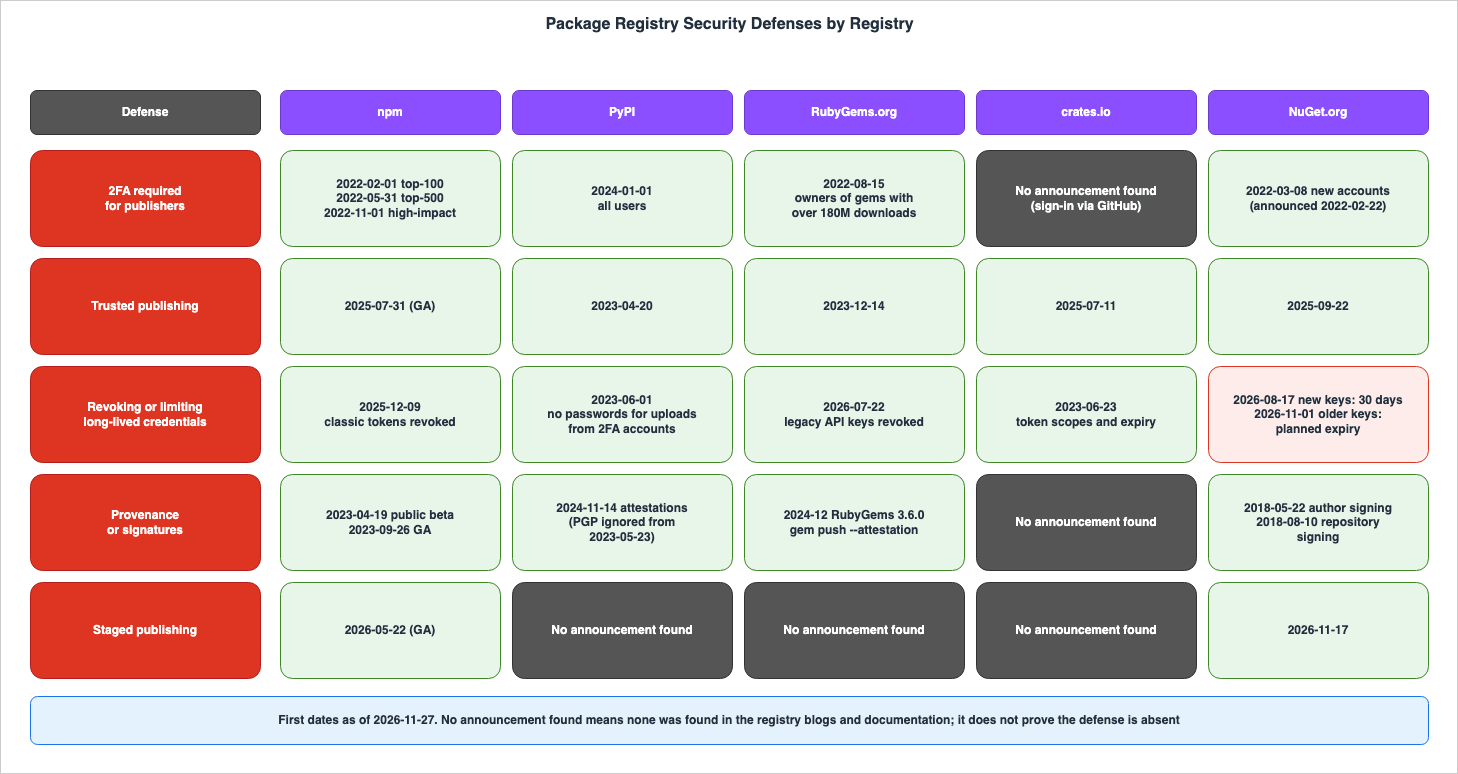
This section presents a table detailing when five different security defenses were implemented across five package registries, as of November 27, 2026. The table lists only the date each defense arrived and the type of that date. The mechanisms are left to the articles listed in the previous section. Any of these values may change after this date.| Defense | npm | PyPI | RubyGems.org | crates.io | NuGet.org |
|---|---|---|---|---|---|
| 2FA required for publishers | 2022-02-01 for maintainers of the top 100 packages, 2022-05-31 for the top 500, and 2022-11-01 for high-impact packages (Enforcement) | 2024-01-01 for all users (Enforcement) | 2022-08-15 for owners of gems with more than 180 million total downloads (Enforcement) | No announcement found. Sign-in to crates.io uses a GitHub account | From 2022-03-08 for new accounts; existing accounts gradually over two months (Announcement on 2022-02-22) |
| Trusted publishing | 2025-07-31, GA (Announcement) | 2023-04-20 (Announcement) | 2023-12-14 (Announcement) | 2025-07-11 (Announcement) | 2025-09-22 (Announcement) |
| Revoking or limiting long-lived credentials | 2025-12-09, all classic tokens revoked (Enforcement) | From 2023-06-01, uploads from accounts with 2FA enabled cannot use a password (Enforcement) | 2026-07-22, all legacy API keys revoked (Announcement) | 2023-06-23, scopes and expiration dates for API tokens (Announcement) | From 2026-08-17, new API keys last up to 30 days. Older keys were scheduled to expire on 2026-11-01 (Announcement on 2026-08-03) |
| Provenance or signatures | 2023-04-19 public beta, 2023-09-26 GA (Announcement) | 2024-11-14, attestations (Announcement). PGP signatures ignored from 2023-05-23 | 2024-12, gem push --attestation in RubyGems 3.6.0 (Release) | No announcement found | 2018-05-22, author-signed submissions; 2018-08-10, repository signatures (Announcement) |
| Staged publishing | 2026-05-22, GA (Announcement) | No announcement found | No announcement found | No announcement found | 2026-11-17 (Announcement) |
* You can sort the table by clicking on the column name.
A cell that says No announcement found means that, after checking the official blogs (PyPI Blog, RubyGems Blog, Rust Blog, .NET Blog) and official documentation, no corresponding announcement was found. It does not show that the defense is absent. Regarding the "crates.io 2FA" field, the section "Publishing on crates.io" in The Cargo Book states that obtaining an API token requires logging in with a GitHub account, and this is currently a requirement. No announcement was found stating that crates.io has made 2FA mandatory. Concerning the "crates.io staged publishing" field, the Rust 1.100.0 announcement (2026-11-12) states that crates.io plans to implement quarantine measures as part of its efforts to strengthen the supply chain. This is a planned initiative, and the implementation date is not specified. This article treats quarantine as a defense separate from staged publishing (see the Before and after publishing section). The same announcement does not mention staged publishing.
This table does not include columns for publish-time scanning and quarantine. npm began publish-time malware scanning on 2026-07-28, and PyPI described its project quarantine mechanism in an article published on 2024-12-30. For other registries, this article could not comprehensively verify the existence of similar security measures, so these are represented only as entries in the timeline. Go, which publishes modules using version-controlled repositories and tags (as described in the Go documentation on "Publishing a module"), has not been included in the columns of this table.
Package Registry Security Defenses Historical Timeline (Updates from March 22, 2016)
The following six tables constitute the main body of this timeline. Following these tables is a "Where the Dates Differ" table, which lists events with dates that vary depending on the source. Each table's columns are defined as described in the previous section. All data was referenced as of November 27, 2026.Index:
- 2016–2021 - The period from the limitations placed on unpublishing after the left-pad incident to the announcement requiring two-factor authentication (2FA) for npm.
- 2022 - The period when npm, RubyGems.org, and NuGet.org implemented mandatory 2FA, and Sigstore reached general availability (GA).
- 2023 - The period when PyPI introduced trusted publishing and stopped handling PGP signatures, and npm provenance and SLSA v1.0 arrived.
- 2024 - The period when PyPI required all users to enable 2FA and implemented attestation and quarantine features.
- 2025 - The period when crates.io, npm, and NuGet.org implemented trusted publishing, and the Shai-Hulud incident occurred.
- 2026 - The period when npm and NuGet.org introduced staged publishing, and Bundler, Composer, and Cargo implemented cooldowns.
- Where the Dates Differ - A list of events where the announcement and implementation dates differed, as well as events with scheduled dates that have passed.
* You can sort the table by clicking on the column name.
2016–2021 — From the Unpublish Limits After left-pad to the Announcement of the npm 2FA Requirement
| Date | Date Type | Registry | Defense | What Happened | Source |
|---|---|---|---|---|---|
| 2016-03-22 | Incident | npm | Incident | The left-pad incident. Following a dispute over the package name, the author unpublished the kik package and 272 other packages. This included left-pad, causing installation failures for projects that depended on it. The page simply states "Tuesday, March 22." The year was verified by checking the timestamp of a post at the bottom of the same page (2016-03-23). | kik, left-pad, and npm |
| 2016-03-29 | Announcement | npm | Before and after publishing | npm changed its unpublish policy. Versions published less than 24 hours prior can now be unpublished. Attempting to unpublish versions older than 24 hours will fail, and users are instructed to contact support. The page includes a note stating that the policy was updated on January 30, 2020. | changes to npm’s unpublish policy |
| 2018-05-22 | Announcement | NuGet.org | Provenance | NuGet.org began accepting submissions of packages signed by their authors. Any user of NuGet.org can now submit signed packages. The page states that this is the implementation of a plan announced in September 2017. Only newer versions of the NuGet client can verify these signatures, and the page notes that Visual Studio 2017 version 15.6 includes verification capabilities. | Introducing signed package submissions to NuGet.org |
| 2018-08-10 | Announcement | NuGet.org | Provenance | NuGet.org began repository signing. From this date forward, all newly submitted packages to NuGet.org will be repository signed. Packages signed by their authors will be countersigned by the NuGet.org repository signature. The page indicates that NuGet.org plans to sign existing packages as well, referring to the May announcement regarding author signatures as Stage 1 and this change as Stage 2. | NuGet.org starts repo-signing packages |
| 2018-11-26 | Incident | npm | Incident | The event-stream incident. In the morning of this day, npm's security team received a notification that a malicious package (flatmap-stream 0.1.1) had been injected into event-stream. npm removed flatmap-stream and event-stream@3.3.6 from the registry. The page notes that flatmap-stream was added as a dependency of event-stream by a new maintainer on September 9, 2018. The year was verified by checking the timestamp of a post on the same page (2018-11-27). | Details about the event-stream incident |
| 2019-08-29 | Announcement | Go | Provenance | Go's module mirror, index, and checksum database went live. Users of Go 1.13 will now use these by default. The date for Go 1.13 (2019-09-03) is referenced in Go Release and Support Timeline. | Module Mirror and Checksum Database Launched |
| 2021-10-22 | Incident report | npm | Incident | The GitHub Advisory Database published an advisory for ua-parser-js. The advisory, titled "Embedded malware in ua-parser-js," has a severity rating of High. | GHSA-pjwm-rvh2-c87w |
| 2021-11-15 | Announcement | npm | Account protection | GitHub announced the mandatory implementation of 2FA for npm. Citing the takeovers of ua-parser-js, coa, and rc as examples, the announcement stated that they would begin requiring 2FA for maintainers and administrators of popular packages, starting with the top packages in the first quarter of 2022. | GitHub's commitment to npm ecosystem security |
| 2021-12-07 | Announcement | npm | Account protection | npm introduced enhanced login verification. Publishers who have not enabled 2FA will now receive a one-time password via email during login. The implementation will be rolled out gradually between December 7, 2021, and January 4, 2022. The post also indicated plans to target the initial group (maintainers of the top 100 packages) starting on February 1, 2022. | Enrolling all npm publishers in enhanced login verification and next steps for two-factor authentication enforcement |
2022 — Mandatory 2FA for npm, RubyGems.org, and NuGet.org, and Sigstore's General Availability
| Date | Date Type | Registry | Defense | What Happened | Source |
|---|---|---|---|---|---|
| 2022-02-01 | Enforcement | npm | Account protection | npm began requiring two-factor authentication (2FA) for maintainers of the top 100 packages. The ranking is based on the number of dependents. Maintainers who have not enabled 2FA will have their web sessions revoked and will be required to set up 2FA before making changes such as updating their email address. | Top-100 npm package maintainers now require 2FA, and additional security-focused improvements to npm |
| 2022-02-22 | Announcement | NuGet.org | Account protection | NuGet.org announced that it would require 2FA. Starting 2022-03-08, new accounts will be required to use 2FA, and existing users will be gradually required to enable it over a two-month period. | Requiring two-factor authentication on NuGet.org |
| 2022-03-01 | Enforcement | npm | Account protection | All npm accounts without 2FA enabled were enrolled in enhanced login verification. The changelog clarifies that this is not a replacement for 2FA. | All npm accounts are now enrolled in login verification |
| 2022-05-10 | Incident report | crates.io | Incident | The Rust Security Response WG issued an advisory regarding a malicious crate, rustdecimal. This was a typosquatting attack, using a name similar to the popular crate rust_decimal. The crates.io team quickly removed the crate from the registry upon discovering the malware. | Security advisory: malicious crate rustdecimal |
| 2022-05-31 | Enforcement | npm | Account protection | npm began requiring two-factor authentication (2FA) for maintainers of the top 500 packages. The ranking is based on the number of dependents. | Top-500 npm package maintainers now require 2FA |
| 2022-06-13 | Announcement | RubyGems.org | Account protection | RubyGems.org began issuing warnings to maintainers who have not enabled MFA. The initial target includes at least the maintainers of the top 100 gems, with warnings appearing in both command-line tools and on the website. | Making popular Ruby packages more secure |
| 2022-08-15 | Enforcement | RubyGems.org | Account protection | RubyGems.org began enforcing MFA for owners of gems with a total download count exceeding 180 million. | Requiring MFA on popular gem maintainers |
| 2022-10-25 | Announcement | Sigstore | Framework | Sigstore reached general availability (GA). An OpenSSF press release stated that the Sigstore community announced the GA of a free software signing service at SigstoreCon. | Sigstore Announces General Availability at SigstoreCon |
| 2022-11-01 | Enforcement | npm | Account protection | npm began requiring two-factor authentication (2FA) for maintainers of high-impact packages. High-impact packages are defined as those with over 1 million weekly downloads or over 500 dependents. | High-impact package maintainers now require 2FA |
| 2022-12-06 | Announcement | npm | Fewer long-lived credentials | npm introduced granular access tokens. These tokens allow users to restrict the packages and scopes they can access, as well as set expiration dates and IP address ranges. The GA date is documented in "Where the Dates Differ." | Limit scope of npm tokens with the new granular access tokens |
2023 — PyPI Trusted Publishing and the End of PGP Signature Handling, npm Provenance, and SLSA v1.0
| Date | Date Type | Registry | Defense | What Happened | Source |
|---|---|---|---|---|---|
| 2023-01-18 | Announcement | pub.dev | Fewer long-lived credentials | pub.dev integrated automated publishing from GitHub Actions. The mechanism is detailed in Trusted Publishing Beyond npm and PyPI. | Screenshots and automated publishing for pub.dev |
| 2023-04-19 | Announcement | npm | Provenance | The public beta for npm package provenance has begun. When building with GitHub Actions, using the --provenance flag allows you to publish provenance information along with the package. | Introducing npm package provenance |
| 2023-04-19 | Announcement | SLSA | Framework | SLSA v1.0 has been released. This is the first stable version. | SLSA v1.0 is now final! |
| 2023-04-20 | Announcement | PyPI | Fewer long-lived credentials | PyPI has introduced Trusted Publishers. This allows publishing without needing to provide long-term passwords or API tokens to external systems. | Introducing 'Trusted Publishers' |
| 2023-05-23 | Announcement | PyPI | Provenance | PyPI has stopped handling PGP signatures. While uploads with PGP signatures will still succeed, the signatures will be silently ignored. | Removing PGP from PyPI |
| 2023-05-25 | Announcement | PyPI | Account protection | PyPI announced the mandatory implementation of two-factor authentication (2FA). All accounts managing projects or organizations will be required to enable 2FA by the end of 2023. | Securing PyPI accounts via Two-Factor Authentication |
| 2023-06-01 | Enforcement | PyPI | Fewer long-lived credentials | On PyPI, accounts with 2FA enabled can no longer use passwords to upload. Instead, you must use an API token or Trusted Publisher configuration. | Enforcement of 2FA for upload.pypi.org begins today |
| 2023-06-23 | Announcement | crates.io | Fewer long-lived credentials | crates.io API tokens now support scopes and expiration dates. The new API token page allows you to select the endpoint scope, crate scope, and expiration date. | Improved API tokens for crates.io |
| 2023-08-08 | Enforcement | PyPI | Account protection | New users registering on PyPI are now required to enable 2FA before performing any management actions. | 2FA Enforcement for New User Registrations |
| 2023-09-26 | Announcement | npm | Provenance | npm provenance has reached general availability (GA). CI/CD systems currently supported at GA include GitHub Actions and GitLab CI/CD. | npm provenance general availability |
| 2023-12-14 | Announcement | RubyGems.org | Fewer long-lived credentials | RubyGems.org has introduced trusted publishing. The article notes that previously, MFA was not compatible with automated gem pushes. The mechanism is detailed in Trusted Publishing Beyond npm and PyPI. | Announcing Trusted Publishing on RubyGems.org |
2024 — PyPI 2FA for All Users, Attestations, and Quarantine
| Date | Date Type | Registry | Defense | What Happened | Source |
|---|---|---|---|---|---|
| 2024-01-01 | Enforcement | PyPI | Account protection | PyPI made 2FA mandatory for all users. | 2FA Required for PyPI |
| 2024-02 | Last updated | OpenSSF | Framework | The OpenSSF Securing Software Repositories Working Group released "Principles for Package Repository Security." The page only lists a "Last updated" date of February 2024. It lists security capabilities that package repositories can use to assess gaps in their defenses, organized into four levels of maturity. | Principles for Package Repository Security |
| 2024-03-01 | Announcement | JSR | Fewer long-lived credentials | The JSR public beta program began. The mechanism for publishing from GitHub Actions is left to Trusted Publishing Beyond npm and PyPI. | Introducing JSR - the JavaScript Registry |
| 2024-07-17 | Decision | PyPI | Framework | PEP 740 was finalized. PEP 740 is a specification for handling attestation in package indexes. It was initially created on January 8, 2024. | PEP 740 |
| 2024-11-14 | Announcement | PyPI | Provenance | PyPI added support for digital attestation. The article states that this completes PyPI's implementation of PEP 740. | PyPI now supports digital attestations |
| 2024-12 | Release | RubyGems.org | Provenance | RubyGems 3.6.0 introduced the --attestation option to gem push. The source is a monthly update article from January 24, 2025, which describes the improvement in RubyGems 3.6.0, released in December 2024. The date listed is only to the month. | December 2024 RubyGems Updates |
| 2024-12-30 | Announcement | PyPI | Before and after publishing | A PyPI article explained the project quarantine mechanism. PyPI administrators can now quarantine potentially harmful projects. While in quarantine, a project is hidden from the simple index and cannot be installed, and the owner cannot modify it. The article notes that this mechanism has been in use since August 2024, and approximately 140 reported projects have been quarantined. | Project Quarantine |
2025 — Trusted Publishing on crates.io, npm, and NuGet.org, and Shai-Hulud
| Date | Date Type | Registry | Defense | What Happened | Source |
|---|---|---|---|---|---|
| 2025-02-10 | Decision | in-toto | Framework | in-toto was graduated by CNCF. The CNCF page states that in-toto was accepted by CNCF on 2019-08-14, entered the Incubating phase on 2022-03-10, and was graduated on 2025-02-10. | in-toto (CNCF) |
| 2025-07-11 | Announcement | crates.io | Fewer long-lived credentials | crates.io introduced trusted publishing. This is based on RFC 3691. Details are available in Trusted Publishing Beyond npm and PyPI. | crates.io: development update |
| 2025-07-31 to 2026-10-02 | Range | npm | Fewer long-lived credentials | This period saw 18 announcements related to npm's token and publishing mechanisms. This includes the GA of trusted publishing (2025-07-31), the revocation of classic tokens (2025-12-09), the GA of staged publishing (2026-05-22), and publish-time scanning (2026-07-28). Details for this period are available in Section 4.1 of Publishing npm and PyPI Packages Without Long-Lived Tokens. | GitHub Changelog |
| 2025-09-12 | Incident report | crates.io | Incident | The Rust Blog reported a phishing campaign targeting crates.io users. The sender used the rustfoundation.dev domain. The report states that there is no evidence that crates.io's infrastructure was compromised. | crates.io phishing campaign |
| 2025-09-14 | Incident | npm | Incident | The Shai-Hulud incident. On this date, GitHub was notified that a self-replicating worm had infiltrated the npm ecosystem through compromised maintainer accounts. GitHub outlined plans for changes to npm's authentication and publishing processes in a post on 2025-09-22. Details are available in Section 4.1 of Publishing npm and PyPI Packages Without Long-Lived Tokens. | Our plan for a more secure npm supply chain |
| 2025-09-22 | Announcement | NuGet.org | Fewer long-lived credentials | NuGet.org introduced trusted publishing. Details are available in Trusted Publishing Beyond npm and PyPI. | New Trusted Publishing enhances security on NuGet.org |
| 2025-09-23 | Incident report | npm | Incident | CISA issued an alert regarding a widespread supply chain compromise affecting the npm ecosystem. The alert stated that a self-replicating worm, known as Shai-Hulud, had compromised over 500 packages. | Widespread Supply Chain Compromise Impacting npm Ecosystem |
| 2025-11-24 | Announcement | SLSA | Framework | SLSA v1.2 was released. This release includes Source Track. | Announcing SLSA v1.2 |
| 2025-12-23 | Incident report | npm | Incident | GitHub reported on multiple waves of the Shai-Hulud activity. The report refers to the second wave as Shai-Hulud 2.0. | Strengthening supply chain security: Preparing for the next malware campaign |
2026 — Staged Publishing on npm and NuGet.org, and Cooldowns in Bundler, Composer, and Cargo
| Date | Date Type | Registry | Defense | What Happened | Source |
|---|---|---|---|---|---|
| 2026-05-11 | Incident | npm | Incident | An incident involving Mini Shai-Hulud. The SLSA official blog (article dated 2026-05-15) reports that on this date attackers compromised 84 npm package artifacts across 42 @tanstack packages. This occurred around the same time as npm's GA launch for staged publishing (2026-05-22), but neither page mentions the other. | Mini Shai-Hulud: Where SLSA's Boundaries Fall |
| 2026-06-03 | Announcement | RubyGems.org | Before and after publishing | Bundler 4.0.13 introduced cooldown. This feature is opt-in. Bundler reads the created_at timestamp for each version returned by RubyGems.org's v2 compact index. | Cool down before you install: give new gems a few days to be vetted |
| 2026-07-08 | Release | npm | Before and after publishing | In npm 12.0.0, lifecycle scripts of dependencies no longer run by default. The 17 rows on default changes in package managers are left to Section 3.1 of Install-Time Scripts by Package Manager. | npm install-time security and GAT bypass2fa deprecation |
| 2026-07-22 | Announcement | RubyGems.org | Fewer long-lived credentials | RubyGems.org revoked all legacy API keys. Due to a CDN caching issue, an account's API key could have been exposed to another user for up to an hour. Instead of relying on log analysis to rule out abuse, RubyGems.org revoked all legacy keys. | Security advisory: Possible leak of legacy API keys via improper cache configuration |
| 2026-08-03 | Announcement | NuGet.org | Fewer long-lived credentials | NuGet.org announced a reduction in the lifetime of API keys. Starting August 17, 2026, new API keys would be valid for a maximum of 30 days. Keys created before that date were scheduled to expire on November 1, 2026. What happened after the planned date is covered in the "Where the Dates Differ" section. | Strengthening NuGet Supply Chain Security: Reducing API Key Lifetime |
| 2026-09-11 | Incident report | RubyGems.org | Incident | RubyGems.org reported on a spam publishing campaign that occurred in May 2026. RubyGems.org temporarily suspended new account registration, blocked and removed the responsible accounts, and yanked more than 500 malicious packages. Registration was resumed on May 16, 2026. | An update on the May spam-publishing campaign on rubygems.org |
| 2026-09-30 | Announcement | Open VSX | Fewer long-lived credentials | Open VSX introduced trusted publishing. Details are available in Trusted Publishing Beyond npm and PyPI. | Trusted Publishing on Open VSX |
| 2026-10-29 | Release | Composer | Before and after publishing | Composer 2.11.0 was released. It includes a new cooldown policy that prevents newly released packages from being included for a specified period. The CHANGELOG mentions this feature, originally introduced in 2.11.0-RC1 (October 22, 2026). | Composer CHANGELOG |
| 2026-11-12 | Release | crates.io | Before and after publishing | Rust 1.100.0 made Cargo's min-publish-age stable. This feature is opt-in and can be configured in .cargo/config.toml. The announcement also mentions plans for crates.io's quarantine support and automated detection of suspicious releases. | Announcing Rust 1.100.0 |
| 2026-11-17 | Announcement | NuGet.org | Before and after publishing | NuGet.org introduced staged publishing. This feature is available to all publishers, allowing them to prepare and verify packages before explicitly choosing to publish them. | Introducing staged publishing on NuGet.org |
Where the Dates Differ
| Event | Dates | Kind of Difference | Source |
|---|---|---|---|
| npm 2FA Requirement | Announced on 2021-11-15, implemented for the top 100 on 2022-02-01, for the top 500 on 2022-05-31, and for high-impact packages on 2022-11-01. | Different kinds of dates | GitHub Blog, GitHub Changelog |
| NuGet.org 2FA Requirement | Announced on 2022-02-22 that new accounts would be required to use 2FA from 2022-03-08, and existing users gradually over a two-month period. No article stating that the requirement took effect was found. | Different kinds of dates | .NET Blog |
| RubyGems.org MFA Requirement | Warnings began on 2022-06-13, and the requirement was implemented on 2022-08-15. | Different kinds of dates | RubyGems Blog |
| PyPI 2FA Requirement | Announced on 2023-05-25, password-based uploads were discontinued on 2023-06-01, implemented for new users on 2023-08-08, on 2023-12-13 announced that enforcement would begin on 2024-01-01, and enforced for all users on 2024-01-01. | Different kinds of dates | PyPI Blog |
| npm Granular Access Tokens | Introduced on 2022-12-06, generally available (GA) on 2023-03-21. | Different kinds of dates | GitHub Changelog |
| npm Provenance | Public beta on 2023-04-19, generally available (GA) on 2023-09-26. | Different kinds of dates | GitHub Blog, GitHub Changelog |
| PEP 740 and PyPI Attestation | PEP created on 2024-01-08, resolution on 2024-07-17, and PyPI support added on 2024-11-14. | Different kinds of dates | PEP 740, PyPI Blog |
| PyPI Project Quarantine | Used starting in August 2024 (as mentioned in the article), and the article was published on 2024-12-30. | Different kinds of dates | PyPI Blog |
| Composer Cooldown | 2.11.0-RC1 on 2026-10-22, 2.11.0 on 2026-10-29. | Different kinds of dates | Composer CHANGELOG |
| NuGet.org Existing API Key Expiration | Scheduled to expire on 2026-11-01 (announced on 2026-08-03). As of the verification date, no documentation was found confirming that the expiration had occurred. | Planned date passed | .NET Blog |
| crates.io 2FA Requirement | No announcement could be found as of the verification date. | Statement not found | Rust Blog, The Cargo Book |
The article page for NuGet.org's staged publishing feature contains several instances of the
datetime value ranging from November 17, 2026, to November 23, 2026. This article uses the date "November 17, 2026" displayed on the page, as well as the article:published_time value (2026-11-17T21:00:00+00:00). The other values represent comment timestamps.When Each Defense Reached Each Registry
This section reorganizes the dates in the timeline and the Current Status table by defense type, showing the order in which the same defense reached each registry. The order follows the date of each registry's first introduction.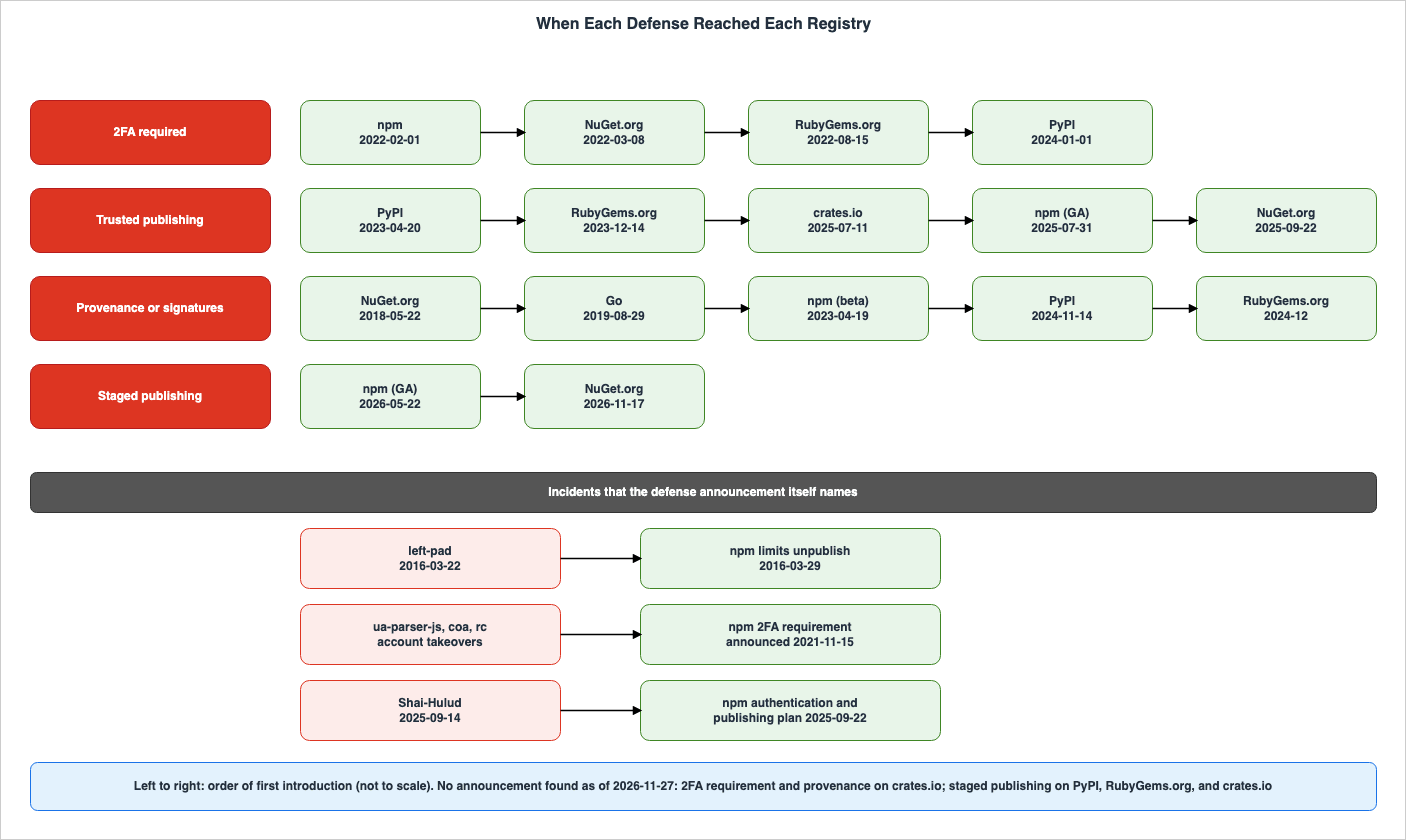
Account protection — Mandatory 2FA
The implementation of two-factor authentication (2FA) was rolled out sequentially across various platforms: npm (starting with maintainers of the top 100 packages on 2022-02-01), NuGet.org (announced for new accounts from 2022-03-08), RubyGems.org (for owners of popular gems as of 2022-08-15), and PyPI (for all users as of 2024-01-01). npm and PyPI initially started with a subset of users and gradually expanded the scope. npm completed three phases of implementation within 2022: targeting the top 100, the top 500, and high-impact packages. PyPI implemented 2FA in three phases following an announcement on 2023-05-25: starting on 2023-06-01 (for uploads), then on 2023-08-08 (for new users), and finally on 2024-01-01 (for all users). NuGet.org began with new accounts and planned to extend the requirement to existing accounts over a two-month period. No NuGet.org article stating that the requirement took effect was found. The Microsoft Learn page Individual accounts (retrieved on November 28, 2026) states that NuGet.org requires all accounts to have 2FA enabled, but does not say since when. The 2022-08-15 implementation on RubyGems.org was initially targeted at owners of popular gems; this article does not confirm any subsequent announcements regarding expansion of the scope. For crates.io, no announcement was found as of the check date.npm's plan, as of 2025-09-22, outlines a requirement for 2FA for publishing packages locally. Changes made after this plan are left to Section 4.1 of Publishing npm and PyPI Packages Without Long-Lived Tokens.
Fewer long-lived credentials — Trusted Publishing and Revoking Older Credentials
Trusted publishing reached pub.dev (January 18, 2023), PyPI (April 20, 2023), RubyGems.org (December 14, 2023), JSR (March 1, 2024), crates.io (July 11, 2025), npm (generally available July 31, 2025), NuGet.org (September 22, 2025), and Open VSX (September 30, 2026). Among these five major registries, PyPI was the first to implement this feature, while NuGet.org was the last. An article on crates.io notes that this feature was inspired by the work of the PyPI team.The handling of older credentials varies between registries. npm revoked all classic tokens on December 9, 2025. RubyGems.org revoked all legacy API keys on July 22, 2026, after a caching issue. NuGet.org announced on August 3, 2026, that new keys would last up to 30 days and that existing keys were scheduled to expire on November 1, 2026. PyPI, on June 1, 2023, disabled the use of passwords for uploads from accounts with two-factor authentication enabled. crates.io, on June 23, 2023, introduced the ability to set expiration dates for tokens.
Provenance — Provenance, Attestations, and Signatures
These defenses reached registries in this order: NuGet.org (author-signed submissions on 2018-05-22 and repository signatures on 2018-08-10), Go (checksum database added on 2019-08-29), npm (public beta launched on 2023-04-19), PyPI (attestation support added on 2024-11-14), and RubyGems.org (RubyGems 3.6.0 in December 2024). A .NET Blog post about NuGet.org, dated 2018-08-10, states that all newly submitted packages will be signed with a repository signature. Prior to adding attestation support, PyPI discontinued handling PGP signatures on 2023-05-23. A PyPI article dated 2024-11-14 indicates that the addition of attestation support follows the implementation of trusted publishing and the discontinuation of PGP signatures. For crates.io, no announcement was found as of the check date.Before and after publishing — Defenses Before and After Publishing
The earliest defense implemented after publication was npm's unpublish limitation (March 29, 2016), a measure restricting the removal of published versions, introduced following the left-pad incident. Defenses implemented before publication include npm's staged publishing (generally available on May 22, 2026), publish-time scanning (July 28, 2026), and NuGet.org's staged publishing (November 17, 2026), all introduced in 2026. PyPI's project quarantine, a mechanism by which administrators make a project uninstallable after it has been published, was implemented starting in August 2024.Dependency cooldowns represent a defensive measure on the consumer's side. Bundler 4.0.13 (June 3, 2026, announced by RubyGems.org), Composer 2.11.0 (October 29, 2026), and Cargo in Rust 1.100.0 (November 12, 2026) all arrived in 2026. All of these features are opt-in. Bundler's cooldown functionality utilizes the
created_at timestamp returned for each version by RubyGems.org's compact index. Configuration for cooldowns in other tools is detailed in Dependency Cooldowns by Package Manager.Incidents and the Defenses That Followed
This section lists only the pairs in which the registry operators or GitHub themselves tied an incident to a defense. The verbatim quotations are copied with the characters on each page.left-pad and the Limits on Unpublishing (npm, 2016)
npm stated the following in an article published the day after the left-pad incident.We will make it harder to un-publish a version of a package if doing so would break other packages.The article regarding the policy on unpublishing, published on March 29, 2016, stated the following as the reason for the policy change:
Last Tuesday’s events revealed that this danger isn’t just hypothetical, and it’s one for which we already should have been prepared.Takeovers of ua-parser-js and Other Packages, and the npm 2FA Requirement (npm, 2021–2022)
GitHub highlighted three examples of account takeovers in a November 15, 2021 article, including:Examples include the recent takeovers of the ua-parser-js, coa, and rc packages.The same article announced the mandatory implementation of two-factor authentication (2FA) with the following statement:
This is why we will begin to require two-factor authentication (2FA) during authentication for maintainers and admins of popular packages on npm, starting with a cohort of top packages in the first quarter of 2022.Shai-Hulud and Changes to npm Authentication and Publishing (npm, 2025)
In its September 22, 2025 post, GitHub wrote that it had been notified of Shai-Hulud, and announced the planned changes with the following sentence.To address token abuse and self-replicating malware, we will be changing authentication and publishing options in the near future to only include: Local publishing with required two-factor authentication (2FA).The remaining two aspects of the plan (short-lived granular tokens and trusted publishing), as well as the subsequent actual changes, are detailed in Publishing npm and PyPI Packages Without Long-Lived Tokens.
Stolen Credentials and the NuGet.org API Key Lifetime (NuGet.org, 2026)
An August 3, 2026, .NET Blog post about NuGet.org cited an incident involving another npm package as a reason for shortening the API key lifetime.The NX console NPM package was recently compromised using stolen credentials.A Cache Bug and the Revocation of RubyGems.org Legacy API Keys (RubyGems.org, 2026)
An article on RubyGems.org, dated July 22, 2026, describes both the bug and the revocation of legacy API keys in the same post.A CDN caching bug on RubyGems.org could hand one account’s API key to another person for up to an hour.Pairs Whose Link Is Not Stated in the Primary Sources
The following incidents have rows in this timeline, but the later defense announcements do not name them. This article does not tie them to defenses.- event-stream (2018-11-26) — An npm article describes the incident's progression and deletion, but the same page does not announce any defensive measures.
- rustdecimal (2022-05-10) and crates.io phishing (2025-09-12) — Articles regarding the scope and expiration of crates.io API tokens (2023-06-23) and trusted publishing (2025-07-11) do not reference these incidents.
- Mini Shai-Hulud (2026-05-11) — This occurred around the same time as the general availability (GA) release of npm's staged publishing (2026-05-22). The staged publishing changelog does not mention the incident, and the SLSA blog post does not reference staged publishing.
Articles on RubyGems.org (dated 2022-06-13) and PyPI (dated 2023-05-25) mention account takeovers in general as a reason for implementing two-factor authentication (2FA), but do not refer to any specific incidents.
Framework Versions — SLSA, in-toto, PEP 740, Sigstore, and the OpenSSF Principles
This section lists the versions and dates of the frameworks that registry defenses refer to.| Framework | Date | What the Source Says | Source |
|---|---|---|---|
| Sigstore | 2022-10-25 | Announced General Availability at SigstoreCon. | Sigstore Announces General Availability at SigstoreCon |
| SLSA v1.0 | 2023-04-19 | Initial stable release. | SLSA v1.0 is now final! |
| OpenSSF Principles for Package Repository Security | 2024-02 (Last updated) | Categorizes the capabilities for defending package repositories across four levels of maturity. | Principles for Package Repository Security |
| PEP 740 | 2024-07-17 (Resolution) | Specification for attestations in package indexes. Status: Final. | PEP 740 |
| in-toto | 2025-02-10 | Graduated by CNCF. | in-toto (CNCF) |
| SLSA v1.2 | 2025-11-24 | Introduced Source Track. | Announcing SLSA v1.2 |
The entry for SLSA v1.0 also appears with the same date in CI/CD Tools History and Timeline. Details on SLSA and methods for verifying provenance on AWS can be found in Software Supply Chain Security on AWS.
Rows Left to Other Articles
This section lists the ranges that this article does not split into rows and leaves to other articles, with the number of dated rows in those articles.| Range | Rows in the Other Article | Where This Article Points | Other Article |
|---|---|---|---|
| Announcements on npm tokens and publishing mechanisms (from 2025-07-31 to 2026-10-02) | 18 | Row in the 2025 table, row for 2025-09-14 | Publishing npm and PyPI Packages Without Long-Lived Tokens |
| Modification of the default script behavior during installation (from 2022-08-06 to 2026-08-26) | 17 | Row for 2026-07-08 | Install-Time Scripts by Package Manager |
| Mechanisms for trusted publishing beyond npm and PyPI | 6 (introduction dates) | This article keeps the 6 introduction-date rows and leaves the mechanisms to the other article | Trusted Publishing Beyond npm and PyPI |
| Configuration and versioning of dependency cooldowns | — | The Before and after publishing section | Dependency Cooldowns by Package Manager |
| GitHub Artifact Attestations and GitHub's mechanisms for linking artifacts to repositories and workflows (from 2024-05-02 to 2026-01-20) | 3 | Section on "Framework Versions" | CI/CD Tools History and Timeline |
| Defaulting Go 1.13 module mirrors and checksum databases (as of 2019-09-03) | 1 | Row for 2019-08-29 | Go Release and Support Timeline |
| The xz Utils incident (2024-03-29) | 1 | This article does not include any rows | Major Security Vulnerabilities History and Timeline |
The incident involving XZ Utils was not about the publishing mechanism of a package registry, but rather about alterations made to the upstream repository and the tarballs used for releases. Because this article cannot tie it to a registry defense row, it places no row here and leaves the incident to the other article.
Frequently Asked Questions about Package Registry Security Defenses
This section answers frequently asked questions regarding security defenses for package registries.Which registries require 2FA for publishers?
As of November 27, 2026, the four registries for which this article found an announcement making 2FA mandatory are npm, PyPI, RubyGems.org, and NuGet.org. The specific requirements vary by registry. PyPI has required 2FA for all users since January 1, 2024. On February 22, 2022, NuGet.org announced that it would require 2FA for new accounts from March 8, 2022, and extend the requirement gradually to existing users. No NuGet.org article stating that the requirement took effect was found, but the Microsoft Learn page Individual accounts (retrieved on November 28, 2026) states that all accounts must have 2FA enabled. npm's implementation in 2022 applies to maintainers of the top 100, top 500, and high-impact packages. RubyGems.org's implementation, effective August 15, 2022, targets owners of gems with a total download count exceeding 180 million. For crates.io, no announcement was found as of the check date.Which registry introduced trusted publishing first?
Among the five main registries, PyPI was the first to introduce trusted publishing (on April 20, 2023). pub.dev implemented automated publishing from GitHub Actions earlier, on January 18, 2023. npm reached general availability (GA) on July 31, 2025, and NuGet.org followed on September 22, 2025.Which registries offer staged publishing?
As of November 27, 2026, the registries that offered staged publishing were npm (generally available since May 22, 2026) and NuGet.org (since November 17, 2026). For PyPI, RubyGems.org, and crates.io, no announcement was found as of the check date. The Rust 1.100.0 announcement lists quarantine support for crates.io as future work and does not mention staged publishing.Did GitHub change npm because of Shai-Hulud?
GitHub's article from September 22, 2025, mentions receiving a notification regarding Shai-Hulud on September 14, and states that it would be changing authentication and publishing methods to address token abuse and self-replicating malware. This article relies only on the link that this post itself states. The actual changes implemented following the plan are detailed in Section 4.1 of Publishing npm and PyPI Packages Without Long-Lived Tokens.Have NuGet.org's older API keys expired?
A .NET Blog post about NuGet.org, dated August 3, 2026, stated that API keys created before August 17, 2026, would expire on November 1, 2026. As of the check date (November 27, 2026), this article has not found any documentation confirming that this expiration has occurred. This information is being presented as a planned event.When did PyPI stop handling PGP signatures?
PyPI's article from May 23, 2023, stated that while uploads with PGP signatures would still succeed, the signatures themselves would be silently ignored. Instead of rejecting uploads, PyPI simply stopped processing the signatures. PyPI began supporting attestation, as defined in PEP 740, on November 14, 2024.Summary
The implementation of defenses for package registries occurred at different times for each registry. The requirement for two-factor authentication (2FA) began with npm, targeting maintainers of the top 100 packages as of February 1, 2022, followed by RubyGems.org in 2022 (NuGet.org announced its requirement in 2022), and then expanded to all users by PyPI on January 1, 2024. Trusted publishing took approximately two and a half years, starting with PyPI on April 20, 2023, and culminating in the adoption by the five main registries, including NuGet.org on September 22, 2025. Staged publishing was introduced by npm on May 22, 2026, and by NuGet.org on November 17, 2026.⇒ Even defenses with the same name differ in scope and in the kind of date. The implementation of 2FA for npm and RubyGems.org began with popular packages. PyPI expanded it to all users as of January 1, 2024, while NuGet.org planned to roll it out from new accounts to existing ones. PyPI's 2FA was implemented in three phases following an announcement on May 25, 2023. For npm, the public beta (April 19, 2023) and general availability (GA) release (September 26, 2023) for provenance were distinct.
⇒ Only the links between incidents and defenses that the operators wrote themselves are certain. After the left-pad incident, npm restricted unpublishing. After the takeovers of ua-parser-js and other packages, GitHub required 2FA for npm, and after Shai-Hulud, it announced changes to authentication and publishing. For event-stream, rustdecimal, and Mini Shai-Hulud, the later defense announcements do not name the incident.
⚠ As of November 27, 2026, no documentation has been found to confirm that the expiration of existing API keys on NuGet.org, scheduled for November 1, 2026, actually occurred. Furthermore, 2FA and provenance on crates.io, along with staged publishing on PyPI, RubyGems.org, and crates.io, had no publicly available announcements found during the verification process. The absence of such announcements does not constitute proof that these features were not implemented. All information presented is current as of November 27, 2026.
This timeline will be updated as package registry security defenses continue to evolve.
In addition, there are related articles on this site, so please have a look if you are interested.
- Publishing npm and PyPI Packages Without Long-Lived Tokens - Trusted Publishing, Staged Publishing, and What Trusted Publishing Does Not Assert
- Trusted Publishing Beyond npm and PyPI - RubyGems, NuGet.org, crates.io, pub.dev, JSR, and Open VSX: Exchanged or Used Directly, What Trust Is Bound To, and What Each Registry Rejects
- Install-Time Scripts by Package Manager - npm, pnpm, Yarn, Bun, Deno, pip, and uv: What Runs When You Install a Dependency, Since Which Version, and Where the Approval Is Recorded
- Dependency Cooldowns by Package Manager - Defaults Since Which Version, What Update Bots Do Not Wait For, and the Publish Times CodeArtifact Returns
- Major Security Vulnerabilities History and Timeline - Disclosure, Impact, and the Response Practices They Changed
- Software Supply Chain Security on AWS - Signing, Attestation, and Admission Control
- CI/CD Tools History and Timeline - Trademarks, Acquisitions, Foundations, and Where the Build Runs
- Go Release and Support Timeline - Release History, the Release Policy, and the Go 1 Compatibility Promise
References:
- kik, left-pad, and npm (npm Blog Archive)
- changes to npm’s unpublish policy (npm Blog Archive)
- Details about the event-stream incident (npm Blog Archive)
- Module Mirror and Checksum Database Launched (The Go Blog)
- Publishing a module (Go documentation)
- Embedded malware in ua-parser-js (GHSA-pjwm-rvh2-c87w)
- GitHub's commitment to npm ecosystem security
- Enrolling all npm publishers in enhanced login verification and next steps for two-factor authentication enforcement
- Top-100 npm package maintainers now require 2FA, and additional security-focused improvements to npm
- All npm accounts are now enrolled in login verification (GitHub Changelog)
- Top-500 npm package maintainers now require 2FA (GitHub Changelog)
- High-impact package maintainers now require 2FA (GitHub Changelog)
- Limit scope of npm tokens with the new granular access tokens (GitHub Changelog)
- General availability of granular access token on npm (GitHub Changelog)
- Introducing npm package provenance
- npm provenance general availability (GitHub Changelog)
- Our plan for a more secure npm supply chain
- Strengthening supply chain security: Preparing for the next malware campaign
- npm install-time security and GAT bypass2fa deprecation (GitHub Changelog)
- GitHub Changelog
- Widespread Supply Chain Compromise Impacting npm Ecosystem (CISA)
- Introducing 'Trusted Publishers' (PyPI Blog)
- Removing PGP from PyPI (PyPI Blog)
- Securing PyPI accounts via Two-Factor Authentication (PyPI Blog)
- Enforcement of 2FA for upload.pypi.org begins today (PyPI Blog)
- 2FA Enforcement for New User Registrations (PyPI Blog)
- 2FA Requirement for PyPI begins 2024-01-01 (PyPI Blog)
- 2FA Required for PyPI (PyPI Blog)
- PyPI now supports digital attestations (PyPI Blog)
- Project Quarantine (PyPI Blog)
- PEP 740 – Index support for digital attestations
- Making popular Ruby packages more secure (RubyGems Blog)
- Requiring MFA on popular gem maintainers (RubyGems Blog)
- Announcing Trusted Publishing on RubyGems.org (RubyGems Blog)
- December 2024 RubyGems Updates (RubyGems Blog)
- Cool down before you install: give new gems a few days to be vetted (RubyGems Blog)
- Security advisory: Possible leak of legacy API keys via improper cache configuration (RubyGems Blog)
- An update on the May spam-publishing campaign on rubygems.org (RubyGems Blog)
- Security advisory: malicious crate rustdecimal (Rust Blog)
- Improved API tokens for crates.io (Rust Blog)
- crates.io: development update (Rust Blog)
- crates.io phishing campaign (Rust Blog)
- Announcing Rust 1.100.0 (Rust Blog)
- Publishing on crates.io (The Cargo Book)
- Introducing signed package submissions to NuGet.org (.NET Blog)
- NuGet.org starts repo-signing packages (.NET Blog)
- Requiring two-factor authentication on NuGet.org (.NET Blog)
- Individual accounts - NuGet.org (Microsoft Learn)
- New Trusted Publishing enhances security on NuGet.org (.NET Blog)
- Strengthening NuGet Supply Chain Security: Reducing API Key Lifetime (.NET Blog)
- Introducing staged publishing on NuGet.org (.NET Blog)
- Screenshots and automated publishing for pub.dev (Dart Blog)
- Introducing JSR - the JavaScript Registry (Deno Blog)
- Trusted Publishing on Open VSX (Eclipse Foundation Blog)
- Composer CHANGELOG
- SLSA v1.0 is now final! (SLSA Blog)
- Announcing SLSA v1.2 (SLSA Blog)
- Mini Shai-Hulud: Where SLSA's Boundaries Fall (SLSA Blog)
- in-toto (CNCF)
- Sigstore Announces General Availability at SigstoreCon (OpenSSF)
- Principles for Package Repository Security (OpenSSF)
References:
Tech Blog with curated related content
Written by Hidekazu Konishi