AWS History and Timeline regarding AWS WAF - Overview, Functions, Features, Summary of Updates, and Introduction
First Published:
Last Updated:
This time, I have created a historical timeline for AWS WAF, the web application firewall (WAF) that inspects HTTP and HTTPS requests at the application layer (OSI Layer 7) and allows, blocks, counts, or challenges them based on rules you define.
Since its announcement at AWS re:Invent 2015, AWS WAF has gone through a full generational change: the original service (now called AWS WAF Classic) was joined in November 2019 by a re-architected new AWS WAF - commonly referenced by its
wafv2 API namespace - and the feature set has since expanded from simple string and IP matching into managed rules, bot management, fraud prevention, and, most recently, verification and management of AI bot and agent traffic.This article focuses on the major service-level releases that shaped AWS WAF, not every minor update, and organizes the main capabilities as a Current Overview, Functions, Features of AWS WAF.
I hope this will provide clues as to what has remained the same and what has changed, in addition to the features and concepts of AWS WAF.
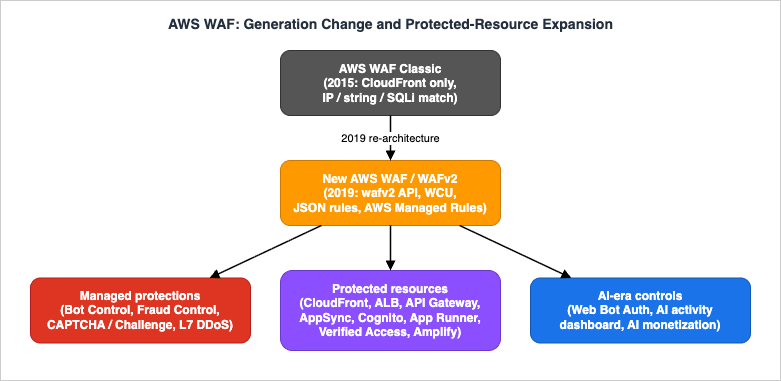
The following diagram summarizes the two-era structure of AWS WAF - the 2019 re-architecture from AWS WAF Classic into the new AWS WAF (WAFv2), and the subsequent expansion into managed protections, protected resources, and AI-era controls.
Background and Method of Creating AWS WAF Historical Timeline
The reason I created a historical timeline of AWS WAF this time is that AWS WAF is one of the clearest examples in the AWS portfolio of a service that underwent a deliberate generational re-architecture while keeping the same name. Understanding where AWS WAF Classic ends and the new AWS WAF begins - and when each managed protection (Bot Control, Fraud Control, CAPTCHA, Challenge) arrived - is genuinely difficult to piece together from scattered announcements, so a single ascending timeline is useful.Another reason is that since the 2015 launch, AWS WAF has steadily expanded the set of resources it can protect (from Amazon CloudFront only, to Application Load Balancer, Amazon API Gateway, AWS AppSync, Amazon Cognito user pools, AWS App Runner, AWS Verified Access, and AWS Amplify Hosting), and I wanted to organize that expansion in one place.
I wanted to organize the information about AWS WAF with the following approach.
- Tracking the history of AWS WAF and organizing the transition of updates
- Summarizing the feature list and characteristics of AWS WAF
There may be slight variations in the dates on the timeline due to differences in the timing of announcements or article postings in the references used.
The content posted is limited to major features related to the current AWS WAF and necessary for the feature list and overview description.
In other words, please note that the items on this timeline are not all updates to AWS WAF features, but are representative updates that I have picked out.
AWS WAF Historical Timeline (Updates from October 6, 2015)
So, from here on, I have a timeline of the features of AWS WAF.The history of AWS WAF exceeds 10 years at the time of writing this article, spanning the AWS WAF Classic era, the 2019 re-architecture into the new AWS WAF, and the recent expansion into bot, fraud, and AI-agent traffic management.
2015 | 2016 | 2017 | 2018 | 2019 | 2020 | 2021 | 2022 | 2023 | 2024 | 2025 | 2026
* You can sort the table by clicking on the column name.
| Date | Summary |
|---|---|
| 2015-10-06 | AWS announces AWS WAF at AWS re:Invent 2015. At launch it protects Amazon CloudFront distributions only, and lets you build a web ACL from conditions such as IP match, string and SQL injection match, and HTTP method or URI matching, all managed through a full API so new rules can be deployed within minutes. [Source] |
| 2016-01-27 | AWS WAF adds HTTP request body inspection and size constraint conditions. Rules can now allow, block, or count requests based on the byte length of the query string, URI, headers, or body. [Source] |
| 2016-03-29 | AWS WAF adds a dedicated Cross-Site Scripting (XSS) match condition. This complements the existing SQL injection match condition to cover two of the most common web application attack classes. [Source] |
| 2016-12-07 | AWS WAF becomes available on the Application Load Balancer (ALB). This is the first expansion of AWS WAF beyond Amazon CloudFront, letting customers attach a web ACL directly to internal or external ALBs in a VPC to protect regional applications. Note: the original December 2016 What's New page is no longer served; the surviving AWS News Blog recap (published 2017-01-25) documents the launch. [Source] |
| 2017-06-21 | AWS WAF launches rate-based rules. This new rule type automatically blocks source IP addresses whose request rate exceeds a configurable threshold over a time window, helping mitigate web-layer request floods, brute-force logins, and bad bots. [Source] |
| 2017-10-16 | AWS WAF adds Geographic (Geo) Match conditions. Requests can now be allowed or blocked based on the country the request originates from. [Source] |
| 2017-10-16 | AWS WAF adds regular expression (regex) pattern matching. Regex pattern sets can be reused across rules and combined with other conditions for more expressive matching. [Source] |
| 2017-11-29 | Managed Rules from AWS Marketplace sellers become available on AWS WAF. Customers can subscribe to ready-to-use rule groups curated by security sellers (for example OWASP Top 10 and CMS-specific protections) and deploy them without authoring the individual rules themselves. [Source] |
| 2018-04-04 | AWS Firewall Manager launches for central management of AWS WAF. Security administrators can now define AWS WAF rules once and enforce them across accounts and resources in an AWS Organization, alongside AWS Shield Advanced protections and security groups. [Source] |
| 2018-08-31 | AWS WAF launches comprehensive full logging. Web ACLs can stream detailed request logs, including matched-rule information, to Amazon Kinesis Data Firehose (and onward to Amazon S3 and other destinations), with the option to redact sensitive fields. [Source] |
| 2018-11-19 | Amazon API Gateway adds native support for AWS WAF. A web ACL can be associated directly with an API Gateway REST API stage, removing the earlier requirement to front the API with a separate Amazon CloudFront distribution just to attach AWS WAF. [Source] |
| 2019-11-25 | The new AWS WAF launches with AWS Managed Rules, re-architecting the service. This release introduces a brand-new API (the wafv2 namespace), Web ACL Capacity Units (WCU) in place of the old per-condition limits, document-based rules expressed in JSON, full logical operators (AND, OR, NOT) with rule nesting, and free AWS Managed Rules rule groups (including a core rule set and the Amazon IP reputation list). The original service is renamed AWS WAF Classic and its APIs remain available in parallel. [Source] [Blog] |
| 2020-03-06 | AWS WAF adds the Anonymous IP List managed rule group. This AWS Managed Rules group blocks traffic from VPNs, Tor exit nodes, proxies, and hosting-provider networks that are often used to hide the true source of requests. [Source] |
| 2020-07-09 | AWS WAF can inspect the X-Forwarded-For and other custom headers to recover the real client IP. This lets IP-based, rate-based, and geo-match rules work correctly when the application sits behind a proxy or another CDN. [Source] |
| 2020-10-01 | AWS AppSync GraphQL APIs become a protected AWS WAF resource. A web ACL can be associated with an AppSync GraphQL API to filter malicious requests and apply rate limiting. [Source] |
| 2021-02-12 | AWS WAF adds native JSON request body inspection. Rules can now parse a JSON body and match specific keys or values rather than treating the body as opaque text. [Source] |
| 2021-03-29 | AWS WAF adds custom responses and custom request header insertion. Rules can return a custom HTTP status code and response body for blocked requests, and can insert x-amzn-waf-* headers into allowed requests to pass context to the backend. [Source] [Source] |
| 2021-04-01 | AWS WAF launches Bot Control. The Bot Control (Common) managed rule group gives visibility into and control over common and pervasive bots such as scrapers, scanners, and crawlers, automatically applying bot labels that later rules can act on. [Source] |
| 2021-04-02 | AWS WAF adds support for labels. A rule can attach descriptive labels to a matched request so that subsequent rules in the same web ACL, and CloudWatch metrics, can act on them - the mechanism that underpins Bot Control and Fraud Control. [Source] |
| 2021-11-24 | AWS WAF introduces the CAPTCHA action. A rule can require the viewer to solve a CAPTCHA puzzle before the request is allowed to reach the protected resource, initially in a limited set of Regions. [Source] |
| 2022-02-14 | AWS WAF launches Fraud Control - Account Takeover Prevention (ATP). This managed rule group inspects login attempts to detect credential stuffing and brute-force attacks, initially for Application Load Balancer and Amazon API Gateway. [Source] |
| 2022-06-21 | AWS WAF CAPTCHA becomes generally available. The CAPTCHA action and its JavaScript integration reach general availability across the supported Regions. [Source] |
| 2022-08-11 | Amazon Cognito user pools gain native AWS WAF support. A web ACL can be associated directly with a Cognito user pool to filter traffic and apply bot and rate-based protections to sign-up and sign-in endpoints. [Source] |
| 2022-10-27 | AWS WAF launches the Challenge rule action. Unlike CAPTCHA, the Challenge action runs a silent, non-interactive JavaScript interrogation in the browser and issues a token, verifying that a real browser is present without user interaction. [Source] |
| 2022-10-27 | AWS WAF launches Bot Control for Targeted Bots. A more advanced protection level that adds machine learning, browser fingerprinting, and behavioral analysis to detect sophisticated bots that try to evade detection, layered on top of the Common Bot Control rule group. [Source] |
| 2023-02-24 | AWS App Runner becomes a protected AWS WAF resource. A web ACL can be attached to an App Runner service to protect its endpoint from common web exploits and unwanted traffic. [Source] |
| 2023-04-28 | AWS Verified Access reaches general availability with built-in AWS WAF support. Verified Access can apply AWS WAF web ACLs to filter broad internet-based threats such as SQL injection and cross-site scripting before applying its identity- and device-based access policies. [Source] |
| 2023-06-13 | AWS WAF launches Fraud Control - Account Creation Fraud Prevention (ACFP). This managed rule group detects and blocks the creation of fake or fraudulent accounts on sign-up pages, complementing the Account Takeover Prevention rule group. [Source] |
| 2023-11-14 | AWS WAF adds built-in console dashboards. Per-web-ACL dashboards built on Amazon CloudWatch metrics (with All traffic and Bot Control views) become available by default, with no additional setup required. [Source] |
| 2024-03-08 | AWS WAF increases the inspectable request body size for regional resources. The maximum inspectable body grows to 64 KB (with a higher default) for regional resources such as API Gateway, Amazon Cognito, App Runner, and Verified Access, so rules can examine larger payloads. [Source] |
| 2024-09-13 | AWS WAF Bot Control expands its bot detection, including verified AI bots. A new version of the Bot Control managed rule group adds cross-network token-reuse detection and many new bot categories, including labels for verified AI bots and cloud-service-provider traffic - the first clear step toward AI-aware bot management. [Source] |
| 2025-03-26 | AWS WAF protection for AWS Amplify Hosting reaches general availability. Customers can attach a web ACL to AWS Amplify Hosting applications and use the full range of AWS WAF capabilities - managed rules, custom rules, and rate-based rules - adding Amplify-hosted web apps to the list of resource types AWS WAF can protect. [Source] |
| 2025-06-12 | AWS WAF launches automatic application-layer (L7) DDoS protection. A machine-learning-based managed rule group establishes a traffic baseline and automatically detects and mitigates application-layer DDoS events within seconds, available to AWS WAF and AWS Shield Advanced subscribers. [Source] |
| 2025-06-17 | AWS WAF makes its simplified console experience with protection packs generally available. Pre-configured protection packs and a redesigned single-page console reduce the number of web application security configuration steps, while keeping full control over the underlying rules. [Source] |
| 2025-11-21 | AWS WAF adds Web Bot Auth (WBA) support. AWS WAF can cryptographically verify a bot's identity through signed HTTP messages and, by default, automatically allow verified AI agent traffic - shifting bot management from heuristic detection toward verifiable identity. [Source] |
| 2026-02-24 | AWS WAF launches an AI activity dashboard. This dashboard provides centralized visibility into AI bot and agent traffic, expanding the Bot Control detection catalog to hundreds of unique bots and agents across categories such as AI search crawlers, data collectors, assistants, and model-training crawlers. [Source] |
| 2026-06-15 | AWS WAF introduces AI traffic monetization. Publishers can price, meter, and collect payment from AI bots and agents by returning HTTP 402 (Payment Required) responses using the x402 protocol, turning AWS WAF into a control point for the emerging AI-agent web economy. [Source] |
Current Overview, Functions, Features of AWS WAF
AWS WAF is a managed web application firewall that inspects incoming HTTP and HTTPS requests at the application layer and takes an action - Allow, Block, Count, CAPTCHA, or Challenge - based on the rules in a web ACL (web access control list) that you associate with a supported resource. It is a core building block of a defense-in-depth web architecture, typically deployed together with AWS Shield (for DDoS protection) and AWS Firewall Manager (for organization-wide management).Differences Between AWS WAF Classic and the New AWS WAF (WAFv2)
Because AWS kept the name "AWS WAF" across a major re-architecture, it is easy to confuse the two generations. The following clarifies the split, using period-correct names alongside the current names.AWS WAF Classic is the retroactive name for the original service launched in 2015. It is exposed through the older
waf and waf-regional APIs, organizes matching into separate "conditions" and "rules," and has fixed per-condition limits (for example, a small maximum number of rules per web ACL).The new AWS WAF - launched on November 25, 2019, and commonly referred to by its
wafv2 API namespace (also visible as the AWS::WAFv2::* AWS CloudFormation resource types) - replaces that model with:- A single, unified API (
wafv2) for both global (CloudFront) and regional resources, instead of the separatewafandwaf-regionalAPIs. - Web ACL Capacity Units (WCU), a capacity budget per web ACL that replaces the old rigid per-condition limits and lets you combine many more rules and rule groups.
- Document-based rules in JSON, so an entire web ACL is a versionable JSON document that can be created or updated in a single API call.
- Full logical operators (AND, OR, NOT) with nested statements, plus chainable text transformations.
- AWS Managed Rules, free rule groups maintained by AWS (a core rule set, the Amazon IP reputation list, the Anonymous IP list, and later specialized groups such as Bot Control and Fraud Control).
AWS WAF Use Cases
- Protecting web applications and APIs from common exploits such as SQL injection and cross-site scripting (for example, using the AWS Managed Rules core rule set).
- Mitigating application-layer request floods and brute-force attempts with rate-based rules and automatic L7 DDoS protection.
- Managing bot traffic - blocking scrapers and scanners while allowing legitimate search-engine and monitoring bots - with Bot Control.
- Preventing account takeover (credential stuffing) and fake-account creation with Fraud Control.
- Distinguishing humans from automated clients at sensitive endpoints with the CAPTCHA and Challenge actions.
- Enforcing geographic or IP-based access policies for compliance or abuse mitigation.
- Gaining visibility into - and, more recently, verifying and even monetizing - AI bot and agent traffic.
Specific Examples of Use Cases
- Attaching a web ACL with the core rule set and the Amazon IP reputation list to a public Amazon CloudFront distribution or Application Load Balancer as a baseline.
- Adding a rate-based rule that blocks any single IP address that sends an unusually high number of requests in a short window to a login or search endpoint.
- Enabling Bot Control in Count mode first to observe bot labels, then switching high-confidence categories to Block.
- Adding the Account Takeover Prevention rule group in front of a Cognito user pool sign-in page to detect credential stuffing.
- Requiring a Challenge (silent) or CAPTCHA (interactive) action on a checkout or account-creation flow that is being abused.
- Using Web Bot Auth to automatically allow verified AI assistants while continuing to inspect unverified automated traffic.
AWS WAF Key Functions and Features
- Web ACLs, rules, and rule groups - a web ACL is the top-level container you associate with a resource; it evaluates rules and reusable rule groups, each with an Allow, Block, Count, CAPTCHA, or Challenge action, governed by a Web ACL Capacity Unit (WCU) budget.
- Match statements - IP set match, geographic match, string and regex pattern match, SQL injection and cross-site scripting match, size constraint, and JSON body inspection, combined with AND/OR/NOT logic and chainable text transformations.
- Rate-based rules - block or challenge source IPs (or composite keys such as header or cookie values) that exceed a request-rate threshold over a configurable window.
- AWS Managed Rules - AWS-maintained rule groups, including the core rule set, the Amazon IP reputation list, the Anonymous IP list, and Known Bad Inputs, plus the specialized managed rule groups below.
- Bot Control - Common Bot Control for pervasive bots and Targeted Bot Control for sophisticated, evasive bots using machine learning and browser fingerprinting; both emit bot labels you can act on.
- Fraud Control - Account Takeover Prevention (ATP) for credential-stuffing defense on login pages and Account Creation Fraud Prevention (ACFP) for fake-account defense on sign-up pages.
- CAPTCHA and Challenge actions - an interactive CAPTCHA puzzle or a silent JavaScript challenge that issues a token to confirm a real browser.
- Custom responses and headers, and labels - return custom HTTP status codes and bodies for blocked requests, insert
x-amzn-waf-*headers into allowed requests, and tag requests with labels that later rules and metrics consume. - Automatic application-layer (L7) DDoS protection - a machine-learning managed rule group that baselines traffic and mitigates application-layer DDoS events automatically.
- Logging, dashboards, and Data Protection - full request logging to Amazon CloudWatch Logs, Amazon S3, or Amazon Kinesis Data Firehose, built-in console dashboards, and controls to hash or redact sensitive log fields.
- AI bot and agent management - Web Bot Auth for cryptographic verification of bots, an AI activity dashboard for visibility, and AI traffic monetization via HTTP 402 responses.
How AWS WAF Evaluates a Request
Understanding evaluation order is essential to using AWS WAF correctly. When a request reaches a protected resource, AWS WAF evaluates the rules in the web ACL in ascending numeric priority order (lowest priority value first) and stops at the first rule whose action terminates the evaluation. If no rule terminates, the web ACL's default action (Allow or Block) is applied.- Allow and Block are terminating actions - they stop all further processing of the web ACL for that request.
- Count is a non-terminating action - AWS WAF records the match (for metrics and labels) and continues to the next rule, which is why Count mode is the standard way to test a rule before enforcing it.
- CAPTCHA and Challenge are non-terminating or terminating, depending on the request's
aws-waf-token: if the token is valid, the match is treated like Count and evaluation continues; if the token is missing, expired, or invalid, the client is served a CAPTCHA puzzle or a silent challenge and the evaluation terminates.
Bot Management and Fraud Prevention in Depth
Three families of managed protection - Bot Control, the CAPTCHA and Challenge actions, and Fraud Control - are frequently confused. The distinctions below reflect how AWS documents them.Common vs. Targeted Bot Control
The Bot Control managed rule group (AWSManagedRulesBotControlRuleSet) offers two protection levels:- Common - detects self-identifying bots such as web-scraping frameworks, search engines, and automated browsers using traditional, static request-data analysis. It labels this traffic and blocks the bots it cannot verify.
- Targeted - includes the Common protections and adds detection for sophisticated bots that do not self-identify, combining rate limiting with CAPTCHA and silent background browser challenges. Targeted rule names begin with
TGT_(browser interrogation, fingerprinting, and behavioral heuristics), and the machine-learning rules begin withTGT_ML_(automated analysis of traffic statistics to flag coordinated, distributed bot activity, expressed as confidence-level labels). Machine learning is enabled by default and can be turned off.
CAPTCHA vs. Challenge
Both actions confirm that a real browser - and, for CAPTCHA, a human - is present, and both issue an encrypted, tamper-proofaws-waf-token cookie on success:- CAPTCHA presents an interactive puzzle that a human solves. It suits sensitive endpoints such as login and checkout pages where you specifically want to stop automated abuse.
- Challenge runs a silent, non-interactive JavaScript interrogation of the browser with no user friction. It suits broad, always-on protection where you do not want to interrupt legitimate users.
Account Takeover Prevention vs. Account Creation Fraud Prevention
AWS WAF Fraud Control provides two complementary managed rule groups that operate on different stages of the credential lifecycle:- Account Takeover Prevention (ATP) protects sign-in pages by inspecting login attempts for credential stuffing and brute-force patterns, including checks against known compromised credentials.
- Account Creation Fraud Prevention (ACFP) protects sign-up pages by detecting the mass creation of fake or fraudulent accounts.
Deployment Best Practices
A few practices recur throughout the AWS WAF documentation and apply regardless of which managed rule groups you choose:- Start in Count mode. Deploy new rules - especially AWS Managed Rules and Bot Control - with their action set to Count first, observe the labels and metrics in the console dashboards, and only then switch high-confidence rules to Block, CAPTCHA, or Challenge. This avoids blocking legitimate traffic because of false positives.
- Use scope-down statements. Restrict an advanced managed rule group to only the paths that need it - for example, apply Bot Control to a
/loginpath or an API prefix rather than the entire site. - Order rules deliberately. Because evaluation stops at the first terminating match, put explicit Allow rules for known-good traffic and cheap, specific Block rules early, and place the advanced managed rule groups later.
- Recover the true client IP. When AWS WAF sits behind another proxy or CDN, configure it to read the forwarded client IP (for example, the
X-Forwarded-Forheader) so that IP, rate-based, and geographic rules act on the real client rather than on the proxy.
Resources AWS WAF Can Protect
AWS WAF is not deployed standalone; it is associated with a supported resource. Over time the list has grown from a single resource type to many:- Amazon CloudFront distributions (global; web ACL created in the US East (N. Virginia) scope)
- Application Load Balancer (ALB) (regional)
- Amazon API Gateway REST API stages
- AWS AppSync GraphQL APIs
- Amazon Cognito user pools
- AWS App Runner services
- AWS Verified Access instances
- AWS Amplify Hosting applications
AWS WAF Pricing Models
This article does not list specific prices, but it is useful to understand the structure of AWS WAF pricing so that the timeline features can be placed in context. AWS WAF charges are based primarily on the number of web ACLs, the number of rules per web ACL, and the number of requests processed. Some managed rule groups - notably Bot Control, Fraud Control (ATP and ACFP), and the automatic L7 DDoS protection managed rule group - carry additional subscription and request-based charges on top of the base AWS WAF usage. For current figures, always refer to the official AWS WAF Pricing page.Relationship to AWS Shield and AWS Firewall Manager
AWS WAF is one part of the AWS application-layer security stack, and its history intertwines with two neighboring services. AWS Shield (Standard and Advanced) protects against network- and transport-layer (Layer 3/4) DDoS attacks and, with Shield Advanced, integrates with AWS WAF for application-layer (Layer 7) mitigation. AWS Firewall Manager centrally deploys and enforces AWS WAF web ACLs and rule groups across accounts in an AWS Organization. In a typical defense-in-depth deployment these services are complementary rather than alternatives: AWS Shield Standard absorbs common network- and transport-layer (Layer 3 and 4) DDoS attacks automatically, AWS WAF filters malicious application-layer (Layer 7) requests, and AWS Firewall Manager keeps the web ACLs consistent across every account and resource in the organization. A full history of Shield and Firewall Manager is out of scope for this AWS WAF timeline, and those two services are covered together in "AWS History and Timeline regarding AWS Shield and AWS Firewall Manager". On 2026-09-24, AWS Network Security Manager, which AWS describes as the service replacing Firewall Manager, became generally available with AWS WAF among the firewall types it supported at launch; how its policies treat existing web ACLs and which policy wins when both services apply are covered in "AWS Network Security Manager and AWS Firewall Manager". For how these layers are chosen rather than sequenced - which resource types each one can be attached to, and what each one does not stop - see "AWS Network and Application Protection Decision Guide". For an application-focused deep dive into using AWS WAF against prompt injection in generative AI workloads, see the dedicated article "AWS WAF for Generative AI - Prompt Injection Defense Implementation Patterns". For the 2026-06-15 entry in the timeline above - AI traffic monetization - and what returning an HTTP 402 puts on the publisher's request path, see "AWS WAF AI Traffic Monetization - Returning HTTP 402, and What It Puts on the Request Path".Frequently Asked Questions about AWS WAF History
This section directly answers the most commonly asked time-based questions about AWS WAF, formatted so that AI search agents and Reference Aggregation consumers can extract them as standalone Q&A units.When was AWS WAF launched?
AWS WAF was announced at AWS re:Invent 2015 on October 6, 2015. At launch it protected Amazon CloudFront distributions only and let customers build a web ACL from conditions such as IP match, string and SQL injection match, and HTTP method or URI matching, all managed through a full API so that new rules could be deployed within minutes. Support for the Application Load Balancer followed in December 2016, and for Amazon API Gateway in November 2018, gradually expanding the set of protectable resources.What is the difference between AWS WAF Classic and the new AWS WAF (WAFv2)?
AWS WAF Classic is the retroactive name for the original 2015 service, exposed through the olderwaf and waf-regional APIs with separate conditions and rules and fixed per-condition limits. The new AWS WAF launched on November 25, 2019 and is commonly referenced by its wafv2 API namespace. It introduced a single unified API, Web ACL Capacity Units (WCU) in place of rigid limits, document-based rules in JSON, full AND/OR/NOT logic with nesting, and free AWS Managed Rules. Nearly every feature added after 2019 - Bot Control, Fraud Control, CAPTCHA, Challenge, automatic L7 DDoS protection, and Web Bot Auth - belongs to the new AWS WAF and is not available in AWS WAF Classic. AWS WAF Classic is going through a planned end-of-life process, with a stated support end date of September 30, 2025 and per-Region milestones published on your AWS Health dashboard, so new work should use the new AWS WAF.When did AWS WAF Bot Control become available?
The Common Bot Control managed rule group launched on April 1, 2021, providing visibility into and control over common and pervasive bots such as scrapers, scanners, and crawlers. A more advanced tier, Bot Control for Targeted Bots - which adds machine learning, browser fingerprinting, and behavioral analysis to detect evasive bots - launched on October 27, 2022, on the same day as the silent Challenge rule action. Bot Control has since expanded its detection catalog, adding verified AI bot categories in September 2024 and, in 2025-2026, Web Bot Auth verification and an AI activity dashboard.Which resources can AWS WAF protect?
AWS WAF is associated with a supported resource rather than deployed standalone. As of 2026, it can protect Amazon CloudFront distributions, the Application Load Balancer, Amazon API Gateway REST APIs, AWS AppSync GraphQL APIs, Amazon Cognito user pools, AWS App Runner services, AWS Verified Access instances, and AWS Amplify Hosting applications. The list started with Amazon CloudFront only in 2015 and grew step by step: ALB in 2016, API Gateway in 2018, AppSync in 2020, Cognito in 2022, and App Runner and Verified Access in 2023.When did AWS WAF add Fraud Control (ATP and ACFP)?
AWS WAF Fraud Control arrived in two parts. Account Takeover Prevention (ATP) - which inspects login attempts to detect credential stuffing and brute-force attacks - launched on February 14, 2022. Account Creation Fraud Prevention (ACFP) - which detects and blocks fake or fraudulent account sign-ups - launched on June 13, 2023. Both are managed rule groups that build on the AWS WAF label mechanism and carry additional subscription and request-based charges.How has AWS WAF evolved to address AI bots and agents?
AWS WAF's AI-bot journey builds on its bot-management foundation. Bot Control began labeling verified AI bots and new bot categories on September 13, 2024. On November 21, 2025, AWS WAF added Web Bot Auth (WBA), which cryptographically verifies a bot's identity through signed HTTP messages and can automatically allow verified AI agent traffic. On February 24, 2026, AWS WAF launched an AI activity dashboard for centralized visibility into AI bot and agent traffic, and on June 15, 2026, it introduced AI traffic monetization, letting publishers meter and charge AI bots and agents via HTTP 402 (Payment Required) responses using the x402 protocol.References:
AWS Documentation(What is AWS WAF?)
Document history for AWS WAF
Migrating your rules from AWS WAF Classic to the new AWS WAF
AWS WAF (product page)
Web ACL rule and rule group evaluation order - AWS WAF
AWS WAF Bot Control rule group
CAPTCHA and Challenge in AWS WAF
Summary
In this article, I created a timeline of AWS WAF's history and looked at a list of AWS WAF's features and an overview.AWS WAF has evolved over more than ten years from a simple, CloudFront-only rule engine (AWS WAF Classic, 2015) into a re-architected, managed application-security platform. The single most consequential event is the November 25, 2019 launch of the new AWS WAF, which introduced the
wafv2 API, Web ACL Capacity Units, JSON-based rules, and AWS Managed Rules - and which is the dividing line for almost every feature that followed. On top of that foundation, AWS WAF added Bot Control (2021, with Targeted Bots in 2022), Fraud Control (ATP in 2022, ACFP in 2023), the CAPTCHA and Challenge actions, and a steadily widening set of protected resources (CloudFront, ALB, API Gateway, AppSync, Cognito, App Runner, Verified Access, and Amplify Hosting). Most recently, the 2024-2026 AI-bot arc - verified AI bot detection, Web Bot Auth, the AI activity dashboard, and AI traffic monetization - has repositioned AWS WAF as a control point for AI agent traffic, while AWS WAF Classic entered a planned end-of-life process, with a stated support end date of September 30, 2025.I would like to continue to watch how AWS WAF will provide what kind of features in the future, particularly around AI bot and agent management, automatic DDoS mitigation, and deeper integration across the AWS application-security stack.
For related reading, see the edge and security articles in this blog: the Amazon CloudFront history and timeline (AWS WAF's first protected resource), the application-focused AWS WAF for Generative AI - Prompt Injection Defense Implementation Patterns, and the Secure Web Application Reference Architecture on AWS, which shows AWS WAF in an end-to-end edge-to-data request flow.
Please note that there is also a timeline of the entire AWS service history, including services other than AWS WAF. If you are interested, please check it out.
AWS History and Timeline - Almost All AWS Services List, Announcements, General Availability(GA)
This timeline will be updated as AWS WAF continues to evolve.
References:
Tech Blog with curated related content
Written by Hidekazu Konishi