What Each Team Can Issue From a Shared AWS Private CA - When X.509 Condition Keys Are Evaluated and Where They Apply
First Published:
Last Updated:
This article describes these condition keys along the question of what each team can issue from a shared CA. It will detail when and against what these condition keys are evaluated, which policy types they can be applied to, potential pitfalls in how conditions are written, and what a
Deny policy might inadvertently block. The information presented is based on official AWS documentation.In conclusion, condition keys can only be used with the
acm-pca:IssueCertificate action and are evaluated against the attributes of the certificate assembled by the AWS Private CA before signing. They can be applied within identity-based policies, SCPs, RCPs, and VPC endpoint policies. However, they cannot currently be placed in the CA's resource-based policies. RAM customer managed permissions, as well as policies configured using PutPolicy, are considered part of the CA's resource-based policies. While AWS What's New lists RAM customer managed permissions as a supported location, the user guide indicates that support is still pending. Restricting certificate issuance from a shared CA, from the CA's perspective, is achieved through the RCP of the organization that owns the CA. However, RCPs do not apply to a CA in the organization's management account, and whether they stop requests made through ACM remains unresolved (Section 6.3).This article was written based on documentation reviewed on November 26, 2026 (Japan Standard Time). It was not tested hands-on. Pricing information is not included. This article was written prior to AWS re:Invent 2026 (November 30 – December 4, 2026) and does not include any information that may be announced at that event.
Related articles on this site:
- AWS Private CA Hierarchy Design - Root and Subordinate CAs, Revocation, Short-Lived Mode, and mTLS on ALB
- Enforcing an ML-DSA Policy on AWS - What kms:KeySpec and acm:KeyAlgorithm Can Stop, and What AWS Private CA and Imported Certificates Leave Open
- AWS Organization Guardrails - Service Control Policies, Resource Control Policies, and Data Perimeter Design
- Certificate Distribution in Kubernetes with AWS Private CA - Issue, Request, Store, Consume, and the Layer Where Renewal Stops
- IAM Policy Evaluation Logic Step-by-Step - Explicit Deny, RCP, SCP, Resource Policy, Identity Policy, Permission Boundary, and Session Policy
- AWS History and Timeline regarding AWS Private Certificate Authority - Overview, CA Modes and Connectors, Features, Summary of Updates, and Introduction to AWS Private CA
Table of Contents
- 1. Scope and Assumptions
- 2. When and Against What the Keys Are Evaluated
- 3. Five Groups of Condition Keys
- 4. Which Policies Can Hold the Keys
- 5. Pitfalls in Writing Conditions
- 6. What a Deny Can Stop
- 7. Investigating Rejections
- 8. Discrepancies and Missing Information in the Documentation
- 9. Frequently Asked Questions Regarding Shared CA X.509 Condition Keys
- 10. Summary
- 11. References
1. Scope and Assumptions
This chapter first defines the intended audience, the scope of this article, the materials referenced, and the usage of terminology. The following seven points represent the key conclusions:- X.509 condition keys are only applicable with
acm-pca:IssueCertificate. They are not available withCreateCertificateAuthority, so this mechanism stops requests at the time a certificate is issued, not whenCreateCertificateAuthorityis called (Chapter 2). - The evaluation looks at the to-be-signed certificate constructed by AWS Private CA, using CSRs, certificate templates, API passthrough, and request parameters. Regardless of which input source provides the attributes, the key value remains unchanged (Chapter 2).
- There are five groups of keys, totaling 34.
acm-pca:x509Key/algorithmdescribes the key included in the certificate, whileacm-pca:x509Signature/algorithmrepresents the CA's signature (Chapter 3). - The keys can be placed only in identity-based policies, SCPs, RCPs, and VPC endpoint policies. They cannot yet be placed in the CA's resource-based policy as of the verification date. The AWS What's New page and the user guide provide conflicting information on this point (Chapter 4).
- The following factors—absent keys, keys with multiple values, hostname normalization, and the 60-minute backdating—modify how conditions are written (Chapter 5).
Denystatements can also stop the requests that ACM and connectors send on your behalf, and requests that carry extensions added by templates (Chapter 6).- Rejection responses do not specify which key triggered the rejection (Chapter 7).
1.1 Intended Audience
This article is intended for the following audience:- PKI, platform, and security engineers who are sharing a single AWS Private CA with multiple accounts or teams using AWS RAM and want to restrict the names, keys, and validity periods that each team can issue.
- Individuals who have previously used the
acm-pca:TemplateArncondition to restrict issuance and are exploring whether more granular restrictions are possible. - Those who want to know what could be stopped before implementing policies using X.509 condition keys across their organization.
1.2 Scope and Exclusions
This article covers the following topics:- The timing and scope of condition key evaluation.
- The five groups of condition keys, and the difference between the two algorithm keys.
- The types of policies where condition keys can be applied, and the CA's resource-based policy, where they cannot be placed yet.
- Discrepancies between AWS What's New and user guides, and the handling of the Service Authorization Reference and IAM Access Analyzer.
- Common pitfalls in writing conditions.
- Impact on ACM, connectors, and templates, and how to investigate denials.
This article does not cover the following topics:
- CA hierarchies, CA sharing mechanisms, and template types. This is covered in the AWS Private CA Hierarchy Design article on this site.
- The overall strategy for implementing ML-DSA within an organization (including aspects related to KMS, ACM, ELB, and SCP). This is covered in the Enforcing an ML-DSA Policy on AWS article on this site.
- General principles regarding SCP and RCP. This is covered in the AWS Organization Guardrails article on this site.
- Operation of cert-manager and connectors. This is covered in the Certificate Distribution in Kubernetes with AWS Private CA article on this site.
- Detailed usage of the condition keys for ACM's
RequestCertificate. - The historical development of AWS Private CA features. This includes the addition of customer managed permissions in April 2026, and the addition of the
IssueCertificateDetailsevent on October 5, 2026. This is covered in the AWS History and Timeline regarding AWS Private Certificate Authority article on this site. - Specific methods for circumventing policies. This article will only address potential pitfalls as design considerations, mirroring the information found in the user guides.
1.3 Date of Review and Materials Reviewed
This article was written after reviewing the following materials on November 26, 2026 (Japan Standard Time). In the text, this article uses the English short names given in parentheses.- In the AWS Private CA User Guide, refer to the Control certificate issuance with X.509 certificate condition keys page (condition keys page). The HTTP
Last-Modifieddate was November 25, 2026, 21:06:52 GMT. - Within the same guide, there are five pages located below the condition keys page: the Supported policy types page (policy types page), the How condition key values are evaluated page (evaluation page), the Certificate request validation page (validation page), the Example policies page (examples page), and the Before you deploy a policy page (before-you-deploy page). The
Last-Modifieddate for these pages ranged from November 25, 2026, 21:07:16 GMT to 21:07:28 GMT. - Also within the same guide: the Resource-based policies page (resource-based policy page), the Customer managed permissions in RAM page (customer managed permissions page), the AWS Private CA VPC endpoints (AWS PrivateLink) page (VPC endpoints page), the AccessDeniedException with X.509 certificate condition keys page (troubleshooting page), the Document History page, the Logging AWS Private Certificate Authority API calls using AWS CloudTrail page (CloudTrail page), and the Installing the CA certificate page (root CA install page).
- In AWS What's New, the entry AWS Private CA now supports X.509 IAM condition keys (What's New) was posted on November 20, 2026.
- In the Service Authorization Reference (SAR), refer to the AWS Private Certificate Authority page. The
Last-Modifieddate was November 26, 2026, 01:36:09 GMT. Also within this document, refer to the AWS Certificate Manager page (ACM SAR). - In the AWS Private CA API Reference, refer to the IssueCertificate page (IssueCertificate API page).
- In the AWS Certificate Manager User Guide, refer to the Conditions for using AWS Private CA to sign ACM private certificates page (ACM CA access page).
- In the AWS Organizations User Guide, refer to the Resource control policies (RCPs) page (RCP page), the RCP syntax page, and the Service control policies (SCPs) page (SCP page).
All the materials were checked against the original data obtained with curl, and by searching AWS documentation. The
Last-Modified values of the user guide pages are the values returned when the pages were fetched. Since many pages show nearly the same timestamp, it is likely that this is the time the entire guide was assembled, and not necessarily the time the content on each individual page was last updated (Inference).1.4 Terminology
This article uses the following terms consistently:- Certificate: In this article, this refers only to X.509 certificates issued by AWS Private CA.
- Certificate Request: A call to
IssueCertificate. This includes the Certificate Signing Request (CSR) and the parameters for the request. - To-be-signed Certificate: A certificate assembled from the request by AWS Private CA, prior to signing. The user guide refers to this as a TBS certificate.
- Absent Key: A key that does not apply to the certificate and therefore is not included in the request context.
- Shared CA: A CA shared outside of the account that owns the CA, using AWS RAM.
- CA Owner and Requester: The account that owns the CA, and the account that requests certificate issuance from that CA.
- Request Validation: The process by which AWS Private CA verifies the readability of certificate attributes before evaluating condition keys. This is referred to as "Certificate request validation" in the user guide.
1.5 Terms for the Status of Sources
This section defines the terms used to describe the status of information sources. These terms, including their English spellings, are also used in the tables.- Stated: The source contains a statement regarding the matter in question.
- No statement found: Despite searching the materials from Section 1.3, using different search terms and exploring different categories, no relevant statement could be found. This does not indicate that the matter is nonexistent or did not occur.
- Sources disagree: The statements from two different sources regarding the same matter are inconsistent. This article presents both statements, along with their sources.
- Inference: An inference made by this article, not a statement in any source. This article marks an inference in the same sentence.
The verification date of this article is November 26, 2026 (Japan Standard Time). The list of condition keys, the types of policies that can be applied, and the error messages are those as of the verification date. In particular, support in the CA's resource-based policy may change after the verification date, because the user guide says that support is coming soon. This article writes every date with its year.
2. When and Against What the Keys Are Evaluated
This chapter describes the operation, the point in time, and the object against which the condition keys are evaluated.2.1 IssueCertificate Only
The condition keys page describes the operations that utilize condition keys as follows:X.509 certificate condition keys are available only for the acm-pca:IssueCertificate action.Only
acm-pca:IssueCertificate can utilize X.509 condition keys (Stated). The same page continues to state that these keys should not be used in statements for acm-pca:RevokeCertificate or acm-pca:GetCertificate. This is because those requests do not include keys, and therefore the conditions will not match as intended (Stated).This means that condition keys can only restrict operations at the point of certificate issuance. They are not applicable to the
CreateCertificateAuthority operation used to create a CA. Based on this statement on the condition keys page, it is not possible to restrict the CA key algorithm using X.509 condition keys during the CA creation process. The discussion regarding creating an ML-DSA CA is covered on this site in Enforcing an ML-DSA Policy on AWS.2.2 The Keys See the Certificate Before It Is Signed
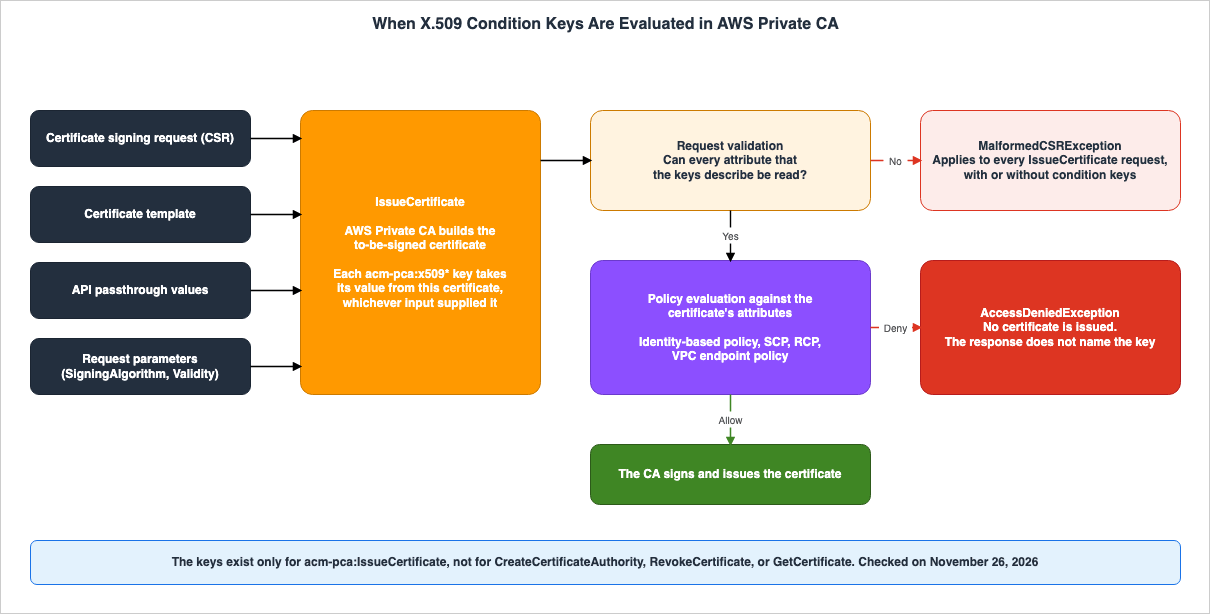
The condition keys page describes the evaluation process as follows:When a caller invokes the IssueCertificate operation, AWS Private CA builds the certificate from the certificate signing request (CSR), the certificate template, any API passthrough values, and the request parameters. It then evaluates your policies against the attributes of that certificate before signing it. If a policy denies the request, AWS Private CA returns an AccessDeniedException and doesn't issue the certificate.AWS Private CA assembles the certificate based on the CSR, certificate template, API passthrough values, and request parameters. Before signing, it then evaluates policies against the certificate's attributes. If the policy rejects the request, it returns an
AccessDeniedException and does not issue the certificate (Stated).Figure 1 arranges this flow as this article reads it (Inference). This article places request validation (Section 7.2) before policy evaluation.
2.3 Independent of the Input Source
The condition keys page describes where the key values come from as follows:The condition keys describe the certificate that would be issued, not how its contents were supplied.The keys describe the certificate that would be issued, not which input supplied its contents (Stated). As an example, the same page states that the value of
acm-pca:x509Ext/ExtendedKeyUsage is the same whether the extended key usage comes from a CSR, a template, or API passthrough, and that moving an attribute to a different input does not get past the policy (Stated). Similarly, What's New indicates that each key derives its value from the final certificate (Stated).Therefore, even if teams build their own CSRs freely, or add extensions through templates or API passthrough, the policy looks at the resulting certificate. Extensions added through templates are also subject to evaluation, which may trigger the considerations outlined in Section 6.4.
2.4 CA Certificate Issuance Also Proceeds Through IssueCertificate
What's New highlights an example of what can be achieved with condition keys, reserving CA certificates for the PKI team (Stated). Whether a certificate is a CA certificate can be determined by examiningacm-pca:x509Ext/BasicConstraints/CA (see Chapter 3).Even root CA certificates are issued through
IssueCertificate. The root CA install page describes signing a CA's CSR with a call to issue-certificate, using the RootCACertificate/V1 template (Stated). Therefore, a Deny statement that rejects CA certificates can also stop the PKI team's work of creating root CAs and subordinate CAs (Inference). Section 6.4 includes similar cautions from the template's perspective.3. Five Groups of Condition Keys
This chapter presents the keys listed on the condition keys page, categorized into five groups.3.1 Five Groups
The condition keys page lists the keys in five tables. Each key has the prefixacm-pca: and represents a certificate before it is signed (Stated). Table 1 lists the keys counted in this article across the five tables. This article counts acm-pca:x509SAN/OtherName/${OID} as one key.| Group | Key | Count |
|---|---|---|
| Subject | acm-pca:x509Subject/empty, acm-pca:x509Subject/CN, acm-pca:x509Subject/C, acm-pca:x509Subject/O, acm-pca:x509Subject/OU | 5 |
| Subject Alternative Name (SAN) | acm-pca:x509SAN/present, acm-pca:x509SAN/critical, acm-pca:x509SAN/count, acm-pca:x509SAN/DNS, acm-pca:x509SAN/IP, acm-pca:x509SAN/URI, acm-pca:x509SAN/RFC822, acm-pca:x509SAN/Name/CN, acm-pca:x509SAN/OtherName/${OID} | 9 |
| Key and Signature | acm-pca:x509Key/algorithm, acm-pca:x509Key/size, acm-pca:x509Key/curve, acm-pca:x509Key/namedCurve, acm-pca:x509Signature/algorithm | 5 |
| Validity Period | acm-pca:x509Validity/notBefore, acm-pca:x509Validity/notAfter, acm-pca:x509Validity/durationDays, acm-pca:x509Validity/durationHours | 4 |
| Extensions | acm-pca:x509Ext/KeyUsage/present, acm-pca:x509Ext/KeyUsage, acm-pca:x509Ext/KeyUsage/critical, acm-pca:x509Ext/ExtendedKeyUsage/present, acm-pca:x509Ext/ExtendedKeyUsage, acm-pca:x509Ext/ExtendedKeyUsage/count, acm-pca:x509Ext/ExtendedKeyUsage/critical, acm-pca:x509Ext/BasicConstraints/present, acm-pca:x509Ext/BasicConstraints/CA, acm-pca:x509Ext/BasicConstraints/pathLen, acm-pca:x509Ext/BasicConstraints/critical | 11 |
There are six key types: Boolean (Bool), Numeric, String, Array of Strings, Array of IP Addresses, and Date (Stated). Out of the subject keys, four, excluding
acm-pca:x509Subject/empty, along with the keys for SAN names and the keys acm-pca:x509Ext/KeyUsage and acm-pca:x509Ext/ExtendedKeyUsage, have an array type. How to write conditions on array-type keys is described in Section 5.2.The main value formats are as follows (Stated):
acm-pca:x509SAN/DNSholds DNS names in lowercase, without trailing dots.acm-pca:x509SAN/IPevaluates IPv6 addresses mapped to IPv4 as IPv4 addresses.acm-pca:x509SAN/OtherName/${OID}represents keys for each type, identified by its OID. Microsoft's user principal name isacm-pca:x509SAN/OtherName/1.3.6.1.4.1.311.20.2.3.acm-pca:x509Key/sizerepresents the key length: for RSA, it is the modulus length; for EC and SM2, it is the field size of the curve; and for ML-DSA, it is the length of the encoded public key. The values for ML-DSA are10496,15616, and20736. To restrict ML-DSA parameter sets, the condition keys page says to useacm-pca:x509Key/algorithm.acm-pca:x509Validity/durationDaysandacm-pca:x509Validity/durationHoursrepresent the difference betweennotBeforeandnotAfter, truncated to days and hours, respectively.acm-pca:x509Ext/ExtendedKeyUsageholds each purpose as its OID, and purposes that RFC 5280 names also by name. For a TLS server certificate, the values areserverAuthand1.3.6.1.5.5.7.3.1.
3.2 Key Algorithms and Signature Algorithms
The key and signature group has two algorithm keys. The two describe different things.acm-pca:x509Key/algorithm specifies the algorithm for the public key that will be included in the certificate, as received from the Certificate Signing Request (CSR). Possible values include RSA, EC, SM2, ML-DSA-44, ML-DSA-65, and ML-DSA-87 (Stated). The condition keys page describes this key as follows:This is the key being certified, not the CA's key.acm-pca:x509Signature/algorithm defines the algorithm used by the Certificate Authority (CA) to sign the certificate, determined by the SigningAlgorithm parameter in the request. Examples of possible values include sha256WithRSAEncryption, ecdsa-with-SHA384, and ML-DSA-65 (Stated). The condition keys page describes this key as follows:This describes the CA's signature, not the subject key.Therefore, to require ML-DSA for the keys in teams' certificates, use
acm-pca:x509Key/algorithm. To keep the CA from signing with SHA-256, use acm-pca:x509Signature/algorithm. The examples page provides examples for both (Stated).3.3 Absent Keys
The condition keys page states that keys not applicable to a certificate will not be included in the request context. For example, RSA keys do not haveacm-pca:x509Key/curve, and certificates that do not specify a path length do not have acm-pca:x509Ext/BasicConstraints/pathLen (Stated). The key acm-pca:x509Ext/BasicConstraints/CA is also absent from certificates that do not have the basic constraints extension (Stated).Absent keys, when combined with negated operators, can produce results that are the opposite of the intended outcome. This is discussed in Section 5.1.
4. Which Policies Can Hold the Keys
This chapter outlines the types of policies to which condition keys can be applied, as well as those to which they currently cannot.4.1 Four Policy Types, and One That Cannot Use the Keys Yet
The policy types page describes the types of policies that can utilize condition keys as follows (Stated). Table 2 summarizes this information as presented in this article.| Policy Type | Where It Is Placed | Statements | Status on the Verification Date |
|---|---|---|---|
| IAM identity-based policy | Requester's users, groups, and roles | Allow and Deny | Usable (Stated) |
| SCP | Accounts in the requester's organization | Deny | Usable (Stated) |
| RCP | Accounts in the organization that owns the CA | Deny | Usable (Stated). Does not apply to a CA in the organization's management account |
| VPC Endpoint Policy | AWS Private CA interface VPC endpoint | Allow and Deny | Usable (Stated) |
Resource-based policy for the CA (including RAM customer managed permissions and PutPolicy) | Shared CA | Allow only | Not yet usable (Stated). Sources disagree with What's New |
Figure 2 illustrates, based on this article's interpretation, the locations where each policy in Table 2 is applied between the shared CA and the requesting account (Inference).
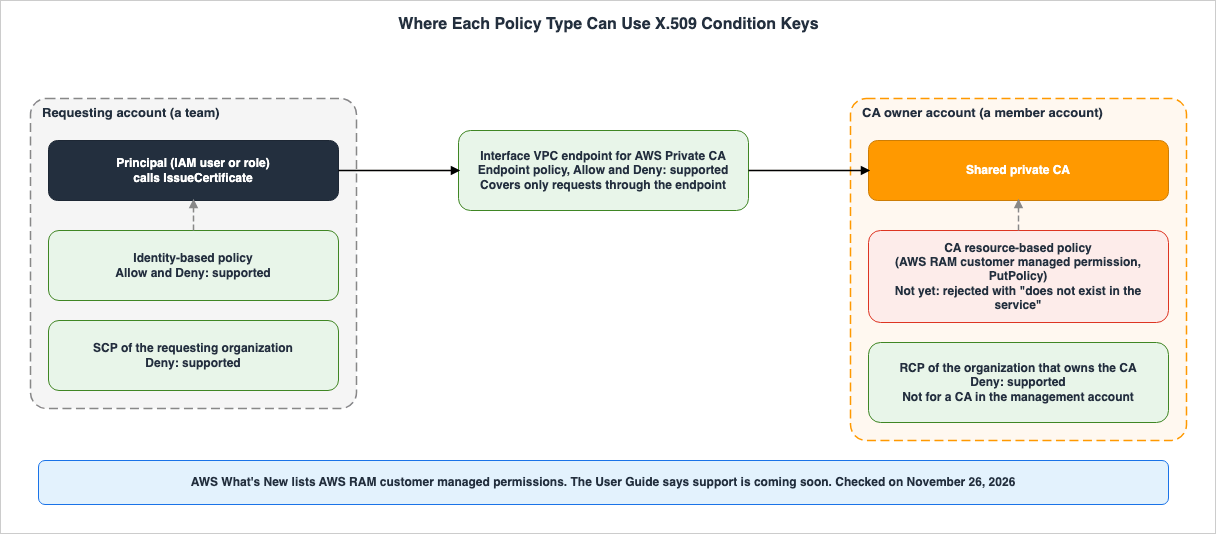
X.509 certificate condition keys (acm-pca:x509*) aren't supported yet in the resource-based policy of a private CA. This includes AWS RAM customer managed permissions and policies that you set with PutPolicy. Support is coming soon.The note also states that, until then, RAM and
PutPolicy reject a policy that uses these keys with an error such as the following (Stated).The condition key acm-pca:x509SAN/DNS does not exist in the service acm-pca. Use a valid condition key.Therefore, it is currently not possible to configure a shared CA's resource-based policy to utilize X.509 condition keys to restrict the certificates that can be issued by team, as policies will be rejected at the time of saving.
4.2 Discrepancies Between What's New and the User Guide
What's New describes where the condition keys can be used as follows:You can use the condition keys in identity-based policies, service control policies (SCPs), resource control policies (RCPs), VPC endpoint policies, and customer managed permissions in AWS Resource Access Manager (AWS RAM).What's New lists RAM customer managed permissions among the places where the keys can be used (Stated). In contrast, seven pages of the user guide state that support is not available yet (Stated). The notes in the condition keys page, policy types page, examples page, before-you-deploy page, and troubleshooting page indicate that the keys "aren't supported yet." The resource-based policy page states that it "doesn't yet support" the feature, and the customer managed permissions page states that it "don't yet support" it.
On this point, the two sources disagree (Sources disagree). As of the verification date, this article follows the user guide, because the user guide even shows the error that RAM and
PutPolicy return. The text in What's New can be read as describing the state after support arrives, but that reading is this article's inference (Inference).4.3 Discrepancies Within the User Guide Pages
There are instances within the user guide where the notes and the main body of the pages contain conflicting information. The main body of the policy types page, in the explanation of resource-based policies, states:To restrict the certificates that a cross-account principal can request, add conditions to the Allow statement for acm-pca:IssueCertificate, for example in a RAM customer managed permission.Similarly, the main body of the customer managed permissions page states:
For example, add X.509 certificate condition keys to the IssueCertificate statement to restrict the certificates that principals in other accounts can request.Regarding the resource-based policy page, the section on creating connectors states that if you add X.509 condition keys to either a RAM customer managed permission or an RCP, you need to allow both the values in the table and the certificates issued by the connector (Stated).
All three pages also contain notes indicating that support in the resource-based policy is not available yet (Stated). The main body describes the process after support has been implemented, while the notes describe the state as of the verification date (Inference). A reader who reads only the main body may take it that RAM can restrict the certificates. This article will treat the notes as reflecting the state as of the verification date.
Another discrepancy exists. The notes on the condition keys page, the examples page, the before-you-deploy page, and the troubleshooting page list three types currently available: identity-based policies, SCP, and RCP, and do not mention VPC endpoint policies (Stated). In contrast, the main body of the policy types page and the VPC endpoints page state that the keys can also be used in VPC endpoint policies (Stated). For VPC endpoint policies, this article follows the statement Supports Allow and Deny statements in the main body of the policy types page.
4.4 Restricting from the CA Side: The RCP of the Organization That Owns the CA
While the keys cannot be placed in the CA's resource-based policy, the policy types page names the RCP as the way to restrict issuance from a shared CA from the CA side.To restrict cross-account issuance from a shared CA, use an RCP in the organization that owns the CA. RCPs don't apply to a CA in the organization's management account. Requesting accounts can also use identity-based policies or SCPs.To restrict issuance from a shared CA, use the RCP of the organization that owns the CA. An RCP does not apply to a CA in the organization's management account (Stated). The RCP page also lists AWS Private Certificate Authority as a service to which the RCP applies, with a prefix of
acm-pca (Stated).The RCP policy text must adhere to the guidelines outlined on the RCP syntax page. In an RCP that you create,
Effect must be Deny, Principal can contain only "*", and the Condition element restricts specific principals (Stated). The Action element must name a service prefix, not only "*" (Stated).The following policy is an example for this article and is not a sample from the user guide. As an RCP of the organization that owns the CA, this policy denies principals within account
111122223333 from issuing certificates with DNS names outside of team-a.example.com.{
"Version": "2012-10-17",
"Statement": [
{
"Sid": "DenyTeamADnsNamesOutsideItsSubdomain",
"Effect": "Deny",
"Principal": "*",
"Action": "acm-pca:IssueCertificate",
"Resource": "*",
"Condition": {
"StringEquals": {
"aws:PrincipalAccount": "111122223333"
},
"ForAnyValue:StringNotLike": {
"acm-pca:x509SAN/DNS": ["team-a.example.com", "*.team-a.example.com"]
}
}
}
]
}This policy does not deny certificates that do not have a DNS name. This is because the
ForAnyValue condition evaluates to false when no value is provided (Section 5.2). If you want to deny certificates with only an IP address or those with only a common name (CN), you need to add statements. The Restrict DNS names to approved domains example on the examples page also notes that certificates without a DNS name are not affected (Stated).The RCP page states that an RCP applies to resources managed by the organization's account and also applies when external principals attempt to access those resources (Stated). Therefore, even if the requesting account belongs to a different organization, it is possible to restrict issuance from the CA's side using the RCP of the organization that owns the CA (Inference). However, RCPs do not apply to service-linked role permissions (Section 6.3).
4.5 Restricting on the Requester Side: Identity-Based Policies and SCPs
Accounts making requests can restrict their own requests using identity-based policies and SCPs (Stated). The customer managed permissions page and the resource-based policy page also state that accounts can limit their requests using identity-based policies or SCPs (Stated).Identity-based policies support both
Allow and Deny statements. The examples page's example that allows only an approved DNS name is an Allow statement, and the examples page states that it can be used in an identity-based policy (Stated). The potential pitfalls of writing Allow statements are discussed in Section 5.2.The SCPs and identity-based policies used to restrict requests are defined by the requesting organization and accounts. The CA owner cannot always write the SCPs of the requesting organization. To enforce the CA owner's rules from the CA side, use the RCP in Section 4.4 (Inference).
4.6 VPC Endpoint Policies
The VPC endpoints page states that you can restrict the certificates that can be requested through an endpoint by adding X.509 condition keys to theacm-pca:IssueCertificate statement (Stated). The policy types page states that VPC endpoint policies can use Allow and Deny statements (Stated).VPC endpoint policies only apply to requests that pass through that specific endpoint. They do not affect requests that bypass the endpoint (Inference).
4.7 Service Authorization Reference and IAM Access Analyzer
As of the verification date, the AWS Private Certificate Authority page of the SAR lists no X.509 condition keys. The condition keys listed in theIssueCertificate row are limited to acm-pca:TemplateArn and aws:ResourceTag/${TagKey}. The table of condition keys on the page also lists only four: acm-pca:TemplateArn, aws:RequestTag/${TagKey}, aws:ResourceTag/${TagKey}, and aws:TagKeys (Stated).The policy types page states the following regarding IAM Access Analyzer:
IAM Access Analyzer might also flag these keys in identity-based policies, SCPs, and RCPs, but the keys still take effect in those policies.IAM Access Analyzer may issue warnings regarding these keys within identity-based policies, SCPs (Service Control Policies), and RCPs (Resource Control Policies), but the keys still take effect in those policies (Stated). This article does not present the absence of a key in the SAR as evidence that the key is unusable, nor does it claim that the SAR is inaccurate. Instead, it simply presents the fact that, as of the verification date, the key is not listed in the SAR, alongside the user guide's statement that the key is functional. Before treating a policy validation warning as a reason not to use a policy, reopen the user guide.
5. Pitfalls in Writing Conditions
This chapter discusses potential pitfalls in how conditions are written. The general evaluation of set operators andIfExists is detailed in this site's IAM Policy Evaluation Logic Step-by-Step. All of these scenarios involve policies that are syntactically correct and do not produce errors, but nevertheless either allow certificates that were not intended or reject certificates that were not meant to be rejected.5.1 Absent Keys and Negated Operators
The evaluation page describes the combination of negated operators and absent keys as follows:Negated operators such as StringNotEquals and StringNotLike return true for an absent key.Negated operators such as
StringNotEquals and StringNotLike return true for absent keys (Stated). In the evaluation page's example, a Deny statement that uses only StringNotEquals on acm-pca:x509Key/curve also rejects every RSA and ML-DSA request, because those keys have no curve (Stated).To ensure that the
Deny statement only applies to certificates that possess a key, a second condition must be added to narrow the scope. The evaluation page suggests two options: either specify EC or SM2 using StringEquals against acm-pca:x509Key/algorithm, or use a Null condition that sets the key to false, which requires the key to exist (Stated).The
IfExists construct does not narrow the scope of a Deny statement. As the evaluation page states:Don't use ...IfExists to narrow a Deny statement. An ...IfExists condition is true when the key is absent, so the statement still denies the request.Because the
IfExists condition evaluates to true when the key is absent, the Deny statement will continue to reject requests (Stated). IfExists belongs in an Allow statement that should allow certificates without the key (Stated).5.2 Keys with Multiple Values
Keys of the ArrayOfString and ArrayOfIPAddress types can hold multiple values. The evaluation page specifies that these should be used with either theForAnyValue or ForAllValues set operators, and describes the result when no values are present.If the certificate has no values for the key, a ForAnyValue condition is false and a ForAllValues condition is true.If a certificate does not contain a value for that key, the
ForAnyValue condition evaluates to false, while the ForAllValues condition evaluates to true (Stated).Therefore, using
ForAllValues:StringLike on acm-pca:x509SAN/DNS in an Allow statement also allows certificates that have no DNS name. The examples page states that such certificates can identify their subject only by IP address, URI, email address, directory name, or other name (Stated). The Allow only certificates for an approved DNS name example on the examples page closes this gap by adding conditions related to Null and the number of SANs. The following JSON is a direct copy of the example on the examples page.{
"Version": "2012-10-17",
"Statement": [
{
"Sid": "AllowOneApprovedDnsName",
"Effect": "Allow",
"Action": "acm-pca:IssueCertificate",
"Resource": "*",
"Condition": {
"Null": {
"acm-pca:x509SAN/DNS": "false",
"acm-pca:x509SAN/IP": "true",
"acm-pca:x509SAN/URI": "true",
"acm-pca:x509SAN/RFC822": "true",
"acm-pca:x509SAN/Name/CN": "true"
},
"NumericEquals": {
"acm-pca:x509SAN/count": "1"
},
"ForAllValues:StringLike": {
"acm-pca:x509SAN/DNS": ["example.com", "*.example.com"],
"acm-pca:x509Subject/CN": ["example.com", "*.example.com"]
}
}
}
]
}The examples page describes the function of each condition in this example as follows (Stated):
"false"foracm-pca:x509SAN/DNSrequires at least one DNS name."true"for keys representing IP addresses, URIs, email addresses, and directory names rejects certificates that have those SANs.- Other names have keys specific to each type, and there is no single
Nullcondition that covers all types. Theacm-pca:x509SAN/countcondition rejects any SAN entry beyond the one DNS name, including other name entries. ForAllValues:StringLikelimits DNS names and the subject's CN toexample.com. A certificate without a CN also matches. CNs are not lowercased, so the condition does not match a CN in a different letter case.
The examples page notes that the pattern
*.example.com does not match example.com itself, and therefore lists both (Stated). It also states that when allowing more than one DNS name, the count cannot exclude other names, so a Null condition must be added for each type to reject, and types not listed are not rejected (Stated).The subject keys can also hold multiple values. Since a subject can have the same attribute repeated, they should be used in conjunction with either
ForAnyValue or ForAllValues (Stated). The Require a subject country example on the examples page separates the statement that rejects certificates without a country (Null) from the statement using ForAnyValue:StringNotEquals. This is because the condition for ForAnyValue becomes false when a country is not specified (Stated).5.3 Extended Key Usage Has Both Names and OIDs
acm-pca:x509Ext/ExtendedKeyUsage holds both the name and the OID of each named purpose (Section 3.1). The evaluation page notes that a condition using ForAllValues:StringEquals that lists only serverAuth will not match certificates with a value of serverAuth and 1.3.6.1.5.5.7.3.1. It recommends listing both forms or using ForAnyValue to test for a specific purpose (Stated).The examples page provides an example rejecting code signing and OCSP signing usages, using
ForAnyValue:StringEquals to list codeSigning and OCSPSigning. To reject purposes that RFC 5280 does not name, list their OIDs (Stated). This site's When Public Certificates Stop Carrying clientAuth describes where AWS asks about the clientAuth purpose.5.4 Hostname Normalization and the CN
According to the evaluation page, AWS Private CA converts hostnames to a standard format before evaluation so that a different spelling of the same name cannot bypass a policy (Stated).acm-pca:x509SAN/DNS: Converts to lowercase and removes trailing dots. For example,WWW.Example.COM.is evaluated aswww.example.com.acm-pca:x509SAN/RFC822: Converts the domain portion to lowercase and removes trailing dots. The local part is unchanged, because it can be case-sensitive.acm-pca:x509SAN/URI: Converts the hostname to lowercase. The scheme, path, query, and fragment remain unchanged.
When specifying hostnames in conditions, use lowercase and avoid trailing dots (Stated). Leading and trailing spaces are also removed from DNS names, email addresses, and URIs. These conversions are solely for evaluation purposes; the requested values are included as is in the issued certificate (Stated).
The Common Name (CN) is not transformed. The evaluation page states:
Common names aren't converted. This applies to both acm-pca:x509Subject/CN and acm-pca:x509SAN/Name/CN, so a request can vary the letter case of a common name.Neither
acm-pca:x509Subject/CN nor acm-pca:x509SAN/Name/CN converts the CN, so a request can vary the letter case of a CN (Stated). To match regardless of case, use ForAnyValue:StringEqualsIgnoreCase or ForAnyValue:StringNotEqualsIgnoreCase. IAM's StringLike has no case-insensitive form, so a wildcard pattern on a CN key is case-sensitive and can be bypassed with a different letter case (Stated). The evaluation page says to use acm-pca:x509SAN/DNS, which is lowercased, when you want to match hostnames with wildcards (Stated).Therefore, to filter by a team's namespace using wildcards, use
acm-pca:x509SAN/DNS. For the CN, use case-insensitive operators, as demonstrated in the Restrict the subject common name example on the examples page, to compare against a predefined list of names.5.5 Latin-1 and Internationalized Domain Names
The evaluation page states that IAM policy conditions only support values consisting of Latin-1 characters. Conditions that match values containing other Unicode characters are not supported (Stated). Internationalized domain names, which are held in the keys as ASCII representations (A-labels) beginning withxn--, must also be specified in the condition using the A-label format (Stated). When using API passthrough and providing DNS names, email addresses, or URIs containing Unicode characters, AWS Private CA will convert them to A-labels. Requests containing CSRs or custom extensions that encode these characters using Unicode will be rejected (Stated).5.6 Validity Period and the 60-Minute Backdating
The evaluation page sets the default value fornotBefore as follows:Unless the request specifies ValidityNotBefore, AWS Private CA sets notBefore to 60 minutes before the issuance time, and calculates notAfter from the issuance time.Unless the request specifies a
ValidityNotBefore value, AWS Private CA sets notBefore to 60 minutes prior to the issuance time and calculates notAfter from the issuance time. Consequently, the duration keys include the extra hour. When requesting a 90-day validity period, durationDays will be 90 and durationHours will be 2161 (Stated).Therefore, when setting an upper limit in terms of hours, it is necessary to account for that extra hour. If you intend to set a 90-day limit and specify
acm-pca:x509Validity/durationHours with NumericGreaterThan set to 2160, it also denies a 90-day request with the default notBefore (Inference). Because durationDays is truncated to the nearest whole day, the Limit the validity period example on the examples page uses durationDays with NumericGreaterThan set to 90 (Stated).5.7 What Cannot Be Compared
The evaluation page only accepts date conditions specified as fixed timestamps in ISO 8601 format and does not support comparisons between condition keys, nor times relative to the request (Stated). The page also states that IAM cannot compare two condition keys; for example, it cannot require that the CN is equal to one of the DNS names. Instead, it instructs users to narrow down each key to the same set of acceptable values (Stated). A statement applies only if all conditions within it are met (Stated).5.8 Curves and How They Are Encoded
acm-pca:x509Key/curve indicates which curve the key uses, but does not describe how that curve is encoded (Stated). A condition that allows only prime256v1 also allows P-256 keys that spell out the curve as explicit parameters. Some libraries, such as the JDK SunEC provider, cannot use such keys, so if the parties that validate the certificates require named curves, also check acm-pca:x509Key/namedCurve (Stated).6. What a Deny Can Stop
This chapter describes whereDeny statements that use the condition keys can stop requests you did not mean to stop. The before-you-deploy page notes that a Deny statement applies to every request it matches, including requests you do not make directly, and recommends checking this before adding X.509 condition keys to an SCP, an RCP, or a widely used identity-based policy (Stated).6.1 Services and Connectors That Send Requests for You
The before-you-deploy page describes the services and connectors that issue certificates on your behalf as follows:AWS Certificate Manager (ACM), AWS Private CA Connector for Active Directory, Connector for SCEP, AWS Private CA Connector for Kubernetes, and your own automation call IssueCertificate with certificate contents that they choose.ACM, the Connector for Active Directory, the Connector for SCEP, the Connector for Kubernetes, and custom automation all call
IssueCertificate with certificate contents that they choose (Stated). Some of these also submit test requests to verify authorization to use a CA. Policies that reject these requests can prevent certificate issuance or renewal, or cause configuration failures (Stated). The before-you-deploy page says to scope statements with conditions such as aws:PrincipalArn, aws:PrincipalTag, and aws:ViaAWSService so that they apply only to the intended requests (Stated).The permissions used by the Connector for Kubernetes are detailed in this site's Certificate Distribution in Kubernetes with AWS Private CA.
6.2 Test Requests When a Connector Is Created
The resource-based policy page describes the test requests sent when a Connector for AD or a Connector for SCEP is created. The connectors, to verify permissions, send two test requests toacm-pca:IssueCertificate. One request is sent as a service principal, and the other is sent with the user's identity via aws:CalledVia (Stated). AWS Private CA evaluates the policy against these requests and, as designed, rejects the requests and does not issue a certificate. CloudTrail logs both test requests as failed IssueCertificate events, resulting in a ValidationException, which is the expected behavior (Stated). If a policy rejects either request, the error code in the event is AccessDenied (Stated).If you add X.509 condition keys to a policy that applies to either request, the conditions must allow the values in the test request. If they do not, the connector creation will fail with the
PRIVATECA_ACCESS_DENIED error (Stated). Table 3 shows the main values from the table on the resource-based policy page (Stated). That table also lists values for other keys, such as acm-pca:TemplateArn, acm-pca:x509Signature/algorithm, acm-pca:x509Ext/KeyUsage/present, acm-pca:x509Ext/ExtendedKeyUsage/present, and acm-pca:x509Ext/BasicConstraints/present (Stated). If you put conditions on these keys, check every row of the table on that page, not only Table 3.| Key | Test Request Value |
|---|---|
acm-pca:x509Subject/CN | A specific string, determined on a per-connector basis. See below. |
acm-pca:x509Key/algorithm | RSA |
acm-pca:x509Key/size | 2048 |
acm-pca:x509Validity/durationDays | 1 |
acm-pca:x509Validity/durationHours | 25 |
acm-pca:x509SAN/present | false |
acm-pca:x509Ext/BasicConstraints/CA | false |
The value for
acm-pca:x509Subject/CN is as follows, for the Connector for AD and the Connector for SCEP, respectively (Stated):AWS Private CA Connector for Active Directory permission check
AWS Private CA Connector for SCEP permission checkThe
durationHours being set to 25 is due to the 60-minute backdating in Section 5.6 (Stated). Because the test requests have no SAN, a Deny statement that requires DNS names can stop connector creation when it applies to a test request (Inference). The resource-based policy page states that the simplest way to keep connector creation working is to allow the connector to use acm-pca:IssueCertificate without X.509 condition keys. If a Deny statement in an SCP, RCP, or identity-based policy applies to the connector's requests, the page says to scope it as described on the before-you-deploy page (Stated).6.3 Which Policies Apply to ACM's Requests
The AWS Private CA pages that this article read do not state which types of policies apply to ACM's requests (No statement found). From statements in other guides, this article infers the following (Inference).- The ACM CA access page states that when the CA and the certificate are in different accounts, ACM sets up a service-linked role that acts as a principal with the PCA policy (Stated).
- The SCP page states that SCPs do not affect service-linked roles (Stated).
- The RCP page states that RCPs do not affect the effective permissions of a service-linked role (Stated).
Combining these three points, it is possible that certificates issued through ACM from a shared CA may not be stopped by
Deny statements in SCPs and RCPs that use X.509 condition keys (Inference). On the other hand, the before-you-deploy page states that policies that reject ACM's requests can stop certificate issuance or renewal (Stated). This article does not definitively conclude which is correct. If the design assumes that this mechanism restricts the certificates issued through ACM, test, in a non-production environment, whether ACM requests and renewals are rejected or allowed.A separate layer restricts ACM's requests on the requester side. The ACM SAR lists condition keys such as
acm:DomainNames, acm:KeyAlgorithm, and acm:CertificateAuthority for the ACM RequestCertificate action (Stated).6.4 Extensions That Templates Add
The before-you-deploy page states that your conditions must allow the extensions that the template adds, and gives an example: a statement that denies CA certificates also denies requests that use a subordinate CA template (Stated). As stated in Section 2.3, template-added extensions are also subject to evaluation.The examples page's Deny CA certificates for tagged principals example states that when
acm-pca:x509Ext/BasicConstraints/CA is true and the principal tag CertificateType is EndEntityOnly, CA certificates are rejected (Stated). Because the statement is restricted by the principal tag, it does not apply to the PKI team's roles. As described in Section 2.4, root CA certificates also pass through IssueCertificate; therefore, scope statements that reject CA certificates by principal in this way (Inference).6.5 How to Scope Statements
This article summarizes sections 6.1 through 6.4 into the following three steps (Inference).- First, decide which principals a statement applies to, with conditions such as
aws:PrincipalArn,aws:PrincipalTag, andaws:PrincipalAccount. Apply each team's rules to that team's principals. - Exclude the principals of connectors, ACM, automation, and the PKI team from the statements, or handle them in separate statements.
- As outlined in the before-you-deploy page, apply policies to non-production accounts or organizational units, issue certificates representing each purpose, and then expand their use (Stated).
7. Investigating Rejections
This chapter outlines the process for identifying the reasons why requests are being rejected based on condition keys.7.1 AccessDeniedException Does Not Specify Which Key
The troubleshooting page states that when a policy using condition keys causes AWS Private CA to reject a request, it returns anAccessDeniedException, but the response does not indicate which condition key or value caused the rejection (Stated). The same page lists the following steps (Stated):- Search for rejected requests in AWS CloudTrail. The error message may indicate the type of policy involved – whether it explicitly denies access, or whether it is due to the absence of an
Allowstatement. If indicated, investigate the type of policy identified. If not, investigate the relevant policy type for each of the following: identity-based policies, SCP, RCP, VPC endpoint policies, and the CA's resource-based policies. - Compare the requested certificate with each statement that references X.509 condition keys. Obtain the value of each key from the CSR, template, API passthrough values, or the request parameters.
- Investigate common causes, such as: negated operators applied to absent keys, case-sensitive CN comparisons, hostnames with uppercase characters or trailing dots, a
ForAllValuescondition on extended key usage that lists names but not OIDs, an hour-based limit that does not allow for the defaultnotBefore, characters outside of Latin-1, and statements that apply to ACM or connector requests.
Five of the eight potential pitfalls described in Chapter 5 (Sections 5.1 and 5.3 through 5.6) are included in this list.
7.2 MalformedCSRException Comes Before Evaluation
The validation page states that to evaluate a condition key, AWS Private CA must be able to read all attributes that the key represents. If it cannot, AWS Private CA rejects the request with aMalformedCSRException instead of evaluating the policies without the key (Stated). The validation page lists six kinds of certificate content that it rejects (Stated).- Public keys for EC and SM2 that either lack curve parameters or include the
implicitCurveparameter. - Public keys for EC and SM2 that have invalid curve parameters or use an OID for a curve that AWS Private CA does not recognize.
- Extended key usage extensions with three or more bytes of extra data after the encoded value.
- SANs that are empty, contain only whitespace, or include control characters.
- IP addresses in the SAN that are neither four bytes nor sixteen bytes in length.
- Unreadable key usages, basic constraints, and SAN extensions, as well as unreadable validity dates.
The validation page describes this check as follows:
These checks apply to all IssueCertificate requests, whether or not your policies use X.509 certificate condition keys.This check applies to all
IssueCertificate requests, whether or not the policies use X.509 certificate condition keys (Stated). Therefore, a MalformedCSRException can occur even for a CA where no policy uses the condition keys. The cause is not the policy itself, but rather the content of the request.7.3 IssueCertificateDetails
The CloudTrail page notes that theIssueCertificateDetails event is recorded when an attempt to issue a certificate concludes, regardless of success or failure, and that when a certificate is issued from a shared CA, this event is delivered to both the CA owner account and the requester account (Stated). The sources that this article read do not state whether this event is also recorded when a condition key policy rejects a request (No statement found). This article does not say that a rejection is recorded in this event. To identify rejections, refer to the IssueCertificate CloudTrail event, as described in Section 7.1.8. Discrepancies and Missing Information in the Documentation
This chapter summarizes the places that the text marked as Sources disagree or No statement found.| Item | Status | Treatment in this Article |
|---|---|---|
| Can condition keys be placed within RAM's customer managed permissions? | Sources disagree (What's New states that they can be placed; the notes on seven pages of the user guide state that they cannot yet.) | State that, as of the verification date, they cannot be placed (Section 4.2). |
| The main text of the policy types page, the customer managed permissions page, and the resource-based policy page explains use in RAM | Sources disagree (the note on the same page states that support is not available yet) | Treat the notes as the state on the verification date (Section 4.3). |
| Can the keys be used in VPC endpoint policies? | Sources disagree (The notes on four pages do not mention them. The main text of the policy types page and the VPC endpoints page state that they can be used.) | State that they can be used (Sections 4.3 and 4.6). |
| The SAR does not include X.509 condition keys. | Stated (The SAR does not include them; the policy types page states that the keys are effective.) | Present both statements without stating which is incorrect (Section 4.7). |
| What types of policies apply to ACM requests? | No statement found | Provide a reasoned inference and suggest verification in a non-production environment (Section 6.3). |
Is a condition key-based rejection recorded in IssueCertificateDetails? | No statement found | Do not state that it is recorded (Section 7.3). |
9. Frequently Asked Questions Regarding Shared CA X.509 Condition Keys
This chapter answers questions based on the reader's assumed understanding from Section 1.1, using the statements in Chapters 2 through 8.Q1. Can RAM customer managed permissions restrict the DNS names that each team can issue?
As of the verification date of November 26, 2026, this is not currently possible. The user guide states that support for CA (Certificate Authority) resource-based policies is not yet implemented, and that RAM andPutPolicy will reject policies that use these keys, resulting in errors. What's New lists RAM among the places where the keys can be used, but this article follows the user guide. To restrict them from the CA side, use the RCP of the organization that owns the CA (Sections 4.1 through 4.4). However, RCPs do not apply to a CA in the organization's management account, and whether they stop requests made through ACM is unresolved (Section 6.3).Q2. Can an SCP prevent the creation of a CA whose key is not ML-DSA?
It is not possible with the X.509 condition keys. The keys are only usable with theIssueCertificate action and are not available with CreateCertificateAuthority. The only point at which this can be controlled is when issuing the certificate (see Section 2.1).Q3. Is acm-pca:x509Key/algorithm the algorithm of the CA's key?
No. This key refers to the public key that will be included in the certificate, specifically the key algorithm from the Certificate Signing Request (CSR). The CA's signature algorithm is in acm-pca:x509Signature/algorithm (see Section 3.2).Q4. IAM Access Analyzer flags these keys. Do the keys still take effect?
Yes, they do. The policy types page states that even when IAM Access Analyzer issues warnings for these keys within identity-based policies, SCPs, or RCPs, the keys still function. As of the verification date, the keys are not listed in the SAR (Section 4.7).Q5. To cap the validity period at 90 days, is it enough to set durationHours to 2160?
No, it is not. By default, notBefore is set to 60 minutes before issuance, so a 90-day request has a durationHours of 2161. Cap durationDays at 90 instead, or allow for the extra hour when using hours (see Section 5.6).Q6. Can the CN be restricted with a wildcard?
It is not recommended. CN values are not converted to lowercase, and the IAMStringLike operator does not support case-insensitive matching, so it could potentially be bypassed using different capitalization. Write wildcards for names with acm-pca:x509SAN/DNS, which is lowercased. CN values should be compared against a defined list of names using a case-insensitive operator (see Section 5.4).Q7. Can adding a Deny statement stop ACM renewals or connectors?
It can. The user guide states that ACM, connectors, and custom automation all call IssueCertificate, and some also submit test requests. Therefore, policies that deny these requests can stop issuance, renewal, or setup. Scope statements to the intended requests with conditions on the principal. The documentation does not specify which types of policies apply to ACM requests, so verify this in a non-production environment (Chapter 6).Q8. Can the keys be used in VPC endpoint policies?
Yes, they can. The main text of the policy types page states thatAllow and Deny can be used with VPC endpoint policies. However, the notes on four pages do not mention VPC endpoint policies (Section 4.3). This applies to requests passing through that specific endpoint (see Section 4.6).10. Summary
Before restricting the certificates that each team can issue using X.509 condition keys, ensure the following:- You understand that condition keys are used only with
acm-pca:IssueCertificateand are evaluated against the attributes of the certificate before it is signed. Calls toCreateCertificateAuthoritycannot be prevented (Chapter 2). - Conditions on the subject public key use
acm-pca:x509Key/algorithm, and conditions on the CA's signature useacm-pca:x509Signature/algorithm(Section 3.2). - The keys are not placed in the CA's resource-based policy, which includes RAM customer managed permissions and
PutPolicy. To restrict from the CA side, the RCP of the organization that owns the CA is used, and the CA is confirmed not to be in the organization's management account (Sections 4.1 and 4.4). - You are aware of any discrepancies between What's New and the user guide, and have re-opened the user guide for review (Sections 4.2 and 4.3).
Denystatements with negated operators are restricted by a second condition or byNull. They are not being narrowed down usingIfExists(Section 5.1).- The gap where
ForAllValuesin anAllowstatement allows certificates with no values is closed withNulland count conditions (Section 5.2). - When comparing extended key usage with
ForAllValues, ensure both the name and OID are specified (Section 5.3). - Wildcard names are used with
acm-pca:x509SAN/DNSand are written in lowercase. Comparisons for CN utilize case-insensitive operators (Section 5.4). - Hour-based limits allow for the 60-minute backdating (Section 5.6).
Denystatements are scoped with principal conditions so that they do not apply to requests from ACM, connectors, automation, and the PKI team. The values of the connector test requests are allowed (Chapter 6).- Certificates for various purposes have been issued and verified on non-production accounts (Section 6.5).
- Since the verification date of November 26, 2026, ensure that the CA's resource-based policy and SAR documentation have not changed by re-opening the relevant pages (Section 1.5).
11. References
- Control certificate issuance with X.509 certificate condition keys - AWS Private Certificate Authority
- Supported policy types - AWS Private Certificate Authority
- How condition key values are evaluated - AWS Private Certificate Authority
- Certificate request validation - AWS Private Certificate Authority
- Example policies - AWS Private Certificate Authority
- Before you deploy a policy - AWS Private Certificate Authority
- Resource-based policies - AWS Private Certificate Authority
- Customer managed permissions in RAM - AWS Private Certificate Authority
- AWS Private CA VPC endpoints (AWS PrivateLink) - AWS Private Certificate Authority
- AccessDeniedException with X.509 certificate condition keys - AWS Private Certificate Authority
- Document History - AWS Private Certificate Authority
- Logging AWS Private Certificate Authority API calls using AWS CloudTrail - AWS Private Certificate Authority
- Installing the CA certificate - AWS Private Certificate Authority
- IssueCertificate - AWS Private Certificate Authority
- AWS Private CA now supports X.509 IAM condition keys - AWS What's New
- Actions, resources, and condition keys for AWS Private Certificate Authority - Service Authorization Reference
- Actions, resources, and condition keys for AWS Certificate Manager - Service Authorization Reference
- Conditions for using AWS Private CA to sign ACM private certificates - AWS Certificate Manager
- Resource control policies (RCPs) - AWS Organizations
- RCP syntax - AWS Organizations
- Service control policies (SCPs) - AWS Organizations
- AWS Private CA Hierarchy Design - Root and Subordinate CAs, Revocation, Short-Lived Mode, and mTLS on ALB
- Enforcing an ML-DSA Policy on AWS - What kms:KeySpec and acm:KeyAlgorithm Can Stop, and What AWS Private CA and Imported Certificates Leave Open
- AWS Organization Guardrails - Service Control Policies, Resource Control Policies, and Data Perimeter Design
- Certificate Distribution in Kubernetes with AWS Private CA - Issue, Request, Store, Consume, and the Layer Where Renewal Stops
- When Public Certificates Stop Carrying clientAuth - Where AWS Sends or Accepts Client Certificates, and What Each Path Says About Extended Key Usage
- IAM Policy Evaluation Logic Step-by-Step - Explicit Deny, RCP, SCP, Resource Policy, Identity Policy, Permission Boundary, and Session Policy
- AWS History and Timeline regarding AWS Private Certificate Authority - Overview, CA Modes and Connectors, Features, Summary of Updates, and Introduction to AWS Private CA
References:
Tech Blog with curated related content
Written by Hidekazu Konishi