AWS History and Timeline regarding Amazon SES - Overview, Functions, Features, Summary of Updates, and Introduction to Amazon Simple Email Service
First Published:
Last Updated:
It powers transactional email (sign-up confirmations, password resets, receipts, and alerts), bulk and marketing campaigns, and inbound email processing pipelines, and it has quietly become one of the most widely used building blocks for application email on AWS.
What distinguishes Amazon SES is the combination of a simple sending interface (an HTTPS API or a plain SMTP endpoint), deep integration with the rest of AWS (Amazon S3, AWS Lambda, Amazon SNS, Amazon CloudWatch, and more), and a steadily growing set of deliverability and email-management features layered on top. Over more than fifteen years it has expanded from a one-way bulk sender into a full email platform that also receives mail, helps you reach the inbox, and isolates the sending of many tenants - while keeping the same pay-as-you-go, no-servers-to-manage model it started with.
Because Amazon SES has accumulated a long list of capabilities over more than fifteen years, it is easy to lose track of when a given feature actually arrived: When did Amazon SES launch, and was there a separate general availability date? When did it add an SMTP interface, DKIM signing, or email receiving (inbound)? When did Configuration Sets, the bounce/complaint/delivery feedback loop, Dedicated IPs, Virtual Deliverability Manager (VDM), and Mail Manager appear? And how did Amazon SES help senders meet the 2024 Gmail and Yahoo sender authentication requirements? This article answers those questions in one place.
This article organizes the history of Amazon SES into a single chronological timeline, drawn from primary AWS sources, and then summarizes the current overview, functions, and features of the service. It is intended as a reference page you can return to whenever you need to confirm when a particular Amazon SES capability became available. The focus is on major, service-level releases that define what Amazon SES is today, not on every minor SDK revision or single-Region rollout. For step-by-step configuration of email authentication, this article links to a dedicated how-to so the timeline stays focused on history.
Background and Method of Creating Amazon SES Historical Timeline
The purpose of this timeline is twofold:- Tracking the history of Amazon SES and organizing the transition of its updates over time.
- Summarizing the feature list and characteristics of Amazon SES as they stand today.
- What's New with AWS?
- AWS News Blog and the AWS Messaging and Targeting Blog
- Amazon SES Developer Guide
Please note that the items on this timeline are not all updates to Amazon SES features, but are representative updates that I have picked out. Pricing changes and single-Region expansions are intentionally omitted; AWS pricing changes frequently, so for current pricing always consult the official Amazon SES pricing page.
A note on "beta" and "general availability": Amazon SES was first announced as a beta on January 25, 2011, and from day one it used the sandbox / production-access model that it still uses today (verify a sending identity, then request production access). Unlike many AWS services, Amazon SES did not have a separate, dated "general availability" announcement; the "(Beta)" label was simply dropped over time, and AWS now describes the service as having been available since 2011. For that reason, this timeline anchors on the January 25, 2011 launch announcement rather than on a distinct GA date. The original announcement is preserved here: Introducing Amazon Simple Email Service (Beta) and the AWS News Blog post Introducing the Amazon Simple Email Service.
Amazon SES Historical Timeline (Updates from January 25, 2011)
Now, here is a timeline related to the functions of Amazon SES. As of the time of writing this article, the history of Amazon SES spans about 15 years since its launch in January 2011.2011 | 2012 | 2014 | 2015 | 2016 | 2017 | 2019 | 2020 | 2021 | 2022 | 2023 | 2024 | 2025 | 2026
* The table can be sorted by clicking on the column names.
| Date | Summary |
|---|---|
| 2011-01-25 | Amazon Simple Email Service (Amazon SES) is announced as a beta. Amazon SES launches as a scalable, low-cost service for sending bulk and transactional email, removing the need to run and scale your own mail servers. From the start it uses a sandbox/production-access model: you verify sending identities, then request production access to send to unverified recipients. At launch it sent through the HTTPS API and integrated with Amazon SES sending statistics, bounce, and complaint handling so senders could maintain their reputation. References: Introducing Amazon Simple Email Service (Beta) |
| 2011-12-13 | Amazon SES adds an SMTP interface. In addition to the HTTPS API, Amazon SES exposes an authenticated SMTP endpoint, so existing applications, frameworks, and off-the-shelf software that already speak SMTP can send through Amazon SES with only configuration changes. This dramatically lowered the barrier to adoption, since many applications could switch to Amazon SES simply by pointing at the SES SMTP endpoint and supplying credentials. References: Amazon Simple Email Service Gets Simpler with SMTP |
| 2012-05-15 | Amazon SES introduces domain verification. Instead of verifying each individual email address, you can verify an entire domain and then send from any address on it. The change also raised the verified-identity limit, making it far easier to manage senders for a whole domain. References: Amazon Simple Email Service Announces Domain Verification |
| 2012-06-26 | Amazon SES adds bounce and complaint notifications via Amazon SNS. Feedback about bounced and complained-about messages can be delivered as JSON to an Amazon SNS topic, instead of being parsed out of a feedback mailbox, making it practical to automate list hygiene and protect sender reputation. References: Amazon SES Announces Bounce and Complaint Notifications |
| 2012-07-17 | Amazon SES launches Easy DKIM. Easy DKIM lets Amazon SES automatically add DKIM signatures to your outbound mail once you publish the required DNS records, improving deliverability and authentication without managing signing keys yourself. DKIM signing is a cornerstone of modern email authentication, and Easy DKIM made it accessible to senders who did not want to operate their own signing infrastructure. References: Easily DKIM-Sign Your Emails with Amazon SES |
| 2012-10-03 | Amazon SES introduces the mailbox simulator. A set of special destination addresses lets you safely test how your application handles successful deliveries, bounces, complaints, and out-of-office responses, without affecting your real deliverability metrics and even while in the sandbox. References: Amazon Simple Email Service Announces Mailbox Simulator |
| 2014-01-29 | Amazon SES expands to additional AWS Regions. Originally available only in US East (N. Virginia), Amazon SES becomes available in EU (Ireland) and US West (Oregon), letting customers send from Regions closer to their workloads and recipients. References: Amazon SES Adds Support for Additional AWS Regions |
| 2014-06-23 | Amazon SES adds delivery notifications via Amazon SNS. Amazon SES can now publish a notification when a message is successfully delivered to a recipient's mail server, completing the bounce / complaint / delivery feedback trio and giving senders a full picture of message outcomes. References: Amazon SES Adds Support For Delivery Notifications |
| 2015-09-28 | Amazon SES launches email receiving (inbound). Amazon SES can now receive incoming email for your domains, applying rule sets and IP address filters that can store messages to Amazon S3, publish to Amazon SNS, invoke an AWS Lambda function, add headers, or bounce the message, with built-in spam and virus scanning. This turned Amazon SES into a two-way service rather than a send-only one, enabling patterns such as parsing replies, building support-ticket pipelines, and routing inbound mail into serverless processing. References: New - Receive and Process Incoming Email with Amazon SES |
| 2016-03-14 | Amazon SES adds support for custom MAIL FROM domains. Using your own domain as the envelope MAIL FROM lets you achieve SPF alignment (not only DKIM alignment), which is an important step toward passing DMARC. References: Amazon SES Adds Support for Custom MAIL FROM Domains |
| 2016-11-02 | Amazon SES introduces Configuration Sets and event publishing (sending metrics). Configuration sets let you group sending and publish fine-grained sending events - sends, deliveries, bounces, complaints, and more - to Amazon CloudWatch for aggregate metrics and to Amazon Kinesis Data Firehose for a per-event stream, so you can segment and analyze email performance. Configuration sets became the central control point for grouping and instrumenting sending, and most later features (event publishing to new destinations, IP pool selection, and suppression overrides) attach to them. References: New - Sending Metrics for Amazon Simple Email Service (SES) |
| 2016-11-21 | Amazon SES now offers dedicated IP addresses. Instead of sharing the default IP pool, customers can lease IP addresses reserved exclusively for their own sending, giving them direct control over the reputation of the IPs they send from. References: Amazon SES Now Offers Dedicated IP Addresses |
| 2017-08-01 | Amazon SES introduces open and click tracking. Engagement events for opens and clicks can be captured and published through event publishing, helping senders measure how recipients interact with their messages. References: Amazon SES Introduces Open and Click Metrics for Tracking Customer Engagement |
| 2017-08-18 | Amazon SES adds dedicated IP pools. Dedicated IPs can be grouped into pools and selected per configuration set, so you can isolate streams such as transactional and marketing mail onto different IPs to protect each stream's reputation. References: New - SES Dedicated IP Pools |
| 2017-08-24 | Amazon SES introduces the reputation dashboard. A console dashboard surfaces account-level bounce and complaint rates, publishing those reputation metrics to Amazon CloudWatch so you can alarm on them before they threaten your ability to send. References: Amazon Simple Email Service (SES) Introduces Reputation Dashboard for Email Accounts |
| 2017-10-11 | Amazon SES introduces email templates and bulk templated email. Reusable templates, together with the SendTemplatedEmail and SendBulkTemplatedEmail API operations, let you send personalized and bulk email from server-side templates without composing each message in your application code. Templates centralize message content and make large personalized sends (such as receipts or notifications to many recipients) far simpler to manage. References: Amazon SES Introduces Email Templates for Sending Personalized Email |
| 2019-11-25 | Amazon SES announces the account-level suppression list, introduced in the new Amazon SES console and API v2. Amazon SES can automatically suppress addresses that previously bounced or complained at the account level, and you can manage entries yourself; suppression can also be overridden per configuration set. This feature shipped as part of the modernized Amazon SES console and the Amazon SES API v2 (API version 2019-09-27). References: Amazon SES Announces Account-Level Suppression List |
| 2019-12-13 | Amazon SES adds BYODKIM (bring your own DKIM). In addition to Easy DKIM, you can configure DKIM signing with your own RSA key pair, which is useful when you need the same signing key across multiple Regions or accounts that send for the same domain. References: Amazon SES now enables you to configure DKIM using your own RSA key pair |
| 2020-10-29 | Amazon SES adds list and subscription management. Built-in contact lists with topics and automatic subscription and unsubscribe handling (through ListManagementOptions) let senders manage recipient preferences and opt-outs without building their own subscription system. References: Amazon SES now offers list and subscription management capabilities |
| 2021-09-13 | Amazon SES supports messages up to 40 MB. Customers can request a limit increase to send and receive larger messages, up to 40 MB, accommodating emails with bigger attachments. References: Amazon SES now supports emails with a message size of up to 40MB |
| 2022-04-26 | Amazon SES v2 raises the default message size to 40 MB. With the Amazon SES v2 API, the default maximum message size becomes 40 MB for both inbound and outbound email, removing the need to request an increase for larger messages. References: Amazon SES V2 now supports email size of up to 40MB for inbound and outbound emails by default |
| 2022-10-19 | Amazon SES introduces a managed model for dedicated IPs (Dedicated IP addresses, managed). This "managed" dedicated IP option automates provisioning, warm-up, and scaling of the dedicated IPs behind your sending, so you get the reputation benefits of dedicated IPs without manually managing the pool. This lowered the operational burden of dedicated IPs, which previously required careful manual warm-up to avoid being throttled or filtered by receiving providers. References: Amazon SES now offers new model to simplify provisioning and managing dedicated IPs |
| 2022-11-02 | Amazon SES launches Virtual Deliverability Manager (VDM). VDM provides deliverability insights at the account and configuration-set level, surfaces issues that hurt inbox placement, and can apply automatic improvements, helping senders raise their delivery success rate. VDM marked a shift in Amazon SES from purely sending mail to actively helping senders get that mail into the inbox. References: Amazon Simple Email Service announces Virtual Deliverability Manager to help enhance email delivery success rate |
| 2023-08-31 | Amazon SES adds delivery and engagement history for every email in VDM. A searchable per-message history shows delivery status and engagement (opens and clicks) for individual messages, filterable by sender, date, subject, and outcome, making it easier to investigate deliverability problems. References: Amazon SES now offers email delivery and engagement history for every email |
| 2024-02-06 | Amazon SES documents one-click unsubscribe to help meet the 2024 Gmail and Yahoo requirements. AWS publishes guidance on implementing RFC 8058 one-click unsubscribe (the List-Unsubscribe header) with Amazon SES, one of the key requirements that Gmail and Yahoo began enforcing in February 2024 for bulk senders, alongside domain-aligned DKIM/SPF, DMARC, and keeping spam complaint rates low (see also the AWS overview, An Overview of Bulk Sender Changes at Yahoo/Gmail). References: Using one-click unsubscribe with Amazon SES |
| 2024-05-22 | Amazon SES launches Mail Manager. Mail Manager is a suite of inbound and outbound email-management features - customizable ingress endpoints, a rules engine, traffic policies and IP filtering, archiving, and security add-ons - that goes well beyond the original SES Inbound shared SMTP endpoint for complex routing and processing of email. Where SES Inbound offered a single shared regional endpoint, Mail Manager adds dedicated, configurable ingress endpoints and policy-driven handling for enterprise email workflows. References: Amazon SES launches Mail Manager to help manage complex inbound and outbound email workloads |
| 2024-06-14 | Amazon SES adds Amazon EventBridge as an event destination. Email sending events can be published directly to Amazon EventBridge, so sends, deliveries, bounces, complaints, opens, and clicks can be routed to any EventBridge target for event-driven automation. References: Amazon SES now publishes email sending events to EventBridge |
| 2024-09-04 | Amazon SES adds enhanced onboarding with an adaptive setup wizard and VDM. A guided, adaptive setup wizard walks new senders through verifying identities, configuring authentication, and enabling Virtual Deliverability Manager, lowering the barrier to a correctly configured, deliverable setup. References: Amazon SES announces enhanced onboarding with adaptive setup wizard and Virtual Deliverability Manager |
| 2024-12-10 | Amazon SES introduces Deterministic Easy DKIM (DEED). Building on Easy DKIM, Deterministic Easy DKIM lets you use the same DKIM-signing identity across multiple AWS Regions without making any additional per-Region DNS changes, removing the Region-specific DNS setup that standard Easy DKIM required. This deterministic, cross-Region DKIM became the foundation for features such as Global Endpoints, where the same DKIM configuration has to authenticate mail sent from more than one Region. References: Amazon Simple Email Services (SES) announces Deterministic Easy DKIM |
| 2024-12-11 | Amazon SES launches Global Endpoints for multi-Region sending resilience. A global (multi-Region) endpoint distributes Amazon SES v2 sending across two Regions with automatic failover, using Deterministic Easy DKIM so the same DKIM configuration works across Regions, improving the resilience of critical email. For senders whose transactional mail cannot tolerate a single-Region outage, this provides built-in cross-Region redundancy without managing two separate sending setups. References: Amazon SES now offers Global Endpoints for multi-region sending resilience |
| 2025-03-21 | Amazon SES adds the Vade advanced email security add-on for Mail Manager. An AI-powered advanced email security add-on brings spam, phishing, and malware filtering into Mail Manager's inbound email processing. References: Amazon SES announces Vade advanced email security Add On for Mail Manager |
| 2025-04-03 | Amazon SES Mail Manager accepts incoming connections from customer VPCs via AWS PrivateLink. A network-type ingress endpoint lets Mail Manager receive email from sources inside a customer VPC over AWS PrivateLink, keeping inbound mail traffic on private networks. References: SES Mail Manager now supports incoming connections from customer VPCs via PrivateLink |
| 2025-06-30 | Amazon SES becomes available in additional AWS Regions. Amazon SES expands to three new commercial Regions, giving customers more choices for sending closer to their workloads and recipients and for meeting data-residency needs. References: Amazon Simple Email Service is now available in three new AWS Regions |
| 2025-08-01 | Amazon SES introduces tenant isolation with automated reputation policies (SES Tenants). Tenants let a single Amazon SES account isolate the sending of different customers or business units, with per-tenant metrics, automated reputation policies that can pause a misbehaving tenant, and Amazon EventBridge notifications, which is especially useful for SaaS and platform senders. Tenants give multi-customer senders a first-class way to keep one customer's sending behavior from affecting the reputation and deliverability of the rest. References: Amazon SES introduces tenant isolation with automated reputation policies |
| 2025-10-21 | Amazon SES adds IP observability for managed dedicated IPs. Customers gain visibility into the IPs in their managed dedicated IP pools, with automatically created Amazon CloudWatch metrics drawing on reputation data, helping diagnose and act on IP-level deliverability issues. References: Amazon SES adds IP observability for Dedicated IP addresses (managed) |
| 2025-11-21 | Amazon SES becomes available in further AWS Regions. Amazon SES expands to two more AWS Regions, continuing to widen the service's geographic footprint for sending. References: Amazon Simple Email Service is now available in two new AWS Regions |
| 2026-04-01 | Amazon SES Mail Manager adds mTLS and new rule actions. Mail Manager ingress endpoints gain optional STARTTLS and certificate-based authentication (mTLS), and the rules engine adds Invoke Lambda function and Bounce actions for richer inbound processing. References: Amazon SES Mail Manager adds new features for enhanced security and email processing |
| 2026-05-29 | Amazon SES adds inbox placement metrics and blocklist monitoring to VDM. New global deliverability capabilities provide industry-sampled inbox placement rates by domain and campaign, pre-send content testing, and passive blocklist monitoring, giving senders an external view of how their mail is treated. References: Amazon SES now offers inbox placement metrics and blocklist monitoring |
| 2026-06-01 | Amazon SES adds tenant-level suppression lists. Building on SES Tenants, per-tenant suppression lists ensure that one tenant's bounces and complaints no longer suppress sending for other tenants in the same account, improving isolation for multi-tenant senders. References: Amazon SES now supports tenant-level suppression lists |
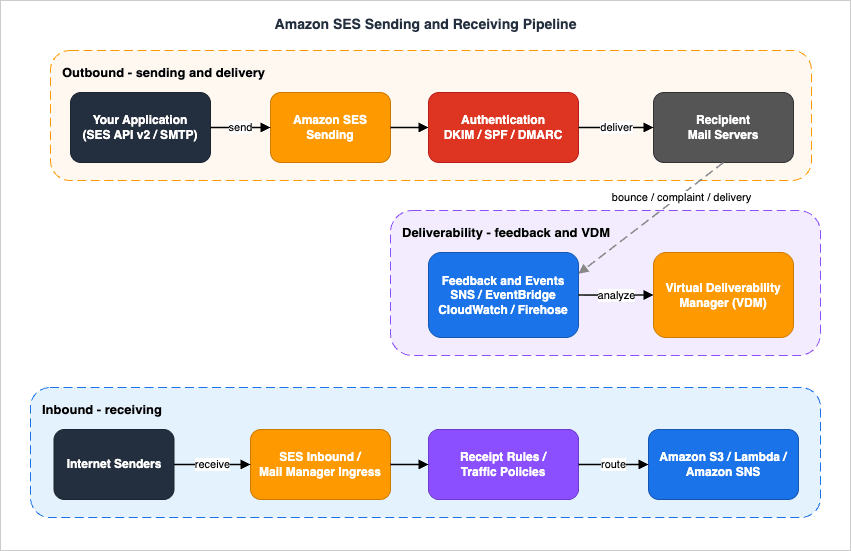
The figure below summarizes how these pieces fit together as a sending and receiving pipeline.
Current Overview, Functions, Features of Amazon SES
Amazon SES is a fully managed service for sending and receiving email at scale. You can send through the HTTPS API (v1 or the newer v2) or the SMTP interface, authenticate with DKIM/SPF/DMARC, observe outcomes through the bounce/complaint/delivery feedback loop and event publishing, optimize inbox placement with Virtual Deliverability Manager, and process inbound mail with email receiving and Mail Manager.Amazon SES Use Cases
- Transactional email - Sign-up and email verification, password resets, order confirmations, receipts, shipping notifications, and security alerts that must arrive reliably and quickly.
- Bulk and marketing email - Newsletters and campaigns sent to large recipient lists, with engagement tracking, dedicated IPs, and deliverability tooling.
- Application and system notifications - Alerts and reports generated by applications, monitoring systems, or scheduled jobs.
- Inbound email processing - Receiving email for a domain and routing it into automation, such as support-ticket creation, parsing replies, or storing messages for later processing.
- Multi-tenant and SaaS sending - Platforms that send on behalf of many customers, isolating each customer's reputation and suppression with SES Tenants.
- Complex mail routing and archiving - Using Mail Manager to apply rules, traffic policies, security add-ons, and archiving across inbound and outbound flows.
Specific Examples of Use Cases
- A web application calls the Amazon SES v2
SendEmailAPI to send a password-reset message, signed with Easy DKIM and tracked through a configuration set. - A SaaS product creates one Amazon SES tenant per customer so a single noisy customer cannot harm the deliverability of the others.
- An e-commerce platform sends order confirmations on a transactional dedicated IP pool and promotional mail on a separate marketing pool.
- An application configures email receiving so that messages to a support address are stored in Amazon S3 and an AWS Lambda function creates a ticket.
- A team enables Virtual Deliverability Manager to find and fix the configuration issues hurting inbox placement, and to watch inbox placement and blocklist status over time.
- A bulk sender implements RFC 8058 one-click unsubscribe and monitors complaint rates to satisfy the Gmail and Yahoo sender requirements.
Amazon SES Key Functions and Features
- Sending interfaces - An HTTPS API (the original API and the newer Amazon SES v2 API, API version 2019-09-27) and an authenticated SMTP endpoint, so both new code and existing SMTP-based software can send through Amazon SES.
- Email authentication (DKIM, SPF, DMARC) - Easy DKIM for automatic signing, BYODKIM for using your own RSA key pair, and custom MAIL FROM domains for SPF alignment, which together let you pass DMARC. Detailed setup is covered in the dedicated how-to linked below.
- Configuration sets and event publishing - Group sending and publish per-event data (sends, deliveries, opens, clicks, bounces, complaints, rejects) to Amazon CloudWatch, Amazon Kinesis Data Firehose, Amazon SNS, and Amazon EventBridge for analytics and automation.
- Feedback loop - Bounce, complaint, and delivery notifications via Amazon SNS, plus an account-level suppression list (and per-tenant suppression lists) so that sending to bad addresses does not harm reputation.
- Email receiving (inbound) - Receive mail for your domains, with receipt rules and IP address filters that store to Amazon S3, publish to Amazon SNS, invoke AWS Lambda, send to Amazon WorkMail, or bounce, with spam and virus scanning.
- Mail Manager - A more powerful inbound/outbound layer with customizable ingress endpoints, a rules engine, traffic policies, archiving, and security add-ons for complex email workloads.
- Virtual Deliverability Manager (VDM) - Deliverability insights and recommendations, per-message delivery and engagement history, and inbox placement and blocklist monitoring.
- Dedicated IPs - Standard (self-managed) dedicated IPs and pools, plus a managed dedicated IP option that automates warm-up and scaling, with IP observability through Amazon CloudWatch.
- Reliability and scale - Global Endpoints for multi-Region sending with automatic failover (using Deterministic Easy DKIM), larger message sizes (up to 40 MB), and availability across a growing list of AWS Regions.
- Multi-tenancy - SES Tenants for isolating the sending, metrics, reputation policies, and suppression of different customers or business units within one account.
- Security and access control - AWS IAM policies, sending authorization, encryption of stored inbound mail, and integration with the broader AWS security and observability stack.
Amazon SES Sandbox and Production Access
Every new Amazon SES account starts in the sandbox. In the sandbox you can send only to verified identities, with a low daily sending quota and a low maximum send rate, which lets you build and test an integration without any risk of harming deliverability or sending to real recipients by mistake.When you are ready to send to arbitrary recipients, you request production access. After approval, the daily quota and send rate increase, and Amazon SES then raises your limits automatically over time based on your sending volume and your bounce and complaint rates. This sandbox-to-production model has been part of Amazon SES since its 2011 launch, and it is the reason the service never had a distinct "general availability" milestone separate from its launch: the path to production was always a per-account workflow rather than a single dated event.
Amazon SES and Related AWS Services
Amazon SES is rarely used in isolation; it sits at the center of a small constellation of AWS services that supply DNS, storage, compute, notifications, and observability:- Amazon Route 53 (or any DNS provider) - Hosts the DKIM CNAME records, the SPF and custom MAIL FROM records, and the DMARC record that make your mail authenticate. The hands-on setup is covered in the dedicated how-to linked below.
- Amazon S3, AWS Lambda, and Amazon SNS - The typical targets of inbound receipt rule actions: store the raw message in Amazon S3, process it with AWS Lambda, or publish a notification to Amazon SNS.
- Amazon CloudWatch, Amazon Kinesis Data Firehose, and Amazon EventBridge - Event publishing destinations for sending events, used for metrics, streaming to a data store, and event-driven automation respectively.
- Amazon SNS - Also carries bounce, complaint, and delivery notifications back to your application, the original feedback mechanism before configuration-set event publishing.
- AWS IAM and AWS KMS - Govern who can send and manage Amazon SES, and encrypt inbound mail stored by receipt rules.
- Amazon WorkMail and Amazon Pinpoint - Amazon WorkMail can be a destination for received mail, and Amazon Pinpoint is a higher-level customer-engagement service that uses Amazon SES as its email-sending channel.
Best Practices for Amazon SES
The following practices help teams send reliably and protect their sender reputation:- Authenticate every message - Configure DKIM (Easy DKIM or BYODKIM), publish SPF through a custom MAIL FROM domain, and set a DMARC policy so mailbox providers can verify your mail.
- Verify domains, not just addresses - Verifying a domain lets you send from any address on it and is a prerequisite for domain-aligned authentication.
- Watch reputation continuously - Monitor bounce and complaint rates through the reputation dashboard and Virtual Deliverability Manager, and keep complaint rates well below the thresholds enforced by major mailbox providers.
- Segment sending with configuration sets - Use configuration sets and the account-level suppression list to separate streams, publish events, and stop sending to addresses that have bounced or complained.
- Separate streams with dedicated IPs when volume warrants - Use dedicated IP pools (standard or managed) to isolate transactional and marketing mail; managed dedicated IPs handle warm-up and scaling for you.
- Honor unsubscribes - Implement RFC 8058 one-click unsubscribe and process opt-outs promptly to meet the Gmail and Yahoo bulk-sender requirements; built-in list and subscription management can help.
- Isolate multi-tenant sending - For platforms that send on behalf of many customers, use SES Tenants and per-tenant suppression so one tenant cannot harm another's deliverability.
- Design for resilience - Use Global Endpoints for multi-Region failover of critical email, and instrument sending with CloudWatch, EventBridge, and VDM so problems are visible early.
Relationship to DKIM, SPF, and DMARC Setup
Email authentication is central to deliverability, but configuring DKIM, SPF, and DMARC records correctly (especially with Amazon Route 53 as the DNS provider) is a detailed, hands-on task that deserves its own walkthrough. Rather than duplicate it here, this timeline links to a dedicated how-to that explains the DMARC parameters and shows configuration examples, so you can move from "when did this feature arrive" to "how do I set it up" without losing the thread:Setting up DKIM, SPF, DMARC with Amazon SES and Amazon Route 53 - An Overview of DMARC Parameters and Configuration Examples
Frequently Asked Questions about Amazon SES History
When did Amazon SES launch, and was there a separate general availability (GA) date?Amazon SES was announced as a beta on January 25, 2011. There was no separate, dated "general availability" announcement; Amazon SES used the sandbox/production-access model from the start, the "(Beta)" label was dropped over time, and AWS now describes the service as available since 2011. This timeline therefore anchors on the January 25, 2011 launch.
When did Amazon SES add an SMTP interface and DKIM signing?
The SMTP interface was added on December 13, 2011. Easy DKIM signing launched on July 17, 2012, and the option to use your own RSA key pair (BYODKIM) was added on December 13, 2019.
When did Amazon SES add inbound email receiving?
Amazon SES launched email receiving (inbound) on September 28, 2015, allowing it to receive mail for your domains and route it to Amazon S3, Amazon SNS, AWS Lambda, and more through rule sets and IP address filters.
When did Virtual Deliverability Manager launch?
Virtual Deliverability Manager (VDM) launched on November 2, 2022, providing deliverability insights, recommendations, and automatic improvements. It has since added per-message delivery and engagement history (August 31, 2023) and inbox placement and blocklist monitoring (May 29, 2026).
When did Mail Manager launch?
Amazon SES Mail Manager launched on May 22, 2024, adding customizable ingress endpoints, a rules engine, traffic policies, archiving, and security add-ons for complex inbound and outbound email, going beyond the original SES Inbound shared endpoint.
How did Amazon SES address the 2024 Gmail and Yahoo sender authentication requirements?
Amazon SES already provided the building blocks senders needed - domain-aligned DKIM (Easy DKIM and BYODKIM), custom MAIL FROM domains for SPF alignment, DMARC support, and complaint monitoring through VDM and the reputation dashboard. To meet the requirements that Gmail and Yahoo began enforcing in February 2024, AWS published guidance on implementing RFC 8058 one-click unsubscribe with Amazon SES (February 6, 2024) and later added an adaptive onboarding setup wizard integrated with VDM (September 4, 2024).
How does Amazon SES relate to DKIM/SPF/DMARC setup?
Amazon SES provides the sending side of email authentication (signing and alignment), while the records that make authentication work live in DNS. The dedicated how-to on setting up DKIM, SPF, and DMARC with Amazon SES and Amazon Route 53 walks through the DMARC parameters and configuration examples that complement this history.
References:
Tech Blog with curated related content
AWS Documentation (Amazon Simple Email Service)
What's New with AWS?
AWS News Blog
Summary
In this article, I assembled a historical timeline for Amazon SES and summarized its current overview, functions, and features.From its launch as a beta on January 25, 2011 as a send-only service, Amazon SES has grown into a comprehensive, two-way email platform: an SMTP interface and an API (v1 and v2); email authentication with Easy DKIM, BYODKIM, custom MAIL FROM domains, SPF, and DMARC; Configuration Sets and event publishing with a full bounce/complaint/delivery feedback loop; email receiving and the more powerful Mail Manager for inbound; Virtual Deliverability Manager for deliverability; dedicated IPs (standard and managed); Global Endpoints for multi-Region resilience; and SES Tenants for multi-tenant isolation. Throughout, the constant has been making reliable, well-authenticated email something you configure rather than operate.
Because email authentication is where deliverability is won or lost, the natural companion to this history is the hands-on guide to configuring DKIM, SPF, and DMARC with Amazon SES and Amazon Route 53:
Setting up DKIM, SPF, DMARC with Amazon SES and Amazon Route 53 - An Overview of DMARC Parameters and Configuration Examples
In addition, there is also a timeline of the entire range of AWS services including Amazon SES, so please have a look if you are interested.
AWS History and Timeline - Almost All AWS Services List, Announcements, General Availability(GA)
Related timelines in this series:
AWS History and Timeline regarding Amazon Route 53
AWS History and Timeline regarding Amazon SNS
AWS History and Timeline regarding Amazon SQS
This timeline will be updated as Amazon SES continues to evolve.
Written by Hidekazu Konishi