AWS History and Timeline regarding Amazon SNS - Overview, Functions, Features, Summary of Updates, and Introduction to Amazon Simple Notification Service
First Published:
Last Updated:
Where Amazon SQS holds messages in a queue until a consumer polls for them, Amazon SNS pushes each message out to every interested subscriber the moment it is published. Together the two services form the classic "fan-out" pattern, and Amazon SNS has grown from a simple HTTP and email notifier in 2010 into a service that delivers to mobile devices, SMS recipients, AWS Lambda functions, Amazon SQS queues, Amazon Data Firehose streams, and arbitrary HTTP/S endpoints, with ordered FIFO topics, content-based message filtering, archiving and replay, and data protection.
Because Amazon SNS has accumulated a long list of capabilities over more than fifteen years, it is easy to lose track of when a given feature actually arrived: When did Amazon SNS gain mobile push? When did the Amazon SNS + Amazon SQS fan-out pattern become a first-class, console-driven experience? When did message filtering, FIFO topics, or message archiving and replay appear? This article answers those questions in one place.
This article organizes the history of Amazon SNS into a single chronological timeline, drawn from primary AWS sources, and then summarizes the current overview, functions, and features of the service. It is intended as a reference page you can return to whenever you need to confirm when a particular Amazon SNS capability became available. The focus is on major, service-level releases that define what Amazon SNS is today, not on every minor SDK revision or single-Region rollout.
Background and Method of Creating Amazon SNS Historical Timeline
The purpose of this timeline is twofold:- Tracking the history of Amazon SNS and organizing the transition of its updates over time.
- Summarizing the feature list and characteristics of Amazon SNS as they stand today.
The content posted is limited to major features related to the current Amazon SNS and necessary for the feature list and overview description.
Please note that the items on this timeline are not all updates to Amazon SNS features, but are representative updates that I have picked out. Pricing changes and single-Region expansions are intentionally omitted; AWS pricing changes frequently, so for current pricing always consult the official Amazon SNS pricing page.
Amazon SNS was first announced on April 7, 2010. The original announcement is preserved here: Announcing Amazon Simple Notification Service and Introducing the Amazon Simple Notification Service.
Amazon SNS Historical Timeline (Updates from April 7, 2010)
Now, here is a timeline related to the functions of Amazon SNS. As of the time of writing this article, the history of Amazon SNS spans about 16 years since its launch in April 2010.2010 | 2011 | 2012 | 2013 | 2014 | 2015 | 2016 | 2017 | 2018 | 2019 | 2020 | 2021 | 2022 | 2023 | 2024 | 2025 | 2026
* The table can be sorted by clicking on the column names.
| Date | Summary |
|---|---|
| 2010-04-07 | Amazon Simple Notification Service (Amazon SNS) is announced. Amazon SNS launches as a fully managed publish/subscribe service that pushes messages to subscribers over HTTP, HTTPS, and email, and can deliver to Amazon SQS queues via the API. Publishers create topics, subscribers register endpoints, and Amazon SNS handles delivery and retries without polling. References: Announcing Amazon Simple Notification Service |
| 2010-10-12 | The AWS Management Console adds support for Amazon SNS. Users can now create topics, manage subscriptions, publish messages, and edit topic access policies through a point-and-click interface, without writing API or CLI calls. References: AWS Management Console adds support for Amazon SNS |
| 2011-11-02 | Amazon SNS introduces SMS text message notifications. SMS joins HTTP, HTTPS, email, and Amazon SQS as a delivery protocol, allowing notifications to be sent directly to mobile phones. SMS delivery was initially available from the US East (N. Virginia) Region. References: Amazon SNS Introduces SMS Text Message Notifications |
| 2011-12-28 | Amazon SNS adds delivery policies and message formatting. Delivery policies provide configurable retry and backoff behavior (linear, geometric, and exponential) for HTTP/S endpoints at the topic and subscription level, while message formatting lets a single publish carry a different payload per protocol. References: Amazon SNS Adds Support for Delivery Policies and Message Formatting |
| 2012-11-21 | Subscribing an Amazon SQS queue to an SNS topic becomes a point-and-click experience, popularizing the Amazon SNS + Amazon SQS fan-out pattern. Although Amazon SNS could deliver to Amazon SQS via the API since launch, this update lets users subscribe a queue to a topic directly from the console, making it easy to fan a single publish out to multiple queues for parallel, durable processing. References: Queues and Notifications - Now Best Friends |
| 2013-06-18 | Amazon SNS and Amazon SQS raise the maximum payload to 256 KB and Amazon SNS adds raw message delivery. The message size limit grows from 64 KB to 256 KB, and a new raw message delivery option lets Amazon SNS deliver the message body to Amazon SQS and HTTP/S endpoints without the JSON envelope it normally wraps around the message. References: Amazon SQS and Amazon SNS Now Support 256 KB Large Payloads |
| 2013-08-13 | Amazon SNS launches Mobile Push notifications. Developers can send push notifications to Apple (APNS), Google/Android (GCM), and Amazon (ADM) devices through a single unified API, with each topic supporting large numbers of device endpoints. References: Amazon SNS Announces Mobile Push |
| 2014-06-12 | Amazon SNS Mobile Push expands to Baidu, Windows Phone (MPNS), and Windows (WNS), and introduces message attributes. Mobile push reaches Android in China via Baidu and Windows devices via MPNS/WNS, while new message attributes allow structured metadata (such as timestamps, identifiers, and geolocation) to travel alongside the message body. References: Amazon SNS Now Has Windows Support and China Android Support with Baidu |
| 2014-07-10 | Amazon SNS adds Time To Live (TTL) for mobile push messages. Publishers can set an expiration on push notifications so that messages undelivered within the specified window (up to two weeks) are discarded rather than delivered stale. References: Amazon SNS Adds Support for Cross-Platform Time To Live (TTL) |
| 2014-08-19 | Amazon SNS raises the per-topic subscription limit to support very large fan-out. The administrative limit on subscriptions per topic is increased dramatically, allowing a single topic to fan out to millions of endpoints without partitioning subscriber lists across multiple topics. References: Amazon SNS Update - Large Topics and MPNS Authenticated Mode |
| 2014-10-09 | Amazon SNS integrates with AWS CloudTrail. All Amazon SNS API calls are now recorded by AWS CloudTrail and delivered to an Amazon S3 bucket, capturing the request, source IP, identity, and timestamp for audit, governance, and compliance. References: Amazon SNS is now integrated with AWS CloudTrail |
| 2015-02-05 | Amazon SNS adds delivery status logging to Amazon CloudWatch Logs. Amazon SNS can record per-message delivery results (success/failure, endpoint response, and dwell time) to CloudWatch Logs, beginning with mobile push endpoints and later extended to other protocols. References: Amazon SNS Adds Delivery Status Feature |
| 2015-04-09 | Amazon SNS integrates with AWS Lambda. A Lambda function can be registered as a subscription endpoint so that publishing to a topic invokes the function directly, with no infrastructure to manage; this also lets services that already publish to Amazon SNS (such as CloudWatch Alarms) trigger serverless code. References: Amazon SNS now integrates with AWS Lambda |
| 2016-06-28 | Amazon SNS launches worldwide SMS. SMS delivery expands to phone numbers in more than 200 countries, providing a single managed service for both transactional and promotional text messaging. References: Amazon SNS Adds Worldwide SMS |
| 2017-03-06 | Amazon SNS offers dedicated short codes for US SMS. Customers can obtain an exclusive 5- or 6-digit short code for high-volume application-to-person messaging, helping them establish identity and manage sender reputation independently. References: Amazon SNS now offers dedicated short codes |
| 2017-11-22 | Amazon SNS introduces message filtering with subscription filter policies. Each subscription can carry a JSON filter policy that matches on message attributes, so subscribers receive only the messages they care about and routing logic moves out of application code into Amazon SNS. References: Amazon Simple Notification Service (SNS) introduces message filtering |
| 2018-03-12 | Amazon SNS expands message filtering with numeric, prefix, and anything-but operators. Building on the 2017 launch of attribute-based filter policies, new operators add numeric exact-value and range matching, string prefix matching, and anything-but (blacklist) matching, making subscription filter policies far more expressive without custom code. References: Amazon SNS introduces new message filtering operators |
| 2018-04-10 | Amazon SNS adds VPC endpoint support through AWS PrivateLink. Applications can publish to Amazon SNS topics from within an Amazon VPC over a private interface endpoint, keeping traffic on the AWS network without an internet gateway, NAT device, or VPN. References: Securing messages published to Amazon SNS with AWS PrivateLink |
| 2018-11-15 | Amazon SNS introduces server-side encryption (SSE) with AWS KMS. Messages can be encrypted at rest using AWS KMS keys, with both AWS-managed and customer-managed keys supported, helping meet regulatory and compliance requirements. References: Amazon SNS adds server-side encryption support |
| 2019-02-05 | Amazon SNS message filtering adds blacklisting of multiple string values. The anything-but operator can accept a list of string values, making it simpler to exclude a set of attribute values without writing multiple conditions. References: Amazon SNS message filtering adds support for multiple string values in blacklist matching |
| 2019-04-04 | Amazon SNS adds VPC endpoint policy support. A JSON endpoint policy can be attached to an Amazon SNS VPC endpoint to control which IAM principals, Amazon SNS actions, and topic ARNs are permitted through the private endpoint. References: Amazon SNS now supports VPC endpoint policies |
| 2019-07-24 | Amazon SNS adds support for AWS X-Ray. Distributed traces now propagate through Amazon SNS topics to downstream subscribers such as Amazon SQS queues and AWS Lambda functions, giving end-to-end visibility into asynchronous, event-driven request flows. References: Amazon SNS adds support for AWS X-Ray |
| 2019-08-08 | Amazon SNS message filtering adds attribute key matching. The exists operator lets a filter policy match any message that carries a specified attribute key, regardless of its value, further offloading routing decisions to Amazon SNS. References: Amazon SNS message filtering adds support for attribute key matching |
| 2019-11-15 | Amazon SNS adds dead-letter queue (DLQ) support for subscriptions. An Amazon SQS queue can be designated as a subscription's DLQ so that messages which fail delivery after all retries are captured for inspection and reprocessing instead of being dropped. References: Amazon SNS adds support for dead-letter queues (DLQ) |
| 2020-10-22 | Amazon SNS introduces FIFO topics with strict ordering and deduplication. FIFO topics preserve message order within a message group and deduplicate messages (by content hash or explicit deduplication ID) within a 5-minute window, delivering to subscribed Amazon SQS FIFO queues for ordered, exactly-once processing. References: Amazon SNS introduces FIFO topics with strict ordering and deduplication of messages |
| 2021-01-12 | Amazon SNS adds subscriptions to Amazon Kinesis Data Firehose (now Amazon Data Firehose). Standard topics can fan out directly to Firehose delivery streams, routing messages to destinations such as Amazon S3, Amazon Redshift, and OpenSearch (and partner providers) without custom consumer code. References: Amazon SNS adds support for message archiving and analytics via Kinesis Data Firehose subscriptions |
| 2021-04-26 | Amazon SNS grows the set of message filtering operators. New operators include matching when an attribute key does not exist, anything-but prefix matching, and CIDR-based IP address matching, expanding the expressiveness of filter policies. References: Amazon SNS grows the set of message filtering operators |
| 2021-11-09 | Amazon SNS supports token-based authentication for APNs mobile push. Developers can authenticate to Apple Push Notification service using a .p8 signing key instead of a .p12 certificate, removing the need for annual certificate renewal. References: Amazon SNS now supports token-based authentication for mobile push notifications |
| 2021-11-18 | Amazon SNS introduces the PublishBatch API for sending messages in batches. A single PublishBatch request can carry up to ten messages to a Standard or FIFO topic, reducing the number of API calls and lowering publishing costs for high-volume producers. References: Amazon SNS now supports publishing batches of messages within a single API request |
| 2022-09-08 | Amazon SNS announces message data protection in public preview. Data protection policies can scan messages in motion on Standard topics for sensitive data such as PII and PHI, using pattern matching and machine learning, with audit and block actions. References: Amazon SNS announces preview of message data protection to identify sensitive data in motion |
| 2022-11-03 | Amazon SNS message data protection becomes generally available with real-time redaction and masking. In addition to audit and block, topic owners can de-identify sensitive data in real time by redacting or masking it, supporting compliance with regulations such as HIPAA, GDPR, and PCI DSS. References: Amazon SNS message data protection is now available with real-time data redaction and masking |
| 2022-11-22 | Amazon SNS launches payload-based message filtering. Filter policies can be scoped to the message body, not just message attributes, which is essential for filtering the JSON events that dozens of AWS services publish to Amazon SNS without custom attributes. References: Amazon SNS announces payload-based message filtering |
| 2023-09-14 | Amazon SNS FIFO topics can deliver to Amazon SQS Standard queues. A FIFO topic can now fan out to a mix of Amazon SQS FIFO and Amazon SQS Standard queues, decoupling the topic type from the subscriber queue type for more flexible architectures. References: Amazon SNS FIFO topics now support message delivery to Amazon SQS Standard queues |
| 2023-10-27 | Amazon SNS adds in-place message archiving and replay for FIFO topics. Topic owners set an archive policy retaining messages for up to 365 days, and subscribers apply a replay policy with start and end timestamps to redeliver archived messages, with no extra infrastructure. References: Amazon SNS now supports in-place message archiving and replay for FIFO topics |
| 2023-11-09 | Amazon SNS increases the default FIFO topic throughput tenfold. The default per-topic throughput for FIFO topics rises to 3,000 messages per second, applied automatically with no configuration changes, while individual message groups remain capped at 300 messages per second. References: Amazon SNS increases default throughput for FIFO topics by 10x to 3,000 messages per second |
| 2023-11-16 | Amazon SNS adds suffix, case-insensitive, and cross-key OR operators to message filtering. Filter policies gain suffix matching, an equals-ignore-case operator, and OR logic across separate attribute keys, making routing rules more expressive. References: Amazon SNS announces additional message filtering operators |
| 2024-01-18 | Amazon SNS adds support for the Firebase Cloud Messaging (FCM) HTTP v1 API for mobile push. Android mobile push platform applications can register FCM HTTP v1 credentials using token-based authentication with a Google service account key, letting customers migrate off Google's legacy FCM (server key) API ahead of its June 2024 retirement. References: Amazon SNS now supports FCM HTTP v1 API for delivering mobile push notifications |
| 2024-09-25 | Amazon SNS delivers SMS text messages through AWS End User Messaging. Amazon SNS routes SMS via AWS End User Messaging, unlocking capabilities such as two-way messaging, phone pools with failover, MMS, an SMS simulator, and centralized configuration, with no code changes required for existing SMS customers. References: Amazon SNS now delivers SMS text messages via AWS End User Messaging |
| 2025-01-21 | Amazon SNS launches high-throughput mode for FIFO topics. Setting the throughput scope to the message group level shifts deduplication to per-group and unlocks much higher parallelism, raising achievable per-topic throughput to tens of thousands of messages per second (up to 30,000 messages per second in some Regions). References: High throughput mode for Amazon SNS FIFO topics is now available |
| 2025-04-03 | Amazon SNS adds IPv6 support for API requests. Customers can call the Amazon SNS APIs over IPv6, IPv4, or dual-stack endpoints, supporting a gradual transition to IPv6 across AWS commercial Regions. References: Amazon SNS now supports Internet Protocol Version 6 (IPv6) |
| 2025-07-17 | Amazon SNS extends cross-Region message delivery to opt-in Regions. New delivery paths allow Amazon SNS to deliver to Amazon SQS and AWS Lambda subscribers across opt-in Regions, enabling more flexible multi-Region, event-driven architectures. References: Amazon SNS announces additional cross-Region delivery capabilities |
| 2025-07-18 | Amazon SNS extends IPv6 support to VPC endpoints through AWS PrivateLink. Building on the April 2025 public-endpoint IPv6 launch, applications can reach Amazon SNS over dual-stack (IPv4/IPv6) interface VPC endpoints across commercial Regions, enabling private, IPv6-ready connectivity. References: Amazon SNS now supports IPv6 for VPC endpoints |
| 2025-07-31 | Amazon SNS adds wildcard operators to message filtering. Filter policies gain wildcard matching, anything-but wildcard, and anything-but prefix-wildcard operators for more pattern-oriented routing without custom code. References: Amazon SNS announces new message filtering operators |
| 2025-07-31 | Amazon SNS Standard topics forward message group IDs to subscribed Amazon SQS Standard queues. Propagating the message group ID activates Amazon SQS fair queuing, preventing noisy-neighbor contention between high-volume tenants in multi-tenant workloads. References: Amazon SNS now supports fair queues for Amazon SQS Standard subscriptions |
| 2026-04-30 | Amazon SNS message data protection is no longer available to new customers (availability change). AWS has communicated that message data protection will not be offered to new customers from this date; existing customers with configured policies may continue to use it, and AWS recommends an AWS Lambda plus Amazon Bedrock Guardrails alternative for new sensitive-data workflows. References: Amazon SNS message data protection availability change |
Current Overview, Functions, Features of Amazon SNS
Amazon SNS is a fully managed, highly available publish/subscribe messaging service.Publishers send messages to a logical access point called a topic, and Amazon SNS pushes each message to all of the topic's subscriptions in parallel. Because publishers and subscribers are decoupled, the same event can drive many independent consumers, and consumers can be added or removed without changing the publisher.
Use Cases for Amazon SNS
Amazon SNS is used across a wide range of event-driven and notification scenarios, including:- Application-to-application (A2A) messaging
Fan a single event out to multiple backend systems such as Amazon SQS queues, AWS Lambda functions, and HTTP/S endpoints. - Application-to-person (A2P) notifications
Send SMS text messages, mobile push notifications, and emails directly to people. - Event-driven and serverless architectures
Trigger serverless workflows in response to events from other AWS services or from your own applications. - Fan-out processing
Deliver one message to many Amazon SQS queues so that different teams or microservices process the same event independently and durably. - System alerts and operational notifications
Deliver Amazon CloudWatch alarm notifications, deployment events, and operational alerts to on-call engineers and dashboards. - Data distribution and analytics ingestion
Forward events to Amazon Data Firehose for delivery into data lakes and analytics stores. - Mobile engagement
Push notifications to iOS, Android, and other mobile platforms for user engagement.
Specific Examples of Use Cases
- An e-commerce order event is published to a topic and fanned out to an Amazon SQS queue for fulfillment, an AWS Lambda function for fraud screening, and an Amazon Data Firehose stream for analytics.
- An Amazon CloudWatch alarm publishes to an Amazon SNS topic that sends an SMS to the on-call engineer and an email to a distribution list.
- A microservice publishes domain events to a FIFO topic so that downstream Amazon SQS FIFO queues process them in strict order without duplicates.
- A mobile app backend sends targeted push notifications to large numbers of devices through a single Amazon SNS topic.
- A multi-account organization centralizes security findings by publishing them to a topic that delivers to a logging account's Amazon SQS queue.
Amazon SNS Key Functions and Features
- Publish/subscribe (pub/sub) model - Publishers send messages to topics; Amazon SNS pushes them to all subscribers, decoupling producers from consumers.
- Topics - The logical access point and communication channel; Amazon SNS offers Standard topics and FIFO topics.
- Subscriptions and supported endpoint types - A topic can deliver to Amazon SQS, AWS Lambda, Amazon Data Firehose, HTTP/S endpoints, email and email-JSON, SMS, and mobile push (APNS, FCM, ADM, and others).
- Standard topics - Maximize throughput and offer best-effort ordering and at-least-once delivery; ideal for high-volume A2A and A2P fan-out.
- FIFO topics - Provide strict ordering within a message group and deduplication for exactly-once processing, delivering to Amazon SQS FIFO (and now Amazon SQS Standard) queues.
- Message filtering - Subscription filter policies let each subscriber receive only matching messages, evaluated against message attributes or the message body (payload-based filtering), with a rich and growing operator set (prefix, suffix, CIDR, exists, anything-but, case-insensitive, OR logic, and wildcards).
- Message attributes - Structured metadata sent alongside the message body, used for filtering and for protocol-specific delivery options.
- Message archiving and replay - FIFO topics can retain messages in place for up to 365 days and redeliver them to subscribers based on a replay policy.
- Message data protection - Data protection policies can audit, block, redact, or mask sensitive data in messages in motion (subject to the availability change noted in the timeline).
- Dead-letter queues (DLQ) - Undeliverable messages can be captured in an Amazon SQS queue after retries are exhausted.
- Security and encryption - Server-side encryption with AWS KMS, IAM and topic access policies, and AWS PrivateLink (VPC endpoints) for private connectivity.
- Durability and availability - Messages are stored redundantly across multiple Availability Zones, and Amazon SNS automatically retries delivery according to delivery policies.
- Cross-Region delivery - Amazon SNS can deliver to Amazon SQS and AWS Lambda subscribers in other Regions, including opt-in Regions.
- Monitoring and auditing - Delivery status logging to Amazon CloudWatch Logs, CloudWatch metrics, and full API auditing through AWS CloudTrail.
How Amazon SNS Publish/Subscribe Messaging Works
At the heart of Amazon SNS is the topic, a logical access point identified by an Amazon Resource Name (ARN).A publisher calls the
Publish API (or PublishBatch for up to ten messages in a single call) against a topic ARN; it does not need to know who, or how many, subscribers exist. Amazon SNS immediately pushes a copy of the message to every subscription attached to that topic, in parallel, and manages the delivery lifecycle - including retries - on each subscriber's behalf.A subscription binds a topic to a single endpoint of a given protocol. For endpoints that require confirmation (such as HTTP/S and email), Amazon SNS first sends a confirmation request, and the subscription only becomes active once the owner confirms it; this prevents a topic owner from spamming an endpoint that has not opted in. Because the publisher and the subscribers are fully decoupled, you can add a new consumer to an existing event stream simply by creating a new subscription, with no change to the publishing application. This decoupling - one publish, many independent deliveries - is what makes Amazon SNS the backbone of fan-out and event-driven designs on AWS.
Amazon SNS Topic Types: Standard and FIFO
Amazon SNS offers two topic types that trade off throughput against ordering and deduplication guarantees.Standard Topics
Standard topics are the original Amazon SNS topic type and are optimized for maximum throughput and the broadest set of delivery protocols.- Throughput - Standard topics support a very high, effectively unlimited number of messages per second.
- Ordering - Delivery is best-effort ordering; messages may occasionally arrive in a different order than they were published.
- Delivery - At-least-once delivery, meaning a message could occasionally be delivered more than once, so subscribers should be designed to be idempotent.
- Endpoints - Standard topics support all endpoint types, including the application-to-person (A2P) protocols (SMS, mobile push, email) that FIFO topics do not.
FIFO Topics
FIFO (first-in, first-out) topics, introduced in 2020, are designed for application-to-application messaging where the order of events and the avoidance of duplicates matter.- Strict ordering - Messages are delivered in the exact order they are published within a message group (identified by a message group ID); different message groups are processed independently and in parallel.
- Deduplication - Within a 5-minute deduplication window, Amazon SNS discards duplicates identified either by a content-based hash (SHA-256 of the message body) or by an explicit message deduplication ID, enabling exactly-once processing.
- Subscribers - FIFO topics originally delivered only to Amazon SQS FIFO queues; since 2023 they can also deliver to Amazon SQS Standard queues, letting a single ordered topic fan out to a mix of queue types.
- Throughput - The default throughput per FIFO topic was raised tenfold in 2023, with individual message groups still bounded; high-throughput mode (2025) moves the deduplication scope to the message-group level to unlock far higher parallelism for accounts that need it.
Choosing Between Standard and FIFO Topics
Choose FIFO topics when strict ordering and exactly-once, deduplicated processing are required and all subscribers are A2A queues. Choose Standard topics when you need maximum throughput, the widest range of delivery protocols, or any A2P delivery such as SMS and mobile push.Subscriptions and Endpoint Types
Amazon SNS endpoints fall into two broad families: application-to-application (A2A) and application-to-person (A2P).Application-to-Application (A2A) Endpoints
- Amazon SQS - The most common A2A subscriber; a queue durably buffers messages for asynchronous, decoupled consumption and is the basis of the fan-out pattern.
- AWS Lambda - A function is invoked directly on each publish for serverless processing, with no consumer infrastructure to run.
- Amazon Data Firehose - Messages are streamed into destinations such as Amazon S3, Amazon Redshift, and OpenSearch (and partner targets) for analytics and archival.
- HTTP/S endpoints - Webhooks and custom services receive messages over HTTP or HTTPS, governed by delivery retry policies.
Application-to-Person (A2P) Endpoints
- SMS - Text messages to phone numbers in more than 200 countries; since 2024 Amazon SNS routes SMS through AWS End User Messaging, which adds two-way messaging, phone pools, and MMS.
- Mobile push - Push notifications to mobile platforms including Apple (APNS), Google/Firebase Cloud Messaging (FCM, including the FCM HTTP v1 API), and Amazon (ADM), with token-based authentication available for APNS and FCM.
- Email and email-JSON - Human-readable email or machine-parseable JSON email for notifications and integrations.
Message Filtering in Amazon SNS
Without filtering, every subscriber to a topic receives every message and must discard the ones it does not need. Amazon SNS message filtering moves that logic into the service: each subscription can carry a JSON filter policy, and Amazon SNS only delivers messages that match.A filter policy's scope determines what it is evaluated against:
- Message attributes - The original filtering scope (2017), matching against the structured metadata attached to a message.
- Message body (payload-based filtering) - Introduced in 2022, this matches against the JSON message body itself, which is essential for events from the many AWS services that publish to Amazon SNS without custom attributes.
- Exact string and numeric value matching, and numeric range matching.
- Prefix and suffix matching, and case-insensitive (equals-ignore-case) matching.
- Key existence checks (
exists: true/exists: false). - Negation with
anything-but, includinganything-butprefix and a list of values. - IP address matching against a CIDR range.
- OR logic across separate attribute keys, and wildcard /
anything-butwildcard matching.
Message Durability, Delivery Retries, and Dead-letter Queues
Amazon SNS stores published messages redundantly across multiple Availability Zones before attempting delivery, so a single facility failure does not lose in-flight messages.Delivery to each subscription is governed by a delivery policy that controls retry behavior - including the number of retries and the backoff function (linear, geometric, or exponential) - which is especially relevant for HTTP/S endpoints that may be temporarily unavailable.
When a message still cannot be delivered after all retries are exhausted, a subscription's dead-letter queue (DLQ) - an Amazon SQS queue - captures it instead of dropping it silently. Operators can inspect the DLQ, alarm on its depth with Amazon CloudWatch, and reprocess the messages once the underlying issue is resolved.
Message Archiving and Replay
For FIFO topics, Amazon SNS can retain messages in place and redeliver them later, without any additional infrastructure.A topic owner sets an archive policy defining a retention period of up to 365 days. A subscriber then applies a replay policy that specifies a start and end timestamp, and Amazon SNS redelivers the archived messages within that window to the subscriber's endpoint. Replayed messages preserve their original message ID and timestamp and are flagged as replayed, and existing filter policies continue to apply, so a new or recovering consumer can rebuild its state from history.
Security and Compliance in Amazon SNS
Encryption
Messages are encrypted in transit using TLS, and server-side encryption (SSE) with AWS KMS encrypts message data at rest. Both AWS-managed and customer-managed KMS keys are supported, giving teams control over key rotation and access auditing.Access Control
Access to Amazon SNS is governed by AWS IAM identity policies and by topic (resource) policies that specify which principals may publish or subscribe and under what conditions. VPC endpoint policies add a further layer of control over what may pass through a private endpoint.Private Connectivity
With AWS PrivateLink, applications publish to Amazon SNS through an interface VPC endpoint, keeping traffic on the AWS network without an internet gateway, NAT device, or VPN - important for regulated and isolated workloads. Amazon SNS API access is available over IPv4, IPv6, and dual-stack endpoints, including dual-stack interface VPC endpoints, supporting a gradual transition to IPv6.Message Data Protection
Data protection policies can scan messages in motion for sensitive data such as PII and PHI and then audit, block, redact, or mask it in real time. As noted in the timeline, AWS has communicated an availability change for this feature for new customers; for new sensitive-data workflows AWS points to an AWS Lambda plus Amazon Bedrock Guardrails approach.Monitoring and Observability
Amazon SNS publishes operational metrics to Amazon CloudWatch (such as numbers of messages published, delivered, and failed), and delivery status logging can record per-message delivery outcomes to Amazon CloudWatch Logs for supported protocols. Every Amazon SNS API call is recorded by AWS CloudTrail, providing an audit trail of who created topics, changed policies, or published messages. Amazon SNS also integrates with AWS X-Ray, so distributed traces propagate through topics to downstream subscribers such as Amazon SQS queues and AWS Lambda functions, giving end-to-end visibility into asynchronous, event-driven request flows. Together these give operators the metrics, logs, traces, and audit history needed to run pub/sub messaging in production.The Amazon SNS + Amazon SQS Fan-out Pattern
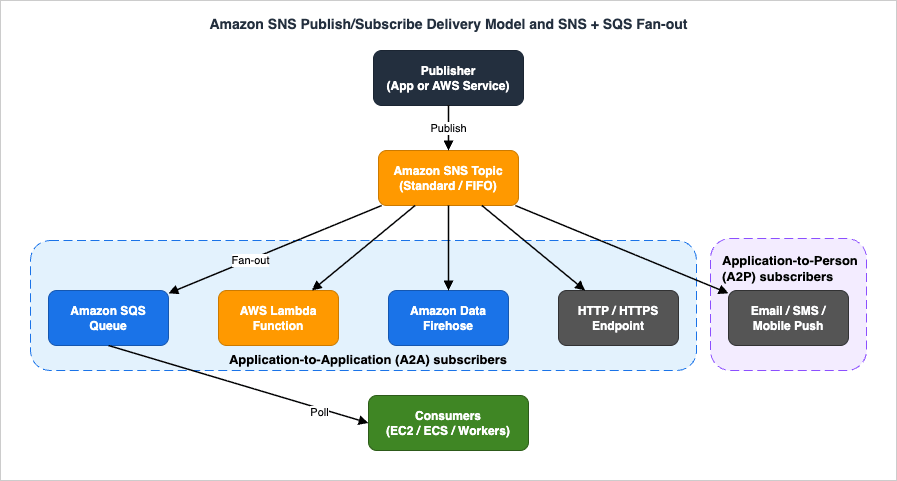
The single most common Amazon SNS architecture is the fan-out pattern, in which a topic delivers each published message to multiple Amazon SQS queues subscribed to it.A publisher sends one message to the topic; Amazon SNS pushes a copy into every subscribed queue; and each queue is drained independently by its own consumers. This combines the strengths of both services: Amazon SNS provides push-based, one-to-many distribution, while each Amazon SQS queue provides durable buffering, independent scaling, retries, and a dead-letter queue for its own consumer. New consumers can be onboarded by adding a queue and a subscription, without touching the publisher. The figure above illustrates this: the publisher sends to the topic, which fans out to Amazon SQS, AWS Lambda, Amazon Data Firehose, HTTP/S, and A2P endpoints, with the queue feeding its own pool of workers.
Amazon SNS, Amazon SQS, and Amazon EventBridge
Amazon SNS is one of three core AWS messaging and event services, and they are frequently combined rather than used in isolation. The table below summarizes how they differ:| Service | Model | Typical role |
|---|---|---|
| Amazon SNS | Push-based publish/subscribe (one-to-many) | High-throughput fan-out to many subscribers, plus A2P (SMS, mobile push, email) |
| Amazon SQS | Pull-based message queue (point-to-point) | Durable buffering and decoupled, independently scaled consumption |
| Amazon EventBridge | Event bus with content-based routing | Routing, schema registry, and SaaS/AWS integrations for event-driven apps |
A common, robust design uses Amazon SNS to fan out an event to several Amazon SQS queues, with Amazon EventBridge handling richer routing and third-party integrations where needed:
- Amazon SQS - A queue where consumers poll for messages; combined with Amazon SNS in the fan-out pattern, one publish is delivered to multiple queues. See the AWS History and Timeline regarding Amazon SQS.
- Amazon EventBridge - An event bus with content-based routing, a schema registry, and many SaaS and AWS integrations; Amazon SNS is the high-throughput, low-latency pub/sub fan-out layer, and the two are often used together. See the AWS History and Timeline regarding Amazon EventBridge.
- AWS Lambda - A frequent Amazon SNS subscriber, letting a publish trigger serverless processing directly. See the AWS History and Timeline regarding AWS Lambda.
Best Practices for Amazon SNS
The following practices help teams use Amazon SNS reliably and securely in production:- Make subscribers idempotent - Because Standard topics provide at-least-once delivery, a subscriber may occasionally receive the same message more than once; design processing to tolerate duplicates (for example, by keying on a message ID).
- Filter at the source - Use subscription filter policies (attribute-based or payload-based) so each subscriber receives only the messages it needs, reducing downstream processing and noise instead of filtering in application code.
- Always configure dead-letter queues - Attach a DLQ to important subscriptions and alarm on its depth in Amazon CloudWatch, so messages that fail delivery after retries are captured for inspection and reprocessing rather than lost.
- Use the fan-out pattern for durable consumers - Subscribe Amazon SQS queues to a topic so that each consumer drains its own durable queue independently, with its own scaling, retries, and DLQ.
- Use FIFO topics only when ordering or deduplication is required - Choose meaningful message group IDs to maximize parallelism, and supply a content-based or explicit deduplication ID; reserve Standard topics for maximum throughput and A2P delivery.
- Encrypt and restrict access - Enable server-side encryption with AWS KMS for sensitive data, apply least-privilege topic (resource) policies and IAM policies, and use AWS PrivateLink for private connectivity from a VPC.
- Instrument delivery - Enable delivery status logging to Amazon CloudWatch Logs and monitor CloudWatch metrics so delivery failures and latency are visible, and rely on AWS CloudTrail for an audit trail of configuration changes.
- Tune delivery policies for HTTP/S endpoints - Configure retry counts and backoff to match how your endpoints behave under load, and enable raw message delivery where subscribers expect the unwrapped payload.
Frequently Asked Questions about Amazon SNS History
When did Amazon SNS launch?Amazon SNS was announced on April 7, 2010, as a fully managed publish/subscribe service delivering over HTTP, HTTPS, and email, with Amazon SQS delivery available via the API. Support in the AWS Management Console followed on October 12, 2010.
When did Amazon SNS add mobile push and SMS?
SMS text message notifications were introduced on November 2, 2011, and expanded to worldwide SMS in more than 200 countries on June 28, 2016. Mobile Push notifications for Apple, Google/Android, and Amazon devices launched on August 13, 2013, with Baidu and Windows platforms added on June 12, 2014.
When did Amazon SNS add AWS Lambda subscriptions?
Amazon SNS integrated with AWS Lambda on April 9, 2015, allowing a publish to a topic to invoke a Lambda function directly.
When did the Amazon SNS + Amazon SQS fan-out pattern become available?
Amazon SNS could deliver to Amazon SQS via the API from its 2010 launch, but subscribing an Amazon SQS queue to a topic became a point-and-click console experience on November 21, 2012, which popularized the fan-out pattern.
When did Amazon SNS add message filtering?
Attribute-based message filtering with subscription filter policies launched on November 22, 2017, and payload-based (message body) filtering followed on November 22, 2022, with the operator set expanding steadily through 2025.
When did Amazon SNS introduce FIFO topics?
Amazon SNS FIFO topics, with strict ordering and deduplication, launched on October 22, 2020. High-throughput mode for FIFO topics became available on January 21, 2025.
When did Amazon SNS add message archiving and replay?
In-place message archiving and replay for FIFO topics launched on October 27, 2023, retaining messages for up to 365 days and redelivering them based on a replay policy.
References:
Tech Blog with curated related content
AWS Documentation (Amazon Simple Notification Service)
What's New with AWS?
AWS News Blog
Summary
In this article, I assembled a historical timeline for Amazon SNS and summarized its current overview, functions, and features.From its launch on April 7, 2010 as a simple HTTP, email, and Amazon SQS notifier, Amazon SNS has steadily grown into a comprehensive publish/subscribe messaging service: mobile push and worldwide SMS for application-to-person messaging; AWS Lambda, Amazon SQS, Amazon Data Firehose, and HTTP/S subscriptions for application-to-application fan-out; and message filtering, FIFO topics, archiving and replay, data protection, and encryption for correctness, governance, and security.
Throughout its history, the natural pairing of Amazon SNS and Amazon SQS - Amazon SNS for push-based fan-out and Amazon SQS for durable, decoupled consumption - has remained one of the most important building blocks of event-driven architecture on AWS, now complemented by services such as Amazon EventBridge and AWS Lambda.
In addition, there is also a timeline of the entire range of AWS services including Amazon SNS, so please have a look if you are interested.
AWS History and Timeline - Almost All AWS Services List, Announcements, General Availability(GA)
Related timelines in this series:
AWS History and Timeline regarding Amazon SQS
AWS History and Timeline regarding Amazon EventBridge
AWS History and Timeline regarding AWS Lambda
This timeline will be updated as Amazon SNS continues to evolve.
Written by Hidekazu Konishi