AWS History and Timeline regarding Amazon ElastiCache - Overview, Functions, Features, Summary of Updates, and Introduction
First Published:
Last Updated:
This time, I have created a historical timeline for Amazon ElastiCache, the fully managed, in-memory caching service that AWS announced in August 2011. ElastiCache started life as a Memcached-compatible service, added support for the Redis engine in 2013, and has since evolved through cluster mode, cross-Region replication, data tiering, and a fully serverless deployment option.
More than any other AWS data service, ElastiCache also tells a clear open-source "fork" story: when Redis changed its licensing in 2024, the community forked the last BSD-licensed release into Valkey under the Linux Foundation, and ElastiCache added Valkey as an engine alongside the renamed "Redis OSS" and Memcached. This makes ElastiCache a useful case study in how a managed service tracks the engines it depends on.
Just like before, I am summarizing the main features while following the birth of Amazon ElastiCache and tracking its feature additions and updates as a Current Overview, Functions, Features of Amazon ElastiCache.
I hope these will provide clues as to what has remained the same and what has changed in Amazon ElastiCache and the caching engines it supports.
Background and Method of Creating Amazon ElastiCache Historical Timeline
The reason for creating a historical timeline of Amazon ElastiCache this time is that ElastiCache has now been generally available for well over a decade, has grown from a single Memcached-compatible cache into a service that supports three engines (Valkey, Memcached, and Redis OSS), and sits in front of a large share of the databases and applications running on AWS.Another reason is that since the announcement of Amazon ElastiCache in August 2011, AWS has continuously expanded the service with new engines, replication topologies, security controls, and deployment models. Therefore, I wanted to organize the information of Amazon ElastiCache with the following approaches.
- Tracking the history of Amazon ElastiCache and organizing the transition of updates
- Summarizing the feature list and characteristics of Amazon ElastiCache
Because part of the ElastiCache story involves open-source engines that are stewarded outside AWS, the engine-lineage details in this article are cross-checked against primary sources from Redis and the Valkey project (stewarded by the Linux Foundation). The licensing and fork description is limited to publicly documented facts, without commentary on the parties involved.
Engine names are written to be period-correct: the Redis-compatible engine is called "Redis" for events before the 2024 rename and "Redis OSS" afterward, and "Valkey" is used from its 2024 introduction onward.
There may be slight variations in the dates on the timeline due to differences in the timing of announcements or article postings in the references used.
The content posted is limited to major features related to the current Amazon ElastiCache and necessary for the feature list and overview description.
In other words, please note that the items on this timeline are not all updates to Amazon ElastiCache features, but are representative updates that I have picked out.
Amazon ElastiCache Historical Timeline (Updates from August 22, 2011)
Now, here is a timeline related to the functions of Amazon ElastiCache. As of the time of writing this article, the history of Amazon ElastiCache spans more than 14 years since its announcement in August 2011.2011 | 2012 | 2013 | 2014 | 2016 | 2017 | 2018 | 2019 | 2020 | 2021 | 2022 | 2023 | 2024 | 2025 | 2026
* The table can be sorted by clicking on the column names.| Date | Summary |
|---|---|
| 2011-08-22 | AWS announces Amazon ElastiCache. It launches as a Memcached protocol-compliant, in-memory cache web service, initially as a public beta in the US East (N. Virginia) Region, so that existing Memcached code, applications, and tools work with the managed service. |
| 2012-04-05 | Amazon ElastiCache introduces reserved cache nodes. Customers can reserve cache nodes for a one- or three-year term at a discount compared to On-Demand pricing. |
| 2012-12-20 | Amazon ElastiCache adds support for launching clusters in Amazon VPC. Clusters can be created inside an Amazon Virtual Private Cloud for private network isolation and control over IP addressing. |
| 2013-09-04 | Amazon ElastiCache adds the Redis engine. Redis becomes the second supported engine alongside Memcached, and the ElastiCache API adds replication groups so that a primary node can have one or more read replicas that stay synchronized for read scaling and failover. |
| 2014-04-24 | Backup and restore for Redis clusters becomes available. Customers can create snapshots of an ElastiCache for Redis cluster, store them in Amazon S3, and restore the data into a new cluster. |
| 2014-10-24 | AWS announces Multi-AZ with automatic failover for Redis. ElastiCache monitors the health of a Redis replication group and automatically promotes a read replica to primary if the primary node fails, improving availability. |
| 2016-10-12 | Amazon ElastiCache adds sharding support with Redis Cluster (cluster mode enabled). Based on Redis 3.2.4, customers can partition data across multiple shards (node groups), with replicas per shard, for greater scalability and faster failover. |
| 2017-10-26 | Amazon ElastiCache introduces encryption for Redis with Redis 3.2.6. The release adds both in-transit encryption (TLS) between clients and nodes and at-rest encryption of backups, plus the Redis AUTH command for an added level of authentication. |
| 2017-11-02 | ElastiCache for Redis becomes HIPAA eligible. Eligibility requires Redis engine version 3.2.6 with encryption in transit and at rest and Redis AUTH enabled, enabling secure healthcare workloads. |
| 2017-11-09 | Online cluster resizing arrives with Redis 3.2.10. Shards can be added to or removed from a Redis Cluster while it continues to serve incoming read and write requests. |
| 2018-06-14 | Amazon ElastiCache adds support for Redis 4.0.10. For the first time a single engine version combines both encryption and online cluster resizing, simplifying the choice between security and elasticity. |
| 2018-09-05 | ElastiCache for Redis becomes FedRAMP authorized. This follows PCI DSS certification earlier the same year (July 5, 2018), broadening the compliance programs ElastiCache supports. |
| 2018-11-19 | Redis clusters can scale up to 250 nodes. The node and shard limit per ElastiCache for Redis cluster is raised, allowing much larger in-memory datasets in a single cluster. |
| 2019-06-13 | Amazon ElastiCache adds a cluster-level reader endpoint for Redis. Applications can direct all read traffic through a single endpoint that load-balances across the available read replicas. |
| 2019-12-18 | Amazon ElastiCache adds support for Redis 5.0.6. The Redis 5.0 generation brings the Streams data type and related capabilities to ElastiCache, along with online configuration changes. |
| 2020-03-16 | Global Datastore for Redis becomes available. A primary cluster in one Region can replicate to read-only clusters in up to two other Regions for low-latency local reads and cross-Region disaster recovery. |
| 2020-10-07 | ElastiCache adds Redis 6 with managed Role-Based Access Control (RBAC). Redis 6 brings user and user-group management for RBAC, versionless support, and client-side caching enhancements. |
| 2020-10-08 | ElastiCache becomes available on AWS Outposts. Customers can run ElastiCache on-premises using Outposts, with the same APIs and tooling as in the cloud. |
| 2021-08-20 | Amazon ElastiCache introduces Auto Scaling for Redis. Using AWS Application Auto Scaling, clusters can automatically add or remove shards or replicas based on target-tracking or scheduled policies. |
| 2021-11-23 | ElastiCache adds Redis 6.2 and data tiering. Data tiering on R6gd nodes automatically moves the least recently used items between memory and locally attached NVMe SSDs, allowing clusters to scale to a lower cost per gigabyte. |
| 2022-05-25 | Amazon ElastiCache adds native JSON support for Redis. Clusters can natively store, query, and update data in the JavaScript Object Notation (JSON) format without custom serialization code. |
| 2022-11-08 | ElastiCache adds support for Redis 7. Redis 7 brings Redis Functions, enhanced Access Control Lists (ACLs), and Sharded Pub/Sub for cluster mode enabled deployments. |
| 2022-11-16 | Amazon ElastiCache introduces IAM authentication for Redis clusters. IAM identities can be associated with ElastiCache users so that applications authenticate with IAM credentials instead of long-lived passwords. |
| 2023-11-27 | Amazon ElastiCache Serverless becomes generally available. Announced at AWS re:Invent 2023 for both Redis and Memcached, ElastiCache Serverless creates a highly available cache in under a minute, scales automatically, and provides a 99.99% availability SLA without capacity planning. |
| 2024-03-20 | Redis changes its source licensing. Beginning with Redis 7.4, Redis moves from the permissive BSD license to dual source-available licensing (RSALv2 and SSPLv1); earlier releases up to Redis 7.2.4 remain under BSD. |
| 2024-03-28 | The Linux Foundation launches the open source Valkey project. Community contributors and cloud providers fork the last BSD-licensed release, Redis 7.2.4, into Valkey, which continues under the open-source BSD 3-clause license. |
| 2024-10-08 | ElastiCache adds support for Valkey. ElastiCache for Valkey ships with Valkey 7.2 (compatible with Redis OSS 7.2) in both serverless and node-based deployments, and the Redis-compatible engine is referred to as "Redis OSS" from this point. |
| 2024-11-21 | Amazon ElastiCache releases version 8.0 for Valkey. Version 8.0 brings faster scaling for ElastiCache Serverless for Valkey and improved memory efficiency on node-based clusters compared with earlier Valkey and Redis OSS versions. |
| 2025-04-10 | ElastiCache for Memcached adds on-demand vertical and automated horizontal scaling. Memcached clusters can scale node size on demand and scale out automatically, narrowing the operational gap with the Valkey and Redis OSS engines. |
| 2025-07-24 | Amazon ElastiCache releases version 8.1 for Valkey. Version 8.1 adds native support for Bloom filters, a new hash table implementation for higher throughput and lower memory overhead, and a COMMANDLOG feature for observability. |
| 2026-05-05 | ElastiCache adds support for Valkey 9.0. Valkey 9.0 introduces full-text and hybrid search that builds on existing vector similarity, hash field expiration, and multi-database support in cluster mode enabled deployments, for real-time and AI-driven workloads. |
| 2026-06-02 | Amazon ElastiCache introduces durability support for Valkey. An optional Multi-AZ transactional log lets cached data survive failures: synchronous writes persist data across at least two Availability Zones before the client receives a response for zero data loss at single-digit millisecond write latency, while asynchronous writes acknowledge first at microsecond latency with up to about ten seconds of potential data loss on failure. The capability is available starting with Valkey 9.0. |
| 2026-06-23 | ElastiCache adds support for Valkey 9.1. Valkey 9.1 brings a redesigned I/O threading model, improved memory efficiency, database-level access control lists that scope user permissions to specific numbered databases, and new commands such as HGETDEL, MSETEX, and CLUSTERSCAN. |
Current Overview, Functions, Features of Amazon ElastiCache
From here, I will explain in detail the main features of the current Amazon ElastiCache.Amazon ElastiCache is a fully managed, in-memory caching service that makes it easy to set up, operate, and scale a cache in the cloud. It removes undifferentiated tasks such as hardware provisioning, software patching, setup, configuration, and failure recovery, so that customers can focus on their applications rather than on cache operations.
Amazon ElastiCache currently supports three engines: Valkey, Memcached, and Redis OSS. Valkey and Redis OSS are both derived from the same Redis codebase and offer rich data structures, replication, and clustering, while Memcached is a simpler, multi-threaded key-value cache. Each engine can be run in one of two deployment models: node-based clusters or ElastiCache Serverless.
Amazon ElastiCache Use Cases
Amazon ElastiCache is used across a wide range of low-latency, high-throughput scenarios. The main use cases include the following:- Database and Application Caching
Caching frequently accessed results in memory to reduce load on backend databases such as Amazon RDS, Amazon Aurora, and Amazon DynamoDB and to serve reads with microsecond latency. - Session Stores
Storing web and mobile session state in a fast, shared cache so that stateless application servers can scale horizontally. - Leaderboards and Real-Time Ranking
Using sorted sets in Valkey or Redis OSS to maintain gaming leaderboards and real-time rankings. - Rate Limiting and Queues
Implementing counters, rate limiters, and lightweight queues on top of in-memory data structures. - Streaming and Messaging
Using Pub/Sub and stream data types for chat, notifications, and event fan-out. - Geospatial Applications
Storing and querying geospatial data for proximity search and location-based features. - Generative AI Semantic Caching and Vector Search
Caching embeddings and responses, and using vector and (with Valkey 9.0) full-text and hybrid search to support retrieval for generative AI applications.
Specific Use Case Examples
- Read-Heavy Web Backend
A web application places an ElastiCache for Valkey cluster in front of Amazon Aurora, caching the most frequently read records and using a cluster-level reader endpoint to spread reads across replicas. - Globally Distributed Reads
A global service uses Global Datastore to replicate a primary cluster to secondary Regions, serving geo-local reads and providing cross-Region disaster recovery. - Cost-Optimized Large Cache
A team with a large but skewed dataset uses data tiering on R6gd nodes so that hot items stay in memory while colder items move to NVMe SSD. - Serverless Session Store
A variable-traffic application uses ElastiCache Serverless so that the cache scales automatically without capacity planning and bills for the data stored and compute used. - Generative AI Semantic Cache
An application caches large language model prompts and responses in ElastiCache and performs vector similarity lookups to reuse prior answers, reducing cost and latency.
Conceptual Diagram of the Amazon ElastiCache Engine Lineage and Deployment Models
Before describing the individual engines, the following diagram shows the lineage of the caching engines supported by Amazon ElastiCache and the two deployment models available for them.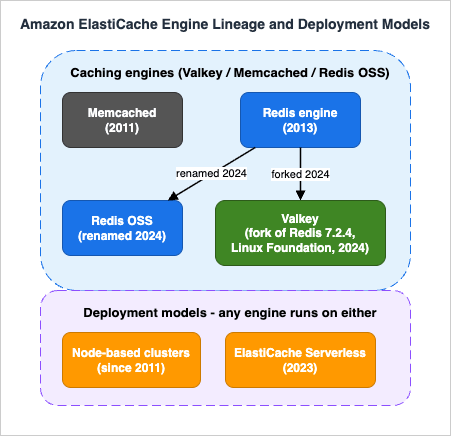
The diagram captures the following major branches:
- Amazon ElastiCache launches in 2011 with the Memcached engine, then adds the Redis engine in 2013.
- The Redis engine evolves through cluster mode (2016), encryption (2017), and successive major versions up to Redis 7.
- In 2024, Redis changes its license from BSD to dual source-available licensing, and the community forks the last BSD-licensed release (Redis 7.2.4) into Valkey under the Linux Foundation.
- ElastiCache adds Valkey in 2024 and renames its Redis-compatible engine "Redis OSS", so the service now offers Valkey, Memcached, and Redis OSS.
- Every engine can run either as a node-based cluster or as ElastiCache Serverless, the fully managed, auto-scaling deployment model introduced in 2023.
Supported Engines in Amazon ElastiCache
Amazon ElastiCache supports the following three engines. Valkey and Redis OSS share a common heritage and a largely compatible command set and data model, while Memcached is a separate, simpler engine.ElastiCache for Valkey
Valkey is an open-source, high-performance key-value datastore stewarded by the Linux Foundation. It began in 2024 as a fork of the last BSD-licensed Redis release (Redis 7.2.4) and continues under the BSD 3-clause license. ElastiCache added Valkey in October 2024 starting with Valkey 7.2, and has since supported Valkey 8.0, 8.1, and 9.0. Valkey supports the same rich data structures, replication, cluster mode, Multi-AZ with automatic failover, Global Datastore, and data tiering as the Redis OSS engine, and AWS positions it as a drop-in path for Redis OSS workloads.ElastiCache for Redis OSS
"Redis OSS" is the name ElastiCache uses for its Redis-compatible engine following the 2024 engine renaming. It corresponds to the open-source Redis versions (4.0.10 through 7.1) that ElastiCache supports, and it provides the same clustering, replication, security, and operational features that ElastiCache built up over the years. Existing Redis OSS clusters continue to be supported, and customers can upgrade from Redis OSS to Valkey.ElastiCache for Memcached
Memcached is a simple, multi-threaded, in-memory key-value cache that ElastiCache has supported since its 2011 launch. It is well suited to straightforward caching where data is transient and does not require persistence, replication, or advanced data structures. Memcached clusters support horizontal scaling by adding nodes, and, since 2025, on-demand vertical scaling and automated horizontal scaling.Amazon ElastiCache Deployment Options
Amazon ElastiCache offers two deployment models for its engines:- Node-based clusters
You choose a node type, the number of shards, and the number of replicas, giving fine-grained control over capacity and placement across Availability Zones. Node-based clusters support the full range of engine versions and features, including data tiering and Global Datastore. - ElastiCache Serverless
Introduced in 2023, ElastiCache Serverless removes capacity planning entirely. It creates a cache in under a minute, scales compute and memory automatically to meet demand, runs across multiple Availability Zones with a 99.99% availability SLA, and bills for the data stored and the compute used. Serverless supports Valkey (version 7.2 and above), Memcached (version 1.4.5 and above), and Redis OSS (versions 4.0.10 to 7.1).
Amazon ElastiCache Key Functions and Features
- Cluster mode and sharding partition data across multiple shards (cluster mode enabled) for horizontal scale, while cluster mode disabled uses a single primary with replicas.
- Multi-AZ with automatic failover promotes a read replica to primary automatically if the primary fails.
- Read replicas and reader endpoints scale read throughput and provide a single load-balanced endpoint for reads.
- Global Datastore replicates a primary cluster to read-only clusters in up to two other AWS Regions for low-latency reads and cross-Region disaster recovery.
- Data tiering extends capacity to locally attached NVMe SSDs on R6gd node types for a lower cost per gigabyte.
- Encryption in transit and at rest protects data using TLS and encrypted backups, with keys managed in AWS Key Management Service (KMS).
- Access control includes Redis AUTH, Role-Based Access Control (RBAC) user groups, and IAM authentication.
- Auto Scaling adjusts shards or replicas automatically through AWS Application Auto Scaling.
- Backup and restore creates snapshots stored in Amazon S3 and restores them into new clusters.
- Native JSON and other data structures support JSON documents in addition to strings, hashes, sets, sorted sets, streams, and (with Valkey 9.0) full-text and hybrid search.
- Monitoring and observability integrate with Amazon CloudWatch metrics and logs, AWS CloudTrail, and slow-log delivery.
- Networking supports Amazon VPC, IPv6 and dual-stack, AWS PrivateLink, Local Zones, and AWS Outposts.
Relationship between Amazon ElastiCache and Amazon MemoryDB
Amazon ElastiCache is a cache: it accelerates access to data whose source of truth lives in another database. Amazon MemoryDB is a separate, Valkey- and Redis OSS-compatible service that is designed to be a durable primary database, using a multi-AZ transaction log for durability. Since June 2026, ElastiCache for Valkey has also offered an optional durability mode backed by a Multi-AZ transactional log, so the boundary is now one of default posture: ElastiCache remains a cache first with durability as an opt-in setting, while MemoryDB is designed as a durable primary database from the start. This article focuses on ElastiCache; MemoryDB has its own history and is only mentioned here to mark the boundary between a cache and a durable in-memory database.References:
AWS Documentation(Amazon ElastiCache)
ElastiCache Documentation history
Amazon ElastiCache (Product Page)
Frequently Asked Questions about Amazon ElastiCache History
When was Amazon ElastiCache launched?
Amazon ElastiCache was announced on August 22, 2011. It launched as a Memcached protocol-compliant, in-memory cache service, initially as a public beta in the US East (N. Virginia) Region, before expanding to additional Regions.When did ElastiCache add Redis support?
The Redis engine was added to Amazon ElastiCache on September 4, 2013, becoming the second supported engine alongside Memcached. The same release introduced replication groups, allowing a primary node to have read replicas.When did ElastiCache add cluster mode and sharding?
ElastiCache added Redis Cluster (cluster mode enabled) sharding support on October 12, 2016, based on Redis 3.2.4. This allowed data to be partitioned across multiple shards for horizontal scalability, with replicas per shard and faster failover.When did Amazon ElastiCache Serverless become available?
Amazon ElastiCache Serverless became generally available on November 27, 2023, announced at AWS re:Invent 2023 for both Redis and Memcached. It creates a cache in under a minute, scales automatically, and provides a 99.99% availability SLA without capacity planning. Support for Valkey followed with the Valkey engine in October 2024.What is the difference between ElastiCache for Valkey and Redis OSS?
Both engines derive from the same Redis codebase and are largely compatible. In March 2024, Redis changed its license from BSD to dual source-available licensing (RSALv2 and SSPLv1) starting with Redis 7.4, and the community forked the last BSD-licensed release (Redis 7.2.4) into Valkey under the Linux Foundation. ElastiCache added Valkey (starting with Valkey 7.2) on October 8, 2024, and refers to its earlier Redis-compatible engine as "Redis OSS". Customers can run either engine and can upgrade from Redis OSS to Valkey.When did ElastiCache add Global Datastore?
Global Datastore for Redis became available on March 16, 2020. It lets you write to a primary cluster in one Region and read from read-only clusters in up to two other Regions, enabling low-latency local reads and cross-Region disaster recovery.What engines and deployment options does Amazon ElastiCache support today?
Amazon ElastiCache supports three engines, Valkey, Memcached, and Redis OSS, and two deployment models. Node-based clusters give fine-grained control over node type, shards, and replicas, while ElastiCache Serverless removes capacity planning and scales automatically with a 99.99% availability SLA.Is Amazon ElastiCache the same as Amazon MemoryDB?
No. Amazon ElastiCache is a cache that accelerates access to data stored in another database, while Amazon MemoryDB is a separate, Valkey- and Redis OSS-compatible service designed to serve as a durable primary database using a multi-AZ transaction log. ElastiCache for Valkey added an optional durability mode in June 2026, but the default roles remain distinct: ElastiCache is a cache first, while MemoryDB is designed as a durable primary database. They are related in engine compatibility but serve different roles.Summary
In this article, I created a historical timeline of Amazon ElastiCache and looked at the list of features and overview of the service.Since its announcement in August 2011, Amazon ElastiCache has grown from a single Memcached-compatible cache into a service that supports three engines (Valkey, Memcached, and Redis OSS) and a deep portfolio of high availability, security, and operational features, including cluster mode, Multi-AZ with automatic failover, Global Datastore, data tiering, encryption, RBAC and IAM authentication, and Auto Scaling.
ElastiCache is also a clear example of how a managed service tracks the open-source engines it depends on: when Redis changed its licensing in 2024, the community forked the last BSD-licensed release into Valkey under the Linux Foundation, and ElastiCache added Valkey alongside the renamed Redis OSS engine while continuing to support Memcached. The introduction of ElastiCache Serverless in 2023 further simplified how all of these engines are deployed and scaled.
I would like to continue monitoring the trends of what kind of features Amazon ElastiCache will provide in the future, including the ongoing evolution of Valkey and the boundary with the durable Amazon MemoryDB service.
This timeline will be updated as Amazon ElastiCache continues to evolve.
In addition, there is also a historical timeline of all AWS services including services other than Amazon ElastiCache, so please have a look if you are interested.
AWS History and Timeline - Almost All AWS Services List, Announcements, General Availability(GA)
AWS History and Timeline regarding Amazon RDS - Overview, Engines, Features, Summary of Updates, and Introduction
AWS History and Timeline regarding Amazon DynamoDB - Overview, Functions, Features, Summary of Updates, and Introduction
Also, if you are interested in related database and caching topics, the following articles may help:
Comparison of AWS Databases Using the Quorum Model
AWS Database Glossary
Semantic Caching for LLM Applications on AWS
The Valkey engine in this timeline exists because of a license change on the upstream project. For the same mechanism read from the license text itself, in the infrastructure-as-code category, see Terraform and OpenTofu History and Timeline.
References:
Tech Blog with curated related content
Written by Hidekazu Konishi