Privacy Sandbox History and Timeline - The Third-Party Cookie Phase-Out Plan, Its Reversal, API Deprecation and Removal in Chrome, and What Remains Supported
First Published:
Last Updated:
is planned for deprecation and removal. Conversely, the Privacy Sandbox status table categorizes nine components, including CHIPS and FedCM, as Continue to support.These APIs were developed under the assumption that Chrome would eventually end support for third-party cookies. Google announced this policy in 2020, subsequently postponing its implementation three times. On July 22, 2024, Google proposed an alternative approach that would allow users to choose their preferred settings instead of phasing out third-party cookies. On October 17, 2025, Google announced the retirement of APIs with low adoption, although no end dates were set at the time of that announcement. The Chrome versions for deprecation and removal were set later in plans posted on blink-dev, and those plans changed several times along the way.
This article presents a timeline of key events from the initial concept announcement on August 22, 2019, through October 1, 2026. For each API, it outlines its current status and references the documentation that details that status. All information was verified as of October 2, 2026.
Background and Method of Creating the Privacy Sandbox Timeline
Developers who have used third-party cookies and Privacy Sandbox APIs for site measurement, advertising, login, and embedded content need to know what stage the APIs their code calls are currently in. The purpose of this article is to clearly outline, based solely on primary source documentation, which features are being phased out and which remain active, and where that information can be found.The Privacy Sandbox name and website continue to exist. The top page of privacysandbox.google.com states
We will continue to retain information on this site, even for features that have not been implemented or that are scheduled to be phased out. This article does not document the end of the initiative. Instead, it records how the APIs built on a premise were retired after that premise was withdrawn, and what remained.Sources Used in This Article
The entries in this timeline are drawn from three groups of sources:- Privacy Sandbox Website — This includes the status table (Privacy Sandbox feature status) on privacysandbox.google.com, individual feature explanation pages, and the developer blog. The older domain, privacysandbox.com, redirected to this site on the verification date.
- Chrome Documentation — This includes release notes by version (developer.chrome.com), Chromium Dash, which shows the stable date of each version, the Chrome Platform Status (chromestatus) which details the status of individual features, and the Intent threads on the blink-dev mailing list. The blink-dev mailing list is where plans for feature release and removal are posted, and their approval is recorded.
- Google Announcements — This includes announcements from The Keyword (blog.google) and the Chromium Blog.
Regarding regulatory bodies, only two facts were extracted from the case page of the UK's Competition and Markets Authority (CMA): the acceptance and the release of the commitments. Past classifications in the status table were verified using the Internet Archive. Support for browsers other than Chrome was confirmed through documentation from Mozilla and WebKit.
How Stages and Dates Are Written in This Timeline
The end of an API comes in stages. This article uses the following terms, aligning with the language used in the documentation:- Retirement announcement: This refers to Google announcing that it will retire a particular API. The announcement made on 2025-10-17 is an example. At the time of the announcement, the Chrome versions for deprecation and removal had not yet been set.
- Deprecation: This indicates that Chrome has marked an API for future removal. This is written in Chrome's release notes or in the Intent posts on blink-dev.
- Removal: This signifies removing the API's implementation from Chrome.
- Stub: This involves replacing the API with a minimal implementation that retains the API's name but does not perform any actual processing. Most removal plans on blink-dev put stubs in place before removal, so that existing web pages do not break.
- Staged rollout: This refers to enabling a change for a portion of browsers through field trials and widening it from 1% to 10% to 100%.
Dates are formatted as follows: The dates for Chrome releases refer to the stable release dates as shown on Chromium Dash. Announcements refer to the publication dates listed on the relevant pages. Posts on blink-dev use the dates displayed on Google Groups. Google Groups displays dates without timezone information, so a date may differ by up to one day.
Names Used in This Timeline
Several APIs have undergone name changes during their development. Each row in this timeline reflects the name used on that particular day; if the name differs from the current name, it is indicated in parentheses.| Name at the Time | Current Name | When the Name Changed | Source |
|---|---|---|---|
| Trust Token API | Private State Token API | 2022-10-19 | Trust Tokens renamed Private State Tokens |
| FLEDGE | Protected Audience API | 2023-04-17 | Protected Audience API: Our new name for FLEDGE |
| First-Party Sets | Related Website Sets | Chrome 117 (2023-09-12) | Related Website Sets - the new name for First-Party Sets in Chrome 117 |
FLoC was not renamed. The announcement on 2022-01-25 stated that the Topics proposal would replace the FLoC proposal.
The How the End Date Is Set Column
The tables of API status include a column labeled How the End Date Is Set. This column indicates how the end of that API was set. The values in this column are as follows:Withdrawn, removed— Its retirement has been announced, and the Chrome release notes name a version in which it was removed. This applies to the Private Aggregation API (Chrome 152).Withdrawn, removal in progress— Its retirement has been announced, and plans for deprecation and removal are underway. As of the verification date, no Chrome release note names the API as removed. This includes APIs in a staged rollout of the removal or being replaced with stubs.Withdrawn, discontinued— The status table classifies the API asDiscontinue.Withdrawn, will not launch— The status table classifies the API asDo not launch.No end announced— The status table classifies the API asContinue to support, and no end has been announced. However, the classification itself has changed in the past. Fenced Frames moved fromContinue to supporttoDeprecate and removein the update of 2026-08-14.
The .NET Release and Support Timeline in this series documents versions where Microsoft publicly announced end dates, assigning the corresponding value in this column as
Declared. The Go Release and Support Timeline documents versions where the end date is derived from a set of rules, assigning the value as Derived. When they shipped, the Privacy Sandbox APIs had neither an announced end date nor a set of rules from which an end date could be derived. Their end began as a retirement announcement, after the plan to deprecate third-party cookies, which they had assumed, was withdrawn. The base term for this column's values is Withdrawn for this reason.What This Article Leaves to Other Articles
This article does not cover the usage and implementation of individual APIs. It also does not address evaluations of the impact on the advertising industry or businesses, nor does it offer commentary on regulations. Android's Privacy Sandbox is outside the scope of this article. While the status table also has rows for Android, this article focuses solely on Chrome's Privacy Sandbox for the Web.How to write the
SameSite and Partitioned attributes of Set-Cookie is covered in HTTP Security Headers Complete Reference. The implementation of site measurement without relying on third-party cookies is covered in Self-Hosted Static Site Analytics. Passkeys, as a login mechanism, are discussed in Passkeys and WebAuthn in Practice. Related timelines include TLS Certificate Ecosystem History and Timeline, another timeline in which browsers have moved industry rules, and AWS Retired Services History and Timeline, which records the decommissioning of services.Third-Party Cookies in Other Browsers
Browsers other than Chrome have been restricting third-party cookies since before the Privacy Sandbox initiative. WebKit announced Intelligent Tracking Prevention on June 5, 2017, aimed at reducing cross-site tracking. On June 4, 2019, Mozilla turned on by default, for new users, Enhanced Tracking Protection, which blocks third-party cookies from known trackers. WebKit announced on March 24, 2020, that Safari would by default block all third-party cookies. Mozilla announced on June 14, 2022, that Total Cookie Protection, which separates cookies on a site-by-site basis, would be enabled by default for a wider range of users. This article's timeline does not list these events as rows; they are summarized in this paragraph.Privacy Sandbox Historical Timeline (Updates from August 22, 2019)
The following five tables constitute the main historical timeline. Each table has the following columns. All references were obtained on 2026-10-02.- Date — The date of the event. The method for determining dates is described in the Background section.
- Area — The type of event. This indicates whether the event relates to
Plan(the initiative and the third-party cookie plan),Cookies(implementation of third-party cookie handling in Chrome),API(API release and general availability),Rename(name changes),Retirement(retirement announcements, deprecation, removal, or changes to the status table classification), orRegulator(CMA). - What Happened — A description of the event.
- Source — The documentation used as the basis for the entry.
Index:
- 2019–2021 - The period when the concept was announced, the policy to end support for third-party cookies was outlined, and the first delay was announced.
- 2022 - The period when Topics replaced FLoC, a second delay was announced, and FedCM shipped.
- 2023 - The period when names changed, the relevance and measurement APIs shipped, and general availability was declared.
- 2024–2025 - The period when the 1% restriction began, the course changed, and the retirement was announced.
- 2026 - The period when deprecation and removal are progressing across Chrome versions.
* You can sort the table by clicking on the column name.
2019–2021 — The Announcement and the First Deadline
During this period, Google announced the Privacy Sandbox initiative and indicated its plan to end support for third-party cookies in Chrome, along with its first delay.| Date | Area | What Happened | Source |
|---|---|---|---|
| 2019-08-22 | Plan | Google announced the Privacy Sandbox initiative. The announcement detailed the company's efforts to create open standards that fundamentally improve web privacy, and named it with the words We’re calling this a Privacy Sandbox. | Building a more private web |
| 2020-01-14 | Plan | Google outlined its plan to gradually phase out support for third-party cookies in Chrome. The Chromium Blog stated that, after mechanisms like Privacy Sandbox meet the needs of users, publishers, and advertisers, and after tools to mitigate workarounds have been developed, the company plans to gradually end support for third-party cookies, and stated its intended timeframe with the words Our intention is to do this within two years. | Building a more private web: A path towards making third party cookies obsolete |
| 2021-06-24 | Plan | First delay. The announcement stated that the ecosystem required more time, and outlined a plan to phase out support for third-party cookies in two stages. The second stage was scheduled to begin in mid-2023 and run over three months, finishing in late 2023. | An updated timeline for Privacy Sandbox milestones |
2022 — Topics Replaces FLoC, a Second Delay, and FedCM Ships
During this period, the Topics proposal replaced the FLoC proposal, and the deprecation of third-party cookies was delayed for a second time, moving to the latter half of 2024. FedCM was shipped in Chrome.| Date | Area | What Happened | Source |
|---|---|---|---|
| 2022-01-25 | API | The Topics proposal was announced. The announcement stated that Topics is a new proposal for interest-based advertising, replacing the previous FLoC proposal. | Get to know the new Topics API for Privacy Sandbox |
| 2022-02-11 | Regulator | The CMA announced its decision to accept Google's commitments. The CMA's case page records 11 February 2022 Decision to accept binding commitments published. | Investigation into Google's 'Privacy Sandbox' browser changes |
| 2022-07-27 | Plan | A second delay was announced. The announcement cited feedback that more time is needed to evaluate and test the new Privacy Sandbox technologies, and said that the testing period would be extended. The announcement expected the APIs to be generally available in Chrome by the third quarter of 2023, and it indicated an intention to begin the phased deprecation of third-party cookies in the latter half of 2024. | Expanding testing for the Privacy Sandbox for the Web |
| 2022-10-19 | Rename | The Trust Token API has been renamed to the Private State Token API. The announcement explained that the original name led to a misunderstanding that browsers were determining user trust. | Trust Tokens renamed Private State Tokens |
| 2022-11-29 | API | FedCM (Federated Credential Management) was released in Chrome 108. The status table states FedCM shipped in Chrome 108. The date is the stable date of Chrome 108. | Privacy Sandbox feature status |
2023 — Renamed APIs, the Chrome 115 Launch, and General Availability
During this period, the names of FLEDGE and First-Party Sets were changed, and the relevance and measurement APIs began to be enabled gradually from Chrome 115, followed by a declaration of general availability.| Date | Area | What Happened | Source |
|---|---|---|---|
| 2023-04-17 | Rename | The FLEDGE API was renamed to the Protected Audience API. The announcement explained that the name FLEDGE indicated a development stage, and stated that while the name was changing, the API and command names within the code would not be altered. | Protected Audience API: Our new name for FLEDGE |
| 2023-05-18 | Plan | A plan for general availability was announced. The announcement stated that starting with the July Chrome release, the relevance and measurement APIs would be made available to all Chrome users over the following weeks. A plan to phase out third-party cookies for 1% of users was also outlined, scheduled for the first quarter of 2024. | The next stages of Privacy Sandbox: General availability and supporting scaled testing |
| 2023-05-30 | API | CHIPS became enabled by default in Chrome 114. CHIPS adds a Partitioned attribute to store cookies separately for each top-level site. The CHIPS page states Supported by default in Chrome 114 and higher. | Cookies Having Independent Partitioned State (CHIPS) |
| 2023-07-18 | API | Chrome 115 was released, and the gradual enabling of the relevance and measurement APIs was set to begin. The APIs included Topics, Protected Audience, Attribution Reporting, Private Aggregation, Shared Storage, and Fenced Frames. The announcement stated that the rollout would begin a few days after the stable release and aimed to make the APIs available on approximately 99% of browsers by mid-August. The announcement said that First-Party Sets (now Related Website Sets) and Private State Tokens were also being enabled gradually. | Shipping the Privacy Sandbox relevance and measurement APIs |
| 2023-08-15 | API | Chrome 116 was released. chromestatus lists Bounce tracking mitigations as enabled by default in Chrome 116. The Bounce tracking mitigations page states that these mitigations were enabled by default for users who have chosen to block third-party cookies, in October 2023 (for the disagreement between the sources, see the Current Overview section). | Bounce Tracking Mitigations (Chrome Platform Status) / Bounce tracking mitigations |
| 2023-09-07 | API | General availability was announced. The announcement stated that the relevance and measurement APIs had reached general availability in Chrome, and encouraged wider adoption and testing in preparation for the planned deprecation of third-party cookies in the latter half of 2024. Ad privacy controls were added to Chrome settings so that users can manage these APIs. | Privacy Sandbox for the Web reaches general availability |
| 2023-09-12 | Rename | Chrome 117 was released. In Chrome 117, First-Party Sets have a new name: Related Website Sets. The title of the announcement is Related Website Sets - the new name for First-Party Sets in Chrome 117. | Related Website Sets - the new name for First-Party Sets in Chrome 117 |
| 2023-10-31 | API | Chrome 119 was released. The status table states that the Storage Access API is available by default from Chrome 119 (for the disagreement with chromestatus, see the Current Overview section). | Privacy Sandbox feature status |
2024–2025 — The 1% Test, the Change of Course, and the Retirement Announcement
During this period, restrictions on third-party cookies were implemented for 1% of Chrome users. After a third delay, Google changed course away from deprecating third-party cookies and announced the retirement of APIs with low adoption.| Date | Area | What Happened | Source |
|---|---|---|---|
| 2024-01-04 | Cookies | Restrictions on third-party cookies by default began for 1% of Chrome users. The announcement stated As of 4th January 2024, Chrome has started restricting third-party cookies by default for 1% of Chrome browsers. The plan to expand these restrictions to 100% of users starting in the third quarter of 2024 was contingent on addressing concerns raised by the CMA regarding competition. | Third-party cookies restricted by default for 1% of Chrome users |
| 2024-04-23 | Plan | Third delay. The announcement stated that the deprecation of third-party cookies would not be completed during the second half of the fourth quarter of 2024. The reasons cited were the need to reconcile differing viewpoints from the industry, regulatory bodies, and developers, as well as the time required for the CMA to review evidence. The announcement suggested that if an agreement is reached, the phase-out would proceed starting in early 2025. | Update on the plan for phase-out of third-party cookies on Chrome |
| 2024-07-22 | Plan | Google changed course. The announcement proposed introducing a new system into Chrome that allows users to make choices applicable to their entire web browsing experience, which they can change at any time, instead of phasing out third-party cookies. Stating that Google would continue to provide and invest in Privacy Sandbox APIs, the announcement also outlined plans to incorporate IP Protection into Chrome's Incognito mode. | A new path for Privacy Sandbox on the web |
| 2025-04-22 | Cookies | A decision was made not to roll out a standalone prompt. The announcement confirmed that the current approach, which allows users to choose regarding third-party cookies, will continue, and stated that it will not be rolling out a new standalone prompt for third-party cookies. Users will continue to make their choices within Chrome's privacy and security settings, and Incognito mode already blocks third-party cookies by default. The announcement said it planned to launch IP Protection in the third quarter of 2025. It said that the role of the Privacy Sandbox APIs may change and that an updated plan would be shared. | Next steps for Privacy Sandbox and tracking protections in Chrome |
| 2025-10-17 | Retirement | The retirement of several APIs was announced. The announcement stated that Attribution Reporting API, IP Protection, Private Aggregation (including Shared Storage), Protected Audience, Related Website Sets (including requestStorageAccessFor and Related Website Partition), SelectURL, Topics, and three technologies exclusive to Android would be retired, citing feedback about their expected value and their low adoption. It said that support for CHIPS and FedCM would continue and that Private State Tokens would also be maintained. | Update on Plans for Privacy Sandbox Technologies |
| 2025-10-17 | Regulator | The CMA released the commitments. The case page states On 17 October 2025, the CMA issued its Decision to release the commitments. and lists the state of the case as Closed. | Investigation into Google's 'Privacy Sandbox' browser changes |
| 2025-11-08 | Retirement | Intents to deprecate and remove were posted to blink-dev. The Intents for Protected Audience, Topics, Attribution Reporting, Private Aggregation, and Shared Storage planned deprecation in Chrome 144 and removal in Chrome 150. The Intents for Related Website Sets and document.requestStorageAccessFor planned deprecation in Chrome 144 and targeted removal in Chrome 150. | Intent to Deprecate and Remove: Protected Audience / Intent to Deprecate and Remove: Topics API / Intent to Deprecate and Remove: Related Website Sets (RWS) |
2026 — Deprecation in Chrome 144 and Removal from Chrome 152
During this period, deprecation began in Chrome 144, and removal has been progressing since Chrome 152. The removal plans follow a process of stubs and staged rollouts, and they have moved between versions several times.| Date | Area | What Happened | Source |
|---|---|---|---|
| 2026-01-13 | Retirement | Chrome 144 was released. The release notes, in the "Deprecations and removals" section, listed the Private Aggregation API, Shared Storage API, and Protected Audience as items to be deprecated and removed. The plans to deprecate Attribution Reporting, Related Website Sets, document.requestStorageAccessFor, and Topics in Chrome 144 are written in the blink-dev Intents and, except for Attribution Reporting, in chromestatus, but they are not in these release notes. | Chrome 144 release notes |
| 2026-06-12 | Retirement | The removal process was revised. Updates were posted to the threads for Protected Audience, Topics, Attribution Reporting, and Shared Storage, outlining a plan to remove the entries for the ads APIs from Chrome settings in Chrome 150, replace the implementations with stubs in Chrome 152, and roll out the removal of the stubs gradually through field trials. The Private Aggregation thread planned to remove the implementation in Chrome 152 (posted on 2026-06-13). The Related Website Sets thread indicated that, due to continued usage, the removal would be postponed to Chrome 152 (posted on 2026-06-10). | Intent to Deprecate and Remove: Protected Audience / Intent to Deprecate and Remove: Private Aggregation API / Intent to Deprecate and Remove: Related Website Sets (RWS) |
| 2026-07-28 | Retirement | Final approval was requested for the removal of document.requestStorageAccessFor. The post indicated that usage had decreased to 0.018% of page loads, and requested approval for its removal in Chrome 153. The post said that a feature flag would be kept for unexpected breakage and that the code would be removed in the Chrome 154 to Chrome 155 timeframe. | Intent to Deprecate and Remove: document.requestStorageAccessFor |
| 2026-08-14 | Retirement | The status table was updated. Fenced Frames moved from Continue to support to Deprecate and remove, and the number of components in Continue to support became nine. In the Internet Archive copies captured on October 18, 2025, and July 10, 2026, Fenced Frames was listed in Continue to support. | Privacy Sandbox feature status |
| 2026-08-25 | Retirement | Chrome 152 was released. The release notes, under the heading Remove Private Aggregation API, stated that the Private Aggregation API is deprecated and removed (along with related Privacy Sandbox APIs). | Chrome 152 release notes |
| 2026-09-08 | Retirement | Chrome 153 was released. The release notes listed five features (Protected Audience, Related Website Sets, Shared Storage API, document.requestStorageAccessFor, and the Attribution Reporting API), each under a Deprecate and remove heading, and stated that removal is planned for each. Topics was not mentioned in these release notes. | Chrome 153 release notes |
| 2026-09-25 | Retirement | Plans for the staged rollout of the removal of Protected Audience and Topics were posted. The Protected Audience thread indicates that the removal, rolled out to 1% of Stable browsers on Chrome 152 and later without issues, will be paused at 10% of Stable browsers until October 12, 2026, before expanding to 100% from October 26, 2026. The Topics thread states that the rollout of the removal reached 1% of Stable browsers on Chrome 153 and later and will be paused at 10% of Stable browsers until October 15, 2026, with a target for the full rollout after October 15, 2026. | Intent to Deprecate and Remove: Protected Audience / Intent to Deprecate and Remove: Topics API |
| 2026-09-28 | Retirement | Stubbing of Fenced Frames landed in Chrome 156. The post said that the <fencedframe> element and window.fence become stubs starting in Chrome 156, and that experiments to remove the stubs would begin in Chrome 157. | Intent to Ship: Remove FencedFrame element and window.fence APIs |
| 2026-09-30 | Retirement | The Shared Storage API was reported to be disabled across all channels. The post stated The Shared Storage IDL was accidentally disabled everywhere, which effectively disabled the API across all channels. and outlined a plan to proceed directly to code removal without any staged rollout. The following day's post answered that the API had been disabled starting with version 153.0.8001.0. | Intent To Deprecate and Remove: Shared Storage API |
Current Overview of Privacy Sandbox APIs, Retirements, and What Remains
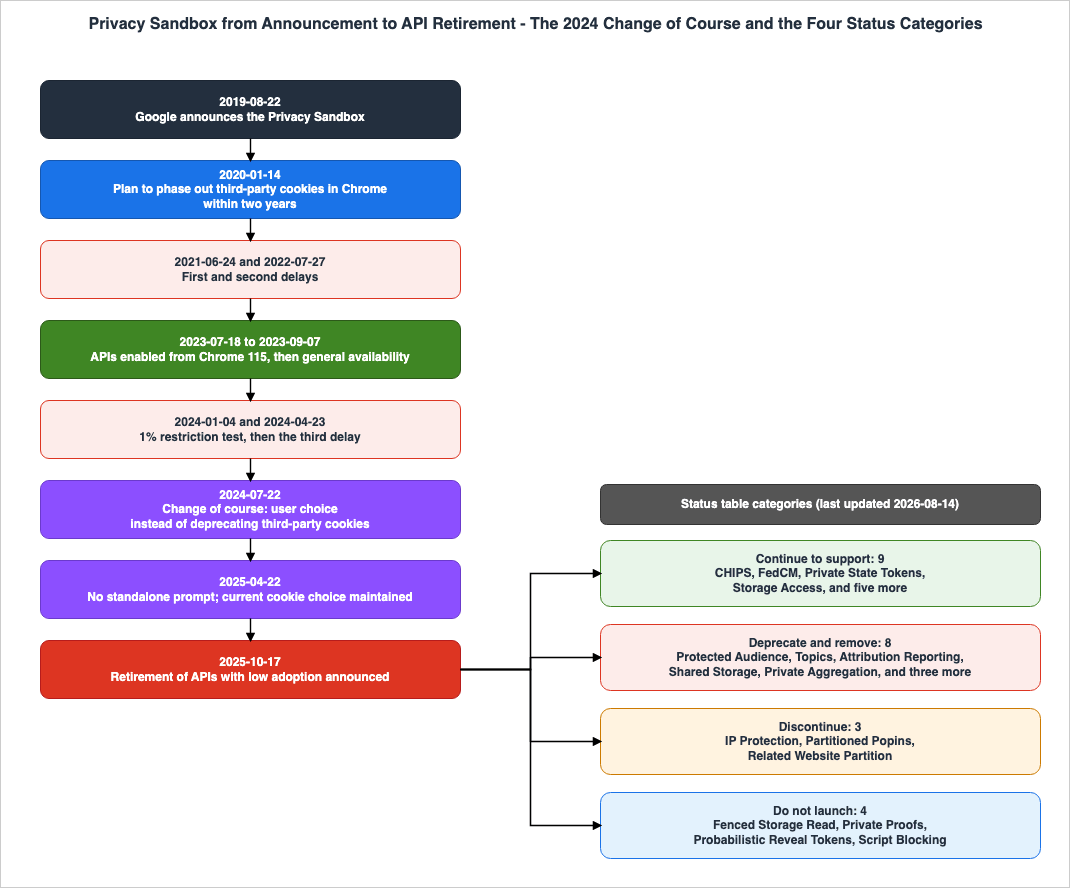
This section summarizes the status of Privacy Sandbox APIs as of October 2, 2026. The status table (Privacy Sandbox feature status) showsLast updated: August 14, 2026. The status table categorizes Chrome features into four groups:Continue to support— Features that will continue to be supported (9 features).Deprecate and remove— Features being deprecated and removed (8 features).Discontinue— Features that will be discontinued (3 features).Do not launch— Features that will not be launched (4 features).
The following diagram illustrates the course from the announcement of the initiative to the announcement of retirement, and how features are sorted into the four groups of the status table.
What Was Retired and How (Deprecation in Chrome 144, Removal Starting in Chrome 152)
The end of most retired APIs goes through three stages. First, Google announced the retirement on October 17, 2025. Next, they were deprecated in Chrome 144. Finally, removal is underway, starting with Chrome 152. For many APIs, the removal plans on blink-dev replace the implementation with stubs first and then roll out the removal gradually, starting with a portion of browsers, rather than removing them entirely from all browsers at once.Who wrote the deprecation and removal, and where, differs by API. Only three APIs (Private Aggregation, Shared Storage, and Protected Audience) had their deprecation noted in the Chrome 144 release notes. For the other APIs deprecated in Chrome 144, the deprecation is written only in the blink-dev Intents and, except for Attribution Reporting, in chromestatus.
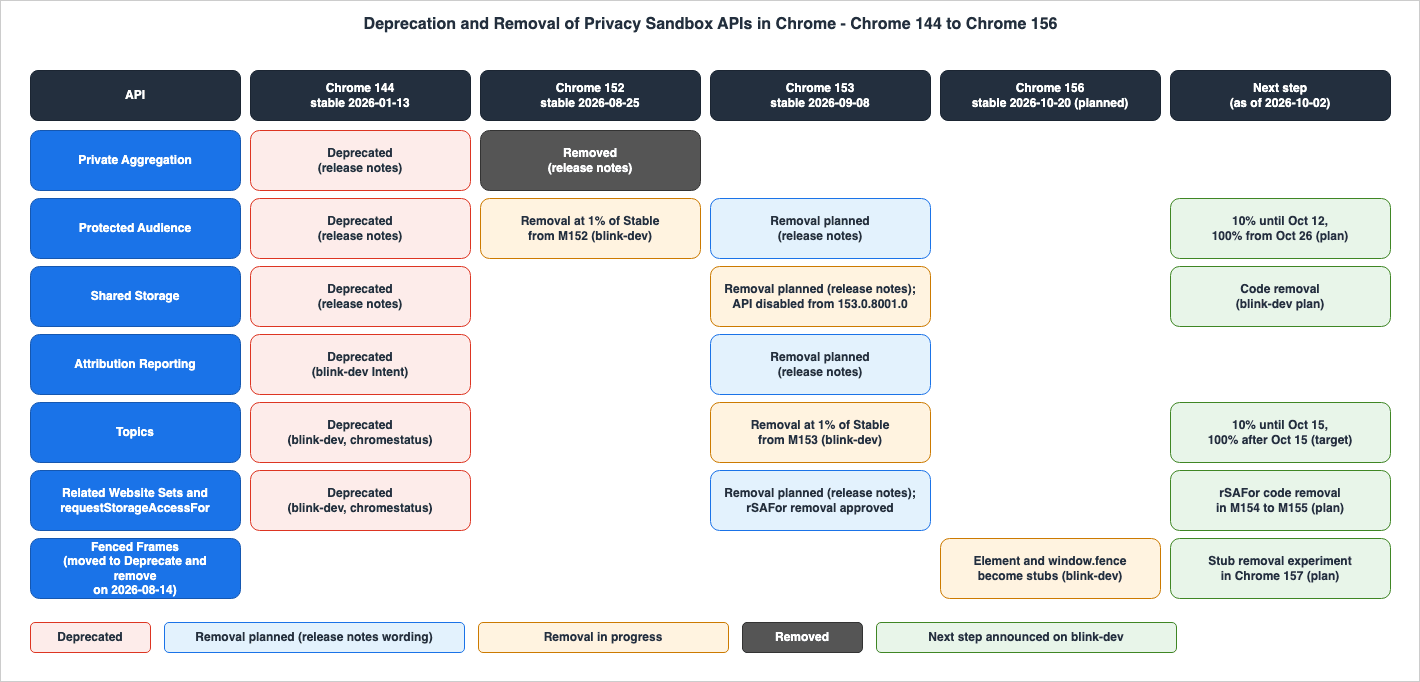
Deprecate and remove.* You can sort the table by clicking on the column name.
| Feature | Deprecation | Removal and Rollout (as of October 2, 2026) | How the End Date Is Set | Source |
|---|---|---|---|---|
| Private Aggregation | Chrome 144 (release notes) | Removed in Chrome 152 (release notes) | Withdrawn, removed | Chrome 144 release notes / Chrome 152 release notes |
| Protected Audience | Chrome 144 (release notes) | The Chrome 153 release notes describe the removal as planned. The blink-dev plan pauses the rollout of the removal at 10% of Stable browsers until October 12, 2026, before expanding it to 100% from October 26, 2026. | Withdrawn, removal in progress | Chrome 153 release notes / blink-dev |
| Shared Storage (including Select URL) | Chrome 144 (release notes) | The Chrome 153 release notes describe the removal as planned. According to blink-dev, the API was disabled starting with version 153.0.8001.0, and the plan is to proceed with code removal. | Withdrawn, removal in progress | Chrome 153 release notes / blink-dev |
| Attribution Reporting | Chrome 144 (blink-dev Intent) | The Chrome 153 release notes describe the removal as planned. The blink-dev plan replaces the API with a stub in Chrome 152 and rolls out the removal of the stub through field trials. | Withdrawn, removal in progress | Chrome 153 release notes / blink-dev |
| Topics | Chrome 144 (blink-dev Intent and chromestatus) | chromestatus lists the removal version as Chrome 153, although Topics is not mentioned in the Chrome 153 release notes. The blink-dev plan pauses the rollout of the removal at 10% of Stable browsers until October 15, 2026, with a target for the full rollout after October 15, 2026. | Withdrawn, removal in progress | Deprecate and remove: Topics API (Chrome Platform Status) / blink-dev |
Related Website Sets (including requestStorageAccessFor) | Chrome 144 (blink-dev Intent and chromestatus) | The Chrome 153 release notes describe the removal as planned. The document.requestStorageAccessFor feature has been approved for removal in Chrome 153, with code removal in the Chrome 154 to Chrome 155 timeframe. | Withdrawn, removal in progress | Chrome 153 release notes / blink-dev |
| Fenced Frames | The status table moved it to Deprecate and remove on 2026-08-14. | blink-dev says that it becomes a stub starting in Chrome 156, and experiments to remove the stub will begin in Chrome 157. The stable release for Chrome 156 is scheduled for October 20, 2026. | Withdrawn, removal in progress | blink-dev / Remove FencedFrame element and window.fence APIs (Chrome Platform Status) |
| Aggregation Service | The status table states Scheduled for phaseout. | This is a server-side service. The Intents for Private Aggregation and Attribution Reporting stated that the server-side computation of summary reports would stop by late December 2025. The sources used in this article do not say whether it stopped. | Withdrawn, removal in progress | Privacy Sandbox feature status / blink-dev |
Notes on the table:
- The wording of the Chrome 153 release notes: The Chrome 153 release notes describe the removal of five features as planned. They do not state that the removals have been completed. How the removals progress depends on the plans and reports in the blink-dev threads.
- The rollout dates are planned dates: The dates of October 12, 2026, October 15, 2026, and October 26, 2026, for Protected Audience and Topics, are from the plans posted on blink-dev on 2026-09-25. As of the verification date, the plans place the rollout to 100% after that date.
- Attribution Reporting: There have been no further posts on the blink-dev thread since 2026-07-02. The sources used in this article do not say how far the rollout for Attribution Reporting has progressed as of the verification date.
- Code that calls the APIs: The blink-dev Intents say that stubs may be kept temporarily so that pages do not break. For example, the Topics Intent states that
document.browsingTopics()will be removed, thebrowsingtopicsattribute will be ignored, and theSec-Browsing-Topicsrequest header will no longer be sent. The same Intent says that, because Topics is not enabled by default for all users, sites should already be using feature detection.
What Remains Supported
The status table categorizes the following nine items asContinue to support. The announcement from October 17, 2025, also states that support for CHIPS and FedCM will continue, and that Private State Tokens will be maintained.| Feature | Shipped in Chrome | Status (as of October 2, 2026) | How the End Date Is Set | Source |
|---|---|---|---|---|
| Bounce tracking mitigations | Chrome 116 (chromestatus) / October 2023 (feature page) | Continue to support | No end announced | Bounce tracking mitigations |
| CHIPS | Chrome 114 | Continue to support | No end announced | Cookies Having Independent Partitioned State (CHIPS) |
| FedCM | Chrome 108 | Continue to support | No end announced | Privacy Sandbox feature status |
| frame-ancestors directive | Version not specified in status table | Continue to support | No end announced | Privacy Sandbox feature status |
| Private State Tokens | Chrome 115 (chromestatus) | Continue to support | No end announced | Private State Tokens |
| Storage and Network State Partitioning | Version not specified in status table | Continue to support | No end announced | Privacy Sandbox feature status |
| Storage Access (including Storage Access Header) | Chrome 119 (status table) / Chrome 117 (chromestatus) | Continue to support | No end announced | Storage Access API |
| User-Agent Client Hints | Version not specified in status table | Continue to support | No end announced | Privacy Sandbox feature status |
| User-Agent reduction | Version not specified in status table | Continue to support | No end announced | Privacy Sandbox feature status |
Continue to support is the classification as of the verification date. It is not a promise of continued support. Fenced Frames was in Continue to support from October 17, 2025, through at least July 10, 2026, but moved to Deprecate and remove in the update of August 14, 2026.CHIPS is usable in browsers other than Chrome. The release notes for Firefox 141 describe CHIPS support as
now re-enabled. WebKit states that Safari 18.4 shipped CHIPS, temporarily removed it in Safari 18.5, and then shipped it again in Safari 26.2. Regarding FedCM, the status table states FedCM isn't supported in other browsers yet. The announcement of October 17, 2025, put CHIPS and FedCM in one sentence and stated that they have seen broad adoption, including support from other browsers.Discontinued and Not Launched
The status table categorizes the following seven items as eitherDiscontinue or Do not launch.| Feature | Status (as of October 2, 2026) | How the End Date Is Set | Note |
|---|---|---|---|
| IP Protection | Discontinue | Withdrawn, discontinued | The announcement of 2025-04-22 planned to launch it in Incognito mode in the third quarter of 2025. The announcement of 2025-10-17 included it in the technologies to be retired. |
| Partitioned Popins | Discontinue | Withdrawn, discontinued | The status on chromestatus is On hold. |
| Related Website Partition | Discontinue | Withdrawn, discontinued | The announcement of 2025-10-17 retired it together with Related Website Sets. |
| Fenced Storage Read | Do not launch | Withdrawn, will not launch | The details in the status table state Scheduled for phaseout. |
| Private Proofs | Do not launch | Withdrawn, will not launch | The details in the status table state Scheduled for phaseout. |
| Probabilistic Reveal Tokens | Do not launch | Withdrawn, will not launch | The details in the status table state Scheduled for phaseout. |
| Script Blocking | Do not launch | Withdrawn, will not launch | The details in the status table state Scheduled for phaseout. |
This article does not say whether IP Protection was made available in Chrome. Its feature page (last updated October 27, 2025) describes a rollout in certain regions in the future tense. The release notes for Chrome versions 136 through 143 do not mention IP Protection. On the verification date, the IP Protection entry on chromestatus could not be retrieved with the method this article used.
Third-Party Cookies in Chrome Today
Chrome has not deprecated third-party cookies. The announcement of July 22, 2024, proposed a system where users choose, rather than deprecating third-party cookies. The announcement of April 22, 2025, stated that Chrome would keep its current approach of leaving the choice about third-party cookies to users and would not roll out a new standalone prompt. Users will continue to be able to make their selection within Chrome's privacy and security settings.The same announcement also noted that Chrome's Incognito mode already blocks third-party cookies by default. The announcement of October 17, 2025, describes two of the remaining components: CHIPS improves cookie privacy and security, and FedCM streamlines identity flows.
Where the Sources Disagree
This article's sources contain the following discrepancies. This article writes both sides without rounding them into one.- The date of Bounce tracking mitigations: chromestatus indicates Chrome 116 (stable release on 2023-08-15), while the feature's page states that it was enabled by default in October 2023.
- The version of the Storage Access API: The status table indicates that it became available by default in Chrome 119, while the chromestatus entry for "Storage Access API with Prompts" lists Chrome 117.
- Where the deprecation in Chrome 144 is written: The deprecation of Attribution Reporting, Related Website Sets,
document.requestStorageAccessFor, and Topics in Chrome 144 is written in the blink-dev Intents and, except for Attribution Reporting, in chromestatus, but not in Chrome 144's release notes. - The version of the Topics removal: chromestatus lists Chrome 153, while Chrome 153's release notes do not mention Topics.
- Support for FedCM in other browsers: The status table indicates that it is not yet supported in other browsers, while the announcement of 2025-10-17 puts CHIPS and FedCM together and says they have been adopted, including support from other browsers.
Frequently Asked Questions about Privacy Sandbox History
This section answers common questions about Privacy Sandbox, drawing from the content presented here. The dates and status reflect the information as of October 2, 2026.Is the Privacy Sandbox over?
The Privacy Sandbox is not over. While the advertising relevance and measurement APIs are being deprecated and removed, the status table classifies nine components, including CHIPS, FedCM, Private State Tokens, and Storage Access, asContinue to support. The top page of privacysandbox.google.com says that information on features scheduled to be phased out will also be kept on the site.When did Chrome deprecate the Protected Audience and Topics APIs?
Both APIs were deprecated in Chrome 144 (stable release on January 13, 2026). The deprecation of Protected Audience is documented in the Chrome 144 release notes. The deprecation of Topics in Chrome 144 is written in the blink-dev Intent and in chromestatus, but not in the Chrome 144 release notes. The Chrome 153 release notes indicate a plan to remove Protected Audience.Has the Protected Audience API been removed from Chrome?
As of the verification date, the removal is in a staged rollout. The blink-dev thread indicates that the removal, rolled out to 1% of Stable browsers on Chrome 152 and later without issues, will be paused at 10% of Stable browsers until October 12, 2026, before expanding to 100% from October 26, 2026. The API whose removal was completed in Chrome 152 is the Private Aggregation API.Did Chrome stop supporting third-party cookies?
Chrome has not stopped supporting third-party cookies. On July 22, 2024, Google proposed a new system in which users choose, instead of deprecating third-party cookies. On April 22, 2025, it stated that it would keep the current approach of leaving the choice to users and would not roll out a new standalone prompt. Chrome's Incognito mode, by default, blocks third-party cookies. The default restriction on 1% of browsers that began on January 4, 2024, was a test that came before this change of course.Which Privacy Sandbox APIs are still supported?
TheContinue to support entries in the status table are these nine: Bounce tracking mitigations, CHIPS, FedCM, the frame-ancestors directive, Private State Tokens, Storage and Network State Partitioning, Storage Access (including the Storage Access Header), User-Agent Client Hints, and User-Agent reduction. However, the classifications in the status table may change. Fenced Frames moved from Continue to support to Deprecate and remove in the update of August 14, 2026.What happened to FLoC, FLEDGE, and First-Party Sets?
The Topics proposal, announced on January 25, 2022, replaced FLoC. FLEDGE was renamed the Protected Audience API on April 17, 2023. First-Party Sets was renamed Related Website Sets, starting with Chrome 117. Both Protected Audience and Related Website Sets are currently being removed.Do other browsers support CHIPS and FedCM?
Other browsers support CHIPS. The release notes for Firefox 141 describe CHIPS support asnow re-enabled, and WebKit says that Safari 26.2 ships CHIPS again. Regarding FedCM, the status table indicates that FedCM isn't supported in other browsers yet. The announcement of October 17, 2025, puts CHIPS and FedCM together and says they have been adopted, including support from other browsers; that one sentence does not show how far FedCM alone is supported.Summary
This article presented a timeline of key events from the announcement of the Privacy Sandbox on August 22, 2019, through October 1, 2026, and organized the stage of each API as of the verification date.The end of the APIs began after their premise was withdrawn. The Privacy Sandbox APIs were developed on the premise that Chrome would end support for third-party cookies. On July 22, 2024, Google changed that premise, and on October 17, 2025, it announced the retirement of APIs with low adoption.
The end proceeds version by version, from the retirement announcement to deprecation and removal. Most retired APIs were deprecated in Chrome 144, and the Private Aggregation API was removed in Chrome 152. The release notes for Chrome 153 indicate plans to remove five features, while the removal of Protected Audience and Topics is in a staged rollout. According to a post on blink-dev, Fenced Frames will become a stub in Chrome 156.
Who wrote what, and where, differs by API. Only three APIs were listed as deprecated in the Chrome 144 release notes; for the other APIs deprecated in Chrome 144, the deprecation is written in the blink-dev Intents and, except for Attribution Reporting, in chromestatus.
Nine components continue to receive support. The status table categorizes components such as CHIPS, FedCM, Private State Tokens, and Storage Access as
Continue to support. However, this categorization reflects the status as of the verification date and may change, as with Fenced Frames.⚠ Things may move after the verification date. The 100% rollout of the removal of Protected Audience is planned from October 26, 2026, and the 100% rollout for Topics is targeted for after October 15, 2026. The planned stable release date for Chrome 156 is October 20, 2026. All information presented is current as of October 2, 2026.
This timeline will be updated as the Privacy Sandbox technologies and their status in Chrome continue to evolve.
In addition, there are related history-and-timeline articles on this site, so please have a look if you are interested.
- .NET Release and Support Timeline - STS and LTS Releases, the Move to Two-Year STS Support, and End-of-Support Dates
- Go Release and Support Timeline - Release History, the Release Policy, and the Go 1 Compatibility Promise
- TLS Certificate Ecosystem History and Timeline - Certificate Authorities, Automation, and Shrinking Certificate Lifetimes
- AWS Retired Services History and Timeline - Discontinued, Sunset, and Closed-to-New-Customer Services
- HTTP Security Headers Complete Reference - CSP, HSTS, COOP, COEP, Permissions Policy
References:
- Privacy Sandbox feature status
- Update on Plans for Privacy Sandbox Technologies
- A new path for Privacy Sandbox on the web
- Next steps for Privacy Sandbox and tracking protections in Chrome
- Building a more private web: A path towards making third party cookies obsolete
- Chrome 144 release notes
- Chrome 152 release notes
- Chrome 153 release notes
- Chromium Dash: Chrome release schedule
- Investigation into Google's 'Privacy Sandbox' browser changes (GOV.UK)
- Firefox 141.0 release notes
- WebKit Features for Safari 26.2
- Intelligent Tracking Prevention (WebKit)
- Full Third-Party Cookie Blocking and More (WebKit)
- Firefox Now Available with Enhanced Tracking Protection by Default (Mozilla)
- Firefox Rolls Out Total Cookie Protection By Default (Mozilla)
References:
Tech Blog with curated related content
Written by Hidekazu Konishi