Debian and Ubuntu Support Timeline - Debian LTS, Freexian ELTS, Ubuntu Pro ESM, and the Legacy Add-on
First Published:
Last Updated:
In Debian, the Debian security and release teams provide regular support for the stable release. Following that, the Debian LTS team takes over, and subsequently, Freexian, a company external to the Debian Project, provides paid Extended LTS (ELTS) support. In Ubuntu, Canonical provides standard security maintenance for LTS versions. Following that, Ubuntu Pro's Expanded Security Maintenance (ESM) takes over, and then a paid Legacy add-on provides further support. Canonical also provides ESM and the Legacy add-on.
As of November 21, 2026, the current stable Debian release is Debian 13 trixie, with the latest point release being 13.7, released on September 12, 2026. Debian 12 bookworm concluded its regular support on July 11, 2026, and is currently in the Debian LTS period, which continues until June 30, 2028. The Debian LTS support for Debian 11 bullseye ended on August 31, 2026. The table on the Debian releases page describes the status of bullseye as follows:
Archived release, under third-party paid extended LTS supportIn Ubuntu, Ubuntu 26.04 LTS was released on April 23, 2026, and Ubuntu 26.10 was released on October 15, 2026. Ubuntu 20.04 LTS concluded its standard security maintenance in May 2025. The Ubuntu release cycle page indicates that ESM support continues until May 2030.
This article presents a timeline and a current status table for Debian and Ubuntu versions, answering three key questions. First, who is responsible for maintaining each version at each stage? Second, what does each stage cover – specifically, which architectures and packages are supported, and whether a subscription is required? Third, for each version, when does each stage transition occur?
In the scope of the available primary sources, the answers are as follows. First, regarding responsibility: Debian's versions have their regular support period of approximately three years, with the security team and release team handling that period. Subsequently, Debian LTS is managed by a separate team. Debian LTS is a part of the Debian Project, while ELTS is a paid service operated exclusively by Freexian. Ubuntu's LTS versions are managed by Canonical throughout all stages, from the initial five years to the final Legacy add-on, with the required subscription varying depending on the stage.
Next, regarding scope: Debian LTS focuses on a limited set of architectures, and ELTS focuses on the packages used by customers and the base packages of that version. Ubuntu's standard security maintenance covers only packages from the main repository, while Ubuntu Pro's ESM covers packages from the universe repository.
Finally, regarding timing: Both Debian and Ubuntu may refer to the end of the same stage of a particular version using different dates or months. This article lists these discrepancies in the "Where the Sources Differ" chapter.
This article only provides information on the release dates of versions, the end of maintenance stages, the entities responsible for maintenance, the scope of coverage, and their respective sources. It does not cover new features of versions, procedures for upgrading versions, which version to upgrade to, or subscription costs. For Red Hat Enterprise Linux (RHEL), this article will only present official values for RHEL 8 through 10 in the comparison chapter. It will not cover Amazon Linux, the LTS versions of the Linux kernel, GitHub runner labels, or the expiration dates of various AWS services.
Background and Method of Creating the Debian and Ubuntu Support Timeline
This chapter defines the materials used in the timeline and tables, the terms used in this article, the columns of the timeline, and how to handle discrepancies between sources. All materials were consulted as of November 21, 2026 (Japan Standard Time). This article is based on a review of these materials; no Debian or Ubuntu systems were run.The Primary Sources Used in This Article, and What Became Rows
The timeline and table were created using the following resources:- Debian: The releases page on www.debian.org (its "Index of releases" table), as well as the "Release Information" pages for each version from Debian 9 stretch to Debian 14 "forky." The table columns are: Release Date, End of Life (EOL), End of LTS, End of ELTS, and Status. In addition, this article used the Debian LTS page, the Distribution Archives page, and two Debian News announcements: one from 2024-08-14 regarding "Security support for Bullseye handed over to the LTS team," and another from 2026-07-12 regarding "Security support for Bookworm handed over to the LTS team." This article did not use the Debian wiki's LTS page.
- Freexian: The Freexian "Debian Extended LTS" page, its FAQ page, the pages for each version from Debian 9 to Debian 13, and the page explaining how to use the Extended LTS repository.
- Ubuntu: The release cycle page on ubuntu.com, the "Expanded Security Maintenance" page, the "Ubuntu Pro" page, the "List of releases" section within Ubuntu's Project documentation, and the documentation for Ubuntu Pro Client (including explanations of ESM, instructions for subscribing machines, and instructions for enabling ESM services).
- RHEL: The JSON data returned by the Red Hat Product Life Cycles API. The table on the Red Hat Life Cycle page is rendered using JavaScript, and this article could not read the data from the page's HTML.
The entries in this timeline highlight key milestones: the releases and transitions of Debian, from version 6 squeeze to version 13 trixie; the releases and transitions of Ubuntu LTS versions, from 12.04 to 26.04; the release and end-of-life for the four most recent interim releases; and the dates when maintenance periods were announced. For point releases, the text lists only the last point release of each Debian version and the latest point release of the current one. In other words, please note that the items on this timeline are not all dates of Debian and Ubuntu releases, but are representative updates that I have picked out.
Two Distributions, and the Names This Article Uses
This article uses a combination of version numbers and codenames to refer to different releases. The following lists the codenames used for each version:- Debian: Debian 9 is stretch, Debian 10 is buster, Debian 11 is bullseye, Debian 12 is bookworm, Debian 13 is trixie, and Debian 14 is forky. Debian 15 is announced to use the codename Duke. Debian 6 is squeeze, Debian 7 is wheezy, and Debian 8 is jessie. Some documentation uses capital letters for the beginning of codenames, while others use lowercase. This article uses lowercase for all codenames, with the exception of Debian 15's Duke.
- Ubuntu: Ubuntu 26.10 is Stonking Stingray, 26.04 LTS is Resolute Raccoon, 24.04 LTS is Noble Numbat, 22.04 LTS is Jammy Jellyfish, 20.04 LTS is Focal Fossa, 18.04 LTS is Bionic Beaver, 16.04 LTS is Xenial Xerus, 14.04 LTS is Trusty Tahr, and 12.04 LTS is Precise Pangolin. The version numbers for Ubuntu indicate the year and month of the release.
Words That Look the Same but Mean Different Things
The following terms have different meanings depending on whether they are used in the context of Debian, Ubuntu, or RHEL. This article will always specify the distribution or company name before using these terms.- LTS: In Debian, LTS refers to a stage of maintenance that follows the end of regular support for a particular release, and also the name of the team responsible for that stage. In Ubuntu, LTS refers to a type of release. Ubuntu releases LTS versions every two years, and releases that are not LTS are referred to as interim releases. A single Ubuntu LTS release has three stages: standard security maintenance, ESM, and Legacy add-on. Therefore, it is correct to say that Debian 12 is in the Debian LTS stage, but this article does not say that Debian 12 is an LTS release.
- Extended: There are three separate "Extended" offerings with similar names. Freexian's Extended LTS (ELTS) is a paid service offered by Freexian after the Debian LTS stage. Ubuntu's ESM is currently an abbreviation for Expanded Security Maintenance. Documentation for Ubuntu Pro Client states that ESM was previously known as Extended Security Maintenance. RHEL's Extended life cycle support (ELS) add-on is the name of an additional subscription offered by Red Hat. These are three separate offerings from different companies, using different mechanisms, and this article will not treat them as the same type of official extension.
- End of Life: On the Debian releases page, the table includes columns for "End of Life" (EOL), followed by "End of LTS" and "End of ELTS." This means that Debian's EOL does not necessarily represent the end of all maintenance for that release. This article will treat the dates listed in this column as the end of regular support. However, no sentence defining this column appears in the sources this article read, and as shown in later chapters, there are instances where the date listed corresponds to the date of the final point release and instances where it corresponds to the end of regular security support. On the Ubuntu List of releases page, the "End of Life" column for LTS releases lists a month that differs by one month from the end of the Legacy add-on on the release cycle page.
- support and maintenance: The Debian pages use the term "support" (full support, regular support, security support, Long Term Support). The Ubuntu pages use the term "security maintenance" (Standard security maintenance, Expanded Security Maintenance). In this article, the term "maintenance" will be used in the main text, while the names of the stages will remain as they appear on each respective page. This article refers to the initial stage of Debian as "regular support." The Debian pages refer to the same stage as "full support." This article refers to the initial stage of Ubuntu as "standard security maintenance."
Terms for the State of the Sources
This article uses four terms to describe the state of the sources. In the tables, this article will consistently use these English spellings.- Stated: The source contains text explicitly stating the matter in question.
- No statement found: Despite searching with different keywords and across various source categories, no relevant text could be found. This does not indicate that the matter is nonexistent or impossible.
- Sources disagree: The text or values from two different sources regarding the same matter are inconsistent. This article will present both pieces of text and their sources, without designating either as incorrect.
- Inference: This represents an inference made by this article, and is not found in any of the source materials. This article will clearly indicate when a statement is an inference.
All dates used in this article will include the year. Dates that only specify the month will be written in the format
YYYY-MM, without adding a day. Ubuntu's release cycle page gives only the month for releases and for the ends of maintenance. Pages may be updated after the verification date.Timeline Table Columns and Sources for the Dates
Each table in the timeline includes the following seven columns:- Date — Represents the date associated with the row. Dates are written in the
YYYY-MM-DDformat, or in theYYYY-MMformat when the source gives only the month. - Distribution — Indicates the distribution that the row is about: Debian or Ubuntu.
- Version — Indicates the version number and code name of the release that the row is about.
- Change — Indicates the type of change. The value will be one of the options listed below.
- What Happened — Describes the event or change. Where a source is quoted, the quotation is verbatim.
- Date Source — Specifies the type of document from which the 'Date' value was obtained. The value will be one of the options listed below.
- Source — Refers to the specific document used as the basis for the row.
The values for 'Change' are as follows:
Release— The initial public release of a version.Point Release— A point release for Debian. This article lists only the final point releases for each version and the most recent point releases for the current stable version.Handover— The date when responsibility for maintaining a particular version was transferred. This includes the handover from the Debian security team and release team to the Debian LTS team, and from Debian LTS to Freexian's ELTS.Stage Change— The month when an Ubuntu LTS version transitioned from standard security maintenance to ESM, or from ESM to the Legacy add-on. While Canonical remains responsible for maintenance, the required subscriptions change.End of Support— The date or month when the last stage of a version ended.Schedule Notice— The date when Debian announced the schedule and planned duration of maintenance.
The values for "Date Source" fall into five categories:
Debian releases table— Dates from the "Index of releases" table on the releases page at www.debian.org.Debian release page— Dates from the "Release Information" page for each Debian version.Debian news— Dates from Debian News announcements.Ubuntu release cycle— Months from the table on the release cycle page on ubuntu.com.Ubuntu list of releases— Dates or months from the List of releases page in Ubuntu's Project documentation.
When a row includes information from multiple sources, the "Date" field contains the date from the source listed in the "Date Source" field, and the other sources are added to the "Source" field. For Debian rows, the dates from the "Index of releases" table are prioritized. For Ubuntu rows, the release date is taken from the List of releases page, and the end of the maintenance stage is taken from the release cycle page. The release cycle page only lists the month for the initial release, while the List of releases page sometimes lists the end of a stage in a different month than the release cycle page.
When Sources Differ
Occasionally, different sources may record different dates for the same event. This article lists these discrepancies in a table in the "Where the Sources Differ" chapter, without discarding either source. The "Kind of Difference" column contains the following three values:Sources disagree: The dates recorded in two sources do not match, and it is not possible to determine which date is correct based on the source materials.Different kinds of statements: The sources record different types of dates. For example, a planned date versus an actual date, or the date of a final point release versus the end date of security maintenance.Different record formats: One source records a transition using the last day of the previous stage, while another records it using the first day of the subsequent stage.
This article does not speculate on the reasons for these discrepancies unless the source materials explicitly state them.
Topics Covered in Other Articles
The following topics are covered in separate articles dedicated to each subject.- Amazon Linux History and Timeline covers the versions and end-of-life dates for Amazon Linux. This article does not list end-of-life dates for Amazon Linux.
- Windows Server and SQL Server Lifecycle Timeline covers the versions and end-of-life dates for Windows Server and SQL Server. As a timeline in the same series, this article follows its table columns and chapter structure.
- containerd, Kubernetes, and Docker Engine Support Timeline covers the versions and support lifecycles for container runtimes. This article only lists the end-of-life dates for the base operating systems.
- Kubernetes Release and Support Timeline covers the versions and end-of-life dates for Kubernetes.
- What a GitHub-Hosted Runner Label Resolves To covers which Ubuntu version each label for GitHub-hosted runners points to. This article does not discuss the runners themselves.
- Rust Release and Support Timeline covers the versions and maintenance policies for Rust.
Who Maintains a Release at Each Stage
This chapter lists the maintainers responsible at each stage of the Debian and Ubuntu release cycles, along with the scope of their responsibilities and whether subscriptions are required. Details regarding the dates for each release version are provided in the two subsequent chapters.Debian — Regular Support, Debian LTS, and Freexian's Extended LTS
The Debian releases page states the life cycle of a release as follows:The Debian release life cycle encompasses five years: the first three years of full support followed by two years of Long Term Support (LTS).The Debian announcement from 2024-08-14 outlines the planned three-year and two-year durations, as agreed upon by the relevant teams.
To make the life cycle of Debian releases easier to remember, the related Debian teams have agreed on the following schedule: three years of regular support plus two years of Long Term Support.However, the end date for Debian LTS is not exactly five years after the release date. Debian 12 was released on 2023-06-10, and its Debian LTS support ends on 2028-06-30. Debian 13 was released on 2025-08-09, and its Debian LTS support ends on 2030-06-30. The Debian LTS support for Debian 11 ended on 2026-08-31. This article avoids using the general rule of five years and instead lists the specific dates for each version on the respective pages.
The Debian security and release teams handle the initial stage, regular support. The announcement from 2026-07-12 describes Debian 12 as follows:
On 12 July 2026, three years after the initial release, the regular support for Debian 12, alias bookworm, has come to an end. The Debian Long Term Support (LTS) Team is taking over security support from the Security and Release Teams.The second stage, Debian LTS, is managed by a different team. The Debian LTS pages state:
Debian LTS is not handled by the Debian security team, but by a separate group of volunteers and companies interested in making it a success.During the Debian LTS stage, the number of supported architectures decreases. The Debian 12 page lists the following architectures as supported under Debian LTS: i386, amd64, armhf, arm64, and ppc64el. The announcement from 2026-07-12 notes that this is the first time ppc64el is a Debian LTS architecture. Debian 11's Debian LTS support covers i386, amd64, armhf, and arm64, and Debian 10 has the same four architectures. The Debian 13 page indicates that the number of supported architectures decreases during the Debian LTS period, but as of 2026-11-21, it does not say which ones remain (No statement found). The announcement also mentions that there are some packages not covered by Debian LTS, and that installing the
debian-security-support package can help identify these packages.Freexian, a company external to the Debian Project, provides the third stage, Extended LTS (ELTS). Freexian's FAQ describes the differences between Debian LTS and ELTS as follows:
The main difference is that Debian LTS is part of the Debian Project. The Freexian Debian LTS service aims to fund the work of Debian LTS contributors to ensure five years of support of the active Debian releases. Extended LTS is a service exclusively run by Freexian to provide five years of additional security support.The Debian bullseye page also describes ELTS as a third-party, paid support option.
Third-parties offer paid security support for bullseye, up to June 30th, 2031.ELTS covers a narrower scope than Debian LTS. The Freexian Extended LTS page lists three limitations compared to Debian LTS: maintaining only the packages used by customers, limiting the supported architectures (at least amd64), and supporting the Linux kernel only by backporting a newer kernel version. The FAQ states that regardless of the package list provided by the customer, the base packages for that version will be included in the support. The Extended LTS page lists one of the included features as a private repository that provides security updates. The page detailing how to use the repository explains that after subscribing, Freexian provides the user's technical contact with a username and password, allowing them to access the APT repository.
Ubuntu — Standard Security Maintenance, ESM through Ubuntu Pro, and the Legacy Add-on
The Ubuntu release cycle page describes LTS and interim releases as follows:LTS are released every two years and receive 5 years of standard security maintenance.They provide cutting-edge features and hardware support every six months, but with only 9 months of updates.Canonical provides the initial stage, standard security maintenance, for packages in the main repository, without a subscription. The Ubuntu Expanded Security Maintenance (ESM) page describes this as follows:
Ubuntu LTS gained popularity due to a 5-year security maintenance commitment for the operating system (specifically all packages in the 'main repository'). This is done by Canonical with no subscription required.Packages in the universe repository are not covered by standard security maintenance. Ubuntu Pro's ESM covers packages in the universe repository for 10 years from the release of the LTS version. The Ubuntu Pro Client documentation describes two streams of ESM as follows:
The esm-apps stream covers all ‘universe’ packages for ten years from the release of the LTS.
The esm-infra stream covers ‘main’ packages for the period after the standard five year security maintenance of ‘main’ packages ends.
As this article's inference, on machines using Ubuntu Pro, the universe packages are covered by esm-apps for the initial 5 years of standard security maintenance, while packages in the main repository are covered by esm-infra from year 6 through year 10.
The ESM page shows the architectures supported with ESM for each release in a table. The table lists the LTS releases from 14.04 through 24.04. For 14.04, it lists amd64; for 16.04, amd64 and s390x; and for 18.04, amd64, arm64, s390x, and ppc64el. RISC-V is added for 20.04 and 22.04, and armhf is also added for 24.04.
The second stage, ESM, is available with an Ubuntu Pro subscription. The Ubuntu List of releases page describes the conditions for ESM and Legacy add-on subscriptions as follows:
Expanded Security Maintenance (ESM) provides security updates on Ubuntu LTS releases for additional 5 years. It is available with both the free and paid Ubuntu Pro subscriptions.Ubuntu Pro with the Legacy support add-on provides security updates on Ubuntu LTS releases for an additional 5 years beyond the end of ESM. It is available with a Paid Ubuntu Pro with Legacy support add-on subscription.The scope of the free Ubuntu Pro is described on the Ubuntu Pro page as follows:
Ubuntu Pro is and always will be free for personal use on up to 5 physical machines, or 50 machines for official Ubuntu Community members.ESM updates are only received when a machine is connected to an Ubuntu Pro subscription. The Ubuntu Pro Client documentation states that on LTS versions, connecting a machine automatically enables both esm-infra and esm-apps. The same documentation also states that the services enabled automatically on attach can be changed in the Ubuntu Pro Dashboard.
The third stage, the Legacy add-on, is a paid, additional subscription that covers the 5 years following the 10 years of ESM. The release cycle page states that the maintenance for LTS versions totals 15 years.
ESM is not available for interim releases. The table on the release cycle page indicates "Not applicable" for both ESM and Legacy add-on for Ubuntu 26.10.
The Stages Side by Side
The following table lists the stages for two distributions. The periods indicated are the stated rules on each page and do not represent dates per version.| Distribution | Stage | Who Maintains | What It Covers | Subscription | Stated Period | Source |
|---|---|---|---|---|---|---|
| Debian | Regular support | Debian Security Team and Release Team | Each version's page lists the architectures supported at the time of release. | No subscription details. | Initial 3 years | Debian Releases |
| Debian | Debian LTS | Debian LTS Team (part of the Debian Project) | Architectures narrowed down for each version; some packages are not covered. | No subscription details. | Subsequent 2 years | Debian Long Term Support |
| Debian | Extended LTS (ELTS) | Freexian (a company outside of the Debian Project) | Packages used by customers and base packages. Architectures include at least amd64. | Freexian's paid subscription | Up to 10 years from release | Debian Extended LTS by Freexian |
| Ubuntu | Standard security maintenance | Canonical | Main packages for LTS versions | Not required | 5 years | Ubuntu release cycle |
| Ubuntu | Expanded Security Maintenance (ESM) | Canonical (Ubuntu Pro) | esm-infra for main from year 6, esm-apps for universe from the release. | Ubuntu Pro (free or paid) | 10 years from release | Ubuntu Expanded Security Maintenance |
| Ubuntu | Legacy add-on | Canonical (Ubuntu Pro) | 5 years after ESM | Paid Ubuntu Pro and Legacy add-on | 15 years from release | Ubuntu List of releases |
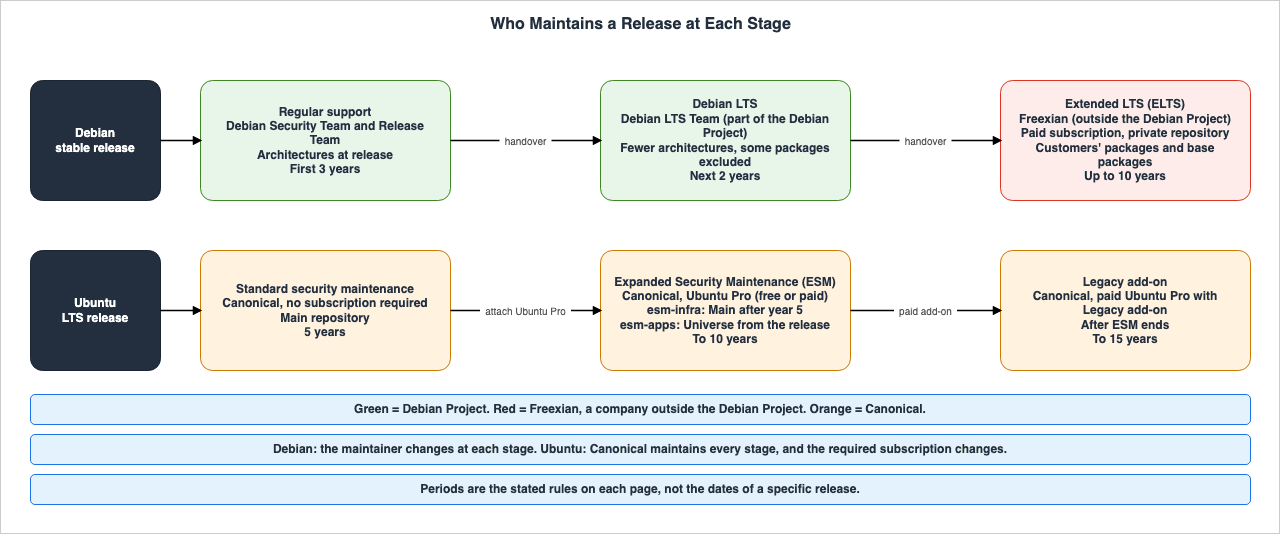
The severity levels of vulnerabilities addressed by ESM are described differently on Canonical's pages. The release cycle page lists critical and high severity fixes, while the Ubuntu Pro page lists critical, high, and some medium severity issues. This article places this discrepancy in the "Where the Sources Differ" chapter, without aligning with either description.
Current Overview of Debian and Ubuntu Support
This chapter lists the Debian and Ubuntu versions that are still receiving some form of maintenance as of November 21, 2026. The dates listed for Debian are taken from the table on the releases page, for Ubuntu they are the release dates listed on the List of releases page, and the ends of the stages are the values on the release cycle page.Debian Releases as of November 21, 2026
| Version | Code Name | Release Date | End of Life (EOL) | End of LTS | End of ELTS | Stage on 2026-11-21 | Debian LTS Architectures |
|---|---|---|---|---|---|---|---|
| Debian 13 | trixie | 2025-08-09 | 2028-08-09 | 2030-06-30 | 2035-06-30 | Regular support (current stable version; latest point release is 13.7, 2026-09-12) | No statement found |
| Debian 12 | bookworm | 2023-06-10 | 2026-07-11 | 2028-06-30 | 2033-06-30 | Debian LTS (latest point release is 12.15, 2026-07-11) | i386, amd64, armhf, arm64, ppc64el |
| Debian 11 | bullseye | 2021-08-14 | 2024-08-14 | 2026-08-31 | 2031-06-30 | ELTS only (latest point release is 11.11, 2024-08-31) | i386, amd64, armhf, arm64 |
| Debian 10 | buster | 2019-07-06 | 2022-09-10 | 2024-06-30 | 2029-06-30 | ELTS only (latest point release is 10.13, 2022-09-10) | i386, amd64, armhf, arm64 |
| Debian 9 | stretch | 2017-06-17 | 2020-07-18 | 2022-07-01 | 2027-06-30 | ELTS only (latest point release is 9.13, 2020-07-18) | i386, amd64, armel, armhf, arm64 |
Debian 14, codenamed forky, is the testing version. The table on the releases page indicates that the release date and end-of-life dates are to be determined (TBA). Debian 15 is currently at the stage where the codename, "Duke," has been announced.
The architectures supported by ELTS are documented on Freexian's page for each version. Debian 9 supports amd64, i386, and armhf. Debian 10 supports amd64, armhf, arm64, and i386. Debian 11 supports amd64, i386 (partially), arm64, and armhf. The documentation for Debian 12 and Debian 13 states that amd64 will be maintained throughout the ELTS lifecycle, while support for other architectures will depend on customer demand.
Ubuntu LTS Releases as of November 21, 2026
| Version | Code Name | Release (List of releases) | End of Standard Support | End of ESM | End of Legacy Add-on | Stage on 2026-11-21 |
|---|---|---|---|---|---|---|
| Ubuntu 26.04 LTS | Resolute Raccoon | 2026-04-23 | 2031-05 | 2036-05 | 2041-05 | Standard security maintenance |
| Ubuntu 24.04 LTS | Noble Numbat | 2024-04-25 | 2029-05 | 2034-05 | 2039-05 | Standard security maintenance |
| Ubuntu 22.04 LTS | Jammy Jellyfish | 2022-04-21 | 2027-05 | 2032-05 | 2037-05 | Standard security maintenance |
| Ubuntu 20.04 LTS | Focal Fossa | 2020-04-23 | 2025-05 | 2030-05 | 2035-05 | ESM |
| Ubuntu 18.04 LTS | Bionic Beaver | 2018-04-26 | 2023-05 | 2028-05 | 2033-05 | ESM |
| Ubuntu 16.04 LTS | Xenial Xerus | 2016-04-21 | 2021-04 | 2026-05 | 2031-05 | Legacy add-on |
| Ubuntu 14.04 LTS | Trusty Tahr | 2014-04-17 | 2019-04 | 2024-05 | 2029-05 | Legacy add-on |
The "End of Standard Support," "End of ESM," and "End of Legacy Add-on" columns are months from the release cycle page. The List of releases page gives some of these rows a month that differs by one month. Which entries vary is indicated in the table in the "Where the Sources Differ" chapter.
The table on the Ubuntu Pro ESM page lists "n/a" for the universe packages in Ubuntu 14.04 LTS. As this article's inference, ESM does not cover the universe packages in 14.04.
Ubuntu Interim Releases as of November 21, 2026
| Version | Code Name | Release (List of releases) | End of Life (List of releases) | State on 2026-11-21 |
|---|---|---|---|---|
| Ubuntu 26.10 | Stonking Stingray | 2026-10-15 | 2027-07 | Supported (ESM not applicable) |
| Ubuntu 25.10 | Questing Quokka | 2025-10-09 | 2026-07 | End of life |
| Ubuntu 25.04 | Plucky Puffin | 2025-04-17 | 2026-01-15 | End of life |
| Ubuntu 24.10 | Oracular Oriole | 2024-10-10 | 2025-07-10 | End of life |
The "Future releases" table on the List of releases page lists the next release with its version number left as xx.yy and the code name "Tenacious T-Rex." The planned release date is April 2027, and the planned end of standard security maintenance is January 2028.
Rows Whose Stage Changes Soon
After November 21, 2026, the following versions will move to a different stage by the end of 2028:- May 2027: Standard security maintenance for Ubuntu 22.04 LTS will end, and it will enter the ESM stage (see the release cycle page. The List of releases page indicates June 2027).
- June 30, 2027: ELTS for Debian 9 stretch will end (see the Freexian page).
- July 2027: Maintenance for Ubuntu 26.10 will end.
- May 2028: ESM for Ubuntu 18.04 LTS will end, and it will enter the Legacy add-on stage (see the release cycle page. The List of releases page indicates April 2028).
- June 30, 2028: Debian 12 bookworm's Debian LTS will end, leaving only ELTS.
- August 9, 2028: Regular support for Debian 13 trixie is scheduled to end, and it will enter the Debian LTS stage (the Freexian page indicates the transition to Debian LTS on August 10, 2028).
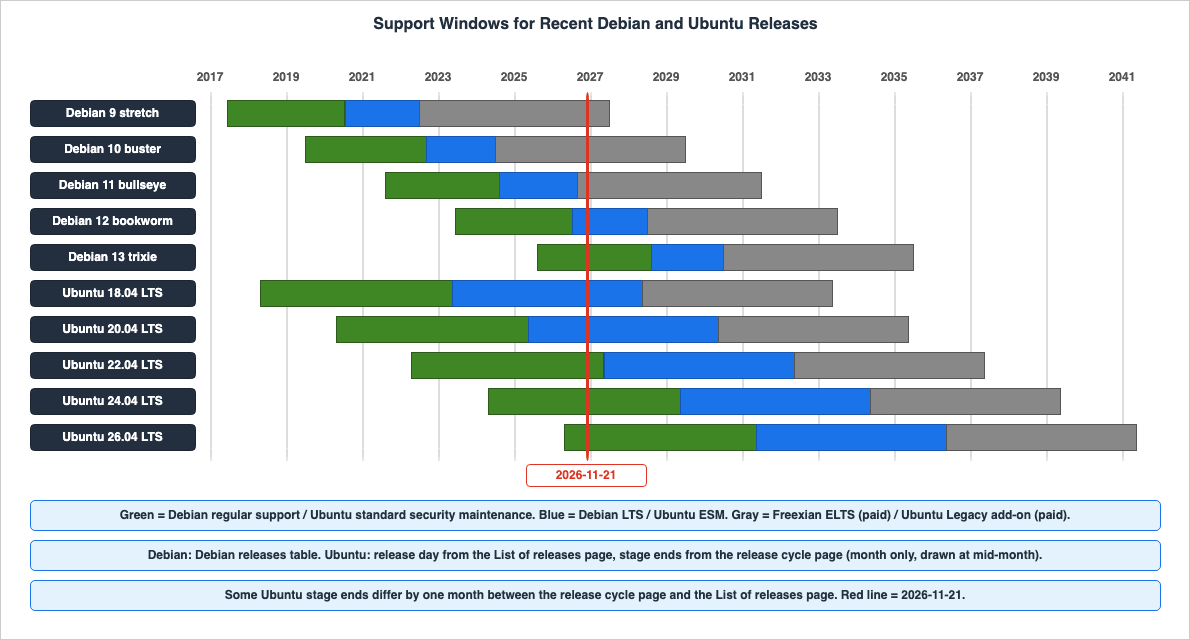
Debian and Ubuntu Support Historical Timeline (Updates from February 6, 2011)
The following three tables constitute the main body of this timeline. Each column is defined as described in the "Background and Method" chapter. All data was referenced as of November 21, 2026. Future plans after November 21, 2026 are listed in the "Current Overview" table and the list of items whose stage will change soon.Index:
- 2011–2019 - This period covers the release of Debian 6 through Debian 10, and Ubuntu 12.04 LTS through Ubuntu 18.04 LTS, as well as the initial launch of ESM on Ubuntu 12.04 LTS.
- 2020–2023 - This period covers the release of Debian 11, Ubuntu 20.04 LTS, and Ubuntu 22.04 LTS, the transition of Debian 9 to ELTS, and the transition of Debian 10 to Debian LTS.
- 2024–2026 - This period covers the inclusion of Debian 12 in Debian LTS, the end of Debian 11's Debian LTS support, and the release of Ubuntu 26.04 LTS.
* You can sort the table by clicking on the column name.
2011–2019 — Debian 6 to Debian 10, and Ubuntu 12.04 LTS to Ubuntu 18.04 LTS
| Date | Distribution | Version | Change | What Happened | Date Source | Source |
|---|---|---|---|---|---|---|
| 2011-02-06 | Debian | Debian 6 squeeze | Release | Debian 6 squeeze was released. | Debian releases table | Debian Releases |
| 2012-04-26 | Ubuntu | Ubuntu 12.04 LTS Precise Pangolin | Release | Ubuntu 12.04 LTS was released. | Ubuntu list of releases | Ubuntu List of releases |
| 2013-05-04 | Debian | Debian 7 wheezy | Release | Debian 7 wheezy was released. | Debian releases table | Debian Releases |
| 2014-04-17 | Ubuntu | Ubuntu 14.04 LTS Trusty Tahr | Release | Ubuntu 14.04 LTS was released. | Ubuntu list of releases | Ubuntu List of releases |
| 2014-05-31 | Debian | Debian 6 squeeze | Handover | Regular support for Debian 6 ended. This is the End of Life date in the table on the releases page. The "End of LTS" column lists 2016-02-29 for Debian 6. | Debian releases table | Debian Releases |
| 2015-04-25 | Debian | Debian 8 jessie | Release | Debian 8 jessie was released. | Debian releases table | Debian Releases |
| 2016-02-29 | Debian | Debian 6 squeeze | End of Support | Debian LTS support for Debian 6 ended. The "End of ELTS" column does not list a value for Debian 6. | Debian releases table | Debian Releases |
| 2016-04-21 | Ubuntu | Ubuntu 16.04 LTS Xenial Xerus | Release | Ubuntu 16.04 LTS was released. | Ubuntu list of releases | Ubuntu List of releases |
| 2016-04-25 | Debian | Debian 7 wheezy | Handover | Regular support for Debian 7 ended. | Debian releases table | Debian Releases |
| 2017-04-28 | Ubuntu | Ubuntu 12.04 LTS Precise Pangolin | Stage Change | ESM support for Ubuntu 12.04 LTS began. The ESM period is listed as 2 years in the ESM table on the list of releases page. The "End of Life" table lists the same date, 2017-04-28, as the end of maintenance for 12.04. | Ubuntu list of releases | Ubuntu List of releases |
| 2017-06-17 | Debian | Debian 9 stretch | Release | Debian 9 stretch was released. | Debian releases table | Debian Releases |
| 2018-04-26 | Ubuntu | Ubuntu 18.04 LTS Bionic Beaver | Release | Ubuntu 18.04 LTS was released. | Ubuntu list of releases | Ubuntu List of releases |
| 2018-05-31 | Debian | Debian 7 wheezy | Handover | Debian LTS support for Debian 7 ended. The "End of ELTS" column lists an approximate date of ~2020-06-30. | Debian releases table | Debian Releases |
| 2018-06-17 | Debian | Debian 8 jessie | Handover | Regular support for Debian 8 ended. | Debian releases table | Debian Releases |
| 2019-04 | Ubuntu | Ubuntu 12.04 LTS Precise Pangolin | End of Support | ESM support for Ubuntu 12.04 LTS ended. | Ubuntu list of releases | Ubuntu List of releases |
| 2019-04 | Ubuntu | Ubuntu 14.04 LTS Trusty Tahr | Stage Change | Standard security maintenance for Ubuntu 14.04 LTS ended. The ESM table on the list of releases page lists 2019-04-25 as the start of ESM support for 14.04. | Ubuntu release cycle | Ubuntu release cycle |
| 2019-07-06 | Debian | Debian 10 buster | Release | Debian 10 buster was released. | Debian releases table | Debian Releases |
2020–2023 — Debian 11, Ubuntu 20.04 LTS and 22.04 LTS, and Debian 9 Moves to ELTS
| Date | Distribution | Version | Change | What Happened | Date Source | Source |
|---|---|---|---|---|---|---|
| 2020-04-23 | Ubuntu | Ubuntu 20.04 LTS Focal Fossa | Release | Ubuntu 20.04 LTS was released. | Ubuntu list of releases | Ubuntu List of releases |
| 2020-06 | Debian | Debian 7 wheezy | End of Support | ELTS for Debian 7 (wheezy) ended. The table on the releases page gives the approximate date ~2020-06-30. | Debian releases table | Debian Releases |
| 2020-06-30 | Debian | Debian 8 jessie | Handover | Debian LTS for Debian 8 (jessie) ended, leaving ELTS only. | Debian releases table | Debian Releases |
| 2020-07-18 | Debian | Debian 9 stretch | Handover | Regular support for Debian 9 (stretch) ended. This is the End of Life date in the table, the same day as 9.13, the last point release listed on the stretch page. The stretch page states that security updates stopped on July 6, 2020. | Debian releases table | Debian Releases, Debian stretch Release Information |
| 2021-04 | Ubuntu | Ubuntu 16.04 LTS Xenial Xerus | Stage Change | Standard security maintenance for Ubuntu 16.04 LTS ended, transitioning to the ESM stage. | Ubuntu release cycle | Ubuntu release cycle |
| 2021-08-14 | Debian | Debian 11 bullseye | Release | Debian 11 (bullseye) was released. | Debian releases table | Debian Releases |
| 2022-04-21 | Ubuntu | Ubuntu 22.04 LTS Jammy Jellyfish | Release | Ubuntu 22.04 LTS was released. | Ubuntu list of releases | Ubuntu List of releases |
| 2022-07-01 | Debian | Debian 9 stretch | Handover | Debian LTS for Debian 9 (stretch) ended, leaving ELTS only. The stretch page indicates this occurred at the end of June 2022. | Debian releases table | Debian Releases, Debian stretch Release Information |
| 2022-09-10 | Debian | Debian 10 buster | Handover | Regular support for Debian 10 (buster) ended. This is the End of Life date in the table, the same day as 10.13, the last point release listed on the buster page. The buster page states that security updates stopped on June 30, 2022. | Debian releases table | Debian Releases, Debian buster Release Information |
| 2023-05 | Ubuntu | Ubuntu 18.04 LTS Bionic Beaver | Stage Change | Standard security maintenance for Ubuntu 18.04 LTS ended, transitioning to the ESM stage. The ESM page states that 18.04 without ESM will no longer receive security updates after May 31, 2023. | Ubuntu release cycle | Ubuntu release cycle |
| 2023-06-10 | Debian | Debian 12 bookworm | Release | Debian 12 (bookworm) was released. | Debian releases table | Debian Releases |
2024–2026 — Debian 12 Enters Debian LTS, Debian 11 Leaves It, and Ubuntu 26.04 LTS
| Date | Distribution | Version | Change | What Happened | Date Source | Source |
|---|---|---|---|---|---|---|
| 2024-04-25 | Ubuntu | Ubuntu 24.04 LTS Noble Numbat | Release | Ubuntu 24.04 LTS was released. | Ubuntu list of releases | Ubuntu List of releases |
| 2024-05 | Ubuntu | Ubuntu 14.04 LTS Trusty Tahr | Stage Change | Ubuntu 14.04 LTS reached the end of its ESM stage and entered the Legacy add-on stage. | Ubuntu release cycle | Ubuntu release cycle |
| 2024-06-30 | Debian | Debian 10 buster | Handover | Debian 10 reached the end of its Debian LTS support and transitioned to ELTS only. | Debian releases table | Debian Releases, Debian buster Release Information |
| 2024-08-14 | Debian | Debian 11 bullseye | Handover | Regular support for Debian 11 ended, and the Debian LTS team took over. An announcement on the same day stated the Debian LTS period would run from August 15, 2024, to August 31, 2026. | Debian news | Security support for Bullseye handed over to the LTS team |
| 2024-08-14 | Debian | Debian 12 bookworm | Schedule Notice | The same announcement set out the rule of three years of regular support and two years of Debian LTS, and the plan for Debian 12. The plan was regular support until June 10, 2026, and Debian LTS would end on June 30, 2028. | Debian news | Security support for Bullseye handed over to the LTS team |
| 2024-08-31 | Debian | Debian 11 bullseye | Point Release | Point release 11.11 was released for Debian 11. The announcement described it as the eleventh and final update. | Debian news | Updated Debian 11: 11.11 released |
| 2024-10-10 | Ubuntu | Ubuntu 24.10 Oracular Oriole | Release | Ubuntu 24.10, an interim release, was released. | Ubuntu list of releases | Ubuntu List of releases |
| 2025-04-17 | Ubuntu | Ubuntu 25.04 Plucky Puffin | Release | Ubuntu 25.04, an interim release, was released. | Ubuntu list of releases | Ubuntu List of releases |
| 2025-05 | Ubuntu | Ubuntu 20.04 LTS Focal Fossa | Stage Change | Standard security maintenance for Ubuntu 20.04 LTS ended, and it entered the ESM stage. The ESM table on the list of releases page indicated that ESM support for 20.04 began in June 2025. | Ubuntu release cycle | Ubuntu release cycle |
| 2025-06-30 | Debian | Debian 8 jessie | End of Support | ELTS support for Debian 8 ended. | Debian releases table | Debian Releases |
| 2025-07-10 | Ubuntu | Ubuntu 24.10 Oracular Oriole | End of Support | Maintenance for Ubuntu 24.10 ended. | Ubuntu list of releases | Ubuntu List of releases |
| 2025-08-09 | Debian | Debian 13 trixie | Release | Debian 13 trixie was released. | Debian releases table | Debian Releases |
| 2025-10-09 | Ubuntu | Ubuntu 25.10 Questing Quokka | Release | Ubuntu 25.10, an interim release, was released. | Ubuntu list of releases | Ubuntu List of releases |
| 2026-01-15 | Ubuntu | Ubuntu 25.04 Plucky Puffin | End of Support | Maintenance for Ubuntu 25.04 ended. | Ubuntu list of releases | Ubuntu List of releases |
| 2026-04-23 | Ubuntu | Ubuntu 26.04 LTS Resolute Raccoon | Release | Ubuntu 26.04 LTS was released. | Ubuntu list of releases | Ubuntu List of releases |
| 2026-05 | Ubuntu | Ubuntu 16.04 LTS Xenial Xerus | Stage Change | Ubuntu 16.04 LTS reached the end of its ESM stage and entered the Legacy add-on stage. The list of releases page indicated that Legacy add-on support for 16.04 began in April 2026. | Ubuntu release cycle | Ubuntu release cycle |
| 2026-07 | Ubuntu | Ubuntu 25.10 Questing Quokka | End of Support | Maintenance for Ubuntu 25.10 ended. | Ubuntu list of releases | Ubuntu List of releases |
| 2026-07-11 | Debian | Debian 12 bookworm | Handover | Regular support for Debian 12 ended. On the same day, point release 12.15 was released. The 2026-07-12 announcement states that the Debian LTS team took over maintenance and that ppc64el is a Debian LTS architecture for the first time. | Debian releases table | Debian Releases, Security support for Bookworm handed over to the LTS team |
| 2026-08-31 | Debian | Debian 11 bullseye | Handover | Debian LTS for Debian 11 ended, leaving ELTS only. The status in the table on the releases page is a release under third-party paid extended LTS support. | Debian releases table | Debian Releases, Debian bullseye Release Information |
| 2026-09-12 | Debian | Debian 13 trixie | Point Release | Point release 13.7 was released for Debian 13. As of 2026-11-21, it is the latest point release for trixie. | Debian release page | Debian trixie Release Information |
| 2026-10-15 | Ubuntu | Ubuntu 26.10 Stonking Stingray | Release | Ubuntu 26.10, an interim release, was released. | Ubuntu list of releases | Ubuntu List of releases |
What Happens After Each Stage Ends
This chapter outlines what information is available after each stage concludes. It does not write what the sources do not say.Debian — Debian LTS, the Archive, and the ELTS Repository
The announcement dated 2026-07-12 advises users of Debian 12's Debian LTS to either subscribe to the Debian LTS announcement mailing list or follow the latest advisories on the LTS Security Information page.Releases whose Debian LTS has ended eventually move to the Debian archive. The Distribution Archives page states that older releases are placed on archive.debian.org. As of 2026-11-21, examining the
dists/ directory on archive.debian.org showed both bullseye and buster. On the same day, the dists/ directory on deb.debian.org showed bullseye but not buster. These observations reflect the state of the directories at the time they were checked and do not represent the dates when the releases were moved. The Distribution Archives page lists releases up to and including buster as of 2026-11-21, but does not list bullseye.Updates for ELTS are delivered from the Freexian repository, not the Debian repository. The page detailing how to use the Freexian repository advises users to disable the Debian repository when adding the ELTS repository.
Whenever you add the Freexian ELTS repository, you should at the same time disable the Debian repositories, because the Debian repositories are likely to break over the lifetime of Freexian’s ELTS service (either because the signing key expires, or because the repository is moved away for archival).Ubuntu — Attaching Ubuntu Pro and Enabling ESM
Once the standard security maintenance for an Ubuntu LTS version ends, machines not connected to Ubuntu Pro will no longer receive security updates. The Expanded Security Maintenance page states the following regarding Ubuntu 20.04 LTS:Running Ubuntu 20.04 without ESM would mean you no longer receive security updates after May 2025.To receive ESM updates, you must connect your machine to an Ubuntu Pro subscription. The Ubuntu Pro Client documentation indicates that running
sudo pro attach will display a link and code. By entering this code into a browser and selecting a subscription, you can connect. The screen for selecting a subscription defaults to the Free Personal Token. After connecting, you can verify that the esm-infra and esm-apps services are enabled using pro status. If they are disabled, enable them using sudo pro enable esm-infra and sudo pro enable esm-apps. The same documentation notes that enabling ESM services may reveal a significant number of new package updates that were previously unavailable. This is particularly common for Ubuntu 14.04 and 16.04.Regarding the Legacy add-on following ESM, the List of releases page states that it is available with a paid Ubuntu Pro with Legacy support add-on subscription. Concerning interim releases, the release cycle page lists ESM and Legacy add-ons as "Not applicable." This article does not cover how to upgrade versions.
How RHEL Compares
This chapter outlines the stages of RHEL, using the values from the Red Hat Product Life Cycles API. The API returns information for RHEL 10, 9, and 8; it does not provide data for RHEL 7 and earlier versions. This article will not include dates for RHEL 7 and earlier versions.| Version | General Availability | End of Full Support | End of Maintenance Support | End of Extended Life Cycle Support (ELS) Add-on | End of Extended Life Phase |
|---|---|---|---|---|---|
| RHEL 10 | 2025-05-20 | 2030-05-31 | 2035-05-31 | 2039-05-31 | Ongoing |
| RHEL 9 | 2022-05-18 | 2027-05-31 | 2032-05-31 | 2036-05-31 | Ongoing |
| RHEL 8 | 2019-05-07 | 2024-05-31 | 2029-05-31 | 2033-05-31 | Ongoing |
The API returns stage names using both a
name and a display_name. The display_name for Extended life cycle support (ELS) add-on is Extended Life Cycle (ELC), and the display_name for Extended life phase is Long-Life Add-On. This article will refer to the name values. The ELS add-on and Extended life phase represent distinct stages. The API describes the ELS add-on as follows:This is an Add-On entitlement. Customers must have this entitlement on their account in order to receive this support.The API describes the Extended life phase as follows:
As there are no bug fixes, security fixes, hardware enablement, or root cause analysis available during the Extended Life Phase, customers may choose to purchase the Extended Life Cycle Support Add-On during the Extended Life Phase, which will provide them with critical impact security fixes and selected urgent priority bug fixes.As this article's inference, the stages of RHEL are similar to those of Ubuntu LTS releases. In both, the same company maintains the release through all stages, and later stages require additional subscriptions. Debian, in contrast, differs in that ownership transitions mid-cycle to a company outside the Debian Project. The granularity of the dates also differs; the RHEL API provides end dates by day, while the Ubuntu release cycle page lists dates by month.
Where the Sources Differ
This chapter presents instances where different sources record different dates for the same events. The "Kind of Difference" value refers to the definition provided in the Background and Method chapter.| Event | Dates by Source | Kind of Difference |
|---|---|---|
| Debian 12 bookworm regular support end | The releases page table and the bookworm page state the end of regular support as 2026-07-11. A 2026-07-12 announcement states that it came to an end "On 12 July 2026." A 2024-08-14 announcement gave the plan as until 2026-06-10. The Freexian Debian 12 page states the transition to Debian LTS as 2026-06-11. | Different kinds of statements (regarding planned dates versus actual dates), Different record formats (2026-07-11 versus 2026-07-12), Sources disagree (regarding Freexian's 2026-06-11). |
| Debian 11 bullseye transition to Debian LTS | The releases page table and the bullseye page state the end of regular support as 2024-08-14. The 2024-08-14 announcement and the Freexian Debian 11 page state the beginning of Debian LTS as 2024-08-15. | Different record formats |
| Debian 13 trixie transition to Debian LTS (planned) | The releases page table and the trixie page state the end of regular support as 2028-08-09. The Freexian Debian 13 page states the transition as 2028-08-10. | Different record formats |
| Debian 10 buster regular support end | The releases page table lists the End of Life as 2022-09-10, coinciding with the final point release (10.13). The buster page states that security updates ended on 2022-06-30. The Freexian Debian 10 page states the transition to Debian LTS as 2022-06-30. | Different kinds of statements |
| Debian 9 stretch regular support end | The releases page table lists the End of Life as 2020-07-18, coinciding with the final point release (9.13). The stretch page states that security updates ended on 2020-07-06. The Freexian Debian 9 page states the transition to Debian LTS as 2020-06-30. | Different kinds of statements, Sources disagree (regarding Freexian's 2020-06-30). |
| Debian 9 stretch end of Debian LTS | The releases page table lists the end as 2022-07-01. The stretch page states the end of June 2022. The Freexian Debian 9 page states the end as 2022-06-30. | Different record formats |
| Ubuntu standard security maintenance end (18.04, 22.04, 24.04) | The release cycle page and the ESM page state 18.04 ends in 2023-05, 22.04 in 2027-05, and 24.04 in 2029-05. The List of releases page states 2023-06, 2027-06, and 2029-06, respectively. The ESM page states that for 18.04, no updates will be received after 2023-05-31. | Sources disagree |
| Ubuntu ESM end (14.04, 16.04, 18.04, 20.04) | The release cycle page and the ESM page state 14.04 ends in 2024-05, 16.04 in 2026-05, 18.04 in 2028-05, and 20.04 in 2030-05. The List of releases page ESM table states 2024-04, 2026-04, 2028-04, and 2030-04, respectively. | Sources disagree |
| Ubuntu LTS versions final stage end (14.04 to 26.04) | The release cycle page's "Legacy add-on" column lists all seven versions (from 14.04 to 26.04) as ending in May (2029-05 to 2041-05). The List of releases page's "End of Life" column lists the same seven versions as ending in April (2029-04 to 2041-04). | Sources disagree |
| Severity of vulnerabilities fixed by ESM | The release cycle page states "critical and high security patches." The ESM page states "high and critical CVEs" in one place and "critical, high, and selected medium CVEs" in another. The Ubuntu Pro page states "critical, high and selected medium vulnerabilities." | Sources disagree |
As this article's inference, the "End of Life" column for Debian versions displays different types of dates depending on the version. Of Debian 9 to Debian 12, whose pages this article read, for Debian 9, 10, and 12 the dates in the column correspond to the release date of the final point release. For Debian 11, the dates reflect the end of regular security maintenance (version 11.11 was released on 2024-08-31). No sentence defining this column appears in the sources this article read (No statement found).
Failure Modes
This chapter lists potential issues that may arise when misinterpreting the information presented in this article, categorized by the type of misinterpretation. Each entry stays in the scope of the original source material.| Failure Mode | What Can Happen | What the Sources Say |
|---|---|---|
| Reading Debian LTS and Ubuntu LTS as synonymous terms | Assuming Debian 12 has stages lasting as many years as those of an Ubuntu LTS release. | Debian LTS is the name of the two-year stage after regular support. Ubuntu LTS refers to a type of version released every two years. |
| Interpreting Freexian's ELTS as a Debian Project maintenance service | Assuming updates for Debian 11 will continue to be received from the Debian repository until 2031. | Freexian's FAQ describes ELTS as a service operated solely by Freexian. Updates are received from a repository provided by Freexian, accessed via credentials. |
| Assuming all architectures are maintained even within Debian LTS | Treating machines with architectures outside of Debian LTS support as if they are being maintained. | Debian 12's Debian LTS support includes the following architectures: i386, amd64, armhf, arm64, and ppc64el. |
| Assuming ELTS maintains all packages for a given release | Assuming updates will be received for packages not in the customer's package list. | ELTS maintains packages used by customers, as well as the base packages for that release. |
| Assuming standard Ubuntu maintenance also fixes packages in the universe repository | Treating universe packages as if they are maintained for five years without a subscription. | Standard security maintenance applies to packages in the main repository; universe is covered by Ubuntu Pro's esm-apps. |
| Assuming ESM updates are received automatically | Assuming Ubuntu 20.04 LTS machines not connected to Ubuntu Pro will continue to be maintained after May 2025. | The ESM page states that 20.04 without ESM will not receive updates after May 2025. ESM becomes active after connecting with sudo pro attach. |
| Assuming Legacy add-on is included in free Ubuntu Pro | Assuming machines running Ubuntu 16.04 LTS will continue to be maintained with a free subscription after May 2026. | The List of releases page states that Legacy add-on is available with a paid Ubuntu Pro subscription that includes the Legacy support add-on. |
| Assuming interim releases also have ESM | Assuming Ubuntu 26.10 can be extended beyond its end-of-life. | The release cycle page lists ESM for 26.10 as "Not applicable" and notes that interim releases receive updates for nine months. |
| Interpreting month-only dates as specific days within that month | Planning dates like 2030-05 as either 2030-05-01 or 2030-05-31. | The release cycle page only lists dates by month, while the List of releases page lists the end of the same stage one month apart for some rows. |
| Interpreting Debian's End of Life dates as the last day of security updates | Assuming security updates for Debian 10 continued until 2022-09-10. | The buster page states that security updates ended on June 30, 2022. The date 2022-09-10 listed in the table corresponds to the last point release. |
| Maintaining Debian repositories even after adding ELTS repositories | The Debian repositories can break when the signing key expires or the repository moves to the archive. | Freexian's page states that when adding ELTS repositories, the Debian repository should be disabled. |
Frequently Asked Questions about Debian and Ubuntu Support
This chapter answers common questions in the scope of the sources used in this article. All dates provided are current as of November 21, 2026.Is Debian 11 bullseye still supported?
Maintenance by the Debian Project ended on August 31, 2026. While Debian 11's Debian LTS support ended on August 31, 2026, the table on the Debian releases page indicates that the bullseye version is now supported under a third-party, paid extended maintenance program. This program is called Freexian ELTS, and the Freexian website states that it will provide support for Debian 11 until June 30, 2031. Using ELTS requires a paid subscription from Freexian, and updates are delivered from Freexian's repository.When does Debian 12 bookworm stop receiving security updates?
Maintenance by the Debian Project is scheduled to end on June 30, 2028. Regular support for Debian 12 ended on July 11, 2026, and as of 2026-11-21 the Debian LTS team maintains it. Debian LTS support will continue until June 30, 2028, and will cover the following architectures: i386, amd64, armhf, arm64, and ppc64el. Following that, Freexian's ELTS will continue until June 30, 2033.Is Freexian's Extended LTS part of the Debian Project?
No. Freexian's FAQ states that Debian LTS is part of the Debian Project, while clarifying that Extended LTS is a service operated solely by Freexian. The Debian bullseye page also mentions that maintenance until June 30, 2031, is provided through a paid security maintenance service offered by a third party.Is Ubuntu Pro ESM free?
Yes, with conditions. The Ubuntu List of releases page states that ESM is available with both free and paid Ubuntu Pro subscriptions. The Ubuntu Pro page indicates that for individual use, it is free for up to 5 physical machines, and for official members of the Ubuntu Community, up to 50 machines. The Legacy add-on following ESM is only available with a paid subscription.When does ESM end for Ubuntu 20.04 LTS?
The release cycle page states May 2030, while the ESM table on the List of releases page states April 2030. Both pages only specify the month. The release cycle page also indicates that the Legacy add-on continues until May 2035.Does Ubuntu's standard security maintenance cover universe packages?
No. Standard security maintenance covers packages in the main repository of LTS releases for a period of 5 years. Ubuntu Pro's esm-apps covers packages in the universe repository for 10 years from the initial release of the LTS version.Do Ubuntu interim releases get ESM?
No. The release cycle page states that interim releases receive updates for 9 months, and indicates that ESM and the Legacy add-on are not applicable for Ubuntu 26.10.How does the RHEL life cycle compare with Debian and Ubuntu?
Red Hat's Product Life Cycles API indicates that RHEL 10 became generally available on May 20, 2025, with full support continuing until May 31, 2030, maintenance support until May 31, 2035, and the Extended life cycle support (ELS) add-on until May 31, 2039. The ELS add-on requires an additional subscription. As this article's inference, RHEL is similar to Ubuntu in that the same company provides support throughout the lifecycle, and an additional subscription is required for later stages, while it differs from Debian.Summary
This timeline begins with the release of Debian 6 squeeze on February 6, 2011. As of November 21, 2026, the current stable version of Debian is Debian 13 trixie (13.7), while Debian 12 bookworm is in the Debian LTS stage. Debian 11 bullseye, Debian 10 buster, and Debian 9 stretch are only maintained by Freexian's ELTS.In Ubuntu, versions 26.04 LTS, 24.04 LTS, and 22.04 LTS are currently in the standard security maintenance stage. Versions 20.04 LTS and 18.04 LTS are in the ESM stage, while versions 16.04 LTS and 14.04 LTS are in the Legacy add-on stage.
⇒ Changes in maintenance stages result in a change of responsibility in Debian and a change in subscription requirements in Ubuntu. Debian versions transition from regular support by the security and release teams to the Debian LTS team, and then further to Freexian's paid ELTS. Canonical maintains Ubuntu LTS versions at every stage. Standard security maintenance requires no subscription, ESM is available with free or paid Ubuntu Pro, and Legacy add-on support requires a paid subscription.
⇒ Changes in maintenance stages also result in a narrowing of the scope of support. Debian LTS focuses on a limited set of architectures, while ELTS focuses on packages used by customers and base packages. Ubuntu's standard security maintenance covers only the main package repository, while Ubuntu Pro's esm-apps covers the universe repository.
⇒ The term "LTS" has different meanings in Debian and Ubuntu. In Debian, "LTS" refers to a maintenance stage, while in Ubuntu, it refers to a type of release. Freexian's Extended LTS, Ubuntu's Expanded Security Maintenance, and RHEL's Extended life cycle support (ELS) add-on are all separate systems offered by different companies.
⚠ The end of the same stage may be written with different dates or months, depending on the page. The end of Debian 12's regular support is 2026-07-11 in the Debian table and 2026-06-10 in the plan in the 2024 announcement, and the Freexian page gives the handover to the Debian LTS team as 2026-06-11. The Ubuntu release cycle page and the List of releases page give the end of some versions' stages in months one month apart. All information is current as of 2026-11-21.
This timeline will be updated as Debian and Ubuntu publish new releases and change their support stages.
In addition, there are related history-and-timeline articles on this site, so please have a look if you are interested.
- Amazon Linux History and Timeline - Amazon Linux AMI, Amazon Linux 2, AL2023, AL2027, and the Clocks That Do Not Move Your Instances
- Windows Server and SQL Server Lifecycle Timeline - Mainstream, Extended, and Extended Security Update Years
- containerd, Kubernetes, and Docker Engine Support Timeline - Recommended Pairings, End of Life, and What Does Not Carry Over
- Kubernetes Release and Support Timeline - Minor Releases, Maintenance Mode, End of Life, and Version Skew
- What a GitHub-Hosted Runner Label Resolves To - ubuntu-latest to Ubuntu 26.04, the macos-14 Retirement, and Tool Versions in AWS Deploy Jobs
References:
- Debian Releases
- Debian trixie Release Information
- Debian bookworm Release Information
- Debian bullseye Release Information
- Debian buster Release Information
- Debian stretch Release Information
- Debian forky Release Information
- Debian Long Term Support
- Debian Distribution Archives
- Security support for Bullseye handed over to the LTS team
- Updated Debian 11: 11.11 released
- Security support for Bookworm handed over to the LTS team
- Updated Debian 12: 12.15 released
- Debian Extended LTS by Freexian
- Debian Extended LTS FAQ
- Extended LTS for Debian 9 Stretch
- Extended LTS for Debian 10 Buster
- Extended LTS for Debian 11 Bullseye
- Extended LTS for Debian 12 Bookworm
- Extended LTS for Debian 13 Trixie
- How to use Extended LTS
- Ubuntu release cycle
- Ubuntu Expanded Security Maintenance
- Ubuntu Pro
- Ubuntu List of releases
- About ESM, esm-apps and esm-infra
- How to attach a machine to your Ubuntu Pro subscription
- How to manage Expanded Security Maintenance (ESM) services
- Red Hat Product Life Cycles API - Red Hat Enterprise Linux
- Red Hat Enterprise Linux Life Cycle
References:
Tech Blog with curated related content
Written by Hidekazu Konishi