containerd, Kubernetes, and Docker Engine Support Timeline - Recommended Pairings, End of Life, and What Does Not Carry Over
First Published:
Last Updated:
The Kubernetes version matrix represents the versions of containerd which are recommended for a Kubernetes release.The same paragraph indicates that the recommendations are based on which versions have been most thoroughly tested. Therefore, this table represents a list of recommended pairings, and does not guarantee that pairings not listed will not work, nor that pairings listed will always function correctly.
As of November 16, 2026, the three series have several deadlines that are near or have just passed. containerd 1.7 reached End of Life on September 30, 2026. containerd 2.2 is still listed as "Active" in the same table, but has already passed its End of Life date of November 6, 2026. Kubernetes 1.34 reached End of Life on October 27, 2026. The moby project's table lists December 4, 2026 as the expected end of maintenance for Docker Engine 25.0. Kubernetes 1.38 is planned for release on December 16, 2026.
This article provides a timeline and pairing tables for containerd, Kubernetes, and Docker Engine versions, answering three key questions: First, which version pairings are recommended in the containerd table, that is, what goes together? Second, until when is each version maintained, and in which status words of which project is that maintenance written? Third, what does not carry over when you upgrade a version?
Based on the information explicitly provided in the primary sources, the answers are as follows. First, regarding pairings. The containerd table recommends containerd 2.4.0 and later and 2.3.0 and later for Kubernetes 1.37, and 2.3.0 and later and 2.2.0 and later for Kubernetes 1.36. The last row that lists containerd 1.7 is Kubernetes 1.35.
Next, regarding deadlines. The three projects use different terminology to describe the end of maintenance. containerd uses "End of Life," Kubernetes uses "maintenance mode" and "End of Life," and the moby table uses "Maintained" and "Unmaintained." The moby table notes that this status is not binding, while the Docker Install page states that Docker doesn't provide support for Docker Engine.
Finally, regarding what does not carry over. Upgrading from containerd 1.x to 2.x results in changes to the names of keys in the Container Runtime Interface (CRI) configuration, and CRI v1alpha2 is no longer present. Kubernetes sources announce that the kubelet will drop its fallback behavior for containerd 1.y and below, and that older containerd versions will fail with newer kubelets. The sources disagree on the version. The KEP-4033 README names Kubernetes 1.38, and the Container Runtimes page, rechecked on November 17, 2026, names no version and says a future release. While cgroup v1 is deprecated by Kubernetes, Docker Engine, and containerd, what "deprecated" means and when it ends vary for each project.
This article only provides the dates, recommended pairings, status words, and what does not carry over when you upgrade, along with their respective sources. It does not address product comparisons, recommendations on which version to upgrade to, migration procedures, Docker Desktop, Windows containers, or the contracts and pricing of Mirantis and Docker's paid products. CRI-O, Podman, gVisor, and Kata Containers are only mentioned by name.
Background and Method of Creating the containerd, Kubernetes, and Docker Engine Support Timeline
This section defines the sources used in the timeline and tables, the words for the state of those sources, the columns within the timeline, and how to represent discrepancies between sources. All sources were referenced on November 16, 2026 (Japan Standard Time). The sources for Docker Engine 29.10.0 and for the kubelet's fallback behavior for containerd 1.y were rechecked on November 17, 2026.The Primary Sources Used in This Article, and What Became Rows
The rows of the timeline and tables were created from the following sources:- containerd: The Releases page on containerd.io and the
RELEASES.mdfile in the containerd repository on GitHub. These two contain the same content, so this article does not count them as two independent sources. This article calls this content the "containerd Releases page." This article used the table of status and End of Life dates for each release, the Kubernetes Support table, the Deprecated features table, and the Upgrade Path section. Dates for each patch are based on the dates listed on the GitHub Releases page.
- Docker Engine: The Docker Engine release notes page on docs.docker.com. This article used the pages for versions 25.0, 26.0, 26.1, 27, 28, and 29. The pages for version 26 are split into 26.0 and 26.1. In addition, this article used the Deprecated features page and the Install page.
- moby table: The
project/BRANCHES-AND-TAGS.mdfile in the moby repository on GitHub. This table details the maintenance status of each Docker Engine branch and provides expected end-of-maintenance dates. Within the sources this article checked, this table is the only source that gives the maintenance status of Docker Engine versions in a table.
- Kubernetes: The Releases page, Patch Releases page, Container Runtimes page, About cgroup v2 page, and Migrating from dockershim page on kubernetes.io. Dates for the initial release and patches for each version are based on the dates listed on the GitHub kubernetes repository's Releases page. The
release-1.38README file in the sig-release repository gives the schedule for Kubernetes 1.38. For the kubelet's detection of the cgroup driver, the sources are the KEP-4033 README andkep.yamlin sig-node, and CHANGELOG-1.38 up to v1.38.0-beta.0.
- cri-dockerd and Mirantis Container Runtime: The Mirantis cri-dockerd repository on GitHub, and the MCR 25.0 Maintenance Lifecycle page in the Mirantis documentation.
- AWS: The Amazon EKS user guide's Kubernetes version release notes page, the EKS optimized AMI page, the AL2 AMI migration FAQ, the EKS Best Practices Guide's cluster upgrade page, the AWS Containers Blog article on Kubernetes 1.24, and the GitHub page for
awslabs/amazon-eks-ami's releases.
The timeline highlights the start and end dates of minor versions of containerd (from 1.0 to 2.5), the initial releases of Docker Engine (versions 25.0 through 29), key milestones for Kubernetes (versions 1.20, 1.24, and 1.30 through 1.38), and the deprecation and removal dates for cgroup v1, dockershim, and CRI v1alpha2. This timeline does not include every patch of containerd, Kubernetes, and Docker Engine. In other words, please note that the items on this timeline are not all dates of containerd, Kubernetes, and Docker Engine, but are representative updates that I have picked out.
Three Projects, and the Names This Article Uses
This article refers to three distinct projects using the following names:- containerd: A container runtime. This name is always written in lowercase, even at the beginning of sentences. Versions are counted by release branches identified by
<major>.<minor>. - Docker Engine: A container engine built from the moby repository. Versions are numbered using major version numbers, and branch names follow the format
docker-29.xor, for older versions,25.0. - Kubernetes: Versions are numbered using a format such as
1.<minor>.
The name "Docker" refers to at least four different entities. Docker Engine is the engine discussed in this article. Docker Desktop is a separate product that is not covered in this article. Mirantis Container Runtime (MCR) is a commercial container runtime that, according to Kubernetes documentation, was previously known as Docker Enterprise Edition. Docker, Inc. is a company. This article avoids using the term "Docker" alone and instead clarifies which entity is being referenced by using the specific name.
Words That Look the Same but Mean Different Things
Here are words that have the same appearance but different meanings depending on the project. This article keeps their English spelling and adds which project each word belongs to.- support: The containerd Kubernetes Support table is a recommendation table. The word "support" on the Docker Install page is about whether the company provides support. "Patch support" in the context of Kubernetes refers to the duration for which patches are released. Amazon EKS standard support is an EKS term, and this article does not cover it.
- LTS: In the containerd table, 2.0 and 2.3 are in the LTS status. Version 2.3 is maintained by the containerd committers. For 2.0, maintenance by all committers ended on November 7, 2025, and since then two individuals have extended it, limited to use with Kubernetes 1.33 on Google Kubernetes Engine. The same word LTS covers different contents for the two releases.
- End of Life: This term refers to the status of containerd and also indicates the End-of-Life (EOL) dates for various Kubernetes versions. The moby table uses "Unmaintained" and "Expected End of Maintenance" instead of "End of Life." The term "End of Life" (EOL) on the Mirantis page is a word for Mirantis's products.
- deprecated: Kubernetes' deprecation of cgroup v1 means that kubelet will no longer start by default on nodes using cgroup v1. Docker Engine and containerd's deprecation of cgroup v1 is accompanied by a statement that support continues until May 2029.
- maintenance mode: In the Kubernetes Patch Releases page, "maintenance mode" refers to the stage when a series of patches enters the two months prior to their End of Life. The AWS AL2 AMI FAQ uses the same term to refer to the support status of cgroup v1.
- 1.7: containerd 1.7 and Kubernetes 1.7 are distinct. The containerd Deprecated table includes a row pairing containerd 1.0 and Kubernetes 1.7. In this article, the project name is always included before a version number.
Goes Together and Carries Over
This article uses the following terms:- goes together: This refers to cases where two versions are written as a pairing in a table in one of the sources. In this article, these are the containerd versions that the containerd Kubernetes Support table recommends for a Kubernetes version, and the bundled containerd versions that the Docker Engine release notes mention. Whenever this article uses the phrase "goes together," it will specify which table is being referenced and whether the listed containerd version is recommended or bundled.
- carries over: This means that after upgrading a version, the previous version's settings, APIs, and operating assumptions can still be used as they are. Whenever this article uses the phrase "carries over," it will specify which version is being upgraded from and which version is being upgraded to, and what does not carry over.
Terms for the State of the Sources
This article uses six terms to describe the state of the sources. This article uses these English spellings in table cells as well.- Stated: The source contains text describing the matter in question.
- Stated as not supported: The source explicitly states that it does not support, or cannot be used for, the matter.
- Documentation does not list: While a list or table exists, the specific item is not included. This does not necessarily indicate that the matter is unsupported or unavailable.
- No statement found: Despite searching using different keywords and examining different categories of sources, no relevant text could be found. This does not necessarily indicate that the matter is unsupported or unavailable.
- Sources disagree: The text from two different sources provides conflicting information regarding the same matter. This includes cases where the statements directly contradict each other, as well as cases where the scope, strength, or subject matter differs, making it impossible to determine from the text which statement applies. This article will present both statements and their sources without designating either as incorrect.
- Inference: This represents an inference made by this article, and is not a statement found in any of the sources. This article marks an inference as such in the same sentence.
Dates within this article are always presented with the year. Pages may be rewritten after the check date. GitHub dates are the value of the
datetime attribute in the page HTML, and are dates in Coordinated Universal Time (UTC).Timeline Table Columns and Sources for the Dates
Each table in the timeline includes the following seven columns:- Date — Represents the date associated with the row. All dates are written in the
YYYY-MM-DDformat. - Project — Indicates the project that the row is about: containerd, Docker Engine, Kubernetes, cri-dockerd, or Amazon EKS.
- Version — Indicates the version or release branch that the row is about.
- Change — Indicates the type of change. The value will be one of the options listed below.
- What Happened — Describes the event or change. Where a source is quoted, the quotation is verbatim.
- Date Source — Specifies the type of document from which the 'Date' value was obtained. The value will be one of the options listed below.
- Source — Refers to the specific document used as the basis for the row.
The Change column has the following nine values.
First Release— The initial release of that version, or the Start date from the containerd release table.Patch Release— A patch release.Maintenance Mode— The date when the Kubernetes patch series entered maintenance mode.End of Life— The End of Life date from the containerd release table, or the End of Life date for each Kubernetes version.End of Maintenance— The Expected End of Maintenance date from the moby table, or the date when a distributor stopped releasing its distribution.Support Change— The date when the support team or scope for a particular version changed.Deprecation— The version in which a feature was deprecated.Removal— The version in which a feature was removed, or the target date for its removal.Pre-release— A release prior to the official release, such as a beta version.
The Date Source column has the following six values.
containerd release table— Dates in the table on the containerd Releases page.GitHub release— Dates from the GitHub Releases page (UTC).Docker release notes— Dates from the Docker Engine release notes on docs.docker.com.kubernetes.io— Dates from the kubernetes.io Releases page or the Patch Releases page.Project schedule— Projected dates from the moby table, dates from the sig-release schedule, or target dates on the deprecated features pages of Docker Engine and containerd.AWS documentation— Dates from AWS documentation.
For a scheduled date that the source gives only to the month, the Date column uses the
YYYY-MM format. When a single row contains information from multiple sources, the date in the "Date" column reflects the date from the "Date Source" listed, with the other sources added to the "Source" field. Planned entries that have not yet occurred are listed in a separate table.When Sources Differ
Sometimes, different sources may record different dates or different statuses for the same event. This article lists them in the table in the Where the Sources Differ and What They Do Not Say chapter, without dismissing either source. The "Kind of Difference" column contains the following four values:Sources disagree— As defined in the previous section, the text in two sources does not match.Disagrees within the same page— Within a single page, the status word and the date, or the policy text and the table values, do not align. For example, the status remains "Active" while the end date has already passed. This article records both, with the check date, without favoring one over the other.Different kinds of statements— The sources provide different types of information. For example, a recommendation table, an advance notice, and a vendor's documentation, or a planned date and an actual date. This article does not determine which is incorrect.Different record formats— The same date may appear different due to differences in time zones or record formats.
This article does not speculate on why sources differ unless the sources say why.
Topics Covered in Other Articles
The following topics are discussed in detail in separate articles:- The End of Life dates, release cycles, and version skew policies for each minor version of Kubernetes are in Kubernetes Release and Support Timeline. This article focuses solely on the dates relevant to Kubernetes when used with containerd and Docker Engine.
- The end-of-support dates for Kubernetes versions on Amazon EKS are detailed in AWS End-of-Support and EOL Reference. In the Where AWS Fits chapter, this article covers only what the EKS documentation says about containerd and cgroup v1.
- The history and timeline for Amazon Linux 2 and Amazon Linux 2023 are available in Amazon Linux History and Timeline.
- Information on containerd’s SOCI snapshotter and lazy loading is provided in SOCI Lazy Loading on Fargate, Lambda Managed Instances, and SageMaker AI.
- Details on workload isolation levels and RuntimeClass on Amazon EKS can be found in Workload Isolation Levels on Amazon EKS.
- The version of Docker Engine used by GitHub-hosted runners is described in What a GitHub-Hosted Runner Label Resolves To.
How Each Project Defines Support
The three projects define version maintenance in different ways. This chapter lists each project's status words and the source of each word.containerd — Active, Extended, LTS, and End of Life
The containerd Releases page defines the status of release branches using eight terms: Future, Alpha, Beta, RC, Active, Extended, LTS, and End of Life. The definitions for the four terms related to maintenance are as follows:Active: The release is a stable branch which is currently supported and accepting patches.
Extended: The release branch is only accepting security patches.
LTS: The release is a long term stable branch which is currently supported and accepting patches.
End of Life: The release branch is no longer supported and no new patches will be accepted.Regarding timelines, the same page states that regular (non-LTS) releases are supported for 8 months from their minor release. One release per year is designated as LTS, and LTS releases are supported for at least 2 years from their initial
x.y.0 release.Regular (non-LTS) releases will be supported for 8 months after a minor release.Concerning release cycles, the page indicates that starting with containerd 2.3 in April 2026, minor releases will be released every 4 months. New minor releases are planned for April, August, and December each year, and this schedule is aligned with Kubernetes release timelines.
Since containerd v2.3 in April 2026, minor releases are provided on a time basis with a cadence of 4 months.As of November 16, 2026, no release in the containerd table is in the Extended status.
Docker Engine — Maintained and Unmaintained on the moby Branch Table
The moby table documents whether each Docker Engine version is maintained. The table lists, for each branch, the Sponsoring Maintainer(s), Contribution Status, Expected End of Maintenance, and Known Distributors. The Contribution Status can be one of three values: Maintained, Maintained (security), or Unmaintained. "Maintained" indicates that the project maintainers continue development, accept contributions and backports, and the version is subject to security advisories. "Maintained (security)" indicates that development has ceased but contributions and backports for critical security issues may be accepted, and the version is subject to security advisories. "Unmaintained" signifies that development has ceased, contributions are no longer accepted, and the version is no longer subject to security advisories. The same section places the following sentence about this status.This status is informational and not binding.The "Install" page on docs.docker.com describes Docker Engine support as follows.
Docker Engine is an open source project, supported by the Moby project maintainers and community members. Docker doesn't provide support for Docker Engine.The docs.docker.com pages that this article checked have no table of end dates for each major version of Docker Engine (No statement found). The "Release lifecycle" page on docs.docker.com, which describes the stages of product features, does not provide end dates for Docker Engine versions. Therefore, all of this article's information on the maintenance status and expected end of maintenance for Docker Engine is based on the values listed in the moby table.
Kubernetes — About One Year of Patches, Maintenance Mode, and End of Life
The kubernetes.io Releases page states that the project maintains release branches for the three most recent minor versions, and that versions of Kubernetes 1.19 and later receive approximately one year of patch support.The Kubernetes project maintains release branches for the most recent three minor releases (1.37, 1.36, 1.35).The Patch Releases page indicates that the support period is approximately 14 months. The first 12 months are the standard period, after which the patch release series enters maintenance mode. During this two-month maintenance mode period, releases may be issued to address vulnerabilities that have an assigned CVE ID, dependency issues, and critical core component problems. Once the two months are complete, the series reaches End of Life. The same page notes that, for simplicity, the target dates for maintenance mode and End of Life are set to the 28th of the month.
The Three Vocabularies Side by Side
The following table lists the status words of the three projects alongside the names of the sources. Even when terms appear in the same row, their meanings may not be identical.| Project | Source | Words for a Maintained Version | Words for a Version That Is No Longer Maintained | Stated Period |
|---|---|---|---|---|
| containerd | containerd Releases page | Active, Extended (security patches only), LTS | End of Life | Regular (non-LTS) releases are supported for 8 months; LTS releases are supported for at least 2 years. |
| Docker Engine | moby table | Maintained, Maintained (security) | Unmaintained | There are no defined periods. Only the Expected End of Maintenance value for each branch is specified. The status is informational and not binding. |
| Kubernetes | kubernetes.io Releases page and Patch Releases page | The latest three minor versions; the final two months are in maintenance mode. | End of Life | Approximately 14 months, with the first 12 months representing the standard support period. |
Current Overview of containerd, Kubernetes, and Docker Engine Support
This chapter presents the status of the three series as of November 16, 2026, using the original terminology for each project. The values in each table represent data from the respective projects and are not this article's judgment.containerd Release Branches as of November 16, 2026
The following table shows rows from the containerd Releases page, specifically for versions 1.6 through 2.5. The "Latest Patch" column reflects the values as of November 16, 2026, on the GitHub Releases page. On the containerd Releases page, the link in each row's "Release" column points to a specific patch, such as v2.4.1 for 2.4 and v2.2.9 for 2.2, which can be older than the "Latest Patch" column of this table.| Release | Status (as of 2026-11-16) | Start | End of Life | Latest Patch | Note |
|---|---|---|---|---|---|
| containerd 1.6 | End of Life | 2022-02-15 | 2025-08-23 | — | |
| containerd 1.7 | End of Life | 2023-03-10 | 2026-09-30 | — | Listed in the Kubernetes Support table up to the Kubernetes 1.35 row. |
| containerd 2.0 | LTS | 2024-11-05 | March 2027 | v2.0.14 (2026-10-13) | Maintenance by all committers ended on November 7, 2025. After that, two individuals extend it, limited to use with Kubernetes 1.33 on Google Kubernetes Engine. |
| containerd 2.1 | End of Life | 2025-05-07 | 2026-07-03 | — | |
| containerd 2.2 | Active | 2025-11-05 | 2026-11-06 | v2.2.10 (2026-10-13) | Status remains Active, despite having passed the End of Life date. |
| containerd 2.3 | LTS | 2026-04-30 | 2028-04-30 | v2.3.7 (2026-10-13) | First release under the four-month cadence. |
| containerd 2.4 | Active | 2026-09-16 | 2027-05-16 | v2.4.2 (2026-10-13) | |
| containerd 2.5 | Planned | 2027-01-06 | 2027-09-06 | — | The eight status words that the same page defines do not include Planned. |
The row for version 2.0 includes a footnote. The full text of the footnote is:
Support for the 2.0 release branch was provided by @containerd/committers until November 7, 2025. Extended support through March 2027 is provided by @samuelkarp and @chrishenzie. This extended support is focused on usage with Kubernetes 1.33 via Google Kubernetes Engine. Changes may not be accepted if they are not needed for this usage.The duration specified in the policy and the actual durations shown in the table do not align for every row. Versions 2.4 and 2.5 have a duration of 8 months, which matches the policy's "8-month" timeframe. Version 2.2 has a duration of approximately 12 months, and version 2.1 has a duration of approximately 14 months. The policy section on the same page states that releases may have an extended security support period after the active period, and that the maintainers decide its length. The table does not state whether the durations for 2.1 and 2.2 correspond to this extended period (No statement found).
Docker Engine Release Branches as of November 16, 2026
The following table combines rows from the moby table with the initial release dates listed in the release notes on docs.docker.com.| Branch | Contribution Status (as of 2026-11-16) | Expected End of Maintenance | Known Distributors | First Release | Latest on Release Notes |
|---|---|---|---|---|---|
docker-29.x | Maintained | After docker-30.x | Docker, Inc., Microsoft | 29.0.0 (2025-11-10) | 29.10.0 (2026-11-16) |
docker-28.x | Unmaintained | — | — | 28.0.0 (2025-02-19) | 28.5.2 (2025-11-05) |
27.x | Unmaintained | — | — | 27.0.1 (2024-06-24) | 27.5.1 (2025-01-22) |
26.1 | Unmaintained | — | — | 26.1.0 (2024-04-22) | — |
26.0 | Unmaintained | — | — | 26.0.0 (2024-03-20) | — |
25.0 | Maintained | 2026-12-04 | Amazon, Mirantis | 25.0.0 (2024-01-19) | — |
Docker Engine 27 does not have a 27.0.0 release. The release notes for version 27 explain the reason for this.
There's no 27.0.0 release due to a mistake during the pre-release of 27.0.0-rc.1 on GitHub which resulted in the v27.0.0 tag being created.The
25.0 branch is the only branch older than 29 in the Maintained status. The branch is sponsored by a single maintainer, and the known distributors are Amazon and Mirantis. The "Expected End of Maintenance" date of 2026-12-04 links to the Mirantis MCR 25.0 Maintenance Lifecycle page. The date listed on that page as of 2026-11-16 is shown in the Where the Sources Differ and What They Do Not Say chapter.Kubernetes Minor Releases as of November 16, 2026
The following table shows the values on the Kubernetes Releases page and Patch Releases page, combined with the initial release date from GitHub.| Release | State on kubernetes.io (as of 2026-11-16) | First Release (GitHub) | Maintenance Mode | End of Life | Latest Release on kubernetes.io | Latest Patch on GitHub |
|---|---|---|---|---|---|---|
| Kubernetes 1.37 | Release History | 2026-08-26 | 2027-08-28 | 2027-10-28 | 1.37.1 | v1.37.2 (2026-10-28) |
| Kubernetes 1.36 | Release History | 2026-04-22 | 2027-04-28 | 2027-06-28 | 1.36.5 | v1.36.6 (2026-10-28) |
| Kubernetes 1.35 | Release History | 2025-12-17 | 2026-12-28 | 2027-02-28 | 1.35.9 | v1.35.10 (2026-10-28) |
| Kubernetes 1.34 | Release History | 2025-08-27 | 2026-08-27 | 2026-10-27 | 1.34.12 | v1.34.13 (2026-10-28) |
| Kubernetes 1.33 | End-of-Life Releases | 2025-04-23 | — | 2026-06-28 | 1.33.13 | — |
| Kubernetes 1.32 | End-of-Life Releases | 2024-12-11 | — | 2026-02-28 | 1.32.13 | — |
Kubernetes 1.34 has passed its End of Life date, but on the Releases page as of 2026-11-16, it appears alongside other maintained versions in the Release History section. The introductory text on that same page states that versions 1.37, 1.36, and 1.35 are currently being maintained. On the Releases page, the "Latest Release" section still lists all four versions as having been released on 2026-09-15. The Patch Releases page lists the next patches as 1.37.2, 1.36.6, and 1.35.10. Neither page includes the four versions released on GitHub on 2026-10-28. The Patch Releases page indicates a target date of 2026-11-10 for the November patch, but on 2026-11-16, attempts to access the release pages for v1.35.11 and v1.37.3 on GitHub returned 404. This does not show that those releases do not exist.
Rows Whose Status Changes Soon
The following four rows indicate status changes expected soon after this article's check date.- The Expected End of Maintenance for Docker Engine 25.0 (as listed in the moby table) is December 4, 2026.
- Kubernetes 1.38 is planned for release on December 16, 2026, according to the sig-release schedule.
- Kubernetes 1.35 is scheduled to enter maintenance mode on December 28, 2026, as indicated in the Patch Releases page.
- containerd 2.5 is scheduled to begin on January 6, 2027, as shown in the containerd table.
The containerd 2.2 row is not a scheduled date: as of November 16, 2026, its status in the table is still Active.
Which Versions Go Together
This chapter states which versions go together, table by table. Each table is the statement of the project that made it, not a commitment by any other project.The containerd Recommendation Table for Each Kubernetes Release
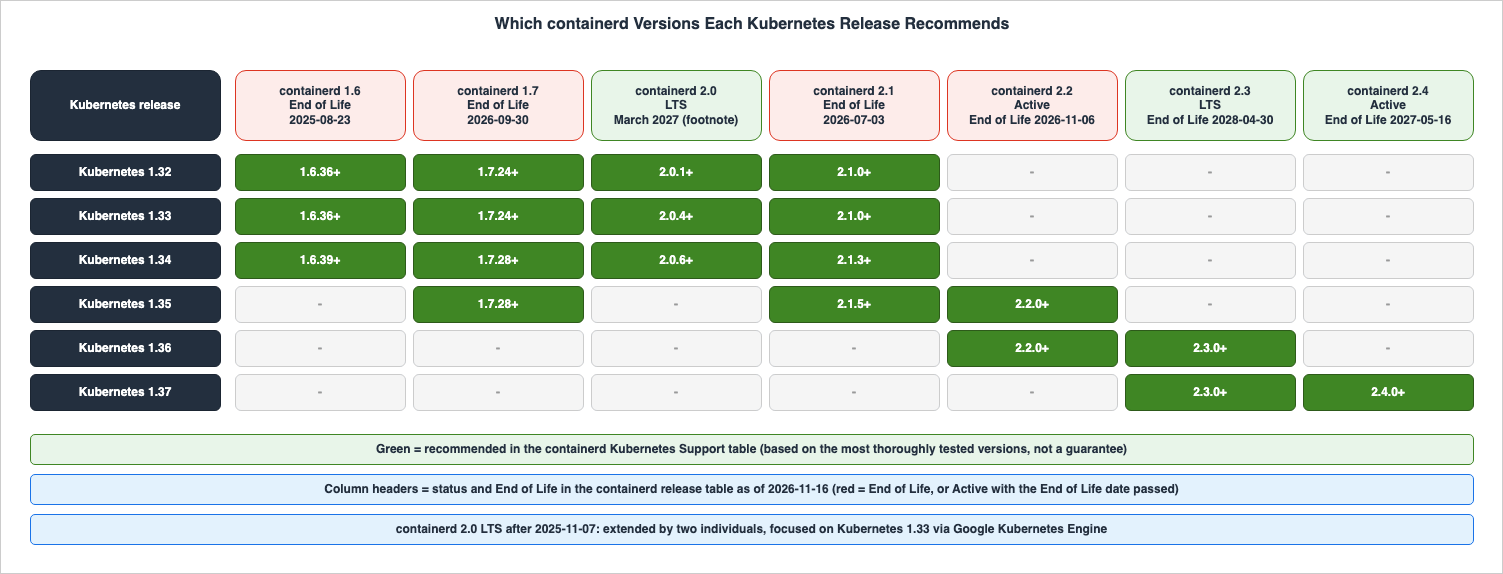
The Kubernetes Support section on the containerd Releases page includes the following paragraph before the table:The Kubernetes version matrix represents the versions of containerd which are recommended for a Kubernetes release. Any actively supported version of containerd may receive patches to fix bugs encountered in any version of Kubernetes, however, our recommendation is based on which versions have been the most thoroughly tested.The same paragraph states that Kubernetes only supports n-3 minor releases, and that containerd will ensure there is always a supported version of containerd for every supported version of Kubernetes. The table is as follows:
| Kubernetes Version | Recommended containerd Versions (containerd table) | CRI Version |
|---|---|---|
| Kubernetes 1.32 | 2.1.0+, 2.0.1+, 1.7.24+, 1.6.36+ | v1 |
| Kubernetes 1.33 | 2.1.0+, 2.0.4+, 1.7.24+, 1.6.36+ | v1 |
| Kubernetes 1.34 | 2.1.3+, 2.0.6+, 1.7.28+, 1.6.39+ | v1 |
| Kubernetes 1.35 | 2.2.0+, 2.1.5+, 1.7.28+ | v1 |
| Kubernetes 1.36 | 2.3.0+, 2.2.0+ | v1 |
| Kubernetes 1.37 | 2.4.0+, 2.3.0+ | v1 |
The following diagram visually represents this table, with Kubernetes versions as rows and containerd versions as columns. Green cells indicate the recommended versions. The column headers show the status and End of Life date in the status table on the same page as of November 16, 2026. A green cell is a recommendation, not a guarantee that the pairing works.
What the Recommendation Table Does Not Promise
The containerd table documents the rationale behind the recommendations, specifying which versions were most thoroughly tested. It does not state that pairings not in the table will not work, nor that pairings in the table will always work. Other projects' documents cover pairings outside the table. For example, the Kubernetes Container Runtimes page announces that in a future Kubernetes release, containerd 1.y and below will fail with newer kubelets (the KEP-4033 README names that release as 1.38). The What Does Not Carry Over When You Upgrade chapter covers this notice.The containerd page also includes a table titled "Deprecated containerd and kubernetes versions." This table lists versions of containerd from 1.0 to 1.7, along with the Kubernetes and CRI versions paired with them. For instance, containerd 1.0, with cri-containerd, is paired with Kubernetes 1.7, 1.8, and 1.9, and its CRI version is v1alpha1. containerd 1.6.15 and later and 1.7.0 and later are paired with Kubernetes 1.26 and later, and their CRI version is v1.
Which containerd Docker Engine Ships
The release notes on docs.docker.com specify the versions of containerd updated in each Docker Engine release. The following table lists Docker Engine releases that include information about containerd version updates.| Docker Engine | Date | containerd in the Release Notes |
|---|---|---|
| 29.0.0 | 2025-11-10 | v2.1.5 |
| 29.1.0 | 2025-11-27 | v2.2.0 (static binaries) |
| 29.2.0 | 2026-01-26 | v2.2.1 (static binaries only) |
| 29.3.1 | 2026-03-25 | v2.2.2 (static binaries) |
| 29.4.1 | 2026-04-20 | v2.2.3 (static binaries only) |
| 29.5.3 | 2026-06-03 | v2.2.4 (static binaries only) |
| 29.6.1 | 2026-06-26 | v2.2.5 (static binaries) |
| 29.6.2 | 2026-07-16 | v2.2.6 (static binaries) |
| 29.7.0 | 2026-07-30 | v2.3.3 (static binaries) |
| 29.8.0 | 2026-09-03 | v2.3.4 (static binaries) |
| 29.8.1 | 2026-09-15 | v2.3.5 (static binaries) |
| 29.8.2 | 2026-09-30 | v2.3.6 (static binaries) |
| 29.9.0 | 2026-10-08 | v2.4.1 (static binaries) |
| 29.9.1 | 2026-10-14 | v2.4.2 (static binaries) |
Within the single major version Docker Engine 29, the containerd version moved from 2.1 to 2.4. Many rows carry the note "static binaries." As an inference by this article, this note refers to the containerd version included in the static binary distributions of Docker Engine. The rows do not state which containerd version a package installation gets (No statement found). Therefore, it is not possible to create a table that directly maps Docker Engine major versions to specific containerd versions based on this documentation.
In older versions, the release notes for Docker Engine 25.0 indicate updates to containerd versions v1.6.28 and v1.7.13 (static binaries only), while the release notes for Docker Engine 28 document updates to containerd versions v1.7.25 through v1.7.28.
Docker Engine 29.7.0 added, as an experimental feature, the ability to run containerd inside the daemon process.
Add an experimental embedded-containerd feature that runs containerd inside the daemon process instead of as a separate managed process.The release notes for Docker Engine 29.8.0 state that if the system's containerd service is not configured and containerd is not installed,
dockerd will use an embedded containerd.Docker Engine and Kubernetes — cri-dockerd after dockershim
Kubernetes previously connected directly to Docker Engine through a component called dockershim. The Kubernetes Container Runtimes page states that dockershim was removed from the Kubernetes project in version 1.24.Dockershim has been removed from the Kubernetes project as of release 1.24.The same page indicates that this removal was announced as part of the v1.20 release. Regarding using Docker Engine as a runtime in Kubernetes 1.37, the page mentions the cri-dockerd adapter, noting that the default location for the CRI socket is
/run/cri-dockerd.sock. The cri-dockerd GitHub repository states Mirantis and Docker have agreed to partner to maintain the shim code standalone outside Kubernetes. As of November 16, 2026, the latest release of cri-dockerd is version v0.4.10 (released October 30, 2026). The Container Runtimes page also states that Mirantis Container Runtime includes cri-dockerd and can be used with Kubernetes.This article has found no table, in the cri-dockerd README or in any other source, that pairs cri-dockerd versions with Kubernetes versions or with Docker Engine versions (No statement found).
Which Upgrades containerd Supports
The "Upgrade Path" section on the containerd Releases page describes how to upgrade versions. Minor versions can only be upgraded sequentially.Upgrades are supported for sequential minor releases. For example, an upgrade from 2.0 to 2.1 is supported, but an upgrade from 2.0 to 2.2 is not.The same section notes that direct upgrades between sequential LTS releases are also supported, with the example that a direct upgrade from 1.7 to 2.3 will be tested and supported, but one from 1.7 to 2.6 will not. Version 2.6 carries the note "tentatively." The same page includes a table indicating that version 1.7 reaches End of Life on September 30, 2026. Regarding upgrades to major versions, the same section states:
There are no compatibility guarantees with upgrades to major versions.The section also mentions that migration mechanisms have been added to facilitate upgrades to version 2.0. The latest releases of 1.6 and 1.7 give deprecation warnings for any configuration that is incompatible with 2.0, and once no warnings show up, the upgrade to 2.0 should be smooth.
What Does Not Carry Over When You Upgrade
This chapter describes which settings and assumptions of the previous version do not carry over when you upgrade, specifying which versions are being upgraded from and to.containerd 1.x to 2.x — Configuration Keys and Configuration Versions
Upgrading containerd from 1.x to 2.x will result in changes to the names of configuration keys for the CRI plugin. The Kubernetes Container Runtimes page details configuration settings for the systemd cgroup driver, specifying them for each version of containerd.# Containerd versions 1.x
[plugins."io.containerd.grpc.v1.cri".containerd.runtimes.runc.options]
SystemdCgroup = true
# Containerd versions 2.x
[plugins.'io.containerd.cri.v1.runtime'.containerd.runtimes.runc.options]
SystemdCgroup = trueThe same page also recommends using the systemd cgroup driver when using cgroup v2.
The containerd Releases page provides a table listing configuration file versions and the minimum containerd version required to read each version. Configuration version 1 corresponds to v1.0.0, version 2 to v1.3.0, version 3 to v2.0.0, and version 4 to v2.3.0. The page also states that containerd migrates older configurations to the latest version on each startup, but does not modify the original files. You can output the configuration for the latest version using
containerd config migrate. However, migrating configurations limits the older versions of containerd that can use them. The page suggests not migrating the configuration file until you are confident that you do not need to quickly roll back your containerd version.The table listing Deprecated config properties for containerd details configuration items that have been removed in containerd 2.0. For example, the
systemd_cgroup setting under [plugins."io.containerd.grpc.v1.cri"] was removed in version 2.0, and the table recommends using the SystemdCgroup option for runc instead. The same table indicates that the planned removal of auths, configs, and mirrors under [plugins."io.containerd.grpc.v1.cri".registry] is scheduled for containerd v2.7.containerd 1.x to 2.x — CRI v1alpha2 and Removed Features
The note on the "Deprecated containerd and kubernetes versions" table on the containerd Releases page states the following regarding CRI v1alpha2:CRI v1alpha2 is deprecated in v1.7 and is not present in containerd v2.0.The same note states that containerd 1.6 and 1.7 support both CRI v1 and v1alpha2 through End of Life, for older Kubernetes versions, cloud providers, and other clients.
The "Deprecated features" table also lists features removed in containerd 2.0. These include the Runtime V1 API and implementation, the V1 implementation of runc in Runtime V2, the built-in
aufs snapshotter, and the releases bundled as cri-containerd-*.tar.gz. Image pulling using Schema 1 was disabled in 2.0 and removed in 2.1. In 2.4, the functionality to restore checkpoint data within the CRI's CreateContainer operation was removed.The kubelet Fallback for containerd 1.y — Kubernetes 1.38 or a Future Release
The Kubernetes Container Runtimes page, in the section about cgroup drivers, states that Kubernetes expects a container runtime that supports theRuntimeConfig CRI RPC. If the runtime supports it, the kubelet automatically detects the cgroup driver from the runtime. containerd 1.y and earlier versions do not support this RPC, so the kubelet falls back to the value of its own --cgroup-driver flag. The kep.yaml file of KEP-4033 in sig-node lists the stage of this detection as stable and the stable version as v1.34. The same page continues with the following (the sentence as rechecked on November 17, 2026):In a future release of Kubernetes, this fallback behavior will be dropped, and older versions of containerd will fail with newer kubelets.This sentence does not name a version. In the copy this article retrieved on November 16, 2026, the same sentence began with "In Kubernetes 1.38," and the page's Last modified date was July 27, 2026. The page rechecked on November 17, 2026, shows a Last modified date of November 9, 2026. The KEP-4033 README, by contrast, states the following in its design section:
The configurations flags (and the related fallback behavior) will be removed in Kubernetes 1.38.The same README also states, in other sections, that the fallback behavior will be removed in a future release after GA. No line describing the removal of this fallback behavior was found in CHANGELOG-1.38 up to v1.38.0-beta.0. Kubernetes 1.38 is planned for release on December 16, 2026, according to the proposed sig-release schedule, and GitHub has v1.38.0-beta.0 (2026-11-06). This article has not seen the final documentation for Kubernetes 1.38. The KEP and the page disagree on the version that drops the fallback behavior (Sources disagree). This article does not decide that either is incorrect.
The containerd table and this notice are different kinds of statements. The containerd table does not list containerd 1.7 among the recommended versions for Kubernetes 1.36 and 1.37. The Kubernetes notice states that the combination of newer kubelets and containerd 1.y will fail (on the version, the KEP-4033 README names 1.38, and the Container Runtimes page names none). The Amazon EKS documentation presents this information in a different way, which is detailed in the Where AWS Fits chapter.
cgroup v1 — Four Deprecations with Different Ends
cgroup v1 has been deprecated by three projects: Kubernetes, Docker Engine, and containerd. Amazon EKS documentation also addresses its handling on EKS nodes. The content of these four documents is as follows:The Kubernetes "About cgroup v2" page states that cgroup v1 is deprecated as of Kubernetes v1.35, and states the following.
Kubelet will no longer start on a cgroup v1 node by default. To disable this setting a cluster admin should set failCgroupV1 to false in the kubelet configuration file.The same page notes that the removal will follow Kubernetes' deprecation policy, but does not specify a version number for the removal.
The Docker "Deprecated features" page states the following.
Support for cgroup v1 is deprecated in the v29.0 release, however, it will continue to be supported until May 2029.The same page states that the latest release in May 2029 may not support cgroup v1, but at least one maintained branch will support cgroup v1.
The containerd "Deprecated features" table lists support for cgroup v1 as deprecated in containerd v2.2, with a target removal date of "May 2029." A note below the table indicates that at least one branch will continue to support cgroup v1 until May 2029, after which no branches will provide support.
No branch will support cgroup v1 after that.The Amazon EKS user guide's release notes for Kubernetes 1.35 describe how EKS handles cgroup v1 on its nodes. This information is further detailed in the Where AWS Fits chapter.
The following table summarizes the information from these four documents.
| Source | Deprecated In | What Deprecated Means Here | Stated End | Status |
|---|---|---|---|---|
| Kubernetes "About cgroup v2" page | Kubernetes 1.35 (2025-12-17) | kubelet will not start on nodes using cgroup v1 by default. This behavior can be overridden by setting failCgroupV1 to false. | Removal will follow the deprecation policy. No version number is specified. | Stated |
| Docker "Deprecated features" page | Docker Engine 29.0 (2025-11-10) | Support will continue until May 2029. | Until May 2029, at least one maintained branch supports cgroup v1. | Stated |
| containerd "Deprecated features" table | containerd 2.2 (2025-11-05) | Target for removal: May 2029. | No branch supports cgroup v1 after May 2029. | Stated |
| Amazon EKS Kubernetes 1.35 release notes | Kubernetes 1.35 | AL2023 uses cgroup v2 by default. Bottlerocket 1.35 sets failCgroupV1: false. Fargate will continue to use cgroup v1. | The EKS documentation does not specify an end date. | Stated |
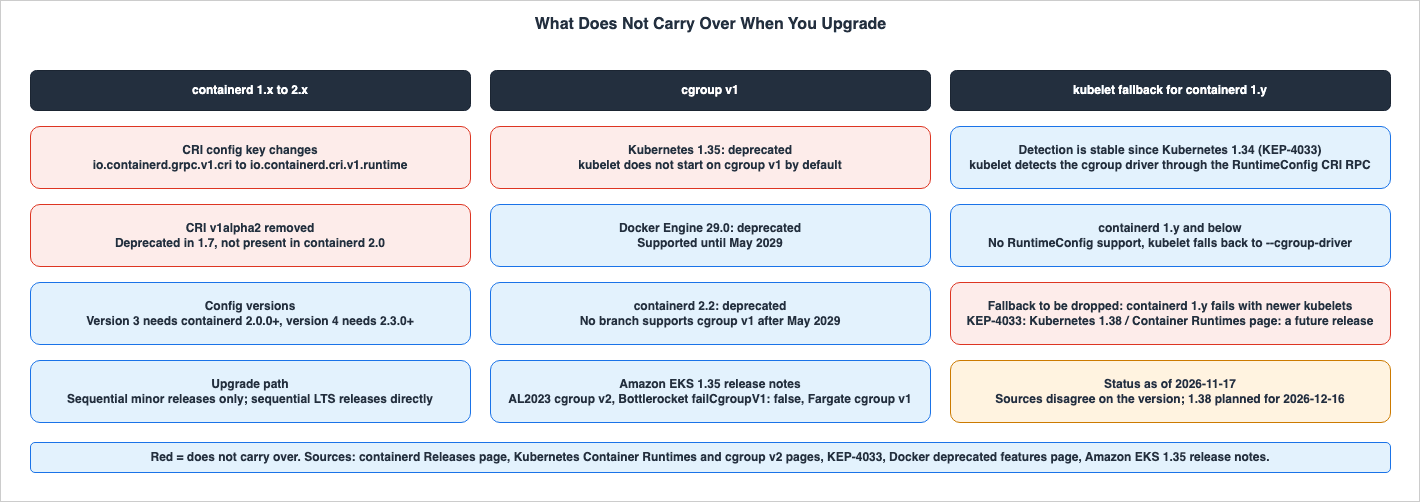
The following diagram shows what does not carry over when you upgrade, in three columns: the upgrade from containerd 1.x to 2.x, cgroup v1, and the kubelet's fallback behavior for containerd 1.y.
Docker Engine 29 — The containerd Image Store for Fresh Installs
The release notes for Docker Engine 29.0 state the following.containerd image store is now the default for fresh installs.The same sentence says that this does not apply to daemons configured with userns-remap. This default is for newly installed environments; the release notes do not state that the image store will be switched when upgrading existing environments to version 29. This article has not found a sentence in the version 29 release notes on how the image store is handled when an existing environment is upgraded to 29 (No statement found).
containerd, Kubernetes, and Docker Engine Historical Timeline (Updates from December 5, 2017)
The following three tables present the core of this historical timeline. After them is a table of scheduled dates that had not yet arrived as of November 16, 2026. Each table's columns are defined as described in the Background and Method chapter. All data was referenced as of November 16, 2026. The Docker Engine 29.10.0 row and the rows that describe the kubelet's fallback behavior were rechecked on November 17, 2026.Index:
- 2017–2022 - This period marks the beginning of containerd versions 1.0 through 1.6, and the removal of dockershim in Kubernetes.
- 2023–2025 - This period saw the introduction of containerd version 2.0 and Docker Engine versions 25 through 29, and continued deprecation of cgroup v1.
- 2026 - This period includes the End of Life dates for containerd 2.1 and 1.7, as well as Kubernetes 1.34.
- Scheduled - Scheduled dates that had not yet arrived as of November 16, 2026.
* You can sort the table by clicking on the column name.
2017–2022 — containerd 1.x, and Kubernetes Removes dockershim
| Date | Project | Version | Change | What Happened | Date Source | Source |
|---|---|---|---|---|---|---|
| 2017-12-05 | containerd | 1.0 | First Release | containerd 1.0 was released. On the same day, containerd 0.2 reached End of Life. In the containerd Deprecated table, containerd 1.0, with cri-containerd, is paired with Kubernetes 1.7, 1.8, and 1.9. | containerd release table | containerd Releases |
| 2018-04-23 | containerd | 1.1 | First Release | containerd 1.1 was released. In the Deprecated table, its CRI version is v1alpha2. | containerd release table | containerd Releases |
| 2018-10-24 | containerd | 1.2 | First Release | containerd 1.2 was released. | containerd release table | containerd Releases |
| 2019-09-26 | containerd | 1.3 | First Release | containerd 1.3 was released. This is the first version that can read configuration version 2. | containerd release table | containerd Releases |
| 2020-08-17 | containerd | 1.4 | First Release | containerd 1.4 was released. | containerd release table | containerd Releases |
| 2020-12-08 | Kubernetes | 1.20 | First Release | Kubernetes 1.20 was released. The Container Runtimes page states that the removal of dockershim was announced as part of this release. | GitHub release | Container Runtimes - Kubernetes |
| 2021-05-03 | containerd | 1.5 | First Release | containerd 1.5 was released. In the Deprecated table, its CRI versions are v1 (Kubernetes 1.23 and later) and v1alpha2 (until Kubernetes 1.25). | containerd release table | containerd Releases |
| 2022-02-15 | containerd | 1.6 | First Release | containerd 1.6 was released. | containerd release table | containerd Releases |
| 2022-05-03 | Kubernetes | 1.24 | Removal | Kubernetes 1.24 was released, and dockershim was removed from the Kubernetes project. | GitHub release | Container Runtimes - Kubernetes |
2023–2025 — containerd 2.0, Docker Engine 25 to 29, and cgroup v1 Deprecations
| Date | Project | Version | Change | What Happened | Date Source | Source |
|---|---|---|---|---|---|---|
| 2023-03-10 | containerd | 1.7 | First Release | containerd 1.7 was released. CRI v1alpha2 was deprecated in this version. | containerd release table | containerd Releases |
| 2024-01-19 | Docker Engine | 25.0 | First Release | Docker Engine 25.0.0 was released. In the moby table, it is the only branch older than 29 in the Maintained status. | Docker release notes | Docker Engine 25.0 release notes |
| 2024-03-20 | Docker Engine | 26.0 | First Release | Docker Engine 26.0.0 was released. The 26 major version was split into two branches, 26.0 and 26.1. | Docker release notes | Docker Engine 26.0 release notes |
| 2024-04-22 | Docker Engine | 26.1 | First Release | Docker Engine 26.1.0 was released. | Docker release notes | Docker Engine 26.1 release notes |
| 2024-06-24 | Docker Engine | 27 | First Release | Docker Engine 27.0.1 was released. There was no release of version 27.0.0. | Docker release notes | Docker Engine 27 release notes |
| 2024-11-05 | containerd | 2.0 | First Release | containerd 2.0 was released. CRI v1alpha2 is not included in this version. This is the first version that can read configuration version 3. | containerd release table | containerd Releases |
| 2024-12-11 | Kubernetes | 1.32 | First Release | Kubernetes 1.32 was released. The containerd table recommends 2.1.0+, 2.0.1+, 1.7.24+, and 1.6.36+. | GitHub release | Kubernetes Releases on GitHub |
| 2025-02-19 | Docker Engine | 28 | First Release | Docker Engine 28.0.0 was released. The release notes for version 28 describe updates to containerd from v1.7.25 to v1.7.28. | Docker release notes | Docker Engine 28 release notes |
| 2025-04-23 | Kubernetes | 1.33 | First Release | Kubernetes 1.33 was released. | GitHub release | Kubernetes Releases on GitHub |
| 2025-05-07 | containerd | 2.1 | First Release | containerd 2.1 was released. | containerd release table | containerd Releases |
| 2025-07-15 | Kubernetes | 1.30 | End of Life | Kubernetes 1.30 reached End of Life. The final patch version was 1.30.14. | kubernetes.io | Releases - Kubernetes |
| 2025-08-23 | containerd | 1.6 | End of Life | containerd 1.6 reached End of Life. | containerd release table | containerd Releases |
| 2025-08-27 | Kubernetes | 1.34 | First Release | Kubernetes 1.34 was released. | GitHub release | Kubernetes Releases on GitHub |
| 2025-11-05 | containerd | 2.2 | Deprecation | containerd 2.2 was released. The containerd Deprecated features table deprecates cgroup v1 support in this version. | containerd release table | containerd Releases |
| 2025-11-05 | Docker Engine | 28 | Patch Release | Docker Engine 28.5.2 was released. This is the final release in the version 28 release notes. | Docker release notes | Docker Engine 28 release notes |
| 2025-11-07 | containerd | 2.0 | Support Change | Maintenance of containerd 2.0 by all containerd committers ended. The extension through March 2027 is provided by two individuals and is focused on use with Kubernetes 1.33 on Google Kubernetes Engine. | containerd release table | containerd Releases |
| 2025-11-10 | Docker Engine | 29 | Deprecation | Docker Engine 29.0.0 was released, deprecating cgroup v1. containerd was updated to v2.1.5. The containerd image store became the default for fresh installs. | Docker release notes | Docker Engine 29 release notes |
| 2025-11-11 | Kubernetes | 1.31 | End of Life | Kubernetes 1.31 reached End of Life. The final patch version was 1.31.14. | kubernetes.io | Releases - Kubernetes |
| 2025-11-26 | Amazon EKS | AL2 AMI | End of Maintenance | Amazon EKS stopped releasing EKS-optimized AL2 AMIs. The last Kubernetes version with AL2 AMIs is 1.32. | AWS documentation | Guide to EKS AL2 & AL2-Accelerated AMIs transition features |
| 2025-12-17 | Kubernetes | 1.35 | Deprecation | Kubernetes 1.35 was released, deprecating cgroup v1. The kubelet does not start on cgroup v1 nodes by default. | GitHub release | About cgroup v2 - Kubernetes |
2026 — End of Life for containerd 2.1, containerd 1.7, and Kubernetes 1.34
| Date | Project | Version | Change | What Happened | Date Source | Source |
|---|---|---|---|---|---|---|
| 2026-02-28 | Kubernetes | 1.32 | End of Life | Kubernetes 1.32 reached End of Life. The final patch was 1.32.13. | kubernetes.io | Releases - Kubernetes |
| 2026-04-22 | Kubernetes | 1.36 | First Release | Kubernetes 1.36 was released. The containerd table recommends only versions 2.3.0+ and 2.2.0+. | GitHub release | Kubernetes Releases on GitHub |
| 2026-04-30 | containerd | 2.3 | First Release | containerd 2.3 began as an LTS release. It is the first release under the four-month cadence and the first version that can read configuration version 4. | containerd release table | containerd Releases |
| 2026-06-28 | Kubernetes | 1.33 | End of Life | Kubernetes 1.33 reached End of Life. The final patch was 1.33.13. | kubernetes.io | Releases - Kubernetes |
| 2026-07-03 | containerd | 2.1 | End of Life | containerd 2.1 reached End of Life. | containerd release table | containerd Releases |
| 2026-07-30 | Docker Engine | 29 | Patch Release | Docker Engine 29.7.0 was released. containerd was updated to v2.3.3. The ability to run containerd inside the daemon process was added as an experimental feature. | Docker release notes | Docker Engine 29 release notes |
| 2026-08-26 | Kubernetes | 1.37 | First Release | Kubernetes 1.37 was released. The containerd table recommends versions 2.4.0+ and 2.3.0+. | GitHub release | Kubernetes Releases on GitHub |
| 2026-08-27 | Kubernetes | 1.34 | Maintenance Mode | Kubernetes 1.34 entered maintenance mode. | kubernetes.io | Patch Releases - Kubernetes |
| 2026-09-03 | Docker Engine | 29 | Patch Release | Docker Engine 29.8.0 was released. If no system containerd service is configured and containerd is not installed, dockerd uses the embedded containerd. | Docker release notes | Docker Engine 29 release notes |
| 2026-09-16 | containerd | 2.4 | First Release | containerd 2.4 was released. Its Start and End of Life dates in the table are 8 months apart. | containerd release table | containerd Releases |
| 2026-09-30 | containerd | 1.7 | End of Life | containerd 1.7 reached End of Life. In the containerd table, the last Kubernetes release for which 1.7 is recommended is 1.35. | containerd release table | containerd Releases |
| 2026-10-13 | containerd | 2.4, 2.3, 2.2, 2.0 | Patch Release | containerd versions v2.4.2, v2.3.7, v2.2.10, and v2.0.14 were released. | GitHub release | containerd Releases on GitHub |
| 2026-10-14 | Docker Engine | 29 | Patch Release | Docker Engine 29.9.1 was released. containerd was updated to v2.4.2. | Docker release notes | Docker Engine 29 release notes |
| 2026-10-27 | Kubernetes | 1.34 | End of Life | Kubernetes 1.34 reached End of Life. As of November 16, 2026, the Releases page lists 1.34 in the Release History section. | kubernetes.io | Releases - Kubernetes |
| 2026-10-28 | Kubernetes | 1.37, 1.36, 1.35, 1.34 | Patch Release | GitHub showed releases for v1.37.2, v1.36.6, v1.35.10, and v1.34.13. As of November 16, 2026, the kubernetes.io pages do not list these four versions as released. | GitHub release | Kubernetes Releases on GitHub |
| 2026-10-30 | cri-dockerd | 0.4 | Patch Release | cri-dockerd v0.4.10 was released. | GitHub release | cri-dockerd Releases |
| 2026-11-03 | Docker Engine | 29 | Patch Release | Docker Engine 29.9.3 was released. | Docker release notes | Docker Engine 29 release notes |
| 2026-11-06 | containerd | 2.2 | End of Life | This was the End of Life date for version 2.2 according to the containerd table. As of November 16, 2026, version 2.2 still shows as "Active" in the same table. | containerd release table | containerd Releases |
| 2026-11-06 | Kubernetes | 1.38 | Pre-release | GitHub showed a release for v1.38.0-beta.0. The planned date on the sig-release schedule was November 4, 2026. | GitHub release | Kubernetes Releases on GitHub |
| 2026-11-16 | Docker Engine | 29 | Patch Release | Docker Engine 29.10.0 was released. As of November 17, 2026, when this article rechecked the release notes, this is the latest release listed in the Docker Engine 29 release notes. The release notes do not list a containerd version update. | Docker release notes | Docker Engine 29 release notes |
Scheduled Dates as of November 16, 2026
| Date | Project | Version | Change | What Happened | Date Source | Source |
|---|---|---|---|---|---|---|
| 2026-12-04 | Docker Engine | 25.0 | End of Maintenance | This date marks the expected end of maintenance for Docker Engine 25.0 in the moby table. The value links to a Mirantis page. | Project schedule | moby BRANCHES-AND-TAGS.md |
| 2026-12-16 | Kubernetes | 1.38 | First Release | This is the planned release date for Kubernetes 1.38. The KEP-4033 README states that in version 1.38, the kubelet will drop its fallback behavior for containerd 1.y and below. The Container Runtimes page, rechecked on November 17, 2026, names no version. | Project schedule | Kubernetes 1.38 Release Information, KEP-4033: Discover cgroup driver from CRI, Container Runtimes - Kubernetes |
| 2026-12-28 | Kubernetes | 1.35 | Maintenance Mode | This is the planned date for Kubernetes 1.35 to enter maintenance mode. | kubernetes.io | Patch Releases - Kubernetes |
| 2027-01-06 | containerd | 2.5 | First Release | This is the planned start date for containerd 2.5. The release table indicates a "Planned" status. | containerd release table | containerd Releases |
| 2027-02-28 | Kubernetes | 1.35 | End of Life | This is the planned End of Life date for Kubernetes 1.35. | kubernetes.io | Releases - Kubernetes |
| 2027-03 | containerd | 2.0 | End of Life | This is the planned end date for the extended support of containerd 2.0. The table simply states "March 2027" without a specific day. | containerd release table | containerd Releases |
| 2027-05-16 | containerd | 2.4 | End of Life | This is the planned End of Life date for containerd 2.4. | containerd release table | containerd Releases |
| 2027-06-28 | Kubernetes | 1.36 | End of Life | This is the planned End of Life date for Kubernetes 1.36. | kubernetes.io | Releases - Kubernetes |
| 2027-09-06 | containerd | 2.5 | End of Life | This is the planned End of Life date for containerd 2.5. | containerd release table | containerd Releases |
| 2027-10-28 | Kubernetes | 1.37 | End of Life | This is the planned End of Life date for Kubernetes 1.37. | kubernetes.io | Releases - Kubernetes |
| 2028-04-30 | containerd | 2.3 | End of Life | This is the planned End of Life date for containerd 2.3. | containerd release table | containerd Releases |
| 2029-05 | Docker Engine, containerd | 29, 2.2 | Removal | This is the last month for which the Docker Engine and containerd pages state that cgroup v1 support continues. The containerd Deprecated features table says that after this month, no branch will support cgroup v1. | Project schedule | Deprecated Docker Engine features, containerd Releases |
Where AWS Fits
This chapter covers only what the Amazon EKS documentation says about containerd, cgroup v1, and Docker Engine. The dates of Kubernetes versions on EKS are in the existing article listed earlier.What the EKS Release Notes Say About containerd 1.x and cgroup v1
The Amazon EKS user guide, in the Kubernetes version release notes for Kubernetes 1.35, includes the following regarding containerd 1.x:Containerd 1.x End of Support: Kubernetes 1.35 is the last release supporting containerd 1.x. You must switch to containerd 2.0 or later before upgrading to the next Kubernetes version.This statement is a different kind of statement from both the containerd table and the Kubernetes notice. The containerd table does not list containerd 1.7 among the recommended versions for Kubernetes 1.36 and 1.37. The Kubernetes sources announce that containerd 1.y and below will fail with newer kubelets (on the version, the KEP-4033 README names 1.38, and the Container Runtimes page names none). The EKS statement, as part of the EKS documentation, describes Kubernetes 1.35 as the final Kubernetes version that supports containerd 1.x. The three statements put the version number in different places, and this article does not decide that any of them is incorrect.
The same section details information about cgroup v1, specifying the following for each operating system. AL2023 has cgroup v2 enabled by default. Nodes running AL2023 that have cgroup v1 enabled manually must either migrate to cgroup v2 or configure the kubelet with
failCgroupV1: false. Bottlerocket 1.35 also has cgroup v2 enabled by default, but sets failCgroupV1: false in the kubelet configuration to keep backward compatibility. Fargate will continue to use cgroup v1. While the section heading reads "Cgroup v1 Support Removed," the body of the text states that Kubernetes 1.35 deprecates support for cgroup v1.The AWS AL2 AMI migration FAQ addresses cgroup v1 support, stating that the Kubernetes community has moved it to maintenance mode. As an inference by this article, the Kubernetes "About cgroup v2" page describes the same situation using the term "deprecated." This article uses the term "maintenance mode" only in reference to a stage name within a Kubernetes patch release cycle.
Where the containerd Version of an EKS AMI Is Written
The EKS user guide's page on the optimized EKS AMI states that the AMI includes components such askubelet, AWS IAM Authenticator, and containerd, but does not list the containerd version (Documentation does not list). The AL2 AMI migration FAQ refers to the EKS AMI release notes on GitHub for the list of AMI components and their versions.The GitHub repository
awslabs/amazon-eks-ami’s "Releases" page provides a table detailing the Kubernetes version and the versions of individual components for each AMI release. As of November 16, 2026, the latest v20261112 release indicates that the containerd version for the AL2023 AMI, across Kubernetes versions 1.34 through 1.37, is 2.3.7-1.amzn2023.0.3. In the v20261003 release, the containerd version for the AL2023 AMI, across Kubernetes versions 1.35 through 1.37, is 2.2.7-1.amzn2023.0.1. This article looked only at releases from 2026-09-23 onward. This article has not checked the first release in which EKS AMIs moved to containerd 2.x.Docker Engine and dockershim on EKS
The AWS Containers Blog's article on Kubernetes 1.24 states that, starting with Kubernetes 1.24, the AMIs provided by EKS only support the containerd runtime. The EKS Best Practices Guide's cluster upgrade section, under the heading "Removal of Dockershim in 1.25," indicates that the EKS-optimized AMIs in version 1.25 will not include support for dockershim. The two sources give different version numbers (Sources disagree).Where the Sources Differ and What They Do Not Say
Where the Sources Differ
| Event | What Each Source Says | Kind of Difference |
|---|---|---|
| containerd 2.2 Status | As of 2026-11-16, the containerd table lists the status of 2.2 as Active and its End of Life as 2026-11-06. | Disagrees within the same page |
| Kubernetes 1.34 Status | The kubernetes.io Releases page, as of November 16, 2026, lists version 1.34 in the "Release History" section and gives its End of Life as October 27, 2026. The same page also states that versions 1.37, 1.36, and 1.35 are maintained. | Disagrees within the same page |
| Latest Kubernetes Patch | On the kubernetes.io Releases page, the Latest Release of each version is the 2026-09-15 release. The Patch Releases page lists the next patches as 1.37.2, 1.36.6, and 1.35.10. GitHub has v1.37.2, v1.36.6, v1.35.10, and v1.34.13, released on 2026-10-28. | Sources disagree |
| End of Docker Engine 25.0 | The moby table lists the Expected End of Maintenance as 2026-12-04, with a link to the Mirantis MCR 25.0 Maintenance Lifecycle page. As of November 16, 2026, that page lists the General Availability (GA) for MCR Enterprise 25.0 as 2024-12-04 (25.0.7) and the End of Life (EOL) as 2027-03-24. | Sources disagree |
| Support Period of Regular containerd Releases | The policy on the containerd page states that regular releases are supported for 8 months. However, the same page's table indicates that version 2.2 is supported for approximately 12 months, and version 2.1 for approximately 14 months. | Disagrees within the same page |
| End of containerd 1.x and Kubernetes Versions | The containerd table recommends containerd 1.7 up to Kubernetes 1.35. The Kubernetes sources state that versions of containerd 1.y and below will fail with newer kubelets. The Amazon EKS release notes state that version 1.35 is the last version of Kubernetes that supports containerd 1.x. | Different kinds of statements |
| Version in Which the kubelet Drops Its Fallback for containerd 1.y | The KEP-4033 README names Kubernetes 1.38. The Container Runtimes page, rechecked on November 17, 2026, says "a future release" and names no version (the copy from November 16, 2026, named 1.38). No line describing the removal was found in CHANGELOG-1.38 up to v1.38.0-beta.0. | Sources disagree |
| Removal of dockershim from EKS AMIs | An AWS Containers Blog article about Kubernetes 1.24 mentions version 1.24. The EKS Best Practices Guide mentions version 1.25. | Sources disagree |
| Release Date of containerd 2.2.0 | The containerd table gives the Start as 2025-11-05. The GitHub v2.2.0 release is 2025-11-06T01:34:14Z (UTC). | Different record formats |
| Release Date of Kubernetes v1.38.0-beta.0 | The planned date on the sig-release schedule is 2026-11-04. The GitHub release is 2026-11-06. | Different kinds of statements |
Regarding Docker Engine 25.0, the Mirantis page lists the "Supported lifespan" for Enterprise 25.0 as two years. As an inference by this article, the moby table's 2026-12-04 is exactly two years after the GA date of 2024-12-04 on the Mirantis page, but no source says that the two dates are linked this way. Furthermore, the "EOL" date of 2027-03-24 listed on the Mirantis page refers to a date for Mirantis's commercial products, and has a different subject from the date of the 25.0 branch in the moby table. This article does not conclude that either date is incorrect.
Concerning containerd 2.2, the containerd Releases page does not explain why the status remains "Active" (No statement found). This article does not speculate on whether this is due to delayed updates or an extension of support.
What the Sources Do Not Say
The following are items that could not be found despite searching with different kinds of sources and search terms (No statement found). None of these items indicate that something is impossible or does not exist.- A table on docs.docker.com listing the end dates for each major version of Docker Engine.
- Whether the "static binaries" note in the Docker Engine release notes applies to versions of containerd installed via package management.
- A table listing the recommended combinations of versions for cri-dockerd and Docker Engine, and for cri-dockerd and Kubernetes.
- The Kubernetes version in which cgroup v1 support will be removed.
- How the image store is handled when upgrading an existing environment to Docker Engine 29.
- The initial release of the EKS AMI that transitioned to containerd 2.x. This article looked only at the EKS AMI release notes on GitHub from 2026-09-23 onward.
Failure Modes
This chapter lists potential issues that may arise when misinterpreting the information presented in this article, categorized by the type of misinterpretation. Every row stays within what the sources say.| Failure Mode | What Can Happen | What the Sources Say |
|---|---|---|
| Reading the recommended containerd table as a table of guaranteed operation. | Assuming that pairings in the table need no testing. Assuming that every pairing not in the table will not work. | The table is a recommendation table, and its basis is the most thoroughly tested versions. |
| Interpreting containerd 2.2 as being actively supported based on the "Active" status in the table. | Overlooking the End of Life date of 2026-11-06 in the same row. | As of 2026-11-16, the table indicates an "Active" status, with an End of Life date of 2026-11-06. |
| Determining active support for Kubernetes 1.34 based on its section on the "Releases" page. | Treating versions past their End of Life date as actively supported. | The End of Life for 1.34 is 2026-10-27, and the maintained versions are 1.37, 1.36, and 1.35. |
| Considering dates in the moby table as promises from Docker, Inc. | Treating the end of maintenance for Docker Engine 25.0 as a date promised by the company. | The status in the moby table is informational and not binding, and the Docker Install page states that Docker doesn't provide support for Docker Engine. |
| Upgrading to containerd 2.x with a containerd 1.x configuration file. | Settings that containerd 2.0 removed, such as systemd_cgroup under the CRI plugin, are still relied on. | Version 1.x uses the io.containerd.grpc.v1.cri key, while version 2.x uses the io.containerd.cri.v1.runtime key. containerd migrates older configurations on each startup, and the Deprecated config properties table lists the settings removed in 2.0. |
| Skipping minor versions when upgrading containerd. | Performing unsupported upgrades. | Minor versions can only be upgraded sequentially. Direct upgrades between sequential LTS releases are also supported. |
| Upgrading to Kubernetes 1.38 while nodes still run containerd 1.7. | The new kubelet is announced to fail with the older containerd version. | The Container Runtimes page announces that containerd 1.y and below will fail in a future release and names no version. The KEP-4033 README names 1.38. |
| Interpreting the deprecation of cgroup v1 as having the same meaning across three projects. | Overlooking that the Kubernetes 1.35 kubelet does not start on a cgroup v1 node by default. | Kubernetes stops the kubelet from starting by default. Docker Engine and containerd state that support continues until May 2029. |
| Reading an upgrade to Docker Engine 29 as switching the image store to the containerd image store. | Mistaking the behavior of a newly installed environment for that of an existing environment. | The release notes for version 29.0 describe the default behavior of a newly installed environment. |
| Searching for the containerd version in the EKS AMI within the user guide page. | Failing to find the version and assuming that the version is not defined. | The user guide page does not list versions. The GitHub EKS AMI release notes specify the version for each release. |
Frequently Asked Questions about containerd, Kubernetes, and Docker Engine Support
Which containerd versions are recommended for Kubernetes 1.37?
The Kubernetes Support table on the containerd Releases page recommends containerd versions2.4.0+ and 2.3.0+ for Kubernetes 1.37. The CRI version is v1. This table lists recommended versions based on which versions have been most thoroughly tested. It does not state that versions not listed will not function, nor does it guarantee that listed versions will function in all cases. As of November 16, 2026, containerd version 2.4 is in the Active state, while version 2.3 is in the LTS status.Is containerd 1.7 still maintained?
In the words of the containerd table, its status is End of Life, which the same page defines as no longer supported. The containerd table lists containerd 1.7 as End of Life, with the End of Life date of September 30, 2026. In the table on the same page, the last Kubernetes version for which containerd 1.7 is recommended is 1.35. The "Upgrade Path" section says that a direct LTS-to-LTS upgrade from 1.7 to 2.3 is supported.Will containerd 1.7 work with Kubernetes 1.38?
The KEP-4033 README states that in Kubernetes 1.38, the kubelet drops its fallback behavior for containerd 1.y and below, and that older containerd versions will fail with newer kubelets. The Kubernetes Container Runtimes page, rechecked on November 17, 2026, says the same will happen in a future release and names no version. As of November 16, 2026, Kubernetes 1.38 is planned for release on December 16, 2026, and this article has not seen the final documentation for version 1.38. The Amazon EKS release notes describe Kubernetes 1.35 as the last release supporting containerd 1.x.When does Docker Engine 25.0 stop being maintained?
The moby table lists December 4, 2026 as the Expected End of Maintenance of the Docker Engine 25.0 branch, and lists Amazon and Mirantis as known distributors. The same table states that this status is not binding. The Docker Install page states that Docker doesn't provide support for Docker Engine. As of November 16, 2026, the Mirantis page that the moby table links to gives March 24, 2027 as the End of Life of Enterprise 25.0, a Mirantis commercial product. These two dates have different subjects, and this article does not favor one over the other.Does Kubernetes 1.35 still run on cgroup v1 nodes?
Not by default. According to the Kubernetes "About cgroup v2" page, cgroup v1 is deprecated in Kubernetes v1.35, and kubelet will not start by default on nodes using cgroup v1. This behavior can be overridden by setting thefailCgroupV1 setting in the kubelet configuration file to false. According to the Amazon EKS release notes, Bottlerocket 1.35 has this value set to false, and Fargate continues to use cgroup v1.Which containerd version does an Amazon EKS AMI ship?
The Amazon EKS user guide's page on optimized EKS AMIs states that containerd is included in the AMI, but does not specify the version. The version information is available on the "Releases" page of theawslabs/amazon-eks-ami GitHub repository, which lists the containerd version for each AMI release. As of November 16, 2026, the latest v20261112 release includes containerd version 2.3.7-1.amzn2023.0.3 for AMIs based on Amazon Linux 2023, for every Kubernetes version from 1.34 to 1.37.Summary
This timeline begins with the launch of containerd 1.0 on December 5, 2017. As of November 16, 2026, four containerd releases are Active or LTS in the containerd table: 2.0, 2.2, 2.3, and 2.4. In the moby table, two Docker Engine branches are Maintained:docker-29.x and 25.0. Three versions of Kubernetes are currently maintained: 1.37, 1.36, and 1.35.⇒ What goes together is the pairing in the containerd recommendation table. The containerd table recommends containerd versions
2.4.0+ and 2.3.0+ for Kubernetes 1.37, and 2.3.0+ and 2.2.0+ for Kubernetes 1.36. The table's basis is the most thoroughly tested versions, and the table does not guarantee that a pairing works. The containerd version named in the Docker Engine release notes changes from patch to patch, even within one major version.⇒ The end of maintenance is written in each project's own words. containerd uses "End of Life," Kubernetes uses "maintenance mode" and "End of Life," and the moby table uses "Unmaintained." The moby table is not binding, and the Docker Install page states that Docker doesn't provide support for Docker Engine. Since November 7, 2025, the containerd 2.0 LTS has been an extension by two individuals, and its contents differ from those of the 2.3 LTS.
⇒ What does not carry over depends on which versions you upgrade between. Upgrading containerd from version 1.x to 2.x will change the keys used in the Container Runtime Interface (CRI) configuration, and CRI v1alpha2 is no longer present. Minor versions can only be upgraded sequentially, except for direct upgrades between sequential LTS releases. Kubernetes sources announce that containerd 1.y and below will fail with newer kubelets (the KEP-4033 README names 1.38, and the Container Runtimes page names no version). Regarding cgroup v1, the Kubernetes 1.35 kubelet does not start on cgroup v1 by default, while the Docker Engine and containerd pages state that support continues until May 2029.
⚠ As of November 16, 2026, some rows are scheduled, and on some pages the status and the date disagree. containerd 2.2 remains Active in the table past its End of Life date, and Kubernetes 1.34 is listed in the Release History even after its End of Life. The dates of December 4, 2026, for Docker Engine 25.0, and March 24, 2027, on the Mirantis page, refer to different subjects. The KEP and the Container Runtimes page disagree on the version in which the kubelet drops its fallback for containerd 1.y. All information is current as of November 16, 2026 (Docker Engine 29.10.0 and the version for the kubelet's fallback were rechecked on November 17, 2026).
This timeline will be updated as containerd, Kubernetes, and Docker Engine release new versions and change their support policies.
In addition, there are related history-and-timeline articles on this site, so please have a look if you are interested.
- Kubernetes Release and Support Timeline - Minor Releases, Maintenance Mode, End of Life, and Version Skew
- AWS End-of-Support and EOL Reference - Lambda, EKS, RDS and Aurora, ElastiCache, and OpenSearch Service
- AWS History and Timeline regarding Amazon EKS - Overview, Functions, Features, Summary of Updates, and Introduction
- Amazon Linux History and Timeline - Amazon Linux AMI, Amazon Linux 2, AL2023, AL2027, and the Clocks That Do Not Move Your Instances
- SOCI Lazy Loading on Fargate, Lambda Managed Instances, and SageMaker AI - Which Index Each Service Reads
- What a GitHub-Hosted Runner Label Resolves To - ubuntu-latest to Ubuntu 26.04, the macos-14 Retirement, and Tool Versions in AWS Deploy Jobs
References:
- containerd Releases
- containerd RELEASES.md
- containerd Releases on GitHub
- moby BRANCHES-AND-TAGS.md
- Docker Engine 29 release notes
- Docker Engine 28 release notes
- Docker Engine 27 release notes
- Docker Engine 26.1 release notes
- Docker Engine 26.0 release notes
- Docker Engine 25.0 release notes
- Deprecated Docker Engine features
- Install Docker Engine
- MKE 3.x, MSR, and MCR Maintenance Lifecycle - Mirantis Container Runtime
- cri-dockerd
- cri-dockerd Releases
- Releases - Kubernetes
- Patch Releases - Kubernetes
- Container Runtimes - Kubernetes
- About cgroup v2 - Kubernetes
- Migrating from dockershim - Kubernetes
- Kubernetes 1.38 Release Information
- KEP-4033: Discover cgroup driver from CRI
- CHANGELOG-1.38
- Kubernetes Releases on GitHub
- Review release notes for Kubernetes versions on standard support - Amazon EKS
- Create nodes with optimized Amazon Linux AMIs - Amazon EKS
- Guide to EKS AL2 & AL2-Accelerated AMIs transition features
- Best Practices for Cluster Upgrades - Amazon EKS
- Amazon EKS now supports Kubernetes version 1.24
- Amazon EKS AMI Releases
References:
Tech Blog with curated related content
Written by Hidekazu Konishi