AWS-LC and s2n-tls History and Timeline - Releases, FIPS 140-3 Validations, and Post-Quantum TLS
First Published:
Last Updated:
Active, and one is Historical. These certificates are categorized by version (AWS-LC FIPS 1.x, 2.0.0, 3.1.0, 4.0.0, and 1.29.1 for NetOS) and form (dynamic and static).The documentation in the AWS-LC repository (
crypto/fipsmodule/FIPS.md) and the CMVP pages do not present the same information as of November 26, 2026. FIPS.md lists two modules for AWS-LC-FIPS v4.0 in the Modules in Process section (undergoing validation). In contrast, the CMVP lists AWS-LC 4 Cryptographic Module (dynamic) (#5595) and (static) (#5596) as having received Initial validation on November 19, 2026, and as now Active. This article will consider the CMVP pages as the definitive source for certificate status and dates, and will highlight any discrepancies with the information presented in FIPS.md.The implementation of post-quantum capabilities also has distinct dates for initial inclusion and default adoption. AWS-LC included a hybrid key share using Kyber drafts (e.g.,
X25519Kyber768Draft00) in libssl in v1.17.4 on November 22, 2023. v1.35.0 and v1.35.1 (released in September 2024) transitioned to FIPS 203 ML-KEM. On February 20, 2026 (v1.68.0), X25519MLKEM768 was added to the default key shares. s2n-tls added post-quantum key exchange to the default security policy in v1.6.0, released on October 30, 2025. Both libraries removed Kyber support in January 2026.This article presents a timeline detailing the history of AWS's TLS implementation, s2n-tls, and the cryptographic library, AWS-LC. The timeline is organized by date and includes links to primary source materials. Three key questions are addressed: which version is covered by which certificate, and from when until when; in which versions post-quantum key exchange and signatures entered, and in which versions they became the default; and when support for each FIPS branch is scheduled to end. All information was verified as of November 26, 2026. The information was verified before AWS re:Invent 2026 (November 30 to December 4, 2026), so announcements from that week are not included.
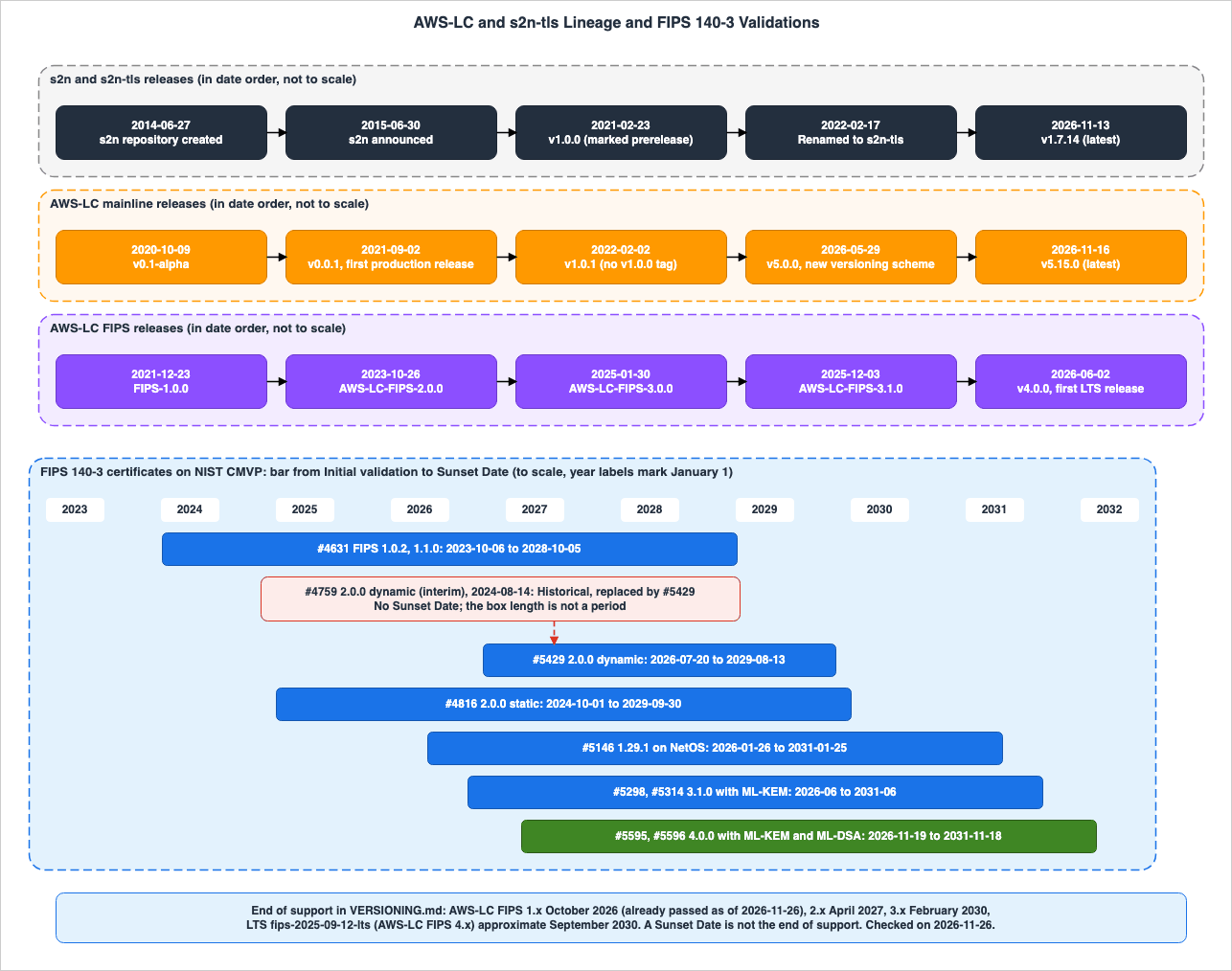
Background and Method of Creating the AWS-LC and s2n-tls Timeline
This section details the sources used to create the timeline and explains how the dates and Change values for each row were determined. All sources were consulted as of November 26, 2026.Primary Sources Used in This Article and What Became Rows
This article utilized the following primary sources and related information:- GitHub repository
aws/aws-lc: README,crypto/fipsmodule/FIPS.md,VERSIONING.md,crypto/fipsmodule/PQREADME.md, the Releases page, and the list of tags and branches. There were 167 entries on the Releases page.
- GitHub repository
aws/s2n-tls: README,docs/BUILD.md, the Releases page (containing 171 entries), and pull requests.
- s2n-tls Usage Guide: The chapter on post-quantum features (
ch16-post-quantum.html) and the chapter on security policies (ch06-security-policies.html).
- NIST CMVP certificate pages: #4631, #4759, #4816, #5146, #5298, #5314, #5429, #5595, and #5596 (9 certificates). The nine are certificates whose Vendor is Amazon Web Services. Modules created by other companies based on AWS-LC (such as SafeLogic's #5525) were not counted. This article reviewed the following information: Module Name, Status, Sunset Date, Caveat, Validation History, and Approved Algorithms. It also reviewed the pages for the Entropy Source Validations (ESV) #E77 and #E280.
- Security Policies for each CMVP certificate (PDF): This article verified the validated versions by reviewing the "Tested Module Identification" tables in the 9 Security Policies.
- AWS Blogs: Articles from the AWS Security Blog from June 30, 2015 (s2n release), November 4, 2019 (post-quantum TLS in AWS KMS), February 17, 2022 (s2n-quic and the rename), October 6, 2023 (FIPS 140-3 certification), and December 10, 2024 (AWS-LC FIPS 3.0 and ML-KEM), as well as an article from the AWS Open Source Blog from April 19, 2023 (aws-lc-rs).
The rows cover the creation of the repositories, the first release of each library and the releases of the FIPS versions, the rename, the versions in which post-quantum features entered, left, and became the default, CMVP certificate validations, the change of the versioning scheme, the first Long-Term Support (LTS) release, and the planned end of support for the FIPS branches. For the regular mainline releases (such as v1.17.4), only the versions related to post-quantum features and the latest versions as of the verification date became rows. In other words, please note that the items on this timeline are not all releases of AWS-LC and s2n-tls, but are representative updates that I have picked out.
Version Numbers, FIPS Version Numbers, and Module Names
AWS-LC has two numbering systems. One is the release version number (the AWS-LC version number), and the other is the FIPS version number.VERSIONING.md states that the FIPS version number is an integer that increments each time a FIPS branch is cut from the mainline, and this value is used for submissions to the CMVP. VERSIONING.md notes that before the new scheme, these two numbers were linked (for example, AWS-LC FIPS 3.0 was the third FIPS submission), and that it removed the link.The Module Name on the CMVP certificate is not the same as the version number. The Module Names for #4631, #4759, #4816, #5146, and #5429 all begin with
AWS-LC Cryptographic Module. #5298 and #5314 begin with AWS-LC 3 Cryptographic Module, while #5595 and #5596 begin with AWS-LC 4 Cryptographic Module. Only #4631 (AWS-LC FIPS 1.0.2 [1] and AWS-LC FIPS 1.1.0 [2]) and #4759 (AWS-LC FIPS 2.0.0) have a Software Versions section on the CMVP page. For the remaining seven certificates, this article took the versions from the Security Policy table of each certificate. FIPS.md also gives versions, but what FIPS.md gives is a version series such as AWS-LC-FIPS v2.0 (static library), and for #5146 it writes (dynamic library, NetOS) instead of a version.When this article simply refers to a "certificate," it is referring to the CMVP validation certificate. X.509 certificates used with TLS are always referred to as "X.509 certificates." Similarly, "Security Policy" refers to the documentation submitted to the CMVP for a module, and TLS configurations for s2n-tls are referred to as "s2n-tls security policies."
How to Describe the Origin of AWS-LC
Different sources describe the origin of AWS-LC in various ways. This article aims to differentiate these descriptions based on their respective sources, rather than adhering to a single approach.- AWS-LC README and the Description on the CMVP pages: It is written as
It іs based on code from the Google BoringSSL project and the OpenSSL project.In this sentence, theіinіsis a Cyrillic character (U+0456) as found on the README page. This article reproduces the character as it appears on the page. Only the Description on the page for #5595 states:It's based on code from the Google BoringSSL project and the OpenSSL project.
- Article from February 17, 2022, regarding s2n-quic: It is written as:
AWS-LC is a general-purpose cryptographic library maintained by AWS which originated from the Google project BoringSSL.
- Article from October 6, 2023, regarding FIPS 140-3 certification: It is written as:
AWS-LC is an open source cryptographic library that is a fork from Google’s BoringSSL.
- Amazon Linux 2027 User Guide: It is written as:
It is derived from code that Google's BoringSSL project and the OpenSSL project released.
Timeline Columns, Row Types, and Date Sources
The timeline entries consist of five columns. The column names and "Change" values are the same as those used on this site's AWS History and Timeline regarding AWS Certificate Manager.- Date — Represents the date associated with the row. The method for determining this date is described in the following paragraph. Rows whose source gives only the month are written as
YYYY-MM. - Change — Indicates the type of change. The value will be one of seven options listed below.
- What Happened — Describes the event or change. The original text from the source material is presented in English.
- Date Source — Specifies the type of document from which the 'Date' value was obtained. The value will be one of eight options listed below.
- Source — Refers to the specific document used as the basis for the row. This column may include documents beyond those used for the 'Date Source'.
The 'Date' value is determined as follows: For release rows, it is the publication date (UTC) from the GitHub Releases page. For CMVP certificate rows, it is the date in the Validation History on the certificate page. For rows where a blog post announced the event, it is the date displayed on the post. For rows of the planned end of support, the month specified in
VERSIONING.md is used as the 'Date'. CMVP dates, which are displayed in the format month/day/year (e.g., 11/19/2026) on the pages, have been converted to the year-month-day format in this article.The 'Change' values are one of the following seven options.
- Added — A feature, integration, Region, or API was added.
- Changed — Default values or behavior were modified.
- Renamed — The name was changed.
- Deprecated — A source stated that a feature is deprecated or that it will end in the future. The feature could still be used at that point.
- Removed — A source stated, using phrases such as
no longer supportsorno longer available, that a feature was removed. - Ended — Support or availability for the feature ended. (Not used in this article.)
- Scheduled — A planned date that had not yet arrived on the verification date (2026-11-26).
This article categorized releases, repository publications, and certificate validations as "Added." Rows where default values or dependencies changed, and the rows of a certificate
Update, were categorized as "Changed." Rows where the release notes stated a removal, such as Remove Kyber completely, were categorized as "Removed." End-of-support dates for the FIPS branches in VERSIONING.md that had not yet arrived on the verification date were categorized as "Scheduled." The planned end-of-support month for AWS-LC FIPS 1.x, October 2026, had already passed on the verification date. Because the heading of that section is Deprecation of legacy FIPS branches and this article has not found a statement that support has ended, this row was categorized as "Deprecated" rather than "Ended."The values for "Date Source" are eight in total. The six values of the AWS Certificate Manager timeline are intended for AWS documentation, so this article uses the following values instead.
- GitHub release — The publication date (UTC) on the GitHub Releases page.
- GitHub repository — The date the GitHub repository was created (UTC), as shown in the GitHub API's
created_atfield. Because it is not a page, it is used for only two rows. - GitHub pull request — The date the pull request was merged (UTC).
- NIST CMVP — Dates from the Validation History on the CMVP certificate page, and the date on the ESV page.
- NIST CMVP (Sunset Date) — The Sunset Date on the CMVP certificate page.
- AWS blog — The date displayed on the AWS blog article page. In rows where the Date is a date written in the body or in an update note of the post, What Happened says so.
- VERSIONING.md — The month mentioned in
VERSIONING.md. - Branch name — The date in the branch name.
VERSIONING.mdstatesThe date in the branch name corresponds to the date the branch was cut for FIPS submission.
Dates in the timelines of other articles are not used as a Date Source.
When the Same Event Has Two or More Dates
When the same event is documented with multiple dates, discrepancies in dates often appear across different sources. In particular, FIPS versions frequently have different dates for the release date, the date the module was added to the CMVP's "Modules in Process" list, and the date of certificate validation. This article does not claim that any of these dates are necessarily incorrect. The main table lists a single date for each event, while dates from other sources are listed in the "Where the Dates Differ" table, organized by source. This table categorizes discrepancies into four types, mirroring the categorization used in the AWS Certificate Manager timeline.- Different kinds of dates — This refers to instances where sources record different types of dates, such as the announcement date, the date a document was updated, the date a feature was discontinued, or the publication date of a blog post.
- Same date, different statements — In these cases, the dates are the same, but the information or names associated with those dates differ between sources.
- The sources disagree — This category covers instances where sources give different dates of the same kind for the same event.
- Statement not found — For one of the dates, this article has not found a source that states it. Not finding a statement does not prove that no such statement exists.
The article also includes instances where the FIPS.md and CMVP pages provide differing information regarding the status of AWS-LC-FIPS v4.0, and these instances are categorized under "The sources disagree."
Topics This Article Leaves to Other Articles
The following topics are covered as main topics by other articles on this site. This article keeps only the timeline rows and short descriptions.- Standardization of Post-Quantum Cryptography and AWS's Support for Post-Quantum TLS — Post-Quantum Cryptography Standardization Timeline and Migration on AWS
- OpenSSL Versions and the FIPS Provider Certificate — OpenSSL Release and Support Timeline
- Amazon Linux Generations and the AWS-LC for Amazon Linux 2027 — Amazon Linux History and Timeline
- ML-KEM Keys in AWS KMS and Decapsulation Outside of KMS — What Decapsulate Does Not Tell You
- FIPS 140-3 Validation for HSMs — AWS History and Timeline regarding AWS CloudHSM. The certificates referenced in this article are all based on software modules with an Overall Level of 1 and are distinct from HSM validation.
- Terminology for FIPS 140-2 and FIPS 140-3 — Cryptography Glossary for Engineers
Current Status of AWS-LC and s2n-tls
This section summarizes the status of AWS-LC and s2n-tls as of November 26, 2026, including the versions, certificates, default post-quantum key exchange, and planned end of support for the FIPS branches. These details may change after this date.| Item | Status on 2026-11-26 | Source |
|---|---|---|
| AWS-LC mainline, latest version | v5.15.0 (2026-11-16) | Releases (aws/aws-lc) |
| AWS-LC LTS, latest version | v4.2.0 (2026-10-30). The LTS branch is fips-2025-09-12-lts (AWS-LC FIPS 4.x), and VERSIONING.md states approximate EOS: September 2030. | Releases (aws/aws-lc), VERSIONING.md |
| s2n-tls, latest version | v1.7.14 (2026-11-13) | Releases (aws/s2n-tls) |
| CMVP certificates | Active: 8 (#4631, #4816, #5146, #5298, #5314, #5429, #5595, #5596); Historical: 1 (#4759) | NIST CMVP certificate pages |
| Certificates with ML-KEM in Approved Algorithms | #5298, #5314, #5595, #5596 | NIST CMVP certificate pages |
| Certificates with ML-DSA in Approved Algorithms | #5595, #5596 | NIST CMVP certificate pages |
| AWS-LC-FIPS v4.0 (FIPS.md) | Still in the Modules in Process section | FIPS.md |
| AWS-LC default key shares in libssl | Include X25519MLKEM768 from v1.68.0 | v1.68.0, PR #2531 |
s2n-tls default security policy | Includes post-quantum key exchange from v1.6.0 (the matching fixed version of default in v1.6.0 is 20251014) | v1.6.0, Usage Guide |
| Kyber drafts | Removed in AWS-LC v1.67.0 and s2n-tls v1.7.0 | v1.67.0, v1.7.0 |
| End of support for FIPS branches | AWS-LC FIPS 1.x: October 2026 (already passed as of the verification date); 2.x: April 2027; 3.x: February 2030 | VERSIONING.md |
What Uses AWS-LC and s2n-tls
AWS documentation indicates that the following resources utilize AWS-LC and s2n-tls. This article does not cover the history of these products.- s2n-tls:
docs/BUILD.mdstates thatAWS-LC is the recommended libcrypto to use with s2n-tls due to increased performance and security.Post-quantum key exchange is only available when used in conjunction with AWS-LC (see the Post-Quantum Milestones section later). - aws-lc-rs: The AWS Open Source Blog post from April 19, 2023, announced aws-lc-rs as
an open source cryptographic library for Rust software developers with FIPS cryptographic requirements. - Amazon Corretto Crypto Provider (ACCP), CPython, and rustls: The December 10, 2024, article highlights the integration of aws-lc-rs and ACCP 2.0, the ability to build CPython with AWS-LC, and the fact that
We enabled rustls to provide FIPS support. - AWS SDK for Java 2.x's AWS CRT client: The PQREADME states that
Support for post-quantum algorithms is provided by AWS-LC when configured to use the AWS Common Runtime (CRT) library for TLS. - Amazon Linux 2027 (preview): The User Guide states that AWS-LC is installed alongside OpenSSL. For details, see Amazon Linux History and Timeline.
AWS-LC and s2n-tls Historical Timeline (Updates from June 27, 2014)
The following eight tables present the main historical timeline. Following these tables is a table titled "Where the Dates Differ," which lists events with differing dates across various sources. Each table's columns are defined as described in the previous section. All sources were consulted as of November 26, 2026.Index:
- 2014–2021 - The period covering the repository and release of s2n, the repository and first release of AWS-LC, and the first FIPS release.
- 2022 - The period marking the beginning of the AWS-LC 1.x series and the renaming of s2n to s2n-tls.
- 2023 - The period when AWS-LC obtained its first FIPS 140-3 certificate and added the hybrid key share with the Kyber draft.
- 2024 - The period when the AWS-LC FIPS 2.0.0 certificates were issued, and ML-KEM and ML-DSA were integrated.
- 2025 - The period when s2n-tls added support for ML-DSA X.509 certificates and a post-quantum default policy, and the first Long-Term Support (LTS) branch was cut.
- 2026-01 to 2026-06 - The period when Kyber was removed, the hybrid key share became the default, the versioning scheme changed, and the FIPS 3.1.0 certificates were issued.
- 2026-07 to 2026-11 - The period when the dynamic FIPS 2.0.0 certificate was replaced, the planned end-of-support month for FIPS 1.x passed, and the FIPS 4.0.0 certificates were issued.
- Scheduled - Events that are planned but have not yet occurred as of November 26, 2026.
- Where the Dates Differ - A list of events with differing dates or descriptions across various sources.
* You can sort the table by clicking on the column name.
2014–2021 — From the Release of s2n to the First FIPS Release of AWS-LC
| Date | Change | What Happened | Date Source | Source |
|---|---|---|---|---|
| 2014-06-27 | Added | The s2n GitHub repository was created. The date is obtained from the GitHub API's created_at field, and is not the date displayed on the page. | GitHub repository | aws/s2n-tls |
| 2015-06-30 | Added | s2n was released. The article announced the release of a new open-source TLS implementation. The current title of the article is Introducing s2n-tls, a New Open Source TLS Implementation, and has the update note February 22, 2022: s2n has been renamed to s2n-tls. | AWS blog | Introducing s2n-tls, a New Open Source TLS Implementation |
| 2019-06 | Added | Post-quantum support was added to s2n. The body of the 2019-11-04 article states In June, 2019, AWS introduced post-quantum s2n. The date is the month in the body. | AWS blog | Post-quantum TLS now supported in AWS KMS |
| 2019-11-04 | Added | AWS KMS added support for post-quantum hybrid TLS using s2n. Details regarding the service's support are available in Post-Quantum Cryptography Standardization Timeline and Migration on AWS. | AWS blog | Post-quantum TLS now supported in AWS KMS |
| 2020-05-14 | Added | The AWS-LC GitHub repository was created. The date is obtained from the GitHub API's created_at field, and is not the date displayed on the page. | GitHub repository | aws/aws-lc |
| 2020-09-09 | Added | A preparatory change was made to s2n for treating AWS-LC as a cryptographic library. The title of pull request #2273 is Add AWS-LC pre-processor directive similar to BoringSSL, and the description states, This change is necessary before enabling AWS-LC as a cryptographic provider dimension in the S2N CI. | GitHub pull request | aws/s2n-tls PR #2273 |
| 2020-10-09 | Added | AWS-LC v0.1-alpha was released. This is the oldest release listed on the GitHub Releases page and is marked as a prerelease. | GitHub release | v0.1-alpha |
| 2021-02-23 | Added | s2n v1.0.0 was released. The release is named Release: v1.0.0 and is marked as a prerelease on the GitHub Releases page. | GitHub release | v1.0.0 |
| 2021-09-02 | Added | AWS-LC v0.0.1 was released. The release notes state, Initial production release of AWS-LC. | GitHub release | v0.0.1 |
| 2021-12-23 | Added | The first FIPS release of AWS-LC, FIPS-1.0.0, was released. The release notes state Initial production release a FIPS 140-3 validated AWS-LC. The first CMVP certificate, #4631, was validated later, on 2023-10-06 (Where the Dates Differ). | GitHub release | FIPS-1.0.0 |
2022 — The AWS-LC 1.x Series and the Rename to s2n-tls
| Date | Change | What Happened | Date Source | Source |
|---|---|---|---|---|
| 2022-02-02 | Added | AWS-LC v1.0.1 was released. This is the first release in the 1.x series. As of 2026-11-26, there is no v1.0.0 tag in the repository. | GitHub release | v1.0.1 |
| 2022-02-17 | Renamed | s2n was renamed to s2n-tls. An article announcing s2n-quic states, we are renaming s2n to s2n-tls. The same article describes s2n-tls as built over other crypto libraries like OpenSSL libcrypto or AWS libcrypto (AWS-LC). | AWS blog | Introducing s2n-quic, a new open-source QUIC protocol implementation in Rust |
| 2022-05-23 | Added | AWS-LC-FIPS-1.0.2 was released. This is the first version in the Software Versions of #4631. | GitHub release | AWS-LC-FIPS-1.0.2 |
2023 — The First FIPS 140-3 Certificate and the Hybrid Key Share with the Kyber Draft
| Date | Change | What Happened | Date Source | Source |
|---|---|---|---|---|
| 2023-01-25 | Changed | s2n-tls and s2n-quic have been updated to only support Kyber. The update note on the November 4, 2019, article states January 25, 2023: ... s2n-tls and s2n-quic have also been updated to only support Kyber. The date is the date of the update note. | AWS blog | Post-quantum TLS now supported in AWS KMS |
| 2023-03-28 | Added | AWS-LC-FIPS-1.1.0 was released. This is the second version in the Software Versions of #4631. | GitHub release | AWS-LC-FIPS-1.1.0 |
| 2023-04-19 | Added | aws-lc-rs was announced. The article states, At our 2022 AWS re:Inforce talk we introduced our customers to AWS Libcrypto (AWS-LC). | AWS blog | Introducing AWS Libcrypto for Rust |
| 2023-05-19 | Added | Integration of post-quantum cryptography appeared in the AWS-LC release notes. Release notes for v1.10.0 mention Merge integrate-pq into main. This is the earliest version found on the Releases page that mentions terms related to post-quantum cryptography (PQ, Kyber, Dilithium). | GitHub release | v1.10.0 |
| 2023-09-14 | Added | Entropy source validation #E77 was issued. FIPS.md states, CPU Jitter RNG 3.4.0. | NIST CMVP | ESV #E77, FIPS.md |
| 2023-10-06 | Added | The first FIPS 140-3 certificate for AWS-LC, #4631, was issued. The Module Name is AWS-LC Cryptographic Module, and the Software Versions include AWS-LC FIPS 1.0.2 [1] and AWS-LC FIPS 1.1.0 [2]. An article on the same day states, awarded AWS-LC its validation certificate as a Federal Information Processing Standards (FIPS) 140-3, level 1, cryptographic module. | NIST CMVP | Certificate #4631, AWS-LC is now FIPS 140-3 certified |
| 2023-10-26 | Added | AWS-LC-FIPS-2.0.0 was released. The release notes state, FIPS module can be statically built. | GitHub release | AWS-LC-FIPS-2.0.0 |
| 2023-11-22 | Added | AWS-LC v1.17.4 added the hybrid key share with the Kyber drafts. The release notes mention, Add HybridKeyShare support for SecP256r1Kyber768Draft00 and X25519Kyber768Draft00. | GitHub release | v1.17.4 |
| 2023-12-06 | Changed | s2n-tls v1.4.0 has been updated to remove its internal Kyber512 implementation and now relies on AWS-LC for Kyber support. The release notes state, Remove s2n's internal Kyber512 implementation, and rely on AWS-LC for Kyber support. | GitHub release | v1.4.0 |
2024 — AWS-LC FIPS 2.0.0 Certificates, ML-KEM, and ML-DSA
| Date | Change | What Happened | Date Source | Source |
|---|---|---|---|---|
| 2024-04-11 | Added | AWS-LC v1.24.0 imported the code of the ML-KEM draft (IPD). The release notes state [ML-KEM] Import ml-kem-ipd source code from Crystals repo. | GitHub release | v1.24.0 |
| 2024-08-14 | Added | Certificate #4759 was issued. The Module Name is AWS-LC Cryptographic Module (dynamic), the Software Versions are AWS-LC FIPS 2.0.0, and the Caveat begins with Interim validation. As of November 26, 2026, the status is Historical with the reason Replaced by certificate #5429. | NIST CMVP | Certificate #4759 |
| 2024-09-17 | Changed | AWS-LC v1.35.0 aligned ML-KEM with the definitions in FIPS 203 and included it in the FIPS module. The release notes mention: ML-KEM-IPD to ML-KEM as defined in FIPS 203 and ML-KEM move to the FIPS module. | GitHub release | v1.35.0 |
| 2024-09-19 | Added | AWS-LC v1.35.1 added the ML-KEM-768 hybrid groups to libssl. The release notes state: Add MLKEM768 Hybrid Groups to libssl. | GitHub release | v1.35.1 |
| 2024-10-01 | Added | Certificate #4816 was issued. The Module Name is AWS-LC Cryptographic Module (static). The version in the Security Policy table is AWS-LC FIPS 2.0.0, and FIPS.md writes AWS-LC-FIPS v2.0 (static library). | NIST CMVP | Certificate #4816 |
| 2024-10-23 | Added | s2n-tls v1.5.6 added support for ML-KEM-768. The release notes mention: Add initial support for MLKEM768 (without any new Security Policies) and Add new MLKEM TLS Policies. | GitHub release | v1.5.6 |
| 2024-11-27 | Added | AWS-LC v1.40.0 added internal APIs for ML-DSA. The release notes state: Add internal APIs for ML-DSA. The term ML-DSA appears in the release notes from v1.37.0 (October 17, 2024), with ML-DSA parameter refactor. | GitHub release | v1.40.0 |
| 2024-12-10 | Added | AWS-LC FIPS 3.0 was added to the NIST CMVP's "Modules in Process" list. The article title is AWS-LC FIPS 3.0: First cryptographic library to include ML-KEM in FIPS 140-3 validation. The article states: AWS-LC FIPS 3.0 has been added to the National Institute of Standards and Technology (NIST) Cryptographic Module Validation Program (CMVP) modules in process list. The certificates that include ML-KEM were issued in June 2026 for AWS-LC FIPS 3.1.0 (Where the Dates Differ). | AWS blog | AWS-LC FIPS 3.0 |
| 2024-12-10 | Added | AWS-LC v1.41.0 added ML-DSA-44 and ML-DSA-87 to the PQDSA API. The release notes state: Add ML-DSA-44 and ML-DSA-87 to PQDSA API. | GitHub release | v1.41.0 |
2025 — ML-DSA X.509 Certificates, a Post-Quantum Default Policy, and the First LTS Branch
| Date | Change | What Happened | Date Source | Source |
|---|---|---|---|---|
| 2025-01-30 | Added | AWS-LC-FIPS-3.0.0 was released. The release notes state, This is our third annual update to the AWS-LC-FIPS module. | GitHub release | AWS-LC-FIPS-3.0.0 |
| 2025-05-22 | Added | s2n-tls v1.5.19 added support for ML-DSA X.509 certificates. The release notes state, Adds support for post-quantum ML-DSA certificates. The Usage Guide indicates that AWS-LC v1.50.0 or later is required for ML-DSA. | GitHub release | v1.5.19, Usage Guide |
| 2025-06-27 | Changed | An Update validation was added to #4631. This is the second line in the Validation History. The Sunset Date remains 10/5/2028. | NIST CMVP | Certificate #4631 |
| 2025-08-25 | Added | Entropy source validation #E280 was issued. FIPS.md describes this as CPU Jitter RNG 3.6.3. | NIST CMVP | ESV #E280, FIPS.md |
| 2025-09-12 | Added | The first Long-Term Support (LTS) branch, fips-2025-09-12-lts, was cut. VERSIONING.md refers to this branch as AWS-LC FIPS 4.x and states, the first branch designated as LTS under this versioning scheme. | Branch name | VERSIONING.md |
| 2025-10-30 | Changed | s2n-tls v1.6.0 added post-quantum key exchange to the default security policy. The release notes list, as changes to default, the addition of TLS 1.3, Added Post-Quantum key exchange, and the removal of CBC cipher suites. In the Usage Guide table, the matching fixed version of default in v1.6.0 is 20251014. | GitHub release | v1.6.0, Usage Guide |
| 2025-12-03 | Added | AWS-LC-FIPS-3.1.0 was released. This is the version in the Security Policy tables of #5298 and #5314. | GitHub release | AWS-LC-FIPS-3.1.0 |
| 2025-12-04 | Added | AWS-LC-FIPS-NETOS-v1.29.1 was released. This is the version in the Security Policy table of #5146 (AWS-LC FIPS 1.29.1). | GitHub release | AWS-LC-FIPS-NETOS-v1.29.1 |
2026-01 to 2026-06 — Kyber Removal, the Hybrid Default, a New Versioning Scheme, and FIPS 3.1.0 Certificates
| Date | Change | What Happened | Date Source | Source |
|---|---|---|---|---|
| 2026-01-22 | Removed | AWS-LC v1.67.0 removed Kyber. The release notes state, Remove Kyber completely. | GitHub release | v1.67.0 |
| 2026-01-26 | Added | Certificate #5146 was issued. The Module Name is AWS-LC Cryptographic Module (dynamic). The Security Policy table lists AWS-LC FIPS 1.29.1 as the version, and NetOS 2024 as the environment. FIPS.md writes AWS-LC Cryptographic Module (dynamic library, NetOS). | NIST CMVP | Certificate #5146 |
| 2026-01-31 | Removed | s2n-tls v1.7.0 removed Kyber. The release notes state Kyber removal means we're bumping the the MINOR version to v1.7.0. (the the is as in the original.) | GitHub release | v1.7.0 |
| 2026-02-20 | Changed | AWS-LC v1.68.0 enabled the hybrid post-quantum key shares by default. The release notes state, Enable Hybrid PQ KeyShares by default. PR #2531 states that it added the X25519MLKEM768 key share to the AWS-LC default SupportedGroups list. | GitHub release | v1.68.0, PR #2531 |
| 2026-05-29 | Changed | AWS-LC v5.0.0 was released under the new versioning scheme. The release notes have the heading New Versioning Policy. The same release lists ML-DSA support as a TLS 1.3 signature scheme. | GitHub release | v5.0.0, VERSIONING.md |
| 2026-06-02 | Added | The first Long-Term Support (LTS) release, v4.0.0, was published. The release notes state, AWS-LC v4.0.0, the first LTS release using our new versioning scheme. Although the version number is lower than v5.0.0, it was released four days later. | GitHub release | v4.0.0 |
| 2026-06-03 | Added | Certificate #5298 was issued. The Module Name is AWS-LC 3 Cryptographic Module (dynamic). The Security Policy table lists AWS-LC FIPS 3.1.0 as the version. Approved Algorithms include ML-KEM. | NIST CMVP | Certificate #5298 |
| 2026-06-05 | Added | Certificate #5314 was issued. The Module Name is AWS-LC 3 Cryptographic Module (static). The Security Policy table lists AWS-LC FIPS 3.1.0 as the version. Approved Algorithms include ML-KEM. | NIST CMVP | Certificate #5314 |
2026-07 to 2026-11 — The FIPS 2.0.0 Replacement, the Planned Month for FIPS 1.x, and FIPS 4.0.0 Certificates
| Date | Change | What Happened | Date Source | Source |
|---|---|---|---|---|
| 2026-07-20 | Added | Certificate #5429 was issued. The Module Name is AWS-LC Cryptographic Module (dynamic), and the version in the Security Policy table is AWS-LC FIPS 2.0.0. The interim validation #4759 is marked as Replaced by certificate #5429 and is now listed as Historical. | NIST CMVP | Certificate #5429, Certificate #4759 |
| 2026-10 | Deprecated | This is the planned end-of-support month for AWS-LC FIPS 1.x. The table in VERSIONING.md gives October 2026. As of the verification date (2026-11-26), this month has passed, but this article has not found a statement that support has ended. Certificate #4631 remains listed as Active. | VERSIONING.md | VERSIONING.md |
| 2026-10-30 | Added | LTS v4.2.0 was released. At the time of verification, this was the latest release in the 4.x series. | GitHub release | v4.2.0 |
| 2026-11-13 | Added | s2n-tls v1.7.14 was released. At the time of verification, this was the latest release. | GitHub release | v1.7.14 |
| 2026-11-16 | Added | AWS-LC v5.15.0 was released. At the time of verification, this was the latest release in the mainline. | GitHub release | v5.15.0 |
| 2026-11-19 | Added | Certificates #5595 and #5596 were issued. The Module Names are AWS-LC 4 Cryptographic Module (dynamic) and (static), and the version in the Security Policy table is AWS-LC FIPS 4.0.0. Approved Algorithms include ML-KEM and ML-DSA. FIPS.md still places v4.0 in the Modules in Process section on the verification date. | NIST CMVP | Certificate #5595, Certificate #5596 |
Scheduled as of 2026-11-26
The following table lists planned activities that have not yet occurred as of November 26, 2026. Any item listed may be subject to change after this date. The Sunset Date of each certificate is the value on the CMVP page.| Date | Change | What Happened | Date Source | Source |
|---|---|---|---|---|
| 2027-04 | Scheduled | Support for AWS-LC FIPS 2.x is scheduled to end. The table in VERSIONING.md gives April 2027. | VERSIONING.md | VERSIONING.md |
| 2028-10-05 | Scheduled | Sunset Date of #4631 (AWS-LC FIPS 1.0.2 and 1.1.0). | NIST CMVP (Sunset Date) | Certificate #4631 |
| 2029-08-13 | Scheduled | Sunset Date of #5429 (AWS-LC FIPS 2.0.0, dynamic). The date is close to five years from the validation of #4759 (2024-08-14), which it replaced, rather than from its own validation (2026-07-20) (this article's inference). | NIST CMVP (Sunset Date) | Certificate #5429 |
| 2029-09-30 | Scheduled | Sunset Date of #4816 (AWS-LC FIPS 2.0.0, static). | NIST CMVP (Sunset Date) | Certificate #4816 |
| 2030-02 | Scheduled | Support for AWS-LC FIPS 3.x is scheduled to end. The table in VERSIONING.md gives February 2030. | VERSIONING.md | VERSIONING.md |
| 2030-09 | Scheduled | Approximate end-of-support month for the LTS branch fips-2025-09-12-lts (AWS-LC FIPS 4.x). VERSIONING.md states approximate EOS: September 2030. | VERSIONING.md | VERSIONING.md |
| 2031-01-25 | Scheduled | Sunset Date of #5146 (AWS-LC FIPS 1.29.1, NetOS). | NIST CMVP (Sunset Date) | Certificate #5146 |
| 2031-06-02 | Scheduled | Sunset Date of #5298 (AWS-LC FIPS 3.1.0, dynamic). | NIST CMVP (Sunset Date) | Certificate #5298 |
| 2031-06-04 | Scheduled | Sunset Date of #5314 (AWS-LC FIPS 3.1.0, static). | NIST CMVP (Sunset Date) | Certificate #5314 |
| 2031-11-18 | Scheduled | Sunset Date of #5595 and #5596 (AWS-LC FIPS 4.0.0). | NIST CMVP (Sunset Date) | Certificate #5595, Certificate #5596 |
Where the Dates Differ
The following table lists events where the dates and descriptions vary across different sources. In the "Dates by Source" column, dates that have been placed in the main timeline have been marked with(timeline). The values in the "Kind of Difference" column correspond to the four categories defined in the previous section.| Event | Dates by Source | Kind of Difference |
|---|---|---|
| Renaming from s2n to s2n-tls | s2n-quic article 2022-02-17 (timeline). Update note at the top of the 2015-06-30 article: February 22, 2022 | Different kinds of dates |
| Initial FIPS release and initial certificate | Release of FIPS-1.0.0 2021-12-23 (the release notes say a FIPS 140-3 validated AWS-LC). #4631 Initial 2023-10-06 (timeline). The Software Versions of #4631 are 1.0.2 and 1.1.0; 1.0.0 is not among them. | Different kinds of dates |
| AWS-LC FIPS 2.0 certificate | An article from 2024-12-10 states: AWS-LC-FIPS 2.0, was certified in October 2024. On CMVP, the interim dynamic #4759 is 2024-08-14 (timeline), the static #4816 is 2024-10-01 (timeline), and the dynamic #5429 that replaced #4759 is 2026-07-20 (timeline). | Different kinds of dates |
| AWS-LC FIPS 3.0 and 3.1.0 | The article announcing that it entered the Modules in Process list 2024-12-10 (timeline). Release of AWS-LC-FIPS-3.0.0 2025-01-30 (timeline). Release of AWS-LC-FIPS-3.1.0 2025-12-03 (timeline). The FIPS 3.1.0 certificates: #5298 2026-06-03 and #5314 2026-06-05 (timeline). | Different kinds of dates |
| Status of AWS-LC-FIPS v4.0 (as of 2026-11-26) | FIPS.md places the v4.0 static and dynamic modules in the Modules in Process section. On CMVP, #5595 and #5596 are Initial 2026-11-19 (timeline) and Active. | The sources disagree |
| The hybrid key share becoming the default | PR #2531 merged on 2026-01-23. Release of v1.68.0 on 2026-02-20 (timeline). | Different kinds of dates |
| Beginning of AWS-LC support in s2n | PR #2273 created on 2020-09-03, merged on 2020-09-09 (timeline). | Different kinds of dates |
| Creation and publication dates of GitHub releases | For example, v4.0.0 was created on 2026-05-27 and published on 2026-06-02 (timeline). s2n-tls v1.7.0 was created on 2026-01-16 and published on 2026-01-31 (timeline). This article uses the publication date. | Different kinds of dates |
| First article mentioning AWS-LC | An article from 2023-04-19 states that AWS-LC was introduced in a 2022 AWS re:Inforce presentation. This article has not found documentation confirming the 2022 presentation or article dates. | Statement not found |
| Default libcrypto in s2n-tls | docs/BUILD.md calls AWS-LC the recommended libcrypto. By default, s2n-tls looks for a system libcrypto when building. This article has not found documentation stating that s2n-tls switched its default libcrypto to AWS-LC. | Statement not found |
FIPS 140-3 Validation Certificates for AWS-LC
This section lists the nine CMVP certificates for AWS-LC from Amazon Web Services as of November 26, 2026. The certificates are organized by version and form. It also details the differences from FIPS.md and provides important considerations when reviewing these certificates.Certificate List
The "Version" column in the following table refers to theSoftware Versions value on the CMVP pages for #4631 and #4759. For the remaining seven certificates, it refers to the values listed in the Security Policy table. "Initial" and "Update" represent dates from the Validation History, while "Sunset" indicates the Sunset Date.| Certificate | Module Name (CMVP) | Version | Form | Validation History | Sunset | Status | ML-KEM | ML-DSA |
|---|---|---|---|---|---|---|---|---|
| #4631 | AWS-LC Cryptographic Module | AWS-LC FIPS 1.0.2, 1.1.0 | — | 2023-10-06 Initial, 2025-06-27 Update | 2028-10-05 | Active | No | No |
| #4759 | AWS-LC Cryptographic Module (dynamic) | AWS-LC FIPS 2.0.0 | dynamic | 2024-08-14 Initial | — | Historical (Replaced by certificate #5429) | No | No |
| #4816 | AWS-LC Cryptographic Module (static) | AWS-LC FIPS 2.0.0 | static | 2024-10-01 Initial | 2029-09-30 | Active | No | No |
| #5146 | AWS-LC Cryptographic Module (dynamic) | AWS-LC FIPS 1.29.1 | dynamic (NetOS 2024) | 2026-01-26 Initial | 2031-01-25 | Active | No | No |
| #5298 | AWS-LC 3 Cryptographic Module (dynamic) | AWS-LC FIPS 3.1.0 | dynamic | 2026-06-03 Initial | 2031-06-02 | Active | Yes | No |
| #5314 | AWS-LC 3 Cryptographic Module (static) | AWS-LC FIPS 3.1.0 | static | 2026-06-05 Initial | 2031-06-04 | Active | Yes | No |
| #5429 | AWS-LC Cryptographic Module (dynamic) | AWS-LC FIPS 2.0.0 | dynamic | 2026-07-20 Initial | 2029-08-13 | Active | No | No |
| #5595 | AWS-LC 4 Cryptographic Module (dynamic) | AWS-LC FIPS 4.0.0 | dynamic | 2026-11-19 Initial | 2031-11-18 | Active | Yes | Yes |
| #5596 | AWS-LC 4 Cryptographic Module (static) | AWS-LC FIPS 4.0.0 | static | 2026-11-19 Initial | 2031-11-18 | Active | Yes | Yes |
All nine certificates have an Overall Level of 1 and a Module Type of
Software, and the testing laboratory is atsec information security corporation. The columns for ML-KEM and ML-DSA indicate whether the Approved Algorithms on the CMVP page have rows such as ML-KEM KeyGen or ML-DSA SigGen. No certificate has an SLH-DSA row in its Approved Algorithms.Differences Between FIPS.md and the CMVP Pages
The Validations section of FIPS.md statesNIST has awarded the FIPS module of AWS-LC the following validation certificates as a Federal Information Processing Standards (FIPS) 140-3, level 1, cryptographic module. and lists six certificates. As of November 26, 2026, there are the following differences between FIPS.md and the CMVP page:- The two v4.0 modules: FIPS.md lists
AWS-LC-FIPS v4.0 (static)andAWS-LC-FIPS v4.0 (dynamic)in theModules in Processsection. On CMVP, #5595 and #5596 were validated on November 19, 2026. Seven days passed between the certificates and the verification date. This article does not consider the information on FIPS.md to be inaccurate, but rather believes that the repository documentation is lagging behind the CMVP page. - #4759: FIPS.md does not list #4759, which is
Historical. It lists the v2.0 dynamic module as #5429. - #5146: FIPS.md lists it as
AWS-LC Cryptographic Module (dynamic library, NetOS)rather than a version. The version AWS-LC FIPS 1.29.1 and NetOS 2024 are in the Security Policy table. The CMVP page does not mention NetOS.
When verifying which certificates your current build corresponds to, you should consult the CMVP page and the Security Policy for that specific certificate, rather than the list on FIPS.md. FIPS.md itself states
This document is not a substitute for reading our latest official FIPS Security Policy.Important Considerations When Reviewing Certificates
- Interim Validation and Replacement: The Caveat of #4759 begins with
Interim validation.As of November 26, 2026, #4759 is marked asHistorical, and the AWS-LC FIPS 2.0.0 dynamic module is covered by #5429. The "Sunset Date" for #5429, August 13, 2029, is not five years from the validation date of #5429 (July 20, 2026). - Sunset Date and End of Support are Distinct: While the planned end of support for AWS-LC FIPS 1.x is
October 2026, the "Sunset Date" for #4631, which includes versions 1.0.2 and 1.1.0, is October 5, 2028, and the certificate isActiveon the verification date.VERSIONING.mdstates, about LTS,EOS applies regardless of the status of any FIPS certificate associated with the branch. This sentence is in the LTS section, and this article has not found a sentence that says the same about the FIPS branches 1.x to 3.x. - Reviewing Caveats: All nine certificates include the phrase
When operated in approved modewithin their caveats. Six of these – #4759, #4816, #5146, #5298, #5314, and #5429 – also stateNo assurance of the minimum strength of generated SSPs (e.g., keys). Caveats for #5595 and #5596 do not include this statement. - ESV Is a Separate Validation: #E77 and #E280 are SP 800-90B validations of an entropy source (CPU Jitter RNG), not of a module.
Post-Quantum Milestones in AWS-LC and s2n-tls
This section outlines the order in which post-quantum key exchange and signatures were integrated into the AWS-LC and s2n-tls libraries. The dates when AWS service endpoints began supporting post-quantum TLS are detailed in Post-Quantum Cryptography Standardization Timeline and Migration on AWS.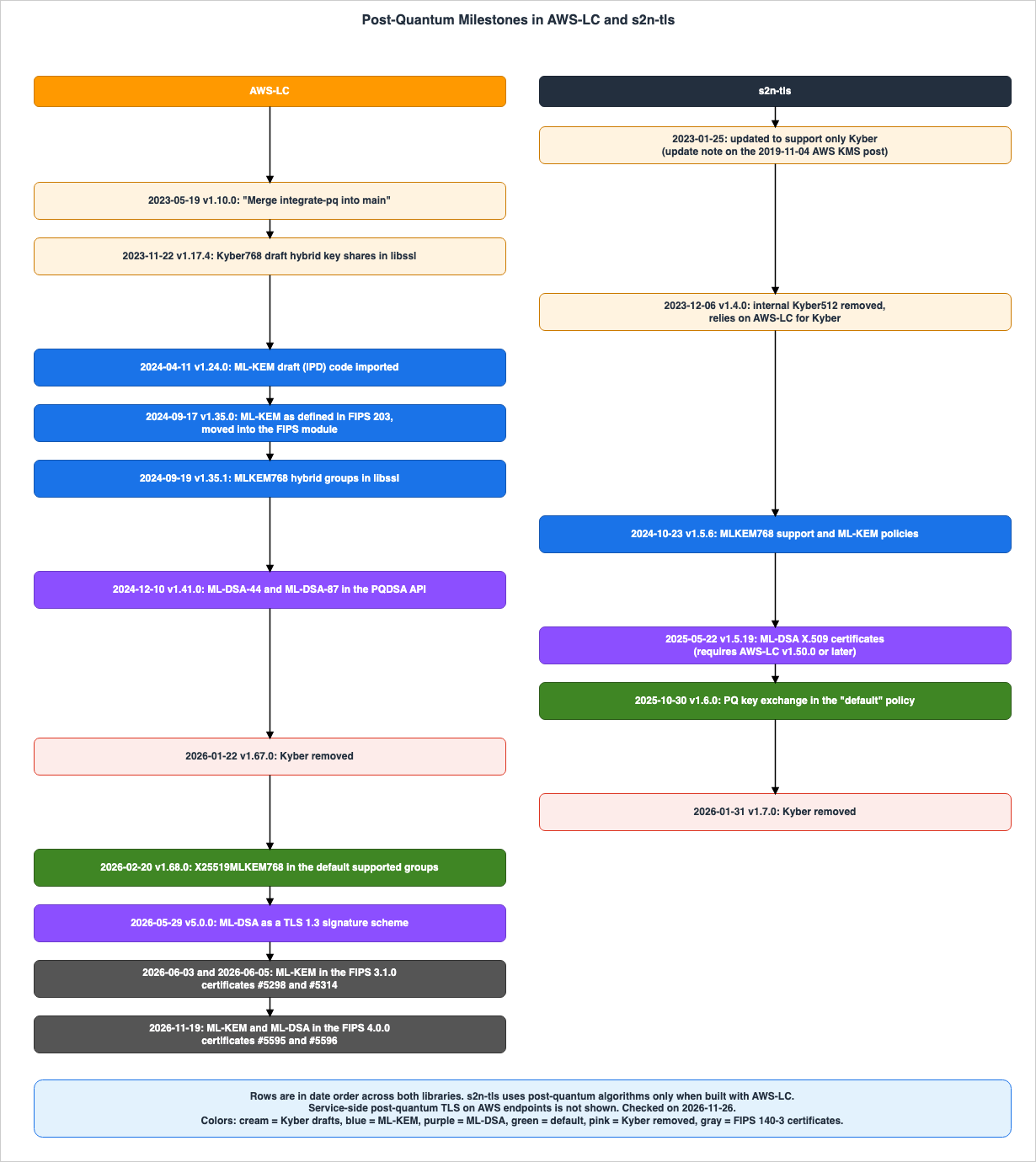
| Stage | AWS-LC | s2n-tls |
|---|---|---|
| Kyber drafts | v1.10.0 (2023-05-19): Release notes mention Merge integrate-pq into main. v1.17.4 (2023-11-22): Added hybrid key shares SecP256r1Kyber768Draft00 and X25519Kyber768Draft00 to libssl. | Update note of 2023-01-25: updated to support only Kyber. v1.4.0 (2023-12-06): Removed the built-in Kyber512 and relies on AWS-LC. |
| ML-KEM | v1.24.0 (2024-04-11): Imported the code of the draft (IPD). v1.35.0 (2024-09-17): Migrated to ML-KEM for FIPS 203 and included in the FIPS module. v1.35.1 (2024-09-19): Added the hybrid group for ML-KEM-768 to libssl. | v1.5.6 (2024-10-23): ML-KEM-768 and ML-KEM security policies. |
| ML-DSA | v1.40.0 (2024-11-27): Internal API for ML-DSA. v1.41.0 (2024-12-10): Added ML-DSA-44 and ML-DSA-87 to the PQDSA API. v5.0.0 (2026-05-29): ML-DSA as a signature scheme for TLS 1.3. | v1.5.19 (2025-05-22): ML-DSA X.509 certificates (requires AWS-LC v1.50.0 or later). |
| Default | v1.68.0 (2026-02-20): Added X25519MLKEM768 to the default SupportedGroups. Release notes for v4.0.0 (2026-06-02) state that the hybrid key shares were enabled on the FIPS 4.0 branch as well. | v1.6.0 (2025-10-30): Added post-quantum key exchange to the default security policy. |
| Kyber Removal | v1.67.0 (2026-01-22): Remove Kyber completely. | v1.7.0 (2026-01-31): Increased the MINOR version due to Kyber removal. |
| FIPS Certificates | ML-KEM: #5298, #5314 (FIPS 3.1.0, 2026-06) and #5595, #5596 (FIPS 4.0.0, 2026-11-19). ML-DSA: #5595, #5596. | s2n-tls does not hold certificates as it is not a cryptographic module. docs/BUILD.md states that FIPS mode is supported with versions of AWS-LC that support FIPS. It also states that FIPS mode is supported with OpenSSL 3.0, with caveats, when a CMVP-validated FIPS provider is loaded. |
As of November 26, 2026, the PQREADME states that libssl supports the hybrid groups
SecP256r1MLKEM768, SecP384r1MLKEM1024, and X25519MLKEM768, and the ML-KEM-only groups MLKEM512, MLKEM768, and MLKEM1024. The PQREADME recommends s2n-tls for post-quantum key exchange in TLS, while stating that the AWS-LC libssl also supports it.The s2n-tls documentation, specifically in
docs/BUILD.md, states that PQ key exchange is only supported with AWS-LC. The Usage Guide also states, s2n-tls must be built with aws-lc to use post-quantum algorithms. When used with OpenSSL, s2n-tls does not support post-quantum key exchange. The Usage Guide notes that for servers that enable post-quantum cryptography, An s2n-tls server that enables post-quantum cryptography will mandate post-quantum key exchange with any client advertising post-quantum algorithms.FIPS Branches and End of Support
This section outlines the types of FIPS branches thatVERSIONING.md describes and the planned end-of-support dates. VERSIONING.md is the document that the release notes of v5.0.0 (2026-05-29) pointed to as New Versioning Policy.Release Types
VERSIONING.md divides releases into two types:- Rolling mainline: It states
Rolling mainline releases are the primary release for most consumers.The mainline is submitted for FIPS validation approximately every six months. The version number is incremented only in the MINOR revision. - LTS: It states
Cut from mainline every 2 years and supported for 5 years from the date the branch is cut.Each LTS branch is submitted for FIPS validation.
There are also non-LTS FIPS branches.
VERSIONING.md treats them as branches that only keep the validated versions, and states They do not receive release tags, and consumers should not depend on them. Moving forward, LTS branches will be named fips-YYYY-MM-DD-lts, while non-LTS branches will be named fips-YYYY-MM-DD-snapshot. As of November 26, 2026, the repository contains the following branches: fips-2021-10-20, fips-2021-10-20-1MU, fips-2022-11-02, fips-2024-09-27, fips-2025-09-12-lts, fips-2026-06-26-snapshot, and fips-NetOS-2024-06-11. The only branch whose FIPS version VERSIONING.md states is fips-2025-09-12-lts (AWS-LC FIPS 4.x). This article has not verified which FIPS versions the other branches correspond to.End of Support Schedule
TheDeprecation of legacy FIPS branches section of VERSIONING.md includes the following table regarding the older FIPS branches before the new scheme:| Branch | End of support | Status on 2026-11-26 |
|---|---|---|
| AWS-LC FIPS 1.x | October 2026 | The planned month has passed. No statement that support has ended has been found |
| AWS-LC FIPS 2.x | April 2027 | Planned |
| AWS-LC FIPS 3.x | February 2030 | Planned |
Following the table, the section states,
After a branch reaches end of support, security fixes will no longer be backported. It also states, Consumers on these branches should migrate to mainline or to the FIPS 4.x LTS branch before the listed date. None of the three rows of the table has the word approximate. Regarding the first LTS, fips-2025-09-12-lts, the same section states, It is supported for 5 years from its cut date (approximate EOS: September 2030).The end of support and the CMVP certificate's Sunset Date are different dates. The planned end of support for AWS-LC FIPS 1.x (
October 2026) is about two years before the Sunset Date of #4631 (2028-10-05). The plan for AWS-LC FIPS 2.x (April 2027) also precedes the Sunset Dates of #4816 and #5429. Even if a certificate is Active, it does not guarantee that security fixes will be backported to that branch. This article has not found documentation stating whether the 1.x row of the table in VERSIONING.md covers AWS-LC FIPS 1.29.1 for NetOS (#5146).Frequently Asked Questions about AWS-LC and s2n-tls
This section answers common questions regarding the versions and validation of AWS-LC and s2n-tls.Is AWS-LC FIPS 140-3 validated?
Whether AWS-LC is FIPS 140-3 validated depends on the version and module. As of November 26, 2026, the CMVP lists 9 FIPS 140-3 certificates for AWS-LC from Amazon Web Services, with 8 currentlyActive. The 8 Active certificates are: AWS-LC FIPS 1.0.2 and 1.1.0 (certificate #4631), the static version of 2.0.0 (certificate #4816), the dynamic version of 2.0.0 (certificate #5429), 1.29.1 for NetOS (certificate #5146), 3.1.0 (dynamic, certificate #5298) and 3.1.0 (static, certificate #5314), and 4.0.0 (dynamic, certificate #5595) and 4.0.0 (static, certificate #5596). All of these are software modules at Overall Level 1. Mainline releases (such as v5.15.0) are not themselves the versions on a certificate. To determine which certificate applies, you need to verify the specific build version and the Security Policy associated with that certificate.Is AWS-LC FIPS 4.0 still in process?
On the CMVP pages, it is no longer in process. #5595 and #5596 received theirInitial validation on November 19, 2026, and are Active. As of November 26, 2026, FIPS.md still places v4.0 in the Modules in Process section. This article treats the CMVP pages as authoritative.Which version of AWS-LC made hybrid post-quantum key exchange the default?
For the libssl of AWS-LC, it is v1.68.0, released on February 20, 2026. The release notes stateEnable Hybrid PQ KeyShares by default, and PR #2531 indicates that X25519MLKEM768 was added to the default SupportedGroups. In s2n-tls, v1.6.0, released on October 30, 2025, added post-quantum key exchange to the default security policy. For the defaults of service endpoints, see Post-Quantum Cryptography Standardization Timeline and Migration on AWS.Can s2n-tls use post-quantum key exchange with OpenSSL?
No.docs/BUILD.md states that PQ key exchange is only supported with AWS-LC. The same document indicates that OpenSSL versions 1.0.2 through 3.0 are supported, while support for OpenSSL 4.0 is described as temporary. On Windows, AWS-LC is the only supported libcrypto.When does support for the AWS-LC FIPS 1.x, 2.x, and 3.x branches end?
The table inVERSIONING.md gives October 2026 for 1.x, April 2027 for 2.x, and February 2030 for 3.x. The month for 1.x has passed as of the verification date, November 26, 2026. The first LTS, fips-2025-09-12-lts (AWS-LC FIPS 4.x), is approximate EOS: September 2030. None of these dates is the Sunset Date of a certificate.Why is there no AWS-LC v1.0.0, and why was v4.0.0 published after v5.0.0?
As of November 26, 2026, there is nov1.0.0 tag in the repository. The first release of the 1.x series was v1.0.1 (February 2, 2022). Both v4.0.0 and v5.0.0 follow the scheme in VERSIONING.md. LTS (Long-Term Support) branches inherit the major version number of the mainline at the time they are cut, while the mainline progresses to the next major version number. v5.0.0 (mainline) was published on May 29, 2026, and the first LTS release, v4.0.0, on June 2, 2026.When was s2n renamed to s2n-tls?
An article about s2n-quic from February 17, 2022, states,we are renaming s2n to s2n-tls. The June 30, 2015, article that announced s2n has changed its title to Introducing s2n-tls, a New Open Source TLS Implementation and has the update note February 22, 2022: s2n has been renamed to s2n-tls. at the top.Summary
s2n was initially released as a TLS implementation on June 30, 2015, and was renamed to s2n-tls on February 17, 2022. AWS-LC first released a v0.1-alpha version on October 9, 2020, and its first production release was v0.0.1 on September 2, 2021. The first FIPS 140-3 certificate for AWS-LC, #4631, was issued on October 6, 2023. As of November 26, 2026, there are nine CMVP certificates from Amazon Web Services, with eight listed asActive.⇒ Certificates are separate for each version and form. AWS-LC FIPS 1.0.2 and 1.1.0 are associated with #4631; 2.0.0 has certificates #4816 (static) and #5429 (dynamic); the version for NetOS, 1.29.1, is #5146; 3.1.0 has certificates #5298 and #5314; and 4.0.0 has certificates #5595 and #5596. The interim #4759 was replaced by #5429 and became
Historical. Four certificates (3.1.0 and 4.0.0) have ML-KEM, and only the two 4.0.0 certificates have ML-DSA.⇒ Post-quantum features have different dates for when they entered and when they became the default. AWS-LC's libssl added the hybrid key share with the Kyber draft on November 22, 2023, and moved to the FIPS 203 ML-KEM in September 2024. ML-DSA was gradually introduced in versions from October to December 2024. AWS-LC added
X25519MLKEM768 to the default key shares in v1.68.0 on February 20, 2026. s2n-tls added post-quantum key exchange to the default security policy in v1.6.0 on October 30, 2025. Both subsequently removed Kyber in January 2026.⚠ As of November 26, 2026, FIPS.md and the CMVP pages say different things about the status of AWS-LC FIPS 4.0. While the planned end-of-support month for AWS-LC FIPS 1.x has passed, certificate #4631 remains listed as
Active. When verifying your local builds, it is necessary to confirm the specific date referenced in each document. All information provided is current as of November 26, 2026.This timeline will be updated as AWS-LC and s2n-tls releases and their FIPS 140-3 validations continue to evolve.
In addition, there are related history-and-timeline articles on this site, so please have a look if you are interested.
- Post-Quantum Cryptography Standardization Timeline and Migration on AWS - From Algorithm Selection to Service Support
- OpenSSL Release and Support Timeline - The Release Strategy, LTS Releases, and Where the End-of-Support Dates Come From
- Amazon Linux History and Timeline - Amazon Linux AMI, Amazon Linux 2, AL2023, AL2027, and the Clocks That Do Not Move Your Instances
- SSH and OpenSSH Algorithm History and Timeline - From SSH-1 to Post-Quantum Key Exchange, and How Algorithms Enter and Leave the Defaults
- TLS Certificate Ecosystem History and Timeline - Certificate Authorities, Automation, and Shrinking Certificate Lifetimes
- AWS History and Timeline regarding AWS CloudHSM - Overview, Functions, Features, Summary of Updates, and Introduction
References:
- aws/aws-lc README
- FIPS.md (aws/aws-lc)
- VERSIONING.md (aws/aws-lc)
- PQREADME.md (aws/aws-lc)
- Releases (aws/aws-lc)
- aws/s2n-tls README
- BUILD.md (aws/s2n-tls)
- Releases (aws/s2n-tls)
- Post Quantum (PQ) Support (s2n-tls Usage Guide)
- Security Policies (s2n-tls Usage Guide)
- Certificate #4631 (NIST CMVP)
- Certificate #4759 (NIST CMVP)
- Certificate #4816 (NIST CMVP)
- Certificate #5146 (NIST CMVP)
- Certificate #5298 (NIST CMVP)
- Certificate #5314 (NIST CMVP)
- Certificate #5429 (NIST CMVP)
- Certificate #5595 (NIST CMVP)
- Certificate #5596 (NIST CMVP)
- Entropy Validation #E77 (NIST CMVP)
- Entropy Validation #E280 (NIST CMVP)
- Introducing s2n-tls, a New Open Source TLS Implementation
- Post-quantum TLS now supported in AWS KMS
- Introducing s2n-quic, a new open-source QUIC protocol implementation in Rust
- Introducing AWS Libcrypto for Rust, an Open Source Cryptographic Library for Rust
- AWS-LC is now FIPS 140-3 certified
- AWS-LC FIPS 3.0: First cryptographic library to include ML-KEM in FIPS 140-3 validation
- Comparing AL2023 and AL2027 (Amazon Linux 2027 User Guide)
References:
Tech Blog with curated related content
Written by Hidekazu Konishi