OpenSSL Release and Support Timeline - The Release Strategy, LTS Releases, and Where the End-of-Support Dates Come From
First Published:
Last Updated:
Versions 3.0, 1.1.1 and 1.0.2 are no longer supported. However, it is not possible to determine when earlier versions ended support based solely on the current content of that page. The information regarding versions 3.1, 3.2, and 3.3 is not found anywhere on the current page. The end-of-support dates are documented in different sources depending on the version.The oldest heading in OpenSSL's NEWS.md is for version 0.9.1c, dated December 23, 1998. The first Release Strategy was published on December 23, 2014, introducing the concept of Long Term Support (LTS) versions and outlining the support duration for each version. Subsequently, the LTS versions were established as 1.0.2, 1.1.1, 3.0, and 3.5. Version 1.1.1 reached its end-of-support on September 11, 2023, and version 3.0 ended support on September 7, 2026. Version 4.0, released on April 14, 2026, removed the ENGINE API that was deprecated in version 3.0, and also removed SSLv3. A second beta version of 4.1 was released on October 9, 2026.
This article presents a timeline detailing when each OpenSSL version was released and when it ended (or is scheduled to end support), along with references to the documents that provide that information. The two questions this timeline aims to answer are: first, what rules govern the determination of end-of-support dates? And second, which documents specify those end-of-support dates, and which entries have differing dates or descriptions across those different documents?
Based on the available primary sources, the answers are as follows. First, regarding the policies. The current Release Strategy states that LTS (Long Term Support) versions will be supported for
at least 5 years, and an LTS will be released every April in odd-numbered years. Non-LTS versions are supported for at least two years up to version 3.4, and for 13 months after version 3.5. The end-of-life dates for versions 1.1.1, 3.0, and 3.5 are exactly 5 years from their initial release dates.Next, concerning the sources. End-of-life announcements (EOL notices) exist for versions 1.1.1, 3.2, and 3.0. The end-of-life dates for versions 3.4 through 4.0 are documented in the current Release Strategy. The end-of-life dates for versions 0.9.8 through 1.1.0, 3.1, and 3.3 are found in archived copies of the Release Strategy on the Internet Archive, listed as planned statements in the format
will be supported until. The end-of-life dates for versions 3.1 and 3.3 are also listed in the table on the OpenSSL Corporation's Lifecycle page. Finally, as of the verification date of 2026-10-13, versions 3.4 (scheduled for end-of-life on 2026-10-22) and 3.6 (scheduled for end-of-life on 2026-11-01) are nearing their end-of-life, while version 4.1 has not yet had its official release.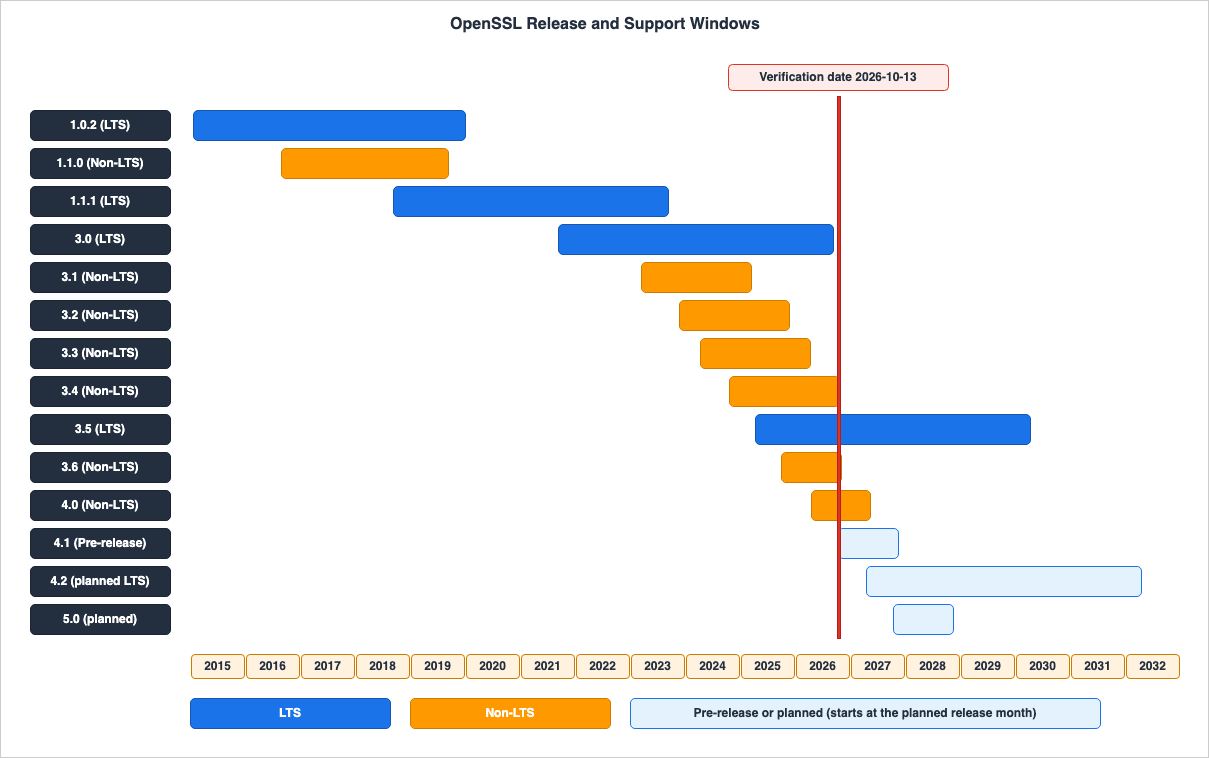
Background and Method of Creating the OpenSSL Release and Support Timeline
This section details the sources used to create the timeline and explains how the dates and “Change” values were determined. All sources were accessed on October 13, 2026.The Primary Sources This Article Used, and What It Made into Entries
This article utilized the following primary sources and related materials:- Release Strategy (openssl-library.org): The page's header indicates it was
First issued 23 December 2014andLast modified 07 May 2026. It details the version numbering system, current support end dates, and rules for LTS (Long Term Support) and non-LTS versions.
- Archived copies of the Release Strategy (Internet Archive): This article read 15 archived copies from the address www.openssl.org/policies/releasestrat.html, spanning from August 27, 2015, to April 9, 2024, and 9 copies from the current address, spanning from July 24, 2024, to August 20, 2026. End dates not present in the current page were obtained from these copies. The text in each copy is a planned statement as of the date of the copy.
- Downloads page (openssl-library.org): This page lists the latest releases for each series, along with their release dates, End-of-Life dates, and a table indicating which versions are FIPS-certified.
- NEWS.md and CHANGES.md (GitHub - openssl/openssl): The initial release dates for each version were taken from the dates within the headings of NEWS.md. As of October 13, 2026, the latest headings in these two files were for version 4.0.2 (August 25, 2026). Releases such as 4.0.3 (September 29, 2026) were obtained from the Downloads page.
- OpenSSL Library blog (openssl-library.org/post/): This article used announcements regarding releases, End-of-Life notifications (for versions 1.1.1, 3.2, and 3.0), and policy announcements (the 2014 Release Strategy, the 2018 announcement regarding the next LTS and version numbering system, the 2025 announcement for 3.5 LTS, the 2025 announcement regarding the removal of ENGINE, and the 2026 announcement regarding the removal of SSLv3 and planned future releases).
- OpenSSL Corporation Lifecycle page (openssl-corporation.org): This page provides a table detailing the release dates, end dates, status, and planned future developments for each version.
- NIST Cryptographic Module Validation Program (CMVP) page: This article checked the status and dates for OpenSSL's FIPS provider certificates #4282 and #4985.
- AWS documentation: This article used the Amazon Linux 2023 User Guide, release notes, and FAQ, as well as the Amazon Linux 2027 User Guide, to check the versions of OpenSSL included with Amazon Linux.
The items listed represent the initial release of each version, the end of support for each version, changes to support policies and version numbering schemes, the deprecations in 3.0 and the removals in 4.0, FIPS provider certification, and the 4.1 pre-releases. Patch releases (such as 3.5.9) are not listed, and neither are vulnerability announcements. Based on these criteria, 49 items were selected. In other words, please note that the items on this timeline are not all releases of OpenSSL, but are representative updates that I have picked out.
Versions and Releases
The Release Strategy states that the version numbering system was changed toMAJOR.MINOR.PATCH starting with version 3.0.0. Within the same major version number, the scheme keeps both API and ABI compatibility. Version 1.1.1 and earlier versions use the old scheme. Under that older system, releases with a letter appended to the version number (e.g., 1.0.2a) included only bug fixes and security patches, while releases with a changed final number (e.g., 1.1.0 and 1.1.1) can include new features.This article refers to units with a defined support period (such as 3.5 or 1.1.1) as "versions," and the actual releases distributed (such as 3.5.9 or 1.0.2a) as "releases." The Downloads page refers to versions as
Series. To avoid ambiguity, this article uses the full version number (e.g., 3.0) rather than simply "3," which reads as the whole series.Timeline Columns, Change Values, and Date Sources
Each table in the timeline has the following five columns. The column names and "Change" values are consistent with those used on this site's AWS History and Timeline regarding AWS Certificate Manager.- Date — Represents the date associated with the row. The method for determining this date is described below. Rows where the source provides only the month are formatted as
YYYY-MM. - Change — Indicates the type of change. This value will be one of seven options listed below.
- What Happened — Describes the event or change. The original text from the source material is presented in English.
- Date Source — Specifies the type of document from which the 'Date' value was obtained. This value will be one of eight options listed below.
- Source — Refers to the specific document used as the basis for the row. This column may include documents beyond those used for the 'Date Source'.
For the row of a version's first release, the Date is the date in the NEWS.md heading. For lines describing policy changes, the date was set to either the date of the blog post announcing the policy, or the
Last modified date from a copy of the Release Strategy. For lines indicating the end of support or planned events, the actual end date was used as the "Date." If a version had an announcement article indicating the end of support, that article was used as the "Date Source." If no such article existed, the planned text from a previous copy of the Release Strategy was used as the "Date Source," and What Happened gives the date of the copy and says that the statement is a planned one. For lines related to the FIPS provider certification, the date was set to the date on the NIST page. For the rows of the 4.1 pre-releases, the date was set to either the announcement date or the date on the Downloads page.The "Change" field has the following seven values:
- Added — A feature, integration, Region, or API was added.
- Changed — Default values or behavior were modified.
- Renamed — The name was changed. (Not used in this article.)
- Deprecated — A source indicated that a feature is deprecated or will end in the future. The feature could still be used at that point.
- Removed — A source stated, using phrases such as
no longer supportsorno longer available, that a feature was removed. - Ended — Support or availability for the feature ended.
- Scheduled — A planned date that had not yet arrived on the verification date (2026-10-13).
This article marks the initial release of a version as "Added" and the end of support as "Ended." Lines where support policies or version numbering systems have changed are marked as "Changed." The 4.0.0 section of NEWS.md describes what it removed with the word
Removed, as in Removed support for engines., so this article uses "Removed." The announcement regarding the removal of ENGINE on 2025-12-18 is considered "Deprecated" because it announced, before 4.0 was released, that 4.0 would remove ENGINE.The six Date Source values in the AWS Certificate Manager timeline are for AWS documents, so this article uses the following eight values instead.
- NEWS.md and CHANGES.md — Dates found within the square brackets in the headings (e.g.,
[14 Apr 2026]). - Release Strategy — A date written in the body of the current Release Strategy.
- Release Strategy (archived) — A date written in the body of a copy of the Release Strategy on the Internet Archive. What Happened gives the date of the copy.
- Downloads page — The dates listed in the "Release" and "End-of-Life" columns on the Downloads page.
- OpenSSL blog — The dates displayed on the blog articles page on openssl-library.org. However, for rows whose Date is a date written in the body of a post, What Happened says so.
- OpenSSL Corporation lifecycle page — A date written in the table on the OpenSSL Corporation's Lifecycle page.
- NIST CMVP — The dates found in the "Validation History" section on the NIST CMVP's certificate pages.
Dates from other articles' timelines are not considered part of the "Date Source."
Conflicting Dates and Statements for the Same Events
Different sources often give different dates for the same event. This article does not claim that any of these dates are incorrect. The main table lists a single date for each event. Dates from other sources are listed individually in the "Where the Dates Differ" table. This table categorizes discrepancies into four types, mirroring the categorization used in the AWS Certificate Manager timeline.- Different kinds of dates — This refers to instances where sources record different types of dates, such as the announcement date, the date a document was updated, the date a feature was discontinued, or the publication date of a blog post.
- Same date, different statements — In these cases, the dates are the same, but the information or names associated with those dates differ between sources.
- The sources disagree — This category covers instances where sources give different dates of the same kind for the same event.
- Statement not found — For one of the dates, this article has not found a source that states it. Not finding a statement does not prove that no such statement exists.
Similar to the example of the end-of-life date for version 1.1.0, if different copies on the same page list different end-of-life dates, this article categorizes those entries under "The sources disagree." The Dates by Source column for those entries lists the dates of the copies.
Topics Covered in Other Articles
Other articles on this site cover the following topics as their main subjects. This article gives them only timeline rows and short descriptions.- OpenSSL Vulnerabilities (including Heartbleed) — Major Security Vulnerabilities History and Timeline
- Post-Quantum Cryptography Standardization and AWS Implementation — Post-Quantum Cryptography Standardization Timeline and Migration on AWS
- History of TLS Certificates — TLS Certificate Ecosystem History and Timeline
- History of Amazon Linux Generations — Amazon Linux History and Timeline
- The Accelerated End of Support for Node.js 16, Aligned with OpenSSL 1.1.1 — Node.js Release and EOL Timeline
- Algorithms Used in SSH and OpenSSH — SSH and OpenSSH Algorithm History and Timeline
- Cryptography Terminology — Cryptography Glossary for Engineers
OpenSSL Release and Support Historical Timeline (Updates from December 23, 1998)
The following six tables constitute the main body of this timeline. Following these tables is a table titled "Where the Dates Differ," which lists events with dates that vary across different sources. Each table's columns are defined as described in the previous section. All sources were accessed on October 13, 2026.Index:
- 1998–2014 - The period from OpenSSL's initial release to the introduction of the ENGINE API and the first Release Strategy.
- 2015–2020 - The period when 1.0.2 and 1.1.1 became Long Term Support (LTS) versions, support for 0.9.8 through 1.1.0 and for 1.0.2 ended, and a change in version numbering was announced.
- 2021–2024 - The period when 3.0 was released with the Apache License 2.0 and provider functionality, the ENGINE API was deprecated, and support for 1.1.1 ended.
- 2025 - The period when 3.5 became an LTS version, the support period for non-LTS versions was changed to 13 months, and support for versions 3.1 and 3.2 ended.
- 2026 - The period when 4.0 was released, removing ENGINE and SSLv3; support for versions 3.3 and 3.0 ended; and the 4.1 pre-releases came out.
- Scheduled - Planned dates that had not yet arrived as of October 13, 2026.
- Where the Dates Differ - Events with differing dates or descriptions across various sources.
* You can sort the table by clicking on the column name.
1998–2014 — The First Release, the ENGINE API, and the First Release Strategy
The announcement of May 18, 2018, describes the Release Strategy of December 23, 2014, as the first one that defined support periods for each version. The rows before December 23, 2014, in this table have no end-of-support dates.| Date | Change | What Happened | Date Source | Source |
|---|---|---|---|---|
| 1998-12-23 | Added | OpenSSL 0.9.1c was released. The oldest heading in NEWS.md is Major changes between SSLeay 0.9.0b and OpenSSL 0.9.1c [23 Dec 1998], and it describes the changes from SSLeay 0.9.0b. The SSLv3 removal announcement of 2026-04-07 states OpenSSL supported both SSLv2 and SSLv3 from its inception in December 1998. | NEWS.md | NEWS.md, The OpenSSL Library no longer includes SSLv3 |
| 2000-09-24 | Added | Version 0.9.6 was released. The ENGINE API was introduced in this version. The date is from the heading of CHANGES.md ([24 Sep 2000]). The section on 0.9.6 in NEWS.md mentions Support for external crypto devices, with a note stating, The support for external crypto devices is currently a separate distribution. The ENGINE removal announcement of 2025-12-18 states that the ENGINE API was released in OpenSSL 0.9.6 on 24 September 2000 and that It was originally designed for supporting external cryptography devices. The heading for the 0.9.6 section in NEWS.md is dated 2000-10-10 (Where the Dates Differ). | CHANGES.md | CHANGES.md, ENGINE code removed from the OpenSSL Library |
| 2005-07-05 | Added | Version 0.9.8 was released. The 2014-12-23 Release Strategy announcement describes version 0.9.8 as It was first released in July 2005. | NEWS.md | NEWS.md, The new Release Strategy |
| 2010-03-29 | Added | Version 1.0.0 was released. The Release Strategy document mentions that As of release 1.0.0 the OpenSSL versioning scheme was improved to better meet developers’ and vendors’ expectations. | NEWS.md | NEWS.md, Release Strategy |
| 2012-03-14 | Added | Version 1.0.1 was released. The section on 1.0.1 in NEWS.md lists Support TLS v1.2 and TLS v1.1. and TLS/DTLS heartbeat support. | NEWS.md | NEWS.md |
| 2014-12-23 | Changed | The initial Release Strategy was published. The announcement on the same day stated that support for versions 0.9.8 and 1.0.0 would end on December 31, 2015, and also mentioned LTS (Long Term Support) with the phrases, We are aiming to introduce the concept of a Long Term Support (LTS) release in the future. and The LTS release will receive support for a period of five years. The announcement from May 18, 2018, reflected on this release strategy, stating, This was the first time we defined support timelines for our releases, and added the concept of an LTS (long-term support) release. | OpenSSL blog | The new Release Strategy, New LTS Release |
2015–2020 — 1.0.2 and 1.1.1 as LTS, and the End of the 1.x Versions
During this period, two LTS versions were available: 1.0.2 and 1.1.1. The end-of-support dates for 0.9.8 through 1.0.2 are all taken from planned statements in past copies of the Release Strategy.| Date | Change | What Happened | Date Source | Source |
|---|---|---|---|---|
| 2015-01-22 | Added | Version 1.0.2 was released. In the copies of the Release Strategy, (LTS) was added to the 1.0.2 line between the copy of 2016-02-27 and the copy of 2016-04-11. | NEWS.md | NEWS.md, Release Strategy (Internet Archive, 2016-04-11) |
| 2015-12-31 | Ended | Support for versions 0.9.8 and 1.0.0 ended. The copy of 2015-12-28 states Support for version 0.9.8 will cease on 2015-12-31. and Support for version 1.0.0 will cease on 2015-12-31. This is a planned statement. The copy of 2016-10-30 states Version 1.0.0 is no longer supported. and Version 0.9.8 is no longer supported. | Release Strategy (archived) | Release Strategy (Internet Archive, 2015-12-28), Release Strategy (Internet Archive, 2016-10-30) |
| 2016-08-25 | Added | Version 1.1.0 was released. The copy of 2016-10-30 states Version 1.1.0 will be supported until 2018-08-31. This end date was later revised twice (Where the Dates Differ). | NEWS.md | NEWS.md, Release Strategy (Internet Archive, 2016-10-30) |
| 2016-12-31 | Ended | Support for version 1.0.1 ended. The copy of 2016-10-30 states Support for version 1.0.1 will cease on 2016-12-31. This is a planned statement. The copy of 2017-02-21 states Version 1.0.1 is no longer supported. | Release Strategy (archived) | Release Strategy (Internet Archive, 2016-10-30), Release Strategy (Internet Archive, 2017-02-21) |
| 2018-05-18 | Changed | It was announced that 1.1.1 would be the next LTS release. The announcement stated, Our next LTS release will be 1.1.1 which is currently in beta. It also stated, The 1.1.0 release will be supported for one year after 1.1.1 is released. The interval for selecting LTS releases is We will specify an LTS release at least every four years. | OpenSSL blog | New LTS Release |
| 2018-09-11 | Added | Version 1.1.1 was released as an LTS version. The announcement on the same day stated, This is also our new Long Term Support (LTS) version and so we are committing to support it for at least five years. It names TLSv1.3 as the main new feature. | NEWS.md | NEWS.md, OpenSSL 1.1.1 is released |
| 2018-11-28 | Changed | Announced a change in the version numbering system. The announcement page, dated 2018-11-28, has the address 2018-09-25-version (Where the Dates Differ). The announcement states that the new system will use the MAJOR.MINOR.PATCH format, and includes the following: The current development version (master branch) will be identified as version 3.0.0., We are skipping the 2.0.0 major version because the previous OpenSSL FIPS module has already used this number., OpenSSL version 3.0.0 will be the first version that we release under the Apache License 2.0. | OpenSSL blog | The Holy Hand Grenade of Antioch |
| 2019-09-11 | Ended | Support for version 1.1.0 ended. A copy from 2019-03-23 states, Version 1.1.0 will be supported until 2019-09-11., which was a planned statement. A copy from 2020-05-03 states, Versions 1.1.0, 1.0.1, 1.0.0 and 0.9.8 are no longer supported. | Release Strategy (archived) | Release Strategy (Internet Archive, 2019-03-23), Release Strategy (Internet Archive, 2020-05-03) |
| 2019-12-31 | Ended | Support for the 1.0.2 LTS version ended. The copies from 2016-04-11 to 2019-03-23 state Version 1.0.2 will be supported until 2019-12-31 (LTS). This is a planned statement. The copy from 2020-05-03 states Version 1.0.2 is no longer supported. and continues to indicate that extended support is available. | Release Strategy (archived) | Release Strategy (Internet Archive, 2019-03-23), Release Strategy (Internet Archive, 2020-05-03) |
2021–2024 — 3.0, Providers, and the Apache License
Version 3.0 was the first version to use the new version numbering system and became a Long Term Support (LTS) release. Versions 3.1 through 3.4 were not LTS releases and, according to the release strategy rules at the time, each is supported for two years.| Date | Change | What Happened | Date Source | Source |
|---|---|---|---|---|
| 2021-09-07 | Added | Version 3.0 was released as an LTS release. The NEWS.md heading is dated [7 sep 2021]. The section for 3.0.0 lists: Changed the license to the Apache License v2.0., Added providers, a new pluggability concept that will replace the ENGINE API and ENGINE implementations., and Added OSSL_LIB_CTX, a libcrypto library context. The Downloads page states: Since 3.0, the OpenSSL Library has been released under an Apache License v2.. An announcement dated 2026-05-07 gives the reason for making 3.0 an LTS as to ensure there was an upgrade path from OpenSSL 1.1.1 for projects that stick with LTS releases, 3.0 was designated an LTS. | NEWS.md | NEWS.md, OpenSSL 3.0 has been released!, Downloads, Future release schedule |
| 2021-09-07 | Deprecated | The ENGINE API was deprecated. The section for 3.0.0 lists: Deprecated the ENGINE API. The same section also states that many lower-level APIs were deprecated. | NEWS.md | NEWS.md |
| 2022-08-23 | Added | The OpenSSL 3.0 FIPS provider has achieved FIPS 140-2 certification (certificate #4282). This date corresponds to the first entry (Initial) in the Validation History on the NIST page. The announcement on 2022-08-24 states that the OpenSSL 3.0 FIPS Provider has had its FIPS 140-2 validation certificate issued by NIST & CSE. | NIST CMVP | Certificate #4282 (NIST CMVP), OpenSSL FIPS 140-2 validation certificate issued |
| 2023-03-14 | Added | Version 3.1 was released. The announcement on 2023-03-07 stated that 3.1 was to be made available on 14th March 2023 and highlighted the FIPS provider, updated for FIPS 140-3, as a major change. | NEWS.md | NEWS.md, OpenSSL 3.1 Final Release |
| 2023-09-11 | Ended | Support for the 1.1.1 LTS version ended. The same-day EOL announcement stated that LTS lasts five years and consequently OpenSSL 1.1.1 has reached its EOL as of today, 11th September 2023.. This site's Node.js timeline notes that the end of support for Node.js 16 was moved earlier to match this date. | OpenSSL blog | OpenSSL 1.1.1 End Of Life, Node.js Release and EOL Timeline |
| 2023-11-23 | Added | Version 3.2 was released. The announcement highlights Client-side QUIC support, including support for multiple streams (RFC 9000) as a key new feature. | NEWS.md | NEWS.md, OpenSSL announces final release of OpenSSL 3.2.0 |
| 2024-04-09 | Added | Version 3.3 was released. The announcement on 2024-04-10 states, This is the first release in accordance with our adoption of biannual time-based releases. | NEWS.md | NEWS.md, OpenSSL 3.3 Final Release Live |
| 2024-10-22 | Added | Version 3.4 was released. Version 3.4 was released under the policy of supporting non-LTS versions for two years, and is the final version to be released under that policy. The current Release Strategy states, Version 3.4 will be supported until 2026-10-22. | NEWS.md | NEWS.md, OpenSSL 3.4 Final Release Live, Release Strategy |
2025 — 3.5 LTS and 13 Months of Support for Non-LTS Releases
In 2025, it was decided that LTS releases will be selected every two years, and that non-LTS versions following 3.5 will receive 13 months of support.| Date | Change | What Happened | Date Source | Source |
|---|---|---|---|---|
| 2025-02-20 | Changed | It was announced that 3.5 will be the next Long Term Support (LTS) release, and that LTS releases will be selected every two years. The announcement stated, the OpenSSL Corporation and Foundation have agreed to designate an LTS every two years. That means there will be an LTS release in April of 2027, another in 2029, and so on. Regarding version 3.0, it stated, will continue to be fully supported until September 7, 2025 and receive security fixes until September 7, 2026. | OpenSSL blog | OpenSSL 3.5 will be the next long term stable (LTS) release |
| 2025-03-11 | Added | The FIPS provider for 3.1.2 has received FIPS 140-3 certification (certificate #4985). This corresponds to the date listed on the NIST Validation History page. The announcement stated, OpenSSL 3.1.2 FIPS Provider holds certificate #4985, which remains valid for five years and expires on March 10, 2030. | NIST CMVP | Certificate #4985 (NIST CMVP), OpenSSL 3.1.2: FIPS 140-3 Validated |
| 2025-03-14 | Ended | Support for version 3.1 has ended. The copies from 2024-07-24 to 2025-05-05 state Version 3.1 will be supported until 2025-03-14. This is a planned statement. The copy of 2025-10-31 has no line for 3.1. This article has not found a post announcing the end of support for 3.1 (it looked at the addresses of the 217 posts in the blog list as of 2026-10-13). | Release Strategy (archived) | Release Strategy (Internet Archive, 2025-03-21), OpenSSL 1.1.1 End Of Life |
| 2025-04-08 | Added | Version 3.5 was released as an LTS (Long Term Support) version. The section for version 3.5.0 lists Support for PQC algorithms (ML-KEM, ML-DSA and SLH-DSA) and Support for server side QUIC (RFC 9000). Details on the standardization process for post-quantum cryptography can be found on this site's Post-Quantum Cryptography Standardization Timeline and Migration on AWS. | NEWS.md | NEWS.md, OpenSSL 3.5 Final Release - Live |
| 2025-06-25 | Changed | The Release Strategy revised the support period for non-LTS versions. The copy of 2025-10-31 is Last modified 25 June 2025 and states Non-LTS releases up to 3.4 are supported for at least two years. Non-LTS releases after 3.5 will be full supported for 13 months. (full supported is as in the original). The copies up to 2025-05-05 stated Non-LTS releases will be supported for at least two years. | Release Strategy (archived) | Release Strategy (Internet Archive, 2025-10-31), Release Strategy (Internet Archive, 2025-05-05) |
| 2025-10-01 | Added | Version 3.6 was released. Version 3.6 is the first non-LTS release to follow the 13-month support policy. The current Release Strategy states, Version 3.6 will be supported until 2026-11-01. | NEWS.md | NEWS.md, Release Announcement for OpenSSL 3.6.0 |
| 2025-11-23 | Ended | Support for version 3.2 ended. The end-of-life announcement dated 2025-11-25 states At that time regular releases were designated for 2 years of public support and consequently OpenSSL 3.2 has reached its EOL as of 23rd November 2025. The Date is the date written in the body of this announcement. | OpenSSL blog | OpenSSL 3.2 End Of Life |
| 2025-12-18 | Deprecated | Announced the removal of ENGINE in version 4.0. The announcement stated, All symbols defined in openssl/engine.h have been removed from the shared library in OpenSSL 4.0. and Applications that use the ENGINE API will fail to compile using the default build settings. To assist with migration, it also provides information on building with stubs by defining OPENSSL_ENGINE_STUBS. However, it notes that When using the stubs the only supported value for the ENGINE argument will be NULL which means no engine. | OpenSSL blog | ENGINE code removed from the OpenSSL Library |
2026 — What 4.0 Removed, and the End of 3.3 and 3.0
In 2026, version 4.0 was released, and some features previously marked as deprecated in version 3.0 were removed. Support for the LTS (Long Term Support) version 3.0 ended on September 7, 2026.| Date | Change | What Happened | Date Source | Source |
|---|---|---|---|---|
| 2026-04-09 | Ended | Support for version 3.3 has ended. The copies from 2024-12-07 to 2026-08-20 state Version 3.3 will be supported until 2026-04-09. This is a planned statement. The Release Strategy as of 2026-10-13 has no line for 3.3. This article has not found a post announcing the end of support for version 3.3 (it looked at the addresses of the 217 posts in the blog list as of 2026-10-13). | Release Strategy (archived) | Release Strategy (Internet Archive, 2026-08-20), Lifecycle (OpenSSL Corporation) |
| 2026-04-14 | Added | Version 4.0 was released. The section for 4.0.0 lists new features, including Support for Encrypted Client Hello (ECH, [RFC 9849])., and the post-quantum group curveSM2MLKEM768. It also lists potentially breaking changes, such as ASN1_STRING has been made opaque. The current Release Strategy states Version 4.0 will be supported until 2027-05-14. | NEWS.md | NEWS.md, OpenSSL 4.0 Final Release - Live |
| 2026-04-14 | Removed | ENGINE was removed in 4.0. The section for 4.0.0 states Removed support for engines. and includes the note The no-engine build option and the OPENSSL_NO_ENGINE macro are always present. | NEWS.md | NEWS.md, ENGINE code removed from the OpenSSL Library |
| 2026-04-14 | Removed | In version 4.0, support for SSLv3 and SSLv2 Client Hello was removed. The section for 4.0.0 states Removed support for SSLv3. and Removed support for the SSLv2 Client Hello. The announcement from 2026-04-07 states As of OpenSSL 4.0, SSLv3 support has been removed altogether. NEWS.md and the announcement give different versions as the one that disabled SSLv3 by default (Where the Dates Differ). | NEWS.md | NEWS.md, The OpenSSL Library no longer includes SSLv3 |
| 2026-04-14 | Removed | In version 4.0, the c_rehash tool was removed. The section for 4.0.0 states Removed c_rehash script tool. and says to use openssl rehash instead. | NEWS.md | NEWS.md |
| 2026-05-07 | Changed | OpenSSL announced that major versions will be released every two years, starting with version 5.0. The announcement reads we now commit to a major release every two years. and continues, So the next LTS will be 4.2 in April 2027 and then we’ll have a major release, 5.0, in October 2027. The current Release Strategy is Last modified 07 May 2026 and states Starting with 5.0 (October 2027), there will be major release every two years. | OpenSSL blog | Future release schedule, Release Strategy |
| 2026-09-07 | Ended | Support for OpenSSL 3.0 has ended. The end-of-life announcement, dated 2026-09-16, states, OpenSSL 3.0 has reached its EOL as of 7 September 2026. The Date is the date written in the body of this announcement. The current Release Strategy states, Versions 3.0, 1.1.1 and 1.0.2 are no longer supported. As of 2026-10-13, the OpenSSL Corporation's Lifecycle page still lists 3.0 as Supported (Where the Dates Differ). | OpenSSL blog | OpenSSL 3.0 End of Life, Release Strategy |
| 2026-09-09 | Added | The first alpha release of 4.1 was released. The announcement states, OpenSSL 4.1 Alpha1 pre-release is available. | OpenSSL blog | OpenSSL 4.1 Alpha Release Announcement |
| 2026-09-21 | Changed | The FIPS 140-2 certificates for the 3.0 FIPS provider have been moved to the CMVP Historical List. The Date is the date written in the body of the end-of-life announcement of 2026-09-16 (the remaining FIPS 140-2 certificates move to the CMVP Historical List on 21 September 2026). As of 2026-10-13, the status of certificate #4282 is Historical, with the reason listed as Moved to historical list due to sunsetting. | OpenSSL blog | OpenSSL 3.0 End of Life, Certificate #4282 (NIST CMVP) |
| 2026-10-09 | Added | The second beta version of 4.1 (openssl-4.1.0-beta2) was released. The date is from the Release column on the Downloads page. The initial beta was announced on 2026-09-23, with the announcement stating OpenSSL 4.1 Beta1 pre-release is available. As of 2026-10-13, 4.1 had not yet had its official release. | Downloads page | Downloads, OpenSSL 4.1 Beta Release Announcement |
Scheduled Dates as of October 13, 2026
The following table lists planned events that have not yet occurred as of October 13, 2026. Any entry may be subject to change.| Date | Change | What Happened | Date Source | Source |
|---|---|---|---|---|
| 2026-10 | Scheduled | Scheduled for the official release of version 4.1. The OpenSSL Corporation's Lifecycle page indicates that version 4.1 is planned (Planned) for release in Oct 2026 and to be supported until Nov 2027. | OpenSSL Corporation lifecycle page | Lifecycle (OpenSSL Corporation) |
| 2026-10-22 | Scheduled | End of support for version 3.4 is scheduled. The current Release Strategy states, Version 3.4 will be supported until 2026-10-22. The Downloads page also lists the End-of-Life date as 22 Oct 2026. | Release Strategy | Release Strategy, Downloads |
| 2026-11-01 | Scheduled | End of support for version 3.6 is scheduled. The current Release Strategy states, Version 3.6 will be supported until 2026-11-01. | Release Strategy | Release Strategy |
| 2027-04 | Scheduled | The next LTS version, 4.2, is scheduled for release. An announcement from May 7, 2026, states, the next LTS will be 4.2 in April 2027. The table on the OpenSSL Corporation's Lifecycle page lists version 4.2 as Planned from Apr 2027 to Apr 2032, with the note Dates subject to change. below the table. | OpenSSL blog | Future release schedule, Lifecycle (OpenSSL Corporation) |
| 2027-05-14 | Scheduled | Version 4.0 support is scheduled to end. The current Release Strategy states: Version 4.0 will be supported until 2027-05-14. | Release Strategy | Release Strategy |
| 2027-10 | Scheduled | Version 5.0 is scheduled for release. The current Release Strategy states: Starting with 5.0 (October 2027), there will be major release every two years. | Release Strategy | Release Strategy |
| 2027-11 | Scheduled | Version 4.1 support is scheduled to end. The Downloads page indicates that the End-of-Life date for version 4.1 (openssl-4.1.0-beta2) is Nov 2027. | Downloads page | Downloads |
| 2030-04-08 | Scheduled | Version 3.5 (LTS) support is scheduled to end. The current Release Strategy states: Version 3.5 will be supported until 2030-04-08 (LTS). | Release Strategy | Release Strategy |
Where the Dates Differ
The following table lists events where the dates and descriptions vary across different sources. In the "Dates by Source" column, dates that have been placed in the main timeline are marked with(timeline). The values in the "Kind of Difference" column correspond to the four categories defined in the previous section.| Event | Dates by Source | Kind of Difference |
|---|---|---|
| Release 0.9.6 (beginning of ENGINE API) | CHANGES.md 2000-09-24 (timeline), announcement of ENGINE removal 24 September 2000, NEWS.md 2000-10-10 | The sources disagree |
| End of support for version 1.1.0 | The Release Strategy copy of 2016-04-11 (before the release of 1.1.0) = 2018-04-30. Release Strategy copies from 2016-10-06 to 2018-01-19 = 2018-08-31. Announcement of 2018-05-18 and the copy of 2018-09-01 = one year after the release of 1.1.1. The copy of 2019-03-23 = 2019-09-11 (timeline). Copies of the same page give different end dates depending on the date of the copy. | The sources disagree |
| Announcement of version numbering system | Date displayed on the page: 2018-11-28 (timeline), date on the address: 2018-09-25 | Different kinds of dates |
| Release of version 3.0 | NEWS.md [7 sep 2021] (timeline), date on the announcement page: 2021-09-07, date on the announcement address: 2021-09-06 | Different kinds of dates |
| Release and end of support for version 3.1 | NEWS.md 2023-03-14 (timeline), date on the announcement page for 3.1: 2023-03-07 (the main text states to be made available on 14th March 2023). End date in the Release Strategy copies: 2025-03-14 (timeline), announcement for the EOL of 1.1.1: 14th March 2025. A table in the 3.5 LTS announcement of 2025-02-20 states that 3.1 will be supported from 7 March 2023 to 7 March 2025. | The sources disagree |
| Release and end of support for version 3.3 | NEWS.md 2024-04-09 (timeline), OpenSSL Corporation Lifecycle page: 09 Apr 2024, date on the announcement page for 3.3: 2024-04-10. End date in the Release Strategy copies: 2026-04-09 (timeline), OpenSSL Corporation Lifecycle page: 09 Apr 2026. A table on the 3.5 LTS announcement states that 3.3 will be supported from 10 April 2024 to 10 April 2026. | The sources disagree |
| Listing of end-of-support dates for versions 3.1, 3.2, and 3.3 | In the Release Strategy copies, the end-of-support date for 3.1 appears in the copies from 2024-07-24 to 2025-05-05, the date for 3.2 in the copies from 2024-07-24 to 2026-08-20, and the date for 3.3 in the copies from 2024-12-07 to 2026-08-20. The OpenSSL Corporation Lifecycle page lists end-of-support dates for all three versions. The body of the Release Strategy as of 2026-10-13 has no lines for these three versions. | Statement not found |
| End of 3.0 Support | End date: 2026-09-07 (timeline), Announcement page date: 2026-09-16 | Different kinds of dates |
| Status of 3.0 (as of 2026-10-13) | The Release Strategy states Versions 3.0, 1.1.1 and 1.0.2 are no longer supported. and the EOL announcement also says that support has ended. The OpenSSL Corporation Lifecycle page lists the end date for 3.0 as 07 Sep 2026 and indicates a status of Supported. | The sources disagree |
| Release Strategy Update Date | Both the copy of 2026-08-20 and the page as of 2026-10-13 show Last modified 07 May 2026. The copy of 2026-08-20 states Version 3.0 will be supported until 2026-09-07 (LTS). while the page as of 2026-10-13 lists 3.0 as no longer supported. | Same date, different statements |
| Version with SSLv3 Disabled by Default | The 4.0.0 section of NEWS.md states OpenSSL had it disabled by default since version 1.1.0 (2016). The announcement of 2026-04-07 states SSLv3 was disabled at build-time in OpenSSL 1.0.2h by default. | Same date, different statements |
| Adoption of Semantic Versioning | The Release Strategy states we have not adopted semantic versioning in the strict sense of its rules. The OpenSSL Corporation Lifecycle page states OpenSSL's versioning scheme has evolved into a semantic versioning system (Major.Minor.Patch) adopted from version 3.x onwards. | Same date, different statements |
| 4.2 LTS Release | Announcement on 2026-05-07: the next LTS will be 4.2 in April 2027 (timeline). The OpenSSL Corporation's Lifecycle page states the 4.2 LTS release confirmed for April 2027, while the same page's table indicates Planned and Dates subject to change. | Same date, different statements |
| Versions covered by FIPS 140-2 certificate #4282 | The Downloads page lists three versions – 3.0.0, 3.0.8, and 3.0.9 – linked to #4282. The NIST #4282 page's Software Versions section lists 3.0.8, 3.0.9. | Same date, different statements |
Current Overview of OpenSSL Releases and Support
This section summarizes the support policies as of October 13, 2026, including the support periods for each version, features deprecated in 3.0 and removed in 4.0, FIPS provider certification, and the version included with Amazon Linux.The Release Strategy — LTS, Non-LTS, and the Six-Month Cadence
The current Release Strategy states the support rules as follows:- LTS (Long Term Support):
Every two years we designate a release as a Long Term Support (LTS) release that will be supported for at least 5 years.For the final year:During the final year of support, we do not commit to anything other than security fixes.For the timing:In essence that means an LTS will be released every April in odd-numbered years., followed byTherefore there will always be two fully supported LTS releases. - Non-LTS Releases:
Non-LTS releases up to 3.4 are supported for at least two years. Non-LTS releases after 3.5 will be full supported for 13 months.(full supportedis as in the original) - Release Frequency:
Every six months (in April and October) there will be a new release. - Major Releases:
Starting with 5.0 (October 2027), there will be major release every two years.andMajor releases (starting with 5.0) will come six months after each LTS. - Extended Support:
Extended support for 3.0, 1.1.1 and 1.0.2 to gain access to security fixes for those versions is available.The EOL announcements describe extended support as asupport contract. This article does not discuss pricing.
These policies have evolved in the following order.
- December 23, 2014: The initial Release Strategy incorporated end-of-support dates for each version and the concept of Long Term Support (LTS).
- From 2015 to May 2025 (archived copies):
We may designate a release as a Long Term Support (LTS) release. LTS releases will be supported for at least five years and we will specify one at least every four years. Non-LTS releases will be supported for at least two years. - February 20, 2025, and June 25, 2025: It was decided to select LTS versions every two years from version 3.5, and non-LTS versions following 3.5 will be supported for 13 months.
- May 7, 2026: It was decided to release major versions every two years from version 5.0.
Based on the current Release Strategy and aligning the dates with the initial release dates, the calculations result in the following: LTS versions 1.1.1 (September 11, 2018 → September 11, 2023), 3.0 (September 7, 2021 → September 7, 2026), and 3.5 (April 8, 2025 → April 8, 2030) are supported for exactly five years. Non-LTS versions 3.1 through 3.4 are supported for exactly two years. Versions 3.6 (October 1, 2025 → November 1, 2026) and 4.0 (April 14, 2026 → May 14, 2027) are supported for 13 months. Versions 1.0.2 (January 22, 2015 → December 31, 2019) and 1.1.0 (August 25, 2016 → September 11, 2019) do not fit this calculation. These two end dates are the values written in the copies and announcements listed in the 2015–2020 table.
The announcement regarding the End-of-Life (EOL) for version 1.1.1 states that the support period for OpenSSL, received from operating system vendors or other third parties, may differ from the period provided by the OpenSSL Project itself. The announcement reads:
If your copy of OpenSSL 1.1.1 is from an Operating System vendor (e.g. via .rpm or .deb packages) or another third party then the support periods for them may differ to those provided by the OpenSSL Project itself.Per-Version Support Schedule
The following figure and table list the initial release and end-of-support dates for versions 0.9.8 through 5.0. The figure only depicts versions 1.0.2 and later. The red vertical line in the figure represents the verification date of 2026-10-13. The bands for versions 4.1, 4.2, and 5.0 are based on the projected values found on the Downloads page and the OpenSSL Corporation’s Lifecycle page.LTS, Non-LTS, or —. LTS refers to versions that have an end date indicated by (LTS) in the Release Strategy, or versions designated as LTS on the OpenSSL Corporation’s Lifecycle page. Non-LTS refers to versions released after 2014-12-23 that do not have the (LTS) designation. — refers to non-LTS versions released before 2014-12-23. The source for the "End of Support" column is indicated in the "Source" column. The "Status" column displays the latest release information, as found on the Downloads page.* You can sort the table by clicking on the column name.
| Version | Type | First Release | End of Support | Status as of October 13, 2026 | Source |
|---|---|---|---|---|---|
| 0.9.8 | — | 2005-07-05 | 2015-12-31 | Ended | Release Strategy (archived, 2015-12-28) |
| 1.0.0 | — | 2010-03-29 | 2015-12-31 | Ended | Release Strategy (archived, 2015-12-28) |
| 1.0.1 | — | 2012-03-14 | 2016-12-31 | Ended | Release Strategy (archived, 2016-10-30) |
| 1.0.2 | LTS | 2015-01-22 | 2019-12-31 | Ended. Release Strategy indicates extended support is available. | Release Strategy (archived, 2019-03-23) |
| 1.1.0 | Non-LTS | 2016-08-25 | 2019-09-11 | Ended | Release Strategy (archived, 2019-03-23) |
| 1.1.1 | LTS | 2018-09-11 | 2023-09-11 | Ended. Release Strategy indicates extended support is available. | EOL announcement (OpenSSL blog, 2023-09-11) |
| 3.0 | LTS | 2021-09-07 | 2026-09-07 | Ended. Release Strategy indicates extended support is available. | EOL announcement (OpenSSL blog, 2026-09-16) |
| 3.1 | Non-LTS | 2023-03-14 | 2025-03-14 | Ended | Release Strategy (archived, 2025-03-21) |
| 3.2 | Non-LTS | 2023-11-23 | 2025-11-23 | Ended | EOL announcement (OpenSSL blog, 2025-11-25) |
| 3.3 | Non-LTS | 2024-04-09 | 2026-04-09 | Ended | Release Strategy (archived, 2026-08-20) |
| 3.4 | Non-LTS | 2024-10-22 | 2026-10-22 | Supported. Latest release 3.4.8 (2026-09-29). End scheduled. | Release Strategy |
| 3.5 | LTS | 2025-04-08 | 2030-04-08 | Supported. Latest release 3.5.9 (2026-09-29). | Release Strategy |
| 3.6 | Non-LTS | 2025-10-01 | 2026-11-01 | Supported. Latest release 3.6.5 (2026-09-29). End scheduled. | Release Strategy |
| 4.0 | Non-LTS | 2026-04-14 | 2027-05-14 | Supported. Latest release 4.0.3 (2026-09-29) | Release Strategy |
| 4.1 | Non-LTS | Not yet released (planned for 2026-10) | 2027-11 | Pre-release. openssl-4.1.0-beta2 (2026-10-09) | Downloads page; OpenSSL Corporation lifecycle page |
| 4.2 | LTS | Planned for 2027-04 | Planned for 2032-04 | Planned | OpenSSL blog (2026-05-07); OpenSSL Corporation lifecycle page |
| 5.0 | Non-LTS | Planned for 2027-10 | Planned for 2028-11 | Planned | Release Strategy; OpenSSL Corporation lifecycle page |
The end-of-life dates for versions 3.4 and 3.6 are scheduled after October 13, 2026. The "Type" designations for versions 4.1, 4.2, and 5.0 are taken from the table on the OpenSSL Corporation lifecycle page. The sources for the dates are listed in the "Source" column.
From Deprecated in 3.0 to Removed in 4.0
The ENGINE API, introduced in 0.9.6, was initially designed to support external cryptography devices. In version 3.0, the 'provider' mechanism was introduced as a replacement for the ENGINE API, and the ENGINE API was marked as deprecated. In version 4.0, ENGINE support was removed entirely. The announcement of December 18, 2025, states that ifOPENSSL_ENGINE_STUBS is defined, it can be built with stubs. When using stubs, the only valid value that can be passed as an argument to ENGINE is NULL, indicating that ENGINE is not being used. The same announcement also indicates that version 3.5, which includes the ENGINE API, will be supported as a Long Term Support (LTS) release until April 8, 2030.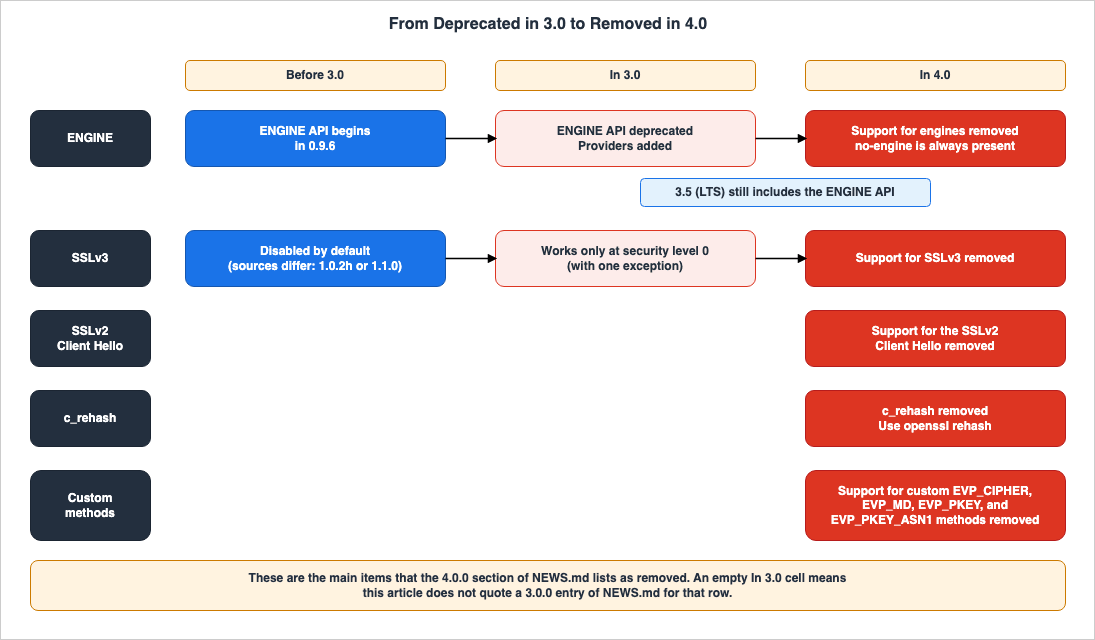
Removed are as follows:- ENGINE:
Removed support for engines.The 3.0.0 section of NEWS.md statedDeprecated the ENGINE API. - SSLv3:
Removed support for SSLv3.NEWS.md and the announcement of 2026-04-07 give different versions as the one that disabled it by default (Where the Dates Differ). The 3.0.0 section of NEWS.md statedSSL 3, TLS 1.0, TLS 1.1, and DTLS 1.0 only work at security level 0, except when RSA key exchange without SHA1 is used. - SSLv2 Client Hello:
Removed support for the SSLv2 Client Hello. c_rehash:Removed c_rehash script tool.The replacement isopenssl rehash.- Custom Methods (e.g.,
EVP_CIPHER):Removed deprecated support for custom EVP_CIPHER, EVP_MD, EVP_PKEY, and EVP_PKEY_ASN1 methods.
FIPS Provider Validations
The Downloads page lists FIPS-certified versions as follows: 3.1.2 (FIPS 140-3), 3.0.9, 3.0.8, and 3.0.0 (FIPS 140-2). The same page statesOther OpenSSL Releases MAY use the validated FIPS provider, but MUST NOT build and use their own FIPS provider. and gives the example For example you can build OpenSSL 3.4 and use the OpenSSL 3.0.9 FIPS provider with it. The certificate #4282 for the 3.0.9 FIPS provider, as of October 13, 2026, is listed as Historical (see the following list).As of October 13, 2026, the NIST CMVP page lists the following:
- #4282 (FIPS 140-2): Status is
Historical, with the reasonMoved to historical list due to sunsetting. TheSoftware Versionsare3.0.8, 3.0.9. The first entry in the Validation History is August 23, 2022. - #4985 (FIPS 140-3): Status is
Active, with aSunset Dateof3/10/2030. The first entry in the Validation History is March 11, 2025.
OpenSSL in Amazon Linux
The versions of OpenSSL included with each generation and release of Amazon Linux, as documented in AWS materials, are as follows. For a detailed history and timeline of Amazon Linux generations, please refer to Amazon Linux History and Timeline.| Amazon Linux | Release | OpenSSL | What the Source Says | Source |
|---|---|---|---|---|
| AL2 | — | 1.0.2 | The AL2023 User Guide states that By default, AL2 comes with OpenSSL 1.0.2. You can build applications against OpenSSL 1.1.1. | AL2023 User Guide |
| AL2023 (preview) | 2022.0.20220824 and others | 3.0 | The release notes state that OpenSSL updated from 1.1 to 3.0. | AL2023 release notes |
| AL2023 | 2023.6.20250107 | 3.0.8 | The release notes, in the Minimal container image section, list openssl-libs-1:3.0.8-1.amzn2023.0.18. | AL2023 release notes |
| AL2023 | 2023.7.20250331 | 3.2.2 | The release notes state that OpenSSL has been updated to version 3.2.2. For the FIPS-validated module, the AL2023 FAQ, regarding the same release, lists openssl-3.0.8-1.amzn2023.0.17 and openssl-fips-provider-certified-3.0.8-1.amzn2023.0.1 (Certificate 5021). | AL2023 release notes, AL2023 FAQ |
| AL2023 | 2023.10.20260330 | 3.5 | The release notes state that OpenSSL has been rebased to v3.5 and list openssl-libs-1:3.5.5-1.amzn2023.0.3 among the updated packages. | AL2023 release notes |
| AL2023 | 2023.12.20261012 | 3.5.8 | The release notes, in the Minimal Container section, list openssl-libs-1:3.5.8-1.amzn2023.0.3. | AL2023 release notes |
| AL2027 (preview) | — | 3.5 | The AL2027 User Guide states that AWS-LC does not replace OpenSSL. OpenSSL 3.5 remains the default system cryptographic library in AL2027. | AL2027 User Guide |
The release notes for AL2023 list the updated packages for each image type. This article has not found a source that states the version of OpenSSL used in the initial release of AL2023 (2023.0.20230315). The AL2023 FAQ states that
Core packages, such as glibc, openssl, openssh, and the dnf package manager, receive support for the lifetime of the major AL2023 release.The User Guide for AL2027 states about AL2027,
It is intended for evaluation and testing only and is not recommended for production workloads. The same page describes AWS-LC with It is derived from code that Google's BoringSSL project and the OpenSSL project released., and states that AWS-LC is installed alongside OpenSSL for applications that choose to use it. Support for AWS-LC's ML-KEM functionality is detailed in Post-Quantum Cryptography Standardization Timeline and Migration on AWS.Frequently Asked Questions about OpenSSL Releases and Support
This section answers common questions regarding OpenSSL versions and support.Which OpenSSL versions are LTS releases?
There are four LTS versions: 1.0.2, 1.1.1, 3.0, and 3.5. Support for 1.0.2, 1.1.1, and 3.0 has ended. According to the current Release Strategy, 3.5 (supported until April 8, 2030) is the only LTS version that is supported as of October 13, 2026. The next LTS release is expected to be 4.2, scheduled for April 2027. The current Release Strategy states that LTS releases will be supported forat least 5 years.When did OpenSSL 3.0 reach end of life, and which source says so?
OpenSSL 3.0 reached its end of life on September 7, 2026. The announcement of September 16, 2026, statesOpenSSL 3.0 has reached its EOL as of 7 September 2026., and the current Release Strategy lists 3.0 as no longer supported. However, the OpenSSL Corporation's Lifecycle page, as of October 13, 2026, lists 3.0's end date as 07 Sep 2026 and indicates its status as Supported. The Release Strategy, meanwhile, states that extended support for 3.0 is available.How long is a non-LTS OpenSSL release supported?
It varies depending on the version. The current Release Strategy states that non-LTS versions up to and including 3.4 are supported forat least two years, while non-LTS versions after 3.5 are supported for 13 months. The end-of-life dates for versions 3.1 through 3.4 are exactly two years after their initial release, while versions 3.6 and 4.0 will reach their end-of-life 13 months after their release. This rule is not in the copies of the Release Strategy up to 2025-05-05, and it is in the copy that is Last modified 25 June 2025.What did OpenSSL 4.0 remove?
The 4.0.0 section of NEWS.md lists ENGINE, SSLv3, and SSLv2 Client Hello, as well as thec_rehash script, with the word Removed. The ENGINE API had previously been deprecated in version 3.0. The announcement of December 18, 2025, stated that applications using the ENGINE API would not be able to build with the default settings in version 4.0. Version 3.5, which includes the ENGINE API, will continue to be supported as an LTS release until April 8, 2030.Which OpenSSL version does Amazon Linux ship?
According to AWS documentation, the default OpenSSL version for Amazon Linux 2 (AL2) is 1.0.2. The release notes for AL2023 indicate that during the preview period, it transitioned from 1.1 to 3.0, then to 3.2.2 in version 2023.7.20250331, and to 3.5 in version 2023.10.20260330. The release notes for version 2023.12.20261012 list packages for version 3.5.8. The preview version of AL2027 uses OpenSSL 3.5 as the default cryptographic library and includes AWS-LC. The FAQ for AL2023 lists OpenSSL as a core package and states that it will be supported throughout the major version lifecycle of AL2023, a period separate from the OpenSSL project's end-of-life date.When is the next OpenSSL LTS release?
As of October 13, 2026, the next LTS release will be version 4.2, scheduled for April 2027. An announcement from May 7, 2026, states,the next LTS will be 4.2 in April 2027. The OpenSSL Corporation's Lifecycle page lists version 4.2 as Planned, with the disclaimer Dates subject to change. Version 5.0 is currently scheduled for release in October 2027.Summary
OpenSSL's NEWS.md began with version 0.9.1c, released on December 23, 1998. The initial Release Strategy, introduced on December 23, 2014, established both end-of-support dates for each version and the concept of Long Term Support (LTS). There are now four LTS versions: 1.0.2, 1.1.1, 3.0, and 3.5. Version 3.0 was released with provider support and the Apache License 2.0, and deprecated the ENGINE API. Version 4.0 removed ENGINE and SSLv3.⇒ LTS versions are supported for at least five years, while non-LTS versions are supported for two years up to version 3.4, and for 13 months after version 3.5. The end-of-life dates for versions 1.1.1, 3.0, and 3.5 are exactly five years after their initial releases. According to the current Release Strategy, as of October 13, 2026, only version 3.5 is a supported LTS version, and the next LTS version, 4.2, is scheduled for release in April 2027.
⇒ The source of end-of-life dates varies depending on the version. Versions 1.1.1, 3.2, and 3.0 have end-of-life announcements. Versions 3.4 through 4.0 are documented in the current Release Strategy. The planned end-of-life dates for versions 0.9.8 through 1.1.0, 3.1, and 3.3 are preserved in archived copies of the Release Strategy. The end-of-life dates for versions 3.1 and 3.3 are also listed in the Lifecycle table on the OpenSSL Corporation website. The current Release Strategy does not list entries for versions 3.1, 3.2, or 3.3.
⚠ As of October 13, 2026, some entries are still planned. Version 3.4 is scheduled to end support on October 22, 2026, and version 3.6 on November 1, 2026. Version 4.1 is still in pre-release. The Lifecycle table on the OpenSSL Corporation website currently lists the discontinued version 3.0 as
Supported. When cross-referencing information, it is important to verify which source and which date are being used. All information is current as of October 13, 2026.This timeline will be updated as OpenSSL releases and the OpenSSL release strategy continue to evolve.
In addition, there are related history-and-timeline articles on this site, so please have a look if you are interested.
- Node.js Release and EOL Timeline - LTS Schedule, Active LTS and Maintenance, and End-of-Life Dates
- Python Version Support and EOL Timeline - Release Schedule, Support Policy, and End-of-Life Dates
- Java Version and LTS Timeline - Release History, the LTS Model, and Support Across Distributions
- .NET Release and Support Timeline - STS and LTS Releases, the Move to Two-Year STS Support, and End-of-Support Dates
- Go Release and Support Timeline - Release History, the Release Policy, and the Go 1 Compatibility Promise
- Amazon Linux History and Timeline - Amazon Linux AMI, Amazon Linux 2, AL2023, AL2027, and the Clocks That Do Not Move Your Instances
References:
- Release Strategy (OpenSSL Library)
- Downloads (OpenSSL Library)
- NEWS.md (openssl/openssl)
- CHANGES.md (openssl/openssl)
- Lifecycle (OpenSSL Corporation)
- OpenSSL 1.1.1 End Of Life
- OpenSSL 3.2 End Of Life
- OpenSSL 3.0 End of Life
- Future release schedule
- ENGINE code removed from the OpenSSL Library
- The OpenSSL Library no longer includes SSLv3
- Certificate #4282 (NIST CMVP)
- Certificate #4985 (NIST CMVP)
- OpenSSL 3 (Amazon Linux 2023 User Guide)
- Amazon Linux 2023 version 2023.7.20250331 release notes
- Amazon Linux 2023 version 2023.10.20260330 release notes
- Amazon Linux 2023 version 2023.12.20261012 release notes
- Amazon Linux 2023 FAQs
- Comparing AL2023 and AL2027 (Amazon Linux 2027 User Guide)
References:
Tech Blog with curated related content
Written by Hidekazu Konishi