AWS History and Timeline regarding Amazon EBS - Overview, Volume Types, Features, Summary of Updates, and Introduction
First Published:
Last Updated:
This time, I have created a historical timeline for Amazon Elastic Block Store (Amazon EBS), the network-attached block storage service for Amazon EC2 that was launched on August 20, 2008. Almost every Amazon EC2 instance that needs durable, off-instance disk relies on Amazon EBS, and the service has been continuously evolving for over 15 years — from a single magnetic volume type to a full lineup of SSD and HDD volume types, online volume modification, incremental snapshots, and built-in encryption.
Just like before, I am summarizing the main features while following the birth of Amazon EBS and tracking its feature additions and updates as a Current Overview, Functions, Features of Amazon EBS.
I hope these will provide clues as to what has remained the same and what has changed, in addition to the features and concepts of each AWS service.
Background and Method of Creating Amazon EBS Historical Timeline
The reason for creating a historical timeline of Amazon EBS this time is that Amazon EBS is one of the oldest and most fundamental services in AWS — it launched in August 2008, less than two years after Amazon EC2 — and yet its evolution is often seen only through the lens of Amazon EC2. Because Amazon EBS is the persistent block-storage layer beneath almost every Amazon EC2 instance, understanding when each volume type, snapshot capability, and encryption feature arrived is useful for storage engineers, SREs, and solutions architects.Another reason is that since Amazon EBS was launched in August 2008, the service has expanded along several axes — volume types (Magnetic, General Purpose SSD, Provisioned IOPS SSD, Throughput Optimized HDD, Cold HDD), snapshots (incremental, cross-Region copy, archive, Recycle Bin, lock), encryption (volume, boot volume, encryption by default), and online operations (Elastic Volumes, Multi-Attach). Therefore, I wanted to organize the information of Amazon EBS with the following approaches.
- Tracking the history of Amazon EBS and organizing the transition of updates
- Summarizing the feature list and characteristics of Amazon EBS
- What's New with AWS?
- AWS News Blog
- AWS Storage Blog
- What is Amazon Elastic Block Store? - Amazon EBS User Guide
The content posted is limited to major features related to the current Amazon EBS and necessary for the feature list and overview description.
In other words, please note that the items on this timeline are not all updates to Amazon EBS features, but are representative updates that I have picked out.
Amazon EBS Historical Timeline (Updates from August 20, 2008)
Now, here is a timeline related to the functions of Amazon EBS. As of the time of writing this article, the history of Amazon EBS spans more than 15 years from August 2008.2008 | 2012 | 2013 | 2014 | 2015 | 2016 | 2017 | 2018 | 2019 | 2020 | 2021 | 2022 | 2023 | 2024 | 2025 | 2026
* The table can be sorted by clicking on the column names.| Date | Summary |
|---|---|
| 2008-08-20 | Amazon EBS launches, providing persistent off-instance block storage for Amazon EC2 instances. It is open and available to all Amazon EC2 users from day one, with volumes ranging from 1 GB to 1 TB that persist independently of the instance lifecycle. Volumes can be snapshotted to Amazon S3, and new volumes created from a snapshot load their data lazily. [Source] |
| 2012-08-01 | Provisioned IOPS volumes for Amazon EBS are introduced (the volume type later named io1). They let customers dial in consistent, predictable storage performance of up to 1,000 IOPS per volume, far above the roughly 100 IOPS of the original Standard (magnetic) volumes. [Source] |
| 2012-08-01 | EBS-optimized instances are introduced, providing dedicated throughput between Amazon EC2 and Amazon EBS. The first EBS-optimized instance types (m1.large, m1.xlarge, m2.4xlarge) reserve 500–1,000 Mbps of throughput so that EBS I/O does not contend with other network traffic. [Source] |
| 2012-12-18 | Amazon EBS Snapshot Copy between AWS Regions launches. Customers can copy an EBS snapshot from one Region to another for geographic expansion, migration, and disaster recovery. [Source] |
| 2013-05-07 | Provisioned IOPS volumes raise the maximum to 4,000 IOPS per volume. This is a fourfold increase from the original 1,000 IOPS limit introduced in 2012. [Source] |
| 2013-06-11 | Cross-Region EBS Snapshot Copy becomes faster through incremental transfers. Subsequent copies transfer only the data that changed since the last snapshot copy, enabling more frequent cross-Region copies; the same change also improves Amazon EC2 AMI copy. [Source] |
| 2014-05-21 | Amazon EBS encryption becomes available for new EBS volumes at no additional cost. It uses AES-256 to encrypt the volume, its disk I/O, and its snapshots, with encryption performed on the Amazon EC2 host. [Source] |
| 2014-06-16 | The General Purpose (SSD) volume type — later branded gp2 — is introduced and becomes the new default. It delivers a baseline of 3 IOPS/GB and can burst to 3,000 IOPS, and in the same announcement the original Standard volumes are rebranded as "Magnetic", creating a three-tier lineup (General Purpose SSD, Provisioned IOPS SSD, Magnetic). [Source] |
| 2015-03-19 | Amazon EBS makes 16 TB volumes and 20,000 IOPS generally available. General Purpose (SSD) volumes scale to 16 TB / 10,000 IOPS / 160 MB/s and Provisioned IOPS (SSD) volumes scale to 16 TB / 20,000 IOPS / 320 MB/s, up from the previous 1 TB / 4,000 IOPS maximums. [Source] |
| 2015-12-15 | Amazon EBS adds encrypted boot (root) volumes, completing end-to-end EBS encryption. Customers can create AMIs whose boot volumes are encrypted with AWS KMS keys, so both data and boot volumes can be encrypted at no extra charge. [Source] |
| 2016-04-19 | Throughput Optimized HDD (st1) and Cold HDD (sc1) volume types are introduced. st1 targets large, sequential, throughput-intensive workloads (up to 500 MB/s) and sc1 targets infrequently accessed, cost-sensitive data (up to 250 MB/s). [Source] |
| 2017-02-13 | Amazon EBS Elastic Volumes enable online modification of size, type, and IOPS with no detach and no downtime. Customers can grow a volume, switch between gp2/io1/st1/sc1, or change provisioned IOPS while the volume is attached and in use, through the console, CLI, or the ModifyVolume API. [Source] |
| 2017-12-06 | Provisioned IOPS SSD (io1) volumes raise their maximum to 32,000 IOPS and 500 MB/s per volume. This lifts the previous 20,000 IOPS / 320 MB/s ceiling at no additional cost in all Regions where Amazon EBS is offered. [Source] |
| 2018-07-12 | Amazon Data Lifecycle Manager (DLM) launches to automate the creation and retention of EBS snapshots. Tag-based policies schedule snapshots and expire old ones, with no additional charge for DLM itself. [Source] |
| 2018-11-26 | Amazon EBS doubles the maximum performance of Provisioned IOPS SSD (io1) volumes to 64,000 IOPS and 1,000 MB/s. The increase from 32,000 IOPS / 500 MB/s applies when io1 volumes are attached to Amazon EC2 instances built on the AWS Nitro System. [Source] |
| 2018-12-03 | General Purpose SSD (gp2) volumes raise their maximum performance to 16,000 IOPS and 250 MB/s per volume. The increase from 10,000 IOPS / 160 MB/s applies at no additional cost; gp2 performance still scales with volume size at 3 IOPS/GiB. [Source] |
| 2019-01-16 | AWS Backup launches as a managed, policy-based backup service, with Amazon EBS supported from day one. A single backup policy can protect Amazon EBS volumes alongside Amazon RDS, Amazon DynamoDB, Amazon EFS, and AWS Storage Gateway. [Source] |
| 2019-05-23 | Amazon EBS encryption by default becomes available as a per-account, per-Region setting. A single setting forces every newly created EBS volume and snapshot in the Region to be encrypted, without changing existing workflows. [Source] |
| 2019-05-29 | Amazon EBS adds multi-volume, crash-consistent snapshots across all volumes attached to an Amazon EC2 instance. A single CreateSnapshots API call captures point-in-time, crash-consistent snapshots of every EBS volume on an instance, and it integrates with Amazon Data Lifecycle Manager. [Source] |
| 2019-11-20 | Amazon EBS Fast Snapshot Restore (FSR) is launched. FSR delivers fully initialized volumes from a snapshot with no pre-warming, so restored volumes provide full performance immediately; it is enabled per Availability Zone. [Source] |
| 2019-12-03 | Amazon EBS direct APIs for Snapshots launch, providing programmatic block-level access to snapshot content. The read APIs (ListSnapshotBlocks, ListChangedBlocks, GetSnapshotBlock) let backup and disaster-recovery tools read snapshot data directly without creating a volume. [Source] |
| 2020-02-14 | Amazon EBS Multi-Attach launches for Provisioned IOPS io1 volumes. A single io1 volume can be attached to up to 16 Nitro-based Amazon EC2 instances in the same Availability Zone, enabling clustered and high-availability applications. [Source] |
| 2020-08-24 | The io2 Provisioned IOPS SSD volume type launches with 100x higher durability and more IOPS per GiB. io2 provides 99.999% durability (versus 99.9% for io1) and up to 500 IOPS/GiB, at the same price as io1. [Source] |
| 2020-12-01 | The gp3 General Purpose SSD volume type is introduced, decoupling IOPS and throughput from capacity. gp3 provides a 3,000 IOPS / 125 MB/s baseline at any size and lets customers provision additional IOPS and throughput independently of the volume size. [Source] |
| 2020-12-01 | io2 Block Express enters preview, quadrupling per-volume capacity and performance. Block Express targets up to 256,000 IOPS, 4,000 MB/s of throughput, 64 TiB of capacity, and sub-millisecond latency, initially on Amazon EC2 R5b instances. [Source] |
| 2020-12-21 | Amazon EBS Multi-Attach support is added to the io2 volume type. io2 Multi-Attach shares a volume across up to 16 Nitro-based instances in one Availability Zone and supports I/O fencing (which io1 lacks). [Source] |
| 2021-07-19 | Amazon EBS io2 Block Express reaches general availability with Amazon EC2 R5b instances. GA delivers up to 256,000 IOPS, 4,000 MB/s throughput, and 64 TiB per volume with consistent sub-millisecond latency. [Source] |
| 2021-11-29 | Amazon EBS Snapshots Archive is introduced to reduce the cost of long-term snapshot retention. Snapshots that are kept for a long time and rarely accessed can be moved to a low-cost archive tier with a 90-day minimum retention; restoring to the standard tier takes hours. [Source] |
| 2021-11-29 | Recycle Bin for Amazon EBS Snapshots launches to recover from accidental deletions. Retention rules let customers recover a deleted snapshot within a configurable retention period before it is permanently removed. [Source] |
| 2022-02-03 | Recycle Bin is extended to EBS-backed Amazon Machine Images (AMIs). Retention rules can now recover accidentally deregistered AMIs while retaining their tags, permissions, and encryption status. [Source] |
| 2023-11-09 | Block Public Access for Amazon EBS Snapshots launches. An account- and Region-level control blocks the public sharing of EBS snapshots, reducing the risk of inadvertent data exposure. [Source] |
| 2023-11-15 | Amazon EBS Snapshot Lock is announced, protecting snapshots from inadvertent or malicious deletion. Governance and Compliance lock modes provide WORM (write-once-read-many) retention from 1 day to about 100 years, with new LockSnapshot / UnlockSnapshot / DescribeLockedSnapshots APIs. [Source] |
| 2024-11-26 | Amazon EBS introduces Time-based Copy for EBS Snapshots and AMIs. Customers can set a target completion duration (15 minutes to 48 hours) for snapshot and AMI copies within or across Regions and accounts to meet recovery point objectives, with a new SnapshotCopyBytesTransferred Amazon CloudWatch metric. [Source] |
| 2025-05-06 | Amazon EBS announces Provisioned Rate for Volume Initialization for predictable snapshot hydration. Customers can specify a constant rate at which a new volume is initialized from a snapshot so that volumes become fully performant in a predictable time, with an Amazon EventBridge notification on completion. [Source] |
| 2025-07-16 | Amazon EBS adds visibility into the volume initialization status of volumes created from snapshots. Customers can determine when a snapshot-restored volume is fully initialized, with an estimated completion time when using Provisioned Rate for Volume Initialization. [Source] |
| 2025-07-22 | Amazon EBS io2 Block Express becomes available in all commercial and AWS GovCloud (US) Regions. The highest-performance EBS volume type expands to all commercial and GovCloud (US) Regions (excluding the AWS China Regions). [Source] |
| 2025-09-26 | Amazon EBS increases the maximum size and provisioned performance of gp3 volumes. gp3 now scales to 64 TiB (4x), 80,000 IOPS (5x the prior 16,000), and 2,000 MiB/s throughput (2x the prior 1,000 MiB/s). [Source] |
| 2025-10-14 | Amazon EBS Volume Clones launch, creating instant point-in-time copies of a volume within the same Availability Zone. A single API call or console action clones an encrypted volume in seconds with single-digit-millisecond latency, removing the snapshot-then-create round trip for dev/test, and it integrates with the Amazon EBS CSI driver. [Source] |
| 2025-11-20 | Recycle Bin adds support for Amazon EBS volumes. Retention rules can now recover an accidentally deleted EBS volume directly — not just snapshots and EBS-backed AMIs — with the recovered volume retaining its tags, permissions, and encryption status and available at full performance immediately. [Source] |
| 2026-01-15 | Amazon EBS allows up to four Elastic Volumes modifications per volume within a rolling 24-hour period. Each new modification can start as soon as the previous one completes, replacing the earlier wait between modifications and improving the agility of online size, type, and performance changes. [Source] |
Current Overview, Functions, Features of Amazon EBS
Amazon Elastic Block Store (Amazon EBS) is a high-performance, network-attached block-storage service designed for use with Amazon EC2. An EBS volume behaves like a raw block device that you can attach to an instance, format with a file system, and use as a boot volume or as data storage. Unlike instance store, an EBS volume persists independently of the life of the instance and can be detached from one instance and attached to another within the same Availability Zone.EBS volumes are stored redundantly within a single Availability Zone, and their durability and availability characteristics depend on the volume type. For Region-level durability and recovery, EBS volumes are backed up as incremental snapshots that are stored in Amazon S3 and can be copied across Regions and accounts.
Amazon EBS Use Cases
- Boot (root) volumes for Amazon EC2 instances — most Amazon EC2 instances boot from an EBS-backed AMI, so the root file system lives on an EBS volume.
- Relational and NoSQL databases — self-managed databases (such as Microsoft SQL Server, Oracle, PostgreSQL, MySQL, MongoDB, and Cassandra) that need consistent, low-latency block storage.
- Enterprise and business-critical applications — SAP, Microsoft Exchange, and other applications that require predictable IOPS and throughput.
- Big data and analytics — throughput-intensive workloads on large, sequential data sets.
- Backup, disaster recovery, and migration — EBS snapshots provide the recovery point for instance-level backup, cross-Region DR, and lift-and-shift migration.
- Development, test, and CI environments — quickly provisioned, easily resized, and snapshot-cloned environments.
Specific Examples of Use Cases
- Hosting a production database on io2 Block Express to obtain sub-millisecond latency and high, sustained IOPS.
- Running a general-purpose application fleet on gp3 volumes and independently provisioning extra throughput for log-heavy workloads.
- Using st1 (Throughput Optimized HDD) for a large Apache Kafka, Splunk, or data-warehouse workload that streams big sequential data.
- Using sc1 (Cold HDD) for infrequently accessed, cost-sensitive colder data.
- Sharing a single io2 volume across multiple Amazon EC2 instances with Multi-Attach to build a clustered, highly available application.
- Capturing crash-consistent snapshots of every volume on an instance and automating their retention with Amazon Data Lifecycle Manager and AWS Backup.
Amazon EBS Volume Types
Amazon EBS volume types fall into two families: SSD-backed volumes optimized for transactional workloads measured in IOPS (gp3, gp2, io2 Block Express, io2, io1) and HDD-backed volumes optimized for throughput in MB/s (st1, sc1). The previous-generation Magnetic (standard) volume is retained only for backward compatibility.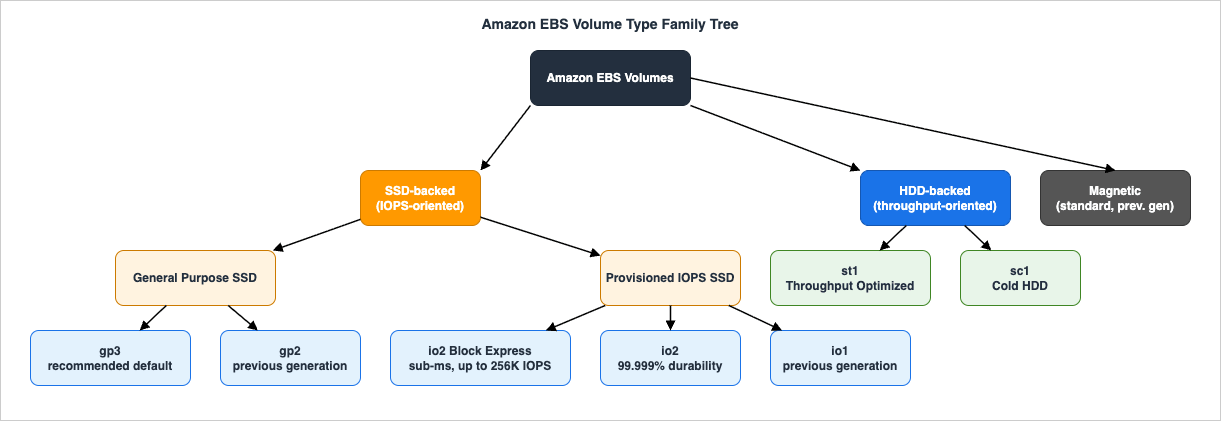
* You can sort the table by clicking on the column name.
| Volume Type | Category | Designed For | Max IOPS / Throughput (per volume) |
|---|---|---|---|
| gp3 | General Purpose SSD | Broad set of transactional workloads; the recommended default | Up to 80,000 IOPS and 2,000 MiB/s; baseline 3,000 IOPS / 125 MiB/s; up to 64 TiB |
| gp2 | General Purpose SSD (previous generation) | Boot volumes and general workloads; performance scales with size | Up to 16,000 IOPS and 250 MiB/s; up to 16 TiB |
| io2 Block Express | Provisioned IOPS SSD | Largest, most performance-critical databases needing sub-millisecond latency | Up to 256,000 IOPS and 4,000 MiB/s; up to 64 TiB; 99.999% durability |
| io2 | Provisioned IOPS SSD | I/O-intensive, latency-sensitive workloads needing high durability | Up to 64,000 IOPS and 1,000 MiB/s; 500 IOPS/GiB; 99.999% durability |
| io1 | Provisioned IOPS SSD (previous generation) | I/O-intensive workloads needing consistent performance | Up to 64,000 IOPS and 1,000 MiB/s; 50 IOPS/GiB; 99.8–99.9% durability |
| st1 | Throughput Optimized HDD | Large, sequential, throughput-intensive workloads (big data, logs) | Up to 500 MiB/s; cannot be a boot volume |
| sc1 | Cold HDD | Infrequently accessed, cost-sensitive cold data | Up to 250 MiB/s; cannot be a boot volume |
| standard | Magnetic (previous generation) | Legacy and backward compatibility only | Approximately 100 IOPS on average; up to 1 TiB |
A few notes on the lineup as of 2026:
- gp3 is the recommended general-purpose volume type. Existing gp2 users can migrate to gp3 online with Elastic Volumes. gp3 separates IOPS and throughput from capacity, so you provision only the performance you need.
- All io2 volumes are now io2 Block Express. As documented in the Amazon EBS User Guide, as of April 30, 2025 all new and previously created io2 volumes are io2 Block Express volumes, so io2 inherits the Block Express performance and latency characteristics.
- io1 and io2 share the same maximum of 64,000 IOPS and 1,000 MiB/s, but io2 offers a far lower annual failure rate (99.999% durability) and a higher 1,000 IOPS/GiB ratio on Block Express.
- st1 and sc1 (HDD) cannot be used as boot volumes and are measured in throughput (MB/s) rather than IOPS.
Amazon EBS Key Functions and Features
- Amazon EBS Snapshots — point-in-time, incremental backups of a volume stored in Amazon S3. Only the blocks that changed since the previous snapshot are saved, and a volume can be re-created in any Availability Zone in the Region. Snapshots can be copied across Regions and accounts. See also the related AWS History and Timeline regarding Amazon S3 article.
- Snapshot lifecycle and protection — Amazon Data Lifecycle Manager and AWS Backup automate snapshot creation and retention; Fast Snapshot Restore removes the cold-start penalty; Snapshots Archive lowers long-term retention cost; Recycle Bin recovers accidentally deleted snapshots, deregistered AMIs, and (since 2025) EBS volumes; Snapshot Lock provides WORM retention; and Block Public Access prevents public snapshot sharing.
- Volume Clones — create an instant, crash-consistent, point-in-time copy of an encrypted volume within the same Availability Zone in seconds, without going through a snapshot, which streamlines dev/test and data-refresh workflows.
- Encryption — EBS volumes, their snapshots, and disk I/O can be encrypted with AWS KMS keys using AES-256. Boot volumes can be encrypted, and EBS encryption by default can be enforced per account and Region. See also the related AWS History and Timeline regarding AWS KMS article. Encryption by default here is an account-level switch you turn on yourself rather than a default AWS changed for existing volumes, and AWS Security Defaults History sorts that difference across services.
- Elastic Volumes — change a volume's size, type, or provisioned IOPS/throughput online, without detaching the volume or restarting the instance; a volume can be modified up to four times within a rolling 24-hour period.
- Multi-Attach — attach a single io1 or io2 volume to up to 16 Nitro-based Amazon EC2 instances in the same Availability Zone for clustered, high-availability applications (io2 adds I/O fencing).
- Relationship to Amazon EC2 — EBS volumes are the standard boot (root) device for EBS-backed AMIs and the standard durable data device for Amazon EC2. See also the related AWS History and Timeline regarding Amazon EC2 article.
- EBS direct APIs — read and write snapshot block content programmatically without creating a volume, enabling efficient backup and disaster-recovery tooling.
- Monitoring — Amazon CloudWatch publishes EBS volume metrics (such as volume read/write operations, throughput, queue length, and burst balance), and snapshot-copy progress metrics support recovery-time tracking.
Amazon EBS Integration with Other AWS Services
- Amazon EC2 — EBS provides boot and data volumes for instances; EBS-optimized instances reserve dedicated EBS throughput.
- Amazon S3 — EBS snapshots are stored as incremental objects in Amazon S3 (managed by AWS, not in customer-visible buckets).
- AWS KMS — provides the keys for EBS volume and snapshot encryption, including the default
aws/ebskey and customer managed keys. - AWS Backup — centralizes EBS backup with policy-based scheduling, retention, and cross-Region/cross-account copy. See also the AWS disaster recovery strategies guide.
- Amazon Data Lifecycle Manager — automates EBS snapshot and AMI lifecycle with tag-based policies.
- Amazon CloudWatch and Amazon EventBridge — provide metrics and event notifications (for example, when a provisioned-rate volume initialization completes).
References:
AWS Documentation (Amazon EBS User Guide)
AWS Documentation (Amazon EBS volume types)
AWS Documentation (Amazon EBS snapshots)
Frequently Asked Questions about Amazon EBS History
- When did Amazon EBS launch?
- Amazon EBS launched on August 20, 2008, as persistent, network-attached block storage for Amazon EC2 instances. From launch it was open and available to all Amazon EC2 users, with volumes from 1 GB to 1 TB that persisted independently of the instance and could be snapshotted to Amazon S3.
- When did Provisioned IOPS (io1) volumes launch?
- Provisioned IOPS volumes for Amazon EBS — the volume type later named io1 — were introduced on August 1, 2012, initially supporting up to 1,000 IOPS per volume. The maximum was raised to 4,000 IOPS on May 7, 2013, and to 20,000 IOPS on March 19, 2015.
- When did General Purpose SSD (gp2) and gp3 launch, and what is the difference?
- The General Purpose (SSD) volume type later branded gp2 was introduced on June 16, 2014, with performance that scales with volume size (3 IOPS/GB, bursting to 3,000 IOPS). gp3 was introduced on December 1, 2020, and decouples IOPS and throughput from capacity — it provides a 3,000 IOPS / 125 MiB/s baseline at any size and lets you provision additional IOPS and throughput independently. As of September 26, 2025, gp3 scales to 64 TiB, 80,000 IOPS, and 2,000 MiB/s. AWS recommends gp3 as the default general-purpose volume type.
- When did io2 and io2 Block Express launch?
- The io2 Provisioned IOPS SSD volume type launched on August 24, 2020, with 99.999% durability and up to 500 IOPS/GiB. io2 Block Express entered preview on December 1, 2020, and reached general availability with Amazon EC2 R5b instances on July 19, 2021, delivering up to 256,000 IOPS, 4,000 MB/s, and 64 TiB with sub-millisecond latency. It expanded to all commercial and AWS GovCloud (US) Regions on July 22, 2025.
- When did EBS encryption and EBS encryption by default become available?
- Amazon EBS encryption for new volumes became available on May 21, 2014, and encrypted boot (root) volumes followed on December 15, 2015. EBS encryption by default — a per-account, per-Region setting that automatically encrypts every new volume and snapshot — became available on May 23, 2019.
- When did Elastic Volumes (online modification) launch?
- Amazon EBS Elastic Volumes launched on February 13, 2017. They let you modify a volume's size, type, and provisioned IOPS/throughput while it remains attached to a running instance, with no detach and no downtime.
- How do the EBS volume types (gp2, gp3, io1, io2, st1, sc1) differ?
- gp2 and gp3 are General Purpose SSD volumes for a broad range of transactional workloads; gp3 is the recommended default and provisions IOPS/throughput independently of size. io1, io2, and io2 Block Express are Provisioned IOPS SSD volumes for I/O-intensive, latency-sensitive workloads — io2 and io2 Block Express offer 99.999% durability, and Block Express reaches up to 256,000 IOPS with sub-millisecond latency. st1 (Throughput Optimized HDD) and sc1 (Cold HDD) are throughput-oriented HDD volumes measured in MB/s — st1 for large sequential workloads and sc1 for infrequently accessed cold data — and neither can be a boot volume.
- How has Amazon EBS volume performance scaled over time?
- Per-volume performance has increased steadily. Provisioned IOPS rose from 1,000 IOPS (2012) to 4,000 IOPS (2013) and 20,000 IOPS (2015); io1 then reached 32,000 IOPS / 500 MB/s on December 6, 2017, and 64,000 IOPS / 1,000 MB/s on Nitro-based instances on November 26, 2018. General Purpose gp2 reached 16,000 IOPS / 250 MB/s on December 3, 2018, and gp3 scaled to 80,000 IOPS, 2,000 MiB/s, and 64 TiB on September 26, 2025. The highest-performing tier today is io2 Block Express, at up to 256,000 IOPS, 4,000 MB/s, and 64 TiB per volume.
Summary
In this article, I created a historical timeline of Amazon EBS and looked at the list of features and overview of Amazon EBS.Amazon Elastic Block Store (Amazon EBS), the network-attached block-storage service for Amazon EC2, launched in August 2008 with a single magnetic volume type. Over more than 15 years it has expanded along several axes — volume types (Magnetic, General Purpose SSD gp2/gp3, Provisioned IOPS SSD io1/io2/io2 Block Express, Throughput Optimized HDD st1, and Cold HDD sc1), snapshots (incremental, cross-Region copy, archive, Recycle Bin, lock, time-based copy), encryption (volume, boot volume, and encryption by default), and online operations (Elastic Volumes and Multi-Attach).
I would like to continue monitoring the trends of what kind of features Amazon EBS will provide in the future.
In addition, there is also a historical timeline of all AWS services including services other than Amazon EBS, so please have a look if you are interested.
AWS History and Timeline - Almost All AWS Services List, Announcements, General Availability(GA)
I have also written related historical timelines for the foundational compute and storage services that Amazon EBS works most closely with:
This timeline will be updated as Amazon EBS continues to evolve.
References:
AWS Documentation (Amazon EBS User Guide)
AWS Documentation (Amazon EBS volume types)
AWS Documentation (Amazon EBS snapshots)
AWS Documentation (Document history for the Amazon EBS User Guide)
Amazon Elastic Block Store (Amazon EBS)
Amazon EBS Pricing
What's New with AWS?
AWS News Blog
AWS Storage Blog
References:
Tech Blog with curated related content
Written by Hidekazu Konishi