What Each LLM API Stores by Default - Request Storage, Abuse Monitoring, and App State Across Gemini, OpenAI, Claude, and Bedrock
First Published:
Last Updated:
This article answers these questions using only the official documentation provided by each company. To answer them, this article splits "stored" into three meanings: first, request storage, kept so that developers can view or reuse it later; second, abuse monitoring retention, kept so that the provider can detect abuse; and third, app state, kept so that features such as continuing a conversation or handling files work. For each provider, it lists the defaults of the three meanings and the unit at which each control that changes them works: request, project, organization and workspace, Region, or approval and contract.
To summarize, none of the four APIs store absolutely nothing by default. Furthermore, at every provider that has
store (the Gemini API, the OpenAI API, and Bedrock), setting store=false does not guarantee zero retention. The Claude API page names no parameter that changes conversation retention. In most cases, store changes only request storage (the first meaning) or app state (the third meaning). Abuse monitoring retention (the second meaning) does not change with request parameters and is determined by approvals, contracts, or the chosen model.This article is based on the documentation reviewed on November 22, 2026 (Japan Standard Time). The durations and dates reflect the information available on those specific pages. This article was written from the documentation; it did not call the APIs to check. It does not cover pricing, legal interpretations of terms of service, or whether using data for training is appropriate.
Related articles on this site:
- Amazon Bedrock Security and Governance - IAM Condition Keys, SCP Design, PrivateLink, and Multi-Account Guardrail Enforcement
- Claude Platform on AWS or Amazon Bedrock - Who Operates It, What Differs, and What a Move Breaks
- Where the Orchestration Program Runs - Programmatic Tool Calling in the Claude and OpenAI APIs, and Code Mode in Agent Harnesses
- Claude Admin and Governance Surfaces - Which API or Setting Answers Which Control Question
- LLM API Parameter Compatibility Reference - Anthropic, OpenAI, Google Gemini, and Amazon Bedrock
Table of Contents
- 1. Scope and Assumptions
- 2. Gemini API
- 3. OpenAI API
- 4. Claude API
- 5. Amazon Bedrock
- 6. The Same Model Is Held by Different Parties Depending on the Entry Point
- 7. The Unit on Which Each Control Works
- 8. Frequently Asked Questions About What LLM APIs Store by Default
- 9. Summary
- 10. References
1. Scope and Assumptions
This chapter first sets out the intended audience, scope, terms, sources read, and how to read the tables. The key conclusions are as follows:- "Stored" has three meanings: request storage, abuse monitoring retention, and app state. The terminology used on each provider's page varies (Section 1.3).
- For the Gemini API, the Generate Content API stores requests by default in new projects created on or after October 26, 2026. This applies only to projects on paid tiers; projects created prior to that date keep their original settings (Chapter 2).
- OpenAI API abuse monitoring logs are, by default, retained for up to 30 days. The
storeparameter in the Responses API is set to true by default, while thestoreparameter in Chat Completions is set to false by default (Chapter 3). - The Claude API page states that conversation content is not retained by default. The exception is for Covered Models, which require a 30-day retention period. The Privacy Center page words the same default as deletion within 30 days (Chapter 4).
- Amazon Bedrock has per-Region data retention modes. For Claude Fable 5, 5.1, and 5.2,
aws_reviewis mandatory, data stays inside the AWS boundary for up to 30 days, and AWS may review it. Model invocation logging is disabled by default (Chapter 5). - For the same Claude Fable 5.2, Anthropic holds the data when it is called through the Claude API, and AWS holds it when it is called through Bedrock. Through Bedrock, AWS does not share the content with Anthropic (Chapter 6).
- The methods for changing the default settings are divided into five units: request, project, organization and workspace, Region, and approval and contract. At OpenAI, Anthropic, and Bedrock, only the approval and contract unit can remove abuse monitoring retention. For the Gemini API, that path is not inside the API, and you move to a separate Google Cloud product (Chapter 7).
- "ZDR" refers to a different system for each provider. Throughout this article, the provider's name always comes before "ZDR" (Section 1.3).
1.1 Intended Audience
This article is intended for the following audiences:- Developers building applications that utilize and switch between multiple LLM APIs.
- Professionals responsible for internal policies and data handling, particularly those involved in security and governance.
- Anyone who wants to check, provider by provider, what is kept, where, and for how long if no settings change.
1.2 Scope
This article covers the following four APIs:- Gemini API. Google's documentation refers to this as the Gemini Developer API. It is the API called with a Gemini API key created in Google AI Studio, and it does not include Google Cloud's Vertex AI.
- OpenAI API. This refers to the APIs within OpenAI's API Platform and does not include the ChatGPT product.
- Claude API. This is the API accessible through
api.anthropic.com. Anthropic's documentation states that the Claude Platform on AWS adheres to the same data retention policies. - Amazon Bedrock. This is an inference service operated by AWS that can call Claude models, OpenAI models, and others.
This article does not cover:
- The selection of an entry point. The choice between Claude Platform on AWS and Bedrock is discussed in Claude Platform on AWS or Amazon Bedrock.
- Tables indicating ZDR (Zero Data Retention) status for individual features. Programmatic tool calling and code execution are covered in Where the Orchestration Program Runs.
- Procedures for configuring and controlling model invocation logging within Bedrock. Section 7.1 of Amazon Bedrock Security and Governance addresses this.
- Compatibility tables for API arguments. The handling of the
storeargument is detailed in LLM API Parameter Compatibility Reference. - The retention of sessions for server-side agents, such as Managed Agents.
- Pricing, tiered pricing structures, legal interpretations of terms of service, HIPAA details, commentary on whether training use is appropriate, or consumer-facing products from each company.
1.3 Definitions
This article splits "stored" into the following three meanings. In the body text, "store" and "storage" follow the sense ofstore, and "retention" refers to how long data is kept.| Meaning | Term Used in This Article | Why It Is Kept | Examples of Terms Used on Provider Pages |
|---|---|---|---|
| 1 | Request storage | To allow developers to view, evaluate, or create datasets. | Gemini's Logs and datasets, OpenAI's Chat Completions (store). |
| 2 | Abuse monitoring retention | To allow providers to identify violations of their usage policies. | OpenAI's abuse monitoring logs, Bedrock's abuse detection, Anthropic's Covered Models (retention). |
| 3 | App state | To enable functionality, such as continuing conversations, managing files, processing batches, or utilizing caching. | OpenAI's application state, Gemini's Interactions API (state), Anthropic's Files API. |
These three meanings are independent of each other. Stopping the first can still leave the second. Even with approval to remove the second, using a feature of the third kind keeps data for that feature's period. Confusing these distinctions can lead to errors, such as assuming that setting
store=false leaves nothing behind."Zero Data Retention" (ZDR) is a separate system for each provider. This article refers to ZDR by specifying the provider, such as "Anthropic's ZDR," "OpenAI's ZDR," or "Bedrock's ZDR." The Google Gemini API page, instead of describing ZDR as a formal system, lists steps customers should take to approximate ZDR (Section 2.5).
The term "default" is used only in reference to behavior when no settings have been modified. The phrase "who can review" is used only when a page describes the possibility of human review. Where a page does not say something, this article says that it does not.
1.4 Materials Reviewed
This article is based on the following primary source materials:- Google: Reviewed the "Logs" page (URL: logs-datasets) from Google AI Studio documentation, "Zero data retention in the Gemini Developer API," "Gemini API Additional Terms of Service" (Effective March 23, 2026), the October 26, 2026 entry in the Changelog, and the overview page for the Interactions API.
- OpenAI: Reviewed "Data controls in the OpenAI platform" (URL: your-data), the API reference for Responses and Chat Completions, and the Deprecations page.
- Anthropic: Reviewed "API and data retention," the Privacy Center's "How long do you store my organization's data?" (updated July 1, 2026), and the Help Center's "Covered Models" and "Data retention practices for Covered Models" (both updated November 9, 2026).
- AWS: Reviewed the Amazon Bedrock User Guide's sections on "Data retention," "Amazon Bedrock abuse detection," "Monitor model invocation using CloudWatch Logs and Amazon S3," and "Data protection," as well as the announcement for Claude Fable 5.2 in the "What's New" section.
The previous URLs for the Google pages can be found under
ai.google.dev, and the previous URLs for the OpenAI pages are under platform.openai.com. Both have been redirected to the new URLs. This article uses the redirect destination URLs.1.5 The Defaults of the Four APIs at a Glance
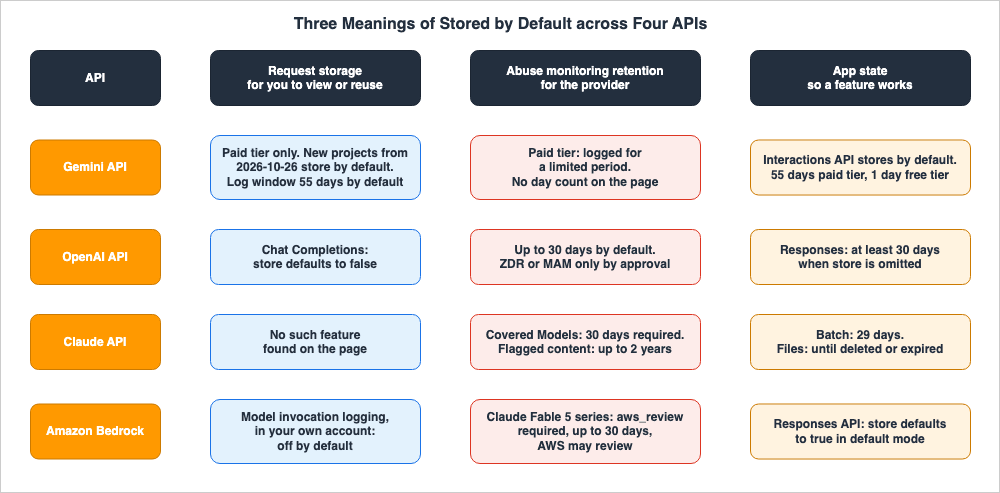
Table 1 puts the defaults of the three meanings in one row per provider. Details and conditions are described in Chapters 2 through 5.| Provider | Request Storage | Abuse Monitoring Retention | App State |
|---|---|---|---|
| Gemini API | On the paid tier, new projects from October 26, 2026 store by default. The log window is 55 days by default. | The paid tier logs for a limited period. The page gives no day count. | The Interactions API stores by default: 55 days on the paid tier, 1 day on the free tier. |
| OpenAI API | Chat Completions store defaults to false. | Up to 30 days by default. | The Responses API keeps at least 30 days when store is omitted. |
| Claude API | The page describes no such feature. | Covered Models require 30 days. For other models, two pages word it differently. Flagged content: up to 2 years. | Batch: 29 days. Files: until deleted or expired. |
| Amazon Bedrock | Model invocation logging, kept in the customer's account, is off by default. | The Claude Fable 5 models require aws_review, up to 30 days. | In default mode, Responses API store defaults to true. |
Figure 1 combines the information from Table 1 into a single view.
2. Gemini API
This chapter reads the Gemini API defaults for the three meanings and the change of October 26, 2026. That is the date on which a Gemini API default changed the most.2.1 The Generate Content API Default Changed on October 26, 2026
The Logs page states:Starting October 26, 2026, the Generate Content API stores requests by default for *new* projects. Projects created before this date keep their existing storage setting for the Generate Content API, which is off (`store=false`) unless previously enabled in AI Studio.The October 26, 2026 entry in the Changelog specifies that this change applies only to projects with a paid tier.
New projects using the Generate Content API (`generateContent`, `streamGenerateContent`, and `batchGenerateContent`) on the paid tier now store requests by default (`store=true`), matching the Interactions API. Existing projects keep their current setting.The two passages show the following:
- The targets are the
generateContent,streamGenerateContent, andbatchGenerateContentcalls. - A "new" project refers to any project created on or after October 26, 2026.
- Projects created before that date keep their original settings. Unless storage was enabled in AI Studio, they do not store requests.
- This change specifically affects projects with a paid tier.
- The Logs page also indicates that calls made through OpenAI-compatible endpoints are included in the logging.
The Logs page limits log storage itself to projects on the paid tier.
Storage for Gemini API logs are only available for projects on the Gemini API paid tier.The terms define whether a project is on the paid tier. They state that the Gemini API is a "Paid Service" only when accessed through a Cloud project associated with an active billing account.
Even in the same organization, the default settings may differ depending on when a project was created. If a team assumes that new projects behave like its pre-October 26, 2026 projects, which had storage off, storage has already started in the new projects. This paragraph is an inference.
2.2 The Log Window Is 55 Days by Default
Stored requests can be viewed in the Logs section of AI Studio, allowing you to see the full prompt and response. The Logs page describes the retention window as follows:Logs will expire and be marked for deletion after a default retention window of 55 days (unless saved to a dataset, which don't expire). You can configure the retention window of a project's logs to 7, 14, 28, or 55 days max.The retention window is set per project to 7, 14, 28, or 55 days. The default setting is 55 days, which is also the maximum allowed duration. Logs saved to a dataset do not expire.
This 55-day window belongs to the first meaning (request storage). It is not the period of the second meaning (abuse monitoring retention) (Section 2.4).
The Logs page also specifies that the following are excluded from log collection: models for Imagen and Veo, embedding models for Gemini, models for Gemini Robotics, as well as any input containing videos, GIFs, or PDFs. Public Preview Agents in the Gemini API are also excluded.
2.3 Request store Takes Precedence Over Project Settings
There are two ways to modify the default storage behavior.- Project setting. Within AI Studio, you can turn storage on or off for both the Generate Content API and the Interactions API through the Settings on the Logs page.
- Request
store. You pass true or false with each request.
The Logs page outlines the priority order as follows:
The request-level `store` property takes precedence over the project-level setting.To pass the
store parameter with Generate Content API requests, there are minimum SDK version requirements. The Logs page specifies that for Python, the google-genai version must be 2.33.0 or later, and for JavaScript, the @google/genai version must be 2.31.0 or later. The minimum versions for Java and Go are also listed on the same page.2.4 Abuse Monitoring Logs Have No Day Count on the Page
The terms define the second meaning. Regarding paid tiers, the terms state:For Paid Services, Google logs prompts and responses for a limited period of time, solely for detecting and preventing violations of the Prohibited Use PolicyThe terms refer to this period as "a limited period of time" but do not specify the number of days. The "Zero data retention" page uses the same phrasing. This article will not state this period is either 55 days or 30 days.
The free tier is treated differently. The "Unpaid Services" section of the terms states that sent content and responses are used to provide, improve, and develop Google's products and services, followed by:
To help with quality and improve our products, human reviewers may read, annotate, and process your API input and output.The same section also requests that users not send confidential or personal information when using the free tier. In some regions, the paid tier terms also apply to the free tier (as stated in the same section of the terms). This article will not list those regions.
Even with a paid tier, if the AI Studio dataset is shared with Google, that dataset is treated under the conditions for the free tier. Human review may occur (see the "Data Logging and Sharing" page).
2.5 What Remains Even with store=false
The Zero data retention page lists, feature by feature, what customers must do to approach ZDR. On abuse monitoring logs, it states:If your workload requires guaranteed zero data retention or enterprise data processing agreements, use Vertex AI.The title of the page linked from this text is "Gemini Enterprise Agent Platform and zero data retention." If guaranteed ZDR is required, you move to a different Google Cloud product rather than change a setting in the Gemini API.
The same page also lists the following scenarios in which customer data is typically retained for limited periods of time.
| Feature | What Remains | Can be Disabled? |
|---|---|---|
| Grounding with Google Search | Prompts, context, and output – 30 days | Not possible. The page states, "There is no way to disable the storage." |
| Grounding with Google Maps | Prompts, context, and output – 30 days | Not possible. |
| Live API | If session resumption is enabled, conversation state – up to 24 hours | The page advises against enabling session resumption to maintain ZDR. |
| File API | Uploaded files – until deletion or expiration | User-managed deletion. |
| Explicit Context Cache | Cached content – until the specified TTL | The page recommends avoiding this feature to achieve zero data retention. |
| Implicit In-Memory Cache | Data stored in RAM – up to 24 hours | The page states that this does not conflict with ZDR. |
Regarding the 30-day retention period for Grounding with Google Search, the page states:
There is no way to disable the storage of this information if you use Grounding with Google Search.2.6 Interactions API Defaults to Storing State
The third meaning relates to the Interactions API. This API maintains conversation state on the server. The overview page states that it became generally available in June 2026. The Logs page states that the Interactions API also stores requests by default.By default, both the Interactions API and the Generate Content API store requests (`store=true`).The Interactions API overview page gives the retention period for stored interactions by tier. Paid tiers offer a retention period of 55 days, while free tiers offer a retention period of 1 day. While log storage is limited to paid tiers, the Interactions API state is retained for 1 day even on the free tier.
Within AI Studio's Settings, disabling Interactions API logs will prevent the saving and retrieval of conversation history unless overridden per request (the warning on the Logs page). To prevent the Interactions API from retaining state, set
store to false. This is stated on the Zero data retention page. However, the overview page notes that setting store=false disables background execution and prevents the use of previous_interaction_id in subsequent interactions. Stored interactions can be deleted at any time using the API's delete function.3. OpenAI API
This chapter reads the OpenAI API defaults for the three meanings. OpenAI's page splits the data that remains into two types: abuse monitoring logs and application state.3.1 The Two Kinds of Data on OpenAI's Page
The Data controls page states:Abuse monitoring logs: Logs generated from your use of the platform, necessary for OpenAI to enforce our Usage Policies and agreements and mitigate harmful uses of AI.Application state: Data persisted from some API features in order to fulfill the task or request.This article's second meaning corresponds to abuse monitoring logs, and its third meaning to application state. The page covers the OpenAI API Platform. OpenAI's page describes the first meaning (request storage) as part of application state (Section 3.3).
3.2 Abuse Monitoring Logs Are Kept for up to 30 Days by Default
The same page states the default:By default, abuse monitoring logs are generated for all API feature usage and retained for up to 30 days, unless longer retention is required by law, or is reasonably necessary to protect our services or any third party from harm.These logs may contain customer content, such as prompts and responses, as well as metadata derived from that content, such as classifier outputs. The page's table of endpoints gives 30 days of abuse monitoring retention for many endpoints. For
/v1/moderations and for audio transcriptions and translations, the table gives None.The relevant section of this page does not say whether people review the default logs. Human review appears in the case where, to investigate or prevent severe risk activity, OpenAI makes a model ineligible for ZDR or Modified Abuse Monitoring for an approved customer.
3.3 Responses and Chat Completions Have Opposite store Defaults
The first and third meanings have different defaults at the endpoints. The API reference specifies the default forstore as follows:| Endpoint | Default for store | Usage of Stored Data |
|---|---|---|
| Responses | true | To retrieve generated responses later via the API. |
| Chat Completions | false | Used with distillation and evals products. |
The Data controls page states the following regarding the Responses API:
Except as noted below, the Responses API has a 30 day Application State retention period by default, or when the `store` parameter is set to `true`. In those cases, response data will be stored for at least 30 days.However, in the same page's table, the application state column for
/v1/responses reads "None, see below for exceptions." While reading only the table might suggest that data is not retained, combining the note under the table with the default in the API reference shows that Responses API requests that omit store are kept for at least 30 days. This paragraph is an inference.The Responses API's background mode has a different behavior. The default completion window in background mode temporarily stores the response data on disk for approximately 10 minutes to allow the request to be executed and the response to be retrieved.
3.4 ZDR and Modified Abuse Monitoring Require Approval
The Data controls page lists two controls that exclude customer content from abuse monitoring logs: OpenAI's ZDR and Modified Abuse Monitoring. OpenAI's ZDR also has a form with Private Safety Processing. Both options require approval.Currently, these controls are subject to prior approval by OpenAI and acceptance of additional requirements.| Control | Abuse Monitoring Logs | Application State |
|---|---|---|
| Modified Abuse Monitoring | Excludes customer content, except image and file inputs in rare cases. | The page says the customer can still use the full capabilities of the platform. |
| OpenAI's ZDR | Excludes customer content. | Treats store on Responses and Chat Completions as always false. |
Approved customers can select either option, at the organization or project level. A project can inherit the organization's settings, explicitly choose an option, or opt out by selecting "None."
The page describes how OpenAI's ZDR handles
store:Additionally, Zero Data Retention changes some endpoint behavior: the `store` parameter for `/v1/responses` and `v1/chat/completions` will always be treated as `false`, even if the request attempts to set the value to `true`.Even with OpenAI's ZDR, the page notes that endpoints excluded from ZDR (such as Conversations, Files, Batches, and vector stores) may still store application state. Image and file inputs are subject to CSAM (Child Sexual Abuse Material) checks upon submission. If the classifier detects a potential CSAM match, the image is retained for manual review, even under OpenAI's ZDR or Modified Abuse Monitoring.
3.5 Rows for a Shut-Down API Remain in the Table
The table on the Data controls page still shows rows for/v1/assistants and /v1/threads. The Deprecations page gives August 26, 2026 as the Assistants API shutdown date. As of the verification date, these rows represent discontinued APIs. The successor APIs are the Responses API and the Conversations API. The Conversations API row gives both abuse monitoring retention and application state retention as until deleted.4. Claude API
This chapter reads the Claude API defaults for the three meanings. On Anthropic's pages, the default splits by model: whether a model is a Covered Model changes the second meaning.4.1 Two Pages Expressing the Same Default in Different Ways
The API and data retention page states the default as follows:Conversation content (your prompts and Claude’s outputs) is not retained by default; the exception is Covered Models, which require 30-day retention.The same page delegates the standard data retention policy, outside these arrangements, to the Privacy Center page. The Privacy Center page (updated July 1, 2026) states the following:
For Anthropic API users, we automatically delete inputs and outputs on our backend within 30 days of receipt or generation, except:Following this, three exceptions are listed. These apply when using services where customers manage data retention (such as the Files API), when a separate agreement exists (such as ZDR), or when longer retention is necessary to enforce the Usage Policy.
The two pages express the same concept using different wording. The API page states "not retained by default," while the Privacy Center page states that inputs and outputs are deleted "within 30 days." This article does not treat either as the default. When writing an internal policy, cite both pages as sources. This paragraph is an inference.
The API page applies to Claude API, Claude Platform on AWS, Claude Models on Google Cloud (Anthropic managed), and Claude in Microsoft Foundry – in all cases, Anthropic is the data processor. For Bedrock and Claude Models on Google Cloud (Google managed), the cloud provider is the data processor; refer to the respective platform pages for details.
4.2 Covered Models Require a 30-Day Retention Period
The API page lists the following six models as Covered Models.| Model | Designation Date | Availability |
|---|---|---|
| Claude Fable 5.2 | November 9, 2026 | General Availability |
| Claude Mythos 5.2 | November 9, 2026 | Limited to Approved Partners |
| Claude Fable 5.1 | August 31, 2026 | General Availability |
| Claude Mythos 5.1 | August 31, 2026 | Limited to Approved Partners |
| Claude Fable 5 | June 9, 2026 | General Availability |
| Claude Mythos 5 | June 9, 2026 | Limited to Approved Partners |
The Designation Date and Availability columns reflect the values in the table on the Help Center's Covered Models page. The same page states the retention as:
30-day minimum retention by default. Prompts and model completions are retained for at least 30 days and then automatically deleted, unless they are subject to a safety investigation or we are legally required to maintain them.Regarding who can review the data, the same page states, "Automated review by default." Automated safety systems first assess retained data. The Data retention practices for Covered Models page describes human review as follows:
By default, no Anthropic personnel can read your retained conversations. Human review can occur only through a controlled access path—for example, when content is flagged by our automated trust and safety systems for potential harm.The same page says that this policy went into effect on June 9, 2026, and that Covered Models follow this retention on every platform where they are offered.
4.3 Organizations with ZDR Enable 30-Day Retention for One Workspace
Anthropic's ZDR is enabled on an organization-by-organization basis, through either the sales team or the account team. The API page defines Anthropic's ZDR as follows:Under a ZDR arrangement, Anthropic does not store customer prompts or responses at rest after the API response is returned.Because the Covered Models require a 30-day data retention period, organizations with Anthropic's ZDR cannot use them unless Anthropic expressly authorizes it. Using Claude Fable 5 as the example, the API page states that requests from an organization whose retention configuration does not meet the requirement return a
400 invalid_request_error. An example message from the documentation reads as follows:In order to access this model, your organization or workspace must have data retention enabled.For organizations with Anthropic's ZDR, the way to use Covered Models works at the workspace level.
Organizations with a ZDR arrangement can make these models available in a specific workspace by enabling 30-day retention for that workspace only.The process involves three steps: first, select the workspace on the Data retention page of the Claude Console; second, select Standard data retention and save; and third, accept the retention terms on the confirmation screen. All other workspaces remain under ZDR. Because the Default Workspace always follows the organization's settings, it is necessary to use a different workspace.
The Covered Models page describes another path: Enterprise Frontier Safeguards (EFS). EFS combines automated safety monitoring with the option to keep retained monitoring data in cloud infrastructure the customer controls. It will be rolled out gradually, starting in the fall of 2026. During the transition period, eligible customers will be able to use Claude Fable 5.2, 5.1, and 5 under ZDR for a limited time, specifically for internal business applications.
4.4 Feature-Specific Exceptions
Even with models that are not Covered Models, some features keep app state (the third meaning). The table below lists representative rows from the feature tables on the API page. For the full tables, see the API page and Section 6.4 of Where the Orchestration Program Runs.| Feature | What Is Kept | Eligible for Anthropic's ZDR |
|---|---|---|
| Batch processing | 29 days | No |
| Files API | Until deleted or the configured expiration | No |
| Code execution tool | Container data, up to 30 days | No |
| Message threads | In memory, deleted within 1 hour of last use | No |
| Prompt caching | KV cache representations and hashes in memory for the cache TTL | Yes |
Even within organizations utilizing Anthropic's ZDR, requests that use features not eligible for ZDR are not blocked. The API page calls using them a choice to step outside ZDR for that feature's data.
4.5 Flagged Content Is Kept for up to 2 Years
The API page describes the retention that applies under any arrangement:Even with ZDR or HIPAA arrangements in place, Anthropic may retain data where required by law or where it has been flagged by Anthropic’s automated trust and safety systems. As a result, if a chat or session is flagged, Anthropic may retain inputs and outputs for up to 2 years.The Privacy Center page says that in the same case, trust and safety classification scores are kept for up to 7 years.
5. Amazon Bedrock
This chapter reads the Amazon Bedrock defaults for the three meanings. On Bedrock, the default is set by the combination of Region and model.5.1 Data Retention Modes Are Set per Region
Bedrock's Data retention page states that retention is set by a mode. The mode is set at the AWS account or project level, per Region. The setting does not propagate beyond the Region in which it is configured. This setting applies consistently across the Messages, Chat Completions, and Responses APIs.| Mode | Behavior |
|---|---|
| none | AWS does not store request and response data in persistent storage and does not share it with the model provider. |
| default | Follows the model's retention policy. Behavior does not change from before. AWS may retain data for safety and abuse prevention. |
| aws_review | Allows inputs and outputs to be retained for human review by AWS. |
| provider_data_share | Legacy mode. Content is not shared with the provider today, so it is handled the same as aws_review. |
| inherit | Does not enforce a specific setting within this scope, deferring to a broader scope. This is the default setting for new accounts and projects. |
The modes are ordered.
none < default < aws_review < provider_data_shareinherit is not part of this order. The active mode is determined by examining the settings in the project, then the account, and finally the model's default setting, selecting the first value that is not inherit. Regions with no setting remain at inherit, following the model's default setting. Projects exist only on the bedrock-mantle endpoint; on the bedrock-runtime endpoint, the setting is made at the account level. The page notes that at launch, the console did not offer a configuration screen, and settings must be configured using the API or SDK.
This article could not confirm in What's New when data retention modes launched, so it gives no launch date.
5.2 The Claude Fable 5 Models Require aws_review
Each model declares inallowed_modes the modes that satisfy its requirement. The Data retention page uses Claude Fable 5, 5.1, and 5.2 as the example.Claude Fable 5, Claude Fable 5.1, and Claude Fable 5.2 require human review (`allowed_modes: ["aws_review", "provider_data_share"]`). You must explicitly set your data retention mode to `aws_review`, or to the legacy `provider_data_share`, before you can invoke these models.When the active mode is none or default, these models appear as
status: "unavailable" on the bedrock-mantle endpoint and will fail with a ValidationException on the bedrock-runtime endpoint.Regarding what data is retained, the documentation states the following:
For models requiring `aws_review` (currently Claude Fable 5, Claude Fable 5.1, and Claude Fable 5.2): user prompts and completions are retained within the AWS boundary for up to 30 days and may be reviewed by AWS to meet the human review requirement the model provider imposes as a condition of access.The abuse detection page limits the review to traffic that the classifier flags.
For Anthropic Claude Fable 5, Claude Fable 5.1, and Claude Fable 5.2, Amazon Bedrock retains all traffic for up to 30 days for automated offline abuse detection. Classifier-flagged traffic will be subject to potential human review performed by AWS.Both pages state that retained content is not shared with the model provider. When using cross-region inference, the retained input and output data are stored in the AWS Region that processed the inference.
Regarding previous Claude models prior to Claude Fable 5, the documentation states:
There is no data retention change to Claude models released before Claude Fable 5.The documentation lists Claude Opus 4.8 as an example of a model that includes none in its
allowed_modes. Models that include none do not retain data, even if the account or project mode is made more permissive.The documentation for abuse detection also covers OpenAI models. For OpenAI models, excluding gpt-oss and GPT OSS Safeguard, traffic flagged by the classifier is retained for up to 30 days for automated offline abuse detection. Eligible customers can request a full ZDR (Zero Data Retention) through their AWS account team.
5.3 store=false Does Not Guarantee Zero Retention
In default mode, thestore parameter in the Responses API is set to true by default, and either value can be specified. The default row of the mode table on the Data retention page carries this note:Setting `store=false` does not guarantee zero data retention. Some models may still retain data for safety review even when `store=false` — in this case, data is retained but is not retrievable by the customer through `GET /v1/responses/{id}`. If you require guaranteed zero retention, set `data_retention_mode` to `none`.In none mode, the
store parameter in the Responses API defaults to false, and specifying store=true is not permitted. The background mode is also unavailable.5.4 Model Invocation Logging Is Disabled by Default
Bedrock also provides a mechanism for customers to retain their requests and responses within their own accounts. This feature is called model invocation logging. The documentation states:Model invocation logging is disabled by default. After model invocation logging is enabled, logs are stored until the logging configuration is deleted.The destination for model invocation logging is CloudWatch Logs or Amazon S3, both in the same account and Region. The documentation specifies that only calls to the bedrock-runtime endpoint are logged, and calls to bedrock-mantle are currently not recorded. For details on configuration and controls, see Section 7.1 of Amazon Bedrock Security and Governance.
Model invocation logging is close to this article's first meaning, but it stores data in the customer's account, not with the provider. Even with model invocation logging off, the data retention mode and retention for abuse detection per model still apply.
5.5 Fixing the Mode Across the Organization
The Bedrock documentation states that IAM policies or SCPs can be used to limit the configurable modes. Write operations include a condition key,bedrock-mantle:DataRetentionMode, while operations on the bedrock-runtime side include the condition key bedrock:DataRetentionMode. The documentation provides examples of SCPs that deny any setting other than none across the entire organization, and one that permits retention but not human review. Under the latter SCP, models that require human review cannot be used.5.6 Bedrock's ZDR Is Decided per Account and Model
To use a model that requires retention under zero data retention, consult your AWS account manager. The documentation states that the evaluation of Bedrock's ZDR is performed in coordination with the model provider, on a per-account and per-model basis. Upon approval, the model'sallowed_modes includes none. For Claude models, ZDR is granted to customers eligible for EFS. The abuse detection page gives the period:If you're eligible for Enterprise Frontier Safeguards (EFS), you can use Claude Fable 5, Claude Fable 5.1, and Claude Fable 5.2 with zero data retention (ZDR) for internal use through at least June 30, 2027.The same page also states that after ZDR ends, all traffic will be retained for up to 30 days.
6. The Same Model Is Held by Different Parties Depending on the Entry Point
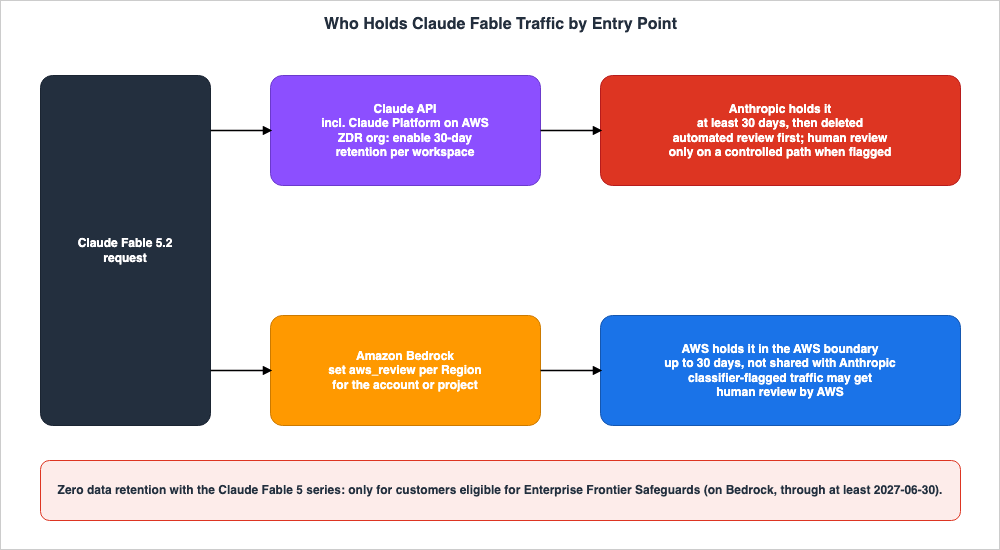
This chapter compares who holds the traffic and who may review it when the same Claude Fable 5.2 is called through the Claude API and through Bedrock. It does not address the selection of entry points.6.1 Two Entry Points for Claude Fable 5.2
| Item | Claude API (including Claude Platform on AWS) | Amazon Bedrock |
|---|---|---|
| Who holds it | Anthropic | AWS, inside the AWS boundary |
| How the period is worded | At least 30 days, then deleted automatically | Up to 30 days |
| How to make it usable | Organizations on standard retention use it as is. Organizations with Anthropic's ZDR enable 30-day retention for one workspace | Set the account or project mode to aws_review in each Region |
| When the requirement is not met | 400 invalid_request_error | mantle: unavailable. runtime: ValidationException |
| Who may review it | Automated review first. Human review only through a controlled access path when flagged | AWS may subject classifier-flagged traffic to human review |
| Shared with the model provider | Not applicable. Anthropic is the provider and the holder | No |
| Path to ZDR | For a limited time, for eligible customers, during the transition to EFS | For customers eligible for EFS, through at least June 30, 2027 |
Anthropic's API documentation describes the Bedrock side as follows:
On Amazon Bedrock and Google Cloud’s Agent Platform, retained data stays within your cloud provider’s environment; review each platform’s documentation for enablement steps.The pages of the two entry points word the period differently. Anthropic's "Covered Models" page states "at least 30 days," while the Bedrock page states "up to 30 days." Because the holders differ, these are separate commitments and not necessarily a contradiction. This article does not lean toward either.
Figure 2 puts the table into a single view.
6.2 "Bedrock Does Not Store by Default" Needs a Model Condition
The What's New announcement for Claude Opus 5 (July 24, 2026) states the following regarding Bedrock:Amazon Bedrock offers Claude Opus 5 with zero data retention (ZDR) enabled by defaultThe subject of this sentence is Claude Opus 5, and it does not apply to all Bedrock models. Since Claude Opus 5 is not included in the Covered Models, it does not conflict with the Data retention page. Conversely, for models in the Claude Fable 5 family, Bedrock requires aws_review and retains data for up to 30 days. To write "Bedrock does not store prompts by default," you need conditions on the model, the mode, and the Region. This paragraph is an inference.
7. The Unit on Which Each Control Works
This chapter lines up the controls from Chapters 2 through 6 by the unit they work on. The table is for deciding, in an internal policy, who changes what and where.7.1 Unit-by-Unit Comparison
| Unit | Gemini API | OpenAI API | Claude API | Amazon Bedrock |
|---|---|---|---|---|
| Request | store. Takes precedence over the project setting | store. Defaults to true on Responses and to false on Chat Completions | The page names no parameter that changes conversation retention | store on the Responses API. Rejects true when the mode is none |
| Project | Turn storage on or off per API in AI Studio Settings. Log window of 7, 14, 28, or 55 days | Choose ZDR or Modified Abuse Monitoring, inherit the organization, or None | Not applicable | Project mode on bedrock-mantle |
| Organization and workspace | The page names no setting for this unit | Choose ZDR or Modified Abuse Monitoring | Organization ZDR. 30-day retention for a single workspace | Limit the modes that can be set with an SCP |
| Region | Not applicable | Not applicable | Not applicable | The account mode is set per Region |
| Approval and contract | For guaranteed ZDR, Vertex AI | ZDR and Modified Abuse Monitoring need prior approval | ZDR through sales or the account team. EFS | ZDR per account and model. EFS for Claude |
"Not applicable" means that the pages showed no way to change retention at that unit. This does not constitute proof that such options do not exist.
7.2 What the Table Shows
The table shows three points. This section is an inference.- At every provider that has it, the request-level
storechanges only the first or third meaning. No provider lets a request argument remove the second meaning (abuse monitoring retention). - Only the units of approval and contract can exclude the second meaning. OpenAI's ZDR, Modified Abuse Monitoring, Anthropic's ZDR, and Bedrock's ZDR all require prior approval or coordination with an account team. For the Gemini API, this functionality is not available in the API itself, and instead requires using a different Google Cloud product.
- Models that require retention (the Claude Fable 5 models) cannot be used under an organization's ZDR as is. To use these models, it is recommended to limit the scope of retention in the Claude API using workspaces, or in Bedrock using Region and project units.
7.3 Verifying Information When Documenting Internal Policies
When writing the default storage into an internal policy, check the following. This section is an inference.- Gemini API: Verify whether the project was created before or after October 26, 2026. Also, confirm if it is a paid tier. Check if you are using Grounding, File API, explicit caching, or Live API session resumption.
- OpenAI API: Verify which endpoints are being used. Check whether
storeis omitted on the Responses API. Confirm whether the organization or project has approval for ZDR or Modified Abuse Monitoring. - Claude API: Check whether the model is a Covered Model. Confirm whether the organization has Anthropic's ZDR. Check if you are using Batch, Files, or code execution features.
- Amazon Bedrock: For each Region used, verify the data retention mode for both the account and the project. Confirm the
allowed_modesfor the model being used. Check whether model invocation logging is enabled.
The dates and figures referenced are as of the verification date (November 22, 2026). Details may change with model additions or policy updates. It is recommended to review each provider's documentation directly before documenting your internal policies.
8. Frequently Asked Questions About What LLM APIs Store by Default
This chapter briefly summarizes the key information presented in the main text, in the form of frequently asked questions. The basis for the answers is the pages cited in Chapters 2 through 7.Q1. With store=false, does the provider keep nothing?
There may still be data retained. The Bedrock documentation states thatstore=false does not guarantee zero retention, and recommends setting the data retention mode to none if a guarantee is required. With the Gemini API, abuse monitoring logs, Grounding (for 30 days), the File API, and explicit caching will remain, separate from the store setting. Similarly, with the OpenAI API, abuse monitoring logs are retained by default for up to 30 days, independent of the store setting.Q2. Does the October 26, 2026 Gemini API change apply to existing projects?
No, it does not. The Logs page and the Changelog state that projects created before that date keep their original settings. Unless storage was enabled in AI Studio, they do not store Generate Content API requests. The change applies only to paid-tier projects created on or after October 26, 2026.Q3. What is kept on the free tier of the Gemini API?
The Logs page limits log storage to the paid tier. However, the terms of service state that content and responses sent through the free tier may be used to improve Google products, and human reviewers may read them. Interactions API state is kept for 1 day, even on the free tier.Q4. What happens when an organization with OpenAI's ZDR sends store=true to the Responses API?
The Data controls page states that under OpenAI's ZDR,store is always treated as false, even if the request tries to set it to true. Consequently, the responses are not stored in a format that can be retrieved later via the API.Q5. Can an organization with Anthropic's ZDR use Claude Fable 5.2?
It cannot be used in the organization as is. Claude Fable 5.2 is a Covered Model, and a 30-day data retention period is required. The API documentation outlines the steps to enable a 30-day retention period specifically for a workspace. Since the Default Workspace follows the organization's settings, you will need to use a different workspace. During the transition to EFS, there may also be a limited-time option for eligible customers to use ZDR.Q6. When you call Claude Fable 5.2 through Bedrock, does the content reach Anthropic?
No, it does not. Both the Data retention and Abuse detection pages in Bedrock state that the content is not shared with the model provider. AWS retains the data, storing it inside the AWS boundary for up to 30 days. AWS may subject classifier-flagged traffic to human review.Q7. If you turn off Bedrock model invocation logging, does Bedrock keep nothing?
Some information may still be retained. Model invocation logging is a mechanism that stores logs in the customer's account, and it is disabled by default. Data retention mode and retention for abuse detection per model apply independently of model invocation logging. For Claude Fable 5 models, data may be retained for up to 30 days under theaws_review setting.Q8. Can an organization enforce "no retention" across the board?
The methods vary depending on the provider. Bedrock lets you reject any setting other than none using an SCP and the condition keysbedrock-mantle:DataRetentionMode and bedrock:DataRetentionMode. OpenAI allows approved organizations to select their ZDR (Zero Data Retention) setting at the organizational level. However, a project can select None to opt out. Anthropic offers organizational-level ZDR, but allows you to enable a 30-day retention period at the workspace level. Anthropic's API page does not specify who can perform this action. The Gemini API documentation states that if guaranteed ZDR is required, Vertex AI should be used.9. Summary
- "Stored" has three meanings: request storage, abuse monitoring retention, and app state. The three are independent; stopping one can still leave the others.
- The Gemini API's Generate Content API stores requests by default in new paid-tier projects from October 26, 2026. The log window is 55 days by default, and the page gives no day count for abuse monitoring logs.
- For the OpenAI API, abuse monitoring logs are, by default, retained for a maximum of 30 days. The
storeparameter in the Responses API is, by default, set to true, ensuring responses are retained for at least 30 days. OpenAI's ZDR and Modified Abuse Monitoring require approval. - The Claude API page states that conversation content is not retained by default, and the Privacy Center page indicates that data is deleted within 30 days. For six designated models (Covered Models), a 30-day retention period is mandatory.
- Amazon Bedrock has per-Region data retention modes. For Claude Fable 5 models,
aws_reviewis required, and data stays inside the AWS boundary for up to 30 days. Model invocation logging is disabled by default and is a separate mechanism from the data retention mode. - At every provider that has
store,store=falseis not zero retention. At OpenAI, Anthropic, and Bedrock, only approval and contract remove the second meaning; for the Gemini API, it means moving to a different product. - The days and dates mentioned are based on the verification date (November 22, 2026). Check each provider's pages again before writing them into a policy.
10. References
- Logs - Google AI Studio
- Zero data retention in the Gemini Developer API - Google AI Studio
- Gemini API Additional Terms of Service - Google AI Studio
- Changelog - Google AI Studio
- Interactions API - Google AI Studio
- Data Logging and Sharing - Google AI Studio
- Gemini Enterprise Agent Platform and zero data retention - Google Cloud Documentation
- Data controls in the OpenAI platform - OpenAI API
- Create a response - OpenAI API Reference
- Create chat completion - OpenAI API Reference
- Deprecations - OpenAI API
- API and data retention - Claude Platform Docs
- How long do you store my organization's data? - Anthropic Privacy Center
- Covered Models - Claude Help Center
- Data retention practices for Covered Models - Claude Help Center
- Data retention - Amazon Bedrock
- Amazon Bedrock abuse detection - Amazon Bedrock
- Monitor model invocation using CloudWatch Logs and Amazon S3 - Amazon Bedrock
- Data protection - Amazon Bedrock
- Claude Fable 5.2 is now available on AWS - AWS
- Claude Opus 5 is now available on AWS - AWS
- Amazon Bedrock Security and Governance - IAM Condition Keys, SCP Design, PrivateLink, and Multi-Account Guardrail Enforcement
- Claude Platform on AWS or Amazon Bedrock - Who Operates It, What Differs, and What a Move Breaks
- Where the Orchestration Program Runs - Programmatic Tool Calling in the Claude and OpenAI APIs, and Code Mode in Agent Harnesses
- Claude Admin and Governance Surfaces - Which API or Setting Answers Which Control Question
- LLM API Parameter Compatibility Reference - Anthropic, OpenAI, Google Gemini, and Amazon Bedrock
References:
Tech Blog with curated related content
Written by Hidekazu Konishi