Claude Platform on AWS or Amazon Bedrock - Who Operates It, What Differs, and What a Move Breaks
First Published:
Last Updated:
bedrock-mantle and bedrock-runtime. All of these entrances can be called with AWS authentication. However, a change in operator results in simultaneous changes to the inference data processor, the party responsible for data retention and Zero Data Retention (ZDR), the IAM namespace, the capacity pool, and available features.This article focuses on the operators and presents four entrances in a comparative table. It then shows the four points where responsibility switches, and what changes when you move between entrances, by the direction of the move. Where Anthropic's and AWS's documentation disagree, this article presents both statements. This article does not recommend a specific entrance, nor does it discuss pricing.
To summarize, Anthropic operates Claude Platform on AWS, while AWS operates both endpoints within Bedrock. Within Bedrock, AWS is responsible for processing inference data, and Anthropic's ZDR program does not apply. On Claude Platform on AWS, ZDR is enabled on request. The IAM namespace for Claude Platform on AWS is
aws-external-anthropic, and the principal that calls it also needs two STS actions. When migrating from Bedrock to Claude Platform on AWS, the base URL, SigV4 service name, model ID, and anthropic-workspace-id header change, and a new Anthropic organization is created. When transitioning from InvokeModel or Converse, the format of requests and responses will also change. Procedures for migrating in the reverse direction were not found in the materials reviewed for this article. Six discrepancies were identified between the two companies' documentation, and both companies' guidance on where to direct new code points in opposite directions.This article is based on materials reviewed on November 12, 2026 (Japan Standard Time). The availability of models, Regions, and SDK status for each entrance changes on a monthly basis. Each table states the verification date.
Related articles on this site:
- Amazon Bedrock Inference Endpoints and API Keys - What bedrock-runtime and bedrock-mantle Each Accept, Which IAM Action Each Call Checks, and What CloudTrail Records
- Which Request Size Limit Hits First Between Your App and Claude - Claude API, Bedrock, Claude Platform on AWS, API Gateway, and Lambda
- Running Claude Apps Gateway on AWS - What the Gateway Holds and Enforces, What Stays on Developer Machines, and Where the Worked Example Stops
- API Keys for AWS Services - Which Calls Accept a Bearer Token, the IAM User Behind Each Key, and Where to Stop It
Table of Contents
- 1. Scope and Terms
- 2. Entrances and Operators
- 3. The Comparison Table
- 4. Where Responsibility Switches
- 5. What a Move Changes, by Direction
- 6. Features That Are Not Available
- 7. Status, Dates, and Where the Sources Disagree
- 8. Failure Modes
- 9. Frequently Asked Questions About Claude Platform on AWS and Amazon Bedrock
- 10. Summary
- 11. References
1. Scope and Terms
This chapter defines the scope, terminology, and resources used in this article. The key takeaways are as follows:- This article covers four entrances for Claude on AWS: Claude Platform on AWS, the
bedrock-mantleMessages API, thebedrock-runtimeMessages API, andbedrock-runtime's InvokeModel and Converse (Section 1.2). - The entrance names P1 through P5 are borrowed from an existing article on this site (Section 2.3).
- "Operator" refers to the entity responsible for managing the inference infrastructure. This terminology aligns with the naming conventions used in Anthropic's comparison table (Section 1.4).
- "Claude in Amazon Bedrock" and "Claude on Amazon Bedrock" are the titles of two distinct pages, differing by only one word (Section 1.4).
legacyis a word in the URL of thebedrock-runtimepage, and does not indicate the deprecation of any entrance (Section 1.4, Section 7.1).- The name "ZDR" refers to two things: Anthropic's program and a term used by AWS's "What's New" section regarding Bedrock (Section 1.4).
- All rows in the comparison table and migration table will reflect the status as of November 12, 2026 (Chapters 3 and 5).
1.1 Intended Audience
This article is intended for the following audience:- Individuals designing and operating applications that utilize Claude on AWS.
- Users of Claude through Bedrock who are considering migrating to Claude Platform on AWS.
- Organizations currently using the first-party Claude API who are exploring a transition to procurement through AWS.
- Security and governance staff who check the data processor, retention, and IAM boundaries.
This article assumes that readers may think the following, and checks each point against the wording of the sources:
- Claude Platform on AWS is a feature of Bedrock.
- Because calls are made with an AWS account, AWS is the inference data processor at every entrance.
- IAM roles created for Bedrock can also be used to access Claude Platform on AWS.
- An existing Anthropic organization can be converted into a Claude Platform on AWS organization.
- ZDR is the same program at every entrance.
- The
bedrock-runtimeentrance, whose page URL sayslegacy, will eventually be deprecated.
1.2 Scope and Exclusions
This article covers four specific entrances. The numbers for these entrances are as shown in the table in Section 2.3.- P2: Claude Platform on AWS
- P3: InvokeModel and Converse within Bedrock's
bedrock-runtime - P4: Messages API within Bedrock's
bedrock-runtime - P5: Messages API within Bedrock's
bedrock-mantle
P1 is the first-party Claude API. This article covers it only as the starting point of a move.
For each entrance, this article will cover the following:
- The operator, the inference data processor, and the party responsible for data retention and ZDR.
- Authentication, IAM namespaces and STS, SDK clients, stream formats, model ID formats, and how beta features are passed.
- The entities responsible for capacity and quotas, the Regions and geographical location of inference, the console, and billing pathways.
- Unsupported features, variations depending on the migration path, discrepancies in documentation, and status and dates.
This article does not cover the following.
- Details of the IAM and CloudTrail behavior of Bedrock's two endpoints, and how AWS's recommendation changed. This site's Amazon Bedrock Inference Endpoints and API Keys covers them.
- How API keys work. This site's API Keys for AWS Services covers it.
- Request size limits. This site's Which Request Size Limit Hits First Between Your App and Claude covers it.
- Where user profiles are stored. This site's Where a Claude User Profile Travels on AWS covers it.
- The impact of API version 2026-10-21. This site's Moving a Claude Integration to API Version 2026-10-21 on AWS covers it.
- Configuring the upstream settings for Claude Apps Gateway. This site's Running Claude Apps Gateway on AWS covers it.
- How STS's GetWebIdentityToken works. This site's AWS IAM Outbound Identity Federation covers it.
- Bedrock's geographic inference profiles. This site's Amazon Bedrock Cross-Region Inference and Data Residency Design covers it.
- Which admin surfaces, such as the Admin API, are available on each platform. This site's article on Claude admin and governance surfaces (Claude Admin and Governance Surfaces - Which API or Setting Answers Which Control Question) covers it.
- Pricing, discounts, multipliers, and guidance on which entrance to choose, and legal judgments about HIPAA.
- Pathways for Google Cloud and Microsoft Foundry, configuration for Claude Code, and acquiring Claude Enterprise (the plan from claude.ai) through AWS Marketplace.
1.3 Date of Review and Materials Reviewed
This article reviewed the following materials on November 12, 2026 (Japan Standard Time). It reviewed the rate limits pages of both companies on November 13, 2026. In the text, this article uses the English names in parentheses.Regarding Anthropic's Claude Platform:
- Claude Platform on AWS (Claude Platform on AWS page)
- Claude in Amazon Bedrock (bedrock-mantle) (bedrock-mantle page)
- Claude on Amazon Bedrock (bedrock-runtime) (bedrock-runtime page)
- IAM actions for Claude Platform on AWS (IAM actions page)
- API and data retention (data retention page)
- Rate limits (rate limits page)
Regarding AWS materials:
- From the Claude Platform on AWS User Guide: What is Claude Platform on AWS?, Claude Platform on AWS vs Amazon Bedrock, Feature support, Migrating from Amazon Bedrock, Data residency, and Rate limits and quotas (6 pages) (AWS user guide)
- From the Amazon Bedrock User Guide: Inference using Anthropic Messages API (Messages API page), Making inference requests (inference page), and Control permissions for generating and using Amazon Bedrock API keys (API keys permissions page)
- From the Service Authorization Reference: Amazon Bedrock Powered by AWS Mantle page.
- Three "What's New" items: the General Availability of Claude Platform on AWS on May 11, 2026; the release of Claude Opus 5 on July 24, 2026; and the release of Claude Fable 5.2 on November 9, 2026.
This article read Anthropic's pages in the body text of the HTML versions retrieved with curl, and AWS's pages in the text retrieved through the AWS Knowledge MCP Server. Any direct quotes in this article have been verified against these specific versions of the materials.
1.4 Terms, and Different Things with the Same Name
This article will consistently use the following terms to refer to the same meanings:- Entrance: One of P1 through P5 from Section 2.3. Refers to a combination of an endpoint and an API.
- Operator: The entity that manages the infrastructure underlying the inference process. Aligns with the "Who operates the stack" row in the comparison table on the Claude Platform on AWS page.
- Data processor: The party that processes inference inputs and outputs.
- Platform: Where Claude is offered. This term matches this site's article on Claude admin and governance surfaces.
- Organization Type: Used to differentiate between the organization associated with the first-party Claude Console and the organization associated with Claude Platform on AWS.
This article references materials that contain entities with the same name but different meanings.
- Claude in Amazon Bedrock and Claude on Amazon Bedrock: The former is the title of the
bedrock-mantlepage, and the latter is the title of thebedrock-runtimepage. Only the preposition differs, yet they point to different endpoints. This article calls them the bedrock-mantle page and the bedrock-runtime page. - Legacy: The URL of the
bedrock-runtimepage ends withclaude-on-amazon-bedrock-legacy. The page title is "Claude on Amazon Bedrock (bedrock-runtime)." This article uses the term legacy only when the documentation sayslegacy, and not to mean deprecation or that something is no longer recommended. - Workspace: Workspaces for Claude Platform on AWS have IDs that begin with
wrkspc_and ARNs, and are associated with a single AWS Region. The Bedrock Messages API page states thatbedrock-mantlesupports Workspaces (Anthropic-compatible). Workspaces in the first-party Claude Console do not carry over to the Claude Platform on AWS organization. These three are distinct entities. - API Keys: API keys for Claude Platform on AWS can be created in the AWS console, or created as short-term keys with token-generator libraries. Amazon Bedrock API keys consist of both long-term and short-term keys. API keys created in the first-party Claude Console are not usable with Claude Platform on AWS. These three are not interchangeable.
- Console: Claude Platform on AWS uses the Claude Console and can be accessed through the AWS console. Bedrock uses its own console.
- Beta: The Claude Platform on AWS service is generally available (GA), and its SDK client is in beta. Beta features are a separate matter and are passed in the
anthropic-betaheader. - ZDR: Anthropic's ZDR program is enabled on request on Claude Platform on AWS and does not apply to Bedrock. The AWS "What's New" section states that ZDR is enabled by default for Claude Opus 5 within Bedrock. The latter is not a term for Anthropic's program (Section 4.2).
1.5 Terms for the State of the Sources
This article uses the following six terms to describe the state of the documentation. These terms, including their English spellings, are also used in the tables.- Stated: The documentation contains a statement regarding the matter.
- Stated as not supported: The documentation explicitly states that the matter is not supported or cannot be used.
- Documentation does not list: While a list or table exists, the specific item is not included. This does not necessarily indicate that the matter is unsupported or unavailable.
- No statement found: Despite searching using different keywords and categories of documentation (as described in Section 1.3), no relevant statement could be found. This does not necessarily indicate that the matter is absent or impossible.
- Sources disagree: The statements regarding the same matter in two different documents are contradictory. This article presents both statements, along with their sources, without designating either as incorrect.
- Inference: This is an inference made by this article, and is not a statement found in any of the documentation. This article says in the same sentence that it is an inference.
All dates referenced in this article are presented with the year. Pages may be rewritten after the verification date.
2. Entrances and Operators
This chapter describes the entrances for Claude on AWS, differentiating them by operator. Anthropic and AWS have different methods for counting these entrances.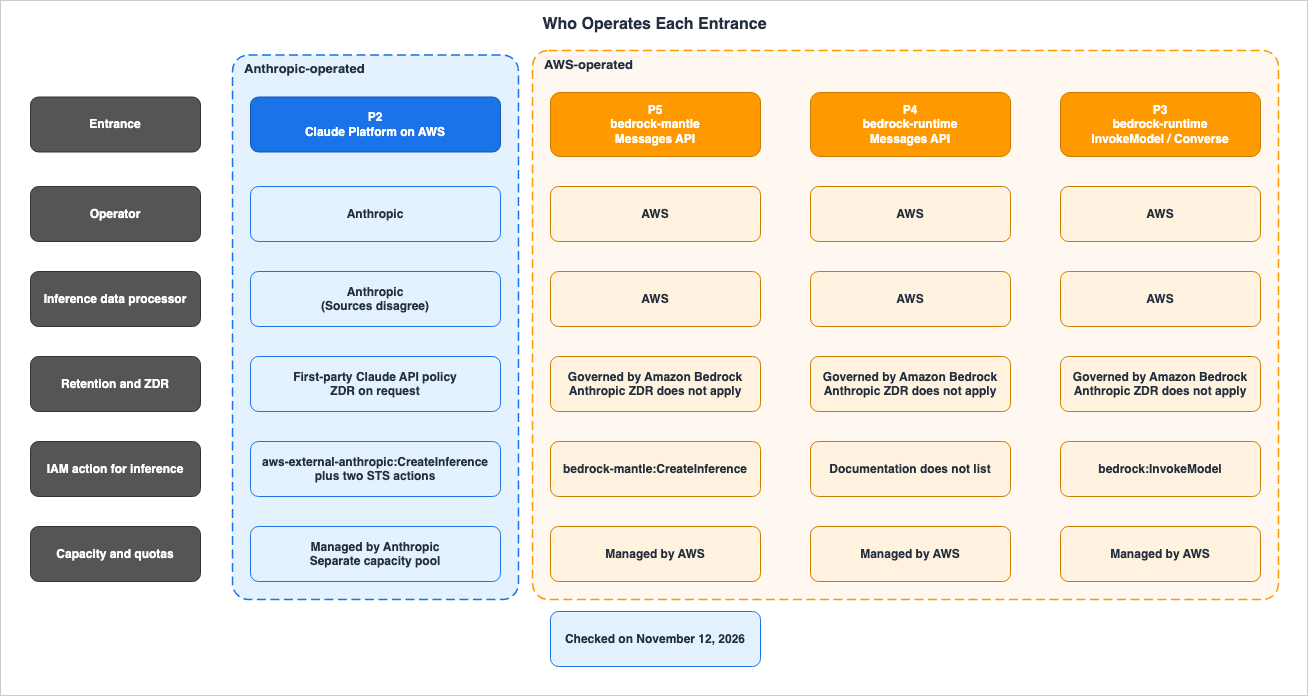
2.1 The Three Columns of Anthropic's Comparison Table
The Claude Platform on AWS page includes a table comparing Claude Platform on AWS and Bedrock. The table has three columns: Claude Platform on AWS, Amazon Bedrock (bedrock-mantle), and Amazon Bedrock (bedrock-runtime). The first row is the operator (Who operates the stack), and its values are Anthropic, AWS, and AWS.The opening of the same page describes the operator as follows. The What is Claude Platform on AWS? page of the AWS user guide has the same sentence.
Unlike Amazon Bedrock, where AWS operates the inference stack, Anthropic operates Claude Platform on AWS. AWS provides the authentication layer (SigV4 or API key), IAM-based access control, and billing integration through AWS Marketplace.In the table, the
bedrock-runtime column refers to Bedrock Converse and InvokeModel. This column does not mention the bedrock-runtime Messages API. Furthermore, the main text on the bedrock-runtime page also does not mention the bedrock-runtime Messages API.2.2 Two AWS Endpoints and Two Paths for the Messages API
The AWS Messages API page states that the Messages API is accessible through two endpoints.You can use the Messages API on both the bedrock-runtime and bedrock-mantle endpoints. For new applications, we recommend the bedrock-runtime endpoint.The base URL for the Messages API within
bedrock-runtime is https://bedrock-runtime.{region}.amazonaws.com/anthropic. The base URL for the Messages API within bedrock-mantle is https://bedrock-mantle.{region}.api.aws/anthropic/v1/messages. AWS provides two paths for the Messages API.The Claude Platform on AWS vs Amazon Bedrock page of the AWS user guide presents a comparison of Claude Platform on AWS and Bedrock in two columns. The Bedrock column lists the base URL for
bedrock-runtime and the Converse and InvokeModel APIs.The
bedrock-runtime page indicates that, for nine models such as Claude Fable 5.1 and Claude Opus 5.5, InvokeModel requests on bedrock-runtime are processed using the same underlying infrastructure as bedrock-mantle.These requests are served by the same infrastructure as the Claude in Amazon Bedrock endpoint.2.3 The Entrance Names This Article Uses
This article borrows the entrance names used in this site's Which Request Size Limit Hits First Between Your App and Claude. Table 1 lists five entrances and their operators. The verification date is November 12, 2026.| Entrance | Endpoint and API | Operator | Treatment in This Article |
|---|---|---|---|
| P1 | Claude API | Anthropic | Only as a starting point for migration. |
| P2 | Claude Platform on AWS | Anthropic | Column in the comparison table. |
| P3 | bedrock-runtime InvokeModel / Converse | AWS | Column in the comparison table. |
| P4 | bedrock-runtime Messages API | AWS | Column in the comparison table. |
| P5 | bedrock-mantle Messages API | AWS | Column in the comparison table. |
Three columns in Anthropic's comparison table correspond to entrances P2, P5, and P3. P4 is an entrance that only the AWS documentation describes. In this article's comparison table, many cells in the P4 column have no statement in Anthropic's documentation.
2.4 Where Each Company Points New Code
The AWS Messages API page, as mentioned in Section 2.2, recommends usingbedrock-runtime for new applications. The table on the same page gives Recommended for new applications. as the use case of bedrock-runtime. How AWS's recommendation changed from bedrock-mantle to bedrock-runtime is covered in Section 1.2 of this site's Amazon Bedrock Inference Endpoints and API Keys.Anthropic's page refers to
bedrock-mantle as Claude in Amazon Bedrock. The Claude Platform on AWS page points readers who need AWS-operated Claude to the bedrock-mantle page.If you need AWS-operated Claude, see Claude in Amazon Bedrock.The
bedrock-runtime page states that these nine models can be called through InvokeModel on bedrock-runtime, and provides the following guidance.For the native Messages API request shape and full feature parity, use that page.Here, that page means the bedrock-mantle page. Each page is consistent within itself. However, for new code, AWS points to
bedrock-runtime, and Anthropic points to bedrock-mantle. This article does not side with either.Both the Claude Platform on AWS page and the AWS user guide describe scenarios where Bedrock is selected. The Claude Platform on AWS page states:
When to choose Bedrock: Organizations in regulated industries that require FedRAMP High, IL4, IL5, or HIPAA readiness, or that need AWS to be the sole data processor, should use Claude in Amazon Bedrock.The AWS user guide, specifically the section "Claude Platform on AWS vs Amazon Bedrock," states:
When to choose Bedrock: Choose Amazon Bedrock if your organization requires AWS-operated inference, AWS as the sole data processor, or coverage under AWS compliance programs (including FedRAMP High, IL4, IL5, SOC, ISO, and HIPAA eligibility).This article cites these as statements from the vendors' respective pages. They are not this article's recommendation.
3. The Comparison Table
This chapter puts the four entrances in a single table. The columns in Table 2 are divided into two categories: P2, which Anthropic operates, and P5, P4, and P3, which AWS operates. The verification date is November 12, 2026.| Item | P2 Claude Platform on AWS | P5 bedrock-mantle Messages API | P4 bedrock-runtime Messages API | P3 bedrock-runtime InvokeModel / Converse |
|---|---|---|---|---|
| Operator | Anthropic | AWS | AWS | AWS |
| Inference Data Processor | Anthropic (Sources disagree, Section 7.2) | AWS | AWS | AWS |
| Retention and ZDR | Same policy as the first-party Claude API. ZDR on request. | Governed by Amazon Bedrock. Anthropic's ZDR does not apply. | Governed by Amazon Bedrock. Anthropic's ZDR does not apply. | Governed by Amazon Bedrock. Anthropic's ZDR does not apply. |
| API Endpoint | Claude API /v1/{endpoint} | Messages API /anthropic/v1/messages | Messages API /anthropic | Converse / InvokeModel |
| Base URL | aws-external-anthropic.{region}.api.aws | bedrock-mantle.{region}.api.aws | bedrock-runtime.{region}.amazonaws.com | bedrock-runtime.{region}.amazonaws.com |
| Authentication | SigV4 or API Key | SigV4 or Amazon Bedrock API key | SigV4, Amazon Bedrock API key, short-term Bedrock bearer token | SigV4 or bearer token |
| SigV4 Service Name | aws-external-anthropic | bedrock-mantle | Documentation does not list | bedrock |
| IAM Action for Inference | aws-external-anthropic:CreateInference | bedrock-mantle:CreateInference | Documentation does not list | bedrock:InvokeModel |
| IAM Action for API Keys | aws-external-anthropic:CallWithBearerToken | Sources disagree (Section 7.2) | bedrock:CallWithBearerToken | bedrock:CallWithBearerToken |
| Outbound Web Identity Federation Enablement | Required once per account. Caller requires sts:GetWebIdentityToken and sts:TagGetWebIdentityToken. | Not required in Bedrock. | Not required in Bedrock. | Not required in Bedrock. |
| SDK Client | AnthropicAWS (beta) | AnthropicBedrockMantle | Documentation does not list | AnthropicBedrock / Bedrock SDK |
| Stream Format | SSE | SSE | Documentation does not list | AWS EventStream |
| Model ID Format | claude-haiku-4-5 | anthropic.claude-haiku-4-5 | us.anthropic.claude-sonnet-5 (AWS example) | us. or global. prefixed to anthropic.claude-haiku-4-5-20251001-v1:0 |
| Beta Feature Delivery | anthropic-beta header | anthropic-beta header | Documentation does not list | anthropic_beta in the body of InvokeModel |
| Capacity and Quota | Managed by Anthropic. Separate pool from both the first-party API and Bedrock. | Managed by AWS | Managed by AWS | Managed by AWS |
| Region Availability | All commercial AWS Regions. Workspaces are tied to a single Region. | Refer to Bedrock's Region table. | All Regions where Claude models are available (AWS). | Refer to Bedrock's Region table. |
| Inference Geography | inference_geo on a per-request basis (US or Global) | Global or regional endpoint, geographical inference profile. | Documentation does not list | Inference profiles such as global. or us. |
| Console Access | Claude Console (accessible through the AWS console) | Bedrock console | Bedrock console | Bedrock console |
| Billing Route | AWS Marketplace | AWS (native service) | AWS (native service) | AWS (native service) |
| Anthropic Organization | New organization created during registration. | Not required | Documentation does not list | Not required |
Table 2 is based on the following rationale.
- Operators, processors, APIs, base URLs, SDK clients, consoles, billing pathways, and capacity and quota information (P2, P5, P3) are detailed in the comparison table on the Claude Platform on AWS page. The beta status of P2's SDK client comes from
in betain the same table. - Retention and ZDR are described in the migration notes on the Claude Platform on AWS page and in the "Data retention" section of the bedrock-mantle page (Section 4.2).
- The column for P4 is based on the AWS Messages API page. Neither Anthropic's comparison table nor its migration table mentions P4. In the P4 column, Documentation does not list means that neither the AWS pages nor Anthropic's pages this article read include that item.
- Authentication is described for P2 on the Claude Platform on AWS page, for P5 and P4 on the AWS Messages API page, and for P3 on the comparison table on the Claude Platform on AWS page. Anthropic's comparison table and the body of the bedrock-mantle page describe P5's authentication differently (Section 7.3).
- SigV4 service names and stream formats are detailed in the migration table on the Claude Platform on AWS page.
- Enabling outbound web identity federation is described in the "Migration pitfalls" section on the Claude Platform on AWS page. This section also states that this step is not required in Bedrock. It does not provide any information regarding whether the two STS actions are required in Bedrock.
- IAM actions for inference are described for P2 on the Claude Platform on AWS page, for P5 on the bedrock-mantle page and the AWS inference page, and for P3 on the AWS inference page. The AWS inference page lists Converse, Invoke, Chat Completions, and Responses as the APIs that
bedrock:InvokeModelallows onbedrock-runtime, and does not list the Messages API. This article therefore marks the IAM action for inference for P4 as Documentation does not list. - The IAM actions for API keys for P3 and P4 are based on the AWS API keys permissions page. This page says that two separate actions stop the use of Bedrock API keys (Section 7.2).
- The format of model IDs is described for P2, P5, and P3 in the migration table on the Claude Platform on AWS page, and for P4 in the examples on the AWS Messages API page. The values in the row for P2 are examples from the migration table.
- Regions are described for P2 on the Claude Platform on AWS page and for P4 on the AWS Messages API page. For P5 and P3, the migration table on the Claude Platform on AWS page refers to Bedrock's Regions page.
- Inference geography is described for P2 on the Claude Platform on AWS page (Data residency), for P5 on the bedrock-mantle page (Regions), and for P3 on the bedrock-runtime page.
4. Where Responsibility Switches
This chapter shows four points that change together when the operator changes: the inference data processor, data retention and ZDR, the IAM namespace and STS, and capacity and quotas. Missing any one of them in a move shows up as a 403 error or as a change in retention policy.4.1 The Inference Data Processor
The Claude Platform on AWS page describes the data processor as follows:Anthropic is the data processor for inference inputs and outputs. AWS processes billing and identity metadata under the marketplace model.The data retention page describes Bedrock's data processor as follows:
On Claude Models on Google Cloud (Google managed) and Amazon Bedrock, the cloud provider is the data processor; refer to those platforms’ data retention and compliance documentation for their equivalent controls.The location where Claude Platform on AWS data is stored varies depending on when the workspace was created. The Claude Platform on AWS page states:
For workspaces created before September 18, 2026, 00:00 UTC, Anthropic might process requests, store data, and run inference outside AWS.The same page also notes that the workspace's Region does not determine the location of inference.
The AWS region your workspace is bound to controls which gateway endpoint you call and where AWS-side resources (IAM, CloudTrail, billing) are scoped. It does not pin where model inference runs.The location of inference is determined by the
inference_geo setting for each request. The possible values are US and Global. The Claude Platform on AWS page indicates that if this setting is omitted, the workspace's default value is used; if that is also omitted, it defaults to Global. The AWS user guide states that it defaults to Global if omitted. The handling of the workspace's default value differs between the two documents (see Section 7.2).AWS documentation uses different terminology to describe the data's location. A "What's New" document from May 11, 2026, states:
Claude Platform on AWS is operated by Anthropic, and customer data is processed outside the AWS security boundary.The "What is Claude Platform on AWS?" section in the AWS user guide states:
Data may not reside in AWS. Inference may route to Anthropic’s primary cloud.The AWS user guide does not list the cutoff date of September 18, 2026 (Documentation does not list). Section 7.2 sets out how the two companies describe the data processor differently.
4.2 Data Retention and ZDR
Data retention for Claude Platform on AWS follows the same policy as the first-party Claude API. The Claude Platform on AWS page states:Claude Platform on AWS follows the same data retention policy as the first-party Claude API. Zero Data Retention (ZDR) is available on request.Data retention for Bedrock is determined by Amazon Bedrock. The "Data retention" section of the bedrock-mantle page states:
Data handling for this offering is governed by Amazon Bedrock.The migration notes for the Claude Platform on AWS page describe the differences in ZDR between the two entrances as follows:
On Bedrock, AWS is the data processor and Anthropic does not retain inference inputs or outputs. Anthropic’s ZDR program does not apply there.When you move from Bedrock to Claude Platform on AWS, you move to the side where Anthropic's ZDR program applies. ZDR is enabled on request. The same note advises verifying your ZDR registration before migrating any production workloads.
The data retention page states who holds retained data under the 30-day retention required for Covered Models:
On the Claude API (including Claude Platform on AWS), Anthropic handles retained data. On Amazon Bedrock and Google Cloud’s Agent Platform, retained data stays within your cloud provider’s environment; review each platform’s documentation for enablement steps.AWS's "What's New" section uses the term "ZDR" in reference to Bedrock. The "What's New" announcement for Claude Opus 5 on July 24, 2026, states:
Amazon Bedrock offers Claude Opus 5 with zero data retention (ZDR) enabled by default, giving you Opus' top-tier intelligence while meeting your data governance requirements.This ZDR is separate from Anthropic's ZDR program, which Anthropic enables on request (see Section 1.4). This article does not treat the two as the same program.
Regarding HIPAA, the Claude Platform on AWS page states that Anthropic's HIPAA-ready program is not available within Claude Platform on AWS. The data retention page, concerning Bedrock, refers readers to that platform's compliance documentation. The AWS user guide states that AWS compliance programs do not cover Claude Platform on AWS.
It is not covered by standard AWS compliance programs, certifications, or audit reports (such as SOC, ISO, or HIPAA eligibility).This article does not determine which entrance meets HIPAA requirements.
The IAM actions page provides an example of a policy that denies the creation of batches and the upload of files within workspaces that handle ZDR data. This example only denies creation. The same page notes that to completely restrict access, you should also deny the actions that get, list, cancel, and delete files and batches.
4.3 IAM Namespaces and STS
The IAM namespace for Claude Platform on AWS isaws-external-anthropic. The resource type is workspace, and the ARN takes the following format:arn:aws:aws-external-anthropic:{region}:{account-id}:workspace/{workspace-id}The action for inference is
aws-external-anthropic:CreateInference. A principal that calls with an API key also needs aws-external-anthropic:CallWithBearerToken. The IAM actions page states that this action is an authentication-layer permission that does not map to a route.Principals that call Claude Platform on AWS also need two STS actions. The Claude Platform on AWS page states:
Every principal that calls the API, with SigV4 or an API key, also needs permission for two AWS STS actions: sts:GetWebIdentityToken and sts:TagGetWebIdentityToken.Regarding behavior when either permission is missing, the same page states:
If either permission is missing, requests fail with a 403 permission_error whose message names the denied action, even when the aws-external-anthropic actions are granted.Furthermore, enable outbound web identity federation once per AWS account. This feature is disabled by default in all accounts.
aws iam enable-outbound-web-identity-federationThe migration notes on the Claude Platform on AWS page state that this step is not required when using Bedrock.
Policies written for Bedrock begin with either
bedrock: or bedrock-mantle:. These policies permit neither the aws-external-anthropic: actions nor the two STS actions. The AWS managed policies AnthropicFullAccess, AnthropicLimitedAccess, and AnthropicReadOnlyAccess, as well as administrator permissions, already include the two STS actions.Permissions to access the Claude Console are also determined in IAM. Principals with the
aws-external-anthropic:AssumeConsole permission can open the Claude Console from the AWS console. However, the role in the Claude Console is not determined by IAM. The IAM actions page states:The Claude Console role (Admin or Developer) is assigned separately by your Anthropic account representative; it is not derived from the principal’s IAM permissions.Regarding the Claude Console pages – Usage, Cost, Rate limits, Logs, and Spend limits – these do not pass through the AWS gateway and are not checked against IAM actions. Section 4.3 of this site's article on Claude admin and governance surfaces (Claude Admin and Governance Surfaces - Which API or Setting Answers Which Control Question) covers how admin surfaces relate to IAM.
4.4 Capacity, Quotas, and Limits
The capacity for Claude Platform on AWS is a separate pool from both the first-party Claude API and Bedrock. The Claude Platform on AWS page states:Claude Platform on AWS uses a separate capacity pool from both the first-party Claude API and Amazon Bedrock. You can run workloads on more than one platform and fail over between them.Anthropic manages the rate limits for Claude Platform on AWS. The Claude Platform on AWS page and the rate limits page state that new organizations are placed in the Start tier and may automatically move to a higher tier as paid invoices accumulate through the AWS Marketplace. The AWS user guide disagrees on two points: the name of the initial tier and automatic tier upgrades (Section 7.2). Tier upgrades in the Claude Console are not available through self-service; upgrades must be requested through an Anthropic representative.
Each tier has a monthly spend cap. The Claude Platform on AWS page states that you can set your own monthly spend limits below the cap for the organization and for workspaces. The AWS user guide disagrees on this point (Section 7.2).
AWS manages the quotas for Bedrock. The bedrock-mantle page states the default quotas as follows:
Default quota is 2 million input tokens per minute (TPM). You can request up to 5 million input TPM and 500,000 output TPM without additional Anthropic approval.The same page also states that AWS imposes a limit on the number of requests per minute for Bedrock. When migrating from Bedrock to Claude Platform on AWS, the owner of the quotas changes from AWS to Anthropic, and the organization begins in the initial tier.
5. What a Move Changes, by Direction
This chapter shows what changes when you move between entrances, by the direction of the move. The documentation has migration steps only for moves to Claude Platform on AWS.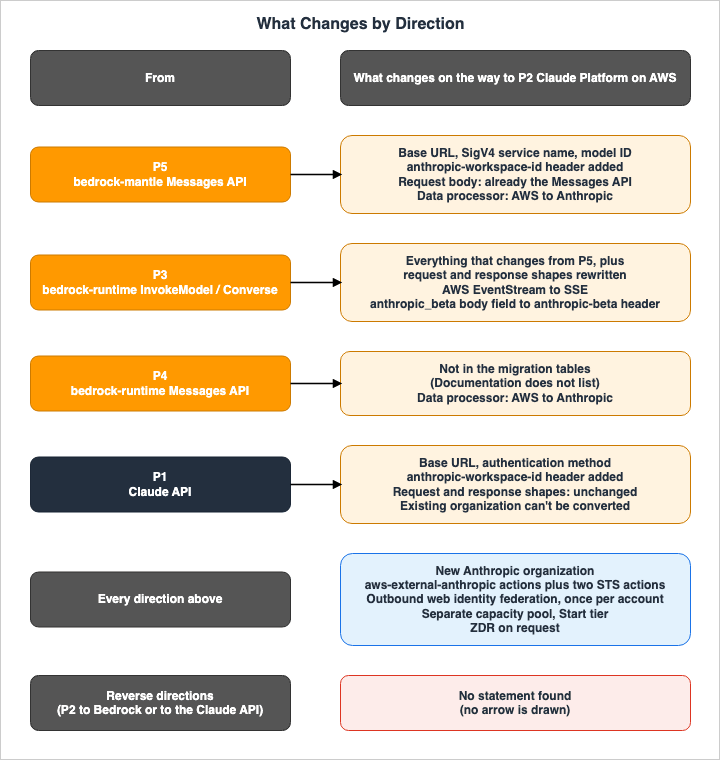
5.1 From P5 to P2
When migrating from thebedrock-mantle Messages API to Claude Platform on AWS, the format of the request body remains unchanged. The Claude Platform on AWS page states the following:If you’re on Claude in Amazon Bedrock, the request body format is already the Messages API. The changes are the base URL, SigV4 service name, model IDs, and the added anthropic-workspace-id header.The migration table on the same page indicates that the SDK client, packages, Region, and Anthropic organization will also change. The SDK client will change from
AnthropicBedrockMantle to AnthropicAWS. A new Anthropic organization will be created during registration.Besides these mechanical changes, the following change quietly:
- The inference data processor will change from AWS to Anthropic (Sections 4.1 and 7.2).
- The workload moves to the side where Anthropic's ZDR program applies. ZDR is enabled on request (Section 4.2).
- The IAM namespace will change from
bedrock-mantletoaws-external-anthropic. This requires two STS actions and the enablement of outbound web identity federation (Section 4.3). - The ownership of capacity pools and quotas will change, and the organization will begin in the initial tier (Section 4.4).
- The console will change from the Bedrock console to the Claude Console.
- The billing path will change from AWS native services to AWS Marketplace. The Claude Platform on AWS page notes that negotiated discounts and AWS Marketplace private offers will not be automatically migrated.
- Organizations that have not yet accepted Anthropic's Commercial Terms of Service and Usage Policy will be required to accept them during registration.
5.2 From P3 to P2
When migrating frombedrock-runtime's InvokeModel and Converse API to Claude Platform on AWS, in addition to the changes outlined in Section 5.1, the format of both requests and responses will also change. The Claude Platform on AWS page states:If you’re on the InvokeModel or Converse API, you’ll also rewrite the request and response shapes to the Messages API format.According to the migration table on the same page, the stream format changes from AWS EventStream to SSE. The model ID changes from the format
us. or global. followed by anthropic.claude-haiku-4-5-20251001-v1:0 to the format claude-haiku-4-5. The SigV4 service name changes from bedrock to aws-external-anthropic. The SDK client changes from AnthropicBedrock or the Bedrock SDK to AnthropicAWS.The method of passing beta features also changes.
bedrock-runtime passes these features in the main body of the InvokeModel call, using anthropic_beta, while Claude Platform on AWS passes them using the anthropic-beta header.5.3 From P4 to P2
The migration table for the Claude Platform on AWS page lists P5 and P3 as starting points, but does not mention P4 (Documentation does not list). The AWS user guide, "Migrating from Amazon Bedrock," also only listsbedrock-runtime's Converse and InvokeModel as starting points.As an inference by this article, because P4 uses the Messages API shape, the changes to the request body are likely close to those for a move from P5. However, no statement in the documentation supports this inference. Regardless of the starting point, certain aspects – such as the base URL, IAM namespace, STS, new organization, data processor, ZDR, and capacity – are inherent to Claude Platform on AWS and will therefore change when migrating from P4 as well.
5.4 From P1 to P2
A first-party Claude API organization cannot become a Claude Platform on AWS organization. The Claude Platform on AWS page states:There is no in-place conversion: an existing organization, such as a first-party Claude API organization, can’t become a Claude Platform on AWS organization.The same page says to plan this move as a cutover to a new organization. Key points include:
- The format of requests and responses remains the same as with the first-party Claude API. The only changes are the base URL, authentication method, and the
anthropic-workspace-idheader. - API keys, workspaces, and settings in the Claude Console will not be migrated. API keys created in the first-party Claude Console cannot be used with Claude Platform on AWS.
- Both organizations can be used concurrently, allowing you to gradually migrate your work to the new organization.
- Billing will transition to AWS Marketplace and will be measured in Claude Consumption Units. During the migration, billing for the existing organization will continue separately.
- Organization members will be managed through AWS IAM, rather than the Claude Console.
- The new organization will begin in the initial tier (Section 4.4).
This article found no statement on whether the ZDR settings of the existing organization carry over to the new organization (No statement found).
5.5 Differences by Direction
Table 3 shows what changes in the four directions of a move to Claude Platform on AWS. The information was verified on November 12, 2026.| What Changes | P5 to P2 | P3 to P2 | P4 to P2 | P1 to P2 |
|---|---|---|---|---|
| Base URL | Changes | Changes | Changes | Changes |
| Authentication and SigV4 Service Name | From bedrock-mantle to aws-external-anthropic | From bedrock to aws-external-anthropic | Documentation does not list | Authentication method changes. Use either SigV4 or an API key created in the AWS console. |
| Model ID | Remove anthropic. | Remove the inference profile prefix, anthropic., and the date/version suffix. | Documentation does not list | Remains unchanged. |
anthropic-workspace-id | Added | Added | Added | Added |
| Request and Response Format | Remains unchanged | Rewritten to the Messages API | Documentation does not list | Remains unchanged. |
| Stream Format | Remains SSE | Changes from AWS EventStream to SSE | Documentation does not list | Remains unchanged. |
| SDK Client | Changes to AnthropicAWS | Changes to AnthropicAWS | Changes to AnthropicAWS | Changes to AnthropicAWS |
| Anthropic Organization | Newly created | Newly created | Newly created | Newly created. Existing organizations cannot be converted. |
| IAM and STS | aws-external-anthropic actions plus two STS actions | aws-external-anthropic actions plus two STS actions | aws-external-anthropic actions plus two STS actions | aws-external-anthropic actions plus two STS actions |
| Outbound Web Identity Federation | Enable once per account | Enable once per account | Enable once per account | Enable once per account |
| Inference Data Processor | Changes from AWS to Anthropic (Section 7.2) | Changes from AWS to Anthropic (Section 7.2) | Changes from AWS to Anthropic (Section 7.2) | Remains with Anthropic (Section 7.2). |
| ZDR | Under Anthropic's program. On request. | Under Anthropic's program. On request. | Under Anthropic's program. On request. | On request. Whether existing organization settings carry over: No statement found. |
| Capacity and Quota | Separate pool. Initial tier (Section 7.2). | Separate pool. Initial tier (Section 7.2). | Separate pool. Initial tier (Section 7.2). | Separate pool. Initial tier (Section 7.2). |
| Billing Route | Changes from native AWS to AWS Marketplace | Changes from native AWS to AWS Marketplace | Changes from native AWS to AWS Marketplace | Changes from Anthropic to AWS Marketplace. |
Table 3 is based on the following:
- Columns P5 and P3 are based on the migration table on the Claude Platform on AWS page, and the paragraph below it.
- Column P1 is based on the section "Moving from an existing Anthropic organization" on the Claude Platform on AWS page.
- Cells in column P4 marked Documentation does not list indicate that the corresponding value is not found in the documentation. Cells in column P4 that contain a value reflect facts related to Claude Platform on AWS, independent of the starting point.
- The Inference Data Processor, ZDR, and Capacity and Quota rows are based on the quotes in Chapter 4.
5.6 Directions with No Steps in the Documentation
This article found no migration steps for the following directions in the materials listed in Section 1.3 (No statement found):- From Claude Platform on AWS to the first-party Claude API.
- From Claude Platform on AWS to Bedrock.
This does not show that such moves are impossible. Information regarding changes that occur during transitions between the two Bedrock endpoints can be found in Section 9.2 of this site's Amazon Bedrock Inference Endpoints and API Keys.
6. Features That Are Not Available
This chapter lists the features that are not available at each entrance. Table 4 of this site's article on Claude admin and governance surfaces (Claude Admin and Governance Surfaces - Which API or Setting Answers Which Control Question) covers which admin surfaces are available on each platform.6.1 Claude Platform on AWS
The "Features not supported" section on the Claude Platform on AWS page lists the following limitations:- HIPAA readiness: Anthropic's HIPAA-ready program is not available.
- Admin API: Only four groups of features are available: workspace management, external key management, telemetry destinations, and the Usage and Cost Analytics API. The following features are not supported: member management, invitations, API keys, the legacy Usage and Cost API, and rate limit reporting.
- Workspace member management: Not supported. Access is determined by IAM policies associated with the workspace ARN.
- Claude Code workspaces and the Claude Code Analytics API: Not supported.
- OAuth authentication: Not supported. Use SigV4 or API keys instead.
- Fast mode: Not supported.
- OpenAI-compatible API endpoints: Not supported.
- MCP tunnels: Only MCP servers accessible via the public internet are supported.
The same page also lists three differences between Claude Managed Agents and the first-party Claude API. Autonomous sessions without user events require re-authentication if they exceed six hours. Sessions in a self-hosted sandbox environment cannot attach memory stores. Workers in a self-hosted environment authenticate using either SigV4 or API keys created in the AWS console.
The AWS user guide's "Feature support" section indicates that the Priority Tier is not available. The Claude Platform on AWS page does not list Priority Tier (Documentation does not list). The AWS user guide does not list fast mode (Documentation does not list). While the AWS user guide lists several features as unavailable, some of these – including spend limits, workspace-level inference geography, and certain aspects of Managed Agents – differ from the information presented on the Claude Platform on AWS page (Section 7.2).
6.2 Bedrock's Two Endpoints
Both the bedrock-mantle page and the bedrock-runtime page list the same set of features not supported.- Input sources: URL sources for images and documents, Files API.
- Server-Side Tools: Code execution, web search, web fetch, advisor.
- Agent Foundation: Agent Skills, MCP connector, programmatic tool calling.
- API Endpoints: Message Batches, Models, Admin, Compliance, Usage and Cost.
- Claude Managed Agents.
- Server-Side Fallback: The
fallbacksparameter. Instead, use client-side fallbacks.
The bedrock-runtime page also lists automatic prompt caching. Instead, use explicit cache breakpoints.
This list comes from Anthropic's pages. For P4, the AWS Messages API page lists supported features but has no list of features that are not available (Documentation does not list).
6.3 Models Differ by Entrance
Claude Fable 5.2 and Claude Mythos 5.2 are not available onbedrock-mantle. The bedrock-mantle page states:Claude Fable 5.2 and Claude Mythos 5.2 aren’t available in Claude in Amazon Bedrock. Amazon Bedrock serves them on the bedrock-runtime endpoint only.The model table on the Claude Platform on AWS page lists
claude-fable-5-2. The "What's New" update from November 9, 2026, states that Claude Fable 5.2 is available on both Bedrock and Claude Platform on AWS. On Bedrock, that means bedrock-runtime.The model table on the bedrock-mantle page does not list Claude Opus 4.6 or older models. The bedrock-runtime page lists them. The bedrock-runtime page warns that models numbered 4.6 or lower do not support API version 2026-10-21 on Bedrock. This site's Moving a Claude Integration to API Version 2026-10-21 on AWS covers the effect.
7. Status, Dates, and Where the Sources Disagree
This chapter lists the status and dates, highlighting discrepancies between Anthropic's documentation and AWS's documentation.7.1 Status and Dates
Table 4 lists the status updates and dates relevant to the claims made in this article. The verification date is November 12, 2026.| Date | Event | Source |
|---|---|---|
| May 11, 2026 | Claude Platform on AWS reached General Availability (GA), listing 17 Regions. | What's New |
| July 24, 2026 | Regarding Bedrock's Claude Opus 5, it was stated that ZDR is enabled by default. | What's New |
| September 18, 2026, 00:00 UTC | Workspaces created before this time may be processed outside of AWS. | Claude Platform on AWS page |
| November 9, 2026 | Claude Fable 5.2 became available on both Bedrock and Claude Platform on AWS. | What's New |
| As of the verification date | Claude Platform on AWS is available in all AWS commercial Regions. | Claude Platform on AWS page |
| As of the verification date | The SDK client for Claude Platform on AWS is in beta. | Claude Platform on AWS page, AWS user guide |
Regarding the date when Claude Platform on AWS expanded from 17 Regions to all commercial Regions, this article found no statement (No statement found). The AWS user guide, specifically the section on Migrating from Amazon Bedrock, states that it is available in all commercial Regions, and adds that opt-in Regions require account opt-in.
The
bedrock-runtime page has the word legacy in its URL. However, the page title is "Claude on Amazon Bedrock (bedrock-runtime)," and the word "deprecated" only appears in the model rows. This article found no statement on a deprecation of the bedrock-runtime entrance or an end to new sign-ups (No statement found). AWS recommends using bedrock-runtime for new applications, as described in Section 2.4.7.2 Where the Sources Disagree
This article identified seven points where the documentation from the two companies differs. This article does not conclude that either company's documentation is incorrect.The first is the inference data processor for Claude Platform on AWS. The Claude Platform on AWS page lists "Anthropic" in the row labeled "Inference data processor." However, on the same page, in the migration notes, it states:
On Claude Platform on AWS, Anthropic processes inference data as an independent data processor, and ZDR follows the first-party Claude API model: it is available on request through your Anthropic account representative.The AWS user guide, in the section comparing Claude Platform on AWS and Amazon Bedrock, lists both "Anthropic and AWS" in the row labeled "Data processors." The AWS user guide's section, "What is Claude Platform on AWS?", states:
Both Anthropic and AWS act as independent data processors.In contrast, the AWS user guide's section on "Migrating from Amazon Bedrock" states something different. The wording varies in the AWS user guide itself.
On Claude Platform on AWS, Anthropic is the data processor, and ZDR follows the first-party Claude API model: it is available on request through your Anthropic account representative.As an inference by this article, the Claude Platform on AWS page's statement that AWS processes billing and identity metadata may be related to the AWS user guide's wording Anthropic and AWS. However, no document says so.
The second is the spend limits for Claude Platform on AWS. The Claude Platform on AWS page states:
You can also set your own monthly spend limits below the cap.The AWS user guide's section on "Feature support" states:
Spend limits: Not available. Rely on AWS billing controls instead.The third is the workspace-level inference geography controls. The Claude Platform on AWS page states:
Workspace-level inference geography controls (allowed_inference_geos and default_inference_geo) are also available on Claude Platform on AWS.The AWS user guide's sections on "Feature support" and "Data residency" state:
Workspace-level inference geography controls (allowed_inference_geos and default_inference_geo) are not available on Claude Platform on AWS. Set inference_geo on each request instead.The fourth is Claude Managed Agents on Claude Platform on AWS. The Claude Platform on AWS page lists "multiagent orchestration" as a supported feature. The AWS user guide's section on "Feature support" states that two features are not supported.
Outcomes: Outcome tracking for agent sessions is not available.
Multi-agent sessions: Sessions with multiple interacting agents are not available.
The fifth is the IAM action that stops API keys on
bedrock-mantle. The "Bearer tokens" section on the bedrock-mantle page provides instructions that state:Block long-term keys by attaching a policy that denies bedrock:CallWithBearerToken unless the bedrock:BearerTokenType condition matches a short-term token.The AWS API keys permissions page states the following. The Service Authorization Reference also lists
bedrock-mantle:CallWithBearerToken as an action of bedrock-mantle.Amazon Bedrock API keys can be used with two endpoints, each controlled by a separate IAM action. To fully prevent all API key-based access, you must deny both actions.On the AWS pages,
bedrock:CallWithBearerToken disables the use of API keys for Bedrock endpoints, while bedrock-mantle:CallWithBearerToken disables the use of API keys for Mantle endpoints. Details for these two actions are in Section 7.2 of Amazon Bedrock Inference Endpoints and API Keys on this site.The sixth is the SDKs that support Bedrock bearer tokens. The AWS user guide, "Claude Platform on AWS vs Amazon Bedrock," describes Bedrock authentication as follows.
AWS IAM / SigV4 or bearer token (C#, Go, and Java SDKs only)The "Bearer token authentication" section on the
bedrock-runtime page provides examples in Python, TypeScript, C#, Go, Java, PHP, and Ruby.The seventh is the initial tier and automatic tier upgrades on Claude Platform on AWS. The Claude Platform on AWS page states:
Organizations on Claude Platform on AWS are placed on the Start tier. Anthropic manages rate limits directly, not through AWS quota systems. Organizations on Claude Platform on AWS can move to a higher usage tier automatically as they build a history of paid AWS Marketplace invoices.The Rate limits and quotas page of the AWS user guide states:
Claude Platform on AWS assigns Tier 1 rate limits when you subscribe.Unlike the first-party Claude API, automatic tier advancement does not apply on Claude Platform on AWS.The rate limits page lists the tiers as Start, Build, Scale, and Custom, and this article did not find the name Tier 1 on that page. The documentation of both companies agrees that higher limits are requested through an Anthropic representative.
7.3 What the Documentation Does Not List, and Where No Statement Was Found
The main matters this article marks as Documentation does not list are the following:- The comparison table on the Claude Platform on AWS page only mentions AWS IAM / SigV4 authentication for
bedrock-mantle. The main text on the bedrock-mantle page, and the AWS Messages API page, also mention API key authentication. - The Claude Platform on AWS page does not list the Priority Tier. The AWS user guide does not list the "fast mode" option.
- The AWS user guide does not mention the workspace cutoff date of September 18, 2026.
- The Anthropic comparison table and migration table do not mention P4.
The main matters this article marks as No statement found are the following:
- The process of migrating from Claude Platform on AWS to the first-party Claude API, or to Bedrock (Section 5.6).
- Whether the ZDR settings of a first-party organization carry over to the new organization (Section 5.4).
- The date when Claude Platform on AWS became available in all commercial Regions (Section 7.1).
- A deprecation of the
bedrock-runtimeentrance, or an end to new sign-ups (Section 7.1).
8. Failure Modes
This chapter lists mix-ups that are likely when you choose an entrance or move between entrances.- Call Claude Platform on AWS with the IAM role set up for Bedrock. The Bedrock-specific policies do not allow the
aws-external-anthropic:actions (Section 4.3). - Allow only the
aws-external-anthropic:actions and forget the two STS actions. Requests will fail with a 403permission_error, and the message names the denied STS action (Section 4.3). - Call Claude Platform on AWS without enabling outbound web identity federation. The Claude Platform on AWS page indicates that all requests will fail, noting that this is the most common setup error (Section 4.3).
- Attempt to use an API key created in the first-party Claude Console with Claude Platform on AWS. This key will not work (Sections 1.4, 5.4).
- Try to convert an existing first-party organization into a Claude Platform on AWS organization. It cannot be converted, and sign-up creates a new organization (Section 5.4).
- Call a workspace created in one Region from an endpoint in a different Region. Workspaces are tied to a single Region and are only accessible through the endpoint in that Region.
- Assume that the workspace's Region determines where inference runs. The geographical location for inference is determined by the
inference_geoparameter for each request (Section 4.1). - Assume that the data retention policies used in Bedrock will continue to apply to Claude Platform on AWS. On Claude Platform on AWS, ZDR is enabled on request (Section 4.2).
- Assume that the quotas used in Bedrock are also applicable to Claude Platform on AWS. Capacity is managed through a separate pool, and organizations begin in the initial tier (Section 4.4).
- Confuse "Claude in Amazon Bedrock" and "Claude on Amazon Bedrock," and read documentation for a different endpoint (Section 1.4).
- See the word
legacyand assume thatbedrock-runtimeis being deprecated. However, no deprecation notices are found in the documentation (Section 7.1). - Call Claude Fable 5.2 using
bedrock-mantle. Bedrock only provides this model throughbedrock-runtime(Section 6.3). - Assume that denying only
bedrock:CallWithBearerTokenstops every Bedrock API key. The AWS page says to deny both actions (Section 7.2).
9. Frequently Asked Questions About Claude Platform on AWS and Amazon Bedrock
Q1. Is Claude Platform on AWS one of the features of Amazon Bedrock?
No. Claude Platform on AWS is a separate service that Anthropic operates, while AWS handles authentication, IAM, and billing through AWS Marketplace. AWS operates Bedrock. Both the Claude Platform on AWS page and the AWS user guide state this (Section 2.1).Q2. If you call Claude with an AWS account, does the data stay in AWS?
It depends on the entrance and the workspace. With Bedrock, AWS processes the inference data. On Claude Platform on AWS, the Claude Platform on AWS page identifies Anthropic as the data processor, while some pages of the AWS user guide list both Anthropic and AWS (Section 7.2). Workspaces created before September 18, 2026, at 00:00 UTC may have their data processed outside of AWS. The Region of a workspace does not determine the location of inference; instead, the geographical location for inference is determined by theinference_geo parameter in each request. AWS documentation states that data may not always be stored within AWS (Section 4.1).Q3. Does the term legacy in the URL of the bedrock-runtime page announce a deprecation?
This article found no explicit deprecation notice. The page title is "Claude on Amazon Bedrock (bedrock-runtime)," and the word "deprecated" only appears in relation to the models listed. AWS recommends usingbedrock-runtime for new applications (see Sections 7.1 and 2.4).Q4. Does the ZDR used with Bedrock carry over to Claude Platform on AWS?
No. Anthropic's ZDR program does not apply to Bedrock, and on Claude Platform on AWS it is enabled on request. The ZDR that AWS What's New mentions for Bedrock is separate from Anthropic's program (see Section 4.2).Q5. Can the IAM role used for Bedrock access call Claude Platform on AWS?
Not as it is. The actions for Claude Platform on AWS are in theaws-external-anthropic namespace. The principal making the call also needs sts:GetWebIdentityToken and sts:TagGetWebIdentityToken permissions. Additionally, you need to enable outbound web identity federation once per account (see Section 4.3).Q6. Can an existing Claude API organization be converted into a Claude Platform on AWS organization?
No, it cannot. Registering for Claude Platform on AWS always creates a new Anthropic organization. API keys, workspaces, and settings in the Claude Console will not be transferred. You can use both organizations concurrently and gradually migrate your work (see Section 5.4).Q7. When migrating from Bedrock to Claude Platform on AWS, to what extent will the code need to be modified?
It depends on the starting point. When migrating from thebedrock-mantle Messages API, you will need to update the base URL, SigV4 service name, model ID, and the anthropic-workspace-id header. When migrating from InvokeModel or Converse, you will also need to adjust the format of both requests and responses, as well as the format of the streams. Whichever you move from, IAM, STS, the organization, the data processor, ZDR, and capacity change (see Chapter 5).Q8. Is there a procedure to move back from Claude Platform on AWS to Bedrock or the first-party Claude API?
This article did not find any such procedures documented (No statement found). This does not necessarily mean that it is impossible to return (see Section 5.6).10. Summary
The various entrances for Claude on AWS can be compared across five key areas:- Operators: Anthropic operates Claude Platform on AWS, while AWS operates
bedrock-mantleandbedrock-runtimewithin Bedrock. Anthropic's comparison table has three columns, while AWS's Messages API offers two endpoints. This article compared four entrances. - Where Responsibility Switches: When the operator changes, the inference data processor, retention and ZDR, the IAM namespace and STS, and capacity and quotas change together. Anthropic's ZDR program does not apply to Bedrock.
- Migration: Migrating to Claude Platform on AWS involves changes to the base URL, SigV4 service name, model ID, and the
anthropic-workspace-idheader. A new organization is also created. From InvokeModel and Converse, the request and response shapes also change. No steps for the reverse direction were found in the documentation. - Documentation Discrepancies: There are discrepancies in the documentation regarding the data processor wording, spending limits, workspace-level inference geography, a portion of Managed Agents, IAM actions for
bedrock-mantleAPI keys, the SDK for bearer tokens, and the initial tier and automatic tier upgrades. Furthermore, the two companies point new code in opposite directions. - Verification Date: The models, Regions, and SDK status at each entrance change over time. Tables 2 through 4 reflect the status as of November 12, 2026.
11. References
- Claude Platform on AWS - Claude Platform Docs
- Claude in Amazon Bedrock (bedrock-mantle) - Claude Platform Docs
- Claude on Amazon Bedrock (bedrock-runtime) - Claude Platform Docs
- IAM actions for Claude Platform on AWS - Claude Platform Docs
- API and data retention - Claude Platform Docs
- Rate limits - Claude Platform Docs
- What is Claude Platform on AWS? - Claude Platform on AWS User Guide
- Claude Platform on AWS vs Amazon Bedrock - Claude Platform on AWS User Guide
- Feature support - Claude Platform on AWS User Guide
- Migrating from Amazon Bedrock - Claude Platform on AWS User Guide
- Data residency - Claude Platform on AWS User Guide
- Rate limits and quotas - Claude Platform on AWS User Guide
- Inference using Anthropic Messages API - Amazon Bedrock User Guide
- Making inference requests - Amazon Bedrock User Guide
- Control permissions for generating and using Amazon Bedrock API keys - Amazon Bedrock User Guide
- Actions, resources, and condition keys for Amazon Bedrock Powered by AWS Mantle - Service Authorization Reference
- Claude Platform on AWS is now generally available - AWS What's New
- Claude Opus 5 is now available on AWS - AWS What's New
- Claude Fable 5.2 is now available on AWS - AWS What's New
References:
Tech Blog with curated related content
Written by Hidekazu Konishi