Software Design Principles in Practice - SOLID, DDD, Clean Architecture
First Published:
Last Updated:
This article tries to close that gap. It walks through every principle in SOLID, the core building blocks of DDD, and the dependency rule of Clean Architecture, as concrete code you can paste into a project today. For each principle, we look at a bad implementation, the same code rewritten to honor the principle, and — equally important — the situations where the principle starts to do more harm than good. Because the second half of becoming a good designer is learning when not to apply a principle.
All examples are written in TypeScript. TypeScript is a small enough language to keep the code unobtrusive, but it has both
interface and class, structural typing, and discriminated unions, which means we can express abstraction and polymorphism without leaning on a specific framework.Beyond Self-Disruption: The Paradigm Shift Software Engineers Need in the AI Era argued that the durable skills of an engineer in an AI-augmented era are defining problems and judging output. Design principles are one of the sharpest tools we still have for both. AI can produce a working
class UserService { ... } in seconds. Whether that class is one you can still change six months from now is a judgment only a human, armed with these principles, can make.1. Why Principles Before Patterns (And When Patterns Mislead)
Before we open the SOLID box, it is worth asking what these principles are for. Robert C. Martin opens his original 2000 paper "Design Principles and Design Patterns" with a description of "software rot": code that starts off elegant and degrades over time, every change introducing a little more friction, until the cost of any modification dominates the project. The principles, he argued, are countermeasures against rot.1.1 The Real Goal: Reducing the Cost of Change
The principles are not aesthetic preferences. They are a bet that change is the dominant cost in software, not initial implementation. A function written in five minutes will be read for years. A class shipped on Monday will be touched by people who never met its author. If you optimize for the first hour of the file's life, you make the next thousand hours worse.Every SOLID rule, every DDD pattern, every Clean Architecture circle exists to make one specific kind of change cheaper: changing one thing without breaking three other things. When a principle stops doing that — when applying it makes the next change harder, not easier — the principle is wrong for that situation. We will return to this idea repeatedly.
1.2 Why "Principle Reading" Doesn't Translate to Code
Books are forced to teach principles in isolation. SRP gets a chapter, OCP gets a chapter, Aggregate gets a chapter. In a real codebase the principles overlap, contradict, and trade off against each other. A change that improves SRP often hurts ISP. A textbook-perfect aggregate is sometimes the wrong choice for a CRUD endpoint.The skill the books cannot teach is which principle to reach for in this situation, and how far to push it. That skill is built by seeing many before/after pairs, and that is what the rest of this article gives you.
1.3 What This Article Covers (and Doesn't)
This article covers SOLID (five principles), DDD tactical patterns (Entity, Value Object, Aggregate), and the Clean Architecture dependency rule. It does not cover language-specific syntax debates (interface vs abstract class, decorators, mixins), framework directory layouts (Spring, Django, NestJS), or strategic DDD (Bounded Context, Context Map). Those are valuable topics; they are not the bottleneck for engineers stuck on the implementation gap.For each principle, the structure is the same:
- The common misreading
- A bad implementation
- The same logic refactored to honor the principle
- The situations where the principle goes too far
2. SRP — Single Responsibility with Concrete Examples
The Single Responsibility Principle is the most-quoted and most-misunderstood of the five SOLID principles. It is usually paraphrased as "a class should do one thing." That is not what Martin wrote, and it is not a useful rule, because almost any class can be argued to be doing one thing if you describe it abstractly enough.2.1 The Common Misreading ("One Function, One Thing")
Martin's actual definition, restated in his later writing, is that a class should have one reason to change, where "reason" means "an actor who can request a change." The principle is not about counting methods or counting verbs. It is about who, in the organization or product, is allowed to ask for this code to behave differently.Most failed SRP refactors split classes by technical layer (validation, transformation, persistence) instead of by change axis (sales asks for new fields, finance asks for new tax rules, operations asks for new export formats). Splitting by technical layer creates ceremony without reducing the cost of change. Splitting by change axis genuinely makes future changes cheaper.
2.2 Bad: A Class That Mixes Persistence, Format, and Notification
Here is a class that violates SRP in a way that is easy to overlook because it "feels reasonable":class InvoiceService {
async createInvoice(order: Order): Promise<void> {
const invoice = {
id: crypto.randomUUID(),
orderId: order.id,
amount: order.items.reduce((s, i) => s + i.price * i.quantity, 0),
tax: 0,
issuedAt: new Date(),
};
invoice.tax = invoice.amount * 0.10;
await db.invoices.insert(invoice);
const pdf = `Invoice ${invoice.id}\nAmount: ${invoice.amount}\nTax: ${invoice.tax}`;
await s3.putObject({ Bucket: "invoices", Key: `${invoice.id}.pdf`, Body: pdf });
await mailer.send({
to: order.customerEmail,
subject: `Your invoice ${invoice.id}`,
body: `Your invoice for order ${order.id} is attached.`,
});
}
}2.3 Good: Separating Reasons to Change
We split by change axis, not by technical noun. Each piece can be changed without recompiling, retesting, or rereading the others:class TaxCalculator {
calculate(amount: number): number {
return amount * 0.10;
}
}
class InvoiceRepository {
async save(invoice: Invoice): Promise<void> {
await db.invoices.insert(invoice);
}
}
class InvoicePdfRenderer {
render(invoice: Invoice): string {
return `Invoice ${invoice.id}\nAmount: ${invoice.amount}\nTax: ${invoice.tax}`;
}
}
class InvoiceNotifier {
constructor(private mailer: Mailer) {}
async notify(invoice: Invoice, customerEmail: string): Promise<void> {
await this.mailer.send({
to: customerEmail,
subject: `Your invoice ${invoice.id}`,
body: `Your invoice for order ${invoice.orderId} is attached.`,
});
}
}
class CreateInvoiceUseCase {
constructor(
private tax: TaxCalculator,
private repo: InvoiceRepository,
private renderer: InvoicePdfRenderer,
private storage: ObjectStorage,
private notifier: InvoiceNotifier,
) {}
async execute(order: Order): Promise<Invoice> {
const amount = order.items.reduce((s, i) => s + i.price * i.quantity, 0);
const invoice: Invoice = {
id: crypto.randomUUID(),
orderId: order.id,
amount,
tax: this.tax.calculate(amount),
issuedAt: new Date(),
};
await this.repo.save(invoice);
await this.storage.put(`${invoice.id}.pdf`, this.renderer.render(invoice));
await this.notifier.notify(invoice, order.customerEmail);
return invoice;
}
}CreateInvoiceUseCase orchestrates, but no longer knows how tax is computed, how the invoice is stored, what the PDF looks like, or how the customer is told. Each collaborator can be changed in isolation, with isolated tests.2.4 The "Axis of Change" Heuristic
When you suspect SRP is being violated, the cheapest test is this: list the last five non-trivial changes to the class. If they came from different stakeholders for different reasons, the class has too many responsibilities. If they all came from the same stakeholder for the same reason, the class is fine even if it is long.This heuristic gives you a defensible answer in code review, where "should we split this?" otherwise dissolves into taste.
2.5 When SRP Goes Too Far
SRP, taken to extremes, produces a fog of two-line classes. Each one is "SRP-correct" in isolation, but tracing a request through the system requires opening a dozen files. The cost of reading has gone up; the cost of changing has gone up because changes now span many files.The reflex of "every method on its own class, injected via the constructor" is the SRP equivalent of cargo cult. When in doubt, prefer one class with cohesive methods over five classes that always change together. We revisit this in Section 9.
3. OCP — Open/Closed in Modern Languages
Bertrand Meyer's original Open/Closed Principle (1988) was about inheritance: you should be able to extend a module's behavior by subclassing, without modifying the existing class. Martin reformulated it in 1996 around abstractions: a module should be open for extension and closed for modification, achieved through polymorphism rather than inheritance specifically.3.1 What "Open for Extension, Closed for Modification" Actually Means
The practical meaning is: when a new variant of behavior arrives, you should be able to add it by writing new code, not by modifying existing code that already works. The reason is regression: every time you reopen a working file, you risk breaking something. If new behavior is added by adding a new file, the blast radius is bounded by that file.OCP is most clearly violated by long
switch or if-else chains that branch on a type tag and need a new case for every new variant.3.2 Bad: switch / if-else Branching on Type
type Shape =
  | { kind: "circle"; radius: number }
  | { kind: "rectangle"; width: number; height: number };

function area(shape: Shape): number {
  if (shape.kind === "circle") {
    return Math.PI * shape.radius ** 2;
  } else if (shape.kind === "rectangle") {
    return shape.width * shape.height;
  }
  throw new Error("unknown shape");
}

function perimeter(shape: Shape): number {
  if (shape.kind === "circle") {
    return 2 * Math.PI * shape.radius;
  } else if (shape.kind === "rectangle") {
    return 2 * (shape.width + shape.height);
  }
  throw new Error("unknown shape");
}Triangle requires editing both functions, plus the type alias, plus every other place a switch on kind exists. The change is mechanical but spread across the codebase.3.3 Good: Polymorphism via Strategy or Discriminated Union
The polymorphic version pushes per-variant code into per-variant files:interface Shape {
area(): number;
perimeter(): number;
}
class Circle implements Shape {
constructor(private radius: number) {}
area(): number { return Math.PI * this.radius ** 2; }
perimeter(): number { return 2 * Math.PI * this.radius; }
}
class Rectangle implements Shape {
constructor(private width: number, private height: number) {}
area(): number { return this.width * this.height; }
perimeter(): number { return 2 * (this.width + this.height); }
}
// Adding Triangle requires no edits to Circle, Rectangle, or any caller:
class Triangle implements Shape {
constructor(private a: number, private b: number, private c: number) {}
area(): number {
const s = (this.a + this.b + this.c) / 2;
return Math.sqrt(s * (s - this.a) * (s - this.b) * (s - this.c));
}
perimeter(): number { return this.a + this.b + this.c; }
}3.4 OCP in TypeScript without Inheritance Hierarchies
Inheritance is not the only way to satisfy OCP. A registry of strategies — a map of variant key to handler function — gives the same property in a more functional style:type AreaCalculator = (shape: any) => number;
const areaCalculators: Record<string, AreaCalculator> = {
circle: (s) => Math.PI * s.radius ** 2,
rectangle: (s) => s.width * s.height,
};
function area(shape: { kind: string }): number {
const calc = areaCalculators[shape.kind];
if (!calc) throw new Error(`unknown shape: ${shape.kind}`);
return calc(shape);
}
// Adding a triangle: no edits to existing functions
areaCalculators.triangle = (s) => {
const semi = (s.a + s.b + s.c) / 2;
return Math.sqrt(semi * (semi - s.a) * (semi - s.b) * (semi - s.c));
};The strategy parameter is typed as
any on purpose, and the trade-off is worth naming. Tightening it — for instance, with a generic constrained to a discriminated union of shapes — would force every new variant to extend that union and modify the file the registry was meant to keep closed. The runtime extensibility of a registry and the compile-time exhaustiveness of a union pull against each other: pick the registry when variants are loaded at runtime (plugins, configuration), and pick the union when the variants are known at build time (where the compiler's exhaustiveness check is the more valuable property).3.5 When OCP Adds Friction Without Payoff
Premature OCP is a trap. If you have two variants and no concrete plan for a third, building the polymorphic structure now is speculative — and the speculation is often wrong. The third variant, when it arrives, may not fit the abstraction you guessed at, and you will rewrite the abstraction anyway.A pragmatic rule: write the
switch the first two times. The third time, refactor to polymorphism with the third variant in hand, using all three to triangulate the right abstraction. This is the Rule of Three we revisit in Section 10.4. LSP — Liskov in Practice
The Liskov Substitution Principle, due to Barbara Liskov (1987), says that objects of a subtype should be substitutable for objects of their supertype without altering the correctness of the program. In practice the principle is violated whenever a subclass throws on a method the parent supports, weakens a postcondition, or strengthens a precondition.4.1 The Square-Rectangle Trap and Why It's Real
The textbook example —class Square extends Rectangle — sounds contrived until you encounter a real one in production. The pattern is always the same: a subclass that seems like a specialization at the math level breaks the contract at the behavior level. Square cannot have its width and height set independently, but Rectangle.setWidth(w) promises that getWidth() === w regardless of getHeight(). The promise breaks the moment a Rectangle reference points to a Square.4.2 Bad: Subclass That Strengthens Preconditions
class Rectangle {
  constructor(protected width: number, protected height: number) {}
  setWidth(w: number): void { this.width = w; }
  setHeight(h: number): void { this.height = h; }
  area(): number { return this.width * this.height; }
}

class Square extends Rectangle {
  constructor(side: number) { super(side, side); }
  setWidth(w: number): void { this.width = w; this.height = w; }
  setHeight(h: number): void { this.height = h; this.width = h; }
}

function resizeAndCheck(r: Rectangle): void {
  r.setWidth(5);
  r.setHeight(4);
  // Caller expects 20. With a Square at runtime, gets 16.
  console.log(r.area());
}setWidth does not affect setHeight — is part of Rectangle's implicit contract. Square strengthens the precondition (width must equal height), violating LSP.4.3 Good: Modeling the Real Invariant
IfSquare cannot be substituted for Rectangle, the type hierarchy is wrong. Model both as separate types, both implementing a smaller, honest interface:interface Polygon {
area(): number;
}
class Rectangle implements Polygon {
constructor(private width: number, private height: number) {}
withWidth(w: number): Rectangle { return new Rectangle(w, this.height); }
withHeight(h: number): Rectangle { return new Rectangle(this.width, h); }
area(): number { return this.width * this.height; }
}
class Square implements Polygon {
constructor(private side: number) {}
withSide(s: number): Square { return new Square(s); }
area(): number { return this.side * this.side; }
}with* methods, which sidesteps the subclassing trap entirely.4.4 Composition Over Inheritance as the LSP-Safe Default
Most LSP violations in modern codebases come from inheritance reaching for code reuse rather than for substitutability. If you find yourself overriding a method to throwUnsupportedOperationException, or to no-op, the inheritance is the wrong tool. Composition — "Square has a side length, Rectangle has a width and height" — avoids the substitutability question entirely because there is no parent type to substitute for.A useful rule: inherit only when the subclass is genuinely a behavioral specialization of the parent, where every parent method makes sense unchanged on the child. Otherwise, compose.
4.5 LSP for Stateful Services (Beyond Classes)
LSP applies beyond OOP class hierarchies. Anywhere a contract is implicit — an HTTP API, a message handler, a function passed as a callback — substituting a "compatible" implementation that strengthens preconditions or weakens postconditions is an LSP violation. A common production case: a payment provider implementation that silently retries idempotently, replaced by one that doesn't. Callers that relied on the original behavior break.The defense is to write the contract down — typed interfaces, postconditions in tests, idempotency guarantees as part of the spec — so that "compatible" has a definition you can check.
5. ISP — Interface Segregation
The Interface Segregation Principle says that clients should not be forced to depend on methods they do not use. In Martin's original framing the concern was multiple-inheritance languages, where a fat interface forced unwilling implementations. In modern languages with structural typing or single-inheritance plus interfaces, the consequence is different but the principle still bites.5.1 Why Fat Interfaces Hurt Even Without Multiple Inheritance
When an interface has fifteen methods and a caller uses two, every change to one of the unused thirteen ripples into the caller's compile graph, mocking burden, and conceptual surface area. Test doubles bloat. Type-narrowing becomes harder. The interface starts to behave like a dumping ground rather than a contract.The deeper cost: the interface no longer tells you what the caller needs. An interface should describe the role a collaborator plays for a specific caller. A fifteen-method interface describes nothing in particular.
5.2 Bad: A Repository Interface with 12 Methods
interface UserRepository {
  findById(id: string): Promise<User | null>;
  findByEmail(email: string): Promise<User | null>;
  findAll(): Promise<User[]>;
  findByRole(role: string): Promise<User[]>;
  count(): Promise<number>;
  insert(user: User): Promise<void>;
  update(user: User): Promise<void>;
  delete(id: string): Promise<void>;
  softDelete(id: string): Promise<void>;
  restore(id: string): Promise<void>;
  bulkInsert(users: User[]): Promise<void>;
  exportToCsv(): Promise<string>;
}

class LoginUseCase {
  constructor(private users: UserRepository) {}
  async execute(email: string, password: string): Promise<Session> {
    const user = await this.users.findByEmail(email);
    if (!user || !verify(password, user.passwordHash)) {
      throw new InvalidCredentials();
    }
    return createSession(user.id);
  }
}
LoginUseCase uses one method but depends on the entire surface of UserRepository. Test doubles must stub twelve methods. A breaking change to exportToCsv forces a recompile of the login flow. Worst of all, the type does not communicate that login only reads by email — that intent is buried.5.3 Good: Role Interfaces Sized to the Caller
The fix is "role interfaces": small interfaces named after the role the collaborator plays for this specific caller. The repository implementation can satisfy many of them at once via TypeScript's structural typing.interface UserFinderByEmail {
findByEmail(email: string): Promise<User | null>;
}
interface UserMutator {
insert(user: User): Promise<void>;
update(user: User): Promise<void>;
}
interface UserExporter {
exportToCsv(): Promise<string>;
}
class LoginUseCase {
constructor(private users: UserFinderByEmail) {}
async execute(email: string, password: string): Promise<Session> {
const user = await this.users.findByEmail(email);
if (!user || !verify(password, user.passwordHash)) {
throw new InvalidCredentials();
}
return createSession(user.id);
}
}
// One concrete class can satisfy all of them at once:
class PostgresUserRepository
implements UserFinderByEmail, UserMutator, UserExporter {
async findByEmail(email: string): Promise<User | null> { /* ... */ return null; }
async insert(user: User): Promise<void> { /* ... */ }
async update(user: User): Promise<void> { /* ... */ }
async exportToCsv(): Promise<string> { /* ... */ return ""; }
}5.4 The "Caller Determines the Interface" Rule
Whose job is it to define the interface — the implementer or the caller? ISP, taken seriously, says the caller. The interface lives next to the code that needs it, named after that need. The implementer comes along and says "yes, I can satisfy that role." This inverts the usual direction (where a service exposes its API and callers wedge themselves into it), and it is the same inversion that DIP (Section 6) generalizes.5.5 When Splitting Interfaces Becomes Theatre
ISP also has an over-application failure mode. DefiningUserFinderById, UserFinderByEmail, UserFinderByRole, UserCounter, UserExistenceChecker, all separately, when in practice they always come together, produces ceremony without value. The right grain is "the smallest set of operations that callers actually take as a unit." If two methods are always used together by every caller, the interface that contains both is fine.The ISP question to ask in code review is not "does this interface have only one method?" but "does any real caller use only a subset of these methods?" If yes, segregate. If every caller uses all of them, leave them alone.
6. DIP — Dependency Inversion
The Dependency Inversion Principle says that high-level modules should not depend on low-level modules; both should depend on abstractions. And: abstractions should not depend on details; details should depend on abstractions. The principle is named for the direction of the dependency arrow at runtime versus compile time, and it is the principle most often half-applied.6.1 Inversion of Direction, Not Just Container Magic
Many engineers learn DIP through a DI framework — Spring, NestJS, Guice — and conclude that DIP is "letting the container wire constructors." That is the mechanism; the principle is older and language-agnostic. DIP is about which way the import statement points.Without DIP, the application core (use cases, domain logic) imports the database driver, the HTTP client, the email service. Every change to those tools is felt by the core. With DIP, the core defines the interface it needs (
UserRepository, EmailSender), and the infrastructure code imports the core to satisfy that interface. The compile-time import points the opposite way of the runtime call.6.2 Bad: High-Level Module Imports a Concrete DB Driver
// src/usecases/RegisterUser.ts
import { Pool } from "pg"; // <-- high-level imports low-level

const pool = new Pool({ connectionString: process.env.DATABASE_URL });

export class RegisterUserUseCase {
  async execute(email: string, password: string): Promise<string> {
    const id = crypto.randomUUID();
    const hash = await bcrypt.hash(password, 10);
    await pool.query(
      "INSERT INTO users (id, email, password_hash) VALUES ($1, $2, $3)",
      [id, email, hash],
    );
    return id;
  }
}INSERT statement to run").6.3 Good: High-Level Module Owns the Abstraction
The use case defines what it needs. Infrastructure implements it. The arrow at compile time points from infrastructure → core, not core → infrastructure.// src/usecases/RegisterUser.ts (high-level — depends on no infrastructure)
export interface UserRepository {
insert(user: { id: string; email: string; passwordHash: string }): Promise<void>;
existsByEmail(email: string): Promise<boolean>;
}
export interface PasswordHasher {
hash(plain: string): Promise<string>;
}
export class RegisterUserUseCase {
constructor(
private users: UserRepository,
private hasher: PasswordHasher,
) {}
async execute(email: string, password: string): Promise<string> {
if (await this.users.existsByEmail(email)) {
throw new EmailAlreadyRegistered();
}
const id = crypto.randomUUID();
const passwordHash = await this.hasher.hash(password);
await this.users.insert({ id, email, passwordHash });
return id;
}
}// src/infrastructure/PostgresUserRepository.ts (low-level — depends on core)
import { Pool } from "pg";
import type { UserRepository } from "../usecases/RegisterUser";
export class PostgresUserRepository implements UserRepository {
constructor(private pool: Pool) {}
async insert(user: { id: string; email: string; passwordHash: string }) {
await this.pool.query(
"INSERT INTO users (id, email, password_hash) VALUES ($1, $2, $3)",
[user.id, user.email, user.passwordHash],
);
}
async existsByEmail(email: string): Promise<boolean> {
const r = await this.pool.query("SELECT 1 FROM users WHERE email = $1", [email]);
return (r.rowCount ?? 0) > 0;
}
}DynamoUserRepository) with no edits to the core. This is the dependency rule at the file-import level.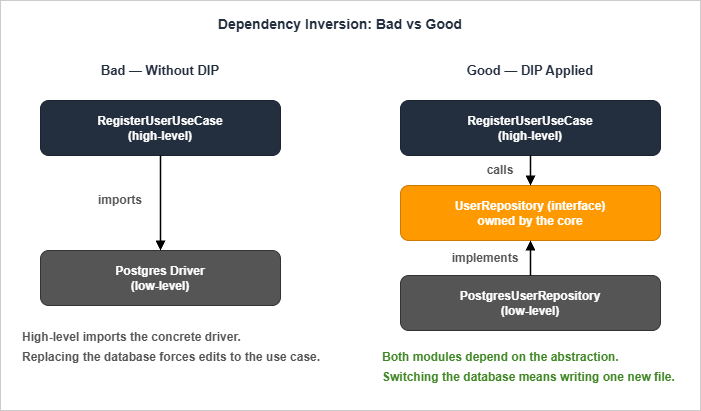
6.4 DIP Without DI Frameworks
You can apply DIP without Spring, without NestJS, without any container. A composition root — typicallymain.ts or an explicit wiring.ts — instantiates the concrete classes and hands them to the use cases. No reflection, no decorators, no XML.// src/main.ts
import { Pool } from "pg";
import { PostgresUserRepository } from "./infrastructure/PostgresUserRepository";
import { BcryptPasswordHasher } from "./infrastructure/BcryptPasswordHasher";
import { RegisterUserUseCase } from "./usecases/RegisterUser";
const pool = new Pool({ connectionString: process.env.DATABASE_URL });
const userRepo = new PostgresUserRepository(pool);
const hasher = new BcryptPasswordHasher();
const registerUser = new RegisterUserUseCase(userRepo, hasher);
// `registerUser` is now ready to be wired into an HTTP route, a CLI, or a test.6.5 The Limits: When Direct Dependency Is Honest
DIP has a cost. Every abstraction is a layer of indirection, an extra file, an extra mock in tests. For a small script that talks to one database forever, inverting that dependency adds rope without adding flexibility. For a function that wrapsconsole.log, hiding console behind an interface is theatre.The rule of thumb: invert the dependency when the low-level module is a plausible substitute target — different database, different cloud, different environment in tests. If the answer to "what would the alternative implementation be?" is "there isn't one," you do not need the interface.
7. DDD Building Blocks (Entity, Value Object, Aggregate)
Eric Evans's Domain-Driven Design (2003) introduced the tactical patterns most engineers recognize from the book's classification: Entity, Value Object, Aggregate. The patterns answer different questions, and many production codebases blur them, which is why understanding them in their purest form is the precondition for blurring them well.7.1 Entity: Identity Beats Attributes
An Entity is an object whose identity persists across changes to its attributes. Two entities with identical attributes are still different entities if their identifiers differ; an entity whose attributes change over time is still the same entity. The canonical example is aUser: rename the user, change their email, change their role, and they are still the same user, identified by an immutable userId.class User {
constructor(
public readonly id: UserId,
public name: string,
public email: Email,
) {}
equals(other: User): boolean {
return this.id.equals(other.id);
}
}7.2 Value Object: Immutable, Equality by Value
A Value Object has no independent identity; it is fully described by its attributes, and two value objects with identical attributes are interchangeable. Money, Email, DateRange, GeographicCoordinate — these are values, not entities. The test is the inverse: if you would not care which one was used as long as the attributes match, it is a Value Object.Value Objects are immutable. Mutating them is a category error.
class Money {
  private constructor(
    public readonly amount: number,
    public readonly currency: string,
  ) {}

  static of(amount: number, currency: string): Money {
    if (!Number.isFinite(amount)) throw new Error("amount must be finite");
    if (!/^[A-Z]{3}$/.test(currency)) throw new Error("currency must be ISO 4217");
    return new Money(amount, currency);
  }

  add(other: Money): Money {
    if (this.currency !== other.currency) {
      throw new Error("cannot add different currencies");
    }
    return Money.of(this.amount + other.amount, this.currency);
  }

  multiply(n: number): Money {
    if (!Number.isFinite(n)) throw new Error("multiplier must be finite");
    return Money.of(this.amount * n, this.currency);
  }

  equals(other: Money): boolean {
    return this.amount === other.amount && this.currency === other.currency;
  }
}Money.of, which validates. Second, add returns a new Money; nothing mutates. Third, equality is by value, not by reference. These three together make Value Objects compose safely — they cannot be in an invalid state, and they cannot be silently changed by a distant caller.Whenever you find a primitive
string or number that travels through your codebase carrying meaning ("this is the user's email", "this is the price in JPY"), you are looking at a missed Value Object. The principle is sometimes called "Primitive Obsession" when it is absent.7.3 Aggregate: The Consistency Boundary
An Aggregate is a cluster of Entities and Value Objects that are treated as a single unit for the purpose of data changes. One Entity in the cluster is the Aggregate Root. External code may hold references to the root only; references to internals are passed out for use within a single operation only.The reason aggregates exist is invariants. A business rule like "the total of an order's line items must equal its declared total" cannot be enforced if any caller can modify any line item directly. Wrap the rule's data in an aggregate, route all modifications through the root, and the root enforces the invariant.
Vaughn Vernon's Effective Aggregate Design (2011) distilled four rules of thumb that the DDD community has converged on:
- Model true invariants in consistency boundaries. If an invariant must hold within a single transaction, the data it spans is one aggregate.
- Design small aggregates. Large aggregates create lock contention and load problems. Smaller is almost always better.
- Reference other aggregates by identity. Within an aggregate, hold references to entities and value objects directly. Across aggregate boundaries, hold only the other aggregate's ID.
- Use eventual consistency outside the boundary. If two aggregates need to stay in sync, do it through asynchronous events — do not extend one transaction across both.
7.4 Bad: Anemic Domain Model with Setters Everywhere
A common antipattern is the "anemic domain model": entities reduced to data bags with public setters, and all behavior moved to a "service" class. The data and the rules that govern it have been separated, and the rules are easy to bypass.class Order {
id!: string;
status!: "draft" | "submitted" | "paid" | "cancelled";
lines!: { productId: string; quantity: number; unitPrice: number }[];
total!: number;
}
class OrderService {
submit(order: Order) {
order.status = "submitted";
}
addLine(order: Order, productId: string, quantity: number, unitPrice: number) {
order.lines.push({ productId, quantity, unitPrice });
order.total += quantity * unitPrice;
}
}
// Anywhere in the codebase, anyone can write:
order.status = "paid"; // bypasses any state-transition rules
order.total = 0; // breaks the total/lines invariant
order.lines.push({ /* ... */ }); // recomputes total nowhere7.5 Good: Behavior Lives with the Data It Protects
Move the rules into the aggregate root. Make the fields private. Expose intentional operations.type OrderStatus = "draft" | "submitted" | "paid" | "cancelled";
class OrderLine {
constructor(
public readonly productId: string,
public readonly quantity: number,
public readonly unitPrice: Money,
) {
if (quantity <= 0) throw new Error("quantity must be positive");
}
subtotal(): Money {
return this.unitPrice.multiply(this.quantity);
}
}
class Order {
private constructor(
public readonly id: OrderId,
private status: OrderStatus,
private lines: OrderLine[],
) {}
static draft(id: OrderId): Order {
return new Order(id, "draft", []);
}
addLine(line: OrderLine): void {
if (this.status !== "draft") {
throw new Error("cannot modify a submitted order");
}
this.lines.push(line);
}
submit(): void {
if (this.status !== "draft") {
throw new Error(`cannot submit an order in status ${this.status}`);
}
if (this.lines.length === 0) {
throw new Error("cannot submit an order without lines");
}
this.status = "submitted";
}
total(): Money {
return this.lines.reduce(
(acc, l) => acc.add(l.subtotal()),
Money.of(0, "JPY"),
);
}
// No public setter for status. No public mutation of lines.
// The aggregate root protects every invariant the business cares about.
}Order cannot be in an invalid state without going through code that would have to be edited intentionally to break a rule. Reviewers and AI tools have a much easier time spotting suspicious changes.7.6 The "Aggregate Per Transaction" Rule and Its Trade-offs
Vernon's rule that a single transaction should modify at most one aggregate is uncomfortable until you understand why. Two aggregates in one transaction create distributed-locking concerns even on a single database, and they entangle two consistency boundaries that you spent effort separating. Eventual consistency between aggregates — orchestrated by domain events — is the correct default.The rule is occasionally bent. Vernon himself notes that user-aggregate affinity — when only one user touches a set of aggregates at once — sometimes makes a multi-aggregate transaction safe in practice. As with every principle in this article, the discipline is not "never bend" but "know what you are bending and why."
8. Clean Architecture Layering
In 2012, Robert C. Martin published The Clean Architecture, a synthesis of Hexagonal (Cockburn), Onion (Palermo), and DCI architectures into a single concentric-circle diagram with one explicit rule: source code dependencies point only inward. The diagram has been redrawn in countless blog posts, but the rule is simpler than the layers.8.1 The Concentric Circles Reread
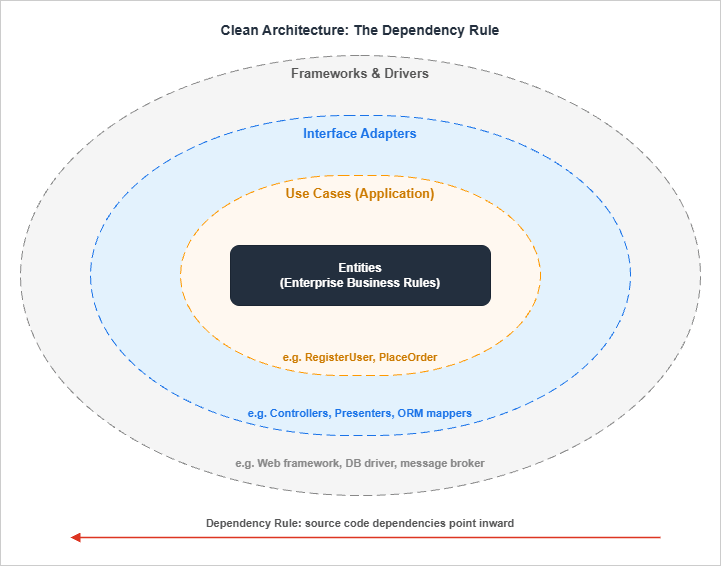
- Entities — Enterprise-wide business rules. Things that would be true even if there were no software.
Money.addbelongs here. - Use Cases — Application-specific business rules. The orchestration of entities to achieve one user-visible operation.
RegisterUser,PlaceOrder. - Interface Adapters — Translators between the use case world and the framework/IO world. Controllers, presenters, ORM mappers.
- Frameworks and Drivers — Web framework, database driver, message broker, file system, external HTTP clients. The volatile edge of the system.
8.2 The Dependency Rule in One Sentence
"Source code dependencies can only point inwards." The name of any class, function, or variable defined in an outer circle must not appear in code in an inner circle. A use case never imports a Postgres client. An entity never imports an HTTP framework. The compile-time graph and the runtime graph point opposite ways: data flows outward at runtime, but the file-levelimport statements always point inward.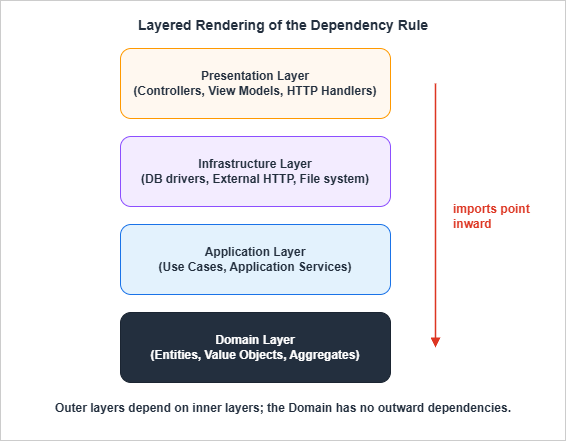
8.3 Bad: Use Case Imports the ORM Entity
A common mistake — especially in projects bootstrapped from a framework template — is to let the ORM-generated entity class leak into use cases.// src/usecases/PlaceOrder.ts
import { OrderEntity } from "../infrastructure/orm/OrderEntity"; // <-- ORM type leaking in
import { dataSource } from "../infrastructure/orm/dataSource";
export class PlaceOrderUseCase {
async execute(customerId: string, items: { productId: string; qty: number }[]) {
const repo = dataSource.getRepository(OrderEntity);
const order = new OrderEntity();
order.customerId = customerId;
order.items = items.map(/* ... */);
order.status = "submitted";
await repo.save(order);
}
}PlaceOrderUseCase lives in the application layer, but it imports an infrastructure-layer class and depends on the ORM's lifecycle methods. Any change in the ORM (schema annotations, decorator syntax, lazy-loading semantics) drags the use case along.8.4 Good: Use Case Speaks in Domain Terms
The use case manipulates a domainOrder (the aggregate from Section 7.5). An adapter in the infrastructure layer is responsible for turning that domain object into rows.// src/usecases/PlaceOrder.ts
import { Order, OrderId } from "../domain/Order";
import { OrderRepository } from "../domain/OrderRepository";
export class PlaceOrderUseCase {
constructor(private orders: OrderRepository) {}
async execute(input: PlaceOrderInput): Promise<OrderId> {
const order = Order.draft(OrderId.generate());
for (const item of input.items) {
order.addLine(/* ... */);
}
order.submit();
await this.orders.save(order);
return order.id;
}
}// src/infrastructure/orm/TypeOrmOrderRepository.ts
import { Order } from "../../domain/Order";
import { OrderRepository } from "../../domain/OrderRepository";
import { OrderEntity } from "./OrderEntity";
export class TypeOrmOrderRepository implements OrderRepository {
// ... ORM-specific code lives entirely here.
async save(order: Order): Promise<void> {
const row = OrderEntity.fromDomain(order);
await this.repo.save(row);
}
}OrderEntity or dataSource. Replace TypeORM with Prisma, with raw SQL, with DynamoDB — the use case is not aware.8.5 Mapping Boundaries: DTO, Domain, ORM
In a Clean-Architecture-shaped codebase, three object representations typically coexist: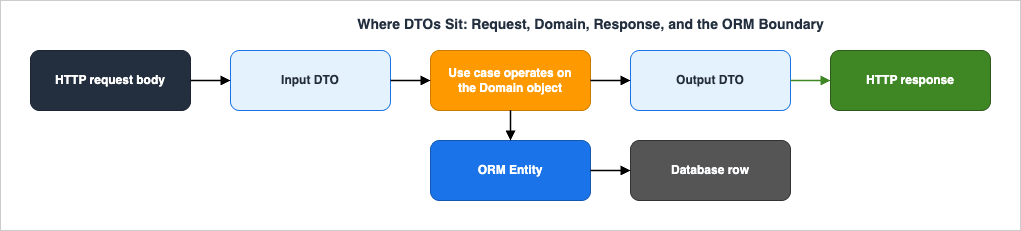
- DTOs are flat, serializable, framework-aware. They enter and leave the system.
- Domain objects are rich, behavioral, framework-blind. They live only in the use case and below.
- ORM entities are flat, persistence-aware. They live only in the infrastructure layer.
8.6 What Clean Architecture Doesn't Mandate
Clean Architecture does not mandate four layers, four directories, or four-letter naming conventions. It does not mandate "one class per file" or "one interface per implementation." It does not mandate hexagonal port-adapter terminology. It mandates one rule — dependencies point inward — and lets you choose how many layers and what you name them.Many production "Clean Architecture" projects ship with so many directories and so many ceremonial classes that the dependency rule is buried under the boilerplate. We turn to that next.
9. Anti-Pattern: Over-Application (Cargo Cult Architecture)
Every principle in this article has a failure mode where applying it harder makes things worse. The collective name for these failure modes is cargo cult architecture: building the visible structure of a principled codebase without the underlying decisions that justify the structure. The forms are recognizable across teams and stacks.9.1 FactoryFactory and the Ceremony Tax
In a healthy codebase, a Factory exists when object construction is genuinely complex — multiple steps, conditional wiring, validation that does not belong in a constructor. AFactoryFactory is a sign that someone has forgotten why factories exist and is reaching for the pattern out of habit. Every layer of construction indirection has to be read, navigated, and held in working memory for every change. After two layers, the cognitive cost outweighs the flexibility.9.2 The "One Interface Per Class" Reflex
A pattern visible in many "enterprise" codebases:UserService is implemented by UserServiceImpl, with the interface holding every method of the implementation, and the only implementation in production. This satisfies neither ISP (the interface is just as fat as the class) nor DIP (the interface is not owned by a higher-level module — it is owned by the implementation, which means the dependency arrow has not actually flipped).The honest version is to write the class without the interface. When a second implementation is genuinely needed — a fake for tests, a different infrastructure variant — extract the interface then, sized to the calling site, named after the role.
9.3 Onion Layers in a CRUD App
A small CRUD service that maps HTTP routes to database tables does not need four layers. It does not need a domain layer with rich aggregates if there are no invariants beyond "this column is a positive integer." A two-layer structure — request handlers + a thin data-access module — is correct for the problem.The overengineered version — controllers calling use cases calling domain services calling repositories calling DAOs — multiplies translation costs without buying anything. This article cares about Clean Architecture; it cares less about cargo-culting it into projects that do not need it.
9.4 Premature DDD in a Tactical Tool
DDD's tactical patterns assume there is a domain worth modeling — invariants, ubiquitous language, business stakeholders. A script that exports CSVs every Sunday does not have a domain. Building it with aggregates, value objects, and domain events is theatre, and the theatre slows down every future edit.A useful test: can you state the invariant the aggregate enforces in one sentence, without using software vocabulary? If you cannot, you do not have an aggregate. You have a struct.
9.5 Symptoms of Over-Engineered Code
Symptoms that the principles are being over-applied:- Tracing one user request opens more than seven files.
- Every test requires a setup helper that builds a graph of mocks.
- Adding a field to a request requires editing five DTOs and three mappers.
- The team's review comments are about layering and naming, not about behavior.
- New hires take weeks to make their first non-trivial change.
10. When to Bend the Rules
Every principle in this article was written by someone arguing against a specific pain. Martin's SOLID papers were written against the pain of brittle inheritance hierarchies and untestable singletons. Evans wrote DDD against the pain of code that drifted away from the language the business actually used. None of the original authors believed the principles applied to all software in all situations.Dan North's CUPID essay (2021) goes further: he argues that the very framing of "principles" — bright-line rules you either follow or violate — pushes teams toward enforcement rather than judgment. He proposes properties (Composable, Unix-philosophy, Predictable, Idiomatic, Domain-based) as a centered-set alternative: directions to move toward, where context decides how far you go. Whether you adopt CUPID or stay with SOLID, the meta-lesson is the same: the principles are means, and the end is code that is cheap to change.
10.1 Optimize for Reading, Not for Theory
When two designs are both defensible, prefer the one that reads better. Code is read far more than it is written, and "principle-correct" is not the same as "easy to follow." A switch statement that fits on one screen often beats a strategy hierarchy spread across six files, even if the hierarchy is closer to OCP-perfection.10.2 The Rule of Three Before Abstracting
The Rule of Three, attributed to Don Roberts and popularized in Refactoring by Martin Fowler, says: write something concretely the first time, copy it the second time, and only on the third occurrence consider extracting an abstraction. Two data points are not enough to triangulate the right abstraction. Three is usually enough.The corollary: a single occurrence of a class with no subclass and no test double does not need an interface. Wait until reality gives you a reason.
10.3 Boundary First, Internal Structure Later
When the design is uncertain, invest in the boundaries — the contracts at the edges of the module — and let the internal structure stay simple. A clean external interface buys the freedom to refactor the internals later. An over-decomposed internal structure with a leaky boundary buys the opposite.This is the half of Clean Architecture that survives even in projects that ignore the layered diagram: keep the seams between subsystems clean, even if the subsystems themselves are CRUD-shaped.
10.4 The Stable Core, Volatile Edges Heuristic
Push the stable, slow-changing rules to the center. Push the volatile, fast-changing details to the edges. The center should be the kind of code where merge conflicts are rare; the edges should be the kind of code where merge conflicts are routine. If your domain layer churns more than your controllers do, the architecture is upside-down.10.5 A Decision Checklist for Reviewers
When a pull request reaches you and the principle question arises ("should this be split?", "does this violate OCP?", "is this an aggregate?"), the following five questions resolve most disagreements:- What change becomes cheaper because of this design? If you cannot name one, the design is not earning its complexity.
- Has that kind of change actually happened, or is it speculative? Speculative complexity is the most common mistake.
- Does the code read better, or worse, than the simpler alternative? Reading cost is real cost.
- Could a new team member find their way through this in a week? If not, the code is optimized for the author, not for the team.
- What is the smallest change that would still address the underlying pain? Often this is the right answer.
Code Review Checklist and Anti-Pattern Catalog: A Reviewer's Reference for Modern and AI-Augmented Codebases develops the reviewer's checklist further, including specific anti-patterns (Premature Abstraction, Defensive Programming Overkill, Tight Coupling via Concrete Types) that map directly to over-application of the principles in this article.
11. References
The principles in this article are decades-old; the literature is rich. The single most useful starting point for each topic:- Robert C. Martin, "Design Principles and Design Patterns" (2000) — the most concise primary source for SOLID.
- Robert C. Martin, "The Clean Architecture" (2012) — shorter than the book and covers the dependency rule directly.
- Eric Evans, "Domain-Driven Design Reference" (2015) — the freely available companion to the 2003 DDD book.
- Vaughn Vernon, "Effective Aggregate Design" (2011) — three-part essay that distills aggregate-design rules of thumb into a focused, three-PDF read.
- Dan North, "CUPID — for joyful coding" (2021) — the most influential recent argument that "principles" should be replaced with "properties."
Related Articles
- Code Review Checklist and Anti-Pattern Catalog: A Reviewer's Reference for Modern and AI-Augmented Codebases — the review discipline that catches violations of the principles described here.
- Beyond Self-Disruption: The Paradigm Shift Software Engineers Need in the AI Era — why preserving design intent matters more, not less, in AI-augmented codebases.
References:
Tech Blog with curated related content
Written by Hidekazu Konishi